Tag Archives: Harrisburg School District

Nora Carreras named to seat on Harrisburg school board

The Harrisburg school district’s Lincoln administration building

The Harrisburg school district has named Nora Carreras to its board of directors, filling an open seat following the death of Gerald Welch.

In a statement, district Receiver Janet Samuels said that she appointed Carreras, who works for the PA Department of Human Services, due to her “long history as a public servant along with her wealth of knowledge of resources that support children, families and the broader Harrisburg community.”

Under state code, Samuels had 30 days to fill the seat, which was left open after Welch died of COVID-19 complications on April 15. Welch was elected last year to the nine-member board and was in the first year of a four-year term. Carreras’ appointment runs through next year.

“It is a pleasure to welcome Ms. Nora Carreras to the Harrisburg school board of directors,” said Acting Superintendent Chris Celmer. “Ms. Carreras has a proven track record of providing advocacy and support for at-risk families through the commonwealth of Pennsylvania.”

In a statement, Carreras expressed excitement for the opportunity.

“I am honored to join and support the district’s effort to bring increased educational quality and fiscal accountability,” she said. “Every student in the city of Harrisburg deserves the opportunity to thrive, to learn in a supportive environment and reach their full potential.”

Continue Reading

Harrisburg school board director, education reformer Gerald Welch dies from COVID-19

Gerald Welch speaks at a school board candidate forum last year at HMAC.

Harrisburg today lost one of its leaders in school reform, as Gerald Welch has died from complications of COVID-19.

Welch, 56, passed away after being admitted to the hospital over the weekend.

“It is a very sad day for Harrisburg,” said Chris Celmer, the district’s acting superintendent, in a tweet this morning. “Please keep the Welch family in your thoughts and prayers during this difficult time. Mr. Welch cared deeply for the students and staff of the Harrisburg SD.”

Celmer and district receiver Janet Samuels later issued a joint statement.

”We are truly saddened by the passing of Harrisburg school board director, Mr. Gerald Welch, a true champion for others,” they said. “We applaud and are extremely grateful for the unwavering support that Mr. Welch shared with the students, families and staff of the Harrisburg school district. As a true public servant, Mr. Welch was a passionate advocate for students and the broader community. The incredible manner in which Mr. Welch served and gave to others was a positive gift to our district.”

They added that Welch would be honored at a “special time of remembrance” at the district’s April 20 virtual board meeting.

Welch last year joined a group of five challengers pushing for substantial school reform following a series of missteps and scandals in the Harrisburg school district. All five candidates emerged victorious in the Democratic primary then won board seats in the November general election.

A year ago, in a series of candidate debates, Welch was vocal in urging the district to improve student graduation rates and ensure that more Harrisburg students went to college.

“I would like to see more college enrollment,” he said at one debate. “That’s the reason I got involved in the school board race, because we were lacking in graduation rates.”

At another debate, he told the story of his own life as a high school dropout who later earned a master’s degree in social work, and repeatedly encouraged the other candidates and the school community to treat one another with respect and empathy.

“If you treat everybody with dignity, honor and respect, you can deal effectively with having a diverse community,” he said.

TheBurg will update this story as more information becomes available.

Continue Reading

Harrisburg city, community leaders discuss businesses, schools during Facebook Live event

Harrisburg Mayor Eric Papenfuse, in a screen shot from Friday’s Facebook Live event

Harrisburg’s mayor held another in a series of Facebook Live events on Friday and, on tap, three topics of great community concern–local businesses, the school district and supporting medical personnel.

Much of Mayor Eric Papenfuse’s “Community Conversation” revolved around a new grant program, the result of a partnership between the city and Impact Harrisburg, a nonprofit for local economic development.

The Neighborhood Business Stabilization Fund will help mitigate damage caused to small businesses by the COVID-19 crisis, explained Nona Watson, director of economic development in the city.

“This project is intended to fill the gap in the offerings of financial assistance to small businesses,” added Sheila Dow Ford, executive director of Impact Harrisburg.

The $1 million fund will provide grants of up to $10,000 for accepted businesses on a first-come, first-served basis.

“This is a Harrisburg-centric grant we are talking about,” Dow Ford said. “It is a way to quickly provide resources to all businesses.”

In addition, Chris Celmer, acting superintendent of the Harrisburg school district, discussed resources the district is providing in light of Gov. Tom Wolf’s closure of all Pa. schools for the remainder of the academic year.

Celmer said that laptops are being distributed to students in grades nine through 12, and the district is working on applying for grants in order to extend the distribution to other grades, as well.

In addition to a partnership with WITF to broadcast educational material for students on television, the district will use the city’s channel WHBG20 to put out individual lessons. Celmer explained that Harrisburg teachers have been recording lessons to broadcast.

“We are really trying to tackle this situation in a number of different ways to ensure that 100 percent of our students will have some access to academic enrichment during this very unprecedented time,” he said.

Lastly, Christian Caicedo, UPMC Dauphin Region president, discussed a new initiative to support medical personnel in Harrisburg.

Caicedo encouraged the community to use the hashtag #HELPTHEHELPERS to show support for health care workers, as well as grocery clerks, garbage collectors and everyone performing essential tasks.

Window signs and social media frames with the hashtag can be downloaded at UPMCPinnacle.com/HELPTHEHELPERS.

Additional updates:

  • 150 free Wi-Fi hotspots can be found around the city; a map can be found here.
  • Families with school-aged children can apply for 60 days of free Wi-Fi here.
  • The Community Policing Division’s Family Food Box program will operate on Thursdays from 4 to 6 p.m. only.
  • The Harrisburg School District’s breakfast and lunch program will operate on Tuesday from 11 a.m. to 12:30 p.m. only. Meals for five days can be picked up.
  • The Harrisburg YMCA on Front Street is opening its showers to homeless individuals on April 13, 15 and 17 from 9:30 a.m. to noon.

Each week’s Community Conversation can be found on YouTube. They are held each Friday at noon through Facebook Live. For more information, visit the City of Harrisburg, Impact Harrisburg and the Harrisburg School District’s websites.

Continue Reading

Harrisburg’s Facebook Live event focused on school, state issues

A screen shot of Harrisburg Mayor Eric Papenfuse, left, along with school district Acting Superintendent Chris Celmer and Chief Academic Officer Susan Sneath.

While Harrisburg students are not in school due to the coronavirus pandemic, district officials today made it clear that they are working on continuing education outside the classroom.

“This is not a weeklong blizzard, this is not a Christmas vacation,” said Susan Sneath, chief academic officer for the Harrisburg school district. “We still have a lot of work to do.”

Through a Facebook Live event on Friday, Sneath and Acting Superintendent Chris Celmer sat down with Mayor Eric Papenfuse to discuss developments within the school district in light of the COVID-19 health crisis.

District teachers reached out to about 5,000 Harrisburg students and families and discovered that over 95 percent had access to television, Celmer said.

With that in mind, Sneath announced a new partnership with WITF, the Harrisburg area’s public broadcasting station, to link the district’s current curriculum with the station’s resources. This allows for television programming catered to all grades, K-12.

“When you can work with such an expert partner like WITF, who already has tried-and-true educational programming in place, maybe we can do something together,” Sneath said.

Papenfuse added there have been discussions with the district to use the city’s TV station, Channel 20, as a tool, as well. Sneath mentioned the possibility of having teachers broadcast lessons through the channel.

“If we are going to stay closed, we would like to take the opportunity to customize what we broadcast as much as humanly possible to truly meet the direct needs of our students,” Sneath said.

While the district is officially closed until April 9 with a return date for students of April 14, Papenfuse acknowledged that it likely could be longer. Wolf signed a bill this week that waives the 180-day requirement for school to be in session.

To support students during the crisis, Celmer announced a teacher parade for Monday at 4 p.m. Students and families are encouraged to watch from their porches as Harrisburg educators drive through the streets.

Also on Friday, Harrisburg city held another “Community Conversation” via Facebook Live. In it, Papenfuse spoke with state Rep. Patty Kim and Dauphin County Commissioner Mike Pries.

Kim brought to attention a few other bills passed on Friday regarding the COVID-19 crisis. They include additional funds for medical equipment in the state and a postponed Pennsylvania primary election date.

Wolf added two more central Pennsylvania counties to the “stay-at-home order” and, while Dauphin County remains off the list, Kim sees it as a looming possibility.

“I think we should all follow the same shelter-in-place order,” she said. “I’m sure the shelter-in-place will happen eventually, but why not practice it now to slow the spread?”

The following are a list of resources mentioned by the city from today’s event:

Click here to watch the full Facebook Live event with Harrisburg school district officials.

Click here to watch the full Facebook Live event with state Rep. Patty Kim and Dauphin County Commissioner Mike Pries.

Harrisburg plans to continue Facebook Live events each Friday at noon during the COVID-19 health emergency.

Continue Reading

PA schools ordered to remain shut for another two weeks

Harrisburg’s Lincoln School building

Public schools in Pennsylvania will be closed for at least another two weeks due to the COVID-19 pandemic.

Secretary of Education Pedro Rivera announced on Tuesday afternoon an extension of the closure order until “at least” April 6. The prior order extended only through the end of this week.

“Protecting the health and safety of students, families, teachers and all employees who work in our schools is paramount during this national health crisis, and we must continue our efforts to mitigate the spread of the virus,” he said.

Rivera said that this directive aligns with Gov. Tom Wolf’s “stay at home” order issued on Monday for seven counties: Philadelphia, Montgomery, Allegheny, Bucks, Chester, Delaware and Monroe.

Rivera on Monday also cancelled standardized testing for students in career and technical education (CTE) programs for the 2019-20 school year. Last week, the department cancelled all PSSA testing and Keystone exams for the 2019-20 school year, as well as the Pennsylvania Alternate System of Assessment (PASA).

“The number of positive cases increases daily and we’re seeing it spread to more counties. We must adhere to the social distancing guidelines,” Rivera said. “Extending the closure will help every community in its efforts to mitigate the spread.”

Continue Reading

The Week that Was: News and features around Harrisburg

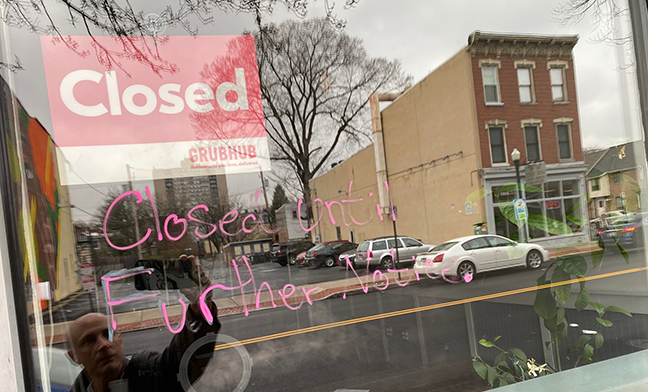
“Closed” signs abound throughout Harrisburg’s business districts.

Around Harrisburg, the past news week amounted to all-coronavirus, all the time, as all other stories understandably took a back seat to the pandemic. At TheBurg, we had both a statewide and local focus, and, if you missed some of our coverage, we have it all listed and linked below.

Art can be seen and sometimes even made out of doors. So, our arts blogger is going directly to nature for his art fix, adding a planned plein air event, with adequate social distancing, naturally.

Broad Street Market remains open as a vital food resource in Harrisburg. Our online feature story explains the surprisingly upbeat and very community-oriented vibe inside the city’s historic food and farmers market.

Gov. Tom Wolf ordered the closure of all “non life-sustaining” business offices, telling people to self-isolate at home unless they’re an essential worker. This office shutdown was arguably the most severe restriction of several over the past week.

Harrisburg declared a state of emergency in the city and shut public access to the city government center as a result. Dauphin County followed suit, closing down public access to county facilities. Our online story offers information on how to continue to do business with both governmental bodies.

Harrisburg suspended street parking enforcement for 10 days, along with street sweeping enforcement. Capital Region Water also explained its policies and actions in light of the crisis. We published an online story explaining both.

Harrisburg school district and the city police are collaborating on ways to feed the city’s schoolchildren, now that school has been suspended. Find out how you can help in the effort from our online story.

Mayor Papenfuse went higher tech than usual this past week, employing Facebook Live to connect with residents and answer questions. The fire chief and police commissioner joined him, addressing many COVID-19-related topics.

Methodist churches closed throughout the Harrisburg area last year. Our magazine feature tells what happened with one parish, in our only non-coronavirus story of the week.

PA Department of Health began a daily coronavirus update of cases in PA, with a county-by-county breakdown. We covered them all, including the latest from Saturday.

PA Liquor Control Board cracked down on license-holding bars and restaurants that have refused to close for on-premises consumption. Sanctions will be imposed on violators, warned the PLCB, which also closed all its state liquor and wine stores.

Restaurants and other small businesses are already suffering immensely, forced to shut down to prevent the spread of the virus. In a blog post, our editor makes a plea for the community to support them.

Runners are a committed bunch. So, even though springtime races have been cancelled, they ran the races independently, taking precautions to ensure social distancing. Our reporter, a runner herself, described the scene along the river.

Sara Bozich traded in her usual list of events for a more important list—guidance on how to support local businesses facing devastating economic times. Visit her story and help your neighbors.

Do you receive TheBurg Daily, our daily digest of news and events delivered right to your email inbox? During these difficult times, it’s more important than ever to subscribe here.

Continue Reading

Harrisburg school district, city police team to ensure food access for students

Harrisburg’s Benjamin Franklin School, one of the meal pick-up locations

On Monday, all K-12 Pennsylvania schools closed for 10 business days in accordance with Gov. Tom Wolf’s mandate during the coronavirus (COVID-19) epidemic.

As a result, the Harrisburg school district will be closed through at least March 27.

But it’s not just classroom instruction that students will miss, as they regularly receive free breakfasts and lunches at school, as well. The district, however, is ensuring that students continue to be fed, even with the epidemic.

“We are trying to put food into our families’ hands,” Acting Superintendent Chris Celmer said.

The school district is giving free grab-and-go breakfasts and lunches to enrolled students. Resources come through their collaboration with the Pennsylvania Department of Education and the National School Lunch Program.

This week, parents can receive food for their children through Friday, between 10 a.m. and 11:30 a.m., at their children’s school. The district asks parents of pre-K to fourth-grade students to arrive at 10 a.m.; fifth- to eighth-grade students to arrive at 10:30 a.m.; and ninth- to 12th-grade students to arrive at 11 a.m.

According to Celmer, a plan for next week is still being developed, although the district should have more information about it on Wednesday.

In addition to breakfast and lunch options, the Harrisburg Police Bureau, in partnership with the Central Pennsylvania Food Bank, will provide students with dinner meals.

“We understand our children have limited means and that creates an obstacle for a lot of families,” Community Policing Coordinator Blake Lynch said. “We want to try and step in because the commissioner and our offices understand that serving is important.”

Parents can pick up these meals on Wednesday, from 10 to 11:30 a.m. and 4 to 6 p.m., and on Friday at the same times.

Food pick-up locations for all three meals are:

  • Foose School (1301 Sycamore St.)
  • Rowland Academy (1842 Derry St.)
  • John Harris Campus (2451 Market St.)
  • Downey School (1313 Monroe St.)
  • Ben Franklin School (1205 N. 6th St.)
  • Camp Curtin Academy (2900 N. 6th St.)

Lynch expects to see the program continue next week. However, the police bureau is working closely with the district to see how plans develop.

Food is being packaged and handed out through the help of community members and groups volunteering alongside the bureau and the school district.

Celmer encouraged families to resist congregating at pick-up sites to reduce the risk of spreading the virus.

The district is also working on academic enrichment activities for students to participate in outside of the classroom, Celmer said. Regular updates will be posted on the district’s website.

“This situation is unparalleled, but we are working together to do the best for our students,” Celmer said.

For more information, visit https://www.hbgsd.k12.pa.us/student_and_families/coronavirus___c_o_v_i_d-19_

Continue Reading

Gov. Wolf orders PA schools closed for 2 weeks

The Harrisburg school district’s Lincoln School

Pennsylvania schools will close for 10 business days in response to the coronavirus threat.

Gov. Tom Wolf made the announcement on Friday afternoon that he was ordering all K-12 schools to close for two weeks beginning on Monday.

“We understand that these are trying times and recognize the impact of the coronavirus on our students and communities,” he said, in a statement. “First and foremost, my top priority as governor—and that of our education leaders—must be to ensure the health and safety of our students and school communities. As such, I am ordering that all schools in the commonwealth close for the next two weeks.”

As a result, schools will not be penalized this year if they fail to meet the 180-day threshold, Wolf said.

Wolf added that the state received a waiver from the U.S. Department of Agriculture to allow eligible schools to serve meals to low-income students in a “non-congregate setting,” such as a drive-through or grab-and-go, during this closure.

Later in the afternoon, the Harrisburg school district affirmed that it would be shut for two weeks, planning now to reopen on March 30.

“Working in collaboration with the governor’s office, we will do our part to ensure the health, well-being, and safety of our students and staff, and to mitigate the spread of COVID-19 throughout the Harrisburg School District and community,” said Acting Superintendent Chris Celmer, in a statement.

The district said that it was committed to continuing free meals for qualified students, but didn’t specify how that service would continue.

“In a district such as ours, we know that closing schools will impact families who depend on the free meals that we provide to students five days a week,” Celmer stated. “To help mitigate the impact on families, the administration will continue internal and external meetings and conversations with our food service department, vendors, and community partners to address this concern.”

In its daily update, the state Department of Health today said that four more residents from Montgomery County and two from Delaware County are presumed to have the coronavirus, bringing the state’s total to 28 cases. All are in the hospital or isolated at home, according to the department.

So far, all presumptive cases have been in eastern Pennsylvania. There have been no cases reported in the immediate Harrisburg area.

This story has been updated with information regarding and comments from the Harrisburg school district.

Continue Reading

To the Ages: With his death, Steve Reed has gone from former mayor to one of Harrisburg’s most important historical figures.

Illustration by Rich Hauck.

Three years ago, I was told to “lay off.”

That directive came after I had written a column critical of former Mayor Steve Reed, following his guilty plea to theft-related charges.

It didn’t come from anonymous hate mail (I got that, too), but from someone whom I know and respect.

“Enough already,” she said, sternly, looking me directly in the eye. “Steve did a lot for this city.”

Her comment got me thinking that maybe I had judged the seven-term mayor too harshly, a thought I had again following his death in late January.

In official statements and on social media, city officials, community leaders and ordinary folks spoke fondly of Reed, pointing to all he had done through 28 years in office. They also praised his character, though, as a journalist, I’m most interested in his actions and importance as a political and historical figure.

I suppose that my harsher assessment had something to do with my own timing. I came to Harrisburg at the tail end of his lengthy tenure, so didn’t know him well or experience his achievements, but I did experience the fallout.

I didn’t know of Harrisburg before the Hilton and Whitaker Center and Harrisburg University and a revived downtown, all things many credit to Reed’s vision and hard work. But I did know first-hand of the city’s subsequent financial collapse.

In other words, I missed half the story.

Since I cover and write about Harrisburg, it’s important for me to consider the totality of Reed’s service. He was one of the most significant historical figures in Harrisburg over the past century, ranking right up there with Harvey Taylor, with arguably an even greater impact on the city.

So, I’m going to give another go at writing about his legacy, which, as it turns out, isn’t radically different from my first try three years ago. I consider his mayoralty to be a mixed bag—granted, a very impactful mixed bag.

Stephen R. Reed became mayor in 1982, 32 years old, already a veteran politician, having served in the state Assembly and as Dauphin County commissioner. He immediately attempted to turn around a demoralized city that had experienced little but bad news for 30 years.

Arguably, his first big success came a few years later, when his failed attempt to build a hydroelectric dam threw off enough interest from a bond offering to pay for cleaning and building up then-seedy City Island. Other victories followed: a new flagship hotel downtown, a minor league baseball team, an impressive arts/science center.

Reed dreamed big, but his big dreams came with equally big price tags. To finance his ambitions, he turned the city’s utility authority into an investment bank, surreptitiously diverted bond fees to buy artifacts for museums he hoped to build, and burned through hundreds of millions trying to salvage the city’s debt-laden incinerator. If you’re reading this column, you probably know all how it all ended—with a financial collapse practically unrivaled in U.S. history.

When assessing Reed’s place in history, it’s important to look at both ends of his legacy. His successes were huge, but so were his failures. He was not a man of small measures.

Ultimately, I believe that the bad outweighed the good, but that’s because I believe strongly in fiscal prudence and in transparency. Furthermore, I don’t believe government should micromanage the economy, and Reed often treated Harrisburg as a real-life version of Sim City.

However, I certainly understand if you weigh the man’s actions and reach the opposite conclusion. Heck, I walk around downtown Harrisburg daily, and I look up and see the buildings and institutions he helped create. What if those weren’t there?

Reed was an ambitious builder and used the public purse in unorthodox, sometimes troubling ways. Many of his projects were moonshots. Some failed horribly, some succeeded magnificently, and others survived but still struggle today, as does the city government itself.

The ones that have succeeded most had great leaders who built upon what Reed seeded, even when the foundations were shaky. Harrisburg University may be the best example of that. On the other hand, the city school district, which Reed took over and promised to turn around, fared poorly then and even worse since.

If I’m still around in 10 or 20 years, I should revisit this subject again, with another reassessment of Reed’s legacy. When enough time passes and all the bills finally get paid, I may agree with his supporters that, yes, Reed made some mistakes, but, in the end, he was the leader that Harrisburg needed.

Lawrance Binda is co-publisher/editor-in-chief of TheBurg.

Continue Reading

Building The Bridge: Four friends have big plans to transform the old Bishop McDevitt building into an “eco-village.” How did this all get started?

Former Bishop McDevitt High School.

Right now, if you walked into the old Bishop McDevitt building, you might feel like you were stepping into a set piece from a Stephen King novel—cracked walls, boarded-up windows, peeling paint and numerous messages stating that so-and-so was here or “RIP.”

But, starting this year, the almost 100-year-old building will begin to transform into an eco-friendly, multi-use property—that is, according to four old friends who collectively call themselves “The Bridge.”

This development company is headed by four guys who have known each other for many years, most since childhood: former NFL player Garry Gilliam Jr., Corey Dupree, DeZwaan “Dez” Dubois and Jordan Hill, another former pro football player.

The goal of the team is to create a complex where community members can eat, work and play, and what better place to start than in their hometown of Harrisburg?

“In a broad sense, we’re trying to create an environment of systematic empowerment, if you will,” said Gilliam. “It’s an environment of learning, fresh food. You can live here, work here, play here. Everything is here in one place.”

The first phase of the proposed “eco-village” is comprised of co-working spaces, which will be on the main floor of the building. According to Dupree, these spaces will keep the classroom-like feel that already exists, including things like chalkboards and whiteboards. The vision is eventually to include sustainable housing, indoor agriculture, an auditorium, a food court and more.

In a sense, the eco-village is almost like an adult version of Milton Hershey School, where Dupree, Gilliam and Dubois all attended. The school had such a tremendous impact on them that they wanted to recreate it and help their hometown community in the process.


Us Together

Gilliam was only 7 years old when his mother drove him up to Milton Hershey School. They had been living below the poverty line, and he spent his childhood skipping between his mother’s house in Edison Villiage and his grandmother’s house on Susquehanna Street in Harrisburg. He and his mother knew about the school because his cousin went there.

When they arrived, his mother sent Gilliam off to the playground while she signed paperwork. He didn’t know that, soon, Milton Hershey would become his home.

The first few months, he cried every night because he missed his family. Fortunately, Milton Hershey was filled with activities to help distract and support him. Over time, Gilliam got involved in arts, academics and, of course, sports. Eventually, when his mother was more financially stable and ready for him to come home, he didn’t want to leave.

“I didn’t want to leave not just because I had friends, but I knew this was what was best for the family,” he said. “I was a growing boy. I needed a lot of food and an environment that is conducive to success.”

Dupree joined Milton Hershey School around the 9th grade. Though born in Boston, he attended the school thanks to his big brother from the Big Brothers, Big Sisters program. Quickly, central Pennsylvania became his home, too.

It took a while for the two to become friends (Dupree swears Gilliam was after his girlfriend), but they started to click and even became roommates during their last year at the school.

Dubois came to Milton Hershey in the fourth grade and joined the football team years later, where he met Gilliam.

Hill grew up seeing Gilliam, Dupree, Dubois and everyone on the Milton Hershey football team as rivals. Unlike the other three, Hill attended Steelton High School, which had an intense rivalry with Milton Hershey.

In fact, the only time Hill said anything positive to Gilliam was during their senior year, after he found out Gilliam was going to Penn State.

“I remember that,” Gilliam said with a smile. “I think he was committed to Rutgers, and he came up to me and said ‘You going to Penn State, huh?’ I was like ‘Yeah,’ and he goes ‘All right.’”

Fast forward a couple of months, and Hill also received an offer to Penn State. He committed and ended up in the same recruitment class as Gilliam. Fast forward a few more years, and they were both on the same NFL team, the Seattle Seahawks.

“Life has kind of brought us together,” Hill said. “We grew up within a five- to 10-mile radius, went to college together and ended up playing professional football on the same team. It’s very rare.”


Bridge We Need

According to Hill, he and Gilliam had a similar mindset. They knew they needed to prepare for life after relatively brief football careers and, concurrently, they wanted to use their fame and money from football to help give back to their community. For them, the eco-village was the perfect starting point.

It didn’t take much for the friends to all agree on creating The Bridge. Dupree, a self-proclaimed comic book nerd, calls his team the Avengers and says each person brings a different specialty to the table. But they also understand that they have one common goal—to help the community.

Instead of deciding what was best to put in the eco-village, they used the hashtag #TheBridgeWeNeed to see what people wanted in their community. Some of the responses were things like community gardens, grocery stores, mental health spaces and even a room for therapy dogs.

The team took in the responses and, around April of last year, began to nail down their plans for the eco-village. Originally, they had their sights set on the old William Penn High School, but the owner, the Harrisburg school district, has not yet responded to their offer. They still hope to secure that building.

The Bridge plans to start renovation of the Bishop McDevitt building this summer. According to Gilliam, Harrisburg is only the pilot model. They plan to expand and create more eco-villages in Philadelphia, Atlanta, Detroit and elsewhere. They already caught the attention of Philadelphia-born rapper Meek Mills via Twitter.

“We’re from here, so I said we have to do it in Harrisburg first,” Gilliam said. “We have to take care of our hometown before we go anywhere else.”

For more information on The Bridge, visit www.thebridgeecovillage.com.

Continue Reading