Tag Archives: Gloria Martin-Roberts

Harrisburg Council may decide on 3rd Street sign removals after residents urge action

The stop sign at N. 3rd and Kelker streets

Harrisburg City Council likely will have the final word on whether to retain or remove stop signs along N. 3rd Street.

That was the main takeaway from a lengthy meeting tonight, which was called specifically to discuss the proposed removal of stop signs at four N. 3rd Street intersections--at Boyd, Harris, Kelker and Emerald streets.

“I serve at the pleasure of City Council,” said city Engineer Wayne Martin. “I hope to get guidance from City Council.”

Martin’s assertion came near the end of a three-hour-plus meeting, which was attended by about 40 residents, many of whom spoke out against the planned removals.

Council President Wanda Williams then said that, before any action could be considered by council, she had to confer with city Solicitor Neil Grover, who was not present at the meeting, as action may necessitate changes to the city’s traffic control map. She said that council may schedule another special meeting on the issue before the next regular legislative session on Sept. 17.

The meeting began with a presentation by Martin, who explained that the stop signs were no longer needed at those intersections. The ongoing 3rd Street multimodal project, he said, would calm traffic along the street due to the project’s numerous curb extensions and bump-outs.

In addition, he said that, with the changes to 3rd Street, the intersections do not warrant stop signs. Per federal and state guidelines, stop signs should be used to control traffic, not slow it down, he said, adding that, in the past, the signs only served to assist sight distance.

“Going back in time, the only warrant that was met was sight distance,” he said. “We installed bump outs to improve sight distance, so there are no sight distance issues.”

Martin also said that stop signs can actually create more dangerous intersections where they’re not warranted.

“Leaving those stop signs in there when they’re not warranted will cause more crashes,” he said.

Despite Martin’s presentation, dozens of residents urged the city to retain the stop signs at those intersections, almost uniformly saying that removing them would create a more dangerous street.

“Everyone understands what stop means,” said Angela Johnson, a Green Street resident. “You have people who are afraid for their safety, who are afraid for their children, who are afraid for their pets.”

The signs were due to be removed on Friday. But, according to Martin, the removal has been rescheduled because the 3rd Street repaving project was delayed due to rain.

Former council President Gloria Martin-Roberts, an Uptown resident, advocated for retaining the stop signs and for greater traffic enforcement at the intersections, as the signs are routinely disregarded currently, she said.

“I’m telling you this is a bad idea,” she said. “If you remove the stop signs, pedestrians will be harmed. This is very, very, very serious.”

In their comments, most council members seemed to side with the residents who objected to removing the signs.

Councilman Dave Madsen said that he helped circulate a petition both online and in person objecting to removal of the signs.

“I can tell you there was overwhelming support among residents for keeping the signs at Kelker and Harris streets,” he said.

Councilman Ben Allatt preached taking a long-term view. He said that, even if 3rd Street does not warrant stop signs today, it may in the near future, given the proposal to return much of N. 2nd Street to two-way traffic, increased development in the area and more people moving into Midtown.

“I think it’s really quite premature to go ahead with the removal of stop signs until we find out what traffic patterns will be in place in the near future and the far future,” he said.

Continue Reading

October News Digest

Harrisburg to Leave Act 47

A bill passed by the state legislature last month allows Harrisburg to preserve its current tax rates and exit Act 47, a state oversight program for financially distressed municipalities.

The House and Senate both voted overwhelmingly to pass House Bill 2557, which allows Harrisburg to maintain its current local services tax (LST) and earned income tax (EIT) for five years after it exits state oversight. The bill also prohibits the city from enacting a commuter tax and convenes a five-member Intergovernmental Cooperation Authority (ICA) to monitor Harrisburg’s finances.

After the vote took place, Harrisburg Mayor Eric Papenfuse thanked the lawmakers who supported its passage, including its sponsor, Rep. Greg Rothman, R-Cumberland County, and Harrisburg’s lawmakers in the House and Senate, Rep. Patty Kim and Sen. John DiSanto.

“While I wish we had been able to achieve a permanent solution for the city and the region, Harrisburg’s immediate fiscal crisis has lifted,” Papenfuse said. “I look forward to working with the new members of the Intergovernmental Cooperation Authority—as it’s time to roll up our sleeves and continue to work for the long-term success of Harrisburg and the capital region.”

The bill is the culmination of a 10-month lobbying effort by Harrisburg officials, who have long said the city needs stronger taxing powers to support the capital city. It will allow Harrisburg to preserve about $12 million in annual revenue that would have been lost in a traditional Act 47 exit.

Act 47 allows Harrisburg to levy a 2 percent EIT on all residents and a $156 LST, even though state law caps EIT rates at 1 percent and LST at $56 per year. Without HB 2557, Harrisburg would have been forced to cut its EIT in half and slash its LST by two-thirds when it exits state oversight.

Local officials say those rates are untenable in Harrisburg, which supports large swaths of tax-exempt properties and a daily population of some 50,000 commuters. Mayor Eric Papenfuse had told lawmakers that the city’s emergency services and infrastructure would be in jeopardy if the city had to cut its taxes.

With HB 2557 in place, Harrisburg will also be spared high property tax increases that were prescribed in a proposed three-year Act 47 exit plan.

The city did make one significant sacrifice in the final bill, which was amended in October to put a five-year time limit on the enhanced taxing power.

The original legislation only required Harrisburg to retire its tax rates once its surpluses partially funded a post-retirement benefit fund for its employees. Projections estimated that could take up to 20 years.

Rep. Kim called it “the best we can do” in a Republican-controlled legislature. She hopes that the five-year timeframe will still give Harrisburg enough time to increase its tax base.


Bowers Named to City Council

Danielle Bowers, a lifelong Harrisburg resident and state government staffer, is the newest member of Harrisburg City Council.

Last month, Bowers beat out 14 other candidates, including one past council president, to take the seat formerly held by council member Cornelius Johnson.

Bowers works as an executive director for the Pennsylvania House of Representatives Tourism and Recreational Development Committee. She previously held researcher roles with the Democratic Policy Office and Legislative Black Caucus and holds a master’s degree in public administration from Pennsylvania State University.

Her appointment to council creates a vacancy on the Zoning Hearing Board, where she has served for the past three years.

Fifteen candidates appeared before council last month to share their qualifications and ask for a chance to serve on the city’s legislative branch. But only four were invited to participate in the interview phase, where sitting council members asked candidates about their skills and goals for public service.

During her interview, Bowers touted her legislative experience and her knowledge of the city’s finances. She said she would like to pass legislation to bolster public safety and hopes to see the city’s Police Bureau return to its full complement.

Candidates Josiah Yonker, an IT professional, Gloria Martin-Roberts, a former council president and mayoral candidate, and Airis Smallwood, a healthcare administrator and musician, also received nominations and sat for interviews.


City Releases Housing Study

The results of Harrisburg’s first citywide housing study are in, and they predict a shortfall of more than 200 rental units at all price points over the next three years.

Representatives from the consulting firm that prepared the study presented their main findings to City Council last month. The authors said demand for rental housing in Harrisburg will outpace supply through 2020, even as development projects put new units on the market.

As a result, Harrisburg will face a shortage of about 244 rental units across the city—a figure that accounts for the city’s existing housing stock, new units coming onto the market and old units becoming uninhabitable.

The study also considers population projections, which anticipate that Harrisburg will gain 300 households in the next three years, mostly in the Allison Hill and Uptown neighborhoods.

The study didn’t offer any policy recommendations, but city hall officials intend to use its findings to develop long-term development strategies and housing policy proposals.


3rd Street Study Released

Harrisburg’s 3rd Street corridor is headed in a positive direction, though it remains a work in progress in terms of redevelopment, economic activity and walkability.

That’s the general conclusion of a study by the Washington, D.C.-based Urban Land Institute (ULI), a nonprofit research and educational organization that recently examined the corridor from Reily Street in Midtown to Chestnut Street downtown.

“The 3rd Street corridor possesses a great deal of momentum and potential for continued development,” stated the report, titled “TLC for Harrisburg’s Third Street Corridor.” “Strategically bridging the gap between the downtown and Midtown neighborhoods can put Harrisburg on the map as a vibrant capital city with a strong urban core.”

ULI visited Harrisburg for two days in April, walking the two-mile stretch then interviewing stakeholders who live, work and own businesses there. Their analysis and report were sponsored by Harristown Development, which owns Strawberry Square.

The 14-page report lauds the recent redevelopment and adaptive reuse that has occurred along the stretch. However, it states that much work still needs to be done so that the corridor can achieve a fuller potential. It cites three specific challenges:

  • “Dead Zones”: Many buildings have been restored, but many have not. There is still too much blight and too many empty storefronts.
  • Forster Street: Forster Street is too wide, busy and inhospitable, cutting off downtown from Midtown and deterring pedestrian activity.
  • Aesthetics: Aesthetics are inconsistent. Some areas appear pleasant, while others do not, both in terms of streetscape and the condition of structures.

The study then offers a variety of recommendations, such as incentivizing homeownership, encouraging pop-ups in empty storefronts, increasing police visibility, enforcing maintenance codes, improving the streetscape and better connecting downtown and Midtown.

Two suggestions stood out as especially ambitious.

The first recommended improving the intersection of N. 3rd and Forster streets by employing traffic-calming measures, making it more pedestrian-friendly and possibly reducing the number of lanes. The second proposed forming a “Third Street Coalition,” which would help promote, brand and advocate for the corridor.


Environmental Council Reconstituted

After more than two years of dormancy, Harrisburg’s Environmental Advocacy Council is back in action.

City Council repopulated the all-volunteer body recently when it voted unanimously to approve five appointees nominated by council members and the city administration. One appointee, Rafiyqa Muhammad, is a holdover from the former EAC that dissolved in 2016.

She’s joined by new members Tanya Dierolf, Christine Proctor, Molly Cheatum and Melanie Cook.

The five-member body will advise the mayor and other city officials on matters related to the environment and sustainability. As an advisory group, it does not have the power to manage or disburse money, but it will make recommendations on how to spend the money collected by Harrisburg’s “host fee.”

Harrisburg collects more than $250,000 a year in fees for hosting a regional incinerator, which is owned by the Lancaster County Solid Waste Management Authority (LCSWMA). State law allows cities with regional waste sites to assess a $1 per ton fee on the waste processed there. That money must be used to make environmental improvements in the city.

Christopher Nafe, the city’s new sustainability coordinator, will manage the EAC and attend all of its meetings, Mayor Eric Papenfuse said.

Papenfuse hopes that having a designated city hall staff member will help the EAC avoid the dysfunction that felled it in 2016, when most of its five members resigned.

Nafe hopes that the new EAC will advise the city on existing and new initiatives. Those include working with the Tree Advisory Council, which monitors the city’s tree population, and developing educational programs at the city’s new composting facility in Susquehanna Township.


New CRO for Harrisburg Schools

A retired Philadelphia-area superintendent will serve as the new state oversight officer for the Harrisburg School District.

The Pennsylvania Department of Education appointed Dr. Janet Samuels as the district’s new chief recovery officer in October.

She will oversee the implementation of a new, long-term recovery plan aimed at raising the district’s academic performance and financial health.

PDE put the school district under a financial recovery designation in 2012. State law requires every district in recovery to have a state-appointed recovery officer.

Samuels replaces Audrey Utley, who retired in June after serving as Harrisburg’s CRO for three years.

Her salary is capped at $144,000 annually and will be paid by PDE.

Last June, Samuels retired as the superintendent of Norristown Area School District, where she oversaw a $150 million annual budget and nine schools enrolling 7,400 students. She previously served as a regional superintendent for the Philadelphia Area School District. Her career in public education spans 35 years and includes experience as a principal and classroom teacher.


So Noted

Donald E. Schell has been named the new chair of the Homeland Center’s board of trustees. Schell, who has served on the board since 2001, takes over from Morton Spector, who will continue to serve on the board as immediate past chair.

Jeanne Troy is the new development director for Tri County Community Action, it was announced last month. In the newly created position, Troy is responsible for advancing the mission of TCCA by developing donor strategies and increasing fundraising opportunities.

Justin Roth has been named marketing manager for Capital City Mall, leading the marketing efforts for the Camp Hill shopping center. He previously served as the marketing and communications manager for the Harrisburg Regional Chamber & CREDC.

Minuteman Press is relocating to larger space next door to its current location on the first block of S. 3rd Street in Harrisburg. Franchise owner Charlotte Todd recently purchased the Original Copy Shop, which had operated for 32 years, and converted it to a Minuteman shop.

Robert W. Morris & Co. last month celebrated the grand opening of its new office at 510 N. Front St., Wormleysburg. This is the second location for the CPA firm, which also has offices in New Bloomfield, Pa.

Three Little Birds Boutique opened a second location last month at the new Hershey Towne Square. The shop, which specializes in women’s clothing, shoes and accessories, joins businesses like Iron Hill Brewpub, Starbucks and several other restaurants and shops at the mixed-use retail and office project in downtown Hershey.
Changing Hands

Bigelow Dr., 22: E. Johnson to T. Henry, $55,000

Briggs St., 214: X. Chen to Around the Corner LLC, $135,000

Capital St., 909: M. Dietz to J. Canamucio & J. Block, $130,000

Chestnut St., 1836: G. Norman to A. Nebbou, $30,000

Crescent St., 219: Anpat LLC to J. Le, $47,000

Croyden Rd., 2926: S. McDougal to A. Guerrero, $74,900

Cumberland St., 260: J. Bane to M. Mueller, $122,250

Delaware St., 266: WCI Partners to D. Taylor, $124,900

Fillmore St., 622: J. Hoch to KAB Rental Properties LLC, $40,000

Fulton St., 1729: J. Tanjung & W. Leyu to M. Gleason, $112,500

Grand St., 924: L. Searles to N. McClure, $79,900

Green St., 1818: J. Lightner to Fratelli Property Investments LLC, $110,000

Greenwood St., 2151: Alliance of Automotive Service Providers of PA Inc. to Edwin L. Heim Co., $320,000

Holly St., 1811: Wells Fargo Bank NA to R. Murphy, $32,500

Holly St., 2009: PA Deals LLC to E. Shelly, $65,900

Hunter St., 1535: P. & F. Kehler to S. Costa, $35,000

Kelker St., 231: Cartus Financial Corp. to E. Bliman & H. Hamilton, $180,000

Kelker St., 332 & 1821 N. 3rd St.: Harrisburg Redevelopment Authority to Pennsylvania National Fire Museum, $125,000

Kensington St., 2302: X. Weng & C. Yang to Fowler Investments LLC, $39,500

Kensington St., 2348: M. Hardison to N. Terry, $66,000

Kent Lane, 198: Neidlinger Enterprises to F. Manzanillo & S. Rodriguez, $75,000

Lenox St., 1910: RTD Properties and Management to R. Do, $40,000

Lewis St., 321: D. Licciardello to R. Neely, $114,900

Luce St., 2354 & 2356: L. Salcedo to C. Santiago, $102,000

Market St., 1829: D. & S. Parikh to G. Allen, $69,000

Market St., 2211: G. Dunn to S., J. & M. Buckham, $84,400

Muench St., 402: M. Huynh to SA Home Solutions LLC, $30,000

Mulberry St., 1842: A. Woolridge to A. Faican & E. Sumbra, $49,900

North St., 1609: W. Davis to R. Cantave, $120,000

N. 2nd St., 901 & 903: W. & J. Hobbie to B. Golper & WG PA Holdings LLC, $365,000

N. 2nd St., 907: D. Pong to R. Anspach Jr., 173,900

N. 3rd St., 1636: MJ Trust Properties LLC & C. Jurasits to Fratelli Property Investment LLC, $110,000

N. 4th St., 2443: T. & K. Malesic to W. Lawrence, $80,000

N. 5th St., 2605: Harrisburg Homes Investment LLC to NGDGR Company Inc., $48,000

N. 6th St., 2605: A. & P. Ashenberg to R2 Property Group LLC, $43,000

N. 7th St., 2400: J. Holmes & BAS Tax Services Corp. to DAP 7 Curtin LP, $270,000

N. 7th St., 2640: Q. Higgs to Riley Residential Real Estate LLC, $35,000

N. 15th St., 1121: Golden Lover Realty LLC to B. Shephard & N. Cook, $39,000

N. 15th St., 1415: J. & O. Hearn to E. Mantilla, $43,500

Peffer St., 613: K. Timmons to J. Santiago, $46,000

Penn St., 1336: H. & L. Roberts to J. O’Neill, $36,100

Penn St., 2105: G. Hanslovan to T. Hage, $45,000

Penn St., 2139: PA Capital Area Investments LLC to DHS Team LLC, $30,000

Reily St., 333: Dobson Family Partnership to ADS Investments LLC, $89,900

Seneca St., 241: J. Williamson to CR Property Group, $32,500

S. 13th St., 1403: M. Stewart to B. Price Jr., $38,000

S. 14th St., 916: 916 S. 14th Street Partnership to Harrisburg Housing Authority, $1,150,000

S. 14th St., 1435 & 1400 Randolph St.: A. Ingram Jr. & W. Blankenship to City of Harrisburg, $43,000

S. 20th St., 1100: Paxton Street Home Benevolent Society Inc. to Paxton Place I LP, $250,000

S. 21st St., 922: A. Mariluz Jr. to D. Ramos, $68,000

State St., 231, Unit 304: P. Brommer to BCRA Realty LLC, $102,000

Susquehanna St., 1805: HBG Rents LLC to V. & C. Vergara, $61,000

Sycamore St., 1711: Leonard J. Dobson Family LP to H. Yunis, $70,000

Valley Rd., 2305: J. Dunn & A. Meyers to J. Alpert, $179,900

Verbeke St., 233: D. Varno & C. Johnson to E. Herrmann & L. Hall, $126,900

Walnut St., 1232: Valley Real Estate Holdings LLC to C. & C. Hinckley, $33,000

Wayne St., 1517: J. Alvarado to A. Sweet Sr., $120,000

Continue Reading

Legislative staffer appointed as newest member of Harrisburg City Council

Harrisburg City Council. Top row, left to right: Shamaine Daniels, Westburn Majors, Ben Allatt, and Dave Madsen. Bottom row: Ausha Green, Wanda Williams, and newcomer Danielle Bowers.

Danielle Bowers, a lifelong Harrisburg resident and state government staffer, is the newest member of Harrisburg City Council.

Bowers beat out 14 other candidates, including one past council president, to take the seat formerly held by council member Cornelius Johnson. She was appointed at a special council session tonight and will take her seat on Oct. 9.

Bowers currently works as an executive director for the Pennsylvania House of Representatives Tourism and Recreational Development Committee. She previously held researcher roles with the Democratic Policy Office and Legislative Black Caucus, and holds a master’s degree in public administration from Pennsylvania State University.

Her appointment to council creates a vacancy on the Zoning Hearing Board, where she has served for the past three years.

President Wanda Williams said that the board is one of the most prestigious volunteer bodies in the city and that Bowers distinguished herself as a dedicated, meticulous member during her service.

“She’s very precise and does her homework,” Williams said. “She did a yeoman’s job on the zoning board.”

Seventeen candidates applied for the vacant council seat in September — an unusually high number, according to council members. One was eliminated during vetting by the city’s human resources department and another did not appear at tonight’s selection meeting.

The remaining 15 candidates appeared before council tonight to share their qualifications and ask for a chance to serve on the city’s legislative branch. But only four were invited to participate in the interview phase, where sitting council members asked candidates about their skills and goals for public service.

During her interview, Bowers touted her legislative experience and her knowledge of the city’s finances. She said she would like to pass legislation to bolster public safety and hopes to see the city’s Police Bureau return to its full complement of officers.

Bowers entered the interview phase with three nominations from council members – an early show of consensus that Mayor Eric Papenfuse said was unprecedented in council appointments. Council members made their nominations anonymously.

Candidates Josiah Yonker, an IT professional, Gloria Martin-Roberts, a former council president and mayoral candidate, and Airis Smallwood, a healthcare administrator and musician, also received nominations and sat for interviews.

During the voting round, council members Ben Allatt, Shamaine Daniels, Westburn Majors, and Ausha Greene cast votes for Bowers. Dave Madsen and council President Wanda Williams voted for Martin-Roberts.

Papenfuse said that council member appointments usually entail multiple rounds of voting or a tie-breaking vote from the mayor.

“This is the fastest it’s ever happened,” Papenfuse said.

The mayor also praised Bowers’ record on the Zoning Hearing Board and applauded her appointment to city council.

Continue Reading

Former mayoral candidate among 17 seeking seat on Harrisburg City Council

A former city council president and mayoral candidate is one of 17 applicants vying for a seat on Harrisburg City Council.

Gloria Martin-Roberts, who lost last year to incumbent Mayor Eric Papenfuse, has applied to fill a seat formerly held by Cornelius Johnson, who resigned this month to take a new job in Atlanta.

Martin-Roberts served two terms on council, including one as president, before deciding not to seek reelection in 2011. She ran for the 103rd legislative district seat in the state’s House of Representatives in 2012 and lost to state Rep. Patty Kim. Martin-Roberts has also served on Harrisburg’s school board.

She announced her mayoral campaign in November 2016 and received 2,048 votes in the May 2017 Democratic primary. Papenfuse earned 2,663 votes. She also ran a last-minute write-in campaign in the general election.

Martin-Roberts isn’t the only Papenfuse challenger seeking a council seat. Jennie Jenkins, who mounted an unsuccessful mayoral campaign last year, has also submitted an application.

Other hopefuls include Devan Drabik, a former city employee who now works for Visit Hershey-Harrisburg; Airis Smallwood, a musician and daughter of former school board president Jennifer Smallwood; Bill Cluck, an environmental lawyer and local activist who served on the Capital Region Water board when it took over the scandal-plagued Harrisburg Authority; and Joshua Burkholder, a former Democratic congressional candidate who also has previously applied for an open council seat.

Candidates had until noon today to apply for Johnson’s former seat. The Harrisburg city clerk disclosed the full list of applicants this afternoon:

  • Devan Drabik
  • Eric Hicks Sr.
  • Shane Gallagher
  • Chris Yellowdy
  • Danielle L. Bowers
  • Elizabeth P. Hobbs
  • Josiah Yonker
  • Stephen Hickey
  • Damion Scott
  • Joshua F. Barker
  • William J. Cluck
  • Airis Smallwood
  • Gloria Martin-Roberts
  • Lakichia Lee Carrier
  • Joshua Burkholder
  • Jennie Jenkins
  • Aaron N. Holt

City clerk Kirk Petroski said that the city’s Human Resources department will vet all applications starting on Monday. The applicants eligible to serve on council will be invited to an Oct. 3 selection meeting, where each one will be given two minutes to speak before the seven-member body.

Once council members have heard from all applicants, they will nominate candidates to move on to an interview round. A nominee must receive a majority of votes to be appointed to a seat.

The new appointee will chair the Building and Housing Committee and serve through the end of 2019.

Continue Reading

Riots & Raffles: Our editor offers his annual review of Harrisburg’s top news stories.

Ah, January.

Bitter winds. Winter storm warnings. Slush up to your knees.

But here’s something to warm your soul—my annual “top 10” list of Harrisburg news. As usual, I’ve employed a totally unscientific, subjective process to judge what I consider to be the top Harrisburg stories for the year just ended.

10. Mega-Murals: Let’s kick off the top-10 list on a happy note, with perhaps the most delightful thing to happen in Harrisburg in 2017—the Harrisburg Mural Festival. In September, artists came to town from near and far, and, at the end of 10 days, more than a dozen new murals were sprinkled throughout Midtown and downtown. It was a fun, affirming community event the likes of which I hadn’t experienced here before. Speaking of public art, I’d like to give a quick quack-out to another way-cool project, the Downtown Ducks, which offered a bit of needed whimsy amidst the hard surfaces of Harrisburg’s business district.


9. To the Limits: Every year, an issue arises that epitomizes the perennial discord and power struggle between Harrisburg’s mayor and City Council. In 2017, there were several, but an effort by council President Wanda Williams to impose mayoral term limits had to be the most overt. Williams recalled the excesses of seven-term Mayor Steve Reed to justify her ordinance, but most people regarded it as a naked swipe at current Mayor Eric Papenfuse. In turn, Papenfuse said he didn’t necessarily oppose term limits for the mayor, but thought they should extend to council, as well. And, months later, that’s where we stand.


8. Going Up: In November, Harrisburg University offered up an early holiday present when it announced plans to build the city’s tallest building—a 30-story-plus neck-strainer at the corner of S. 3rd and Chestnut streets. The project, currently slated to break ground next year, may include a hotel and conference center, in addition to classrooms and student housing. Downtown saw other development news in 2017, as Harristown Enterprises announced new projects on 2nd Street and continued its transformation of Strawberry Square with the debut of high-quality tenants like Fresa Bistro, Provisions, Freshido and the UPMC Pinnacle medical offices.


7. What’s the Plan? A single story rarely lasts through an entire calendar year, but the saga of Harrisburg’s comprehensive plan has now extended through 2015, 2016 and 2017. The year began with the city dismissing consultant Bret Peters, as relations between the administration and its hired architect reached a breaking point. In an odd twist, it ended with the Planning Commission adopting Peters’ plan as its final working draft. Because the plan still must pass muster with City Council, I’ve already penciled in this never-ending story as part of my 2018 top-10 list.


6. Not a Laugh Riot. By springtime, it looked like 2017 might be a difficult year on the streets of Harrisburg, as the capital city got drawn into the nation’s pro- and anti-Trump drama. Following clashes between factions at one protest, Harrisburg police asked council for $65,000 for new protective, or riot, gear. That got the crowds to council chambers, with most speakers opposing the purchase. In October, council tied the funding to the creation of a new, eight-member citizen task force to advise on police issues. However, as of mid-December, council had not passed a resolution authorizing it.


5. Triple Tragedy: Every year, a few stories in this often-fragile city seem particularly tragic. For instance, the double-murder in November of stepsisters Kaliah Dearing and Natasha Harner was especially horrible and heartbreaking. But arguably no story was more tragic than the triple loss in March of 10-year-old Savannah Dominick, 2-year-old Ashanti Hughes and Harrisburg firefighter Lt. Dennis DeVoe. The girls perished from a house fire in Uptown Harrisburg sparked by a faulty hover board, and DeVoe was killed when his car was T-boned on his way to the fire. Fittingly, the Fire Bureau later retired DeVoe’s badge number and placed his name on the Memorial Wall at the PA National Fire Museum.


4. Reed Plea: Harrisburg’s “trial of the century” was set to start, with the city’s former seven-term mayor and erstwhile savior, Steve Reed, in the dock facing more than 100 criminal counts. Then, poof, it all ended. Reed suddenly accepted a plea deal on 20 counts of receiving stolen property and, a week later, was sentenced to two years of probation. The conviction was cold comfort for those wanting someone to answer for hanging Harrisburg out to dry, driving it the brink of bankruptcy. Back in 2015, the state had charged Reed with nearly 500 corruption-related counts, but most of those were dismissed because a judge ruled that the statute of limitations for prosecution had expired. Following the sentencing, the state and the city declared that, with the criminal case settled, they now could pursue civil charges against the myriad people responsible for the city’s financial implosion. So far, crickets.


3. Election Division: High-stakes elections often bring out the worst in a body politic, and so it was once again with Harrisburg’s mayoral contest. The five-candidate primary race was rather quietly (and often poorly) run until about two weeks before the primary election, when a series of debates finally forced the candidates out from behind their Facebook pages. Then it was all division: race, neighborhood, class and anything else that could be used by challengers to try to divide and conquer. In the end, incumbent Papenfuse had the overall best debate performances and won handily. And, with the Democratic nomination determined, the mayoral election seemed to be all but settled, until . . .


2. Raffle Wreck: In Harrisburg, nothing ever seems resolved. So, candidates lose in the primary, but then often reappear in the general election. This time around, two of the losing primary candidates decided to mount last-minute write-in bids, which seemed rather innocuous and, honestly, pointless, until one of them, Gloria Martin-Roberts, lost control of her campaign. Several supporters decided to mount their own rogue campaign on her behalf, rounding up a bunch of homeless men to distribute flyers supporting the candidate. The men also handed out raffle tickets, which offered a chance to win big prizes just for voting. “Foul!” cried several concerned citizens, who complained to the county elections bureau. A judge, seeing a possible connection between the flyers and the tickets, issued an order to halt the raffle. Over ensuing days, most folks complicit in the strange affair laid the blame on others or denied involvement completely. To quote those New Zealand pop gods, OMC, “How bizarre.”


1. Up and Up: Several years ago, in my year-end “Top 10” list, I remarked that most news items were surprisingly positive, even though the city itself, broke and under state receivership, was a basket case. This year, I have the opposite assessment. Many of my top news items are rather negative, but, in truth, the city had a very good year overall. The budget is balanced, many new businesses opened, re-development continued, the city’s first bike share launched and home sales were brisk. Back in 2012 and 2013, I never could have imagined such a rapid turnaround and bright future for Harrisburg. But, thankfully, here we are. So, that’s my No. 1 story of the year.

Numerous other stories almost made the cut in this news-rich little city. My runner-up list included City Council resignations, the doomed Eastern University deal, the sinkhole solution, the surprising Civil War Museum accord, the delayed (finally begun) 3rd Street project and the Hail Mary bid for the Amazon headquarters.

Wait—did I just finish up an entire year-end news review without once mentioning parking? This is Harrisburg. That can’t be right.

Lawrance Binda is editor in chief of TheBurg.

Continue Reading

November News Digest

City Election Marred by “Raffle”

Harrisburg’s uncontested mayoral election last month was supposed to be a sleepy affair, but it was upset by a raffle with apparent connections to a write-in candidate.

A Dauphin County judge issued an injunction on Election Day to stop the distribution of raffle tickets that may have encouraged people to vote a certain way in the race for Harrisburg mayor.

“The Court finds that the raffle ticket is also promoting of a particular race and suggestive of balloting,” according to the court order.

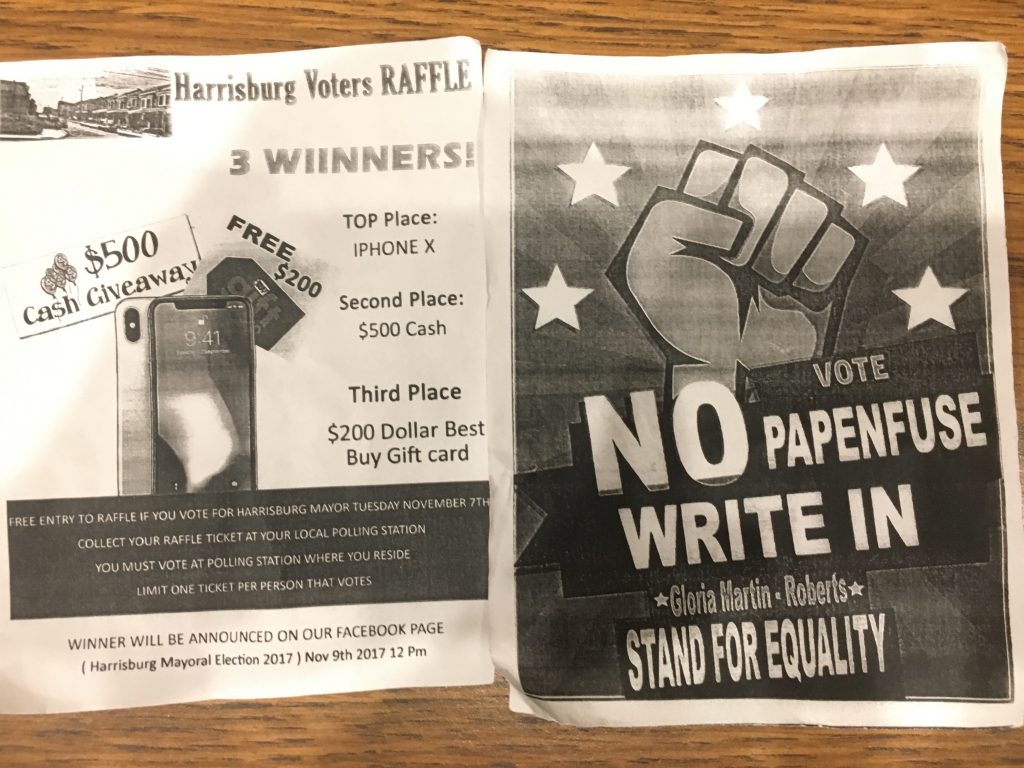
People at many city polling stations were found to be handing out raffle tickets, which promised prizes for voting. These included a new iPhone X (first prize), $500 in cash (second prize) and a $200 Best Buy gift card (third prize).

Dauphin County Sheriff Nicholas Chimienti later visited a downtown office owned by developer Jeremy Hunter, where Hunter stored both raffle tickets and flyers supporting write-in candidate Gloria Martin-Roberts.

Martin-Roberts, however, later denounced Hunter’s efforts, saying she never authorized the raffle or the flyers.

“I clearly told Jeremy, ‘do not distribute any of that information with my name on it,’” Martin-Roberts said. “He does not listen to anyone.”

Hunter also told TheBurg that he spent thousands of dollars in the primary and general elections in support of Martin-Roberts. At press time, those expenditures had not been reported to the Dauphin County elections bureau.


3rd Street Project Starts

Harrisburg officials last month broke ground on the long-awaited repaving of 3rd Street, though most of the work will not start until the spring.

Crews began on the Midtown portion with new curbing and ADA-compliant ramps at intersections. Work is expected to continue through December, depending on the weather, and will resume in March.

The entire project includes about a two-mile stretch of the main artery from Chestnut Street downtown to Seneca Street in Uptown Harrisburg.

Actual milling and paving of the street will hold off until next year, said Mayor Eric Papenfuse. The project is expected to continue throughout much of 2018, wrapping up in October.

Papenfuse stressed that the project is not just for motorists. He said the improvements will make it easier to walk and bike, as well as drive along the street.

“By the time we are done, this entire area will be returned to the residents of the city,” he said.

City Engineer Wayne Martin said that, when paving begins next year, he expects temporary road closures and detours lasting about three days at a time. He also said that some parking, about 10 spaces at a time, will be occupied by construction equipment.

As part of the project, Capital Region Water will install trees and other environmentally friendly infrastructure, including green “bump outs,” to reduce storm-water flow, said CRW board chairman J. Marc Kurowski.

He said the project is part of CRW’s City Beautiful H2O program, which is meant to replace outdated infrastructure and improve storm-water flow.

“We’ll have new trees and new ways to manage storm-water,” Papenfuse said. “This will become a showcase for design for the whole region.”

Harrisburg has contracted with Elizabethtown-based Doug Lamb Construction Inc. for the $5.5 million project, a cost split between the city and CRW. The city is paying an estimated $3.5 million, with CRW footing the remaining $2 million.

Most of the project is funded by a grant from Impact Harrisburg, a nonprofit set up as part of the city’s financial recovery.


City Incumbents Returned to Office

Harrisburg Mayor Eric Papenfuse sailed to an easy re-election victory last month, despite two candidates mounting late write-in bids.

With all 28 precincts reporting, Papenfuse garnered 3,788 votes. All write-in candidates together tallied 502.

Shortly before the election, two of Papenfuse’s defeated opponents in the Democratic primary, Gloria Martin-Roberts and Lewis Butts, declared that they would mount write-in campaigns in the general election.

With his victory, Papenfuse will begin his second, four-year mayoral term in January.

Five Harrisburg City Council candidates also ran unopposed in their races. Council incumbents Wanda Williams, Shamaine Daniels and Ben Allatt each won four-year terms, as did newcomer Ausha Green. Councilman Dave Madsen earned a two-year seat.

Harrisburg Treasurer Dan Miller and Controller Charlie DeBrunner each ran unopposed and will serve four-year terms.

For school board, all the listed Democrats won four-year seats: Brian Carter, Carrie Fowler, Danielle Robinson and Judd Pittman. Incumbent James Thompson, who lost in the Democratic primary but cross-filed, lost on the Republican side.

Percel Eiland, running unopposed, took the two-year seat for school board.

One district justice seat was contested. In the race for district 12-01-05, Democrat Hanif Johnson defeated Claude Phipps, who was on the Republican ballot, by a vote of 954-347.

In Dauphin County, Republican Matthew Krupp defeated Democrat Diane Bowman in a close race for prothonotary. In the heated contest for three Court of Common Pleas judgeships, sitting Judge Lori Serratelli lost to challengers Ed Marsico, Royce Morris and John McNally.

HU Proposes Downtown High-Rise

A new high-rise may soon add to downtown Harrisburg’s skyline, as Harrisburg University of Science and Technology last month issued a request for proposals for a new, mixed-use building.

According to the RFP, the proposed building at Chestnut and S. 3rd streets would house the school’s emerging Health Science Education Center, from which it would offer degree programs in nursing, pharmaceutical sciences and other health programs.

The RFP is asking for bids of at least 200,000 square feet for educational space, plus housing for more than 300 students. The building, currently proposed to be 36 stories, may also contain amenities such as a boutique hotel, restaurant, executive conference center and/or fitness facility.

The school envisions the building as a high-rise on parcels that include 222 Chestnut St., currently a surface parking lot owned by Vartan Enterprises, and 24, 26 and 28 S. 3rd St., which contain small commercial buildings owned by Mechanicsburg-based Dauphin Land Co. Under the RFP, those low-rise, 19th-century commercial buildings would be demolished.

HU President Eric Darr said that the current property owners have agreed to sell their parcels to HU for the project. He added that the proposed location was perfectly situated between UPMC Pinnacle and the university’s main academic building on Market Street.

“Being a block away from Harrisburg Hospital makes all the sense in the world,” said Darr, who estimates the total cost of the project at $120 to $140 million.

HU has set Feb. 2 as the deadline for responses, with a proposal selection date of April 10. An evaluation committee comprised of members of the university’s executive staff, board of trustees and outside advisers will evaluate the proposals.

Darr said he hopes to break ground in 2019 and that construction should take about two years.

Overnight Shelter Opened

Following a change in policy at Harrisburg’s largest rescue mission, a downtown shelter will open an emergency overnight shelter for 30 homeless men.

Downtown Daily Bread, a soup kitchen and daytime shelter operated by Pine Street Presbyterian Church on N. 3rd Street, got approval from the city to operate a 30-bed men’s shelter from Dec. 1 to March 31 at its facility at 234 South St., according to Anne Guenin, director of Downtown Daily Bread.

Downtown Daily Bread currently runs a daily drop-in shelter where people can nap, shower, receive meals and pick up mail. It serves between 70 and 90 people on an average day, Guenin said.

The night shelter will be in the same facility as the daytime shelter, which operates from 8 a.m. to 4 p.m. The nighttime shelter will open at 7:30 p.m., giving crews time to clean and convert the gymnasium to a dormitory with cots, and will close at 6 a.m.

Guenin said that the shelter originated in response to an operational change at Bethesda Mission, which this year decided to focus its efforts on long-term recovery programs and open its emergency shelter only in extreme weather conditions.

Comp Plan Back on Track

Harrisburg’s long-delayed comprehensive plan appears to be back on track, as the city’s Planning Commission last month agreed on a draft plan and set forth a path for final approval.

The commission unanimously opted for a draft submitted by the Office for Planning and Architecture, a city-based firm headed by urban design consultant Bret Peters.

In May 2015, the city hired Peters for $200,000 to create a comprehensive plan, which cities use as frameworks to guide policy, ranging widely from land use to recreation. Plans typically have a shelf life of only 15 to 20 years, though Harrisburg’s had not been redrafted in some four decades.

Originally, the city expected its plan to be finished in about 10 months. However, a dispute with Peters over the editing process, communication and, especially, pay, led to a long delay.

At one point earlier this year, the city and Peters parted company after Peters wanted more money to complete the project.

That holdup ended with the commission’s decision to go with Peters’ draft, which is now public. A public hearing is slated for Jan. 10.

Following the hearing, the commission may make additional changes based on public input. It then must approve the final draft before submitting it to City Council for its approval.

More Apartments Approved

Harrisburg is poised for more apartment conversions, as the city’s Zoning Hearing Board last month gave the go-ahead to two projects.

The board voted unanimously to permit as many as 18 rental units in Tracy Mansion, which would complete the restoration of the historic Midtown building.

Owner Jack Kay of York-based Susquehanna Real Estate plans between 14 and 18 one-and two-bedroom units in the eastern portion of the century-old building at N. Front and Muench streets, space that has long sat empty.

“All of the existing architectural features will be restored and, if anything, enhanced,” Kay told board members.

Industrialist David Tracy built the 30-room mansion as a private residence in 1918. In 1951, it became an osteopathic hospital and eventually a mental health facility.

Kay bought the building in 2005 with plans to convert it to an office condominium, adding a new, seven-story building in the parking lot next door. He received zoning board approval two years later, but the project died after the recession hit in 2008.

In 2012, Kay sold the western part of the building to Char Magaro, who opened the restaurant, Char’s Tracy Mansion, there.

Kay said that he believes there now is a market in Harrisburg for upscale apartments, which motivated him to seek a special exception for that use. He said that his apartments will be “nice units” with such features as high-end finishes, river views and in-unit washers and dryers.

He said that he hopes to undertake the project next year, but that the timing depends upon securing financing, among other factors. He said that he had not yet determined rental rates, but that they would be competitive with recent projects by Harristown Enterprises and WCI Partners.

Last month, the zoning board also unanimously granted a variance to Harristown for the conversion of a downtown office building to residential space.

Harristown plans to develop 12 one- and two-bedroom apartments from a worn-out, long-empty office building at the corner of N. 2nd and Cranberry streets. It currently has the building under contract with the seller, Camp Hill-based CJ2 Group.

With Planning Commission and zoning board approvals, Harristown now must have its land use plan approved by Harrisburg City Council before it can begin the project.

Water, Sewer Rates Rise

Water and sewer rates in Harrisburg are set to increase more than 7 percent next year, as Capital Region Water passed its 2018 budget last month.

The CRW board unanimously approved the spending plan, which will raise drinking water rates 7.5 percent for all city and suburban customers. Sewer rates will go up by 7.1 percent for city customers and vary for suburban customers, depending on their location.

The 2018 full-service rates for water and sewer service are $9.46 and $6.99 per 1,000 gallons, respectively. Under the new rates, an average customer who uses 4,500 gallons of water per month will pay an additional $5.56.

A few months ago, the board was faced with even higher rate increases, in excess of 10 percent, said board Chairman J. Marc Kurowski. However, CRW was able to scale those back to more reasonable levels, he said.

“Nobody’s excited with having to have rate increases, but we’ve kept them manageable,” Kurowski said.

CRW has raised rates for several years running. For 2017, the utility increased drinking water rates by 11.6 percent and sewer rates by 7.9 percent.

David Nowotarski, CRW’s chief financial officer, said the rate increases were needed, in part, to pay for ongoing capital upgrades to water and sewer infrastructure.

For 2018, CRW expects to spend about $8.9 million for water system upgrades and about $33 million for sewer projects. CRW has several major initiatives in place to repair and upgrade the city’s aged water and sewer infrastructure.

So Noted

Brighter Living held its grand opening last month at its facility at 979 E. Park Dr., Harrisburg. Brighter Living offers daily activities for seniors such as crafting, cooking, watching movies and gardening, as well as therapeutic activities.

Merit Marketing last month acquired Portland, Ore.-based communications firm, LT Public Relations. Harrisburg-based Merit stated that the acquisition strengthens its West Coast presence and gives it a team of senior advisors in media relations, executive training and crisis communications management.

UPMC Pinnacle opened its new medical office, Strawberry Square FamilyCare, last month in downtown Harrisburg. The office features six exam rooms, a laboratory, conference room and waiting area. It is open weekdays, 8 a.m. to 4:30 p.m., located on the first floor, atrium-level of Strawberry Square, adjacent to Rite Aid.

Changing Hands

Balm St., 119: K. & R. Thames to T. McNair, $55,000

Berryhill St., 2216: M. & N. Haile to PA Deals LLC, $31,000

Berryhill St., 2334: W. J. & J. Morrow to X. Rios & L. Vega, $52,000

Berryhill St., 2338: PA Deals LLC to L. Myers, $59,500

Briarcliff Rd., 2311: W. & E. Warren to S. & A. Cornick, $220,000

Briggs St., 2035: L. McArthur to C. & M. Bruner, $64,000

Calder St., 321: C. Steinbacher to R. & F. Armetta, $40,000

Chestnut St., 1200, 1202, 1204, 1206, & 1208: San Pef Inc. to Round Rock Investments LLC, $369,000

Derry St., 2612: J. Beal to T. Dunmyre, $68,900

Evergreen St., 26 & 28: San Pef Inc. to Round Rock Investments LLC, $95,000

Fulton St., 1418: PA Deals LLC to E. Shenk, $109,500

Girard St., 740: I. Naranjo & D. Benitez to O. Caban, $64,000

Green St., 1327: S. O’Neal to B. & S. Cincotta, $118,000

Greenwood St., 2237: J. Erb to A. & S. Rankin, $50,000

Herr St., 1614: T. Lawson to E. Andrades, $52,000

Holly St., 1914: J. Kaffaya to D. Berhe, $43,000

Hudson St., 1215: PI Capital LLC to V. Jackson, $97,000

Hummel St., 342 & 1508 Hunter St.: Equity Trust Co. Custodian Terry Casey IRA to E&K Homes, $34,000

Kensington St., 2335: PA Deals LLC to End Properties LLC, $69,500

Kensington St., 2343: PA Deals LLC to L. Myers, $59,500

Lenox St., 2032: J. & J. Belfonti to S. Ash, $43,000

Linden St., 128: Hal Don Properties LLC to A. Elkanouni, $56,500

Maclay St., 1037: J. & S. Pagliaro to P2N2, $65,000

Mercer St., 2440: T. Carey to D. Chen & M. Brinkman, $55,000

Mulberry St., 2000: L. & R. Moore to P. Robinson, $50,000

N. 2nd St., 912: S. Meyers to J. Radabaugh, $185,000

N. 2nd St., 1215: R. Shultz to R. & G. Armetta, $137,700

N. 2nd St., 2401: R. Buxton to M. Rathfon & S. Ewing, $162,000

N. 2nd St., 3301: D. & C. Gilkey to K. & K. Eshenaur, $197,900

N. 3rd St., 1914: J. Hobbs to J. Vega Jr., $90,000

N. 3rd St., 2016: WCI Partners LP to K. Reed, $212,000

N. 3rd St., 3301: N. Johnson to E. Verbos, $135,000

N. 4th St., 1336: M. Reed to R. & F. Armetta, $80,000

N. 4th St., 1620: Keech Equity Investments LLC to Acharya Rentals LLC, $60,000

N. 4th St., 3116: L. Deatrick to G. & J. Desgres, $90,000

N. 6th St., 930 & 932: K. & N. Galoyan to R. & F. Armetta, $170,000

N. 5th St., 3024: J. Olan to C. Geis, $95,000

N. 6th St., 3020: S. McCutcheon to L. Harris, $70,300

N. 7th St., 2301 & 2327: Sam Hill Properties LLC to DF7 LP, $410,000

N. 17th St., 28: V. Rivas to I. Mirambeaux, $35,000

N. Cameron St., 1301: J. & J. Salinger to R. Chatue & H. Tambo, $295,000

Oakwood Rd., 2301: PI Capitol LLC to J. Swetlick, $280,00

Penn St., 1721: PA Deals LLC to L. Myers, $129,000

Pennwood Rd., 3120: S. McCoy to J. Mohler & J. Suter, $38,000

Pennwood Rd., 3143: F. Travitz to T. Marhon, $85,500

Rolleston St., 1033: V. Clyde to L. Le, $35,500

Rudy Rd., 1959: E. Ripka to J. & M. Weaver, $66,500

Rumson Dr., 2627: G. & G. Chacon to L. & M. Holston, $81,000

Rumson Dr., 2956: A. & M. Berra to R. Gonzalez & M. Cabrera, $68,000

S. 14th St., 1407: R. Williams to City of Harrisburg, $51,000

S. 14th St., 1417: J. Vogelsong to City of Harrisburg, $49,000

S. 14th St., 1421: S. Mosley to City of Harrisburg, $57,000

S. 14th St., 1425: J. Coleman & A. Dannar to City of Harrisburg, $48,500

S. 14th St., 1430: L. & C. Matter to City of Harrisburg, $51,000

S. 14th St., 1438: A. & M. Reuveni to City of Harrisburg, $51,000

S. 14th St., 1444: Atlantic North Star Properties to City of Harrisburg, $55,000

S. 14th St., 1447: C. & F. Randolph to City of Harrisburg, $46,000

S. 14th St., 1451: C. Colon to City of Harrisburg, $57,000

S. 14th St., 1454: J. McFarland to City of Harrisburg, $52,000

S. 25th St., 736: M. Anderson to L. Crowder, $44,500

S. Cameron St., 130: Goldman Sachs Mortgage Co. & Ocwen Loan Servicing LLC to D&F 130 Cam LLC, $161,500

State St., 1326: Arthur A. Kusic Real Estate Investments to C. & T. Semancik, $100,000

Susquehanna St., 1635: R. Drakeford to S. & D. Williams, $99,900

Susquehanna St., 1932: St. Glecos to J. Gallant, $82,450

Swatara St., 1518: Tri County HDC Ltd to D. Kiser, $68,000

Sycamore St., 1625: T. Price to K. Fields, $79,042

Verbeke St., 208: M. Barrette to C. Malloy & K. Sica, $89,999

Wayne St., 1517: R. Palmer to J. Alvarado, $40,000

Harrisburg property sales for October 2017, greater than $30,000. Source: Dauphin County. Data is assumed to be accurate.

Continue Reading

TheBurg Podcast, Nov. 17: Raffles and High Rises Edition

Ring in the weekend with TheBurg Podcast!

TheBurg’s editor in chief Larry Binda sits down with city reporter Lizzy Hardison to rehash the past two weeks in Harrisburg news. They recap what the heck happened with that election day raffle, discuss the city’s new comprehensive plan, and imagine a skyline changed by Harrisburg University’s new building project.

A note to our listeners: We are working hard to bring you better audio quality! We’ve acquired new microphones and hope that you’ll see a marked improvement in sound quality in our next episode.

You can listen here on Soundcloud, or download the podcast in iTunes or the iPhone and Android podcast apps.

Read the stories mentioned in this week’s podcast:

Thousands of dollars later, campaign yields no finance report and one unhappy candidate.

It’s Here: Harrisburg’s draft comprehensive plan released

Healthcare & a Hotel: HU plans mixed-use high-rise in downtown Harrisburg

Stream this week’s episode on SoundCloud. You can also download it in iTunes, or on the Apple and Android podcast apps.

Continue Reading

Thousands of dollars later, campaign yields no finance report and one unhappy candidate.

Some of the fliers that Jeremy Hunter paid canvassers and poll workers to distribute during the General Election on Nov. 7. Hunter claimed he did not organize the election day raffle advertised in the flier on the right, but admitted to paying some of the people who promoted it.

A Harrisburg-area developer who reportedly spent thousands of dollars trying to influence Harrisburg’s mayoral race has not yet filed any of his expenses with the Dauphin County Board of Elections—but was denounced today by the write-in candidate he tried to promote.

Jeremy Hunter, a Camp Hill resident who wishes to buy and develop William Penn High School in Harrisburg, paid field workers last week to campaign for Gloria-Martin Roberts, a former city council member and mayoral candidate.

He reportedly disbursed $900 of wages to canvassers and poll workers through an associate late Tuesday, and he told TheBurg himself that he spent $5,000 that night paying canvassers, poll workers, and people who promoted an election day raffle.

He also said he spent $35,000 in the primary season on radio ads attacking Harrisburg Mayor Eric Papenfuse, who was reelected last week.

Pennsylvania campaign finance law allows individuals not associated with any campaign to make independent expenditures to influence the election of a candidate or ballot question.

Any independent election expenditure over $500 made between Tuesday, Oct. 25, and Wednesday, Nov. 8, must be reported to an Election Board within 24 hours. All independent expenditures during primaries must be reported in May.

Hunter said on Monday that his legal counsel did not inform him of any rules regarding independent election expenditures, and confirmed that he had not filed any reports with the Dauphin County Board of Elections.

He did, however, draw the ire of the candidate headlining his campaign.

Martin-Roberts denounced Hunter’s efforts in an interview with TheBurg on Monday, claiming she did not approve of any of the literature he circulated on her behalf. She said she took particular offense to a flier showing a raised fist — an emblem of the black power movement.

“I clearly told Jeremy, ‘do not distribute any of that information with my name on it,’” Martin-Roberts said. “He does not listen to anyone.”

The only action Martin-Roberts took before the general election, she said, was to film a video at the Voter Registration Office instructing people how to cast a write-in vote. The video was posted to her Facebook page.

Hunter told TheBurg last week that he printed 40,000 fliers denouncing Papenfuse and promoting Martin-Roberts before the Nov. 7 elections.

Hunter said that Martin-Roberts knew about his fliers, but claimed he acted “independently of everyone.” He said that he did not have the candidate’s permission but also claimed that she never forbade any aspect of the campaign.

He also recruited and paid scores of people to distribute the literature that Martin-Roberts said she rejected. One of them, Harrisburg resident Betty Wallace, helped assemble a team of canvassers and poll workers for the general election.

Wallace, who previously worked for Martin-Roberts’ primary campaign, added that Hunter did not give her an operating budget, but offered to pay each worker $120.

Elisha Thomas was hired by Wallace to be a poll watcher for Gloria Martin-Roberts. Thomas said she was paid $40, a fraction of what she was promised, by Hunter’s associate, Kyle Myers, on Tuesday night.

She and Wallace watched Myers distribute a total of $900 among more than 20 poll workers and canvassers before he ran out of money, they said. He issued the payments at 1941 Market St., in the offices of Magisterial District Judge candidate Claude Phipps, where some of the field organizers happened to be working.

Hunter told TheBurg he paid campaign canvassers and raffle workers in his office at 308 N. 2nd Street the same night.

“I probably paid out $5,000 of my own money and have it on record,” Hunter said on Wednesday. He claimed that he filmed every transaction he made that night, and had each person on camera state their name and the job they performed.

Wallace said she hired more than 30 people to canvass and work polls for the write-in campaign on Election Day. Hunter personally gave her $700 on Wednesday to pay her team, which Wallace said did not nearly cover everyone’s wages. That payment, which Hunter made on Nov. 8 and acknowledged in text messages shared with TheBurg, also falls within the 24-hour reporting period.

In a Nov. 9 text message sent to Wallace, Hunter claimed that he paid more than $8,000 in wages for canvassers and poll watchers since Nov. 7.

Wallace claimed that Hunter promised her $500 for field organizing; he said he never made that offer. She said she’s received countless phone calls this week from people claiming Hunter owes them money.

Hunter and Myers received criticism for delaying payments to the homeless shelter residents they recruited to hand out raffle tickets at polling places.

Myers claimed responsibility for the raffle, which offered voters the chance to win a free iPhone if they participated in Harrisburg’s mayoral election. He said it was meant to encourage voter turnout.

Hunter helped Myers recruit raffle workers but insisted that the raffle was separate from his own canvassing efforts. He admitted that running both projects out of his 2nd Street office created the perception of collusion between the raffle and the write-in campaign.

But Corby Chester, who was hired by Wallace as a Martin-Roberts canvasser, said that the bag of supplies he received on Election Day contained both campaign literature and raffle materials.

“Jeremy told us to give them out together,” Chester said. Hunter denied the allegation.

Chester, Wallace, and a canvasser named Roynel Reed all said that Hunter told them separately about his plans to develop the former William Penn High School campus in Harrisburg.

“He said he wanted to buy the high school, and Papenfuse is freezing him out,” Reed said.

Hunter told Burg reporters on two occasions that he wishes to buy the school and turn it into a “soft landing” campus for international students studying at American universities. On Wednesday, he said that he does not think Papenfuse supports his development projects.

Harrisburg School Board president Danielle Robinson confirmed that Hunter’s company, William Penn Holdings, expressed interest in the now-empty high school campus.

Dauphin County Property Investors, a subsidiary of William Penn Holdings, owns 14 properties in Harrisburg. DCPI purchased all of the properties at tax sale for prices ranging from $800 to $12,000.

Hunter said on Monday that he would call the county Board of Elections about his campaign expenditures. He also reported that he fired his legal counsel, who he confirmed was James Ellison, the former treasurer of Martin-Roberts’ primary campaign.

This story was updated to include the name of Hunter’s lawyer. 

Continue Reading

Burg Blog: Oh, Harrisburg

A polling station on State Street in Harrisburg.

On Tuesday night, someone texted me a “face palm” emoji.

That’s a little picture of a guy bringing his hand to his face in a gesture of frustration and exasperation.

I knew where he was going with this.

We had just run a couple of stories about a bizarre Election Day scheme, which began with homeless men standing at polling stations handing out raffle tickets that promised a chance to win big prizes for simply casting a vote, and ended, hours later, with a visit by the Dauphin County sheriff to the hastily assembled downtown campaign office of write-in candidate Gloria Martin-Roberts.

As another friend often says, with a sigh, “Oh, Harrisburg …”

Yes, it was another shameful day for Harrisburg’s political class and, by extension, the rest of us. And now the national press has picked it up, with stories today in the New York Times and Chicago Tribune, among other papers, reminding me of the day the big-city press jumped on the story of former Mayor Steve Reed and his house full of museum artifacts.

As of now, details remained a bit sketchy over the plot to round up men from Bethesda Mission and Downtown Daily Bread and dispatch them, armed with campaign flyers and raffle tickets, to polling stations throughout the city. It’s also unclear if the campaign crossed any legal line or if it will be able to maintain a veneer of plausible separation between the pro-Martin-Roberts (and anti-Eric Papenfuse) flyers and the iPhone/cash/gift card raffle drawing.

But this much is clear—the episode is disgraceful, another black eye for the city doled out by some of its own “leaders.” That’s bad enough. But I’m perhaps even more astounded by the profound stupidity of this half-baked enterprise.

Since I’ve been here, I’ve been told that Harrisburg is a “different” kind of place. Too big to be a town, too small to be a proper city, it exists in an urban netherworld, sometimes exhibiting the worst (sometimes, the best) traits of each.

So, Harrisburg has big-city problems, but these often reside within a small-town political framework more akin to Mayberry than Manhattan, in which the players know each other well, often detest each other and engage in a battle to be the biggest minnow in the pond.

In cities with a more evolved political class, here’s what happens in a primary election. People lose, and then they call and congratulate the winner. The losers graciously bow out of contention and support the party’s nominee in the general election. Serious-minded candidates who want another shot study what went wrong, how they can do better and plot a long-term strategy on how to come back and fight another day.

In contrast, here’s what happens in Harrisburg. A candidate loses in the primary and then, more often than not, whines, complains and makes accusations and excuses. He or she then plots and schemes how to still win in the general election they’ve just been knocked out of.

So, for instance, maybe a lifelong Democrat cross-files and wins on the Republican side, becoming the standard-bearer for a party he loathes. Or maybe he backdoors his way in, earning enough write-in votes to get a spot on the other side of the ballot. Or, absent any other alternative, he mounts a pointless write-in campaign.

In any case, staying in a race despite a primary loss usually says nothing good about a candidate or his chances. When candidates continue to run, they’re usually doing so from a place of profound personal ego and political weakness. They simply can’t abandon the spotlight or the belief that they should be the next mayor or council member or whatever. It also usually confirms the primary result, as they typically run as bad a campaign the second time around as the first.

But, mostly, it’s a just a big waste of everyone’s time and attention, since primary losers rarely end up winning. In Harrisburg, the Democratic victor in the primary wins in the general election almost every time, barring intervening scandal or death.

Harrisburg’s recent mayoral races offer great examples. Four years ago, one of the losing Democrats continued to run after “winning” the Republican primary through write-in votes. At the time, I wrote that he would lose badly in the general election running as a Republican, and that’s what happened. A whole lot of time and money was spent for nothing.

This year, we were faced with an even odder situation. Of the four losing primary candidates, two mounted write-in campaigns in the general election. Write-in efforts almost never succeed, requiring months of intense voter engagement and education for even the slimmest chance. Instead, these candidates declared just days before the election—“campaigning” mostly through Facebook. They then lost by a 7 to 1 margin.

This was simply was not a serious effort. So then what was the point? Ego? Delusion? Coercion? Pique? Honestly, I have no idea.

But here we are, stuck with the Election Day version of the Keystone Kops, a group who raided the city’s homeless shelters to field a workforce to support a hopelessly desperate and strangely executed write-in campaign. Their bizarre scheme is now being examined by law enforcement, which may not take kindly to partisans running a raffle to encourage “voter turnout.”

But that still leaves us, the people of Harrisburg, saddled with a political class that, too often, proves to be embarrassing, incompetent or even corrupt. We must demand better from those who purport to represent us: more maturity, more professionalism, more care for the whole of the city. And they must be able to accept criticism and even loss gracefully.

In the battle over the question—is Harrisburg more a big town or a small city?—I tend to side with the latter. However, I’m still waiting for politicians, as a whole, to show greater competence and thicker skins: to do battle, accept their lumps, shake hands and move on. I believe this city has had enough of their petty squabbles, lingering vendettas, Facebook feuds and crazy, embarrassing schemes.

Lawrance Binda is editor in chief of TheBurg.

Continue Reading

Election day raffle mixed with campaign literature by accident, supervisors say

This story was updated on Nov. 14 with comment from Claude Phipps.

A suspicious Election Day raffle led Dauphin County sheriffs on Tuesday to the offices of a Harrisburg developer, who, along with the raffle organizer, now denies any collusion between the raffle and political campaigns.

Jeremy Hunter, a real estate developer with property holdings in Harrisburg, owns the 308 N. 2nd St. property where raffle workers reported to receive training and payment on Tuesday. The office was also command central for poll watchers and canvassers promoting two other campaigns in the city: that of Gloria Martin-Roberts, a write-in candidate for mayor, and Claude Phipps, the Republican candidate for a Magisterial District Judge seat in precinct 12-01-05.

Following reports that men were distributing raffle tickets and promotional flyers at polling stations on Tuesday, Dauphin County Judge Scott Evans issued an injunction against the materials, ordering their seizure from seven polling places across the city. The flyer said that voters who participated in Harrisburg’s mayoral race could enter a raffle to win a free iPhone, cash and a gift card.

Raffle materials, along with flyers promoting Martin-Roberts’ write-in campaign, were in Hunter’s office on Tuesday afternoon when county Sheriff Nicholas Chimienti arrived for an investigation.

The coexistence of the raffle materials and campaign operations in the office was sheer coincidence, Hunter said. He denied any intent by the campaign to influence voters by offering them the chance to win a free iPhone.

A bag of material obtained by a poll worker, shown to TheBurg yesterday, showed campaign flyers and raffle tickets intermingled. Kyle Myers, the York county resident who organized the raffle, acknowledged that at least one person he employed for the raffle also distributed campaign literature.

Hunter claims to have spent thousands of dollars on radio and print ads since the primary season attacking Harrisburg Mayor Eric Papenfuse. Papenfuse defeated Martin-Roberts in the Democratic primary in May and won a second term last night.

A self-described “anti-politics” guy, Hunter said he printed 40,000 anti-Papenfuse flyers prior to Tuesday’s general election. The flyers, which were distributed by canvassers and poll workers before and during Election Day, also promoted Martin-Roberts’ write-in campaign. Hunter said that he paid for the printing and distribution himself, acting of his own volition.

According to Hunter, his reputation as a self-financed political organizer led Myers to contact him about his own Election Day project.

“He came to me because he knew that I was spending money on literature in the city,” Hunter said. “He knew I had people to pass off material.”

Hunter said he agreed to help Myers hire people to promote the raffle at polls.

Myers claimed that his goal for the raffle was to encourage people to vote. But he could not explain why he chose to debut a voter turnout initiative in a city where most municipal races were uncontested, or why he chose to focus specifically on the mayoral election, where Papenfuse had the nominations of both major political parties.

Myers said he grew up in central Pennsylvania and lives in York County now, adding that he decided to run the raffle in Harrisburg because it is Pennsylvania’s capital city.

Funding for the raffle, including prize money and wages for people distributing tickets and promotional fliers, came from private sources, including Myers’ contacts in Harrisburg. He would not name any of his donors, but denied that any of them worked for campaigns.

Hunter would not say definitively if he thought the raffle would generate votes for Martin-Roberts, his candidate of choice. But he also blamed Martin-Roberts’ loss in the May primary on low voter turnout and believed that incentivizing voters would result in “more honest opinion” from voters.

“I told [the raffle organizers] I wanted as many people to come out as possible, because how do you know what people will do unless everyone comes?” Hunter said. “Last time, we lost by 500 votes because nobody came out. I agree the city needs a big turnout, so I agreed to let my office be used by raffle people.”

Hunter also denied that his office doubled as Martin-Roberts’ official campaign office, even though a woman working there on Tuesday told reporters it was. On Wednesday, Martin-Roberts volunteers waiting outside the office for payment said that the write-in candidate had not sanctioned the raffle.

In response to reports that raffle promoters were denied their pay on Tuesday evening, Hunter said that 50 people who worked out of the 2nd Street office were paid there that night. Hunter claims that he gave out more than $5,000 of his own money to poll watchers, canvassers and raffle workers who were waiting outside his office at 9 p.m. on Tuesday.

“It was chaos last night,” Hunter said. “Claude [Phipps’] people weren’t paid, ticket people weren’t paid. I was just handing out $50 bills like I was a McDonalds or something.”

In remarks on Friday, Nov. 10, Phipps denied ever working with Hunter on his campaign. Phipps said that he hired and paid all of his own staff, but Shymar McBride, his campaign manager, acknowledged that some Phipps staffers sought out additional work with Hunter in their off hours.

Myers pledged to personally pay everyone who was owed money by Thursday, Nov. 9. He also said he would compensate people who were underpaid on Tuesday night.

Six men from Bethesda Mission who were promised $10 an hour to work for Myers were not paid by Wednesday morning, according to Bill Christian, director of the men’s shelter. Myers said he plans to pay those men tonight.

Hunter says now that he wishes Myers hadn’t approached him with his Election Day project. He regrets that confusion in his office on Tuesday led to the perception of collusion between campaigns.

As for his part, Myers doesn’t think he’ll try a voter turnout raffle in another city. He said he’s “not passionate about politics,” but does want people to be informed and educated.

“Given the backlash from this, I’m not really sure we’ll repeat it in the future,” Myers said. “But the message of getting people to the polls is still a good message.”

Martin-Roberts did not respond to requests for comment on Wednesday.

Continue Reading