Tag Archives: Chisuk Emuna

Harrisburg Zoning Board weighs three apartment projects, approves one

Three apartment projects met very different fates on Monday night, as Harrisburg’s zoning board considered building proposals in Midtown, Allison Hill and Uptown.

At the beginning of the meeting, Thomas Leonard, chair of the city’s Zoning Hearing Board, stated that Seven Bridges Property Development had withdrawn its application for the construction of two small apartment buildings in Midtown.

Last October, the Harrisburg-based builder unveiled plans to construct a nine-unit building at Calder and N. 4th streets and a 12-unit building a block away at Calder and Marion streets on property owned by the Harrisburg Redevelopment Authority.

The developer was originally scheduled to make its case for zoning relief last November, but requested a series of continuances from month to month. It finally withdrew its application entirely for the two-building project, according to the city.

Seven Bridges could not be reached immediately for comment.

Next, the board heard the continuation of a case from May—a proposal to convert a blighted, 11,500-square-foot industrial building on Allison Hill into a 12-unit apartment building.

Philadelphia-based Radon Construction wants to renovate and construct one-bedroom units in the former Church of God/Central Publishing House at 100 N. 13th St., a building that has been abandoned for decades. However, its proposal has been met with concern by some neighbors, mostly over issues of parking.

A rendering of the proposed apartment building (Chris Dawson Architects)

Originally, owner Gregory Radon proposed 12 parking spaces, two fewer than mandated by the zoning code. City building setback and landscaping requirements further reduced the number of parking spaces to 10.

At the virtual meeting on Monday night, Loretta Barbee-Dare, president of the Summit Terrace Neighborhood Association, asked why more parking couldn’t be provided on empty lots at the rear of the building on Linden Street. Those lots conveyed with Radon’s $135,000 building purchase from CPenn Patriot Properties in January 2020.

“With nine parcels, how can you not find more parking for your tenants?” asked Barbee-Dare, who advocated for 15 total parking spaces.

After much discussion, the board approved zoning relief of three parking spaces, indicating a configuration with 11 total spaces, with the understanding that the project’s site civil engineer will try to carve out additional parking in its final design.

“If there’s the opportunity to squeeze in more space on these lots, they will,” said the project’s architect, Chris Dawson.

With zoning approval, the project’s land development plan now must be approved by the city’s Planning Commission and City Council, before construction can begin.

Parking also was a key issue in the final case on Monday night, a proposal by Harrisburg-based D&F Realty Holdings to convert a 16,500-square-foot building at 423 Division St. into an apartment building.

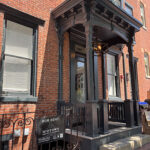
The 65-year-old building long housed Congregation Chisuk Emuna, but the synagogue was heavily damaged in a 2009 fire. In 2012, it was sold to the Ahmadiya Movement in Islam, but has remained boarded up and blighted. D&F Realty bought the building in May for $110,000, according to Dauphin County.
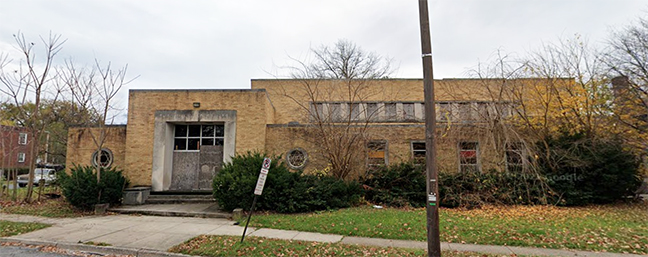
A developer wants to turn the former Chisuk Emuna synagogue into an apartment building.

Originally, D&F proposed a 24-unit apartment building, which met with objections from both the city Planning Bureau and the Planning Commission, as the city’s zoning code only allows 11 units by right for a building of its size.

D&F has now scaled back its proposal to 18 units, which Deputy Planning Director David Clapsaddle said that the city could support.

The project also has no parking on site, but D&F has proposed entering into an agreement for parking with the Scottish Rite Cathedral, which is located about two blocks away.

“We think the 18 units and the parking with the Scottish Rite Temple really heads us in the right direction,” said Clapsaddle, who added that the city wants to encourage adaptive reuse of Harrisburg’s older institutional buildings.

Speaking on behalf of D&F, Dale Hair of Lemoyne-based KD3 Design Studio, said that 18 units were needed for the project to be financially viable, as the blighted, fire-damaged building needs major restoration.

“We’re trying to look to convert this property that has been sitting there for over 10 years in dilapidated condition and get it back on the tax roles, too, “ Hair said. “There is a need for housing, as we know, in this Uptown neighborhood.”

He added that D&F hadn’t yet entered into negotiations with Scottish Rite for parking, but planned to do so.

Nonetheless, numerous neighbors voiced objections to the project, on both density and parking grounds.

“I like the idea of Scottish Rite Cathedral providing parking,” said neighbor Sarah Chambers. “That seems like a good compromise, but it is concerning. What are they going to do when they don’t want to walk over the two blocks to park at the Scottish Rite Cathedral, and they want to park closer to the building?”

In the end, Hair asked for a continuance until the July meeting. He said that he would present more financial information on the project to justify the 18 units at that time, and, in the interim, would work towards an agreement with Scottish Rite for parking.

If zoning relief is granted, the project next would need to have its building plan approved by both the city Planning Commission and City Council.

If you like what we do, please support our work. Become a Friend of TheBurg!
 

Continue Reading

Harrisburg faith leaders hold vigil to pray for a peaceful election

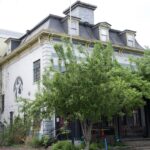
A screenshot from the community vigil.

On the eve of Election Day, it may be in one’s best interest to pray.

On Monday night, the Mayor’s Interfaith Advisory Council held a virtual community vigil to pray for a peaceful election and discuss the importance of unity despite the results.

“Voting is sacred,” said Chad Dion Lassiter, executive director of the Pennsylvania Human Relations Commission. “We are praying for healing for our nation. This aspect of prayer is so essential.”

Leaders of various religious organizations called for mutual respect from both political parties despite the results.

“Politics is about persuasion and conversion, yet one would hope with respect and a peaceful acceptance of the outcome of an election,” said Russell Goodman, who is part of the Interfaith Advisory Council. “We pray this evening for the latter.”

Unity instead of hatred and violence was a recurring theme amongst the remarks of the leaders. This comes after a few instances of hate activity took place in Harrisburg. A Black Lives Matter mural in Midtown was defaced with the logo of a white supremacist group, and there was vandalism at the Harrisburg LGBTQ Center. In August, a vigil was held by the council in support of the Kesher Israel congregation after swastikas were found painted on the building.

“Deepen our understanding that words matter, that our actions matter,” Rabbi Ron Muroff of Chisuk Emuna said. “What we say or do affects others.”

Just as the interfaith council unites despite differences in beliefs and perspectives, the members said that they hoped to see that among people identifying with different political parties.

There were also prayers said for law enforcement officials, national leaders and voters.

“Our community, especially in these uncertain times, now more than ever, we need to pull together and support each other with humility and compassion,” said Saima Mumtaz of the Ahmadiyya Muslim Community.

To learn more about the Mayor’s Interfaith Advisory Council, visit their Facebook page.

Support quality community journalism. Join Friends of TheBurg!

Continue Reading

New home planned for Kesher Israel, as congregation purchases former Riverside Methodist church

Rabbi Elisha Friedman stands in front of the future home of Kesher Israel Congregation in Riverside.

Last year, the Susquehanna United Methodist Conference closed many of its churches, and now one has been bought by another religious organization.

Kesher Israel, an Orthodox Jewish congregation in Uptown Harrisburg, is moving from its home of 72 years to the former Riverside United Methodist Church on the 3000-block of N. 3rd Street.

“It’s really exciting,” Kesher Israel’s Rabbi Elisha Friedman said. “People feel like we’ve got the perfect building.”

Friedman explained that they’re moving because members felt the old synagogue on the 2500-block of N. 3rd Street was not located centrally enough for their community.

Most families live anywhere from one-half to two miles away from Kesher Israel, he said. That may not seem far, but for a congregation whose observation of Shabbat, the Sabbath day, restricts driving on a Saturday, it entails a lot of walking to and from services and prayers.

“Walking a mile with two or three little kids on a Saturday can be really difficult,” Friedman explained.

Kesher Israel was interested in the location of the church building for a while, but the sale and consolidation of the Methodist Churches in Harrisburg allowed them to begin negotiations. The synagogue purchased the church building last month for $176,000.

The new building is significantly smaller than the current synagogue, so Friedman believes the congregation will save money in the long run. However, with a congregation of about 125 families and individuals, some members are concerned about the size and have proposed an addition.

Other renovations may include work on heating and air conditioning, electricity and bathrooms.

And what about their current building?

Friedman explained they have received offers for it, but have not yet decided when to sell. He is also not certain when the congregation will move into the new building, but hopes to at least transition Friday evening and Saturday afternoon services to the space soon.

The new building will place Kesher Israel in close proximity to another synagogue, Chisuk Emuna, which is just next door.

“One of the nice things is we are going to be close to this conservative synagogue,” Friedman said. “We are hoping that the relationship will develop a little more.”

Kesher Israel also is working heavily to market their congregation and the Jewish community generally in Harrisburg. Friedman believes the community they built in Harrisburg is unique.

“We are really trying to grow our community,” he said. “We are the only legit small town in the U.S. where you can live a full Jewish life. Our hope is that this move is going to contribute to that.”

Kesher Israel is located at 2500 N. 3rd St., Harrisburg, and is moving to 3200 N. 3rd St. For more information, visit https://www.kesherisrael.org/.

Continue Reading

Up by the Riverside: A close-knit community celebrates 100 years as part of Harrisburg.

Riverside Fire House, 1923.

You know the neighborhoods of Harrisburg. South Allison Hill. Midtown. Olde Uptown. Bellevue Park. Downtown. Riverside.

Back up there. What the heck is Riverside?

For those of us who live here, Riverside is our little secret. But since September marks the centennial of Riverside’s annexation into the city of Harrisburg, maybe it’s time to stake our claim as a distinct neighborhood with a unique quality of life. No, it’s not “walkable” to coffee shops and cinemas, but there are trees and backyards, parking and birdsong, quick commutes to downtown and quick getaways to highways.

First, to answer your question, Riverside is the last chunk of city land along the 2nd Street corridor. Imagine holding a Hershey chocolate bar in your hand and breaking off the far left squares. That’s Riverside, from Division Street to just north of Vaughn Street (call it Italian Lake to the Jewish Community Center) and from Front Street to 7th Street (Susquehanna River to the railroad tracks).  

“Riverside, before it was annexed, was known as a hamlet,” Howard Parker told me. “I’ve always wanted to live in a hamlet.”

New Age

We were meeting at the Olde Uptown Little Amps (like I said, we got no coffee shops). Parker, a New Jersey native who moved east and has lived in Riverside since 1980, is a history buff and president of the Riverside United Neighbors community group.

Archival records of that 1917 annexation, the year America entered the “Great War,” show that change never happens in Harrisburg without controversy and the occasional threat of fisticuffs. Riverside was still its hamlet self, home to 500 or 600 people who’d been attracted to the Susquehanna Township development since its launch in 1905 with promises of “sewer, water, light and river view.”

“One car-fare takes you from Riverside to any part of city, Steelton, Paxtang, Reservoir, Progress, Penbrook and Rockville,” pledged an ad from developer Lewis M. Neiffer.

Harrisburg had “briefly flirted with an industrial period in the 1890s,” said Historical Society of Dauphin County Librarian Ken Frew, but the ornate Beaux Arts Capitol built in 1906 ushered in a new age.

“Once the (original) Capitol burned down, and they built a new one, the whole tenor of Harrisburg changed,” said Frew. “It became a white-collar city.”

Those government workers found a bucolic escape in their Riverside homes.

“They were people who didn’t want to be down in the city,” said Frew. “They were a little more independent. They liked living up there, but they missed the city services.”

Parker confirmed that Riverside’s street paving was “not really fantastic,” and some residents were dissatisfied with schools that one resident of the day called “miserable.”

In September 1916, about 60 percent of Riverside homeowners petitioned for annexation by Harrisburg. This would be the city’s 12th annexation of adjoining lands, but money concerns intervened. Would annexation mean that “outlay on the part of the city will be far greater than the revenues derived from the Riverside section,” as the Harrisburg Daily Independent speculated? Sewer, lighting and fire hydrant upgrades would all cost money.

Despite the costs, the Harrisburg Telegraph considered the deal’s apparent collapse ill-advised.

“It was assumed that at no distant day the suburb would be taken over by the city and now, when it comes knocking at our doors, having fulfilled the requirements of the municipality and being one of the most desirable residential districts in all the country roundabout, we turn our neighbor away,” the Telegraph editorialized.

“One of the most desirable residential districts in all the country roundabout”? My Riverside? Sweet.

Wordy Battle

Back to 1917.

The Telegraph accurately predicted eventual annexation. This being Harrisburg, a backroom deal or two might have given this creature life. The plan’s sudden revival prompted a letter to the Telegraph editor signed “ONE OF THE EXPLOITED,” insisting that the so-called majority clamoring for annexation was actually a minority poised to gain, possibly through the city’s purchase of the hamlet’s sewers.

“There always has been, and never so violently as at present, a strongly voiced antagonism to annexation . . .,” complained “Exploited.” “It is a question of searching for the individuals who aim to profit at the community’s expense.”

By now, annexation was big news. City Council’s 3-1 vote to approve annexation shared banner headline space with news from the Great War in the Aug. 27, 1917, Evening News: “Riverside is Added to Harrisburg; Italians Capture 90 Square Miles.”

But then a Sept. 1 banner headline proclaimed “Riverside Citizens Oppose Annexation” (above a photo captioned “Uncle Sam Cocks His Big Guns for the Boches”). The fight to block codification of a City Council vote seen as “railroaded” seemed to be on, until the city solicitor announced that the ordinance had been signed into law, making it irreversible. With the painful news, some argued for withdrawing their opposition. Others wanted to keep up the fight.

And then things got heated. Professor George Hill, a teacher and annexation supporter, argued that “bugaboos” like the higher taxes feared by opponents might never materialize. A certain W.H. Bishop seemed to think that Professor Hill was calling Mr. Bishop and his fellow opponents “bugaboos.” A “wordy battle” ensued.

“Come out here in the hall and settle it,” Professor Hill suggested to Mr. Bishop. Mr. Bishop declined the offer but “politely went on with his criticism.”

Howard Parker shook his head as he shared news accounts of the near-altercation. “This is so frickin’ Harrisburg,” he said. “It just is.”

Wild Waste

In September 1917, the hamlet of Riverside joined the city of Harrisburg, and life went on.

A school that started as a one-room schoolhouse in 1905 grew into a modern school “heated by a furnace in the basement!” recalled one student. A fire company formed in 1915 and built its firehouse, long a community center, in 1923.

“It is situated in a northern part of the city in a district in which there are fine homes, hence they are always willing to do all they can for the welfare of the community,” the company boasted.

Corner drug stores served cherry cokes. There were barbershops and salons, churches and markets. The Riverside Baseball Team gathered for a team picture in 1921.

The “wild, wild waste” known as Italian Park, where gypsies encamped every year, became Italian Lake in 1919, beginning a string of up-and-down years for a park where residents today walk their dogs, admire azalea blooms in the spring, and jog up and down the hillside. By 2013, Riverside School had come down, making way for Chisuk Emuna’s beautiful synagogue, now a polling place and R.U.N. meeting spot.

The city’s northward march culminated in completion of the imposing, now vacant William Penn High School in 1926. The last anyone heard of plans for the school, a developer was considering its use for senior-living apartments. In the eyes of developers, classrooms make perfect apartments, said Harrisburg School Board Vice President James Thompson. But they found no uses for the auditorium, gym and the campus’ separate career school building.

“People will come in and look at it and try to make the numbers work,” Thompson said. “I’m always the optimist. Somebody will find the right use for it, but the building needs work.”

Plus, developers hungrily eye the acreage and sports fields on the William Penn campus, but the district “would like to preserve the land,” Thompson said. “I think we owe it to the community and to the neighborhood to preserve the land for current and future recreational needs.”

Life Changes

Keeping pace with the rest of the city, Riverside’s 2017 home sales have been brisk, said RE/MAX realtor Ray Davis. “Riverside” isn’t a name that prospective homebuyers instantly recognize, but just as in 1905, the neighborhood offers “a natural progression” in city dwelling, he said.

“You have buyers in Midtown who eventually want a yard, want the parking,” said Davis. “That causes them to move up because their needs change. The parking and the yard for the dog or the kids become a little more important than the walkability of downtown. Life changes.”

Another thought struck Davis, a realtor for 20-plus years. In many other city neighborhoods, houses are similar, and so, for instance, a young adult or middle-ager with durable knees can manage Midtown’s three-story rowhomes. Riverside, though, is “one of the few neighborhoods where you have some single-level homes. You have Cape Cods. You have two stories and three stories. You have some large homes. You have smaller homes.”

Diversity is a hallmark of all city neighborhoods, he continued, but Riverside’s is “a different kind of diversity.”

“The housing inventory there is really diverse, which I think adds to the diversity of the people who live there,” he said. “You have price, size, style. It’s as assorted as the people.”

That’s my Riverside. Curious? Cross Division Street and come explore for yourself. Just be sure to bring your own coffee.

To learn more about the Riverside neighborhood, visit the Riverside United Neighbors website at www.riversideunitedneighbors.com.

Author: M. Diane McCormick 

Continue Reading

A Sweet Dream of Peace

emilehassandyer

“I’m not going to speak for very long,” Donna Orbach said, “but I did want to take this opportunity to tell you a bit about why we’re doing this. And how weird is it, we’re having a birthday party for my dead son.”

It was Thursday night, a few minutes past 7:30 p.m., and Orbach stood before a crowd of 200 or so people at Chisuk Emuna Congregation, on Green Street in Uptown Harrisburg. The crowd had gathered to hear—or provide, really—a concert of vocal music with a global pedigree. There would be songs from West and South Africa, from the Tuscarora and Navajo people, from Aboriginal Australia. Proceeds from the event would benefit the REMember Foundation, a charitable organization established in memory of Orbach’s son, Reuben Eli Mitrani, who died of a sudden brain hemorrhage while studying international relations in Geneva, Switzerland, in September of 2012. He was 20 years old.

“But Reuben was a joy,” Orbach continued, “and he is a man to be celebrated. And his 20 years of life—boy am I glad he was born. And so this is his birthday, and I wanted to bring all that love back into the world that we all felt and feel for Reuben.”

The concert was the culmination of a day of community-singing workshops around town, at Londonderry School, which Reuben attended, and at Capital Area School for the Arts, a charter school downtown. The day’s final workshop took place at Chisuk Emuna itself, where many of the adults now gathered for the performance had learned, not much more than two hours prior, the songs they were about to sing.

The workshops’ leaders were Emile Hassan Dyer, a vocalist and percussionist, and the actress Maggie Wheeler, best known as the character Janice on the sitcom “Friends.” Last August, Orbach met Wheeler at the Omega Institute, a retreat center in Rhinebeck, N.Y., where Wheeler was offering vocal workshops of the sort she has taught for more than 15 years.

“I am completely and utterly tone-deaf,” Orbach said. “I have been told lovingly by other people, ‘Can you please mouth the words during ‘Happy Birthday’?’” But Wheeler had a way of putting people at ease, and Orbach soon found herself joining in songs that, as she put it, “resonate in your soul.” After the group learned of Reuben’s death, they decided spontaneously to hold a memorial and sang a Native American spiritual: “When you were born, you cried and the world rejoiced. Live your life in such a way that when you die the world cries and you rejoice.”

On Thursday evening, before the start of the adult workshop, Wheeler and Dyer stood at the front of the room, soothing their throats with thermoses full of tea. “That’s hot!” Dyer said. He unscrewed the lid and started blowing. Wheeler, tall and lean, with wavy brown hair and a wide, winning grin, told the attendees, who had just taken their seats, that it was already time to move.

“What we would really love is for all the men to move to this side of the room—”

“The lower voices,” Dyer said.

“—with the very lowest voices over here,” Wheeler went on, “and the middle voices—now, tenor, alto, soprano. If it doesn’t mean anything to you, don’t fret. So, the lowest voices over here, the higher men’s voices and the lower women’s voices over here…”

Within a few moments, the singers had sorted themselves by gender and range, more or less, into an ensemble of 40 or 50 women and an attachment of around 10 men on one wing. Wheeler introduced herself and Dyer and briefly described the inter-generational choir the pair directs in Los Angeles, an “ever-evolving, ever-growing, wonderful thing that we get to do together and that brings us a lot of joy.”

Then Wheeler turned to the men and started singing. “A-hooma, a-hooma, a-hooma, a-hooma…” Tentatively, the men waded in with their voices, and a rich baritone murmur swelled beneath her. Satisfied, Wheeler pivoted and, with a gesture for the men to keep going, invited the altos in with a line of harmony. She did the same for the sopranos, and then, a three-part texture established, she floated in with a new lyric: “Sha-la-la-la, sha-la-la-la, sha-la-la-la, sha-la-la…”

For the next four minutes, she swung from one section of the choir to the next, swapping in new parts and nudging errant voices back onto the path. Dyer supported with voice and drum. At first, the singing was timid, exploratory, but soon several smiles had broken out, and knees were bobbing. When the song was finished, Dyer swiftly introduced the next one, an aboriginal chant from Australia.

“The way it works is, when you’re coming to a village…before you get to the village, you start singing. And it’s a call and response. And the people coming to the village call, and they respond, and it keeps building and building, and they come together. And the interesting thing is, no business can happen, no celebrations can continue, until everybody’s in synch.”

The singing continued, through a Tuscarora migration song, which had the men mime paddling a canoe; a South African song of celebration; and an American peace song, “If Every Woman in the World”:

If every woman in the world had her heart set on freedom
If every woman in the world dreamed a sweet dream of peace

After learning several more pieces, and being coaxed periodically to stand up in closer quarters, in order to “feel the vibrations,” the group broke for dinner. Upon request, Wheeler offered a brief flash of a former role. “In the house of God, am I allowed to say that here?” she said, smiling. Then, in a nasally New York accent, she let fly the Janice catchphrase: “Oh, my, gawd!”

Over Utz chips, cookies and wraps, the newly trained vocalists discussed the event so far.

“Fabulous, absolutely fabulous.”

“It was very easy, very fun. I was singing in the alto section, though I’m really a soprano.”

“So many cultures use songs as a way of teaching. In African cultures, they teach by song.”

“Do they really?”

“A couple of times, I stopped singing just to listen.”

“To feel the vibrations.”

During the concert itself, Wheeler and Dyer summoned the members of each successive workshop from throughout the day, producing what amounted to a multi-generational revue. The Londonderry children went first, wide-eyed and readily volunteering; then the high-school students, with the added poise and inhibitions of young adulthood. Last of all were the adults from the evening workshop, carrying with them, at least at first, all the inertia of later life: stashing their hands in pockets, adjusting their sweaters, folding their arms.

Then the song began with a chant from the men: “Ee-yo, hey. Ee-yo, hey.” On the last syllable, they swept their arms as if paddling a canoe. Simultaneously, at the back of the audience, a group of middle-schoolers formed a circle. They had learned the same song in the morning, and they now canoed the air as well, singing and giggling.

One motto of the REMember Foundation is the question, “How long is a lifetime?” As the children at the back of the room sang and danced in concert with the adults onstage, the distance between them seemed not very far at all.


Continue Reading

A Vision, Rising: Chisuk Emuna’s Riverside synagogue takes shape.

Some big changes are happening at the corner of Vaughn and Green streets in uptown Harrisburg. The brick building once known as Riverside Elementary School has been replaced with dug-up earth and huge pieces of construction equipment. A chain-linked fence and trailers surround the property.

It’s all part of the work being done to build a new Chisuk Emuna Congregation synagogue at 3219 Green St. by this time next year.

In April 2009, right before Passover, an accidental fire decimated the former synagogue at 5th and Division streets. It left the building uninhabitable. Since then, the congregation has held events at the Jewish Community Center on Front Street. In October 2010, members broke ground for a synagogue at its new location.

“It’s going to be gorgeous,” one neighbor, who lives across the street from the construction, said. “I can’t wait for it to open,” agreed another neighbor. Both declined to give their names.

Carl Shuman, president of Chisuk Emuna congregation, said, “We have enjoyed getting to meet our new neighbors and we want Chisuk Emuna to be a place in which they, too, take pride.”

“Great excitement,” Rabbi Ron Muroff said, visiting the site one afternoon. “To see a building is rising is very exciting and the building will serve a higher purpose.

“We hope this new home will allow us to serve our members, serve our communities in ways we weren’t able to before, and move from strength to strength.”

The 15,000-square-foot contemporary building will be smaller than the 200,000 square feet at Chisuk Emuna’s former home, but it will provide the same services and more.

The new building will be one level instead of three, beneficial for older members of the congregation and for visitors with special needs. There is hope for a garden to grow vegetables to share with neighbors and those in need within the community.

While Riverside Elementary, which had been re-named Thomas Morris Chester School, no longer exists, gone the way of the wrecking ball, a member of the Chisuk Emuna congregation had actually been the principal there for years.

“I’m delighted that Jay Krevsky’s grandchildren will be attending Hebrew school at the site where he nurtured so many other children,” Shuman said.

The construction means the end of the old school’s popularly used grassy slope.

“Riverside Elementary’s hill probably won’t be available any longer for winter sledding,” Shuman said. “[But] I hope that we’ll be able to develop programs for our children, and for the children of the neighborhood, that will be as rewarding and leave them with equally happy memories.”

Rabbi Muroff said: “The story of one small congregation partnering with other congregations within the Jewish community, with Christians, Jews, Muslims, others; there’s something good going on, something is happening here.”

Chisuk Emuna is looking to open its new home in a year. It has raised $2.8 million of the $3.5 million needed, thanks to the generosity of its congregation along with the community. If you would like to make a contribution, you can do so by mailing it to: Chisuk Emuna Congregation, P.O. Box 5507, Harrisburg, PA 17110. You can also find out more by going to www.chisukemuna.org

Continue Reading