Tag Archives: Capital Area School for the Arts

Showbiz Kids: Gamut completes theater build-out with Education Center, Second Stage.

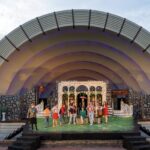
Pictured, above: Jeff Lutter Moser, dean of Gamut Theatre Summer Academy, speaks at the debut of the Alexander Grass Second Stage.

According to an old saying, good things come to those who wait.

For Gamut Theatre Group, the wait has been long, but the good things are here, and they’re in abundance.

After five years of planning, fundraising and construction, Gamut last month officially opened the Gamut Theatre Education Center, featuring the Alexander Grass Second Stage. The center is part of the final phase of the theater’s renovation of its downtown home, fully converting the historic building on N. 4th Street that was originally constructed as the First Church of God.

Purchased in 2013, the building’s initial renovations focused on the main stage, lobby, classrooms and support spaces for costumes, sets and props. After the mainstage opened in November 2015, the focus shifted to additional fundraising for the Education Center. The Alexander Grass Foundation sponsored the Second Stage during the initial renovations, but additional fundraising was necessary to complete important facility upgrades.

An official ribbon cutting was held last month at the side door to the theater, which is the new entrance to the Education Center.

In addition to the Second Stage, the 10,000-square-foot Education Center includes a new, ADA-compliant entrance, an elevator, classroom improvements, a digital projector and screen, and learning areas for costumes, sets, lighting and sound.

“We wanted the Education Center to be a teaching/learning space for students,” said Executive Director Melissa Nicholson. “This is a very simple, hard-to-mess-up space. Students will be able to design lights with an iPad and plug in their own devices for sound. There are some things they can learn about sound equalizing and lighting design, but it’s much simpler and easier to use than traditional equipment.”

Long-time Gamut colleague Lynne Kay Porter from Fairfield University designed the space, while local artist Jacintha Clark, through Sprocket Mural Works, painted a floor-to-ceiling wall mural.

“The mural invokes the feeling of being inside a storybook, but not necessarily a children’s storybook,” Nicholson said. “Audience members feel like a part of the story, with sunshine behind you that turns into a dark night to focus in on the stage.”

Even the ceiling has been considered and is filled with a sky full of stars.

The Second Stage enables Gamut to be more flexible in its use of the space. Popcorn Hat Players, Gamut’s children’s theater, will primarily use the Second Stage, as will the more informal, educational “Stage Door Series” and some classes. Last month, the first show to use the Second Stage was the innovative “Choose Your Own Play: Hijacked!”

“Prior to the availability of the Second Stage, smaller performances were held in the Gamut lobby,” Nicholson said. “The new space seats about 75 people. It holds more than the reception lobby but less than main stage.”

Nicholson also hopes the Education Center will be another space that smaller community groups will be able to use.

“A lot of people come to us wanting to use the main stage, and it’s difficult because of the programming,” she said. “This space doesn’t have as much nighttime usage. It can also be cost prohibitive to use large spaces downtown. It’s part of our mission in serving the community to offer something more reasonable for smaller groups that may need a space.”

One partnership has already developed between Gamut and The Capital Area School for the Arts (CASA). This summer, Gamut used some CASA classrooms for its summer programs. Next year, CASA will hold its midyear performances at Gamut. There are also plans in progress for internships for students and other ways to partner.

Some exterior work remains on the agenda. But, now that the internal renovations are complete, Gamut staff is able to focus completely on their core mission.

“What’s really attractive about reaching this finish line is we’re not finishing growing,” said Artistic Director Clark Nicholson. “We are now able to focus on programming and what we do here. We’ve been focused on modifying the physical space for years.”

To that end, Gamut staff has been working with its board on short- and long-term strategic planning.

“In many ways, the opening is just the beginning,” said Melissa Nicholson. “It’s nice to turn our excitement to what we’re meant to do—our programming.”

Gamut Theatre is located at 15 N. 4th St., Harrisburg. For more information, visit www.gamuttheatre.org.

Photograph courtesy of the Harrisburg Regional Chamber & CREDC.

Continue Reading

Take a Bow: With a new charter, arts-focused CASA continues its run as one of Harrisburg’s premier schools.

Photo by Ben Miller.

Back in 2011, the CASA story did not seem headed for a happy ending.

Enrollment was down 40 percent, school districts were withdrawing funding, and the arts-oriented high school had lost its program director.

But in seven short years, the plot has turned dramatically in favor of the Capital Area School for the Arts. In April, CASA received a five-year charter renewal in a school district that typically does not embrace charter schools.

“This is a huge validation of the past four years—all the kids we’ve reached, all the work we’re doing,” said Tim Wendling, CASA’s principal and CEO.

Wendling arrived at CASA in 2013 after it had just received its first charter, following a dozen years as a struggling magnet school. It’s one of just three brick-and-mortar charter schools in the Harrisburg school district, which must approve charter applications.

Applying for a charter is a painstaking process. The charter renewal for CASA contained 3,500 pages of documents, including information about curriculum, test scores, school design, operations and management and future plans. Visits and questions from district officials were part of the process, as well.

Why was CASA’s charter renewal approved?

“We are meeting and exceeding the goals that were set down in the first charter,” said Wendling. “[We’re] a premier provider of arts education in the city.”

CASA’s performance numbers bear this out. The school’s graduation rate is 94 percent, and student proficiency scores are strong—87 percent in biology, 93 percent in literature and 78 percent in algebra.

Those scores don’t necessarily arrive with the students, who are accepted to CASA based solely on an audition. The school has no information on students’ academics, attendance or behavioral history until after they are accepted to the school.

Once enrolled, CASA students often begin to thrive academically because they like going to school, Wendling said.

“We have 200 very different kids,” he said. “This place is perfect for them. They all fit in.”

The school’s six disciplines include creative writing, dance, film and video, music, theater and visual arts, providing many places for students to excel both in academics and arts.

Lois Lehrman Grass, long a supporter of the arts in Harrisburg, has been a part CASA since its inception in 2001, seeing the school grow from leasing empty rooms to its current state-of-the-art facility in Strawberry Square.

“Everybody who has a wonderful talent should be in a safe environment to be able to do what they do,” Grass said.

She said the creation of the school was not a “one-man band” but involved many people working together. The same could be said of the charter renewal, she said.

“It was more than a little nerve-wracking,” said Grass, a fixture at the school who is greeted affectionately by staff and students as she walks down the bustling hallways.

So, what’s in store for CASA now that it’s met this milestone?

“No big changes,” Wendling said. “We want to take this great thing we started and keep making it better.”

CASA plans to stay in Strawberry Square, in keeping with the school’s mission to use the city as a classroom, Wendling said.

Having the school in the city is mutually beneficial. Students and parents who don’t live in or frequent the city can “come and see Harrisburg’s true self,” he said. And Harrisburg residents get to see high school students in a different, creative light— filming, painting by the river, taking pictures in the downtown, etc.

“[CASA] is an art school that has the city of Harrisburg as our landscape,” said David Skerpon, a board member.

Besides maintaining its arts focus, CASA plans to continue building on its strong academic foundation, focusing on math and science, Wendling said. The school also wants to continue to foster its “fantastic collaboration” with the local arts community.

“We hope to see that we are even more integrated with the art scene than we are today,” Skerpon said.

That integration includes internships with Gamut Theatre Group and Open Stage of Harrisburg, film viewings at Midtown Cinema and art exhibitions at the Art Association of Harrisburg and the Susquehanna Art Museum.

One new thing is the College and Career Readiness Program, designed to connect and direct students to the opportunities available after graduation. Students will select “pathways” of study that take into account their interests and strengths.

Even though CASA has just received a new charter, there’s little time to rest, Wendling said. In about a year, administrators will begin contemplating the next charter renewal process. CASA, after all, can’t afford to take a break, as there’s always another group of talented students waiting in the wings.

“When you look at the 200 kids and try to picture them somewhere else, you can’t,” Wendling said. “This is the perfect school for them.”


Capital Area School for the Arts will hold its CASA Celebration Soiree, celebrating its charter renewal and honoring founders Lois Lehrman Grass and Dr. Glenn Zehner, on Sept. 20 at Whitaker Center, 222 Market St., Harrisburg. For more information about the event and about CASA, visit www.casa-arts.org.

Continue Reading

Art & Stroll: At Wildwood Park, the beauty is all natural.

Mash-up might be a newish word, but it’s certainly not a new idea—fusing together two or more unrelated items or concepts, then something inspiring springs from the mix.

“Art in the Wild” is Harrisburg’s mash-up of an art gallery, a student film project, a contest and a hike.

From now through October, you can walk the 3.1-mile trail encircling Wildwood Park’s 229 acres and wetlands to see unique expressions from area outdoor artists. The theme for the sixth annual contest, “Natural Abstraction,” lends itself to creative interpretations through 17 works, all composed of natural, native elements like logs, vines, branches and herbaceous materials.

According to committee Chair Elizabeth Johnson, you will find entries from both talented individuals and groups—first-timers and seasoned outdoor artists.

Veteran contributor Beau MacGinnes designed his sculpture this year with the goal of showing the beauty of the world around us.

“I like to only use things found in nature,” he said. “The past two years that I won first place, I incorporated dead or fallen sticks and branches. In past years, I’ve transplanted moss from other locations to my site.”

For MacGinnes, season changes also hold appeal. In April, the canvass is colorless from winter. Then a little magic happens.

“Spring and summer fill the pieces with lush greens and other colors,” he said. “Each art piece shapes around its background, growing into the environment.”

Brook Lauer, first-place winner in 2013, said that her entry plays upon interactivity with natural surroundings. Her sculpture, “Natural Connections,” is a simulation of heart and brain neurons using vines and sticks united with rainbow-colored yarn, symbolizing biological links.

To further connect the public with her piece, visitors can write a word or phrase of gratitude on a nearby rock and place it in a heart-shaped basket.

“[It shows] the “importance of our human experience and its connection to our natural environments,” she said. “How we need each other to survive.”

Main Driver
“Art in the Wild” also has a community component, with participation by students at the Capital Area School for the Arts. This year, 16 students in the film and video program shot a video, designed for those who cannot walk the trail themselves.

CASA teacher Mick Corman said he enjoys this project for its fast-paced, documentary-style filming. The video features how some pieces in the exhibit were created, along with artist interviews.

“It gives [students] the ability to film artwork outside the usual gallery setting,” he said. “Students have been happy with the resulting video and to work on a great project.”

The exhibit also inspired a Dickinson College “art and sustainability” class, which submitted an entry as a class project.

Well Received
To encourage and reward artists, “Art in the Wild” is a juried exhibit, featuring a prominent outdoor artist as judge. This year, it’s Roy Staab, a Wisconsin-based artist who has mounted sculptures throughout the world, including along the Hudson River, in New York’s Central Park and in Finland.

“It is important that this exhibition is well received in Harrisburg,” Staab said.

In judging the pieces, his criteria are materials and how they are used, how well the exhibit is crafted, siting, originality and creativity, he said. A first-place prize of $600, a second-place prize of $400 and a third-place prize of $200 will be awarded.

An extra layer of community voting offers more chances for honors and prizes. So, when you’re walking around the loop, be sure to cast your ballot for the People’s Choice Awards, which will be announced at the “Celebrate Wildwood” event on Sept. 23. Winners will receive monetary awards and a year’s membership with Friends of Wildwood.

Over the years, “Art in the Wild” has become one of the main drivers for visitors to Wildwood Park. Park, said Manager Chris Rebert. He cited a record attendance in 2017 of more than 100,000 visitors—a 40 percent increase from six years ago.

“I believe ‘Art in the Wild’ pushes people to get out and exercise and see beautiful sculptures while doing so,” MacGinnes said. “I really hope to see more parks adopt similar ideas.”

“Art in the Wild” runs through October at Wildwood Park, Harrisburg. For more information, visit www.wildwoodlake.org.

Continue Reading

Runners without Borders: Harrisburg’s architecture, parks create a parkour playground.

Photo by Ben Miller

I soared through the air across a 13-foot gap and jutted my feet firmly in front, aiming for a concrete ledge another 10 feet off the ground. In an ideal world, I’ll land on the balls of my feet on the ledge, sticking like glue to the cement.

Parkour is an adrenaline rush, more than anything,” said Daniel Sorbello, a traceur, another word for parkour practitioner, from Maryland. “I’ve been training a little more than four years now, and I’ve never found something that quite compares.”

Since the sport’s birth in the late 1990s, parkour has spread around the world, even finding its way to Harrisburg. Daniel and a training partner, Patrick Smith, travelled up to give the city a shot. I met with the two of them at the Capitol Complex to kick off a session in May. With its refined and elegant architecture, the complex’s unique walls and ledges make it a perfect place to put theory into practice.

“It’s based around freedom,” Patrick said. Your freedom to move and jump just the way you like. That’s what I like so much about it. I’ve got a lot of creative energy and parkour allows me to release it all.”

Tough One

The very essence of parkourand what draws most traceurs to the sport—is the ability to break free from the conventional. Many athletes, like Patrick, have an innovative and creative style, their movement unique to themselves. The idea of something so exclusive is one of the compelling traits of parkour.

The pair spent longer than 10 minutes working on one jump. They took off from one leg to a wall, 8 feet away and 4 feet higher than the take off. A jump like this leaves potential for injury, making it necessary to focus very intently on everything that goes into it. Their dedication to the maneuver caught the attention of some government employees. Interested and astonished, they began to ask questions.

“What is it?” one asked.

“Um, that’s a tough one,” Patrick said. It’s an expressionistic style of movement, one where you’re able to use the obstacles around you to jump and flip off from. It’s kind of like dance, almost, in an urban setting.”

Parkour is known for its showy features, such as roof gaps and unthinkable flips, which often get attention from onlookers. Thus, the sport is often misunderstood and seen as harmful. I feel a responsibility to educate people, to make them aware what we practice.

The workers’ interest grew. They asked if it was popular, and Patrick said, “Yeah. All around the world. It’s become a very widespread practice.”

So much so that Patrick and I travelled to Washington, D.C., in May for a parkour event called Beast Coast. There, I spoke with Mark Toorock, founder of American Parkour, a national parkour organization.

“I really, right off the bat, connected with it and thought this was going to be a thing that people really enjoy,” he said. There are no boundaries [in parkour]. The world is so full of divisions. There is no division between us as people. Parkour is just about people wanting to move, and that’s a human trait.”

Mark began doing parkour in 2002 in London. Two years later, he created American Parkour and hosted one of the world’s largest events in 2016 with more than 650 people. Speaking with him opened my eyes to the vastness of parkour, that it helps people transcend what they once thought was impossible, both mentally and physically.

“We’re meant to explore,” he said. We’re meant to play. We’re meant to skin our knees. That’s how we grow.”

Beauty and Wonder

A huge part of parkour circles around exploration. We, as athletes, take any opportunity given to us to venture to places we wouldn’t otherwise go. Parkour has taken me all over the East Coast and introduced me to many friends. The desire to explore is a trait that traceurs share.

Mark mentioned that some people have a negative image of the sport.

“I try to help them understand why there’s nothing wrong with parkour,” he said. “A lot of the negative perceptions come from things that aren’t actually part and parcel to parkour.”

Many in the community have dealt with people seeing them as mischief-makers who harm the environment and themselves.

After spending a couple of hours training at the Capitol Complex, Daniel, Patrick and I made a quick stop at Kunkel Plaza and finished our session at the PinnacleHealth building

on Front Street. That spot is so exposed that we attracted the attention of many passersby. After jumping for a while, a police officer pulled up.

“We got a call saying there were some kids vandalizing and loitering here,” the officer said, getting out of his car.

“We weren’t trying to vandalize anything,” Patrick said. I understand if that’s what it looked like, but that’s the last thing we want to do.”

We mentioned parkour, and that rang a bell.

“I’ve seen that on the internet,” he said. “That’s awesome.”

We showed him a little of what we do, flipping off the walls and stairs. He appreciated our display and politely told us to find a different spot to train. We thanked him and were on our way.

“I understand it’s a liability issue,” Daniel said. That’s why we leave when people ask us to. I don’t ever want to infringe. This kind of thing happens almost every time we train. I just like walking away knowing they understand we didn’t have any malicious intentions.”

Parkour, as a means of self-expression, has given Patrick, Daniel and me the ability to see the beauty and wonder in exploration. The sport provides a new appreciation for architecture and the simple structures in cities like Harrisburg.

“I hope to spread the knowledge of parkour with as many people as possible,” Patrick said. “I think it’s an incredible addition to society.”

Benjamin Miller will be a senior studying at the Capital Area School of the Arts Charter School (CASA).

Continue Reading

And The Winners Are… 25 years of the best in Harrisburg arts.

Jeff Lynch and Bebe Mullaugh were munching on some lunch with Mike Greenwald at Mangia Qui when Greenwald announced to the pair that they would be recipients of an award recognizing their contributions to the area’s cultural life.

“We were surprised and deeply flattered to be in the company of past recipients, many of whom are also friends,” Lynch said later.

Flattered? Yes, and for good reason. The 2017 Awards for Distinguished Service to the Arts in the Capital Region (aka the “Arts Awards”) is now in its 25th year of celebrating extraordinary individuals (Stuart Malina, Lois Lehrman Grass, Steve Rudolph to name a past few) whose magic touch is felt throughout art arenas.

Surprised? The pair, Harrisburg residents, shouldn’t have been. Lynch, a commercial filmmaker, designer, photographer, musician and local impresario, has presented, produced, performed, mentored and supported some of the major music organizations in the region. Mullaugh, an attorney with McNees Wallace & Nurick and president of the Capital Area School for the Arts Charter School, shepherded the plan that led to the school’s creation. She also served as past board member and board chair of Concertante, the chamber music ensemble.

“The level of artistry available to this community is on a strikingly high level and, in many cases, equal to or exceeding many major metros,” Lynch said. “For us, it’s particularly satisfying to provide some degree of support and guidance to aspiring artists as they work to create inspiring work going forward.”

Lynch and Mullaugh will be joined by other honorees whose accomplishments are just as impressive.

The Central Pennsylvania Youth Ballet (CPYB) is a recipient this time around, 25 years after its founder, Marcia Dale Weary, received the award for her solo efforts in bringing this Carlisle-based organization worldwide recognition for offering the finest in classical ballet training. Many alumni have gone on to perform as principals, soloists and corps de ballet members in some of the most prestigious ballet companies in the world, including the American Ballet Theatre, New York City Ballet and National Ballet of Canada.

“Right now, 81 of our dancers are active and performing professionally,” said Nicholas Ade, CPYB’s chief executive officer. “But there are much more than 81 who are lawyers and doctors and working in other professions who have been trained by us, and we are equally proud of both. Dance teaches life skills. It teaches resilience, strength, self-confidence. It creates a more well-rounded person. It creates better lives.”

Despite all sorts of accolades CPYB has received over the decades, receiving this award is special. Ade admits he was thrilled when Greenwald phoned him to let him know that the group would be added to a historic list of arts honorees.

“I was elated,” Ade said. “I immediately called our board members to let them know about this high honor. At the ceremony, we are planning to have our youngest dancers perform and our older current dancers. We will also have a surprise alumni guest.”

Another recipient, Dr. George Orthey of Newport, will be given a special achievement award at the ceremony in June. Orthey is a premier autoharp maker who has had a folk arts award named after him. In fact, he annually hosts the Mountain Laurel Autoharp Gathering at Little Buffalo State Park, where hundreds of autoharpists from around the world arrive for five days of workshops and concerts.

Greenwald, the producer for the event, a noted arts advocate and the bearer of good news for this year’s winners, was himself an honoree last year, though a reluctant one.

“I initially declined it because I didn’t see myself as a candidate,” he said. “I felt my role was as a producer and not wanting or needing to be chosen. After further consideration—and encouragement and sentiments expressed to me by past recipients—I felt terribly honored to be embraced in such a way and ultimately decided to accept.”

Using the Kennedy Center Honors concept, the Arts Awards were initially staged as “Accolades & Applause” by Harrisburg Community Theatre, now Theatre Harrisburg. Barbara L. Schell, a former theater board member, chaired the special events committee when the concept turned into reality.

“So many wonderful people have been involved over the years,” she said. “To that end, the Arts Awards event has continued to evolve over the years from honoring just artists and philanthropists to including corporations and foundations. This award represents their achievements in our community and is a way of saying thank you for bringing their talents to life for all of us to enjoy.”

The 2017 Awards for Distinguished Service to the Arts in the Capital Region will be presented June 4, 5:30 p.m. to 9 p.m., at Whitaker Center for Science and the Arts, 222 Market St., Harrisburg. For more information about the awards and the event, visit theatreharrisburg.com.  

Author: Lori M. Myers

Continue Reading

Downtown’s Town Hall: Brad Jones and the re-imagining of Strawberry Square.

The mayor of Strawberry Square is holding court on this Tuesday morning. From his soaring chamber, he greets his constituency.

Some passersby get a wave and a hello, as in “Hi, Mr. Regan,” who happens to be state Sen. Mike Regan. Others stop at his table for a quick word about their businesses or schools. When he notices grandparents and their preschool-aged grandson looking at the centerpiece Chockablock Clock, silenced for the moment, he obligingly takes out a key and turns on the clanking, whirring, Rube Goldberg-ian centerpiece of Harrisburg’s downtown mall.  

It’s all in a morning’s work for Brad Jones, president and CEO of Harristown Enterprises. He is, of course, not a mayor at all. But from a table at Little Amps Coffee Roasters—one of the new businesses in Strawberry Square—he sometimes presides over the moving pieces of Harristown’s ambitious plan to transform a dated, 1970s-era idea of urban renewal into a fresh, 21st century hub for live, work and play.     

“We’re trying to create community here,” he said. “This was always the town hall.”

A brief history: Under the aegis of Harristown, a private nonprofit created in 1974, urban revitalization bulldozed into downtown Harrisburg with demolition of the iconic, if distressed, Penn Harris Hotel, making room in 1979 for a retail-office complex along Strawberry Alley. By 1990, phase two incorporated historic 19th- and 20th-century buildings along Market Street, where retail once flourished.

Verizon rented much of the upper-level office space, but, despite the presence of such mainstay businesses as Auntie Anne’s, the Strawberry Patch and Ideas and Objects, Strawberry Square, with its massive atrium, seemed empty and lost in time.

The recession years were especially chilling, but Harristown’s volunteer board of directors had already launched a reinvention plan seeking revitalized retail, the addition of residential units and support for what Jones calls an “education corridor.”

The pending 2016 vacancy of the Verizon Tower was the launching point. Painstaking negotiations with the state relocated 900 Department of General Services workers into the heart of downtown from their old digs at the former State Hospital grounds at the edge of the city.

Getting that 17-year lease with the state, and its power to nearly erase $41.6 million in debt obligations on the facility, “was like breathing again,” said Jones. Those 900 workers didn’t displace existing bodies but filled a space where only about 250 people knocked around by then. As Jones put it, “Retail follows people.” And so does residential.

One of the first signs of new life was a childcare facility, immediately popular among office workers happy to drop off, visit and pick up their kids right where they work. New office tenants included highly desirable tech businesses and a health care consultant. A space accessed both from an interior corridor and the street was converted into the bright Market on Market, stocked with convenience-store fare like soda, Tastykakes and Hershey’s Ice Cream pints, plus millennial chow like okra chips and a bin of fresh onions.

In a survey, Strawberry Square workers, residents and patrons clamored for a drug store, so Harristown obliged by luring in Rite Aid from across Market Street, coming soon to 14,000 square feet in the same corner once occupied by a Thrift Drug.

“We’ve been working on this for 10 years,” said Jones, who declined to share Rite Aid’s lease length but promised it’s lengthy. “This is a business that is clearly going to prosper here.”

Reasons to Stay

Amma Johnson, who sells her bags and other boutique ware in her shop, Amma Jo, cheers the innovation of a mixed-use complex, in contrast to shopping malls where she would be “next to a million other people selling handbags.”

Today’s customers seek experiences, she said. For her, they include state workers on lunch breaks, attorneys on Dauphin County Courthouse business, contractors working in Pennsylvania’s capital city or Strawberry Square residents.

“People want to come downtown,” said Johnson, who opened in December 2015 then, last year, gobbled up the storefront next door. “They want to browse. They want to eat. They want to have a cup of coffee, and they want to have it all in one place.”

In short, they “need more reasons to stay,” she said, just before two browsing Amma Jo customers left the store with a cheery, “We’ll be back with money tomorrow.”

Not every vendor agrees with Strawberry Square’s new direction. Vendors who asked to remain anonymous said they worry that the one-stop shop convenience of Rite Aid, stocked with some things also sold at surrounding specialty vendors, will drain their customer pools.

But what “The Square,” as Jones often calls it, takes away, it also gives. Twenty-two upscale apartments, carved out of former office space, opened last year and filled immediately, bringing in full-time residents for the first time, all with their own need to eat and drink and buy. Many of the new tenants work at DGS or Harrisburg University or with a Harristown-tenant business, Jones said. Harristown pitches the residents’ easy access to retail, restaurants, entertainment and nature. In his usual energetic manner, he enthusiastically explained that tenants can stay entirely roofed during the course of a day: eating in the food court or at the Hilton Harrisburg, seeing a show at Whitaker Center, taking classes at Harrisburg University, working out at FitnessU. All are directly linked to the complex.

As for restaurants, Harristown is helping slake the city’s seemingly insatiable appetite for new eateries. From the owners of El Sol Mexican Restaurant, Fresa Bistro (“Fresa is Spanish for strawberry,” remarked Jones. “How cool is that?”) is slated to offer sandwiches and wraps, paninis and salads.

Harrisburg might not ever be an 18-hour city, but 12 or 14 hours of ceaseless activity seem feasible, Jones said.

“Some days, you might have a shot at a 16-hour city, but we’ve got to do more,” he said. “We’ve got a lot of density, but we’ve got to continue to do more and capitalize on the opportunity to help these corridors grow.”

In addition to Harrisburg University, the education corridor includes the Capital Area School for the Arts Charter School, for which Harristown recently added new music-room space, and Temple University, which offers undergraduate and graduate degrees, certificate programs and professional development. Harrisburg High School SciTech Campus is across the street.

Strawberry Square aligns with HU’s notion of city as campus by offering such amenities as eateries, banks and a fitness center.

“These are all important assets that we don’t have to provide,” said HU President Dr. Eric Darr.

HU interns have worked with Harristown entities, and WildFig, a data analytics startup that launched from HU and employs HU students, rents Harristown space. Jones also serves on HU’s board.

As in any marriage, there are occasional differences. Darr said he would like HU to be “THE university in the corridor,” but added that he recognizes the collaborative advantages of nearby university students and faculty.

“In general, we’re aligned with the direction Harristown is trying to take the corridor, particularly the more recent movement toward trying to attract technology businesses and analytics businesses, and providing nice, yet affordable housing for younger workers,” he said.

Future collaborative plans for HU and Harristown include an expanded, “more formal” business incubator and accelerator, to replace HU’s outgrown Blackberry Alley incubator, Darr said.

“We all know there’s a lot of work to do in the corridor,” he said. “Generally, as long-term players, we’re focused on some of the basics of trying to improve the basic corridor itself and the buildings and the facilities and the infrastructure, some of those basic pieces that have to be taken care of. Unfortunately, the city’s not in a position to do it themselves, and, so, we’re left as private entities to try to piece together ways to do this. When you’re talking infrastructure, that’s a pretty expensive proposition.”

About People

In all this, there is still the matter of Strawberry Square’s design, that living tribute to the disco era. Jones and Harristown are trying to give it new life.

A $16 million energy efficiency retrofit replaced every light fixture in the complex, saving money and brightening up the place. A $400,000 rebuild brought a wheezing escalator into the modern age (“As one who uses the escalator almost every day, I appreciate the undertaking,” said Darr). HVAC systems were revamped and bathrooms renovated. Badly needed elevator and skylight refurbs are on the 2017 docket, said Jones.   

Of course, nobody hangs around to admire light fixtures, but the Harristown board elected to tackle needed infrastructure upgrades first, “reinvesting in the systems of the buildings,” Jones said. Attention should turn to cosmetic improvements by 2018, the year when a Christmas tree, now on order and proportionally big enough for the atrium, will deck the halls for the holidays, he added.

In the meantime, the push is on to attract what Strawberry Square needs most—living bodies spending money. Among new businesses, Little Amps opened its third café in 2015, warming up the cold, open atrium and offering an attractive, central meeting place for workers, students and residents. Inside the vast space, the HBG Flea found a winter home for its monthly craft market, and pop-up events like craft beer tastings increasingly encourage mingling and socializing.

Jones said that Strawberry Square’s growth spurt originated with his predecessor, Russell Ford, and the Harristown board. Jones took over the helm in January 2015, 13 years after starting there as corporate director for public and community services. His career in economic development went from the state and federal levels to “nose right to the ground,” with oversight over “just about every brick, every fire hydrant, every tree.”

“I went from 10,000 feet to ground level,” he said. “I have to say, ground level is a lot more fun.”

To Jones, this is all perfectly natural. The son of Cliff Jones, legendary Pennsylvania Chamber of Business and Industry president and cabinet secretary for six governors, Brad Jones grew up with economic development, attending ribbon cuttings at 5 years old. “If you try to make somebody’s day every day,” Cliff Jones would say, “you’ll make your own day.” He also preached that, “It’s not about projects.”

“It’s about people,” Brad Jones said. “Helping people get jobs. Helping people find places to live. Helping people start businesses. Those kinds of lessons stuck with me.”

Jones is a Camp Hill resident with three children, one still in high school. He hopes that Harristown’s support for CASA and SciTech help create opportunities for more families to find quality schooling for their children. He is also a guitarist who once played with a band in Washington, D.C. Sitting at his de facto conference table by Little Amps, he says he is “the luckiest guy.”

“To me, this is the best job in the city,” he said. “It couldn’t get any more fun than this. You’re building your environment, adding to it every day. It’s exciting.”
For more information about Strawberry Square, visit www.strawberrysquare.com.

Author: M. Diane McCormick

Continue Reading

Up or Down? School Board to vote on new arts charter school at next meeting

The former building for Bishop McDevitt High School has sat vacant since 2012.

The former building for Bishop McDevitt High School has sat vacant since 2012.

The former home of Bishop McDevitt High School may become an arts-centered charter school, pending a vote by the Harrisburg school board.

On Feb. 21, the board is slated to decide whether to grant a charter to the newly formed Arts to the Core Charter School. The school incorporates music, dance, visual arts and theater into teaching core curriculum to kindergarten through eighth-grade students, said Richard Caplan, president of Arts to the Core.

“[The arts are] an attraction for kids going to school,” he said. “The arts cater to a lot of different learning pathways. Some kids learn better by physically doing things.”

If approved, Arts to the Core will open in September for the 2017-18 school year. More than 500 children from the Harrisburg School District have pre-enrolled. The school would accept 300 students from a lottery system to fill the first kindergarten through fourth grade classes, he said.

Students do not need to demonstrate artistic ability to attend the school.

“We essentially write off their talents if we don’t try to encourage them,” said Caplan, whose academic background is in the arts.

A Lancaster-based attorney, Caplan pursued music degrees before receiving his law degree from New York University. He said he “grew up in a family of educators” and has served for 10 years on public school boards in Lancaster County.

Caplan modeled the Arts to the Core school after the North Carolina Arts Council’s A+ charter school program. He said this approach is successful with inner-city children.

“The teachers find it much more exciting to teach because it’s more creative for them,” he said. “The parents love it because the kids want to go to school instead of being coerced to go to school.”

Jim Thompson, vice president of the school board, said he supports the Arts to the Core school and the arts-centered approach.

“I think it’s a good idea. I’ll ask them if they’ll let me come in and draw,” said Thompson, an architect. “To me, having an arts charter school as a feeder program to CASA makes a lot of sense.”

He said the community has reacted positively, most saying that it will be a good use of the iconic, 115,000-square-foot building at 2200 Market St. The building has sat vacant since 2012 and has been subject to vandalism since the private Catholic school relocated to Lower Paxton Township.

“I’m sensitive to community input,” he said, adding that he would not approve the charter just because it would put the property back into use.

Mayor Eric Papenfuse also supports the Arts to the Core school, saying that the school would encourage young families to stay in or move to Harrisburg.

“There’s probably no more important issue in terms of Harrisburg’s recovery,” Papenfuse said.

An increase in population, he said, is vital to re-energizing the city and boosting the tax base.

“We have seen growth among young professionals in various sectors,” he said. “A lot of times, young people will move to the city, enjoy city living and all that it has to offer, but, when it comes time for children to become school age, they have concerns.”

Students would attend the nonprofit school for free. The district would pick up the tab, at an estimated $1 million per 60 students. The school could apply for state and federal funds, as well. As a nonprofit, the school also could accept public donations.

Laws around charter schools restrict the school board from considering cost when voting on the proposal.

“Theoretically, [the district] should save that million dollars by not educating those children,” Caplan said.

Superintendent Dr. Sybil Knight-Burney, citing legal restrictions, declined to comment on the charter school.

Caplan brought the idea to the school board last November after a difficult search for urban school buildings in York, Lancaster and Chester counties led him to the former Bishop McDevitt building.

The building, built in 1930, needs renovations, including a new boiler, a security system and accessibility updates per the Americans with Disabilities Act, he said. This construction will take four to six months and cost more than $2 million, an expense Caplan said he will pay out of pocket.

Arts to the Core will complete the purchase of the school from the Harrisburg Catholic Diocese contingent on the charter’s approval from the school board, he said. If the board approves the charter, Caplan said he will move ahead with renovations and hiring staff. He said 12 people have expressed interest in heading the school.

For more information about the Arts to the Core Charter School, please visit the Facebook page.

Author: Danielle Roth

Continue Reading

Student Scribes: A Little More than Just Gore

I exit my mother’s car and walk on the mushy grass and mud toward Asylum Run, located in Harrisburg. I have a huge smile anticipating a fun night with my Asylum Run family.

I take out my purple makeup bag, which holds everything I need to turn everyone at Asylum Run into nightmares. This year, our theme, “Freak Show,” required a lot of clown makeup. Some actors just blacked out their eyes because they wore masks. Knowing that I get to do what I love for the next few hours puts me in an extremely joyous mood. I walk over to the shed where we keep our extra makeup and pull out the clear, stacked cabinets. Tonight Raelee, the manager, sits inside, her gorgeous grey eyes lighting up when she sees me.

“Yay, you’re here tonight! Are you starting now?”

“Yep, where do you want me?” I say, champing at the bit to get started.

“Behind the shed should be fine,” she said.

I pick up the makeup cabinet and walk out, ready to set everything up.

For some people, makeup is a job, a hobby. In my case, it’s a lifesaver. I first discovered SFX makeup at a theater camp in 2014. The camp was held at Harrisburg Area Community College, HACC. The camp offered improv classes, making costumes and memorizing scripts. During this time, my depression haunted me—I was self-harming and had been hospitalized earlier that year. Doing makeup helped me to become someone else and something different. Knowing that I could do whatever I want to do without actually hurting myself makes me feel free. Whenever I felt sad, I would use glue and create burns. I didn’t have most of the supplies I needed, so I used eye shadows for colors and glue in place of liquid latex. Whenever I attempted a makeup with blood, I would use bright red lipstick, but this inhibited me from creating the looks I wanted. Trying to figure out how to make my passion a reality was difficult, but, eventually, I made it work. When I volunteered at Asylum Run, I learned techniques I later added to my special makeup effects toolbox.

Though SFX makeup is my favorite type of makeup, I also like to do beauty makeup—kind of like glam and gore. According to www.instyle.com, 86 percent of women in the United States who wear makeup said it makes them feel more self-confident. On average, women spend around $144 a year on beauty. Beauty makeup allows me to transform myself into different people and different things: Kylie Jenner, Lorde, Katy Perry, a man. Doing my makeup SFX or beauty helps me to feel more confident and happy with myself. Knowing I can create something that is beautiful and scary at the same time is pretty amazing. Getting to work with and meet new people, for me, is the best part of doing makeup. Picking up techniques along the way is also a great part of makeup. Anthony Stewart, a professional special effects artist, who’s currently working on Fox Network’s supernatural series, “Sleepy Hollow,” stated, “You get to dabble in a lot of different things around the shop, constantly learning new techniques and figuring things out, floating around from shop to shop, and occasionally landing a semi-permanent position.”

Stewart said special effects work is a hard field to get into. It’s all about who you know. “It took me a little bit to come to terms with just how much work it is, but, once I got into the swing of things and working more jobs, I kind of got hooked. Looking for work when one job ends gets easier,” Stewart said.

Although I want to go into a different field of special makeup effects than his, speaking with Stewart really gave me a clear idea on how to better my career. Being able to be creative is a great part of the job and being able to work with my hands will most likely help me to push myself harder. Eventually, I hope to win a season of the Sy-Fy network’s show “Face-Off” and get my career shot from there. Being in this field of work can also help to set myself up for other occupations.

When asked about his future in SFX, Stewart said, “…there are a few different paths this occupation could send me or anyone down.” Knowing that there are so many paths to pursue gives me hope for my future in my career. For example, Stewart is a professional sculptor as well as a creature designer—and an amazing one at that. “To become an established sculptor, you just need to work hard, practice until you’re good and then keep practicing because you can only get better.” When working with special effects, Stewart said that it’s always a good idea to have personal projects to show employers both enthusiasm and passion.

Knowing for myself that I can be pretty much anything I want to be as long as I have the correct mindset helps me to plan better for myself. Going into makeup is something for which I’ve always had a passion. SFX makeup is still extraordinarily new to me, and there are many things for me to try and to learn. Working at Asylum Run has helped me in so many ways, from the amazing and beautiful people that I’ve met there to the makeup skills that I now have today because of volunteering there. Asylum Run isn’t just a haunted house for me—it’s my home. It isn’t just, as NBC News says, “a $300 million industry,” it’s a place for people like me, who don’t fit into society, to feel safe and secure in their own skin and to be surrounded by people they know and love.

Eileen Reinnagel is a junior at CASA.

Continue Reading

“Quiet Is OK:” An essay from a student writer at Capital Area School for the Arts (CASA).

Grace Beatty

Grace Beatty

Children’s voices pierce the air. The sun burns bright in a crisp blue sky as they play on the blacktop. A boy kicks a ball through the air before sprinting around a painted kickball diamond. Four square games host lines of students, chatting away as they wait their turn. The swings creak, their seats full. Girls braid each other’s hair on the climbing rock, soaking in the warmth it absorbs.

Away from this chaos, one girl sits alone. Underneath a black lamppost, she shrinks into her bumblebee-colored coat, book in hand. Her little eyes dart back and forth, immersed in the story. Two kids walk past, ignored by the girl. This behavior could raise some questions. Is she socially developed? Is she mentally ill? Does she need medication?

Or perhaps it’s normal, a part of her introverted personality.

Introverts have often been categorized as shy, unconfident people, which couldn’t be further from the truth. It is not self-esteem that defines the introvert, but how they obtain and expend energy.

Kate Bartolotta explains this well in her Huffington Post article, “What Is it Really Like to be an Introvert?” She compares an introvert’s energy storage to a cup. Each moment an introvert spends with other people, a little more energy is taken from the cup. Once it’s empty, they need to go spend some alone time to fill it back up.

The opposite is true for those on the other end of the spectrum. Extroverts need to spend time socializing to fill their cups and become drained when solitary. People can usually identify themselves with one type or the other, but some are an equal mix of both, called ambiverts. However, someone cannot be all introvert or extrovert. Carl Jung, the psychologist who popularized “introvert” and “extrovert,” describes such a person as “a man who would be in the lunatic asylum.”

Introverts’ tendency toward being alone depends on the amount of energy they can hold in their cup. Some introverts are able to spend more time socializing, to the point where they may be mistaken for extroverts. But there are others who aren’t as easily motivated by social stimulation, their cups holding a small fraction of energy. These people might want to take solitary trips to restaurants or libraries, or stay at home, in contrast to going out each night and meeting new people.

Such introverts may appear, upon observation, anti-social, even hermitic. Those who prefer more extreme seclusion, or who speak only on occasion, could be labeled mentally ill. But this isn’t new. According to an article published in Psychology Today, the World Health Organization has included “introverted disorder of childhood” in its medical manual, “International Statistical Classification of Diseases and Related Health Problems,” for years. Having their personality catalogued in a book of mental illnesses gives introverts the hint that something is wrong with them.

Susan Cain writes often about Steve Wozniak in her book “Quiet.” Wozniak, a co-founder of Apple, worked often on what he called “The Dream.” His dream was to make a computer that used a screen and a keyboard and was small enough to use at home. He spent his time working on this prototype. According to “Quiet,” each morning he’d show up at work “around 6:30, and… read engineering magazines, study chip manuals, and prepare designs in his head. After work, he’d go home, make a quick spaghetti or TV dinner, then drive back to the office and work late into the night.” He labored alone and loved it, recalling it as “the biggest high ever.”

As a child, Wozniak studied alone, his skill with computers placing him on the low end of the social ladder. But he didn’t mind. He welcomed the solitude as a chance to spend more time messing with circuits and playing with knobs.

He’s not the only example. Bill Gates, another introvert, founded Microsoft and became a billionaire. Rosa Parks, a soft, quiet person, launched the Civil Rights movement with one act of bravery aboard a bus. Even actresses like Audrey Hepburn have described themselves as introverts.

An important part of these famous introverts’ stories would be missing if we only focused on one end of the spectrum. The fact that Wozniak met extrovert Steve Jobs is crucial in explaining the founding of Apple. Had it not been for Jobs, Wozniak would have had a more difficult time bringing his “Dream” to the world. Parks met Martin Luther King Jr., who helped raise awareness for Civil Rights by making groundbreaking speeches to huge crowds. It’s where the idea started—in solitude—that matters.

Just because someone is an introvert doesn’t make him or her better than anyone else. But to direct them from the world turning inside their heads to the party going on outside could rob the world of other great advances. Everyone has been created differently, to act differently, think differently, and express differently than everyone else. It’s what makes them individuals, helping to shape their future.

The future that little girl—curled up with her book in the bumblebee coat—will create.

Continue Reading

“What Team?”: An essay from a student writer at Capital Area School for the Arts (CASA).

Annabelle van Hemert

Annabelle van Hemert

The band waited in the tunnel, the atmosphere bristling with excitement and jangled nerves.

Someone tapped twice on the brim of a friend’s shako, the marching band hat, for good luck. That started a chain reaction; band members wanted all the luck they could get. The crowd cheered from inside the stadium. A beat started to lead the other band off the field, in time. Slowly, the new band moved out into the lighted stadium. The prop team raced to set up the smoke stacks in the back of the field and gears in the front. The band marched onto the field, clumped together for a quick pep talk from their director, and hurried to their dots, their placements on the field.

The Mechanicsburg Area Senior High Marching Band would place third in the USBands Nationals Competition. Preparation for the show, “The Factory,” started at the beginning of the summer. Since the beginning of the year, the director and leaders worked on the drill, the formations of the band during the show, and the music. During band camp, an extensive two-week camp, the band worked hard to learn as much drill, flag work and music as possible.

The color guard congregated out on the field, spinning their flags, racing to get to their dots, the girls, tired and sweaty, still managing to yell out an “and we’re loving it!” toward Kristy Templin, the color guard instructor. The pit squeezed together for warm ups, playing their scales faster and faster, building up callouses on their hands. The drum line practiced not far from the pit, their rhythms echoing throughout the small town of Mechanicsburg.

Jim Weaver, the percussion director, jumped between the two sections to keep them on track. The winds stood together in two arcs, playing their own set of warm-ups, trying to tune the flutes, piccolo and saxophones. William Stowman, a Messiah College music professor, led the band. Ben Goldsborough, the band director, hung out with the winds and could be seen enthusiastically jumping up and down to get the band to play louder at the crescendos.

The band got used to winning that season. Its hard work paid off in the end, winning every competition up until Nationals. The week before Nationals, the band won first place at the Atlantic Coast Championships with a score of 97.70 and earned awards for high music, auxiliary, visual, percussion and brass.

When asking Greg Hutchison, a Lower Dauphin band director, about performing as a high schooler in his marching band, he said, “I had an incredible marching band in high school. I went to Red Land and was a part of their band when they won three Atlantic Coast Championships in four years. Performances were great because we were taught to take so much pride in what we did.”

Mechanicsburg students feel the same way. Leaving the field after the Nationals performance, the band gathered together to rate their individual performances and talk about what would happen next. As soon as everyone gathered together, Goldsborough shouted, “MECHANICSBURG, HOW DO YOU FEEL?” The band yelled a collective “HOOHAH, FEEL GOOD,” in response.

Tournament of Bands (TOB), a competitive band organization founded in 1972 by the National Judges Association for high school marching band competitions, grew from 18 bands performing in the Atlantic Coast Championships to more than 400 schools that participate in competitions in 13 states.

The Mechanicsburg Area Senior High Marching Band performed with USBands for the first time for Nationals. USBands started in 1988, by the Cadets, to allow high school bands to perform in advanced competitions with top judges.

The Cadets, the founders of USBands, started as a program for boys in a church parish in the 1930s. In 1940, they won the American Legion Junior National Championship. They broke away from the parish in 1958, began their own organization, and placed second in Legion Nationals. The Cadets proceeded to become World Class Champions throughout the years.

USBands judge in a more difficult way than TOB, So, that morning, Mechanicsburg borrowed Cresskill High School’s football field to practice and perfect the details. The band arrived at the field in the morning and got right to work. The color guard took over the field. The drummers went their own way. The pit set up at the front of the field. The band went over to an open air to work on music and marching techniques, practicing until lunchtime, with a break for subs and chips. Then, they came out and worked some more. They gathered all together for group ensemble time, where every section practiced the show together to make sure everything fit together.

The band members nearly sprinted to their dots. The color guard ran around them, simultaneously waving and tossing their flags and rifles. The drumline, avoiding any collisions with the band members, crab stepped, a march that requires crossing one leg over the other, and yelled out the garbled phrases they use to remember what to do. The pit, using all its instruments, focused on keeping perfect time.

Judges used a 100-point system when judging a band’s show. They raced around the band members, glorifying the good components, catching the meaning behind the show, but pointing out feet not marching in time, bad technique and weak crescendos. They look for dropped flags and rifles in the color guard.

Sound touched silence. The beat moved faster. The last notes of the song ended together in a tired, but triumphant manner. The band exited the field.

The band director stood in the middle of the group, completely surrounded by sweaty, out-of-breath teens. He asked if any of them scored their individual performance less than a five. No one raised their hands. Six? Same response. Seven? None. Eight? A couple hands popped up in the air. Nine? More hands. Ten? Everyone else raised their hands, proud of their hard work.

The band hurried to the buses to put away the instruments and returned to the stadium for awards. The seniors are sent out before the ceremony to prepare to collect the awards. The rest of the group headed to the stands. They waited group by group, until they heard Group IV Open Class’s awards. The members linked arms, completely silent as they waited to hear the scores. Third place: Mechanicsburg Area Senior High School Marching Band. Cheers and screams erupted, but the band quickly quieted down to applaud the rest of the bands. Pride took over, knowing they earned and deserved this moment.

Continue Reading