Cultural Hop: Newport: Go for the art, stay for the charm.

There was a time when people scoffed at the words “culture” and “Newport” in the same sentence. However, that was then and this is now.

In recent years, a cultural renaissance has enveloped this village about 20 miles northwest of Harrisburg, led by the Perry County Council of the Arts (PCCA). Founded in 1979, PCCA operates the gallery that anchors the square and showcases the work of more than 180 established and emerging artists.

“The gallery is a friendly place where visitors can enjoy looking at photographs, illustrations and paintings in a variety of techniques,” said Manager Jasmine Colbert. “Visitors quickly realize that not only does the gallery have a complete collection of quality art and crafts, but that PCCA showcases unique gifts, gifts you might not find in other places.”

A perfect example is reflected in the work of Harrisburg artist Jason Lyons, whose animal sculptures are made of repurposed kitchen utensils, tools and typewriter parts.

“I feel the main reason for my continued success is that Jasmine as gallery manager nurtures new talent and promotes established artists’ work with a wide-ranging and ever-changing inventory of high-quality fine art and crafts,” said Lyons. “This creates a fresh experience every time a patron visits the gallery.”

In addition to the gallery, PCCA operates an arts-in-education program, which places professional artists in classrooms in Perry, Juniata, Mifflin, Huntingdon, Snyder, Union and Northumberland counties.

“In 2012, over 50,000 people took a class, saw an exhibit, displayed their art, attended a recital, interacted with an artist, read their poetry, bought artwork, met, danced, sang, painted, or photographed, all under the auspices of PCCA,” said Executive Director Roger Smith.

Heart of a Community

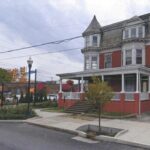
Arthur Clair and Bertha Landis, who had lived the life of expatriates in Germany directly after World War I, left their home in Hamburg and returned to central PA when the Nazis rose to power. In 1938, they purchased a stately home in Newport at 67 N. Fourth St. Bertha and youngest daughter Mary briefly returned to Germany and arranged for the shipment of the contents of the Hamburg mansion to Newport.

Upon her death in 2004, Mary Landis bequeathed her home, its contents and an endowment to PCCA. It was Mary’s wish that Landis House become a museum and a venue for recitals and exhibitions. It opened to the public in September 2009 with its first exhibition, “Central Pennsylvania Self-Portraits,” in which 32 contemporary artists from the region revealed how they saw themselves.

Within the Landis Collection are scores of Meissen and Dresden figurines, military campaign buttons from the Spanish-American War, flapper dresses and tuxedos, artwork from noted European painters, including the French realist Gustav Courbet, beautifully hand-carved and inlaid German furniture and a 90-year old Bechstein grand piano.

Since its opening, Landis House has witnessed many recitals of classical music, including Harrisburg Symphony Orchestra Maestro Stuart Malina on the fabulous Bechstein piano, plus evenings of show tunes and country, bluegrass, jazz and Celtic music. Exhibitions of contemporary art by both established and emerging artists have drawn participants from around central Pennsylvania.

Coffee to Kale

After visiting the PCCA Gallery and the Landis House, it’s time to satisfy your palette at Espresso Yourself Cafe. Proprietor Cheryl Miller ran a natural food stand at the Broad Street Market in Harrisburg for 17 years before opening the café on the square in Newport. In addition to coffee, tea, and delightful pastries, she serves breakfast and lunch from a menu boasting a commitment to natural, organic and local ingredients.

“I learned to cook from my grandmother, but I like to incorporate modern techniques and global flavors into my recipes,” said Miller. “I enjoy making my meals as healthy as possible, but I’ll have to say that my potato rivel soup, a Pennsylvania Dutch classic, is one of the most popular items on the menu.”

Stacey and Mark Butcher are happy to be a part of Newport’s growth.

“We farm 100 acres of produce that we fresh pick every morning and take directly into our market two miles away,” Stacey said.  “We want to give our customers that real farm experience by seeing the produce being brought in from the fields on our green tractors and wagons—mud on those tires and Hunter the dog, riding the tractor with farmer Mark.”

Five years ago, they could not give kale away, but this year they are planting double the amount of kale from last year.

“Now, the increased sale of kale is due to the many new customers who have made Newport their home or who visit Newport on a regular basis,” said Stacey. “Not only are we growing more kale, but we are growing many new items, including Chinese cabbage, bok choi, radicchio and broccoli rabe—to name a few.”

The last stop on your visit should be Hunters Valley Winery, located about 10 miles east of Newport. It’s a small winery, producing about 4,000 gallons of wine annually. The vineyard offers a magnificent view of the Susquehanna River and valleys to the east. Opened in 1986 by Bill and Darlene Kvaternik, the winery moved into its current hilltop location in 2006.

The winery offers two free open house and craft fairs yearly. Local vendors display their wares on the lawn, and musicians perform in the nearby pavilion.

“We love to see our customers enjoying the wine and the scenery and having a place to meet with friends.” Darlene said.  “Our winery takes part in two wine trails: Susquehanna Heartland Wine Trail and the Hershey Harrisburg Wine Country.”

So, is it time to give Newport a try? Long-time Camp Hill resident Diane Beible thinks so.

“I’ve found Newport to be a charming town with lots of surprises,” she said. “I’ve taken many friends on visits there, and they all return and bring more friends. It’s a great way to spend the day.”

Going There

Perry County Council of the Arts: Open Monday through Friday, 10 a.m. to 5 p.m. and Saturday, 9 a.m. to 4 p.m. www.perrycountyarts.org.

Landis House: Open Wednesday and Friday afternoons, 1 p.m. to 5 p.m., the first Saturday of each month, 1 p.m. to 4 p.m., or by appointment.

Hunters Valley Winery: Open Wednesday, Thursday and Saturday, 11a.m. to 5 p.m., Friday, 11 a.m. to 7 p.m. and Sunday, 1 p.m. to 5 p.m. www.huntersvalleywines.com

Butcher’s Farm Market:  Open year around. Summer hours:  Monday to Friday, 9 a.m. to 6 p.m.   www.butchersfarmmarket.com.

Espresso Yourself Cafe:  Open Tuesday, Wednesday and Saturday, 7 a.m. to 3 p.m., and Thursday and Friday, 7 a.m. to 6 p.m.

Don Helin published his first thriller, “Thy Kingdom Come,” in 2009.  He recently published his second, “Devil’s Den.” He lives in Perry County and is hard at work on his next thriller, “Red Dog.” Contact him at www.donhelin.com.  
Continue Reading

In a Tight Spot: Urban gardening: short on space, long on creativity.

It’s spring, and, for many people, thoughts begin to turn to gardening.

Even if you’re within city limits with limited space, there’s no reason not to grow vegetables or flowers.

“It’s often overlooked how important gardening is to people in the city,” said Ray Davis, an avid gardener and agent with RE/MAX Realty. “A lot of us have gardens behind fences and barriers.”

His garden is an “outdoor space” with patio furniture, where he (and dog Bella) relaxes as often as possible. Davis planted everything there except the Japanese maple tree.

“I enjoy watching the ostrich ferns grow, and I have flower beds,” he said.

Ruth Consoli, a freelance landscape designer who often collaborates with Jeff Deitrick of EarthTone Hardscapes in New Cumberland, noted that the lack of urban space can be countered by vertical gardening—such as trellises for climbing plants, or hanging pots.

Products called wooley pockets can be used to hang plants on walls or other structures. You can also do terracing with planter boxes on a small paved area, Deitrick said.

“I had a customer with a small patio who built little beds around the edges and a fence around it,” Consoli added.

A little illusion doesn’t hurt either when you have height but little width. Selecting flowers of paler, pastel-y, colors—white, purple and soft green—make a garden look more spacious, as opposed to a “hot” color like red or orange.

Imagination is key. “Regardless of the space or lack of it, you can make an interesting garden,” said Consoli.

The first thing to decide is whether you want edibles, flowers or plants—or a combination. Seth Maurer, of Seth Maurer Landscaping in Harrisburg, said that even a small space can be a “self-sustaining grocery store” of vegetables and herbs.

Within that spectrum, you’ll have to choose between in-the-ground planting and container gardening. Each has its advantages and disadvantages. For example, the earth tends to retain more water and give a plant more room to grow, but some gardeners like the ability afforded by container gardening to pick up plants and move them around, like “rearranging a room every season,” as Davis put it.

“The choice depends on the site,” Maurer said. “My brother’s girlfriend has a 15-by-15-foot patio covered with pavers. There’s room for a fire pit or grill, tables and chairs, but none to plant in the ground. Container gardening is the way to go.”

One aficionado of container gardening is Bob Deibler, owner of the Bare Wall Gallery. “I do all container gardening, almost all in terra cotta. But they don’t winter well. The new, cheaper plastic containers are wonderful, and now I’ve gone to Styrofoam; they’re compressed and sturdy and light to carry.”

Recently he planted arbor vitae, an evergreen shrub that doesn’t need a lot of light and is doing well. “We don’t get a lot of sun in the space behind the store, so we can’t raise marigolds or petunias.”

Deibler takes joy in the fact that a few plants can make a garden seem lush and full. “If something’s not doing well, we can put it in the back, and put nice big plants in the front. We can showcase something in particular,” Deibler said.

Ann Rosenberg, a city resident who grew up in another urban environment, recalls her middle son, Geoffrey, wanting, as a child, to plant vegetables. Her initial response was that it would “take a lot of ground,” which the family didn’t have.

“But we got hanging planters and shepherd hooks and planted vegetables upside down 4 feet off the ground,” said Rosenberg. “We used plants rather than seeds to plant from, because seeds would have taken too long.”

The family chose cherry tomatoes instead of big ones, as well as hot peppers and bell peppers. “It was like a little side garden, not deeper than a big air conditioner condenser unit,” she laughed.

One regret is when her elder son, Ruby, wanted an apple tree, she told him there would be no room. “We could have done it,” she realized later. “We could have grown dwarf fruit in pots.”

It’s self-evident to select the right plants for the area—in terms of moisture, drainage and sunlight. A general caution is not to “overplant,” if you don’t want “overgrown,” Maurer advised. “For example, people may buy four gold mop cypresses, which are 6-by-6 inches (each), and plant four in a row. The following year, the plant will be 4-feet-by-4-feet, and, a few years later, 12-by-12.“

You have to choose plants that can weather the winter and container materials such as fiberglass or plastic, for the same reason.

New to gardening? Start small and simple. If you tend to forget to water plants, consider a drip irrigation system and set a timer or use rainwater harvesting.

“The key is low maintenance,” suggested Deitrick.

Gardening is as much work as you want to make it. “I put in a few hours every week,” said Davis. “It’s therapeutic. “

It’s easy these days to get good advice—the Internet, commercial garden centers or freelancers like Consoli. Get a ticket to the HYP Annual Home Tour in May, visit the Pennsylvania Garden Expo or Hershey Gardens, or try one of Dauphin County’s Community Gardens. They’re all great places to get ideas for your tight urban plot.

Continue Reading

Springtime is for Lovers: There’s no need to search far for the perfect romantic weekend.

Who says a romantic getaway has to be far away?

Between fine dining and a cozy place to stay, Harrisburg can kindle romance this spring, the season when a person’s fancy turns to love.

In fact, with the weather beginning to warm, it’s a perfect time to celebrate your love not just for 24 hours but also for a long weekend.

Where to stay? The capital city has hotels and motels, but what could be more romantic than a bed and breakfast, near tourist attractions and the Susquehanna?

“We get out of-towners but also locals,” says Erica Bryce, proprietor of City House Bed & Breakfast on Front Street.

Norah and Jeff Johnson, who live within short walking distance of the bed and breakfast, are among them.

“We both have very busy schedules, and this offers us a little respite, when we can’t physically go away,” said Norah. “It has a nice, relaxing feel.”

The couple also appreciates the little touches, like big showers and cable TV. Built in 1925, City House has Spanish-style architecture. Additions in 2010 have turned it into a blend of old-world charm and modern amenities, including gated parking and keyless entry.

The bed and breakfast offers a private bath in every room, and three of its four rooms have fireplaces with candles. You can watch on-demand movies on 40-inch flat-screen TVs or play music from your iPod or iPad on an iHome. Each room has its own distinct view of the river—direct, or not quite.

After checking in, start the weekend “officially” with cocktails and dinner nearby at Home 231, a comfortable, yet stylish restaurant with an American home-style cuisine.

As the weather warms up, you’ll be able to enjoy the outside patio, booked on a first-come, first-served basis.

You can follow dinner with a moonlit (hopefully) stroll along the river or past the magnificent state Capitol. Or maybe take a horse-drawn ride, courtesy of Harrisburg Carriage Company on City Island.

Sleep in, then partake of the fresh-baked cookies and coffee served right outside your room at the bed and breakfast.

Wide awake? Eat lunch (or Sunday brunch) at Mangia Qui, a restaurant that takes you on a culinary trip to Sicily, Piedmont, Trentino and Campania.

“If you’ve never traveled to Italy, our food is as authentic as it gets, true to the region it came from,” said Staci Basore, owner and partner.

Even with its Italian flavor, Mangia Qui buys fresh, locally grown, farm-raised produce and meats whenever possible. Fresh fish is selected daily. The restaurant also emphasizes environmental concerns.

Basore describes Mangia Qui as “very warm, cozy, small and intimate.” For those who prefer a livelier environment, there’s Suba upstairs, with its casual and “louder” lounge atmosphere and specialty of Spanish tapas. No reservations are required at Suba.

For an enchanted Saturday evening, sample dinner at the brand-new Char’s Tracy Mansion. Veteran restaurateur Char Magaro opened the elegant, classic French cuisine eatery in October in the historic residence, which dates back to 1913 and went through several transformations before she bought it.

“We like to think patrons feel somewhere special, with ambiance that is rich, warm and inviting,” she said.

Char’s offers, in the owner’s words, “several opportunities to experience food and beverage.” You can start with drinks, served daily beginning at 4 p.m. in the Lounge/Library, which has the warmth and charm of a family den.

The establishment encompasses a long bar, the Gallery—for private events—and an intimate corner with a high top and two stools that you might prefer for an evening focused on romance.

Then there’s the elegant dining room, with a beautiful view of the river all along one wall, particularly breathtaking during a midday Sunday brunch. Throughout, glass sculptures by Magaro’s daughter, Ona, lend a special feel.

Don’t wait too long before celebrating the arrival of spring, the most romantic of seasons, as the heat of summer is not far away. Fortunately, some of your best options are close to home.

So where should you start for a romantic weekend in Harrisburg? Try these places mentioned in our story.

Char’s Tracy Mansion, 1829 N. Front St.; 213-4002; wwwcharsrestaurant.com

City House Bed & Breakfast, 915 N. Front St.; 903-2489; www.cityhousebb.com

Home 231, 231 North St.; 232-4663; www.home231.com

Mangia Qui, 272 North St.; 233-7358; www.mangiaqui.com

Continue Reading

Arc of a Career: For Steel-High’s golden girl, one last modest march to victory.

Malia Tate-DeFrietas misses on the first 3-pointer I witness during the first quarter of Steelton-Highspire’s District 3-A Championship game against Halifax. She misses another one, and, when I look up at the Giant Center’s scoreboard, 27-1 in favor of her Rollers, I understand her short lapse in concentration and form.

This sample of her game speaks nothing to her legendary, if not understated, success. Her 3,272 points to-date is good for third all-time in Pennsylvania women’s high school basketball. She averages 35.2 points per game (fifth nationally) and shoots a ridiculous 52 percent from the field. And now her Rollers aim for their third Class A State Championship in a row.

The rest of the District Championship game is nothing to write home about, Steel-High winning the game by 49 points. Malia’s mom, Jennifer, states that she “didn’t think it would be that close.”

This kind of sports stratosphere is hard to find. And more impressive is how grounded and focused Malia appears on-and-off-the-court.

On-the-court, she’s poised, reacts well to ball pressure, and her passing, overlooked because of her prolific scoring, is impressive, particularly a driving jump-pass she utilizes that would rile up most coaches. This is because that dash of flair often results in a charge/turnover, but Malia is somehow able to avoid this contact. She’s almost expressionless on the court, which may be conceived as aloofness, but you would be wrong, according to Coach “Chis,” Malia’s mentor since seventh grade.

Coach Jeffrey Chisolm shows up late to their Monday practice, and oddly inhabits a similar personality to that of Malia when I talk with him—reticent and quiet. Coaches can often have almost bipolar temperaments between their practice and game management, so I chalk this meeting up to a long season.

I attempt to create a courtesy call out of this one. But he slowly opens up, citing that he thinks Malia has exceeded in greatness to local legends like Ashley Langford and Jasmine Poole.

“Some people will say she scores a lot because it’s 1-A. We played Harrisburg High; she dropped 54. When she steps on that court, she doesn’t care who you are. Doesn’t matter if you’re 84.”

Off the hardwood, Malia is humble and reserved, something Coach “Chis” says is the best part of Malia. “She’s well-mannered and respects everyone.”

She concisely sums up her strengths and weakness, which adds “self-aware” to her repertoire of characteristics. “I think I’m a good passer, and my weaknesses…my left-hand and I need to get stronger.”

Trying to chink her armor a little, I ask about her tattoos, half-hoping they were impulsive ink purchases. She points to behind her ear, where a black, two-leaved design is located.

“I have one leaf on my side for 1,000 points, two leaves for 2,000, and the tattoo here (near her shoulder) are the names of my two deceased grandmothers.”

When asked about getting three leaves for exceeding 3,000, she says, “she’s done with tattoos for now.” The tattoos were touching and self-assured tributes to her success and who she owes her success to—her family.

No matter the outcome after this month’s tour de force of PIAA championship basketball, her future scholastic and athletic career awaits her at Hampton University.

“I want to major in business/marketing or kinesiology, then work for either Under Armor or Nike.”

When I ask her about the WNBA or playing in Europe, she kind of waves it off.  Modest. No surprise there.

Continue Reading

School Day Dream: New City School wants to give Harrisburg children an educational alternative—but first it needs a lift off the ground.

What is the answer to Harrisburg’s deeply indebted and low-performing schools?

Some groups have proposed charter schools, which mostly have been rejected by the school board. Other parents send their children to a host of private schools. Yet others stick with city schools and hope for the best.

One church-affiliated group wants to give city residents another choice and, in the process, help Harrisburg’s revitalization. It plans to start a Midtown school devoted to classical education, one open to impoverished families.

New City School could open in fall 2013 or 2014, depending on financing. It would start with younger grades, possibly pre-kindergarten through second, and add a grade in each following year. Based in space owned by historic Second City Church, Green and Verbeke streets, the Christian-based school would be open to students of all faiths.

Jedidiah Slaboda, pastor of Second City Church, called the pending school a “catalyst for renewal,” meant to educate “future stewards of Harrisburg.”

Congregants developed the idea to meet city needs without duplicating existing schools. The effort isn’t meant to detract from city schools—saddled with low achievement rates and a deficit of $12 million and climbing—but provide a quality option for families at all income levels, Slaboda said.

“I think it’s going to take a long time to address the problems (of city schools),” he said. “So do we wait until those problems are addressed, or do we find other sources of income to educate the children of the city?”

New City School would offer a classical, liberal arts education emphasizing literacy and character development. By-laws require that 60 percent of students come from families in poverty.

Classical schools instill values and language skills that help students succeed in careers and as community leaders, said Christopher Perrin, Camp Hill, a classical education consultant and New City School board member. Classical schools have started nationwide, but many charge tuition that low-income families can’t afford, he said.

New City School would finance scholarships through state earned income tax credits, which allow businesses to divert tax payments to education. The school is modeled after the urban-based Logos Academy in York and the Oaks Academy in Indianapolis.

“If it is a really great education for some, why wouldn’t we try to make it available for everybody?” said Perrin, who was the first head of school for Covenant Christian Academy in Susquehanna Township.

Second City Church’s Verbeke Street complex includes a former school that still houses an after-school program but is otherwise vacant.

“How can we give this space back to the community?” Slaboda said. “We certainly don’t need it as a congregation, but even if we did, there’s certainly enough to share.”

Organizers can open the doors when they’ve raised about $100,000, said Perrin. EITC dollars can finance scholarships, but there are renovations to make and teachers to hire. So far, they’ve raised $6,000 and “have a lot of people interested,” he said. Fulton Bank stepped up with a substantial commitment, Slaboda said.

“We’re willing to start with a couple of grades and grow,” said Perrin.

Education would be tailored to city families, with a participatory school community of families, students, teachers and administrators.

“This would be a school in the city, for the city,” said Slaboda. “Hopefully, partnering with what’s good going on in the city and filling in a need where there’s a lack in the city.”

For more information, including donor opportunities, visit https://newcityschoolharrisburg.org.

Continue Reading

On the Wall: Harrisburg-area Artists

During TheBurg’s winter hiatus, we missed covering several spectacular art events in and around Harrisburg. Fortunately, we still have time to tell you about two great exhibits at the State Museum.

The first, “A Tribute to Nicholas Ruggieri,” displays a selection of watercolors by a man practically synonymous with Harrisburg art. Ruggieri was the long-time art director of the Patriot-News. In the early 1970s, to mark the nation’s bicentennial, the newspaper sent him on a five-year mission to paint an iconic scene in each one of Pennsylvania’s 67 counties. Last year, the Patriot donated these paintings to the State Museum, which now has several of his scenes from central Pennsylvania on display.

Just across the hall, please indulge yourself in “Where There Is Light,” a multi-disciplinary exhibit featuring photographs by Kevyn Bashore, sculpture and painting by Freiman Stoltzfus and glass sculptures by Through the Fire Glass Studio, Aspen Glass Studio and Katherman Glass Studio. Linger over Bashore’s photographic journey of a calendar year, in which he chronicles his daily life through images taken only with his iPhone camera, along with his insightful narratives.

“Where There Is Light” was originally scheduled to run only through mid-February, but was extended through the end of April, when the Ruggieri exhibit also will end. Hurry over so you don’t miss seeing the works of these gifted midstate artists.

Continue Reading

Shakespeare Behind Bars: Penn State’s Irene Baird helps Dauphin County inmates find inspiration in the Bard’s sonnets.

A few years ago, Dr. Irene Baird came across the autobiography of an inmate in Philadelphia. His story would become the inspiration for her latest project.

As the days slowly passed while this prisoner was held in isolation, he realized that the small table in his cell was being balanced on a copy of Shakespeare’s sonnets. Lonely and bored, he began to page through the well-worn book, he wrote. Gradually, the discarded volume became a gateway for the prisoner. Through Shakespeare’s verse, he saw himself transformed.

Baird decided to see what her students would do when presented with Shakespeare’s immortal words. Like the man in Philadelphia, her students also called a prison cell home.

As she puts it, “When I spoke to colleagues about my desire to teach Shakespeare to inmates, they laughed. ‘It’s hard enough teaching college students about Shakespeare! How are you going to get prisoners to read these sonnets?’ they would say. But I had faith in my students. I knew what powerful literature could do. Now I get the last laugh.”

Hope through Literature

Dr. Irene Baird, an adjunct professor of education at Penn State Harrisburg and the director of the Women’s Enrichment Center here in the city, began bringing hope through literature to the disenfranchised more than 20 years ago. As a form of educational outreach, she worked with homeless women in conjunction with the Harrisburg YWCA, presenting them with literature as a way to assist them in finding their own stories and the will to change.

In 1994, Baird began doing the same type of work with women at Dauphin County Prison. In 1999, she began working with men, as well.

Despite the change of venue, Baird’s approach remained the same. She used literature to help people find a voice and find themselves.

Over the years, Baird has observed patterns among her students. For the women she works with, she found that healing comes by transforming their definitions of relationships and their self-esteem. For the men, the focus was placed on responsibility and respect both for self and for others. But for both men and women, Baird insists that she is but an outside facilitator. The voices and the transformations must come from within the inmates themselves.

“I am not an agent of change. Only those who want to change can,” says Baird.

Opening Doors

Baird decided to focus her students’ attention on one sonnet in particular, Sonnet 29.

“When, in disgrace with fortune and in men’s eyes, I all alone beweep my outcast state,” is Shakespeare’s dejected opening, a cry borne of loneliness and despair. Yet, by the sonnet’s end, Shakespeare proclaims, “That then I scorn to change my state with kings.” Even in his darkest moments, Shakespeare would not trade his life for any other.

Her students began to compose their own versions of Sonnet 29. The results reveal the complex humanity of the men and women who have found themselves within Dauphin County’s prison community. Their sonnets parallel Shakespeare’s, stating that even in a place as hopeless as a prison, the lives they have been given are gifts. Like Shakespeare, Baird’s students would not exchange their lives for another.

Baird never made any comments concerning form or grammar. Some students chose to write more traditional poems, while others incorporated modern styles and genres such as free verse and hip-hop into their interpretations. Her only goal was to give students another avenue out of voicelessness.

The inmates’ sonnets demonstrate what Baird had long suspected.

“I realize that some students I work with will not make the changes they need to make in order to turn their lives around,” she said. “But these sonnets show me that many of my students realize that they can be valued in the community if they first value themselves.”

Baird’s motivation is bolstered by visits from her graduates who have made it outside. Her graduates come to her office to tell her about the jobs they are working. One of her graduates is now working in a law office. She takes heart in the small irony of a former inmate working for the legal system. Her hope is that the words of Shakespeare and other literary greats played a part in that.

The desire to be responsible and to start again; the regret of letting down family and friends; and the knowledge that there is more to life than prison walls—these themes all burst from the words of Baird’s students. Furthermore, her students express a desire to be a part of the community that they have offended, to do right by Harrisburg. And their words remind us that our community includes Dauphin County Prison as much as the neighborhoods where we live. They remind us that we are all in this together.

Continue Reading

Core Values: Meet the actors who make Gamut run.

You’ve seen them many times if you’re a frequent visitor to Gamut Theatre.

Emily C. Gray, Thomas Weaver, and David Ramón Zayas are part of the “Core Company” of actors who act, teach, build sets, keep props and costumes in working and wearing order. In other words, they do what needs to be done to keep the operation running smoothly at this prized theater on the third floor of Strawberry Square in downtown Harrisburg.

And what a theatrical education they receive: one minute, they are reciting Shakespeare; the next, vacuuming the stage to get ready for a Popcorn Hat children’s show; and another piling into a car to perform one of many touring shows at a local school. Then there are production meetings to attend, rehearsals to conduct, emails to answer: It’s intense, it’s tiring, it’s wonderful.

“Gamut is special to me because I’ve grown up there,” Gray says. “I’ve learned so much about myself and about acting during my time with Clark and Melissa Nicholson—Gamut Theatre Group’s artistic and executive director respectively. I’ve gained confidence in myself and feel that, if I can keep up with the pace here, I can do almost anything.”

And keeping up with the pace is key.

A typical day for Gray—the first Gamut theater school student to return and become a core company member—begins at 9 a.m. as the group begins preparations for a Popcorn Hat show. Gray assists Weaver in setting up the stage and, as the overseer of the costumes, she sprays them with “watered-down vodka” to keep them fresh, then places props where needed. She’s in charge of opening up the theater when it’s just about show time and greeting audience members—young and young at heart—as they file in.

In a recent Popcorn Hat performance, Gray played three physically demanding roles. After the show and staying in costume, she says good-bye to the audience, changes, has lunch. Then it’s clean the kitchen, make some props, pull costumes for the next show, run errands, do laundry, assistant teach theater school classes, send out mailers—the list goes on. Most days go into late afternoon; others continue into the evening.

Meanwhile, Weaver, as technical director of the theater, builds, paints and cleans— generally keeping the theater running efficiently.

“Translation: I take out the trash and change lights bulbs, too,” Weaver says.

Of course, Weaver also performs in the children’s shows, on main stage, and in Gamut’s Shakespeare in the Park at Reservoir Park, as does Zayas, who recently completed a one-man show on Gamut’s main stage.

“As far as work routine goes, there was a lot more ease given to me (during the run of the show) to allow me rest and preparation time, which I am exceedingly appreciative of,” he says.

The creation of a core company arose out of necessity, said Melissa Nicholson. When Gamut formed in 1993, the theater didn’t have enough money to pay actors; instead it paid on percentage. Now, these full-time Gamut actors make a living wage and live together for free at the Town House Apartments in Harrisburg.

“The advantages are that it fosters a sense of ensemble,” Nicholson explains. “It makes it easier and faster to put up shows because the actors are used to each other.”

Both Gray and Weaver are from central Pennsylvania, but Zayas hails from Detroit. The Nicholsons attend national auditions like those in Memphis or hire others through recommendations. Core actors must be multi-talented in all facets of stage work, be flexible, have specific backstage skills and have a sense of humor.

Over the years, about 34 actors have been employed by Gamut through its Core Company program; some have continued on in theater; others have pursued different interests and lives. One is currently doing a national tour of a children’s play, one went on to work with a Shakespeare company in the south, another went on to found a Shakespeare company in the north.

“I have very mixed emotions when someone leaves,” Nicholson says. “Proud. Sad. Melancholy. Excited for the next one.”

Weaver is not completely sure what will happen after his Gamut experience. He does, however, look forward to continuing his professional and personal relationships with everyone he’s lived and performed with.

“That is what is special to me about Gamut,” he muses, “and what I will take with me when I leave: the family.”

Continue Reading

City Beautiful Re-Boot: Concerned residents are trying to revive the movement that transformed Harrisburg. Can they succeed?

Last January, a large group of residents gathered in the ballroom of the Harrisburg Civic Club, the stately, Tudor-style mansion nestled within Riverfront Park.

The hundred or so people hailed from a cross-section of the city: politicians, historic preservationists, developers, environmentalists, along with a smattering of concerned citizens.

They were called together on that blustery mid-winter night to consider a grand proposal, one that, if successful, might play a vital role in reviving a city plagued for so long by neglect, misplaced priorities, under-investment, malfeasance and just plain bad luck.

They called their movement City Beautiful 2.0, recalling the original City Beautiful movement of more than a century ago. That ambitious project turned Harrisburg from a filthy, unplanned backwater into a modern city with clean water, a functioning sewage system, paved roads and beautiful parks.

But that was then.

Today, century-old pipes rot beneath the pavement. Sinkholes are swallowing streets. Reservoir Park, Riverfront Park and Italian Lake are all desperately in need of basic maintenance and repair. The graceful river walk, which magnificently combined flood control and beauty, is being reclaimed by the Susquehanna.

Given its financial crisis, can Harrisburg restore this legacy our forebears graciously left us, much less address the new challenges of the 21st century? And, if so, can these well-intentioned citizens really do enough to make a difference?

A Movement Re-launched

It was entirely appropriate that the first meeting of City Beautiful 2.0 was held in one of the few buildings in the city that remains standing on the west side of Front Street.

Before the original City Beautiful movement, which began in 1900, Riverfront Park was incomplete. It was pockmarked with houses, shacks, docks, boat liveries, coal dredging and logging outfits and filthy, waste-strewn mud, all descending into a river choked with industrial and human waste. One of the top priorities of City Beautiful was to clean up the park and the river, providing an uninterrupted stretch of green and walkways from Shipoke to the city line.

City Beautiful leaders Mira Lloyd Dock and J. Horace McFarland, along with the young reformist mayor Vance McCormick, led a team of vast ambitions. In a short period of time, alliances were formed, arms twisted, funds raised and a large municipal bond floated.

Over the ensuing years, a complex, multi-faceted plan was launched and largely realized. Work began quickly, but it took more than two decades before the final pieces of the project, such as the creation of manicured Sunken Gardens, were in place. At the end, Harrisburg was transformed, a little jewel of a city with what seemed like a boundless future.

The group that met in the Civic Club last January, and again in February at HACC Midtown 2, frequently recalled that glorious past in a hope to restore and build upon it.

Facilitated by John Campbell, executive director of the Historic Harrisburg Association, and Jeb Stuart, the project consultant, the speeches, slide show and visioning sessions were small steps forward into awakening a conceptual outlook for conservation and sustainability projects within the city.

Campbell believes that this group serves a number of purposes, the first as a clearinghouse of sorts. In the future, project leaders will be able to go to the City Beautiful 2.0 website and identify similar initiatives others are working on to prevent redundancy and promote collaboration, he said.

Another noble goal: “to make sure this group is reflective of the city” through geographical, socioeconomic, race and gender lines. “Our next hurdle is making sure everyone is at the table, and we know that it won’t be a successful movement” without that type of participation, said Campbell.

Then there’s Stuart’s project, which is to begin the application process so the park system in Harrisburg can receive historical recognition on a national and statewide scale. The hope here is to allow places like Riverfront and Reservoir parks and Wildwood and Italian lakes to receive funding, activating “the religion of the movement; understanding what the City Beautiful movement was and how Harrisburg was the catalyst for a national City Beautiful movement,” said Campbell.

Erica Bryce, owner of City House Bed & Breakfast located along N. Front Street, attended the meeting and believes, “Cities, in general, need to be clean, green and safe. I think we [citizens] can tackle the clean and green here” and “clearly someone needs to step up.”

No doubt, but Harrisburg’s needs may be too great for even the most dedicated volunteers. Perhaps the greatest obstacle is this: the city’s financial crisis has made the local government almost a non-actor in this project, a vast difference from the original City Beautiful effort.

As city Councilman Bruce Weber told the 2.0 attendees, monies for parks have been slashed, and the funds that are available have gone to recreational programs. In addition, the Public Works Department now is charged with the maintenance of city parks, which has never been its primary responsibility. Worse yet, the city, in default on both its incinerator and general obligation bonds, has been cut off from the financial markets.

That’s the bad news. The good is that there already are numerous groups that have taken up the burden of trying to make Harrisburg a better, cleaner place. Perhaps City Beautiful 2.0 can learn from and build upon the efforts of these groups, which have accomplished much with little local government involvement.

What Works Now

Indeed, civic groups abound in Harrisburg that have committees or missions dedicated to environmental stewardship.

Chris Fegley, Community Action Commission’s (CAC) Neighborhood Revitalization Manager, has been on a vocational and civic mission in South Allison Hill. As part of CAC’s five-year strategic plan, he is required to interview residents regarding the state of their neighborhoods. The biggest concern he found was trash and the deteriorating condition of homes.

“As of Jan. 1, we’ve collected over 15 tons of trash” with collaboration from the State Probationary Office, Messiah College and Habitat for Humanity,” he said. “We’re financed through public-private grants received through Wells Fargo and DCED (state Department of Community and Economic Development), so as to not take any money away from the local tax base.”

Harrisburg Young Professionals (HYP) has had long-standing commitments to conservation projects. Since 1998, HYP has maintained the Forster Street median in alliance with PENNDOT and the Department of General Services, ensuring that best practices went into the construction and planting processes.

Catherine Hoover, vice president of HYP’s Beautification Committee, said that the project is “integral to the history” of the organization. HYP, she said, has continued to make strides in this area, particularly in the new median installation along State Street, which includes native, low-maintenance plants, bringing a much needed face-lift to the landscape leading up to the entrance of the Capitol building.

Many more noteworthy landscaping and beautification projects exist around the Capital region: Rotary Club of Harrisburg’s planting of 100 trees along the river front about two years ago; Green Urban Initiative’s aggressive expansion of community garden plots in the Midtown and Uptown neighborhoods; and the Joshua Farm, Harrisburg’s only urban farm, which is planted on Edison Elementary School’s former athletic field.

Each of these projects highlights the due diligence and hard work necessary to improve even a slice of Harrisburg’s landscape. Without exception, all have cultivated community partners to ensure procedural liability, build capacity and improve funding opportunities. In addition, they all sourced funding in creative ways through foundations, private corporations and public grants. Lastly, they’ve all either required or will require vast short- and long-term volunteer sweat equity to re-plant, maintain and improve upon their plots and pick-ups.

Take Joshua Farm. Started in 2005, founder Kirsten Reinford received approval from the school district to lease the S. 18th Street lot. Early funding came from a number of foundations: M&T Bank, Lowe’s and the Joshua Group, the umbrella organization the farm sits under. Reinford works with colleges, Boy Scout troops, local high schools, church groups and others to assist in overall maintenance. She also understands that sustainability projects require progress, and expansion outside the fenced walls of Joshua Farm occurred for the first time just three years ago on an Elmerton Avenue plot granted to the farm by the Department of Agriculture. On a personal level, she is deeply committed, with the vision and the mettle to see this important project thrive through collaboration, sustainable funding and labor sources, both paid and unpaid.

These are a few takeaways that City Beautiful 2.0 will need to incorporate into its framework to fulfill its vision. Whether or not the group has the will or persuasion to bring the leaders of the aforementioned projects to the table—to consult, recount their narratives and add substance—will be a colossal task, one that Campbell recognizes.

“I think if we [City Beautiful 2.0] achieve nothing else in the next five years but to bring everyone to the table and break down the barriers of everything that exists, I think we’ve achieved something great…the dialogue that hasn’t happened on a centralized scale that needs to happen,” he said.

In a speech entitled “The Great Civic Awakening,” City Beautiful organizer J. Horace MacFarland said “that self-respect comes to a community when it has roused to a sense of its civic sins and has methodistically shown by repentance a desire for regeneration.”

In another time, this spiritual call to renewal was what Harrisburg needed. Today, we may need something more—things like collaboration between groups, an examination of what has worked and creative ways of raising funds. To be even somewhat successful, City Beautiful 2.0 will need an integration of wisdom, savvy and sustained dedication. Perhaps then this fledgling movement, born of idealistic vision and practical need, can gain true momentum.

Next article in this series: What can City Beautiful 2.0 learn from other town/city greening initiatives?

Continue Reading

Take the Field: The crack of the bat, the roar of the crowd . . . it’s time for baseball!

The grass is cut, the lines are striped and a young, starry-eyed hurler is about to throw the first heater of the new season.

Or . . . the beer is flowing, the grill is fired up and friends are talking and laughing at the newly redesigned First Base Plaza.

Or . . . it’s bobblehead night, the Cowboy Monkeys are in town and the fireworks are about to shoot off.

Maybe you attend a Harrisburg Senators game for the baseball—or for the socializing—or for the family-friendly promotions. Regardless, the long winter is finally done, and the home team is set to take the field against the Bowie Baysox on Thursday, April 4.

Like many of you, I hike across the Walnut Street Bridge for all three reasons, though, as a baseball fan, I tend to focus on the balls and strikes.

Over the past few seasons, baseball nerds like me have been in heaven, as some of the best young prospects in a generation have made their way through Metro Bank Park. So, what could possibly beat watching potential Hall of Famers like Stephen Strasburg and Bryce Harper in the infancy of their careers?

How about watching potential stars like Anthony Rendon or Brian Goodwin?

Fortunately, the Washington Nationals farm system remains stocked with players on their way up to the big leagues, and their substantial talents will be on display for at least some of the year on City Island.

“We’re looking really good this year,” said Senators Manager Matt LeCroy, adding that the team is rich with Major League prospects. “This is probably the youngest group of players in Harrisburg for a long time.”

Youth, speed, ambition—these qualities should keep the baseball exciting through the year and, with a little luck, into another post-season.

In addition, Harrisburg always benefits from its proximity to D.C., which means that we often see genuine Major League players on rehab assignments from injuries. Do you think that, years from now, I’ll still be telling the story of how I saw Strasburg playing in Harrisburg after elbow surgery? You bet I will.

But maybe you’re not in it primarily for the action on the field. That’s fine with team President Kevin Kulp, who has spent the off-season planning ever-better ways to attract folks who don’t attend primarily for the baseball.

A few years ago, Metro Bank Park underwent a significant upgrade. Now, Kulp is tweaking the plan, this year redesigning the First Base Plaza, the area behind the stands along first base.

The plaza now has a stage, an open-air grill and new tables, umbrellas and landscaping. Some of the most popular concession stands, formerly beneath the stands, will relocate to this area.

Kulp expects the plaza to be a new place for people to meet and socialize, enjoy a freshly grilled hot dog and a beer, and where bands will perform before games—sometimes even during play.

“In the off-season, we did a lot of meeting and discussing what works and what doesn’t, so we can make the experience new and different and more exciting,” said Kulp.

For families, the Senators’ promotions are always a big part of the experience. Kulp said the team will hold more promotional events this year than ever before. Almost every game will feature a reason (other than the baseball, of course) to visit the stadium.

Bobbleheads, T-shirts, posters, jerseys—giveaways will be held throughout the year, many times per month. Do you prefer your promotions on the livelier side? On 16 nights, fireworks will cap off the evening. Come July, the Dallas Cowboy cheerleaders will shimmy into the stadium and, yes, boys and girls, the Cowboy Monkeys will be back, riding bareback on a few doggies.

Plan now for an exciting year at the stadium. And, if you see me, say hi. I’ll be the guy actually watching the game.

For more information on what’s in store for this season and to order tickets, visit www.senatorsbaseball.com.

Continue Reading