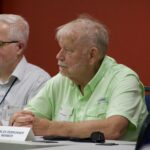
Mile-Eyed: Runners stretch for the annual sprint down Front Street.

You will find James Collins at the start line, his soft voice lost amid heavy breathing and cracking joints.

“Hold … hold … hold,” the 73-year-old will offer seconds before the race, a method that he’s perfected over the years. 

He may look inconsequential, but the man has the toughest job on Front Street. 

He needs to be punctual, like an accountant on deadline. As the race starter for the Harrisburg Mile for the past seven years, Collins has learned that time holds an almost mystical significance. 

His job is to start the Mile on time. With 12 different heats, that becomes difficult when the only communication he has between the finish line and start line is his heat sheet, which he checks almost religiously. 

As each heat inches closer to its exact time, Collins typically hushes the crowd and ushers them toward the timing board. He looks at his watch, then commences the race at the exact moment the heat is set to begin. 

“I line them [the runners] up on the street, and then I do a countdown,” says Collins, a computer programmer for the state Department of Welfare. “I hold them, and then it gets exciting.” 

The Harrisburg Mile will host its 32nd annual event on July 17 on Front Street. Held on Wednesday evening, the event typically draws close to 1,500 competitors, with much of that contingent composed of corporate teams and families.

The Mile has become a versatile event over the last several years, with a wide variety of runners making up the participants, said YMCA Race Director Andy Wahila. 

At the highest level, there are competitive runners, some with storied collegiate backgrounds and sub-5-minute times, looking to win their age group or field. East Pennsboro graduate Ryan Blood, a former Olympic Marathon qualifier, owns the course record in 2009 with a time of 4:08. 

Then there are corporate teams looking to build company relationships through wellness and activity. TE Connectivity and Phoenix Contact have battled for the top position for the past three years. 

There are families with children to entertain. And then there are many 20- and 30-somethings who register for the social scene—specifically the post-race party and beer tent—which typically lasts late into the night at Riverfront Park. 

“The Wednesday night date fits with the summer season and everything,” Wahila said. “We wanted to stay away from weekends because some families won’t have time. You attract a lot of the after-work runners who are looking for something fun to do.” 

Wahila thinks the Mile brings out the best in the city. The YMCA contracts with a company to shut down Front Street—from Maclay to Forster—and then the Harrisburg police ensures safety with patrol officers on city streets.  

“They’ve done it so many years,” Wahila said of both the police and the outside contractor. “Both of them do a wonderful job.” 

The Mile ends up being a special race for a lot of reasons. For starters, within the midstate, there isn’t a race like it. The mile distance is abstract, since most high schools compete on a metric track. The 1,600-meter distance is run at the PIAA level, which is slightly less than a traditional mile. 

Next is location. While many YMCA-run races are conducted on Harrisburg soil and macadam, few operate on Front Street itself, a three-lane road that carries much of the city’s dense traffic flow. 

And perhaps most significant is the experience. While the beer tent tailors to the younger professionals in the city, the event also features food vendors and music, filling Riverfront Park with entertainment and promotions. 

A local running expert—for years it was Inside Track Manager Henry Klugh, a well-known running coach in the area—typically announces the race from the finish, picking out key runners deep into the event. 

And then you have Collins, who volunteers every year. He began his role in 2006 after five years as a runner himself. From 2000 to 2005, he ran the Mile, his best finish coming in 2004, when he posted a 5-minute, 44-second time.

Collins, who was a black belt martial artist for 15 years before he picked up running at the age of 60, decided to volunteer. He belonged to the Harrisburg Road Runners Club, and a fellow member urged him to try it out.

“Well, the only thing I can say about [running] is you either love it or you hate it,” Collins said. “There are a lot of people who don’t like it. They don’t train for it. I’m not one of those people.”

The 32nd annual Millers Mutual Harrisburg Mile will be run on July 17 starting at 6 p.m. For registration and other information, visit www.harrisburgymcaraces.com.

Continue Reading

Harrisburg Wants Fighters: Voters sided with reform in City Council election.

While the Harrisburg mayoral race has another leg, barring any atypical occurrence, we  know what the next City Council will look like.

In this Democrat-heavy town, only Democrats have run for council in the past few years, so it’s the primary election that determines the winners and the losers.

This year, there were four seats up for grabs, and of the ten candidates who ran, there were three incumbents—Wanda Williams, Eugenia Smith and Kelly Summerford.

Summerford lost, and two fresh faces were elected to office. In fact, one of those newbies, Shamaine Daniels, garnered more votes than anyone else, which was a surprise to many and, most certainly, to the incumbents.

Aside from the fact that a relatively unfamiliar newcomer succeeded above the rest, it’s worth noting who lost, most especially Summerford, who was considered a Linda Thompson defender and upholder.

When looking back on City Council votes since 2010, when Summerford took office, his voting record indicates an alignment with Thompson and her positions. He was not alone. His comrade was former City Council President Gloria Martin-Roberts. In 2011, she retired from council at the end of her term, choosing no longer to run for local government, but rather tried to make the jump to state. In 2012, she ran for the 103rd PA House of Representatives seat, coming in last in the primary.

She also has stood out as a fervent Thompson supporter.

On the other hand, we have City Council incumbents who have been re-elected. And whether it was this run or the last, what we know is that the “Fabulous Four” made it, while the others have not.

Who are the Fabulous Four?

In a long story made short synopsis….

Back when Linda Thompson was on council, she and Mayor Stephen Reed engaged in a fight about whose right it was to appoint members to the Harrisburg Authority (THA) board—the mayor’s or council’s. The issue headed to the courts, where it went as high as it could. However, there was no final ruling until Thompson defeated Reed and took the office of mayor.

On May 26, 2010—as City Council-appointed members of THA were making progress on the organization of chaotic files and setting terms of negotiations with creditors in the incinerator debt matters—the state Supreme Court came down with its ruling on the matter.

It ruled that the mayor has the right to appoint members to THA’s board, not City Council. Thus, by law, THA’s board was immediately dismantled. Work on a plan to face the incinerator crisis and on a much-discussed forbearance agreement stopped.

Despite a lot of public pressure to do so, Mayor Thompson refused to re-appoint the board members so they could get back to work. It could have been done. The next day. The irony, of course, was that Thompson as city councilor fanatically claimed it was council’s prerogative to appoint the THA board. Hence, the lawsuit with “Linda Thompson” explicitly named as one of the parties involved, meaning she believed so full-heartedly that City Council should appoint the board, not the mayor, that she was willing to spend public money and time to prove her righteousness of principle.

Yet, when the tables turned and she was mayor, instead of returning the council-appointed board back to business, she delayed and then began to send down a list of new candidates who either withdrew themselves before they came before council or caused strife amongst city councilors.

This is the first time we saw the so-called “Fabulous Four,” as the media began to refer to them. There were four members of City Council who stuck together and demanded a re-appointment of the old board—Wanda Williams, Susan Brown-Wilson, Eugenia Smith and Brad Koplinski. They stood strong despite the mayor and City Council President Gloria Martin-Roberts calling them “obstructionists,” “hypocrites” and “children.” This is when Summerford was noted to side with Martin-Roberts and Thompson.

Why does this matter? Because, looking back on that summer of 2010, reflection easily demonstrates how bad of a move it was for Harrisburg to have an inactive THA Board.

It gave creditors power and ultimately contributed to Thompson’s application to the state for the Act 47 program in October 2010, which led to a state takeover and the appointment of a receiver.

The “Fabulous Four” stuck together for a long time. They formed a bloc that voted down various Thompson administration initiatives, including premature asset monetization moves, high-interest financings and the Act 47 program and plans. They even fought receivership and never failed to call Thompson out in unity if there were a questionable claim or deal on the table.

They were publicly applauded. They were voted back into office.

Gloria Martin-Roberts and Kelly Summerford were not. Even Patty Kim, who continuously teetered in the middle of the two sides, won the 103rd seat by a very slim margin.

Apparently, Harrisburg wants fighters. Voters have indicated they want elected officials who seem to understand the complexity of the issues at hand, who have noble opinions and who express perspective for the common good.

The electorate wants representatives to fight the fights that matter the most and not the ones that don’t.

If anything, this election seems to reflect that.

For the two newcomers—Daniels and Ben Allatt—they’ve been given a chance to show who they will listen to and what they’re made of. Clearly, the standard has been set.

Continue Reading

Towards Recovery: A Q&A with Gene Veno & Sybil Knight-Burney

Last month, Harrisburg School District Chief Recovery Officer Gene Veno and Superintendent Sybil Knight-Burney stopped by TheBurg offices to talk about the recently passed school recovery plan, designed to lead the district to financial stability and improve academic performance. We share most of this extensive interview on these pages.

TheBurg: The recovery plan is designed so the district can achieve a budget surplus by 2017. That seems like quite a monumental task. Can you take us through how you hope to achieve that?

Veno: First, I’d like to thank you for having us here today. Anytime we can get out positive information about the school district, we’re very appreciative.

The plan is designed on a forecasted five-year model. The idea, when we came into the district, was first to see where we were financially. That was not known prior to coming in. We found out there was a deficit in the current general budget of which the superintendent had known previously, but we didn’t know the depths of how much. We started to drill down on what could we do without making cuts, what could we do without closing schools, what could we do without furloughing educators or eliminating any programs.

I’ve been saying this now in the community, and it seems to be really a catchphrase: this is really “Recovery 2.” “Recovery 1” was the board previously working on doing some of the harder decision-making as far as closing five schools; they had to furlough a number of employees; they cut $22 million in their operating budget. So, I call the recovery plan the Phase 2 process, which will give the board and the superintendent the opportunity to get through to the next stage of recovery.

Now, that being said: how do we get from where we were to a balanced budget in the 2017-18 school year? Well, there are very specific initiatives within the plan. If you’ve reviewed the 128 pages, there are guidelines that have to be followed, not necessarily just financially, but academically.

Financially, there are ways that we have now to manage our budget, and one of the areas that we have to look at is that we will see a dollar amount of $14 million. That will be from $6 million to $14 million in this budget year to next budget year of money going to charter cyber schools. We looked at 672 students at $15,000 approximately a student. That is money that we would like to see stay within the district. So, one of the initiatives to achieve that goal is to, hopefully within the next month, retain a cyber director who will oversee the cyber Cougar Academy, which we currently have, which is only 9-12. We’d like to expand it to K-12. It would be a blended model, where students will be both on site and at home. That’s one area.

The other area is looking at where we can bring in additional revenue. As I said, there were five shuttered buildings. One of them, we’re going to try to keep for the school administration building, that being Lincoln. The board had previously looked at the admin building cost and targeted about $40,000 a month. So, there’s about half-a-million there that will go away in the 2013, ’14, ’15 years. So, by 2017, we won’t be spending that half-a-million. So, if you add up there, we’re almost at a point of eradicating the current deficit that we see for next year, which would have been $14 million, if we didn’t do something, which we did.

Finally, there are many other aspects of the recovery, such as sale of buildings, which would come into the general fund, increasing student population (we average about $14,000 per student cost). So, we’re looking, as every student brings in revenue, our goal is to immediately to start to keep our 6,340 students and increase it. We want to see the population change, and that’s the challenge in the urban district.

TheBurg: The additional funding that comes in per student, does that essentially come in from state aid?

Veno: State aid, yes. But the point being: you don’t get it unless you have the students. So, it’s the average daily measure—the ADM as they call it. We want to stem the egress of students outside the district. We want to keep students in the district and increase the student enrollment in the district. And that’s one way of increasing the value revenue of the school.

TheBurg: Do you plan to do that mostly through the Cougar Academy?

Veno: That’s only one stage of that. We’ll have three academies, which I want Doctor (Knight-Burney) to speak on. It’s her vision to create special academies for children of [grades] 5, 6, 7 and 8, which we believe will inspire many parents to keep their children in our schools not only through 5, 6, 7 and 8, but on through graduation.

TheBurg: Getting back to this revenue question—if you have greater enrollment, you will get more money in from the state, plus you hope to get more students from the cyber charter school, correct?

Veno: If you take the number I gave, times the number we’re looking at, we’re looking at almost $10 million we’d like to stay in the district. So, right there, if we had $10 million this year, we’d have beyond a surplus, and we wouldn’t be looking at a 5 percent budget and 5 percent wage cut.

Knight-Burney: And provide options in our district so that families who are looking at other options can consider us.

Veno: So that was one area that we noted immediately in our discussions—that we needed to do something about the egress of students. When we got down to it, we said, “672 students times 15,000.” Right there, that was one area that we targeted. 672 are in a cyber school right now in the school district. Statewide, there are currently 103,000 students in a cyber charter school. That is their choice. We commend any parent who wants to do that. That is not for us to make that determination, but we have an obligation under the school code to pay that fee. We looked at it as, “Why are they going there?” And we are going to come out and do an aggressive marketing campaign to educate the community, the citizenry and the parents of these children that we do have a good product. We need to have a quality product, and one of the areas is through our academy. So, we’re going to do that.

Knight-Burney: This whole charter and cyber charter is something many districts are facing. Some districts have even higher charter costs than we have.

Veno: We don’t have a large number of charter buildings in brick and mortar. Ours is in cyber. So, that’s what we focus on, and we’ll do the best to compete. Again, what parents decide is their choice, but we’re going to try to give them a good choice in the Harrisburg City School District.

TheBurg: The accumulated deficit in the district is almost half-a-billion dollars. For a community this size, that number seems daunting. Do you really think that kind of debt can ever really be retired?

Veno: Yes. The number is $437 million. At one of the meetings, I asked our financial team, “What is our total outstanding debt? And if we were to pay it down over a period of time, what is that period of time?” Our total debt load right now is about $265 million. But I asked a question, “Well, when would it be paid?” And, if you look at it and amortize it over 25 years, it comes to the $437 million. And I put that number out there because that was kind of the benchmark for where we have to stop on our debt and have to reduce that.

I also looked at other districts, and we’re running about 12.5 percentage of debt to budget. And I’m looking at most universities and most other high schools and districts, and they’re running about pretty much from 9 to 12 percent, as well. Now, the thing I feel good about, in this respect, finding this, is that the money was not wasted. It was spent on refurbishing and reforming all of these schools—actual structural buildings. So, we have good schools. So, that part is done.

We have now set the stage for the next five years. That (debt payment) will grow another $6 million this year, from $14 million to $20 million, and then flatten out for five years. So, once I saw those numbers trending, I felt more comfortable knowing that I know what my fixed is for the next five years. And that’s predicated in the five-year plan, as well. That being said: $20 million a year is a lot of money. Our goal is to try to trend that down. How do we do that?

We’d like to place three of our buildings into the marketing of the KOZ (Keystone Opportunity Zone): Hamilton, William Penn and Shimmel. We already had some interest in William Penn through the State Museum Archive Society. We had a few medical facilities taking a look at it. But our biggest challenge the last month was looking at the property at 1901 Wayne Ave., which is not in the city. It’s in Susquehanna Township—42 acres. We would not receive all of that money because that money would have to be in context with the state because they’re the ones that gave it to the city school district to build a public education facility. If it should move forward, we would generate a net, at this point, of almost $1.8 million, which would have to go back to the state. Then the state would have to determine how much we would receive.

So, we’ll put these other buildings into the same kind of a process. We’re not going to sell them immediately, but we’ll do our best to market them so they become a viable source of revenue not just for the district but for the city.

Hamilton, for example: we had one interested party coming to rent it. I saw him, and it’s just not going to work out. We don’t want to be in the lease business; we want to sell it. We had another developer taking a look at it to make it into an apartment complex. We don’t base a dollar value on this. Any of that dollar that comes in will go right into the general fund.

TheBurg: You received significant interest in William Penn? Any potential action?

Veno: We gave some tours of the building. Again, we haven’t marketed any of the buildings. The property needs to be rezoned, and we met with City Council and the mayor and that will take place. I just think it’s a beautiful facility of 25-plus acres that could be turned into just about anything. I’d like to see it tax-driven too. So it would be a revenue-producer for the city, as well as the school district.

TheBurg: How is the search for the proposed CFO (chief financial officer) going?

Veno: We just finalized the job description. It’ll be posted on our website in the next day or two.

We’ve been in deep negotiations with the labor unions. On May 17, the plan was approved. Once it was approved, one item on my list was to get to the bargaining table with all the labor unions, and we did, and they’re completed. We will have hopefully this checked off our list very soon that two bargaining units (AFSCME and HEA) and the meeting group, which is for administrators. I was looking for a sign-off by all three groups. HEA signed off on it. They agreed to the 5 percent wage and benefit [cut]. All administrators and principals have signed off on it. And AFSCME—the non-certification employees—will sign off on it hopefully. If they do not sign off on it, we do not go into receivership, but we will go into furloughing employees. We do not want to see that happen. [Ed. Note: Days after the interview, AFSCME negotiators rejected the district’s offer, but then reversed and accepted it.]

Knight-Burney: Over the years, after closing five buildings, after furloughing over 300-some-odd people, we were out of ideas. Every year, we were able at the minute to balance the budget. But the point has come that we can’t close any more buildings. We’d have kids sitting on top of each other. We won’t have teachers to teach them. We’d have 40 to 50 kids in a classroom. In an urban school district, where we have kids with so many needs, that’s crazy. We already are looking at downsizing more with our psychologists and our counselors and, in an urban school district, they are vital to the academic environment. So we will do everything we can to hold our district together and to make it the high-performing, high-achieving district that it once was. I know we can do that.

Veno: We will make this turnaround. This is not in a receivership mode. It is an actual recovery plan . . . this a five-year forecasted model. This will be the key to the recovery of the district. We will stick to it. In the out years, the revenues increase, the costs go down, no tax increases in the fourth or fifth year, plus increases back to the teachers, employees, non-certification. And, if we can get there sooner, we will. One thing I keep saying: this is a five-year plan, but we really have three years. We can’t miss a mark in the next 36 months.

TheBurg: Have you gotten a lot of pushback from the teachers?

Veno: Yes, and they should. I don’t feel this is a win to ask anybody to accept any reduction in salary or benefits. They’ve been asked to take a lot of hits in the past three years. They have been invested in this district to stay and teach at wage freezes. They have not had a signed wage agreement in two years. They have not received a cost-of-living. They have not received a step increase. I’m very saddened this has to be the case for the next two years [5 percent salary cuts] and a freeze in the third year, but, if you work with us and you continue to stay with us, we’re going to try to resolve this quickly before the third year.

Knight-Burney: It beats the alternative, and the alternative is that we don’t have a district. We don’t have any place for our kids.

Veno: I’m trying to save the district. We all need to save the district. I would not go for charterization of the district. That’s one thing I said: I’d like to keep a traditional program. I’d like to keep the Cougar pride. But more importantly, I didn’t want to see anyone furloughed. We did not furlough an educator. I did not want to see us closing schools. I did not want to see tax increases at 10 percent. And the only way we can get to that was to get to some of the tougher decisions on wage cuts and benefit cuts.

Knight-Burney: One of the good things about having an outsider come in, they also bring in resources, and we’ve had a good relationship with the Department of Education, but it’s even better now. One of the things Gene was able to do was to bring in some experts to look and assess what we’re doing. One of the things we had started doing is building that academic piece, which is important because, if the academics don’t approve, we’re not going to have a district. It doesn’t matter what the finances are. If you’re failing, you can’t justify pouring any more money into it. So we’ve been able to be a part of pilot programs on teacher effectiveness, principal effectiveness. Gene has been able to go in and negotiate classes for our principals.

The only thing that’s going to make a difference is the instruction in the classroom: what the teachers are teaching and how the kids are learning and how they perform.

Continue Reading

Fashion Forward: Higashi brings style to the Midstate.

Mechanicsburg resident Susan Fotos must be doing something right because the little jewelry store located at the West Shore Farmers Market is as popular as ever. Named after the Japanese word for “east,” Higashi has been providing shoppers with a variety of jewelry and accessories for 13 years now.

Fotos took a circuitous route to end up in the place she now calls home, having resided in Minneapolis, New York and eventually Tokyo, where she worked for Syracuse University in international recruitment. You could say serendipity paid her a visit while she was in Japan because she became friends with a major pearl exporter who suggested she sell pearls in Pennsylvania when he learned she was relocating.

And that’s how it all began.

Fotos started with pearls and expanded the business to include jewelry, gifts, eyewear and accessories for both men and women. The former art major, who holds a master’s degree in counseling, says her background comes in handy in running her shop.

“I have a love for art and a good eye,” she said. “Counselors help people solve problems. I help people select gifts for the ones they love.”

Business acumen, a discerning eye for the unique and unusual and a willingness to take risks have all contributed to her success. “I approach the jewelry business differently than most,” she said, explaining that her lack of retail background kept her from being constrained. “There were no rules, so I was always ready to say, ‘let’s try it.’”

Fotos prides herself on carrying products for a wide range of budgets. She sells some of the finest gold and diamond jewelry crafted by an array of talented designers, alongside items tailored to the more budget-minded.  “We offer the best gifts you can find in the $50 price range; it’s not stuff you can just pick up at the mall,” she said.

Traveling the world to select merchandise is one of her favorite tasks as owner of Higashi, and her eyes light up as she expounds on her travel itinerary.

“I just brought back clutches from Spain and they’re fabulous, and I’m currently importing a line of jewelry from Italy. Next week, I am going to Paris for a big, international accessory and jewelry expo, and, in September, I’m traveling to a show in London,” she said, adding that she stays on the cutting edge of what’s happening with fashion in New York as well. “I keep a little apartment there and walk around SoHo and the Upper East Side to get the scoop,” she said.

Lemoyne resident Debra Yates is a regular customer. “’I’ve collected a lot of jewelry pieces throughout the years, and she always has something new and exciting. I’m not far away, which makes it dangerous,” she said with a laugh. Yates also said she enjoys the wide range of eyewear available at Higashi.

“We have the best selection of frames in central Pennsylvania. Eyewear is the most fun product there is,” Fotos said.

Customer Suzanne Love agrees. “Her selection of eyeglasses is head and shoulders above all others in the area. Choices range from elegant to funky, to those with a European flair. The range is wonderful,” said the Camp Hill resident who also shops for jewelry there. “It’s the only jewelry store I shop in this area,” she said.

Fotos’ love of the region is obvious as she talks about her customers, small town life and her favorite charity—the YWCA, which fits in well with her passion for serving women. “We fundraise and participate in the Power of Style Fashion Show,” she said, referring to an event that raises money for domestic violence intervention.

When asked about her plans for the future, she said she is looking forward to remodeling her shop and adding to her collection of merchandise. “I will be bringing some exciting new brands to the area in the fall,” she said.


Higashi Jewelry & Eyewear

West Shore Farmers Market, 900 Market Street, Lemoyne

717-303-0336

https://www.higashijewelry.com

Continue Reading

Preacher Feature: It’s movie night at Wesley Union.

Screen Shot 2013-06-28 at 10.59.34 PM“To choose doubt as a philosophy of life is akin to choosing immobility as a means of transportation,” says Pi Patel, the syncretic narrator of Yann Martel’s novel “Life of Pi.”

On a Friday night in June, in the parking lot of Wesley Union AME, a church at the corner of 5th and Camp, spectators at varying levels of doubt and faith sat still and were transported. The pastor, Willie Dixon, had bought a 12-by-17-foot inflatable Gemmy screen, which stood by the church’s east wall, its air pump blowing. It was the first night of Wesley Union’s free movie series, which will take place Fridays at sundown through Labor Day.

“We wanted to offer the neighborhood an alternative to just hanging out and waiting for something to happen,” said the Rev. Michael Stanley, who was manning the projector.

The movie—the screen adaptation of “Life of Pi,” about an Indian boy stranded by the wreck of a freighter carrying his family’s zoo—sat in the drive of a laptop, ready to play. But, first, an audience would have to gather, and the sun would have to set.

The reverends looked at the sky and looked at their watches. A family appeared at the end of an alley, toting white, plastic lawn chairs and pushing a stroller. Another caravan, all children, paraded down Camp Street on foot and on scooter, hauling collapsible chairs.

”Is it starting yet?” An adult came over and picked up a seat while two girls asked if they could help. While the man unfolded the legs, the girls grazed its canvas backing with their fingers. “I did it,” one said. “Me too!” said the other.

A man named Charles, with pale, thick arms and a stubbly beard, wearing an Iverson jersey and matching shorts, milled around doing whatever needed doing. “Pastor turned my life around,” he said. He gave a tour of the church’s new garden: five rows of plywood boxes filled with soil, sprouting cabbage, broccoli and peas.

“Guess which ones are mine?” said Pastor Dixon. Two of the boxes flourished noticeably with thicker, advanced vegetation. The pastor nodded.

More people arrived. There was a seating shortage. Someone tossed a Dora the Explorer blanket on the macadam, giggling. “Y’all can sit on this thing,” she said.

Nevin Mindlin, the mayoral candidate, arrived and shook hands with the pastor. Mindlin, who has collaborated with Dixon on various neighborhood projects over the years, was fresh from a two-week vacation in Barcelona and Provence. “These cities have public spaces, where people can gather and converse,” he said. “People want to do this. This is what Harrisburg needs.”

A crescent moon rose in the sky, but the daylight lingered. Dixon spoke into a microphone, thanking everyone for coming. He announced that next week’s movie would be “Courageous,” an independent Christian film about fatherhood. (Later, this selection would be swapped for “Madagascar,” a DreamWorks blockbuster in which David Schwimmer plays a giraffe.) “You need to bring your own chairs,” he said. He quieted the crowd for prayer.

“We ask, Lord, that our neighbors will embrace this and that we may be a blessing to one another. Amen. And remember, bring your own chairs.”

A rendition of the gospel song, “He’s a Keeper,” took over on the standing speakers. Kids lined up at a buffet table, and came away with hot dogs, Capri Suns, sodas and cookies.

A man in a brown beret brought chips to a woman and child bundled in a clamshell seat. “Look at you two. Look at you all. Can I come in there?”

The crowd in the lot swelled to more than 70, most of them children, excluding a handful of neighbors lounging on porches across the street. In a row near the front, a girl peered into a bag of trail mix, shook it and skimmed the top for M&Ms.

The sky grew darker, the moon more sharply defined. Purple clouds sailed past the steeple. Suddenly the music faded, and the fanfare sounded for Twentieth Century Fox. Then came the sound of a sitar and drum, and the screen filled with scenes of animal life in a zoo in Pondicherry.

Continue Reading

Sink or Swim: Flooded out, Harrisburg River Rescue dedicates itself to finding to a new home.

Nestled in the back of a former Brenner dealership building on Paxton Street in Harrisburg, members of the Harrisburg River Rescue are at the ready, waiting for the inevitable summertime call that a boater, kayaker or swimmer is in trouble.

They have called this location home for nearly two years since the 2011 floods that devastated parts of the city and outlying areas. While crew members were assisting with water rescues in the Hershey/Hummelstown area, the River Rescue itself was being flooded out of its long-time location on S. Cameron Street.

The Central Penn Business Journal, located on high ground on Paxton Street, provided the group with a temporary facility on its property.  But, even after the waters subsided, members were unable to return to their former home because they didn’t own the building and the landlord decided to sell the property.

Eventually, they made their way to their current location at Paxton and S. 19th streets. Members like this spot because it’s not prone to flooding, but is still close to the river. However, the old Brenner site is not suited to the very specific needs of the organization, since it’s designed like, well, a car dealership.

“We’re looking for a place that can house fundraising and catering events and that we can move into while still on-call for rescues,” said Steve Ketterer, a member of Harrisburg River Rescue for 41 years.

The group has been working with an agent to locate a new headquarters.

“We’ve seen several properties, but they’re not conducive to us. They’re either too expensive, or they’re in shambles, or they are too expensive and need to have more money put in them for re-modeling,” said Joe Ketterer, public information officer and a 37-year member of the group.

The Harrisburg River Rescue has 72 members, with 35 trained in water rescue. Twelve to 15 members are solely responsible for fundraising events and are constantly looking to host events, such as bingo and flea markets. Many of the events are held off-site because of the space.

“We do an annual basket bingo in October, and we’re looking for a way to hold it here,” said Joe Ketterer.

The group also gets help from the community.

In May, Earl David Reed, radio personality from the morning show on 105.7 the X, along with other comedians from the area, held a fundraiser comedy show for the organization at the Harrisburg Midtown Arts Center. RJ Harris, radio host on WHP 580, holds an auction on the radio during the holidays. On July 15, the River Rescue is hosting a Harrisburg Senators community night, in which the group will receive a portion of the ticket sales.

While some of the money is going to a potential new home, fundraising also helps pay for other essentials, such as insurance and equipment.

“We’re not included in any kind of funding of any type, including Homeland Security funds or anything like it. We tried to get introduced in there as an add-on, but any type of water rescue or any special type of rescue is not included, unlike fire and EMS,” said Joe Ketterer.

As a non-profit, any donation made to the Harrisburg River Rescue comes with tax advantages. Someone could benefit with a tax write-off if they have a vacant building or a piece of land within the city of Harrisburg that they don’t plan on selling or renting, as long as the organization finds it suitable, said Ketterer. The group also encourages everyone to support them by attending one of their many fundraising events.

If you are interested in making a donation, or want more information about the organization and its fundraising events, check out harrisburgriverrescue.org. 

Continue Reading

News Digest: A roundup of news events from the prior month.


New COO for City

Robert Philbin will fill the post of Harrisburg’s chief operating officer/chief of staff until the end of Mayor Linda Thompson’s term, it was announced last month.

Philbin served as Thompson’s spokesman for almost two years before leaving in February to accept the post of marketing/communications officer for Capital Area Transit (CAT). He said he plans to return to CAT after his stint as COO.

The COO post was open after the sudden departure of Ricardo Mendez-Saldivia, who served about one year. Mendez-Saldivia was the city’s first COO, a position created as part of Harrisburg’s financial recovery plan in an effort to bring more professional management to city operations.

During his six-month tenure, Philbin said he would focus on continuing to implement the city’s financial recovery plan, crafting a budget for 2014 and helping with the transition to a new administration. The job pays an equivalent of $110,000 annually.

“I’m honored to serve the city during this historic period of fiscal recovery and transition, and I look forward to working closely with Mayor Thompson and her administration in the coming months,” Philbin said.

Philbin’s career with the city has been a rocky one. He took the communications director post in 2011, the fourth person to hold that job in over 2½ years, soon becoming a close aide to Thompson. City Council struck the job from the 2012 budget, leading him to work without pay all of last year. Council reinstated the position in 2013 only to have Philbin leave for CAT shortly afterwards.


Fee Hikes on Tap

The Harrisburg City Council last month boosted fees for a variety of services, such as answering false alarms, taking out building permits, renting park space and hanging banners.

The hikes, approved unanimously, were in response to suggestions made last year by Maximus Inc., one of several firms assisting the city in its financial recovery. In many cases, the fees had not risen in more than a decade, said Councilman Brad Koplinski.

For instance, the fee for a second false burglar alarm goes from $10 to $50; for a fourth false burglar alarm from $35 to $100. The permit fee for a plumbing fixture and trap increases from $15 to $25.

City Council members said they didn’t want to raise fees, but that the city needed to consider every option to increase revenue. Raising long-stable fees is part of the receiver’s financial recovery plan for the city.


Harrisburg Threatened with Fund Cut

The state House last month passed a budget plan that would slash the amount of direct state funding Harrisburg receives from $2.5 million to $496,000.

That money flows into the Fire Bureau budget for compensation to protect the Capitol complex. The bureau estimates that it costs Harrisburg about $4 million annually to provide emergency fire service to the Capitol complex.

State Sen. Rob Teplitz (D-Dauphin County), state Rep. Patty Kim (D-Harrisburg) and Mayor Linda Thompson all said they would work hard to restore the funding for the cash-strapped city before the state budget is finalized.

“At a time when the city is already struggling to maintain safety, this painful cut to fire protection funding further jeopardizes the safety of Pennsylvanians and adds to the burden of the city’s fiscal crisis,” said Kim.

Harrisburg already faces an operating budget deficit of around $3 million this year. The proposed funding cut would widen that gap considerably.


School Unions Agree to Cuts

Harrisburg’s two school unions have signed off on a plan to cut staff salaries as part of the financial recovery package for the debt-laden school district.

Both the Harrisburg Education Association (HEA) and AFSCME Council 13 last month tentatively agreed to salary and benefit cuts of 5 percent, said school Chief Recovery Officer Gene Veno. Already, Harrisburg school district personnel have not received regular raises for the past two years.

AFSCME, which represents non-instructional staff, originally rejected the offer, leading Veno to plan layoffs. The union later reversed itself, stating that members objected more to tougher evaluations and performance standards than to the salary and benefit cuts.

At press time, the memberships of both HEA and AFSCME had yet to ratify the agreements.

A third group representing school administrators also agreed to the cuts, said Veno.


Vacant Lot Ignites Dispute

A dispute over the use of a vacant lot at the corner of 6th and Herr streets could come to a head this month.

Bethel AME Church had run a commercial parking operation out of the lot until 2010, when its temporary variance to the zoning code expired. In May, the church applied for another temporary variance, but some members of the Fox Ridge neighborhood near the lot raised objections.

Ted Hanson, whose house abuts the southern edge of the lot, said the church falsely claimed “community support” for the commercial parking plan.

“Not one of the signatories on the church’s petition resides in Old Fox Ridge,” he said.

He added that the church historically has not made any effort to develop the lot appropriately, as past variances have required. On a website, foxridgeneighbors.org, Hanson also called into question Bethel’s appeal to make the lot tax-exempt, saying the church already owes nearly $6,500 in back taxes on the property.

Bethel AME declined to comment.

The application was to be considered at a meeting of the Zoning Hearing Board on June 17, but the meeting was cancelled at the last minute due to an error in the public announcement. The board’s next meeting is July 22, though Geoffrey Knight, the city’s zoning officer, said an earlier date is being sought to review the application.


Harrisburg Again without Health Officer

Harrisburg lost its Health Officer last month after the city, acting on the instruction of receiver William Lynch, declined to raise the position’s annual salary from $40,000 to $50,000.

The officer, Cornelius Johnson, left the post to accept a $50,000-per-year offer for the same position in Susquehanna Township.

The Health Officer conducts routine inspections on Harrisburg restaurants and food vendors to ensure they are complying with health codes. The city is currently seeking someone to fill the position at a starting salary of $42,000. In the meantime, inspections will be conducted by other codes officers employed by the city.

City Council President Wanda Williams expressed regret over Johnson’s departure and criticized Lynch and Mayor Linda Thompson for not ensuring the position offered competitive pay.

“City Council did everything it could to try to retain him,” she said.

Recently, Harrisburg has had trouble filling that position. The health officer post was vacant for more than a year before Johnson took the job.

Councilwoman Susan Brown-Wilson praised Johnson’s abilities, adding that he was Susquehanna’s “number one choice” for the job.

Lynch, however, pointed out that all other city employees are experiencing a pay freeze and stressed that making an exception for one employee would have a “corrosive” effect.


Another Independent for Mayor

Air Force Staff Sgt. Nate Curtis last month announced his candidacy for Harrisburg mayor, the second independent in the race.

At a press conference in the Pennsylvania State Museum, he said his political party affiliation will read “Curtis for Mayor” on the Nov. 5 general election ballot.

Curtis grew up in Harrisburg, where his mother worked at a number of restaurants around the city. His father, whom Curtis said he met when he was a teenager, was a homicide detective with the police department.

Curtis recently returned to the city after a tour in Afghanistan and said he was distressed to find “my hometown at war with itself.” In 2007, his brother Dax was murdered in the foyer of his apartment on Woodbine Street.

His priorities as mayor, he said, would be addressing education and blight and cutting the city’s budget, including a 10 percent pay cut to the mayoral salary and a dismissal of the mayor’s security detail.

The race to replace Mayor Linda Thompson has grown increasingly crowded. Midtown Scholar Bookstore owner Eric Papenfuse captured the Democratic nomination for mayor in May, and Uptown resident Nevin Mindlin also is running as an independent.

City Controller Dan Miller, who lost the Democratic primary, narrowly won the Republican primary based upon 196 write-in votes. At press time, he had not announced his intentions for the general election.


Broad Street Market Loses Manager

Harrisburg’s historic city market is again without a manager as Dennise Hill left after less than a year on the job.

The board of the Broad Street Market confirmed Hill’s resignation, saying that Market vendors were informed of the departure, but refused further comment on this personnel issue.

The Market has had great difficulty retaining top staff, with the past three managers all serving very short stints.


Restaurant Roundup

Harrisburg-area foodies got a triple treat last month as two long-promised eateries and a café made their debut.

The month started out strong as Little Amps Coffee Roasters opened its second location at the corner of N. 2nd and State streets on June 1. Little Amps first rocked Harrisburg’s gourmet coffee market in October 2011 with a storefront in Olde Uptown, and its new downtown spot offers the same fresh-roasted coffee along with a selection of goodies and sandwiches from Yellow Bird Café.

In mid-month, Taco Solo began serving tacos and salads from a central location at the corner of N. 2nd and Locust streets. The downtown taqueria is the inspiration of Juan and Lisa Garcia, owners of the popular Mexican restaurant El Sol, who wanted to bring their cuisine to the takeout crowd.

About a week later, owner Sri Kumarasingam gave a culinary nod to Midtown in the form of Pastorante, a new pasta-themed restaurant at 1012 N. 3rd St. The completely renovated space features an open kitchen, homemade pastas and numerous creative Italian dishes and pizzas. The storefront has been empty for years, last housing the greatly missed Italian Market.

Speaking of Midtown: Fine diners will be delighted that Char’s Tracy Manor will begin to serve Sunday dinner starting July 7. Until now, Char’s only served Sunday brunch, which will be suspended. Also, the beautiful riverside restaurant at 1829 N. Front St. now features live outdoors music on Friday and Saturday nights, 7 to 10 p.m.


Changing Hands: May Property Sales

Briggs St., 1608: T. Simmons to Fannie Mae, $61,911

Capital St., 1007: 3rd Street LLC to CJ Good LLC, $125,000

Cumberland St., 216: D. Maguire Trust to P. Wambach III, $117,500

Derry St., 1711: J. Mendoza to D. Patel, $36,432

Green St., 1628: C. Lex to M. & A. Collins, $90,000

Hale Ave., 433: T. Bryant to G. & C. Speroff, $72,500

Hanna St. 110: Donna C. Flath Trust to M. Knouse, $150,000

Harris St., 625, 641, 643 & 1521, 1523, 1525, 1527 Wallace St.: J. Close to

U.S. GSA, $63,600 each

Harris Terr., 2481: PA Deals LLC to S. Hill, $66,000

Hoffman St., 3028: V. & C. Piatos to J. Hull & L. Downs, $140,000

Holly St., 1849: B. & K. Kreps to D. Reed, $69,900

Hudson St., 1256: J. Fabiankovitz to Lemoyne Land Corp. Inc., $45,000

Hummel St., 224: V. Mainardi to Brethren Housing Assoc., $48,500

Kensington St., 2135: S. Orfanelli to A. Segin, $45,000

Kensington St., 2147: PA Deals LLC to J. Gaidos, $67,900

Liberty St., 1404, 2021 Holly St, 2651 Jefferson St. & 1826 Briggs St.:

Shokes Enterprises & R. Shokes Jr. to R. & D. Requa, $201,000

Locust St., 103 & 105: Front & Locust LLC to Browser Properties, $150,000

Maclay St., 524: W. Grannison to 524 Real Estate Holdings LLC, $100,000

Manada St., 2003: D. Barrick to M. Jackson, $63,000

N. 2nd St., 1225: J. Van Allen to M. & L. Day, $120,000

N. 2nd St., 1404: Kyzer Rentals LLC to Tang Liu Realty LLC, $100,000N. 2nd St., 2405: PBE Companies LLC to M. & R. Lindquist, $140,000

N. 2nd St., 2533: J. & V. First to K., C. & E. Meisinger, $120,000

N. 2nd St., 2619: R. Davis Jr. to D. Skerpon & C. Baldridge, $225,000

N. 15th St., 17: B. Miller to Wofford Enterprises Ltd., $50,000

N. 15th St., 1217: PA Deals LLC to A. Plowman, $79,900

N. Cameron St., 101, 101 Rear, 109 & 111 Hancock St.: C. Green to R. & S.

Otto, $269,000

Oakwood Rd., 2309: M. & S. Gruin to M. Knopf, $245,000

Penn St., 1523:  K. Thralls to E. Jones & J. Lindgren, $134,000

S. 12th St., 1442: Beneficial Consumer Discount Co. to N. Sanchez, $42,500

S. Cameron St., 1119: River Rescue to Statewide Enterprises LLC,

$385,000

Verbeke St., 210: K. Leitner to R. Katsifis, $90,000


Sales data is collected from Dauphin County records and is assumed to be accurate.

Continue Reading

Safe Spaces

Police Chief Pierre Ritter, COO Bob Philbin, and Mayor Linda Thompson at this morning's press conference.

Police Chief Pierre Ritter, COO Bob Philbin and Mayor Linda Thompson at this morning’s press conference.


The city will begin cracking down on crime and blight in Safe Zone 6, Mayor Thompson announced this morning at a press conference in City Hall.

The Neighborhood Safety Zone program, launched in February, aims to reduce crime by directing the efforts of a team of officials—including cops, code officers, social workers and sanitation workers—at specific neighborhoods.

Safe Zone 5, which was announced on May 20, centered on Hall Manor, a housing project at South 17th and Hanover Streets. Since Zone 5 was announced, the mayor said, 11 traffic citations were issued and 33 warrants were served in the area for misdeeds ranging from parole violations to theft by unlawful taking and public drunkenness.

Thompson also reported that 1 1/2 tons of garbage were removed from the area, 44 streetlights repaired and 13 properties inspected.

“No firearms were removed this time, which was surprising,” Thompson said. “Not that there are none, but none were confiscated.”

The Neighborhood Safety Zone program has at times had something of a confused execution. Safe Zone 2, for instance, at 14th and Vernon Streets, was erected one afternoon in late March and dismantled an hour and a half later. In addition, the targeted areas were initially announced in advance, but are now concealed from the public, to maintain an “element of surprise,” according to Thompson.

But now, she said, the program is running smoothly. “It works. It’s a new and improved way of building and rebuilding the neighborhood.”

Asked about recent trends in violent crime—the city saw its 11th homicide of 2013 last Saturday—Thompson suggested that she was not overly concerned.

“Some of our homicides are unpreventable,” she said. She pointed out that this year’s homicides so far have involved victims and perpetrators who knew each other and often were the result of domestic disputes. She cited one murder that was the outcome of a fight inside a home. “No amount of cops would have prevented that,” she said.

Continue Reading

Paved Paradise III: The Reverend Replies

The view of the lot from Herr St., with the Zoning Hearing Board notice in the foreground.

Friday, July 5, at 3 p.m., the Zoning Hearing Board will meet to determine the fate of the Bethel AME lot at N. 6th and Herr Streets.

The question before the board is whether to extend a temporary exception to the zoning code, which would allow Bethel AME to resume use of the lot as a site for commercial parking. The meeting had previously been scheduled for June 17, but was cancelled due to an error in the notice the city had sent out for publication.

I wrote about the history of the lot, and of the temporary exceptions granted to Bethel in the past, early last week on the blog. (The truly curious, or truly idle, might also refer to our May feature about this historic block of N. 6th—which, besides explaining how a few people at loggerheads can stall an entire block’s development for decades, might also explain why we’ve been following this zoning-code story with particular interest.)

Ted Hanson, a resident of the Fox Ridge neighborhood near the lot, has mounted a somewhat aggressive campaign against the church’s application. His charges are detailed in the earlier post. Last night, I had a chance to speak with the Reverend Micah Sims, who became Bethel’s pastor in February.

Sims said he doesn’t understand why Hanson has singled out his church’s application for scrutiny. “You have one person who has belligerently attacked this church since 1988,” Sims said. “It’s a personal vendetta, not a neighborhood or community concern.”

He acknowledged that the church has applied and re-applied for the temporary exception without developing the lot, but said this was not unusual for Harrisburg. He took issue with the claim that previous exceptions were granted with the expectation of more appropriate development in the future. “’Expectation’ is not the correct word,” he said. “There is hope and interest.”

Sims also said that there’s a “demand for parking” which the lot could help meet, and that the lot would bring revenue into the city. “People can park, go downtown and shop, and not have to run out of the city because parking’s running out on the meter,” he said.

“It’s the church’s property, and it needs to go back to its original use,” he added. “I’m paying insurance on it. It’s sitting there dormant, and it needs to provide a service to the community.”

The word “community” has proven to be the main sticking point in the saga. Hanson objected that the petition of “community support” Bethel submitted with its application was misleading, because none of its signatories actually lived in the Fox Ridge neighborhood surrounding the lot.

Sims acknowledged that the petitions had been circulated in his church and at select “retail outlets,” and confessed he wasn’t quite sure what the boundaries of the Fox Ridge neighborhood were. But he stressed that he had spoken with a property owner in the neighborhood, Annette Antoun, and had her support. (Antoun, a main player in the May feature, does not reside in Fox Ridge; a building she owns on the corner of Boas and N. 6th was condemned in 2010 due to persistent neglect.)

Sims also said that several residents living near the lot had called him and voiced their support, though he declined to provide any names or addresses.

He said he saw a better use of the land on the horizon, but insisted it would require community involvement. For the moment, he said, “we don’t know what the ideal use is.” Whatever happens, though, should reflect the block’s unique role in the history of African-Americans in the city, he said.

In any case, Sims would like Hanson to let the church go about its business in peace.

“He’s not God, he’s not the pastor, he’s not the bishop,” Sims said. “Why is it his lifelong pursuit to make the church develop this land?”

Interested citizens can pursue an answer to that question at next Friday’s hearing, during which Hanson is likely to testify. Enjoy your 4th of July—then come watch the fireworks.

Continue Reading

Same-Sex Marriage & the Urge to Localize

Two decades ago, when I was a young pup in the journalism biz, an editor gave me an assignment that I thought the height of absurdity.

I was told to “localize” the Rodney King riots.

I should mention that, at the time, I worked nowhere near Los Angeles or even in a city. I was at a newspaper in north-central New Jersey in a suburban county that was probably 99 percent white.  Essentially, I was being told to go find some black people to talk to.

“I think that this event is as historic to blacks as the JFK assassination was to the country,” said my overly confident, middle-aged white editor, as if he knew what in the world he was talking about.

Since then, I’ve scoffed at the old journalism nugget of localizing national stories, so was hesitant this morning to join the media throng, which was assembling in full force at the LGBT Community Center of Central Pa., to hear the Supreme Court’s decisions on the Defense of Marriage Act and California’s Proposition 8.

By the time I got there, satellite trucks already lined N. 3rd Street in front of the center in Midtown Harrisburg. Inside, a large bank of cameras peered onto the rows of folding chairs that the Center’s Executive Director Louie Marven had hurriedly put out. In front, he had set up a screen with a Twitter feed that gave real-time updates of the decisions.

As the 10 a.m. announcement neared, most of the seats were occupied. I sat in the front row chatting with Center board President Stuart Landon about this and that. Then someone said, “Quiet, quiet,” and the buzz in the room silenced.

The decision was in: a split court ruled DOMA to be unconstitutional. A loud cheer went up. People hugged. “Of course, it’s unconstitutional!” one woman called out, expressing her personal belief more than the inevitability of the decision.

For the next 10 minutes, people huddled in groups to discuss specifically what this meant in Pennsylvania. Not too much at the moment, they agreed. Still, it was necessary, they said, both in terms of the continuing battle for equality and for ensuring that Pennsylvania couples are not denied federal benefits once the commonwealth approves same-sex marriage, which they vowed to work hard to make happen.

In contrast, the subsequent decision over Prop 8, which basically sent the matter back to Californians to decide for themselves, was something of a letdown, but generally didn’t surprise the crowd.

“This is what I expected to happen,” said City Treasurer John Campbell, who viewed the day’s decisions as another step forward in the fight.

I can’t say that the day’s events changed my mind about the value (or lack thereof) of localizing national stories. I still think it’s cheap, brainless journalism, such stories assigned by editors who rarely leave their cubicles and know nothing about the communities they allegedly serve.

But, on this day, there actually was a story — and a good one at that — as a roomful of people rejoiced together, believing momentum was on their side, that, some day soon, gay couples in the Harrisburg area would enjoy legal equality in their relationships.


Continue Reading