Direct Viewing


County Commissioner George Hartwick, Mayor-Elect Eric Papenfuse, and GreenWorks' John Tierney at the Midtown Cinema.

County Commissioner George Hartwick III, Mayor-Elect Eric Papenfuse, and GreenWorks’ John Tierney at the Midtown Cinema.

Late Friday afternoon, as the city darkened in a warm fog, half-a-dozen or so employees of the Midtown Cinema set up for the evening. The cinema, closed for the completion of about $250,000 in renovations, was hosting a grand re-opening.

Someone hauled a massive glass jar of lemon water across the room. Eric Papenfuse, the mayor-elect, arrived in a dark suit, wearing a bookshelf tie. “Well, well,” he said cheerfully. “It looks great!” The walls, sporting a new coat of gray, were lettered here and there with lines from the classics (I’ll have what she’s having; Mama always said).

“ ‘This is a new day for the Midtown Cinema,’ said Tierney,” said a media handout. John Tierney, the president of GreenWorks Development and owner of the cinema, was not immediately at hand, but George Hartwick III, the Dauphin County commissioner, had arrived, in trim jeans, a sports coat, and a sweater vest. “Yeahhh!” he said to someone in a far corner of the lobby, whom he proceeded to high-five, and then hug.

Adam Porter, who along with Stuart Landon has been managing the cinema since earlier this year, went to and fro, snapping his fingers.

In one corner, near the wall-to-wall window facing Reily Street, sat one of the theater’s old 35mm projectors, which had been replaced with new digital equipment. It had a hulking teal body, refrigerator-shaped, and a warning: “DANGER. HAZARDOUS LIGHT. EYE DAMAGE WILL RESULT FROM DIRECT VIEWING OF THE BULB WHEN OPERATING.” Below, next to the words “Automation Model,” was a sticker with a service number.

Behind the counter was a chalkboard menu with a mix of classic and modern fare. One of the featured smoothies is “The King,” with peanut butter, banana, and bacon. There is also popcorn, available in small ($3), medium ($3.75), large ($4), and posh ($5).

“Posh comes with flavors, and it’s in a bigger bag, so you can shake it,” said Sammi Melville, a cinema employee. Among the flavors are Memphis BBQ, pirate’s gold (“like a spicy mustard”), and French toast (“messy, but it’s really good”). “We were kind of going for, like, what are synonyms for ‘classy’?” she said. “Posh” had beaten out “fancy pants,” which was rejected “because it was a little too silly.”

A semicircle formed around a podium near the popper, and John Tierney took center stage.

“This is a new day for the Midtown Cinema,” said Tierney. “These investments in new technology will provide our customers an entertainment experience that is second-to-none in the theater business.”

He called up Hartwick. “Thank you, John,” Hartwick said. “Good to see ya.” He praised the cinema’s presentation of “real documentaries,” which can “portray a perspective often not seen in the larger types of theaters.”

“This theater has a truly competent staff,” he went on. He pointed at Porter and Landon, “two of the most creative guys in Midtown Harrisburg.” Then he opened up a folder and read a proclamation.

“Whereas the only movie theater within city limits, the Midtown Cinema, is often recognized as a regional center for art and culture, and represents the renaissance of the city of Harrisburg,” he read, “therefore, we join with the 268,000 residents of this county in cutting the ribbon on the newly renovated Midtown Cinema and wishing the owners and staff enduring success in the years to come.” The day, November 22, 2013, was proclaimed Midtown Cinema Day in Dauphin County.

Hartwick passed the podium to Tierney, who passed it to Papenfuse. “I have no proclamation,” Papenfuse said, to laughter. “I have no authority to do anything at the moment, but.” He acknowledged the cinema’s role in inspiring him to open his own business downtown.

“The Midtown Cinema was the pioneer,” he said. “It was the attempt to jump-start and have a ripple effect in the arts community here in Midtown. The bookstore came right on the heels of the Midtown Cinema. And in fact we chose our name, Midtown Scholar, in part to affirm what it was the Midtown Cinema was trying to do.” He pledged that his administration would have an “arts, culture and tourism transition team” that will “focus on what we can do to drive Harrisburg’s revitalization through an emphasis on arts and culture.”

It was time to cut the ribbon. Tierney and Hartwick unwound it, and Papenfuse wielded the scissors. “Neat,” Papenfuse said later, in line for a drink. “Those were some serious scissors,” he added.

In the projection room, Porter showed off the new equipment: a hulking box, just like the old one, but black, and affixed with a touch screen. External hard drives, each containing a single movie, will now arrive by UPS; the movies are uploaded to the projector’s drive, which can hold maybe half-a-dozen. A digital key, sent by email, is also required to unlock each film. Porter held up a zip drive.

“That was one concern, whether there’d be a problem with the keys,” he said. He looked around and then found a wooden table, which he rapped with his knuckles. “Knock on wood.” Otherwise, though, Porter only saw advantages. “There are no worries in terms of things getting snagged or caught,” he said. “Do you see any moving parts?”

Next door, in Theater 3, the screen looped through trailers. A spot with Helena Bonham Carter and Ralph Fiennes was playing: Dickens’ “Great Expectations.” In the lobby, the support number on the old projector was dialed. The line was out of service.

Continue Reading

Bad Reads

RadioRead

Somewhere on an outer wall of the building you live or work in, if you live or work in Harrisburg, or Somerset, or one of hundreds of other cities, townships, and boroughs across the mid-Atlantic, there’s a small white box with a battery inside that may or may not be dying.

Once a month, a municipal worker drives by, and the box, which is connected by wire to your water meter, beams data about your usage to her computer. The data is recorded and, sometime later, turned into a bill.

If you’re in Harrisburg, the odds have lately been pretty good that your box beams nothing at all. The boxes were installed 13 years ago, with batteries that have a lifespan of around 10 years. The city periodically orders replacement batteries, but has never done so on the scale that started making itself felt a few years ago, when the number of offline boxes began climbing dramatically.

Sue Weldon, one of the city’s two drivers making the data collection routes, said she started sensing the scope of the problem around the fall of 2011. Each month, after doing her routes, she’d get a printout from the city; each page, listing around 40 houses, would show the addresses that had failed to record a reading. When she started doing the routes, in 2007, the printout would be 10 or 11 pages long. Over the past two years, however, it has grown to almost 200 pages of errors citywide.

When the city doesn’t get a meter reading from a building, Weldon or another employee must perform a manual inspection to resolve the problem. (The problem, by the way, isn’t always the battery: it could be a damaged wire or a broken meter.) Before the spike in bad reads, Weldon said she could stay on top of the in-person visits. But as more and more units went offline, it became impossible to keep up.

The city, overwhelmed, resorted to estimating residents’ bills, relying on past usage rates. There didn’t appear to be all that much to fret over. Estimating bills is standard procedure when the city can’t get a reading, and the water bureau does it all the time. The meters themselves are mechanical, rather than electronic, and they continue to record accurate data even while the radio unit is down. The city apparently planned to do what it has always done: reconcile the estimates with actual consumption once the radios went back online.

The problem, in this case, was the length of the delay, which for some customers lasted over a year. City Councilwoman Sandra Reid, for example, received estimated bills for 18 months. When the city finally caught up in October and got an accurate reading, Reid learned she’d regularly been undercharged, and now owed $628.

She raised the topic at a meeting last week of council’s public works committee, where she vented, at length, about an experience that she found “incredibly frustrating.” “It’s just the stress level,” she said later. “I can pay my bills, but I put myself in the position of residents, because I work for them. How is a little old lady on a fixed income going to pay a bill in the hundreds of dollars?”

The issue made partial rounds through the usual channels. On Nov. 12, the Patriot published a letter to the editor by a woman from Susquehanna Township, whose mother lives in the city. “Two months ago, my mother received a bill for almost $300, about four times the amount she usually pays,” the letter says. “She was shocked.” The letter even goes on to portray Reid’s hypothetical “little old lady.” When she went to pay the bill, the author wrote, “The person ahead of me in line at the water bureau was an elderly lady who owed over $800 for water service. She had to pay $300 today to keep her water on and the clerk told her she needed to pay another $250 by the end of the month.”

To adapt a favorite line of the mayor’s, it was setting up to be another stumblebum day in the city of Harrisburg. The night of the council meeting, abc27 ran the story, under the headline “Harrisburg residents battle huge water bills.” After references to “faulty batteries” and “botched water bills,” the segment quoted a resident, Thorin Burgess, whose catch-up charge had totaled nearly $1,000. “‘Estimated’ means you rolled the dice, you crapped out,” Burgess says, presumably implying that the city, having made a bad gamble, should foot the bill. “That’s what ‘estimate’ means.”

Setting aside that there is no “battle,” since residents will pay what they owe, just like others did whose meters were working; that the batteries are not “faulty,” but expiring on schedule; and that the bills were not “botched,” except insofar as they didn’t say “estimate” in bolder type—how much of a scandal is really here?

On the engineering side, the city has actually achieved a clever workaround of a tricky problem. When the city installed its radio boxes, in 2000, it did so through a direct account with the manufacturer, a global utility infrastructure company called Sensus. (If you’re at home, take a peek: the unit on the outside of your building should say “Sensus RadioRead.”)

At the time, the planned lifespan of the installations was 25 years. But the technology has since advanced considerably. When the city looked into resolving the battery issue, the company—more accurately, its local distributor, LB Water—encouraged the city to consider a wholesale replacement. Pursuant to its latest model, Sensus would install receptors on the city’s water towers, and new boxes, with improved signal strength, would update meter readings every hour.

The upgrade, which Brad Everly, LB Water’s director of technologies, described as a “smart grid for water,” would have come with several advantages. The new system can spot leaks early, preventing waste and saving money for customers, and it allows usage to be tracked online, presumably encouraging better conservation. “Once you have these systems in, they pay for themselves,” Everly said.

The problem was that the city couldn’t afford the upgrade, which would involve replacing all of its 24,000 boxes. So instead, the city’s water bureau simply placed an order for 1,200 replacement batteries, which they bought from Sensus earlier this year, at a cost of $18.50 per unit. They installed them over the summer, and would have bought more, but in the meantime, Sensus notified them that it wouldn’t sell any more batteries. Instead, the city would have to buy replacement MXU-battery combinations, for around $90 a pop.

The city, to its credit, decided to stay on budget and allow the existing boxes to run out the useful life that had originally been projected. According to Dave Stewart, the engineering director of the Harrisburg Authority, which is assuming control of water and sewer systems under the city’s recovery plan, a system-wide upgrade “will become appropriate as we approach the expected life of the current system (between 2020 and 2025).”

In the meantime, Dan Galbraith, an employee in the water bureau, had been looking for an alternate solution. He managed to dismantle an existing battery and come up with specs for what the city would need, and Tenergy, a company in Fremont, Calif., eventually won the bid to manufacture them, at a cost of $8 per unit.

There remained a final problem. The lithium batteries were manufactured in China, and trade regulations mandated that they be sent by ship rather than cargo plane. This created further delays, and the shipment of 2,300 new batteries didn’t arrive until mid-October. But for the most part, by the time the supposed scandal made headlines, the actual technical problem had been solved. According to Stewart, the Authority is set to purchase another 2,300 batteries this year, and, pending an evaluation, will “likely undertake a significant procurement” in early 2014.

What, then, should be made of last week’s council meeting, with its familiar undertone of exasperation? The city could certainly have communicated better that it might be underestimating residents’ usage. No one likes to be surprised with an unplanned bill, although in fact, customers were apparently just as likely to receive an unplanned rebate. In the latest billing cycle, for instance, 70 percent of the 143 customers who finally got accurate readings had been overcharged and received credits to their accounts.

But last week’s meeting also represented a moment where, however fleetingly, the possibility of better government flickered through city hall. Shannon Williams, the Authority’s executive director, appeared before council, in person, with a plan of action to solve a problem she hadn’t created. That’s a major change in Harrisburg government—an executive actually showing up to take accountability—and residents would do well to take note of it. City workers, meanwhile, held Sensus equipment to the company’s own promise (“Our customers should expect a twenty-five year life from the system,” the official bid said in 2000) and found a solution that will save the city money.

Everly, for his part, acknowledged that the current system, if properly maintained, is still “very efficient” and “works very well.” He expressed sympathy for the city’s financial constraints: “It seems like when we talk to them,” he said, “they just don’t have any money.” This might be a story about why Harrisburg can’t have nice things—but it’s also about how city government, even when budgets are tight, is capable of good work.

Continue Reading

Man in the Field

Write-in mayoral candidate Aaron Johnson after the debate at the Allison Hill Community Center in October.

Write-in mayoral candidate Aaron Johnson after the debate at the Allison Hill Community Center in October.

Tuesday night, around 7 p.m., three supporters of Aaron Johnson—the write-in candidate for Harrisburg mayor who, despite having entered the race only in October, managed to score nearly 18 percent of votes cast—sat at a table on the second floor of Rookie’s, a television-screen-and-fried-food place next door to the Derry St. Car Wash.

The room was hung with blue West Virginia curtains and painted West Virginia gold, with posters for the West Virginia Mountaineers. The supporters, speaking on cell phones, were telling out-of-town college students they ought to have voted absentee. Besides a young waitress, a few tables under white tablecloths, and a pair of incessantly loud jumbo-screen TVs, they had the room to themselves.

Then, suddenly, Aaron Johnson was there, in a brown newsboy cap, a brown suede jacket, and a striped Oxford with an open collar. He circled the table, hugging the supporters. One of them, a white woman with short gray hair, said, “My whole household voted for Aaron Johnson today!”

Johnson took a seat, and the supporters began relating their experiences at the polls. “We had a gentleman ask about your mathematical qualifications,” someone said. The waitress walked over; Johnson ordered water and potato skins. The lone reporter, sensing the futility of his effort to be invisible, mentioned he’d seen Johnson on TV, in St. Louis, during the World Series.

“You saw me on TV? They treat you like royalty out there,” Johnson said. “People mistook me for Ozzie Smith.” He’d attended with members of M.O.S.E.L.F., or Men of the South-East League Field, the inner-city baseball organization he has led for 20 years, and whose senior division he helped lead to a national championship in August. Johnson took a phone call and sucked his pint of water down to bare ice.

Images of the mall in Paramus, N.J., where a 20-year-old gunman killed himself Monday night, filled the giant screens. “Oh no,” the TV-news narrator intoned gravely. “Not again. A madman opens fire at a mall.”

“Did y’all talk to Jason?” one of the supporters asked. “The one that’s running for mayor in Steelton? Said there’s a lot of negativity towards him.”

“What’s the negativity about?”

“Racial.”

“Oh, that’s a surprise?”

“Down there it is.”

“Across the country, people are training for the nightmare that is a gunman at the mall,” said the TV reporter.

Johnson retired to a nearby couch and took more calls.

“Nobody could give me a real reason about why they were supporting Papenfuse,” one of the supporters said.

“Our guy asked them, ‘What church does he go to?’ They couldn’t answer. ‘What church does Dan Miller go to?’ They couldn’t answer. I’m not saying it’s the most important thing, but it’s something you should know about the candidate.”

Johnson returned to the table. “Field artillery,” he said, in response to a question about his job in the army. He yawned, pushed up his glasses, and adjusted his cap. The waitress came over and deposited red plastic baskets of food.

“And the grandfather now faces drunk driving and reckless driving charges,” said the television anchor.

More supporters filed in. Johnson stood up for hugs. Shawn Wilson, the director of M.O.S.E.L.F.’s Pony League (“a step under midget, and a step above tee ball”), has known Johnson for more than 20 years, as long as Johnson has worked for the city. “You would think we was brothers, because we’re so close,” Wilson said. He had picked Johnson up at 6:30 that morning and shuttled him between polls all day. “As it got a little later, he started getting a little concerned as far as the votes. He wants to win, but he’s not gonna be upset if he don’t. No bitterness at all.”

At another table, Rhoda Howard, a Harrisburg native who grew up with Johnson, said she was proud of how much he had made out of so short a campaign. “I think he did very well tonight. I know he did better than what the pollsters said.” (Last week, a poll by Susquehanna Polling and Research, commissioned by abc27, had predicted Johnson would draw a mere 6 percent.)

“Aaron was raised in Harrisburg, went to Harrisburg schools, was in the military, and worked in the city,” Howard said. Should Johnson win, what did she hope would be his top priorities? “First, job creation. Blight in the city. School district—well, education. Not necessarily school district education.”

“That should be on all of their agendas,” someone added.

“Get the city back on track. That’s first!” someone else said.

“Yes,” said Howard, nodding.

Nearby, Kelly Summerford, the city councilman whose term expires in December, checked for the latest count in his race for prothonotary. Summerford, also wearing a newsboy cap, along with a black leather jacket, black turtleneck, and a miniature pair of comedy-tragedy masks on a necklace, was running as a Democrat against the Republican incumbent, Stephen Farina. He asked the lone reporter what publication he worked for, and when he heard the answer, his look grew stony.

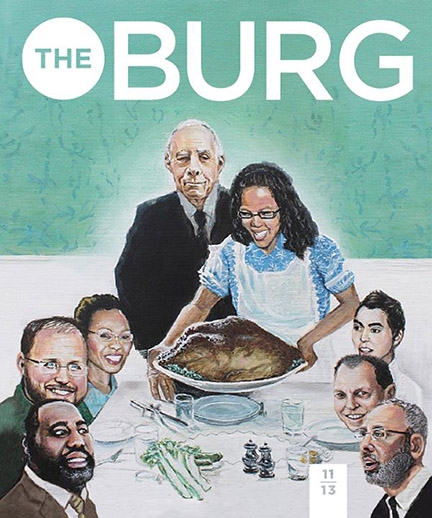
“Were you behind the cover?” He was referring to the cover of the November issue, whose parody of Norman Rockwell’s “Freedom from Want,” portraying Mayor Linda Thompson in a matronly dress and apron, had become controversial. The reporter, his invisibility further compromised, offered a meek defense.

“I’m an artist. I know just about every piece of Rockwell,” Summerford said. “But the difference between a family and enemies, and a husband and a wife—it’s that kind of thing. It was offensive, at first.” But, he said, “art is not to be judged.” Then he added, “If it is art.”

As more and more precincts reported, there were some murmurs about totals, but there was no one, it appeared, officially charged with keeping an up-to-date tally. Johnson was in a far corner, sitting on a barstool. He learned from the lone reporter that Dan Miller had already conceded the race.

“Why in the hell did he do that?” Johnson mused. “I’m riding it all the way out.”

Jennifer Smallwood, the school board president, approached. “What’s up, baby?” Johnson said. She gave him a hug and a kiss.

“I love you and I’m proud of you,” she said.

When she left, Johnson, alone at the bar, began to reflect on the race. “It was about 40 people that met with me in the church”—Trinity, at 4th and Maclay—“and asked me to consider a write-in. My sister gathered them up. She knew they’d make me consider it. That was right before the World Series in Minnesota, so I said I had to give it some thought while I was out there for two weeks.

“I don’t look at myself as being a mayor. I’m just a community-oriented guy. I love the city, and I do what I do. Even though I’ve been in leadership positions, in the military and things, even in public works—that’s what I get paid to do, and I just do my job. I’m not no career politician or nothing. I think you just need a regular person in there, that makes sure everybody get a piece of the pie.”

Johnson, who said he delayed his entry out of deference to his boss, the current mayor, had no stern words for the previous mayor, either. “Mayor Reed is the one that jump-started my baseball program. He put the seed money up for me to get started. His concern was the investment, whether the kids would take care of it. We put a perimeter fence around the field. But all the other stuff—I don’t have proof. People make accusations, you know.”

Someone approached with a little notebook, asking Johnson for his name and contact info. There was mention of a church database, and keeping in touch with the community. Johnson scrawled in the book and handed it back.

“Basically, what the community’s feeling is that grassroots folks are never brought to the table,” he continued. “And that’s essential, because they’re the eyes and ears of the community. We gotta start getting back to the basics. This city’s divided, but it don’t have to be. But these grassroots folks gotta sit at the table.”

In the room with the televisions, a man named Darryl Charles Troup said he became committed to Johnson after going door-to-door and gaining “a lot of knowledge about the character of Aaron Johnson as viewed by the public.” Troup, a native of Camden, N.J., usually goes by the moniker Minister 50. He is known for his rendition of Dr. King’s “I’ve Been to the Mountaintop,” a recording of which is available on YouTube. “I’ve been prepared to work with somebody like Aaron a long time,” he said, reflectively.

Morgan Chisholm, a softball player in Johnson’s league, was too young to vote, but had come to support her director. “His speeches are very good,” she said. “I was watching something the other day, saying they thought it was gonna be between the other two candidates, that they didn’t think Aaron would have much of an effect. I don’t think that’s true, because he’s such an important person in the community. He has a big heart, he does so much for people.”

The lone reporter, refreshing his computer screen, showed 28 out of 28 precincts reporting. A few people peered at the screen. Papenfuse commanded 3,618 votes; Miller, 2,333; and there were just over 1,300 write-ins, most of them presumed to be Johnson’s. The candidate, meanwhile, was being shown something on a cell phone—photo? text? video?—and was laughing.

Then the television, piercing as ever, declared that Papenfuse had won. Johnson muttered something to the waitress, and she muted the screens. He stood with his back to the room for a moment, looking at the television and wiping his lips. He spun around, paced a moment, and turned back to the TV. Nothing in particular was on. Voices in the room dimmed to whispers. Johnson spun again and strode forward.

“Hey everybody, gather here,” he said. “I know it’s late now. I want to say a few words to everybody.”

Someone said his name. The room erupted in applause. Johnson scratched his head.

“First of all, thank you to everybody who supported me. It means a whole lot to me, because again, I didn’t know what I was getting myself into. For you to have that sort of confidence in me, that I could become a good mayor… it means a lot.”

He expressed concern about what was in store for Harrisburg. “They want to privatize parks and recreation. That’s where a lot of our youth get their summer jobs from. If they outsource that, we gonna be in bad shape.”

He brought up the issue of money in the race, and hinted that some of his acquaintances had boosted other candidates just to get paid. “I know it’s hard times out there. I just hope that’s why they did what they did. I saw some guys I’ve known since kindergarten—I was shocked when I went to some of the polls. Literally just out there badmouthing somebody, just for the sake of getting somebody in that they don’t know.

“We started the race in August. We got a shoestring budget. But it’s important for me, that these kids can look at me and respect who I am. And that’s important to me. I’m gonna be straight with them. We got a meeting tomorrow at 9 o’clock. We’re gonna try to identify, who are the black leaders in Harrisburg? ‘Cause we ain’t got none. We need to identify them, because we need to be sitting at these tables, making these decisions.

“This little pettiness and stuff, the division, we gotta work on it. Either we gonna stand together, or you ain’t gonna be part of the agenda.” He mentioned Brenda Alton, a top aide to Mayor Thompson, who recently announced her bid for Lieutenant Governor. “We have to get her in, because it’s important for us to be in these seats,” Johnson said. “Because if we don’t get in, we don’t get our issues out.

“I’m gonna be off tomorrow, I can tell you that.” The room laughed. “But Thursday, I’ll get your trash, don’t worry about it. Whoever the commander in chief is, I’m gonna make sure they’re OK. I protect whoever the mayor is, because that’s my job.

“I just want to thank you again for coming out, supporting me, believing in me—”

“We love you, Aaron!” someone cried. There was another round of applause. Johnson had hands to shake and people to say goodnight to. He thanked the room once more, stepped out of the spotlight, and got to work.


Continue Reading

Same Old City

Pap3

Eric Papenfuse makes his acceptance speech last night.


So, what was that all about?

And, by “all that,” I mean the last couple of months of debates and divisions and accusations and counter-accusations and raising money and spending money and negative mail and countless interviews and news stories, all so voters overwhelmingly could re-affirm their selection from the May primary.

In the end, was it a good thing that Eric Papenfuse once again faced off against Dan Miller in the general election? Or was repeating the primary a waste of time, energy and money?

As I’ve written before, I found it disheartening that independent candidate Nevin Mindlin, who would have added a new dimension to the race, was tossed from the general election ballot after a petition challenge. But a Papenfuse/Miller rematch? Hadn’t we just been down that road?

I’ve asked a few colleagues and friends this question and have received a variety of responses. Some come down on the “worth it” side; others say no. Still others split the difference.

After Miller made his announcement to re-enter the race, I was definitely on the “not” side. I looked ahead and saw only more acrimony and bitterness in this already-divided city. I thought that a political repeat would serve little purpose other than to set people against one another again. Meanwhile, I saw almost no path to victory for Miller, so was even more confused over why this committed Democrat would decide to run on the Republican side, a ballot spot he had earned with 196 write-in votes.

I’ve since softened my opinion to a degree.

The race, in fact, did spark exactly the negativity I feared. Both sides hurled their share of barbs, with Miller notably more negative than during the primary campaign. This is no surprise, as challengers and candidates who face longer odds often go on the attack.

So, as the campaign wore on, Miller exploited and mischaracterized the issue of Papenfuse’s personal debt, while returning again and again to his campaign donors, in one mailer even turning Papenfuse into a marionette, implying that his wealthy contributors would pull his strings. Papenfuse responded with his own questionable assertions, such as calling Miller a career politician and comparing him to a chameleon. 

But, if you listened carefully, the candidates did offer substantive, interesting discussion that may have been lost had Miller stayed out. The Harrisburg Strong recovery plan was debated extensively, though I’m not sure many minds were changed. City management, priorities, debt, public safety, education, economic development and many other issues all were addressed through debates, interviews and campaign speeches. It is my belief that many residents are better informed as a result, though at a rather high cost.

Last August, after Miller announced that he would run on the Republican side, setting up the rematch, I summed up the coming general election contest with this: Harrisburg, are you really, really sure you want Eric Papenfuse, not Dan Miller, as your mayor?

After another tough, bitter contest, the answer certainly appears to be “yes.”

—–

How Harrisburg is like Springfield: In a post-election story today, PennLive reporter Emily Previti quotes Miller as saying this about his defeat, “There are 2,300 people who get it. But the city’s made their decision, and they’ve had their chance.”

This rather ungracious remark reminded me of a well-known scene from a Simpsons’ episode entitled “Trash of the Titans.” In it, Homer beats the incumbent Ray Patterson for sanitation commissioner. In his concession speech, Patterson says only this to the residents of Springfield before marching off the stage: “You’re screwed. Thank you. Bye.”


Continue Reading

Eric Papenfuse Elected Mayor of Harrisburg

PapenfuseFB

Eric Papenfuse makes his acceptance speech as mayor-elect of Harrisburg at Midtown Scholar Bookstore.


Democrat Eric Papenfuse tonight assumed the mantle of mayor-elect of Harrisburg, besting Republican candidate Dan Miller and write-in candidates Aaron Johnson and Lewis Butts Jr.

With all 28 precincts reporting, Papenfuse won the race with 3,618 votes versus 2,333 for Miller and 1,334 for a write-in, most of that vote presumably going to Johnson.

“The real victory will lie in the years ahead when our streets are clean, when our homes are safe, when our young professionals rush to get back to Harrisburg, rather than flee from it,” said Papenfuse, who, in his acceptance speech, encouraged his supporters at Midtown Scholar Bookstore to be humble and seek reconciliation with his opponents in the election.

“The true victory will lie in the days, the months, the years ahead when Pennsylvanians are once again proud of their capital,” he said. “When the people of Harrisburg once again cherish their homes, and when the rest of the nation connects Harrisburg with culture, prosperity and renaissance and not bankruptcy, despair and defeat.”

Running unopposed, Democrats Shamaine Daniels and Ben Allatt earned four-year terms on Harrisburg City Council, while sitting councilwomen Wanda Williams and Eugenia Smith were re-elected. Charles DeBrunner was elected in an uncontested race for city controller.

For Harrisburg school board, Democrats Danielle Robinson, Patricia Whitehead Myers, James Thompson and Kenneth Mickens earned four-year terms. Monica Blackston-Bailey, LaTasha Frye and Adara Jackson each won two-year seats on the school board.

In Dauphin County races, Bill Tully outpolled Democrat Anne Gingrich Cornick for Court of Common Pleas judge, and incumbent Republican Stephen Farina won his contest for prothonotary against Democrat Kelly Summerford.


Continue Reading

Communication Breakdown

A trash hauler on the tipping floor of the Harrisburg incinerator.

A trash hauler on the tipping floor of the Harrisburg incinerator.

We have no doubt that, in making these transactions, the Mayor had the best interests of the City in mind.  Nevertheless, it is always a serious matter when a city official disregards a judicial ruling and yields to Machiavellian precepts in assuming authority which is not vested in him. 

Judge Joseph H. Kleinfelter, May 29, 1997

This is exactly the kind of stuff the current mayor complained about the previous mayor doing. If council would have known about these secret contracts 3 weeks ago, Philbman [sic] would be gone… I was right not to trust him! 

Councilwoman Sandra Reid, Oct. 30, 2013

The RFP for Sanitation Services is under review by the various vendors. At the last meeting Council President Williams asked what vendors had attended the Pre-Bid Conference.

Municipal Financial Recovery Advisory Committee meeting minutes, May 8, 2013

Let me just say this Mr. Philbin. You did request to do the Power Point two times but we were so inundated, we had so much on the agenda… I do apologize. 

Council President Wanda Williams, Oct. 30, 2013

At some point in early 2014, the majority of Harrisburg’s trash will cease to be collected by employees in the city’s department of public works. Instead, it will be collected by employees of Republic Services, a Fortune 500 company and the second-largest solid waste management company in the United States.

Whether you know this, and whether you view this as a much-needed influx of competence and capital or a bit of behind-the-scenes skullduggery by the mayor and her administration, depends on how closely you’ve been paying attention. And to whom.

Earlier this week, the chair of City Council’s public works committee, Sandra Reid, tipped off a reporter at abc27 that the negotiation of the contract with Republic might not be above board. The station ran the story, under the headline “Are big money contracts being covered up in Harrisburg?”, on Oct. 29. “When I ask specific questions,” Reid says on camera, “I don’t get any answers. And I’m wondering, what are we hiding?” The story quotes Reid saying that residents’ trash fees will “undoubtedly” go up if collection is privatized.

By council’s legislative session Wednesday night, the sense of betrayal had spread to Reid’s colleagues. A few minutes into a presentation by Bob Philbin, the chief operating officer, and Kevin Hagerich, the director of public works, council members were ready to vent their displeasure. “This whole process lacks some common courtesy to City Council,” Eugenia Smith said. “I’m a little shocked and appalled on how this contract is surfacing.”

Kelly Summerford expressed surprise that the union president had apparently not objected to the loss of union jobs. Wanda Williams noted that council was “not aware as far as what has been happening with the negotiations with the employees,” and requested that she be invited to every future meeting of the committee negotiating the contract. And Bruce Weber, after an exasperated sigh, blasted the mayor’s administration and the receiver’s team for being “horrible at communicating the fact that there was a significant change to what is essentially a utility that will be coming down the pipeline very quickly.” He wondered about the rush to complete the deal, which has no financial bearing on the rest of the recovery plan, and demanded the process “stop and reverse course immediately.”

To the likely frustration of Hagerich and Philbin, the question of whether trash privatization is actually good for the city went largely unaddressed. That question will be more prominent on November 7, when the administration, representatives from Republic, and members of the receiver’s team will appear before council. Before getting into the communication breakdown, though, it’s worth pointing out the evidence in favor of the contract.

In the first place, as Philbin has already said, on television and before council, the new contract should save the city around $900,000 each year. Furthermore, the possibility of contracting out trash collection is not new. The original receiver’s plan, from February 2012, suggested partial privatization as a way to improve efficiency and access upgraded equipment that the city could not afford. Most municipalities around Harrisburg already have private contracts for trash services, and Hagerich, acting on behalf of the mayor, researched several of these arrangements to help craft the city’s request for proposals. And according to Harrisburg Authority Chairman Bill Cluck, who also advised the city on its request, the arrangement with Republic is deliberately designed to incentivize increased recycling.

None of these facts quite mattered Wednesday night, though, because the dispute was not really about trash. It was, instead, a chance to revisit one of Harrisburg’s time-honored traditions: antipathy between the mayor and council.

The particular struggle here, over who has the power to negotiate contracts, has been unambiguously settled in the courts. In 1989, in Moore v. Reed, the Commonwealth Court ruled that Mayor Stephen Reed had overstepped his executive function by entering into a contract with the Senators baseball team. “The authority to negotiate a valid and binding contract for a municipality is vested in the City Council,” the court wrote. In 1997, in a case concerning the allocation of funds from the sale of the city’s water system, the court upheld the ruling in Moore, maintaining that the city code “limits the Mayor’s function in the contractual process to ‘ministerial duties’ and does not embrace the negotiation process.” (Reed, during his defense, continued to hold that Moore was “wrongly decided.”)

In one sense, then, council is correct: its negotiating right has been violated. Part of the presentation on Wednesday included a timeline for implementation, and a letter has apparently already been delivered to city workers, explaining their options for continued employment at Republic. As Reid observed, that sounds like “a finalization of a contract, not a ‘middle-of-negotiating’ of this contract.” Council’s vote on the agreement is still required, but in the meantime they’ve tasked Hess, the city solicitor, with writing an opinion on council’s proper role.

As to the intimations of mayoral “secrecy,” however, council’s position is less credible. The request for proposals to privatize trash hauling was announced in March last year, at a press conference covered by local media. Since then, the receiver’s team has released updates on the proposal process at every single meeting of their advisory committee—a committee of which Williams, council’s president, is a member, and whose meetings are open to the public. The minutes of those meetings are available on the receiver’s website, and they show that Williams was frequently absent and neglected to send a replacement.

In short, council knew this was happening. And if they’d been paying closer attention, they’d have known the negotiations they are now clamoring to be part of had started a month ago without them. (Meeting minutes for Oct. 9: “Contract negotiations are under way with Republic Services…”) That’s not to excuse the mayor for poor communication. Nor does it invalidate the question of whether the administration has undertaken duties that are properly council’s. But it does undermine Reid’s insinuation about what the mayor is “hiding.”

In the wake of financial crisis, and under the terms of receivership, the procedures of city governance have been thrown into confusion. That’s partly due to the legal implications of state oversight, which remain a matter of controversy. And it’s partly due to the extraordinary workload that the receiver, council, and the administration all bear, which allows things to slip by unnoticed, even when they’re publicly aired.

But it’s also a consequence—familiarly, regrettably, and avoidably—of the persistent lack of communication between the mayor and council. On Wednesday night, council laid this at the door of the mayor, and not without reason. She has squabbled with council over the extent of her powers almost since the moment she was elected. (She has also regularly skipped both their meetings and the receiver’s advisory meetings, preferring to communicate through delegates, which may go a long way towards explaining the frequent disputes.)

In this case, though, council shares the blame. If privatization matters so much now, it should have mattered seven months ago, when the process to privatize started. This late in the game, after plenty of opportunities to get involved, it’s irresponsible to charge the mayor with concealment, and to rile up residents with an unfounded claim that they’ll be worse off with Republic.

The team of receiver William Lynch, for its part, is hopeful the matter will be resolved. “We’d certainly be in favor of anything that’s more inclusive of city council,” said Cory Angell, a spokesman for the receiver’s office. He acknowledged that the receiver, if need be, could take matters to court, but said that option was “not even being considered right now.”

Lynch’s preference, he said, was to open lines of communication and make sure all parties are comfortable. “Coming to some sort of common ground is more effective,” Angell said. “We’re better off sitting down and talking it out.”

Continue Reading

TheBurg Cover: An Explanation of Our Parody

FreedomFromWant1 BurgNovCover

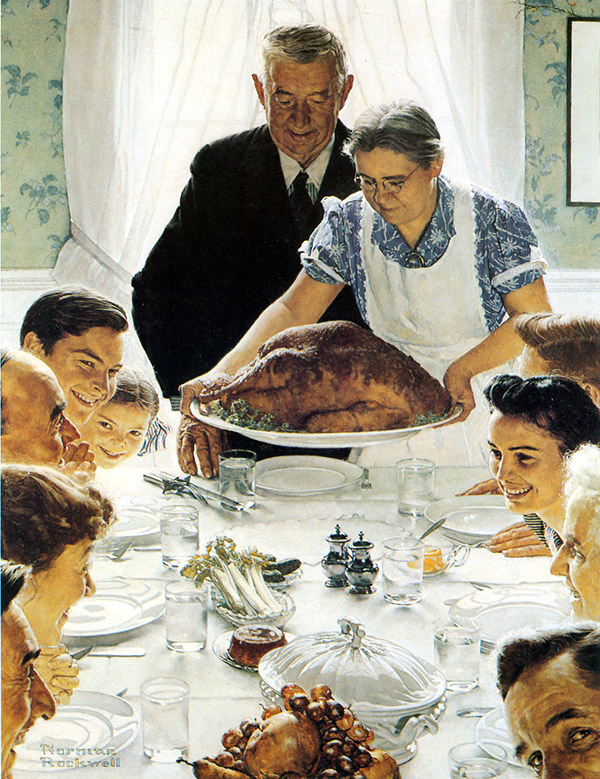
As many people may know, Norman Rockwell’s classic painting, “Freedom from Want,” depicts an American Thanksgiving dinner (above left) during the 1930s. In it, the family matriarch serves a feast to her hungry brood. 

In our November issue, we used the painting, which has been parodied often, to humorously depict the current political situation in Harrisburg (above right). Our intention was to show Mayor Linda Thompson, with receiver William Lynch standing behind her, offering the main course (the transfer of political power in the city) to Democratic candidate Eric Papenfuse (and two of his principal allies, Joyce Davis and Karl Singleton) on the left side of the table and Republican candidate Dan Miller (and two of his principal allies, John Campbell and Nevin Mindlin) on the right side.

We thought this was a timely concept and cover, given that November is both the month of Thanksgiving and an important election in Harrisburg. In this space, we wished to make clear our intention so that it would not be misinterpreted.

Lawrance Binda, Editor-in-Chief


Continue Reading

The Next Mayor of Harrisburg: From financial recovery to the role of mayor, the two candidates give voters a clear choice.

In recent decades, the general election for Harrisburg mayor has been something of a snoozer.

Most of the action rested in the primary, where this heavily Democratic city nominated the clear favorite come November. Could this year be different?

Indeed, it’s been a fascinating race.

The primary saw the late entry of businessman Eric Papenfuse, who quickly lapped incumbent Mayor Linda Thompson and her principal challenger, city Controller Dan Miller, to capture the Democratic nomination.

Then, just as the Democrats were rallying around their candidate, the saga took another turn. Independent Nevin Mindlin, regarded as the remaining credible alternative to Papenfuse, was tossed off the ballot following a petition challenge.

So up stepped Miller, who, while losing the Democratic nomination, had won the unchallenged Republican nomination by getting 196 write-in votes. With Mindlin off the ballot, Miller declared himself back in, setting up another Papenfuse/Miller contest for the Nov. 5 ballot.

To help Harrisburg voters, we asked each candidate four questions that we believe are relevant to the city at this time. We hope their answers, which we limited to 1,200 words for each candidate, will help voters who remain undecided make this important decision.  –Lawrance Binda

Screenshot 2013-10-30 20.45.26Dan Miller

It was a Thursday in early August, and City Controller Dan Miller, who only days before had announced the end of his mayoral campaign, was appalled by what was happening to the November ballot. The nominating petitions of independent candidates Nate Curtis and Nevin Mindlin had been challenged in court. If the judge agreed, Eric Papenfuse’s only competition on Election Day would be write-in candidate Lewis Butts, who had reaped a mere 64 votes in the primary.

In a sense, it was politics as usual in Harrisburg, a solidly Democratic city where races are usually foregone conclusions by November. But Miller, who had lost by a 6-percent margin in May, saw a political opportunity. “It’s a civic responsibility for me to get on the ballot,” he said the next day at the county Bureau of Elections, where, with his $25 filing fee in hand, he posed for photos before accepting the Republican nomination. “Let’s have a choice.”

In the weeks since, that choice has sharpened. On Aug. 26, the state-appointed receiver, William B. Lynch, submitted his updated recovery plan for the city of Harrisburg. In the wake of that 350-page behemoth’s unveiling, the public sphere clamored with voices of celebration and dissent. Where Papenfuse joined the chorus of approval, no one objected more forcefully than Miller, who claimed he saw in the plan’s various forecasts and provisions the same shaky accounting, and the same abuse of the local taxpayer, that had afflicted city government for years.

Miller, a native of the area, is a partner at Miller Dixon Drake, an accounting firm at the corner of N. 2nd and North streets that he founded after he was fired for being gay. (The ordeal was the subject of a lengthy profile in the New Yorker.) In 1994, he ran for a Democratic Party committeeman post and won. In 2005, he was elected to City Council, and four years later, to his current post of city controller—in a race during which, it must be observed, his opponent was successfully thrown off the ballot by a challenge to his nominating petition.

On council, Miller had been a fervent critic of Mayor Steve Reed’s intemperate borrowing. As controller, he found himself in repeated squabbles with Reed’s successor, Mayor Linda Thompson. The acrimony, over issues such as the city’s direct deposit system, the Act 47 process and the sale of museum artifacts, lasted through the entirety of Thompson’s tenure. It even extended to the virtual sphere, where Miller maintained a website for his office separate from the city’s.

The site, which contains a useful trove of documents about city finances, reflects the common thread that runs through much of Miller’s career. His leadership style may look stubborn or stalwart, depending on where one stands. It can be summed up in a slogan that, like many slogans, carries a double edge: if Dan Miller wants a thing done, he’s going to do it himself.

Miller Q&A

Q. We’ll start with a broad one. What do you think is the proper role of Harrisburg’s municipal government, and how do you perceive the mayor’s function within it?

A. The role of any municipal government is to serve the needs of its citizens in the most efficient and effective way possible. That means providing basic city services that enhance the quality of life for the entire community. The mayor serves as the chief executive of the municipality and is therefore responsible for establishing an achievable vision, appointing staff who share that vision and who work cooperatively toward its implementation. The mayor is also responsible for ensuring that the entire workforce understands his or her goals and expectations, and that success can only be achieved by their cooperation and dedication to their jobs. By leading a workforce with high morale and pride in their accomplishments, improving basic city services and operating in an open and transparent manner, the mayor establishes an image for the city as a welcoming place to live, work and play.

Q. One of the problems that the current mayor has confronted is an inability to retain city employees. As mayor, how would you ensure that the city keep and attract top-notch professionals to perform its various services?

A. I have had to confront this issue for the past 20 years as a small business owner, city controller and consultant to hundreds of businesses. To attract the best and the brightest, we must offer a competitive salary. Beyond that, we must treat people fairly, with respect, and make them feel valued. I have had great success retaining employees in living wage jobs. Three of my four full-time associates have been with me 11 or more years. As controller, I was able to recruit the most knowledgeable finance professional in city government. We need to create an atmosphere where city employees feel appreciated and get satisfaction from doing their jobs serving the public. By achieving those goals, we will be able to attract and retain the high quality employees the city seeks to staff its resurgence.

Q. If you are elected, what will be your top three priorities upon taking office?

A. The next mayor’s highest priority must be taking steps to improve public safety and ensure delivery of basic city services in an efficient and effective manner. While the mayor has no direct control over the school district, it is essential to advocate for and improve city education as much as possible. He must provide steady fiscal stewardship while making the city cleaner, greener and more attractive. He must be a vocal advocate for the best interest of the residents of the city of Harrisburg within the context of the receiver’s plan.

Q. Perhaps the most significant development since the mayoral primary has been the unveiling, and subsequent confirmation in court, of the state-appointed receiver’s recovery plan for the city. What positives and/or negatives do you see in the Harrisburg Strong Plan, and how do you view the next mayor’s role with respect to the plan’s implementation?

A. The next mayor will be required to execute the terms and conditions of the receiver’s plan. It brings much appreciated state financial aid to the city but does so at a very high cost. The optimistic financial projections on which the plan is founded would not meet the standard set by most financial professionals. The loss of so much future self-determination about infrastructure investment and economic development is a major concern for me and should be of concern to every citizen. I have substantial concerns about the plan’s long-term economic viability. Creditors, as willing participants in the incinerator retrofit financing deal at the root of many of the city’s financial woes, should be required to make as many concessions as the city’s taxpayers are being asked to make.

Despite these problems, the plan will have to be implemented in the most advantageous manner benefiting Harrisburg residents. This will require a skilled financial professional to balance the budget within confined limitations. I am the only candidate with the knowledge, experience and ability to achieve this goal.

Screenshot 2013-10-30 20.45.37Eric Papenfuse

Upon winning the Democratic primary in May, Eric Papenfuse, who had seen his share of electoral losses, seemed poised at last for success. He had run unsuccessfully for City Council in 2009, and again for county commissioner in 2011, where he lost by a mere 12 votes in the primary. But on the night of May 21, when he announced his victory at the Midtown Scholar bookstore, the business he built over the past dozen years, he all but assumed the mantle of mayor-elect. After saluting his former opponents, he spoke of plans for transition, including a series of public meetings on the city’s most pressing issues.

By the end of the summer, Papenfuse’s general election victory had begun to look less certain. Dan Miller returned to the race on the Republican ticket, taking with him a slice of traditionally Democratic voters. The late write-in candidacy of Aaron Johnson threatened to gobble up another chunk of that constituency. Meanwhile, the race began to be dominated by another development: the release of the receiver’s financial recovery plan.

In October, at the Harrisburg Hope debate, the opening question reflected the newly polarized terrain: were the candidates for or against Harrisburg Strong? The recovery plan had become a test of the candidates’ sympathies, which were measured by the same bitterness, hopes and suspicions that had defined city politics for years.

Papenfuse, meanwhile, tried to steer the focus to the issues he’d outlined in May. He held his public meetings on crime, blight, economic development and education, which he tended to conduct in a classroom style. The meeting on blight was essentially a two-hour policy discussion, where a handful of experts fielded residents’ questions on trash, utility rates and sewer mapping.

Papenfuse, a Baltimore native, has been increasingly involved in Harrisburg politics since settling in the city with his family in 1999. In his previous campaigns, he was a vocal critic of former Mayor Steve Reed. On more than one occasion, he testified about predatory loans knowingly entered into by the Harrisburg Authority, a process he witnessed as a member of the Authority’s board. His mayoral campaign, in contrast, has been defined by a technocratic approach. He has built his campaign around a promise to govern the city with informed, forward-looking initiatives.

Of course, the dominant issues of a political contest are rarely a candidate’s to choose. Since May, Papenfuse has had to navigate a series of surprises. Months ago, he expected to face independent Nevin Mindlin; he now finds himself in a heated rematch with Miller, who has portrayed him as an ally of moneyed interests and Harrisburg’s familiar power brokers. It must be a frustrating reversal for Papenfuse, long the crusading outsider. His challenge, in this fractious capital, is classically political: to run the campaign he always wanted while standing on shifting ground.

Papenfuse Q&A

Q. We’ll start with a broad one. What do you think is the proper role of Harrisburg’s municipal government, and how do you perceive the mayor’s function within it?

A. Harrisburg’s municipal government’s primary role is simple: to serve the city’s residents. The municipal government fulfills this responsibility by ensuring people within the city limits are able to live and work in safety and security. To effectively carry out its mission, the city needs a mayor with a broad vision, one who fully embraces the importance of collaborative relations with neighboring townships and counties.

As head of city government, Harrisburg’s mayor is the face of the city. The mayor sets the proper tone and atmosphere to nurture pride in our history and hope for our future.  Harrisburg needs positive, inclusive leadership now more than ever as it emerges from financial and political catastrophe. As mayor, I will provide that leadership and create a new image for our city at home and throughout the nation. Above all, I will ensure Harrisburg’s municipal government stays connected to the people, transparent in governing and prudent in management of our budget and resources.

Harrisburg needs a visionary leader in City Hall to take advantage of the second chance the city has been given through the “Strong Plan.” Harrisburg needs a leader who can do more than simply add and subtract. We need someone who can inspire people and galvanize a community. As mayor, I will inspire a new birth in our city as well as ensure the efficient functioning of municipal government.

Harrisburg needs the kind of leadership I can provide. It needs a leader who understands the importance of promoting business and investment to create jobs and provide goods and services. It needs a leader passionate about promoting quality education for our children as the only path to economic vitality. And it needs a leader who will unite the diverse communities and cultures within our city so that we all thrive.

Q. One of the problems that the current mayor has confronted is an inability to retain city employees. As mayor, how would you ensure that the city keep and attract top-notch professionals to perform its various services?

A. Any successful businessman knows the best way to retain quality employees is to pay them fairly and treat them well. It’s no different for city employees. They need to be paid fairly, treated with respect and inspired to serve the people of Harrisburg. As a businessman, I know that my enterprise is only as good as the people who keep it running. I also know the importance of maintaining high morale, and the Midtown Scholar bookstore has been lauded as one of the best places to work in Harrisburg. Of course, as we nurture high morale, it is important to address the serious salary issues that impede attracting the best and brightest to Harrisburg. We must find creative ways to increase salaries for professional positions in city government while not overburdening taxpayers. I am investigating ways to enlist the help of corporations to supplement salaries of key city workers through public-private partnerships. This is an idea that has been tried successfully in other municipalities and that might help Harrisburg attract the kind of talent it will need to get the city moving again. Public-private partnerships have the potential to augment scant resources in city government and bring in expertise and talent that will be sorely needed in the years ahead.

Q. If you are elected, what will be your top three priorities upon taking office?

A. Our top three will be attracting business and investment, crime and safety, and advocating for education. Beautifying our neighborhoods also is a priority as it impacts quality of life and economic development.

One of the most important things the next mayor can do is create a business-friendly atmosphere to create jobs for the people of Harrisburg. Being hostile to business and negative to investment is the wrong message for any mayor to send. I am an advocate for restoring pride and prosperity to our city. We can’t do that by pitting “Main Street” against “Wall Street,” as some have done in divisive, political rhetoric. We need both business and labor working side by side with the common goal of making better lives for us all. I am a strong advocate of labor and unions, but I am not foolish enough to believe that Harrisburg can be prosperous again without ensuring businesses feel welcome. I plan to create a Department of Economic and Community Development that will support business and investment and make it easier for small businesspeople to thrive.

Unless we reinvigorate our police department and reduce the crime rate, businesses will continue to shy away from our city. Ensuring strong leadership in the police department and accountability of police officers are at the very top of my priorities.

And while the mayor has no direct role in our schools, I will be a tireless advocate for our children, teachers and parents. The mayor can inspire businesses to support our schools through creative investment programs and by helping teachers feel appreciated. I have called for keeping school libraries open late to provide a safe haven for youth after school. As father of three small children, being an advocate for education is not only a political priority, it is a personal mission.

Q. Perhaps the most significant development since the mayoral primary has been the unveiling, and subsequent confirmation in court, of the state-appointed receiver’s recovery plan for the city. What positives and/or negatives do you see in the Harrisburg Strong Plan, and how do you view the next mayor’s role with respect to the plan’s implementation?

A. The next mayor will have to implement the Harrisburg Strong Plan, which is essentially a business plan for Harrisburg’s economic development. I am the only candidate with the business acumen and expertise to be able to effectively institute a business plan for the city of Harrisburg. Right now, Harrisburg needs more than an accountant. It needs someone experienced in business development who can inspire and stimulate growth. I built a successful business from scratch and stimulated the economic revitalization of Midtown Harrisburg. I can do that for the rest of the city and carry out the vision of the Harrisburg Strong Plan. I am the only candidate on the ballot who has pledged to work with the receiver to support the Harrisburg Strong Plan. As a businessman, I have the experience to be able to envision the significant possibilities the Harrisburg Strong Plan represents for the residents. As a community leader, I am encouraged at how the city’s leaders and debtors were able to reach common ground; and as a city resident, I am heartened that there is hope for Harrisburg to rise again. The plan is not perfect, as its creators acknowledge. A compromise is never perfect, and some of the plan’s failings may become known only in time. But for a city facing the bleak prospect of bankruptcy and possibly decades of financial uncertainty, the Harrisburg Strong Plan is a political, financial and morale boost for the city at a time when it so desperately needs hope. What Harrisburg needs is a mayor with a “can-do” attitude who will aggressively work to help the plan succeed . . . not someone who wants to see it fail. What Harrisburg needs is a mayor who will look past his own self-serving interests and work for the good of the people of our great city.

Continue Reading

Blog Response: Former mayoral candidate Nevin Mindlin reacts to “Stick to the Plan.”

After reading David Black’s response (to Paul Barker’s blog post, “Stick to the Plan“), I thought, “I get it, ‘Don’t worry about habeas corpus, just worry about the hanging!’”

Control over an economy, and the comprehensive planning of how that economy is shaped, has always been a political concern. Who is in control of the planning is exceedingly important, as history has revealed, even in our own community.  Ironically, that subject was just recently addressed in an article entitled, “China’s Coming Economic Slowdown,” by Josef Joffe in The Wall Street Journal’s Weekend “Review” section, Oct. 25, 2013.  In that article, Mr. Joffe discusses “rent seeking,” the economic term for an economy that is  “guided” or  managed by government, and explains that “authoritarian or ‘guided’ modernization plants the seeds of its own demise.”  

Mr. Joffe cites the social scientist Francis Fukuyama, who, reflecting on the French ancien régime, explained the concept of rent seeking, as follows: “In such a society, the elites spend all of their time trying to capture public office in order to secure a rent for themselves”—in effect, seeking to gain more economic return through political control than a free market would grant. Put in other words, rent-seeking is “the game of the mighty” to “convert public power into personal profit.” The phraseology that I have used to describe Harrisburg’s political game is “privatizing profits and socializing losses.”

“Rent seeking” is an incestuous political game where government and favored, organized interests, work together.  Government raises the banner of economic advantage through planning and managing the advertised outcome; in turn, favored interests seek and are given more power in the form of monopolies, subsidies, tax breaks and protection so as to increase their “rents.” “Licenses, building permits, capital, import barriers and anticompetitive regulations go to the state’s own or to favored players, breeding corruption and inefficiency.” And, as Mr. Joffe concludes, “This widening web of collusion breeds either stagnation or revolt.”

This is true whether under socialism/communism or corporate capitalism. It is true whether in China or in the United State under an increasingly managed economy. It is true at the national, state and local levels. The regime “rent-seekers” include both the Democratic and Republican parties. 

You can watch it play out in Harrisburg, first under Reed, then under Thompson, and now the hope is Papenfuse (the “new face of the old regime”)–“trying to capture public office in order to secure a rent for themselves.” Just look at the comprehensive planning process they tried foisting on us– both the LT and Papenfuse gangs together–trying to plot out how they intend to plan the projects and secure the grants, loans, subsidies and tax breaks that go with them. It is all just part of the “Harrisburg Wrong Plan.”

Nevin Mindlin is a former independent candidate for Harrisburg mayor.


Continue Reading

Your Credit Score: A Potentially Powerful Number

Screenshot 2013-10-30 20.48.47What is this score you hear so much about? And how can one number have so much power? Understanding the facts about credit scores will help you make choices that will protect your options in the long run.

First, know what a credit score is. It is a mathematical risk assessment based on the information available in your credit report. It does not factor in such information as income, employment, age, sex, and race.

If you are in the market for a home or car loan, a high score is important, as lenders will look to it to assess their risk in lending you money. The same goes if you are looking for a credit card with a low interest rate. Even potential landlords may look at your credit score to help them determine their risk in renting to you. Though you may not be in the market for a loan or home now, you never know what the future holds. Keeping your score as high as possible is usually a good idea.

A common scoring model is one developed by Fair, Isaac and Company. They issue a FICO score, which is based on many factors. Five of these factors are significant and within your power to control. They are (in order of greatest weight) payment history, amounts owed, length of credit history, pursuit of new credit, and types of credit in use.

If your score isn’t where you want it to be, the good news is that you can take steps to improve it.

• Obtain copies of your credit report from all three major credit reporting agencies to check for and correct errors.

• Pay down your debt. If you can’t pay the total balance each month, pay more then the minimum required payment.

• Pay on time, every time.

• Avoid aggressively transferring balances to new cards.

• Keep your credit card balances well under the maximum available limit.

• Only apply for and have the credit you need.

• Repay collection accounts, judgments, and liens.

Recent information matters most – so the faster you do all the right things, the faster you can repair damage. And avoid “credit repair clinics,” as they can’t do anything you can’t do for yourself for free.

Keep in mind that you can’t build credit without using it. Having several (two to four is a good rule of thumb) active credit instruments shows capacity and responsibility. Balance is key. Too many unused open accounts shows potential for high future debt, which can lower your score, while too few accounts can also have a negative impact because you won’t have a long history of responsible credit use.

Continue Reading