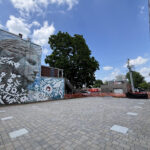
Convenience Store Application Denied

CornerStoreFB

A convenience store will not locate in Midtown Harrisburg after its application was struck down tonight by the city’s Zoning Hearing Board.

About two dozen neighbors packed into the hearing room to object to an application filed by Mohamed Ahmed Ahrar of Mechanicsburg, who wanted to open a store at the corner of Green and Kelker streets.

“I’m not at all convinced that another place to buy prepackaged food, if you want to call it that, will help our neighborhood in any way,” said Mike Banks, one of numerous area residents and property owners to testify against the plan.

The hearing began when Zoning Hearing Board Chairwoman Marian Frankston asked Ahrar what he expected to sell from the snug, 650-square-foot space. He responded by saying “soda, chips,” with Frankston adding that his application also mentioned cigarette sales.

Ahrar then said little, as Terry Lawson, manager for property owner Michael Goldberg Properties, testified on his behalf. Lawson mentioned that, over more than a century, the property has housed many businesses, including a tea shop, drugstores and several “cut-rate” or convenience stores. 

A few nearby residents testified that that the neighborhood breathed a sigh of relief after the most recent tenant, a barbershop, closed last April, saying that it had attracted loitering and alleged drug activity. Banks said he had called the police many times due to possible criminal activity in front of the shop.

“We finally have gotten some sense of safety and quiet after a decade,” he said. “We finally got it. I’m not sure my neighbors want to roll the dice again.”

In denying the application, the zoning board went against the vote of the city’s Planning Commission, which last week recommended approving the application, which sought a special exception from parking requirements and another to allow a convenience store to operate at the site.

About half-a-dozen other residents voiced objections to the application on such grounds as noise, parking and littering concerns. No residents spoke in support of the application.

Lawson said that the store would add to, not subtract from, the renaissance of the area, which sits at the border of the Engleton and Olde Uptown neighborhoods in Midtown. He added that the convenience store was the best use for the property compared to other applications his company had received, including for a skate shop and a tattoo parlor.

“We’re not being out of line with what we want to put there,” he said. “We’re being in line.”

Nonetheless, several residents said they feared a repeat of the disruption caused both by the barbershop and by a former convenience store long located at the corner of Green and Muench streets. Others said the neighborhood already has several other convenience stores within blocks of the site.

“I personally do not think it’s needed in the area,” said David Alexander of Kelker Street.

This is the second proposed convenience store in Midtown shot down recently by the zoning board. Several months ago, the board denied a store proposed for the corner of N. 3rd and Hamilton streets following similar objections by neighbors. 

Continue Reading

Residents Vent Fears, Frustrations at Parking Advisory Meeting

Ashia Richardson, owner of Hair at the Square salon in downtown Harrisburg, has started keeping a "notation system" in a notebook to keep track of when her clients need to feed the meter.

Ashia Richardson, owner of Hair at the Square salon in downtown Harrisburg, has started keeping a “notation system” in a notebook to keep track of when her clients need to feed the meter.

The hardship on low-income residents and the fear that visitors will be driven away by higher rates were among the concerns expressed at the first meeting of Harrisburg’s parking advisory committee, which took place Thursday morning at the Crowne Plaza hotel downtown.

While committee members sat around tables in the second-floor ballroom, supplied with microphones, pitchers of ice water and bowls of mints, a total of 16 members of the public stepped forward to voice their concerns about what the parking changes would do to the city. Among their number were a pastor, a deacon, a City Council member, a salon owner, a hardware store owner, the director of a theater group, numerous residents, property owners and landlords, and a disabled man.

Their comments struck a universal theme: that the expansion of meter hours and the increased meter prices and fines will hurt an already fragile economy and prevent people from shopping or locating in Harrisburg.

But each speaker added his or her own variation. Church representatives, for example, were particularly concerned about parking for funerals and weddings on Saturdays, and about the possibility that reduced parishioner contributions would impede their ability to provide services for the needy. Walter David Prediger, a deacon at Salem United Church of Christ, on the corner of Chestnut and S. 3rd Street, worried about the volunteers who drive in to help with a Saturday clothing giveaway, and park from 8 a.m. to 1 p.m. “That’d be $15 for one car,” Prediger said.

Business owners feared that the prices would simply drive customers away. Ashia Richardson, who opened her salon, Hair at the Square, across from Strawberry Square last year, said her clientele was “really taking a hit” since the introduction of the new rates. “The cost of service now includes $15 to park,” she said. “Our clients aren’t coming because they simply can’t afford parking.”

Residents expressed a variety of concerns, from how the rates would affect their own ability to park to what an exodus of frustrated drivers might mean for their city. John Mank, who lives in the Grayco apartment building downtown, said he found charging Saturday visitors “inexcusable.” “These people make this city live,” he said. “You’re doing more harm than good.” Mank, who had started with a quip that got a big laugh—“I’m gonna make this short, I’m at the meter right now”—concluded on the same note. “I gotta go and feed the meter so I’ll see you all later.”

The parking advisory committee was formed as part of the long-term lease of the city’s parking assets, a deal that closed on Dec. 24 and was a major component of the state-appointed receiver’s recovery plan for Harrisburg. Though it has no power to adjust rates or hours, the nine-member committee can approve recommendations to management, and its meetings provide a public forum for updates on the system’s operations.

The advisory committee includes representatives from just about every entity involved in the ongoing management of the lease—including the asset manager, PK Harris Advisors, Inc., an affiliate of Trimont Real Estate; the new operator, Standard Parking; the Dauphin County commissioners and Assured Guaranty Municipal, who both provided security for the $294 million bond issue associated with the lease; and the Pennsylvania Economic Development Financing Authority, or PEDFA, which issued the tax-exempt bonds.

The committee also includes a representative from the mayor’s office and a representative from council, though, for now, it includes no direct representative for downtown residents or for downtown businesses. Bruce Weber, the city’s budget and finance director and the mayor’s representative on the committee, tried to change that Thursday morning with a motion to add two seats to the table. But no one seconded the motion, and the proposal did not come to a vote.

During public comment, committee members listened without responding. “Public comment is not a question-and-answer session,” John Gass, the representative for PK Harris Advisors, had reminded members before he opened the floor. Instead, he said, the committee would take note of public concerns and address them later.

Before concluding the meeting, however, Gass did offer a few remarks about the “perspective from the working end.” “I don’t know one issue brought up today that hasn’t been discussed by our working group,” he said. He explained that the 60 days since the parking transaction closed had seen a “tremendous amount of activity” on a “very challenging project.” “We’d appreciate if you could give us the ability to try to work on your comments,” he concluded. “We’re dealing with many issues.”

Among those issues is the parking system’s tight budget this year, with projected revenues only just covering the many obligations under the parking lease, including debt payments, operating expenses and payments to the city. (To see TheBurg’s visual breakdown of the system’s financial obligations in 2014, click here.) That budget includes combined revenues from on-street meters and enforcement of around $5.5 million—a much smaller figure than the $16.6 million expected from garages, but an amount still critical to the system’s bottom line.

In the meantime, business owners like Richardson are feeling the pinch. Clients who once came to her salon every other week, she later explained, have reduced their appointments to once a month. Others have started coming after 7 p.m., when on-street parking is free, forcing her to work late into the evening.

“I had to walk one client to her car at 11:30 at night,” she said. To help customers avoid getting tickets, Richardson has even started a parking “notation system” in her salon, to keep track of when clients need to feed the meter. Nonetheless, three have already been ticketed, including Richardson herself.

“When I went to the office to pay the ticket, it was so dysfunctional,” she said. “They didn’t have receipt paper or cash for change. I had to wait 25 minutes in line while this woman wrote on a piece of scratch paper.”

For the parking system’s 2014 operating budget, or to see a visual breakdown of the sytem’s financial obligations this year, please click on the links below.

Park Harrisburg 2014 Operating Budget

Park Harrisburg 2014: Where the Money Goes

Continue Reading

Proposed Convenience Store Gets First OK

CornerStoreFB

The Harrisburg Planning Commission tonight gave unanimous approval to a planned convenience store at the corner of Green and Kelker streets.

By a 4-0 vote, the commission recommended that a special exception be granted to allow a convenience store to operate at the site and to waive the four-vehicle off-street parking requirement. The commission only mandated that the property pass a health inspection and follow city-mandated rules for signage. Commission members also recommended that a trash receptacle be located outside the store, which is slated to operate from 6 a.m. to 8 p.m. daily.

Otherwise, the commission asked few questions of the applicant, Mohamed Ahmed Ahrar, or of the representative of property owner Michael Goldberg Properties. Despite some opposition in the Olde Uptown neighborhood to the proposal, not a single member of the public attended the meeting.

The commission did read a letter in opposition submitted by Historic Harrisburg Association, which claimed the proposed store was incompatible with the neighborhood, but quickly dismissed the reasoning.

The commission’s recommendation now goes to the city’s Zoning Hearing Board, which will meet on Monday to consider the application. The board has the final say over whether to grant the special exception. 

The century-old property at 224 Kelker St. most recently housed a barbershop, though, over the years, has served many uses, including as a corner store, a drugstore and a tea shop.

Continue Reading

Firefighters Agree to Cuts, Health Care Cost Sharing Under New Labor Contract

Photo credit: Brian Bastinelli, BrianBastinelli.com.

Photo credit: Brian Bastinelli, BrianBastinelli.com.

The Harrisburg chapter of the International Association of Firefighters has agreed to a new labor agreement, Mayor Eric Papenfuse announced on Tuesday. The agreement, which the union approved by a 38 to 15 vote, includes reductions in scheduled salary increases, an increase in employee health care contributions and salary cuts for new hires. It also represents the final concession from the city’s labor unions required as part of the state-appointed receiver’s recovery plan.

“I think the important thing to note here today is that a tremendous number of sacrifices are being made by the members of the firefighters’ union in an effort to allow this city to move forward,” Papenfuse said. In meetings with the firefighters, he said, he had tried to convey that, without contract modifications, “the budget would not be balanced and the city would stay mired in the financial difficulties that had gotten us first into Act 47 and then into receivership.”

The mayor’s proposed budget for 2014 already included the expected savings under the new agreement, projected to be around $1.6 million, or around $20,000 for each of the 79 bargaining-unit positions in the fire department. This figure is somewhat misleading, however, as the direct effect on an individual firefighter depends on his or her time of hire, family size and consumption of health care.

Some of the savings are achieved through the elimination of scheduled pay raises, previously set under a contract extension signed by former Mayor Stephen Reed. The raises, which had been set at 3 percent per year beginning in 2013, will be zeroed out in 2013 and 2014 and replaced with a 1-percent raise in 2015.

A sizeable portion of the projected savings—around $485,000 per year, according to Susan B. Friedman, a lawyer for the receiver—will come from a change in firefighters’ health care plans. Formerly, the majority of firefighters contributed nothing to the cost of coverage beyond their co-pays. Under the new agreement, their health care plans will now include partial contributions from each paycheck, at a rate of $40 for individuals and $90 for family care, as well as deductibles, out-of-pocket maximums and a change in co-payments for prescriptions.

The largest chunk of the savings, around $520,000, is expected to come from a reduction in numbers manning each shift, from 16 to 14 firefighters.

On Tuesday, Mayor Papenfuse attributed the union vote, in part, to a pair of “behind-closed-doors meetings” he held with firefighters in January, during which he tried to restore trust between the city and its public safety personnel. “We met right where they sleep, right inside their quarters,” he said. “I extended a hand of partnership, of trust, and I am pleased to say I was met with a hand from the other side.”

Glenn Sattizahn, the local union president, also acknowledged the mayor’s role in bringing the new agreement to a vote. “The turning point, I would venture to say, was after the meetings with the mayor,” Sattizahn said. “He’s quite persuasive.”

But, Sattizahn added, continued pressure from the receiver’s office, which could eventually compel the firefighters to comply through the courts, also played a role. “There wasn’t really a whole lot of compromise,” he said. “We were, for the most part, forced into this.”

Continue Reading

Harrisburg Declares Snow Emergency

Harrisburg Mayor Eric Papenfuse today declared a snow emergency for the city, beginning at midnight and requiring the removal of all vehicles from snow emergency routes. The full text of his statement is below.

MAYOR ERIC PAPENFUSE DECLARES SNOW EMERGENCY EFFECTIVE MIDNIGHT TONIGHT

HARRISBURG – Mayor Eric Papenfuse is declaring a snow emergency effective midnight tonight, requiring city residents to move their cars from emergency snow routes.

By special arrangement with Standard Parking, residents can park without charge at the Locust Street Garage. Free parking is also available on City Island, the Fire Museum at 1824 N. 4th St., and at the Farm Show Complex (Maclay Street side near Front Entrance).

Through special arrangement with the Capital Area Transit (CAT), shuttle service from the Locust Street Garage, City Island and the Farm Show, will be extended until 8 p.m. Wednesday. The shuttles will resume at 6:45 a.m. Thursday, if weather permits.

Mayor Papenfuse is also urging people to voluntarily move cars parked on Penn, Allison and Zarker Streets to facilitate plowing, salting and access by emergency vehicles.

The National Weather Service is warning the winter storm could dump an estimated 8-12 inches of snow on the region.

To qualify for free parking in the Locust Street Garage, drivers will need proper ID or documentation.  Residents may enter the garage from 4-10 p.m. Wednesday, Feb.12, 2014 or from 8 a.m.-7 p.m.  Thursday, Feb.13, 2014 to qualify for free parking.

To gain access to the garage, residents will pull a ticket at the entrance.  To exit residents will need to show a driver’s license with a Harrisburg address or proof of residency.  

To help accommodate residents, garage hours have been extended three hours – to 10 p.m. on Wednesday, Feb. 12.  After 10 p.m. vehicles in the garage will not be accessible until 8 a.m. Thursday, Feb. 13.  The garage will then remain open and accessible to everyone until 7 p.m. Thursday.

Unless further notice is given, all residents will need to exit the Locust Street Garage by 6:30 a.m. Friday, Feb. 14 to avoid being charged for parking in the garage during this period. Residents wishing to park their cars after 10 p.m. Wednesday should chose City Island, the Fire Museum or the Farm Show. Cars must be removed from the Farm Show parking lot by 6:30 a.m. Friday.

If poor conditions persist, free parking times may be extended.  Please monitor www.parkharrisburg.com. www.harrisburgpa.gov  or local media for communication of extended time.

SNOW EMERGENCY ROUTES INCLUDE:

·         Division Street – Front Street to 7th

·         Second Street – Paxton St. to Division St

·         Maclay Street- Front to 7th St.

·         Seventh Street – Division to Fisher Plaza St.  (Fisher Plaza is between Forster and Walnut Streets at the Capitol Complex, to the immediate east of the Main Capitol Building. The city has no responsibility for streets within the Capitol Complex)

·         Walnut Street – Fisher Plaza to Front St.

·         Paxton Street – Cameron to City/Swatara Township line

·         Derry Street- Mulberry Street Bridge to City/Paxtang Line

·         Market Street – Cameron Street  to 25th St.

·         State Street – Fisher Plaza to City/Susquehanna Twp. Line

·         Herr Street – Cameron Street to city/Susquehanna Twp. Line

·         Seventeenth Street – Sycamore Street to Arsenal Boulevard

 On Thursday, Standard Parking will restrict their ticketing to cars parked on Snow Emergency Routes.  The Mayor will hold a press briefing at noon Thursday to update the public on weather conditions. City Hall will remain open during the Snow Emergency, but city employees are being allowed liberal leave.

 For more information, contact Joyce M. Davis at [email protected]; or call (717) 255-3015.


Continue Reading

Old Business

Susan Brown-Wilson, foreground, and other members of City Council at council's legislative session, Tuesday, Feb. 11.

Susan Brown-Wilson, foreground, and other members of City Council at council’s legislative session, Tuesday, Feb. 11.

During her opening statement at last night’s legislative session, a few moments before she and her colleagues swiftly gutted the proposed pay raises and new positions in Mayor Eric Papenfuse’s 2014 budget, City Council President Wanda Williams asked the assembly to remember Feb. 13, 2010.

On that day, she recalled, council rejected the proposed raises of the newly elected Mayor Linda Thompson, whose first budget included a similar raft of pay increases. “I have to be consistent and fair,” Williams said. “I cannot treat this administration any different when it comes to fiscal responsibility.” She then proceeded to lead council members through a series of votes that, amendment by amendment, strained the Papenfuse proposal through the sieve of austerity.

They cut the proposed raises for the communications director, Joyce Davis ($9,500); the finance director, Bruce Weber ($4,950); the human resources director ($4,000); and the special assistant to the mayor ($5,000). They trimmed the salary for the heftily titled “Senior Advisor for Education, Youth & Civic Engagement,” Karl Singleton ($9,500), and removed a new position, director of sustainability, from the budget entirely. They even slashed the vacant position of business administrator, from $79,500 to $75,000—less than the cut to Singleton and Davis, which makes sense, because it’s better to save the biggest slaps for faces that are actually there.

To sum up, it was the old familiar scene in city hall. Facing requests from the mayor, council members threw up a wall of resistance and naysaying in order to achieve—well, what, exactly? Apparently not savings. No sooner had council stacked up the clippings from the Papenfuse budget than they proceeded to spend them all, restoring a “diversity officer” position at an annual salary of $50,000. The decision effectively reversed a separate proposal of the mayor’s, to consolidate the diversity officer’s role, which had been vacated in early January, with another position in human resources. This led to a long and tortured discussion about whether such a position was necessary, followed by council’s conclusion that it was, followed by a recess, as it was realized that the sum of council’s alterations was an imbalanced budget. (This was finally resolved by a $5,000 cut to the restored, and vacant, diversity officer position.)

It’s fair, of course, to question whether the mayor’s proposed raises are really about attracting the “best and brightest,” as he has said. Papenfuse filled many of the positions with close allies from his campaign—no surprise there—who will no doubt stay on board irrespective of the lure of a higher salary. But residents who were pleased with council’s performance last night might pause to reflect on what it represents, and whether it’s really worth celebrating.

For one, it would appear that communication between the mayor and council has already broken down. During the recess, Papenfuse said his overtures to discuss the budget had been rebuffed by every member except Ben Allatt. (Allatt, in any case, voted in favor of the cuts.) Instead, council simply sent him their proposed amendments by email on Tuesday afternoon. One member, Sandra Reid, seemed delighted with this strategy. When asked whether she had tried to engage with the mayor, she referred, with a smile, to a “gift” she had given him—a bag of sugar cubes, with a message about everyone “having to take their lumps.” It’s one thing to disagree with the mayor, but quite another to skip the step of negotiating and head straight for childishness and snark.

The second disturbing thing about last night’s session is how little council seems to have bothered with Papenfuse’s rationales. The boost to the human resources director, for instance, was meant to reflect the addition of a labor-law background to the position’s qualifications. In testimony last week, Papenfuse explained that the solicitor’s office was routinely inundated with legal questions from human resources; by placing a lawyer at the H.R. helm, he hoped to free up the solicitor for other matters. Council ignored this justification and made the cut without discussion. They did the same for the position of mayor’s assistant, despite the fact that the “raise” really reflected a consolidation of positions in the former mayor’s cabinet, from two assistants to one.

Before and after their votes, members of council claimed to defer to a sense of fairness, particularly with regard to the financial pain distributed across Harrisburg’s populace. They wanted to be the voice of residents, who have put up with increased taxes, and workers, who have put up with frozen wages. And indeed, at the start of Tuesday’s session, a handful of residents admonished council not to grant raises to a few in the mayor’s cabinet when many continue to endure cuts in the name of recovery.

But council went a good deal further than fairness, and wound up making adjustments that were indiscriminate and, in many cases, petty. The city will now spend exactly what it would have before, but in place of the mayor’s own cabinet priorities, we have a redundancy in human resources. And, thanks to the preferred style of several members of council, we also have that old Harrisburg standby—pointless acrimony.

Continue Reading

Harrisburg 2014: A Balanced Budget?

Mayor Eric Papenfuse’s amended 2014 budget, which Harrisburg’s City Council is expected to vote on Tuesday night, has been touted as the city’s first balanced budget in years—a sign of the capital city’s successful sacrifices in the form of increased taxes and labor concessions, and a testament to its return to health after unending fiscal crisis.

But a close look reveals that the picture of a balanced budget is somewhat misleading, as the budget actually includes a $4 million shortfall, disguised in the form of a “negative expenditure” representing assumed concessions and other savings which were not realized at the time of its initial passage in December.

Deep within the 176-page budget document, under the “General Expenses” section, is a line item labeled “Concessions and Vacancies,” in the amount of $3,959,157. The item is carry-over from Mayor Linda Thompson’s final budget, adopted at the end of last year, and was retained in the amended budget Papenfuse submitted to City Council in January. The item is listed as a negative expenditure—an amount reducing, rather than adding to, the total expenditures for the year. It represents a variety of savings that the city hopes to realize before the end of 2014.

Some of these, such as the projected $1.6 million in savings achieved under the firefighters’ new labor agreement, approved by a majority union vote last Friday, have already been secured. Others, such as potential reductions in health care costs across a smaller city workforce and reductions in overtime, are hoped for but not guaranteed. The just-under $4 million figure also includes certain city positions that are budgeted for but have not yet been filled. If the city doesn’t realize all the savings that it hopes for, it could close the gap by leaving some of these vacant.

Steven Goldfield, a financial advisor to the receiver, said that the negative expenditure, while “unconventional,” should not be taken to imply a funding deficit. “We’re not going to let them adopt a budget that’s not balanced,” he said. He attributed the line item to the city’s former finance director, Robert Kroboth, and said he was uncertain why Kroboth had balanced the budget that way. The receiver and his team, Goldfield said, had emphasized to Mayor Papenfuse and the new finance director, Bruce Weber, that the new administration would have to “own this budget,” including the decision to maintain the $4 million negative expenditure line.

Weber could not be reached for comment, but Joyce Davis, the mayor’s communications director, said that Weber, the mayor and council were all aware of the negative expenditure. “It’s part of the budgeting process going forward,” she said.

Continue Reading

August Wilson’s “Fences”–Intense Family Drama at Open Stage

FencesFB1

Race and class become one on a family’s front porch in 1950s America, the setting of August Wilson’s “Fences.” The Pulitzer Prize- and Tony Award-winning drama tackled heavy issues in a light fashion during Friday’s opening night at Open Stage of Harrisburg’s thrust-stage theater.

Wilson, a Pittsburgh native, dealt with his share of bigotry as a mixed-race child of divorced parents growing up in the ‘50s. He died in 2005, only a few months after the Los Angeles opening of “Radio Golf,” his final play. Wilson’s “The Pittsburgh Cycle,” a compilation of 10 plays, including “Fences” and “Radio Golf,” are each set in a different decade and depict life for African Americans throughout the 20th century.

“Fences” centers on Troy Maxson, played by a wry Leonard Dozier, who conveys the emotion of a bitter father, straying husband and unfulfilled African-American man. At times, the audience may have laughed inappropriately, but Dozier conveyed passion and conflict that finally silenced even the faintest snickers.

Troy’s experiences with racial oppression allow him to view opportunity as something for whites only. Despite a promotion at work and the offer for his son to play football on a university team, Troy views whites, easy money and most institutions as “the devil.” Troy’s juxtaposition with son Cory (J.C. Payne) shows the failures of a father who doesn’t want his son to out-achieve him. Baseball talent Troy, prohibited from the Major Leagues because of his race and/or age, limits Cory to work and chores instead of allowing him to pursue college football. Physical fight scenes between father and son help build action while stressing their relationship and showing Troy’s age and hypocrisy.

Cory’s growth in the play leads him to the Marines, which he joins also to strike out against Troy, who similarly hates his own father. The audience senses a progression in Payne, and it feels like he actually matures during the performance. Payne effectively shows the pain of a child who hopes to do better than his own father and who struggles with repeating his parents’ mistakes while living under their roof. His final defiance against Troy—absence from his funeral—is spoiled by Cory’s mother Rose, a measure that saves Cory from becoming like him.

Sharia Benn’s Rose is not the only woman with whom Troy has fathered children. Son Lyons (Jeremy Patterson) and daughter Raynell (Seneh Green) each have different mothers. Rose is forced to raise Raynell after Troy’s mistress dies during childbirth, a tense moment that Benn nails.

Benn’s portrayal is overwhelming, as she encapsulates all the upset and abandon of a woman who has tried too long to make things work. With Troy’s news of his mistress’ baby, Benn’s easy-going Rose makes way for a heartbroken, betrayed Rose who won’t put up with nonsense any more. Her sweet demeanor changes to a deep and serious one in the following scenes with Troy, with passionate delivery that brought this reviewer to tears.

Troy’s best friend, Bono, is similarly authentic in Aaron Bomar’s performance. His gestures, facial expressions and line delivery are the most convincing in the show, as Bomar captures everyone’s favorite family friend.

Gabe (Michael Powell), Troy’s brother whom he uses for money, is a war veteran with a plate in his head. Consequently, Gabe runs around the neighborhood causing drama within the community. As the family prepares for Troy’s funeral, Powell delivers a powerful holler that, though crazy, is the most sobering moment for “Fences” characters, and the family on-stage seems to transcend the problems Troy has caused, even after his death.

The cast seems to be a real family, and the connections between characters benefit from this chemistry. These tough issues, showed in a relatable dynamic, remind us of America’s unjust past, an important step to improving the future. Open Stage’s production is a must-see, a drama, beautifully written and presented, hit straight over the fences.

August Wilson’s “Fences” runs through March 1 at Open Stage of Harrisburg, 223 Walnut St., Harrisburg. For more information, visit https://openstagehbg.com or call 717-232-OPEN.

Continue Reading

A Plan, a TRAN and City Hall

For much of Wednesday night’s budget hearing—the second regarding Mayor Eric Papenfuse’s amended budget and, like its sister hearing last week, a four-hour marathon—Councilwoman Sandra Reid aggressively set the tone, as she often has in the past year.

The recently re-elected Reid, who chairs council’s public works committee, has a confrontational style that can assert itself even over seemingly innocuous matters. Last November, she raised an awful lot of hell over what she claimed were exorbitant water bills, but which turned out to be no scandal at all. At other times, her complaints are like misbegotten PSAs: the right message, more or less, but the wrong delivery. This was the case when, on Wednesday night, council broached the topic of Papenfuse’s proposed partnership with the regional chamber, CREDC, under which CREDC will help fund an economic development position in city hall. Papenfuse has defended the proposal as a way to bring welcome assistance to the city without tapping tax dollars, which it may well prove to be, though some have reasonably wondered whether it will yield any quid pro quo.

Reid brought up the ethics question, but then drifted into a bizarre analogy, comparing the late-arriving boost from the chamber to the release of Americans in the Iran hostage crisis in 1981. “They made sure that the previous president was out of office before they let one hostage [be] released,” Reid said. Similarly, Dave Black, CREDC’s president, “didn’t do anything to help us when we were struggling financially. Now all of a sudden we have a brand new mayor, now he has $90,000 to give.”

This pugnacious quality of Reid’s also came into play during one of the more interesting points of discussion Wednesday night: whether the city should issue a tax and revenue anticipation note, or TRAN.

A TRAN is a form of short-term debt aimed at solving a cash-flow problem that afflicts many municipalities. A municipality must make payroll throughout the year, but it typically receives the bulk of its revenue in bunches. In Harrisburg, the largest influx of revenue occurs in March, when most residents pay their property taxes. A second injection, from the state, is subject to the caprice of the state budgeting process. Last year, the city received $5 million, much more than in years past, but didn’t get the money til October. The periods just before these influxes, like the last days of the month for someone living from paycheck to paycheck, can get pretty lean. The purpose of a TRAN is to establish a line of credit the municipality can draw upon in the event of a funding shortfall.

In December, under advice from the receiver, Harrisburg requested proposals from lenders for terms of a possible TRAN. According to Steve Goldfield, a financial advisor on the receiver’s team, a number of “one-time events” had placed additional pressure on Harrisburg’s budget, among them a spate of retirements since the fall and a delay in consummating the recovery plan. Though the city ended the year with a projected fund balance of $4 million, there’s a chance it might feel a pinch by the end of February and struggle to pay all its bills. The TRAN offer the city ultimately accepted, from Metro Bank, would likely be issued in the amount of $2 million—enough to cover any temporary shortfall before March revenues arrive.

In the eyes of Papenfuse administration, the $2 million TRAN is a modest proposal. Bruce Weber, formerly a council member, and now the mayor’s budget and finance director, has called it an “insurance policy.” It would cost Harrisburg around $15,000 in fees, plus interest on any portion of the $2 million that the city actually draws on, at an annual rate of 2.5 percent. At the first budget hearing, on Jan. 30, Weber expressed the administration’s hope that the amount drawn on “would be nothing,” and that the TRAN would expire “quietly” on June 30, the end of its term.

For some, however, the merest mention of new debt was enough to raise alarms. In a typewritten testimony submitted to council, Nevin Mindlin, the former independent candidate for mayor, took the TRAN as evidence that the recovery plan was already “headed for failure.” The city, he wrote, “remains in financial distress, as indicated by the need to take on debt to pay its bills”; given the city’s fund balance of $4 million, he added, there was “no excuse” for a TRAN. Reid concurred. In the wake of the recovery plan, she said, “We thought it would be kumbaya and angels singing.” How could it be that, barely more than a month into the new year, the city might already need to borrow again?

In a city so recently scarred by bad debt, it’s reasonable to be wary of anything even resembling a frivolous loan. But not all debt is created equal, and Reid, along with her colleagues on council, must know that sooner or later the city will have to borrow. When it does, a track record of modest, responsible borrowing will be a good thing to have. A TRAN, with its short term, its low interest rate, and its limited scope, is about as far from extravagance as debt can be. Neil Grover, the city solicitor, likened it to an individual applying for a gas card or other simple line of credit to rebuild her rating after bankruptcy. “The city needs to re-establish itself in the market,” he said.

In his column this month, Lawrance Binda, TheBurg’s editor-in-chief, described the return to “normalcy” he hopes will occur in Harrisburg. “In many places, normalcy would be judged as a low bar to aim for,” he writes. “However, in Harrisburg, it would represent an improvement, an end to years of uninterrupted crisis.” On council, and among some members of the public, the debate over a TRAN was greeted with reflexive distrust, as if it represented an extension of that crisis. But however council settles the debate, they should recognize—and we should be relieved to know—it’s a normal debate to have.

Continue Reading

The High Cost of (Cheaper) Parking

“Stop the parking meter hike! Make the rich pay, not the workers! Don’t squeeze workers and small business. This is a tax on the people!”

If you poked your head into the public sphere during the past two weeks, you probably encountered a complaint about Harrisburg’s parking fee hike, adopted in the fall as part of the receiver’s recovery plan and taking full effect this month.

The new rates at on-street meters—$3 per hour in the central business district, $1.50 per hour outside it—and the extension of hours to include Saturdays and weekday evenings, from 5 to 7 p.m., have prompted angry reactions from just about every corner. Complaints that the changes are “draconian” or “sudden,” or that they’ll spell doom for downtown businesses, could be heard at Tuesday’s parking forum at the Hilton, arranged by Roxbury News. If you missed that, you could find them on TheBurg’s Facebook page, or in the PennLive comments section, or in an online petition drawn up by a local entrepreneur.

The quote at the top of this article, though, isn’t from Harrisburg and isn’t from this year. It actually comes from a flyer handed out in the fall of 2009, at a meeting of the Municipal Transportation Authority in San Francisco’s city hall. At the time, the San Francisco MTA was beginning to undertake a parking meter study that would lead to expanded hours, increased enforcement, and—in many places—increased rates. A group of activists who opposed the study, from the ANSWER Coalition (for “Act Now to Stop War and End Racism”), handed out the flyers as people entered the room. During the meeting, a representative from ANSWER took to the microphone and issued warnings about a “tax that is disproportionately put on the poor, the working class and small-business owners.”

What the activists didn’t seem to realize was that the parking study was actually designed to achieve goals that ANSWER, several of whose members opposed the Iraq war under the mantra “No Blood for Oil,” might have shared. The MTA study was based on the principles outlined in “The High Cost of Free Parking,” a landmark text in urban planning by Donald Shoup.

In his book, Shoup, an economist and urban planning professor at UCLA, argues that the wide availability of underpriced parking in America has had devastating consequences for the environment and for our cities. For decades, urban planners sought to make cities accessible to cars—for example, by requiring new developments to provide adequate off-street parking. The result, according to Shoup, is that people now expect to find parking everywhere they drive, which in turn encourages them to favor cars over every other form of travel. “Free parking,” he writes, “helps to explain…extreme automobile dependence, rapid urban sprawl, and extravagant energy use.”

To correct this, Shoup suggests, cities should embrace three remedies. First, they should match the price of curb parking to demand, which usually means increasing it. Second, they should stop requiring new developments to provide ample off-street parking for potential customers. Finally, they should direct any additional parking revenues to projects in the neighborhoods where they are collected. The ultimate goal is to eliminate the expectation of cheap and abundant parking everywhere we travel, thereby encouraging more people to walk, carpool, and use public transit and reducing the number of cars on the road.

I thought of Shoup’s work this week and last, when the public reaction to the new rates in Harrisburg reached fever pitch. Harrisburg differs from San Francisco and other cities in that the demand for parking has never been so great as to produce congestion. But Harrisburg has also suffered the ill effects of cheap and abundant parking. People who live in the city often drive when they could bike or walk, and people outside the city drive alone when they could carpool or use public transit. This has obvious environmental costs, but it also has social consequences. Much of the city looks the way it does because its planners, for several decades running, have operated on the assumption that everyone will drive everywhere they go. As a result, we have wide urban highways slicing up neighborhoods and surface lots and multi-story garages dotting our downtown.

I now wonder whether the reaction to the parking hike is really a knee-jerk resistance to changes that city residents would have readily embraced if they’d been presented in a different frame. No one likes to pay more for things, of course, and there are plenty of reasons to be wary of increased fees in a city whose management of money has been, shall we say, less than sterling. (Where those fees will be going under the new arrangement, and whether that’s an improvement, will be the subject of a second parking column next week.)

But I think that a long view of the new parking system should acknowledge several potential upsides. For one, daily commuters who previously dodged garage rates will now, as a result of higher on-street rates and increased enforcement, be pushed into the garages. That may not seem obviously good for the city, except that, under the new arrangement, a portion of the higher revenues will flow into the city’s general fund. If City Council and the mayor take Shoup’s advice, and direct some of these revenues towards the improvement of the district producing them, I suspect downtown businesses will come to see the rate hike as less of a threat.

City residents, for their part, will have an incentive to walk, bike or carpool where previously they drove. That’s good for the environment, and though it may require a change in ingrained habits, I suspect such a change is more likely to occur than not. Last week, several business owners expressed a worry that their customers would flee for venues with free parking. That may be true for some suburban customers, but I’d wager that businesses have nothing to fear from city residents, who locate here in part because they want proximity to urban amenities. We’re more likely to walk or share the cost of parking with friends than to ditch Federal Taphouse and Little Amps for the Olive Garden and Starbucks. Federal Taphouse and Little Amps are part of why we moved here.

That brings me to the suburban customers. It may be the case that downtown businesses will lose some of their customers who drive into Harrisburg expressly for weekday happy hours and Saturday events. But here, again, I’d urge business owners to take the long view. In the short term, they may have to work to keep some suburban customers with incentives like rewards for carpooling or parking validations. But in the long term, these patrons will be replaced by new urban ones, as easy access to urban amenities becomes increasingly dependent on actual proximity to them.

A recent comment on our Facebook page is a good demonstration of this point. Last week, we posted the photo above, of a new downtown meter, on our wall. Below it, a reader from Mechanicsburg lamented that, because of the addition of Saturday parking charges, what was once a free afternoon in the city for the film and art festival “will now be an approx $20 expense.” “I’m sure this will be changing my plans,” he added.

When I read that, I thought, Which plans? The ones to live outside the city but have free and easy access to its amenities? It’s a well-worn point that the rise of the automobile contributed to the decline of many an American city, including this one. Our continued deference to car ownership, in the form of cheap parking, has helped to artificially devalue what cities have to offer. As Shoup writes, “Free parking is an invitation to drive wherever we go.” Parking in Harrisburg wasn’t free, but it was cheap and abundant—and as a result, it was an invitation for people to enjoy the amenities a city can offer without paying city property taxes or sending their children to city schools. To the extent that it’s an invitation to live here, rather than simply park here, the fee hike in Harrisburg may not be such a bad thing.


Continue Reading