Council Candidate Kennedy-Shaffer Faces Petition Challenge

Alan Kennedy-Shaffer, left, with former Harrisburg receiver David Unkovic at a Harrisburg Hope forum at the Midtown Scholar Bookstore in 2011.

Alan Kennedy-Shaffer, left, with former Harrisburg receiver David Unkovic at a Harrisburg Hope forum at the Midtown Scholar Bookstore in 2011.

Harrisburg City Council candidate Alan Kennedy-Shaffer faces two challenges to his bid for office that, if successful, would strike him from the ballot in the May Democratic party primary.

The challengers filed their complaints with the Dauphin County court this week, alleging that Kennedy-Shaffer, a notary public, improperly certified his nominating petitions with his own notarial seal.

The challengers are David L. Smith, of the 2600-block of Lexington Street, and Jan Prosseda, of the 2800-block of N. 2nd Street, both registered Democrats, according to court filings.

Candidate nominating petitions contain a section in which the person circulating the petition must attest to its legitimacy in the presence of a notary.

In their complaints, Smith and Prosseda claim that Kennedy-Shaffer acted as the notary on the affidavits for 11 of the 12 petitions he filed to get on the ballot.

Doing so, they allege, was a violation of state law, which states that a notary public cannot act in an official capacity on transactions in which he or she is “directly or pecuniarily interested.”

The challenged petitions contain a total of 243 signatures. A twelfth petition, which was stamped by a notary other than Kennedy-Shaffer, contains an additional six signatures. A candidate needs 100 signatures to get on the ballot.

Destini Hodges, a running mate of Kennedy-Shaffer’s, circulated some of the challenged petitions, as did Stanley Gruen, who recently applied unsuccessfully with Kennedy-Shaffer for a zoning variance to open a distillery in Midtown.

In a separate section of the petitions, called a “candidate’s affidavit,” Kennedy-Shaffer did obtain the seal of an independent notary.

A hearing on the petition challenges has been scheduled for Friday, March 27 before Judge Scott A. Evans.

Reached late Friday, Kennedy-Shaffer said he had not yet received copies of the challenges, but that he was aware of them and “optimistic Judge Evans will let the voters decide who will best represent them on City Council.”

Kennedy-Shaffer, an attorney and a former employee at the state Liquor Control Board, is one of 12 Democratic candidates running for City Council in this year’s primary.

He is the founder of Harrisburg Hope, a grassroots political organization that has hosted candidates’ nights, debates and other public events since early 2011. In 2014, he failed in a bid for chairman of the Dauphin County Democratic Committee.

The primary election is scheduled for May 19.

Continue Reading

TheBurg Podcast, March 20, 2015

Welcome to TheBurg Podcast, a weekly roundup of news in and around Harrisburg.

March 20, 2015: This week, Larry and Paul talk about the faintest glimpse of a conclusion to the grand jury probe into the city’s incinerator debt fiasco, a challenge to a City Council candidate’s run for office, a bid for a blighted Midtown building and council’s eyes for independent legal advice.

Special thanks to Paul Cooley, who wrote our theme. You can find his podcast, the PRC Show, on SoundCloud and in the iTunes store.

TheBurg Podcast can be downloaded by clicking on the date above or by visiting the iTunes store. You can also access the podcast via its host page, here.

Continue Reading

Mixed Use Proposed for Historic Moose Lodge


WCI Partners may be interested in converting the historic Moose Lodge into a mixed use project.

WCI Partners may be interested in restoring and repurposing the historic Moose Lodge in Midtown Harrisburg.

WCI Partners is eyeing the former Ronald H. Brown Charter School site, which it would like to restore and convert to a mix of commercial and residential space.

WCI President David Butcher confirmed that the Harrisburg-based developer is interested in the property, but would offer few additional details, saying that a plan had not been finalized.

“We are looking at a potential mixed-use project there and are currently doing our due diligence,” said Butcher.

The property consists of four individual parcels along the 900-block of N. 3rd Street. It includes the 38,000-square-foot Moose Temple lodge at the corner of N. 3rd and Boas streets and three much smaller, dilapidated townhouses. According to a legal notice in PennLive, the sales price is $900,000.

For-profit charter school company Mosaica Education bought the property group in 2000 for $6.6 million, contracting with Ronald Brown to run the school. The buildings have been empty since 2005, after the Harrisburg school district’s Board of Control refused to reauthorize Ronald Brown’s five-year charter.

In 2010, local businessman Phil Dobson bought the properties at judicial tax sale for $188,000, flipping them back to Mosaica a few months later for $320,000.

The property group originally included the old Boas School at the corner of Forster and Boas streets. That parcel was sold in 2009 and now houses an executive-style apartment building.

In October 2014, a federal judge placed Atlanta-based Mosaica in receivership after the company defaulted on $20 million in debt. The receiver is now disposing of some of Mosaica’s real estate holdings in an attempt to turn around the ailing chain of charter schools.

A hearing on whether to approve the sale of the properties to WCI is slated for March 25 in U.S. District Court in Atlanta.

The Harrisburg Moose Temple lodge was built in 1924, designed in the Beaux Arts style by renowned Harrisburg architect Clayton J. Lappley.

Disclosure: Alex Hartzler, publisher of TheBurg, is a principal with WCI Partners LP.

Continue Reading

Kane: Incinerator Probe Hoped To End Soon

Former Harrisburg Mayor Steve Reed, left, and former Harrisburg Authority board member Fred Clark at a Senate hearing on the incinerator financings in 2012.

Former Harrisburg Mayor Steve Reed, left, and former Harrisburg Authority board member Fred Clark at a Senate hearing on the incinerator financings in 2012.

Pennsylvania Attorney General Kathleen Kane briefly addressed the progress of the probe into Harrisburg’s incinerator financings Tuesday morning, saying her office hoped to bring the case to a conclusion “in the very near future.”

The remarks came at a budget hearing before the Senate appropriations committee in response to a question by Sen. Rob Teplitz, D-Dauphin, whose district includes Harrisburg.

Teplitz brought up the investigation as a prelude to a question about funding for a military and veterans affairs division in Kane’s office.

It was critical to his constituents, Teplitz said, to find out “whether that debacle was the result of criminal activity on the one hand or just bad government or bad lawyering on the other hand.”

In response, Kane said she understood the importance of coming to a conclusion, adding that “dedicated agents” had been working on the investigation “since its inception.”

“All people want is the truth,” she said. “We’re hoping to draw to a conclusion in the very near future. And we understand that no stone will be left unturned.”

Teplitz is also the Democratic chair of the Senate local government committee, which held hearings on the incinerator financings in the fall of 2012.

Those hearings sought to shed light on how a series of borrowings in the mid-2000s related to a retrofit of the city’s trash-burning facility had ballooned to a more than $350 million debt that pushed the capital nearly to bankruptcy.

A host of witnesses testified, including Harrisburg’s first receiver David Unkovic, former Mayor Stephen Reed, future Mayor Eric Papenfuse and a number of past board members from the municipal authority that approved the borrowings.

Continue Reading

TheBurg Podcast, March 13, 2015

Welcome to TheBurg Podcast, a weekly roundup of news in and around Harrisburg.

March 13, 2015: This week, Larry and Paul talk about Gov. Wolf’s proposed state budget and its possible pluses for Harrisburg, the incremental movements in the lawsuits over the city’s gun laws, and the fateful decade when Harrisburg city government went into the hotel business.

Special thanks to Paul Cooley, who wrote our theme. You can listen to Paul’s own podcast, the PRC Show, on SoundCloud or in the iTunes store.

TheBurg Podcast can be downloaded by clicking on the date above or by visiting the iTunes store. You can also access the podcast via its host page, here.

Continue Reading

TheBurg Podcast, March 6, 2015

Welcome to TheBurg Podcast, a weekly roundup of news in and around Harrisburg.

March 6, 2015: This week, Larry and Paul talk about Gov. Wolf’s proposed state budget and its possible pluses for Harrisburg, the incremental movements in the lawsuits over the city’s gun laws, and the fateful decade when Harrisburg city government went into the hotel business.

Special thanks to Paul Cooley, who wrote our theme. You can listen to Paul’s own podcast, the PRC Show, on SoundCloud or in the iTunes store.

TheBurg Podcast can be downloaded by clicking on the date above or by visiting the iTunes store. You can also access the podcast via its host page, here.

Continue Reading

Harrisburg School Property Taxes Eliminated under Wolf Plan

SchoolSpreadsheet

A page from the school funding spreadsheet distributed today by Gov. Tom Wolf’s office. In order, the final three columns represent the total proposed property tax reduction allocation for the 2015-16 school year; the 2012-13 residential real estate tax collected; and the percentage of proposed residential real estate tax reduction for the 2015-16 school year.

Harrisburg residents would see their school property taxes zeroed out if a bold plan proposed today by Gov. Tom Wolf passes the state legislature.

Wolf’s proposed 2016 budget would dramatically change how schools would be funded, as increased income and sales taxes would provide much of the money for public schools. As a result, residential school property taxes in many of the state’s poorer districts would be eliminated, while wealthier districts also would see a reduction.

In Harrisburg, residents would pay no school property tax at all. Even non-resident homeowners would have their taxes reduced under Wolf’s proposed budget.

To pay for his plan, Wolf would raise the state’s income tax to 3.7 percent from 3.07 percent and the sales tax to 6.6 percent from 6 percent. The proposal was a key part of the $29.9 billion spending plan for 2016 that Wolf unveiled today.

“This is quite an exciting day,” said Harrisburg Mayor Eric Papenfuse. “If you take school property taxes to zero for Harrisburg, you’ll see people flocking in to buy properties in the city.”

Papenfuse said he wasn’t sure of the odds of Wolf’s plan being passed, but hoped it would not be summarily rejected by the Republican-controlled legislature.

“He’s building on a Republican House proposal to do something similar,” Papenfuse said.

Wolf’s proposal would not eliminate school property taxes for most suburban jurisdictions, but would substantially lower them.

For instance, the school property tax for Camp Hill residents would fall by about one-third, with a similar decrease for homeowners residing in the Central Dauphin School District.

Historically, property taxes have provided the bulk of school funding in the United States. In recent years, however, some states have begun to look to other ways of funding schools so that the burden is shared more equally among all taxpayers, not just property owners.


Continue Reading

TheBurg Podcast, Feb. 27, 2015

Welcome to TheBurg Podcast, a weekly roundup of news in and around Harrisburg.

Feb. 27, 2015: Larry and Paul try (and mostly fail) to speed through the many topics of a newsy week. Among the topics of discussion: the once-a-year Airing of Greivances before the city’s parking committee, a partial victory for lawyers, guns and money, the rejection of a land sale and the newest edition of TheBurg. And the answer to a piece of Harrisburg trivia. Q: What drives Harrisburg residents to council meetings in droves? Clue: It rhymes with “balsa music.”

Special thanks to Paul Cooley, who wrote our theme. You can find his podcast, the PRC Show, on SoundCloud and in the iTunes store.

TheBurg Podcast can be downloaded by clicking on the date above or by visiting the iTunes store. You can also access the podcast via its host page, here.

Continue Reading

The City’s Interest: In 1993, Harrisburg went into the hotel business. More than two decades later, it’s still living with—and paying for—this legacy.

Screenshot 2015-02-22 11.26.38On Sunday, April 20, 1997, around 3 a.m., a pair of Saint Vincent College students, in town for the College Republican State Convention, were in a room at the Ramada in downtown Harrisburg when they heard a knock on the door.

According to a taped statement given later by one of the students, whom I’ll call Jill, her friend went to open the door when three men suddenly pushed their way into the room. Two of the intruders pinned her friend to the wall. A third put on a mask and started demanding money. Then he approached another student, whom I’ll call Tom, who had been sleeping in one of the beds. Tom “looked up and the guy just came down and just smashed him right across the face,” Jill recalled. “And blood just started coming out everywhere.”

Jill’s statement, which she didn’t give until two years later, wound up as an exhibit in a long-running personal injury lawsuit Tom filed, alleging the hotel bore responsibility for his injuries—a broken nose, a deviated septum and “shock and injuries to his nerves and nervous system.” The suit hinged on Tom’s claim that the hotel had lax security and that the automatic lock on the room’s door had failed.

In its response, filed with the court in May 1998, the hotel’s owners denied the charges. That wasn’t surprising. But the person who signed the document was—Robert Kroboth, the city’s deputy business administrator and chairman of the Capital City Economic Development Corporation.

The city formed Capital City Economic Development Corporation in late 1993 to facilitate an ambitious takeover of what was then the Harrisburg Hotel. The hotel, a 10-story concrete and masonry structure with an underground garage and a swimming pool, sat at the corner of 2nd and Chestnut streets, a block away from city hall. Prior to the opening of the Hilton, in 1990, it had spent several years as the only major hotel downtown. But, in October of that year, about a week before the Hilton’s grand opening, the hotel’s owner, a Florida-based management company, filed for bankruptcy. A year and a half later, the property was seized in foreclosure.

When the city got involved, in 1993, the hotel was on the brink of being shuttered. Rick Staub, who’d been brought in to manage the facility during a period of receivership, recalled it being a “real throwback kind of a place.” The service carts were equipped with shag rakes, which housekeeping staff would drag over the carpet on their way out of the rooms. The restaurant bar had porthole windows through which patrons could see into the swimming pool. The Aetna Life Insurance Company, which had taken control of the hotel in the foreclosure action, planned to close it and put a fence around it. They had gotten as far as an estimate of its carrying cost when then-Mayor Stephen Reed intervened. “Steve Reed caught wind of it,” Staub recalled, “and said, ‘We just can’t have a commercial building like that close downtown.’”

This past January, Harrisburg signed off on a plan to manage a $42 million debt it must pay in increments each year through 2033. The debt stems from a complex transaction from 1998 involving the city’s sale of three downtown office towers to one of its many municipal authorities. In a memo that year, Mayor Reed outlined a plan for spending proceeds from the sale—around $24 million—on all manner of city needs: repaving streets, demolishing blighted structures, buying fire trucks and police cars, planting trees. At the top of the list, at $10 million, was a single expense: “Retirement of Ramada Hotel Bonds.”

At the time the hotel takeover occurred, people understood it was unusual. The Patriot-News linked it to Reed’s other public-finance experiments, like the purchase of the Senators baseball team and the backing of $16.3 million of the Hilton’s mortgage. At the same time, downtown Harrisburg was experiencing a revival that no one wished to see disrupted. Kroboth, in an email, explained that the mayor and council “agreed that it made more economic sense to purchase and renovate the hotel to get it to the point that it could later be sold than the alternative of blighting a half-city block in the midst of the downtown renaissance.” They also wanted to save people’s jobs, as the “vast majority of the hotel’s employees were city residents.”

Reed, for his part, sold the move as essential to the Hilton, whose convention bookings he said would suffer without overflow lodging nearby. (According to Kroboth, Reed also saw a need for a “middle-market hotel” to attract visitors who wouldn’t spring for the Hilton.) Years later, when the risks started to show, he stood by the decision. “I can still say candidly that I do not regret our having intervened to save the hotel and keep it in existence,” he told the Patriot in 1999. “I believe it was the right decision then, and the interests of the city and its central business district demanded that such occur.”

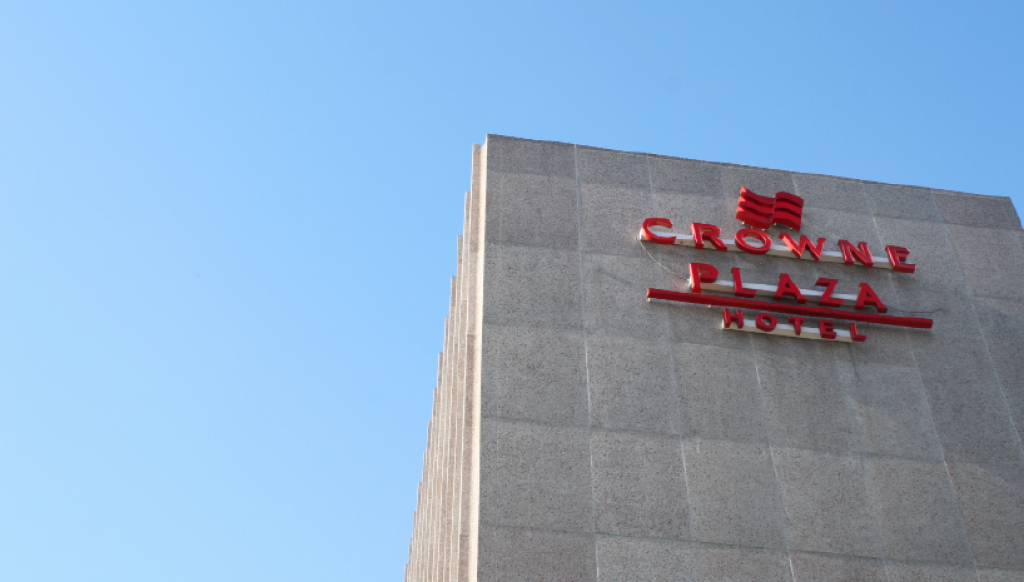
Indeed, after the period of city ownership, the hotel was upgraded and joined the Crowne Plaza chain, under whose flag it operates today. “He succeeded in keeping it open, and you have to give him credit for that,” Staub said. Or, as a more recent advisor to the city put it, “There is a Crowne Plaza and not a hole in the ground.” As far as the health of downtown Harrisburg is concerned, that seems an obvious benefit. What was the cost?

At the time of the 1998 lawsuit, Capital City Economic Development Corporation had a five-member board, most of them, like Kroboth, closely connected to city government. One of them was Richard House, the City Council president. Another was Milt Lopus, a financial advisor to the city. A third was Wilmer Faust, executive director of the Harrisburg Redevelopment Authority.

The board met each month, typically at the hotel itself, and heard reports from Staub, who stayed on as manager. Meetings were “serious, structured and professional,” Kroboth recalled, conducted according to Robert’s Rules of Order, with written minutes and formal agendas. Bruce Foreman, the corporation’s solicitor throughout the ownership period, said members would also review the progress of renovations. “It was a very old hotel and needed upgrades,” he recalled.

The renovations were a key part of the takeover’s financing plan. The hotel was reportedly in terrible shape—in the course of the former owner’s bankruptcy workout, half the rooms had been stripped of valuables. Reed’s plan, which he brought to City Council in July 1993, was to spend several million dollars renovating it, then sell it off when it turned a profit. Patriot articles at the time referred to a “market analysis” supposedly showing the hotel would break even sometime in 1995. But, according to the paper, the city treated the analysis as confidential.

The proposal was controversial. Council delayed an initial vote, after residents and local hotel owners opposed the plan at public hearings. The owner of the Quality Inn on Front Street worried about having to compete with a city-backed enterprise. In August, the CEO of another hotel company told the Patriot the Harrisburg Hotel should be shuttered immediately because of safety problems, including inadequate fire protection. But the city dismissed the concerns. “You’re going to find there are some envious hotel operators that are afraid when this is all done, the Harrisburg Hotel could possibly dip into their clientele and that’s why they’re screaming foul,” Councilman House said.

The city ultimately financed the takeover and renovation with a $10 million borrowing, in the form of bonds issued in early 1994 by the Harrisburg Redevelopment Authority. Out of the proceeds, around $3.5 million were slated for renovations, including $300,000 for a new sprinkler system, $425,000 for asbestos abatement and $597,000 for revamping rooms. Around $2.2 million went towards repaying the city, which had advanced money to HRA to buy the hotel from Aetna and to cover operating expenses while the borrowing was negotiated.

A little more than $4 million went towards costs that were only indirectly related to acquiring and fixing up the hotel. Such costs, which are present in every municipal borrowing, are important—the true price of a public project can’t be measured without them. In the case of the hotel project, the city spent $605,052 on what are called “costs of issuance,” which include things like fees to ratings agencies, financial advisors and lawyers. One of the larger payments was to Eckert Seamans, a local law firm, which received $95,000—$45,000 as bond counsel, $20,000 for organizing Capital City Economic Development Corporation, and $20,000 for the city’s agreement guaranteeing payments on the debt, plus expenses.

These indirect costs can also give a sense of a borrower’s actual assessment of a project’s risks. The confidential market analysis, according to the city, projected the hotel would become profitable in 1995. But the city also borrowed large sums as a kind of insurance in case things turned out differently. For instance, $1.5 million of the 1994 borrowing was what’s known as capitalized interest—money borrowed upfront to cover early debt payments, in this case through May 1996. Another $1.1 million was for “working capital,” to cover operating expenses while the renovations were completed. The city also borrowed $1 million for a reserve fund, to cover some of the debt in case of a shortfall.

Such borrowings are normal in construction projects, which often require a “ramp up” period before they become profitable. But, as a 2012 investigative report on the Harrisburg incinerator debt discussed, they can also result in unnecessary expense. Steven Goldfield, who worked on the audit and later served as an advisor on the city’s financial recovery team, explained why this was so. “If the construction is supposed to be done in one year, why borrow for two years of debt service?” he said. “It’s just more debt.”

As it turned out, when it came to generating enough revenues to make interest payments, the hotel needed all the time it could get. The $3.5 million renovations budget depended on an exemption from a state law requiring public projects to pay contractors the prevailing union wage. When the state deemed the hotel a public project, construction costs on the hotel ballooned. The renovations, which Staub said were originally expected to bring the hotel into the Doubletree chain, were scaled down; the city had to seek a new franchise.

In July 1995, the Patriot reported the hotel would become a Ramada. The article quoted Reed as claiming the hotel had been profitable since the previous April. But, the article also noted, the mayor and hotel officials “refused to disclose financial records for the hotel or discuss occupancy rates.” A year and a half later, in November 1996, the paper reported the hotel was running a deficit of half-a-million dollars. The city blamed the shortfall on the prevailing wage problem, which had prevented two whole floors from being renovated. In Kroboth’s recollection, though occupancy was “good” on the finished floors, the inability to charge Ramada rates on the others made it difficult to meet original projections. (The hotel, according to Staub, rented rooms on those floors at steep discounts to rail and airline employees—$30 per night, compared with the $100 the Hilton was charging.)

To solve the problem, Reed said he would seek another $3 million from City Council to finish the renovations. He brought the proposal to council in December, prompting a reproachful editorial. “That the city would put together a borrowing plan based on a hunch it could get around the law is not evidence of good management,” the Patriot’s editorial board wrote. In a subsequent critique, they urged the controller and council members to pay closer attention to the mayor’s spending. A year later, Reed backed off the plan for the additional borrowing. The extra debt, he told the paper, would have stayed on the books until 2020. Instead, he started looking for a buyer.

When the plans to sell the Ramada were initially reported, in the summer of 1998, Reed pledged the city would recoup its entire investment. The private investor, a company called Monarch, was going to pay $1 million upfront, and then another $500,000 after several millions in renovations were completed. The city would later get a share of net profits, or a share of any proceeds in the event of a sale, sufficient to repay at least the full $10 million.

As part of the 1994 borrowing, however, the city had entered a series of agreements tying up the hotel’s revenues. In June 1998, those agreements were relinquished to clear the way for the sale. This was made easier by the fact that all of the bonds had been sold to a single lender—what was then Phoenix Home Life Mutual Insurance Company. Phoenix signed off on the city’s revised guarantee agreement, releasing the hotel from its ties to the debt. Under the new agreement, the bonds were secured solely by city tax dollars.

The exposure was only temporary. That fall, Reed brought a new real estate proposal to council. The city would sell its downtown office towers in Strawberry Square to the Redevelopment Authority, thereby generating a one-time infusion of $24 million. The money would go to a variety of projects, including paying off the stranded debt from the Ramada hotel. In a memo to City Council, Reed was careful to characterize the new bonds as “self-liquidating,” meaning city taxes would never be used to repay them. In fact, he said, profits left over after operating expenses and debt service would “come to the City’s General Fund in the Year 2016 and beyond.”

In recent years, as 2016 approaches, the 1998 debt has returned to headlines. The problem is the security on one portion of the bonds—rents from Verizon, a tenant in one of the Strawberry Square towers. The company’s lease expires in early 2016, shortly before the first scheduled debt payment. In lieu of rent, the city will be on the hook for the full obligation. In September, the Commonwealth agreed to rent additional office space after Verizon leaves, relieving the city of a portion of the burden. But the city will nonetheless have to budget tax dollars to cover a majority of the debt payments, due each year through 2033.

These bonds, often referred to as the “Verizon tower bonds,” are technically separate from the ones that were used to pay off the hotel debt. Those were secured by rent payments from the Commonwealth, which had a separate lease for Strawberry Square offices through 2025. Still, it’s hard not to see them both as threads in the same elaborate quilt. Throughout 1999, City Council drew on the proceeds from both sets of bonds without distinction, paying for all kinds of “capital projects”: police sedans, fire bureau equipment, a Civil Rights History project, Verbeke St. landscaping. And Reed’s November 1998 memo, outlining a list of proposed uses for the $24 million, didn’t discriminate, either.

Capital City Economic Development Corporation still exists, though it doesn’t appear to have conducted any business for several years. Kroboth, who left the city at the end of 2013, said that to his recollection it never embarked on any other projects. In 2003, it briefly changed its name to HarrisCom, Inc., as part of an abortive enterprise involving the sale of phone lines to city entities. Wilmer Faust, the Redevelopment Authority executive director who was on the corporation board, died in 2005. Milt Lopus, the board member whose firm served as financial advisor to the city on numerous deals, including the original $10 million borrowing in 1994, the 1998 bond issue and the sale of the hotel, died in February of 2014. (Lopus’s former associate, Bruce Barnes, declined to be interviewed.)

Several months after the hotel sale was reported, Monarch and Capital City Economic Development Corporation quietly amended the agreement to reduce the city’s share of proceeds. Officials, confronted by the Patriot in 1999, said the original version was preventing Monarch from receiving financing. But, Reed said, there was still “no question” the city would recover its investment. That September, officials told the paper they’d received the last of a down payment, totaling a little more than $1 million, at least some of which had gone towards hotel expenses.

In 2000, the hotel reopened as a Crowne Plaza after $10 million in renovations. In 2003, however, Monarch defaulted on its loan. A Connecticut hedge fund specializing in distressed assets, after taking over the mortgage, bought the property at sheriff sale for $856. The city lost its investment. The hotel stayed open.


Continue Reading

Playbills and Paying Bills: Artsy types often have to get creative to make a living.

Screenshot 2015-02-22 11.29.13

Ask any artist, actor, writer, musician. It’s not easy being a creative type in a world where “show me the money” is the ongoing mantra and sunless cubicles become day jobbers’ second homes. But one has to get food on the table and, gosh, electricity would be nice.

But how does one avoid punching the clock? Well, some starving artists have worked the system by finding creative outlets by day that support their creative needs at night.

Would you believe donuts?

Yes, even donuts are creative, according to Angela Ruediger of Lemoyne, who began her business, Donut Dolly, as a way to support her theatrical itch. As her siblings toil in the traditional business world, Ruediger sells cinnamon sugar, plain sugar and “naked” mini-donuts—a treat popular west of the Mississippi.

She created Donut Dolly last year after noticing a “donut hole” at craft fairs and festivals, where out-of-towners searched in vain for the mini-donuts they loved. Ruediger now sets up shop at craft shows and festivals where her machine spits out 155-dozen mini-donuts per hour. Her competition? Funnel cakes.

This venture is a way for Ruediger to make some extra “dough” to supplement her 21 years of teaching at HACC’s York campus as an adjunct professor. At night, after papers are graded and the donut machine is tucked away, audiences have delighted in her beautiful operatic voice at Theatre Harrisburg’s summer concerts and in such shows as “Gypsy” and “A Little Night Music.”She also does some Christmas caroling at various spots in the region.

“The question is: ‘How do you feed your need to be creative and still pay the bills?’” she says. “For me, creativity often trumps the money, or I’d be way wealthier.”

Ruediger has been performing on stage for years, as has Stuart Landon of Harrisburg, who first discovered theater in an acting class when he was 8 years old. But it was in his Texas high school, where the arts were highly valued, that Landon sealed the deal on his future.

“We had four theater teachers at one point, led by a marvelous woman named Marilyn Miller,” Landon recalls. “Marilyn, who was fabulously Texan with her long nails and her big blond hair, looked at me one day and said, ‘Stuart, you can make chicken salad outta chicken shit. You need to do theater for a living.'”

Landon took the poultry reference to heart. He went on to attend the University of Oklahoma for musical theater—a school that boasted a head professor who put equal emphasis both on the art and the business of theater.

Landon never forgot what he learned and has combined art and business in the best possible way. By day, Landon wears two hats in two different places. He is the director of community engagement for the Midtown Cinema, responsible for marketing, outreach and programming. He also serves as the marketing and sales operations manager at Open Stage of Harrisburg, is an instructor for its Studio/School and gets to perform at the theater in various musicals and plays produced there. No matter which hat he wears, Landon says that theater performance has taught him collaboration skills, which he then brings to his day jobs.

“I feel that my experiences working on new theater have really shaped me as an artist and as a person and now as a manager,” he says. “There are other collaborative arts, but few involve as many minds as theater, musical theater especially.”

And Steelton resident Marc A. Faubel’s mind can never be confined inside an office. By day, he’s primarily a dad, but Faubel also owns Echo Reality Photography, a creative outlet that mushroomed from his other artistic talents.

Faubel, as they say, gets it honest. While growing up, his parents were involved in community theater, and, as a teen and beyond, he staged-managed shows.

“Growing up immersed in musicals and productions, it was sort of natural to gravitate towards wanting to be an entertainer in some way,” he says. “I, too, chose to go to college for theater/performing. I sing, I act, I write. I’m a Jack of all entertainment trades.”

Those trades include performing magic, being a DJ/general manager for Mad Hatter Production Company, and being a member of the Don’t Break The Streak improv group. That creative effort led to his photography career when a camera gifted to him proved useless to videotape the group’s shows. Instead of being discouraged, he decided to put the camera to good use. His hobby turned into an obsession, and Echo Reality Photography was born.

While it certainly is his business, for Faubel, photographs are art; they are connections and moments meant to be captured in unique and creative ways.

“Capturing those moments and suspending them forever is a very special thing,” he says. “I never realized the importance of a photograph until I had my son, Calvin. I just love the idea and ability to take one instance and preserve its beauty forever.”

You can reach Angela Ruediger at [email protected] and Marc Faubel at www.erfotos.com. 

Continue Reading