Beer Here: Crave & Co. Cleared for Brewery

A few tables at Crave and Co., where you soon may enjoy homemade soup and home-brewed beer.

The interior of Crave & Co.

By this time next year, you may be sipping beer at Crave & Co., as the downtown Harrisburg eatery has received the city’s all clear to open a nano-brewery.

Owner Kristin Messner-Baker said today that the city reversed itself, deciding that the brewery could operate by right—without the need for a zoning variance.

“We were all shocked by this,” she said. “Now, we’re just really excited to start.”

Two weeks ago, Messner-Baker and brewer Kristen Richards received the approval of the city’s Planning Commission and were due to make their case before the Zoning Hearing Board.

However, in the interim, city Solicitor Neil Grover informed them that the city had determined that their planned nano-brewery at 614 N. 2nd St. did not need special zoning permission to operate, said Messner-Baker. Grover could not be reached for comment.

Richards said she will simply move her existing, automated home-brewing system to the basement of Crave & Co., where she will produce fewer than 1,000 gallons a year, which will be sold only by the glass and in growlers for on-site consumption and take-away.

Messner-Baker said that the Crave & Co. Brew Works likely still will not open until early next year, as federal and state permissions will take time, as will the transformation of the empty Crave & Co. basement to beer-making space.

Separately, Crave & Co. plans to extend its hours starting in mid-June. The organic and vegetarian eatery will open for dinner on Thursday, Friday and Saturday nights. It currently closes at 2 p.m.


Continue Reading

TheBurg Podcast, April 24, 2015

Welcome to TheBurg Podcast, a weekly roundup of news in and around Harrisburg.

April 24, 2015: This week, Larry and Paul talk about PAC money and endorsements in the City Council race, and why glass is trash, paper is gold and beer is almost always good news. Also, they give a nod to City Beautiful H2O, a green-infrastructure and educational initiative from the folks at Capital Region Water.

Special thanks to Paul Cooley, who wrote our theme music. You can listen to his podcast, the PRC Show, on SoundCloud or in the iTunes Store.

TheBurg Podcast can be downloaded by clicking on the date above or by visiting the iTunes store. You can also access the podcast via its host page, here.

Continue Reading

In Council Endorsements, Mayor, PAC See Eye to Eye

Harrisburg Mayor Eric Papenfuse.

Mayor Eric Papenfuse.

Councilman Brad Koplinski.

Councilman Brad Koplinski.

In 2013, they spent heavily on his mayoral campaign, helping him secure the Democratic nomination in the primary and cruise to victory in the general.

Now, as voters prepare to elect new candidates to City Council, the members of Harrisburg Capital PAC and Mayor Eric Papenfuse are again in step.

Though they have yet to make a formal announcement, the PAC will endorse the same three council candidates running for four-year seats—one incumbent and two challengers—that Papenfuse officially declared he was endorsing last Friday, according to J. Alex Hartzler, the group’s co-founder.

(Hartzler, a principal at WCI Partners, an area developer, is TheBurg’s publisher.)

The challengers Papenfuse and the PAC have endorsed are Westburn Majors, a lobbyist with Gmerek Government Relations, and Cornelius Johnson, a Susquehanna Township health officer. The incumbent they endorsed, Jeff Baltimore, is a former Harrisburg city economic development officer who was appointed to council in 2014 to replace Eugenia Smith, who died that April.

Papenfuse endorsed them during an appearance last week on TheBurg Podcast, a weekly news roundup produced by the magazine.

In explaining his endorsement, Papenfuse highlighted Johnson’s experience in municipal government, Majors’ connections at the statehouse and Baltimore’s background in economic development. He did not make an endorsement for the two-year seat, for which seven candidates, including Baltimore, are also running.

The PAC is endorsing the same three candidates, Hartzler said, because they “share our desire to make the city better.”

The PAC also sponsored a telephone survey earlier this month that was mentioned during a candidate’s night last week at Harris Street United Methodist Church, sponsored by Friends of Midtown, a neighborhood association.

During his remarks that night, Brad Koplinski, an incumbent candidate who has served on council since 2008, accused the poll of being specifically designed to test negative messages against him and no other candidates.

But John Jones, a partner at the WS Group, a Harrisburg-based political consulting firm that has contracted with Harrisburg Capital PAC since 2013, strongly objected to Koplinski’s description. He described the survey as a message-testing poll, designed to “get a feel of where the population is” in advance of the May 19 primary.

Jones said the survey, conducted by a “well-respected Democratic polling firm,” tested a mix of positive and negative messages on a variety of candidates and issues. Claims it was weighted unfavorably against Koplinski are “patently false,” he said.

The polling firm, Greenberg Quinlan Rosner Research, headquartered in Washington, D.C., has worked on behalf of several high-profile clients, including Pennsylvania Gov. Tom Wolf and New York  Mayor Bill DeBlasio.

A representative at the firm did not return calls Wednesday.

The American Association for Public Opinion Research, a professional organization for survey and opinion researchers, distinguishes between legitimate message-testing polls and “push polls,” which are used to spread usually negative information under the guise of research and which the organization condemns as illegitimate.

The survey had around 300 respondents, according to Jones, a sample size more in keeping with a message-testing poll than a push poll, which would normally seek to reach huge swaths of the electorate rather than a representative sample.

Marie Ledger, a Midtown resident who took part in the telephone survey on April 2, said the call came from a Washington state number and lasted around 16 minutes.

During the call, the surveyor asked her to name three council candidates she was considering voting for. When her list included Koplinski, she said, the survey proceeded to ask whether the mention of various past votes or positions of Koplinski’s would cause her to change her mind.

“They didn’t have any problems with the other two, just with Brad,” Ledger recalled. “I started thinking, ‘What is this?’” When she asked who was conducting the survey, the surveyor “said he didn’t know, he was new on the job,” she said.

Papenfuse, asked about the survey Wednesday, said he was aware of the poll and had viewed its results. He denied, however, that he and Harrisburg Capital PAC were “coordinating” campaign efforts in the race for City Council. (The PAC contributed extensively to Papenfuse’s 2013 mayoral bid, spending $185,380 during that election cycle, $60,500 of which were direct contributions to the Papenfuse campaign, according to campaign finance filings.)

Even so, Papenfuse has made no secret of his distaste for Koplinski, who obstructed the mayor’s efforts to pass a citywide tax-abatement policy in late 2014 and earlier this year. He was the sole candidate the mayor bestowed with an anti-endorsement during his statements about the council race last Friday.

“We have to make sure that we don’t reelect Brad Koplinski,” Papenfuse said. “There has to be fresh, independent new voices.”

Koplinski, who has said he supports a more limited form of abatement than what the mayor proposed, tied the survey to his position on the policy, saying it had been paid for by “moneyed interests and developers” who sought to dislodge him.

Hartzler denied this, however, saying that Koplinski was simply trying to divert attention from his “personal failings” as a two-term council member.

“Elections aren’t about any one issue,” he said. “Politicians on the losing side of things try to make them about one issue.”

An earlier version of this article incorrectly stated the length of time Koplinski has served as a City Council member. He has been a councilman since 2008, not 2004.

Continue Reading

Harrisburg Mayor Endorses 3 for City Council

Harrisburg Mayor Eric Papenfuse today made endorsements for three candidates for next month’s Democratic primary for City Council.

Papenfuse gave his nod to incumbent Jeff Baltimore and challengers Cornelius Johnson and Westburn Majors for the three four-year seats on council.

He said that Baltimore, Johnson and Majors are the best choices of the eight residents running for the full council term. He did not make an endorsement for the single, two-year seat.

Johnson, Papenfuse said, is a “young man who has incredible experience and insight” from his time as a Harrisburg health inspector and as the director of the health department of Susquehanna Township. “He wants to bring those skills to bear on City Council,” he added, describing him as a “can-do person.”

Papenfuse said that Majors, a registered lobbyist for Gmerek Government Relations, would deliver knowledge of how best to work with the state government. He said that Baltimore, in his year on council, has shown himself to be conscientious, open-minded and fair.

He also gave an anti-endorsement to a single candidate, Brad Koplinski, whom he accused of needless obstruction on council, particularly regarding a bill for property tax abatement that the mayor proposed last year. “There has to be fresh, independent, new voices,” Papenfuse said.

The primary is set for May 19.The other candidates for the four-year seats are Jeremiah, Chamberlin, Ron Chapel, Brad Koplinski, Rhonda Mays and Ellis R. Roy. No Republicans are running in the primary.

Papenfuse made the endorsements while being interviewed as a guest on this week’s episode of TheBurg Podcast.

Continue Reading

TheBurg Podcast, April 17, 2015

Welcome to TheBurg Podcast, a weekly roundup of news in and around Harrisburg.

April 17, 2015: In a special extended edition of the podcast this week, Larry and Paul speak with their guest, Harrisburg Mayor Eric Papenfuse, about myriad issues from his first year-and-change in office. They discuss public safety, schools, mayoral power and Papenfuse’s political history and future ambitions – and also get the mayor’s endorsements for the 10-way City Council race this year. “Being mayor is a tough job,” he tells them. It “requires standing up for what’s right, pushing when you need to push, and trying to bring things into the public light when they need to be brought in.”

Special thanks to Paul Cooley, who wrote our theme music. You can listen to his podcast, the PRC Show, on SoundCloud or in the iTunes Store.

TheBurg Podcast can be downloaded by clicking on the date above or by visiting the iTunes store. You can also access the podcast via its host page, here.

Continue Reading

Mayor’s Receipts For Artifact Purchases May Factor in Grand Jury Probe

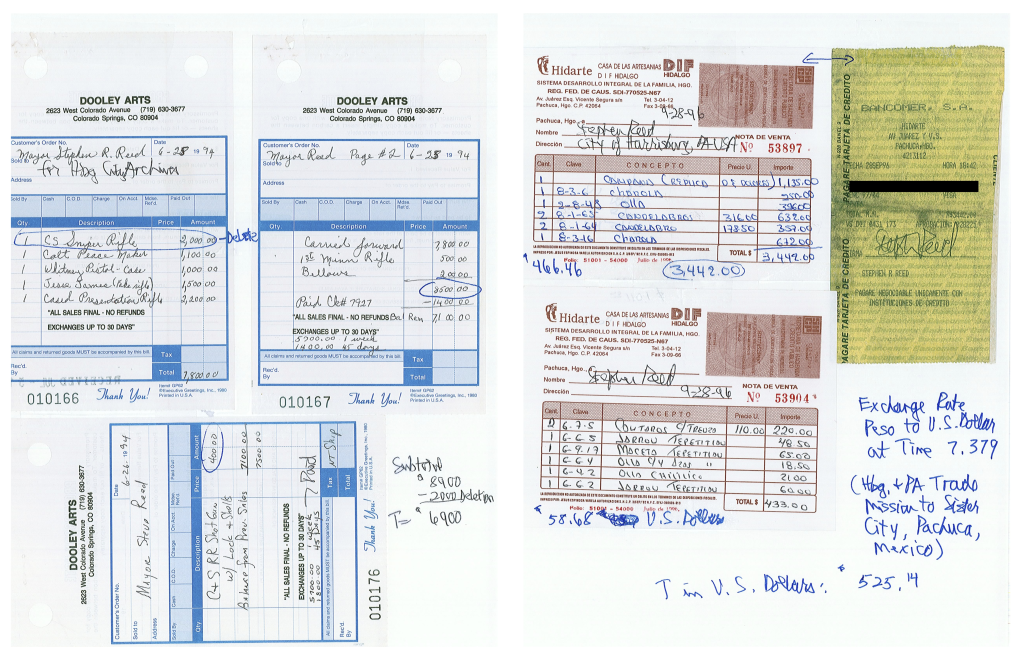
These receipts, with Mayor Stephen Reed's handwritten notes in the margins, are among the decade's worth of purchase records for which Reed sought a $33,000 reimbursement.

These receipts, with Mayor Stephen Reed’s handwritten notes in the margins, are among the decade’s worth of purchase records for which Reed sought a $33,000 reimbursement.

The receipts were from antique malls, book stores and outfits with names out of a Zane Grey novel—Bischoff’s Shades of the West in Scottsdale, Ariz., Arrowsmith’s in Santa Fe, N.M., and Garden of the Gods Trading Post in Manitou Springs, Colo.

They tracked purchases from the summer of 1991 through mid-2001, for items as varied as an 1896 Swedish bayonet, a Jesse James “fake rifle,” a Southwestern medicine pot and a Civil War daguerreotype.

And in 2003, more than a decade after the earliest purchases, they were collected to justify a $32,928 reimbursement to the man whose name is on virtually all of them: former Harrisburg Mayor Stephen Reed.

The receipts, along with other records of the reimbursement, are a token of city government under Reed, a mayor who has been both hailed for his work ethic and vision and criticized for reckless spending and an autocratic governing style.

They may also feature in an ongoing probe into the city’s recent debt fiasco. A witness who testified before a state grand jury, and who asked not to be named, said they were among the files presented during testimony.

The probe is reportedly looking into risky borrowings related to a retrofit of the city incinerator in the mid-2000s. The reimbursement records, though apparently not related to those borrowings, give a brief glimpse into Reed’s spending habits and his control of theoretically independent city entities.

If they are indeed among the documents being aired before the grand jury, they suggest the probe has expanded into other areas of city government during his tenure.

Reed asked for the reimbursement in a memo dated May 20, 2003, explaining he’d bought the items for the city and its museum projects using his own money.

He addressed the memo to the Harrisburg Authority, the former all-purpose municipal authority that served as a financing vehicle throughout the 1990s and early 2000s.

The memo, receipts and other reimbursement records were provided to TheBurg by Capital Region Water, the successor agency to the Harrisburg Authority, in response to a right-to-know request.

Reed had come across the receipts, he wrote, while “pulling files that have been set aside in storage, for the purpose of making room for future files.”

Though he was aware of “past personal expenditures” he’d made on behalf of the city, he said, he “was astounded to find the extent” of the purchases recorded.

Former Harrisburg Mayor Stephen Reed, left, and former Harrisburg Authority board member Fred Clark at a Senate hearing on the incinerator financings in 2012.

Former Harrisburg Mayor Stephen Reed, left, and former Harrisburg Authority board member Fred Clark at a Senate hearing on the incinerator financings in 2012.

The items, bought from collectors across the country, were all part of the city archives, he said. They were distributed across sites including city hall, the National Civil War Museum and “the suite of the Office of the Mayor.”

In the memo, Reed noted that federal tax rules precluded him from claiming a deduction on the items, but that it was “fiscally unfeasible to simply donate them absent deductibility,” which is why he was seeking reimbursement.

Nearly all of the purchases were physical artifacts, though the reimbursement also covered $350 in expenses from a trip to Gettysburg in the summer of 2001, including $283 for three rooms at a Holiday Inn Express and a $66 tab for a five-person dinner at General Pickett’s Buffet.

The receipts also reflect a certain degree of meticulousness, as Reed’s handwriting appears on many of them, identifying which items are to be reimbursed and which are to be excluded.

On one 1991 receipt, from a vendor called Covered Wagon in Albuquerque, N.M., Reed circled $2,180 worth of items for reimbursement, but left out an item identified only as “2 Snake Dancers,” listed at $995.

On another, he calculated the exchange rate from peso to U.S. dollar, noting the receipt was from a “trade mission to sister city, Pachuca, Mexico” in 1996.

It’s not clear whether the reimbursement would constitute an ethics violation under state law. Rob Caruso, executive director of the State Ethics Commission, said that his agency’s policies precluded him from commenting on specific cases.

But he said that, in general, the ethics act covers cases involving a conflict of interest, which he defined as a public official using his or her office for personal enrichment.

Reimbursement of goods bought on a municipality’s behalf, Caruso said, would seem not to be a case of enrichment, though there are also considerations about whether those expenses were approved in advance by the municipality.

“If the public official bought those goods on his own, without the authorization of the municipality, that puts it in a different category,” he said.

In Reed’s case, reimbursement was to be paid out of a special Harrisburg Authority fund filled with fee proceeds from various bond financings throughout the 1990s. Reed claimed sole authority to requisition payments for city projects out of the fund, pursuant to a resolution the authority board adopted in 1991.

In his memo, Reed seemed to suggest the special fund was not the typical source for the request he was making, noting that “normally” he would have submitted it for payment from the city’s general fund.

But, he wrote, the “2003 fiscal constraints on the City preclude this now.”

At least two officials signed off on the reimbursement payment, which was made by check dated May 20, 2003. The check, from an account labeled “City Special Projects Reserve Fund” at M&T Bank, bears the signatures of Leonard House, then an authority board member, and Thomas Mealy, then the authority’s executive director.

Mealy, reached by phone, declined to comment, saying he had been advised not to answer questions about his time at the authority.

Though the grand jury proceedings are secret, there have been a few hints about the duration and scope of the probe. Current Harrisburg Mayor Eric Papenfuse and Steve Goldfield, a financial expert who worked on a 2012 forensic audit of incinerator financings, previously acknowledged testifying before the grand jury in early 2014.

Last month, Attorney General Kathleen Kane, whose office is overseeing the investigation, said during a Senate hearing that she hoped it would draw to a close “in the very near future.”

More recently, the Patriot-News identified a series of potential witnesses arriving this week in Pittsburgh, where the grand jury is seated, including former Mayor Linda Thompson, Dauphin County Commissioner Jeff Haste and Robert Kroboth, a finance director under Reed. On Wednesday, the paper photographed Reed himself outside the attorney general’s office there, accompanied by midstate lawyer Allen C. Welch, Jr.

Welch, reached Thursday, confirmed he is representing Reed but said neither he nor his client could comment on the reimbursement records. He could not even confirm whether he knew of their existence, he said, citing a judicial gag order.


 

Continue Reading

Harrisburg Seeks to Revoke Business Licenses for 3 Bars

Bars

Harrisburg is trying to shut down the Third Street Cafe, foreground, and the Taproom next door for alleged violations of their mercantile licenses.

When you enter the Taproom in Midtown Harrisburg, you immediately notice several things: the ingrained smell of stale cigarette smoke, the sound of some old jukebox rock, a few well-oiled customers at the bar.

It’s about 11 a.m. on a Monday, and one guy who says he works construction (and plans to return to work) is deep into a pitcher of beer. A couple of older men in disheveled suits, laughing and slurring their words, say they’ve been regulars for years.

It’s a mixed crowd: young, old, black, white, workingman, professional, and the patrons all seem to know each other.

This is bar culture at its most basic, the kind of place that once lined block after block of old Harrisburg—the watering hole for the neighborhood, a gritty, downscale “Cheers.”

The Taproom is also, according to the city, a magnet for crime, and because of this determination, is under threat of losing its business license at the end of the month.

Harrisburg has notified three bars—the Taproom and the Third Street Café, located next door to one another in Midtown, and the Royal Pub in Uptown—that it intends to revoke their mercantile licenses.

“We’re revoking their business licenses on grounds that they violated their agreement to operate in an acceptable manner,” said Mayor Eric Papenfuse. “We consider a business license a privilege, not a right.”

Papenfuse said city police have documented repeated incidents of criminal activity in and around the bars, such as drug activity, though he would not state the exact claims against the bars.

Dave Larche, 68, has operated the Taproom for 23 years and, recently, has seen many changes come to the commercial core of Midtown. He believes that’s the real issue, that powerful people no longer want his bar on the block.

“I think there’s an agenda because they want to do something on this side of the street,” he said, adding that, years ago, there were five bars like his along the 1400-block of N. 3rd Street.

TapRoom2

Dave Larche, owner of the Taproom, inside his bar.

Indeed, Midtown is undergoing a transformation. In January, the new Susquehanna Art Museum opened across the street, and, two doors up, starting this summer, Greenworks Development plans to create a U-GRO Learning Center pre-school from a former hardware store. Nearby, the Millworks restaurant and art studio space recently opened, as did the Zeroday Brewing Co. tasting room.

The dissonance between SAM’s gleaming new facility and the two rundown bars across the street is striking. As art patrons visit the museum, visibly intoxicated people often loiter nearby, sometimes causing commotion. Just last month, a fight broke out outside Third Street Café, with a man collapsing near the front door, and, a few weeks later, a shooting occurred in the back alley.

Larche largely blames his next-door neighbor, Third Street Café, for the problems on the block, which he says include public urination, people sleeping in nearby doorways and fights.

Third Street Café’s owner, Tony Paliometros, denies responsibility, saying that he runs a clean, professional bar and that he can’t control what happens outside his place.

“If someone wants to do something, they can do it outside a school or the courthouse,” he said. “Does that mean you close the school or courthouse?”

Paliometros agrees with Larche that his bar is a victim of people who wish to change the neighborhood.

“They built the new museum, and I guess they want to clear the area,” he said.

Papenfuse, who owns Midtown Scholar Bookstore and several other buildings nearby, denies that he is purposely targeting the bars for closure. Drug activity, he said, has been linked to both bars in violation of the terms of their mercantile licenses.

According to the city’s “Business Privilege and Mercantile Tax Regulation” handbook, the city reserves the right to revoke licenses for “any behavior which would constitute a crime under federal, state or local laws, including, but not limited to, drug trafficking or drug possession; committed an act of gross negligence, or allowed any manner or form of public nuisance.”

Larche admits that cocaine was found inside the Taproom last year, within a dart box, but that he can’t control what each of his customers does, even inside his bar.

Paliometros said that he needs to meet with his attorney to decide if he’s going to appeal the revocation before the city’s three-person Mercantile Licensing and Tax Appeals Board, which meets in city hall at 2 p.m. on April 30. Larche said that he is appealing, but holds little hope of winning.

“It don’t look good,” he said. “My lawyer said we can appeal it, but I think it’s pretty well done.”

Both Paliometros and Larche wonder where their patrons will go if their bars close. Paliometros expects that some will migrate to bars Uptown, while Larche said that he just doesn’t know.

“This is a neighborhood bar—a real neighborhood bar,” he said. “There are people in this world who don’t want to go to Arooga’s.”


Continue Reading

Community Comment: Front Street Redesign Is “Ill-Conceived”

FrontStreet2

Traffic moves along Front Street in Harrisburg. Starting next month, PennDOT will begin work to reduce the three-lane road to two lanes, with a bike lane, through much of Uptown and Midtown Harrisburg.

The mayor is to be applauded for efforts to make the city more livable and pedestrian-friendly. However, the proposed bike lane on Front Street is ill-conceived, if not downright dumb.

While I’m all for bicycle commuting, and used to do so frequently myself, why would anyone ride next to traffic when there is a perfectly good (safer, less exhaust-choked) bike path immediately adjacent to Front Street in Riverfront Park? The existing bike path is never so crowded that it justifies reducing the volume of Front Street.

If the city wants to promote bicycle commuting, it should consider working cooperatively with Camp Hill to remove the curb under the railroad underpass on the Camp Hill bypass and promote that as a convenient, direct path with nice, safe, wide shoulders, into the city from Camp Hill, a major West Shore-to-Harrisburg travel corridor. Or even better, work cooperatively with Linglestown, DEP and the Army COE to widen Riverfront Park to the north to Linglestown Road, thereby creating additional recreational space and opening up a convenient bicycle commuting corridor to the north.

Here’s what will likely happen. The bike lane in Front Street will sit empty while frustrated and stressed commuters and other travelers trying to get to I-83S will aggressively veer left onto Reily or Herr or other eastbound, narrow city streets and try to fight their way south around the now even more congested Front Street, all the while endangering Midtown and downtown pedestrians by doing so.

Why try to deny that people commute to and from Harrisburg? Before reducing the available volume by 33 percent, why not try a few traffic calming devices like raised pedestrian walkways or enforcing the speed limit on Front Street? Leave Front Street alone unless and until there are relatively convenient safe southbound routes out of the city.

Ted Fridirici
Former avid bicycle commuter and proud Midtown resident since 1998

Continue Reading

TheBurg Podcast, April 10, 2015

Welcome to TheBurg Podcast, a weekly roundup of news in and around Harrisburg.

April 15, 2015: This week, Larry and Paul give a brief update on two historic houses that may be spared demolition. Then, they turn to the more troublesome topic, on their minds because of a recent notable arrest, of crime, the community and the police.

Special thanks to Paul Cooley, who wrote our theme. You can listen to his podcast, the PRC Show, on SoundCloud or in the iTunes Store.

TheBurg Podcast can be downloaded by clicking on the date above or by visiting the iTunes store. You can also access the podcast via its host page, here.

Continue Reading

Agency To Seek Buyer For Historic Downtown Homes

The houses at 110 and 112 Locust St. slated for demolition, which could date as far back as the 1820s.

The houses at 110 and 112 Locust St. slated for demolition, which could date as far back as the 1820s.

A pair of historic homes downtown on Locust Street may avoid demolition after all, as the Pennsylvania Housing Finance Agency, which proposed tearing them down earlier this month in a bid for more office space, has lowered the price for someone to take them off the agency’s hands.

In a meeting at PHFA’s Front Street offices last night with preservationists and neighbors, the agency agreed to offer the attached clapboard homes for $150,000, a bit below the $175,000 figure Brian Hudson, PHFA’s executive director, had cited at a planning commission hearing last week.

At that meeting, commissioners urged the agency to meet with members of Historic Harrisburg Association and Capitol Area Neighbors, two groups whose members spoke vigorously in opposition to the demolition during a presentation on the agency’s proposal.

PHFA, which says it has outgrown the eight-story office building it has occupied at Front and Locust since 2004, sought to demolish the homes to clear the way for a new 12-story, 160-foot office tower adjoining its existing structure.

Preservationists and neighbors objected to both the design of the tower and the destruction of the two homes, which are among Harrisburg’s oldest extant residential buildings, likely dating to the early 19th century or perhaps even earlier.

The agreement to seek a buyer “by no means makes all this a done deal,” said David Morrison, HHA’s interim executive director. The neighbors and his group still have concerns about whether the proposed new tower will be compatible with other buildings in the riverfront neighborhood, a historic district, he said.

The agency, for its part, has said that the Locust Street homes sat on the market unsold for three years before they finally purchased them last May for $140,000.

Hudson also noted that PHFA, though tax-exempt as a state-affiliated agency, makes annual payments-in-lieu-of-taxes to the city each year of nearly $100,000, and would continue to do so on any new building built under the proposal.


Continue Reading