Mayor’s Slate Victorious in City Council Primary

Signs

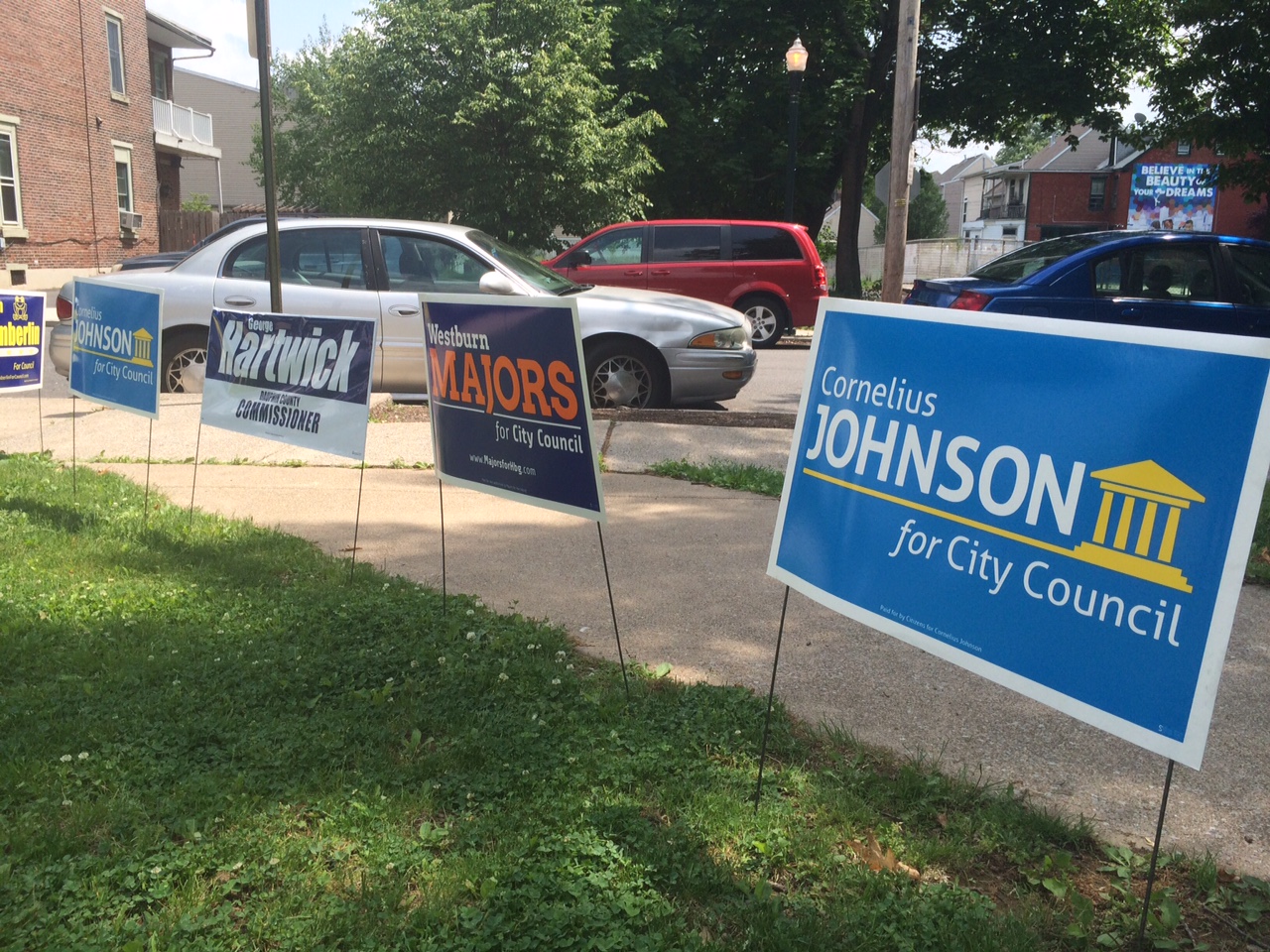
Campaign signs from earlier today outside a polling station.

Mayor Eric Papenfuse wasn’t on the ballot, but he may have emerged the greatest victor in today’s Democratic primary for Harrisburg City Council.

The three candidates endorsed by Papenfuse–incumbent Jeffrey Baltimore and challengers Cornelius Johnson and Westburn Majors–won nominations for four-year terms on council. Challenger Destini Hodges tallied the most votes for the lone two-year seat.

No Republicans ran in the primary, meaning the winners of the Democratic primary will be strongly favored in November’s general election.

Moreover, Papenfuse vocally denounced incumbent Brad Koplinski, pleading with residents to vote against him. Koplinski placed fourth, losing to Majors by just 18 votes for the nomination for the final four-year seat.

“This is a big night for Harrisburg, absolutely phenomenal,” said Papenfuse after the final votes were reported. “I’m elated that we’re finally going to get new leadership to move the city forward.”

He added that he believed the public, with its vote, sent a message that it was “tired of the dysfunction on City Council.” Papenfuse advocated for new blood on council to help move his agenda forward and to replace Councilwoman Wanda Williams as council president.

Primary results were as follows: Johnson, 1,474; Baltimore, 1,429; Majors, 1,257; Koplinski, 1239; Ellis “Rick” Roy, 1,048; Rhonda Mays, 760; Jeremiah Chamberlin, 719; Ron Chapel, 332; Koscina Lowe, 226.

In the race for city treasurer, Tyrell Spradley defeated challenger Brian Ostella by a count of 1,279 to 1,221. Council appointed Spradley last year to fill the unexpired term of former city Treasurer John Campbell, who was arrested on theft charges.

For Harrisburg school board, Jennifer Smallwood, Monica Blackston-Bailey, Matthew Krupp and Melvin Wilson Jr. won nominations for four-year seats. Daunessy Penn and Lionel Gonzalez were tied for the final four-year slot, each with 1,159 votes. Judd Pittman defeated LaTasha Frye for the nomination for the sole two-year seat.


Continue Reading

Harrisburg Zoning Board Approves Moose Lodge Conversion

WCI Partners may be interested in converting the historic Moose Lodge into a mixed use project.

The historic Moose Lodge in Midtown Harrisburg

The landmark Moose Lodge Temple in Midtown Harrisburg took a step closer to revival and reoccupation tonight, as the city’s Zoning Hearing Board approved a plan to renovate it as mixed-use space.

The board unanimously granted a variance to WCI Partners LP for 33 apartments on three upper floors with commercial space on the ground floor. WCI needed the variance because the size of the apartment units, about 500 square feet apiece, is less than the 1,200-square-foot size permitted under the zoning code for the 900-block of N. 3rd Street.

WCI President David Butcher told the board that the apartment sizes needed to be small due to beams that run vertically through the building, limiting design options. He also said the project would not be economically feasible without the apartment density.

Board members seemed skeptical that WCI could not create a floor plan to accommodate larger units. However, they voted in favor of the variance largely because they want to see the building redeveloped, as it has sat empty and increasingly blighted for a decade.

“This case is a case that must recognize the reality of the facts in this neighborhood,” said board member Thomas Leonard. “The reality is that this property has been vacant for 10 years.”

Leonard also cited a lack of community opposition. Several community organizations in Midtown submitted letters supporting the project, and David Morrison, the interim executive director of Historic Harrisburg Association, spoke in favor of it before the board.

Butcher assured the board that the apartments, while small, would have high-end finishes that would appeal to young professionals. He estimated that the units would rent for around $1,000 per month.

WCI is purchasing the four-story building at the corner of N. 3rd and Boas streets for $900,000 from Atlanta-based Mosaica Education, a for-profit charter school company that is in receivership.

The purchase includes several adjacent parcels of land—three dilapidated townhouses and a 40-vehicle parking lot. Butcher said that WCI also plans to renovate the townhouses into apartments and retail space and would landscape the area around the parking lot to make it more attractive.

Harrisburg City Council now must approve WCI’s land use plan. If all goes smoothly, the project should start by the end of summer with completion expected in 12 to 18 months, said Butcher.

For five years, the former Moose Lodge housed the Ronald Brown Charter School. However, the building has been empty since 2005, when the school district’s board of control refused to reauthorize the school’s charter.

The Harrisburg Moose Lodge Temple was built in 1924, designed in the Beaux Arts style by renowned Harrisburg architect Clayton J. Lappley.

Disclosure: Alex Hartzler, publisher of TheBurg, is a principal with WCI Partners.

Continue Reading

TheBurg Podcast, May 15, 2015

Welcome to TheBurg Podcast, a weekly roundup of news in and around Harrisburg.

May 15, 2015: This week, Larry and Paul talk about some surprise reversals over a tax-break policy at City Council, the departure of the school district’s chief recovery officer and the upcoming municipal primary.

Special thanks to Paul Cooley, who wrote our theme music. Check out his podcast, the PRC Show, available on SoundCloud and in the iTunes store.

TheBurg Podcast can be downloaded by clicking on the date above or by visiting the iTunes store. You can also access the podcast via its host page.

Continue Reading

Two City District Justice Seats Up For Grabs in May Primary

A challenge against a sitting judge accused of ethics violations and a five-way race for an open judicial seat are among the races in which Harrisburg residents will cast their votes next Tuesday, May 19, in the municipal primary.

The seats up for election oversee two districts, one encompassing parts of Uptown and North Allison Hill and the other Shipoke, South Allison Hill and Hall Manor.

In the Uptown district, Sonya Baltimore McKnight, a parent engagement specialist at Ben Franklin School, is running against Robert Jennings III, an incumbent who was charged last November by the state Judicial Conduct Board of ethics violations.

The charges, which resulted in Jennings’ suspension with pay while he awaits prosecution, including demanding kickbacks from constables, sitting on citations against him and friends and making sexual remarks to women.

Downtown, a five-way race pits Paul Zozos, the son of a sitting judge in another district, against Bill Cluck, an environmental lawyer, Marva Brown, a social worker, Angel Fox, a casework manager for a state representative and Ausha Green, an employee at the state Department of Education.

The sitting judge in the district, Lavon Postelle, is not running for reelection.

The two Uptown candidates are running on the Democratic ticket, as are all five downtown candidates. Zozos has also cross-filed as a Republican candidate.

Magisterial district judges serve in the minor court system created under the 1968 Pennsylvania Constitution. They hear lower-level cases including traffic violations, landlord-tenant disputes, and civil claims for damages below $12,000.

Their courts also hold original jurisdiction over criminal cases. District judges issue warrants and determine whether to send misdemeanor and felony charges to the county Court of Common Pleas.

Harrisburg currently has five magisterial districts, with judges each serving six-year terms. There are no term limits.

The position comes with an annual salary of $88,000. The city’s district judge offices, funded by the county, have annual budgets this year ranging between $388,000 to $610,000.

A district judgeship has often been a plum prize—and more than once in this city, something of a family business—with candidates occasionally going to great lengths to make a bid for the seat.

In 2002, for example, the state Supreme Court established two new magisterial districts in the city. The next year, one of the freshly created seats attracted a three-way race between Joseph Lahr, Virginia Weaver Zozos and Lavon Postelle.

All three filed as both Democrats and Republicans, and all three mutually attempted to strike each other’s nominations from the ballot. Only Postelle, who currently holds the seat, survived the challenges.

Lahr was at the time the committeeman for the Dauphin County Republicans. He resigned that post the day he filed his nominating papers, but Dauphin County Judge Joseph Kleinfelter ruled that was too late to avoid a conflict.

Zozos, meanwhile, listed a home address in the 1200-block of Hudson Street—even though her family home was in the 600-block of S. 25th St., in a separate district, where her husband, George Zozos, was already a magisterial judge.

Her challengers claimed she didn’t actually live in the district, a requirement for candidacy, offering among other evidence the Hudson Street property’s suspiciously low water bills.

Zozos admitted in court that the sole purpose of buying the other property was to support her judicial campaign. In striking her from the ballot, Judge Kleinfelter called her residency there a “thinly veiled sham.”

Continue Reading

TheBurg Podcast, May 8, 2015

Welcome to TheBurg Podcast, a weekly roundup of news in and around Harrisburg.

May 8, 2015: This week, Larry and Paul talk about potential lawsuits against lawyers involved in the city’s borrowings and the team of architects and designers that will be leading an update to the city’s comprehensive plan. Also, a brief update on those Midtown and Uptown bars whose licenses the city is trying to revoke, and some news about a restaurant opening in Midtown.

Special thanks to Paul Cooley, who wrote our theme music. Check out his podcast, the PRC Show, on SoundCloud or on iTunes. Especially his latest episode about his new roommate!

TheBurg Podcast can be downloaded by clicking on the date above or by visiting the iTunes store. You can also access the podcast via its host page, here.

Continue Reading

Harrisburg Architect To Steer City’s Comprehensive Plan

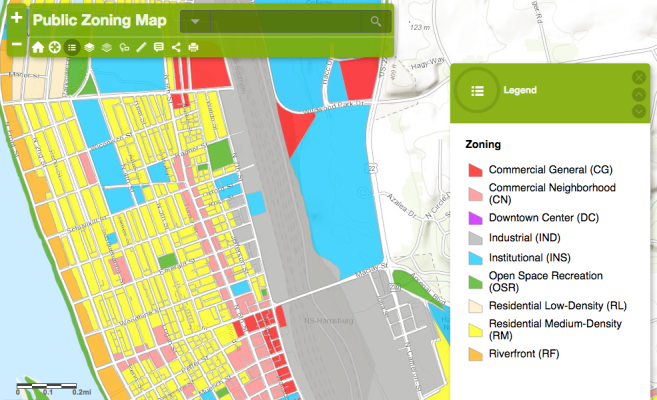
A screenshot of the new interactive zoning map on Harrisburg's planning page.

A screenshot of the new interactive zoning map on Harrisburg’s planning page.

Harrisburg has awarded a contract to a consulting team for the first update in more than 40 years to its comprehensive plan, a document that will guide development across the city for the next two decades.

The $200,000 contract went to a team led by Bret Peters, of the Harrisburg firm Office for Planning and Architecture, that includes designers, planners and engineers from both local and global firms.

Mayor Eric Papenfuse and city planner Geoffrey Knight, sporting ties with street-grid designs from Philadelphia and New York City, respectively, said the update was long overdue and would help speed the city’s recovery.

Papenfuse described the plan as “the vision of the residents, and the business owners, and the stakeholders, and everyone who has a stake in Harrisburg and its future development.”

The mayor added that he expects the plan to be ready for formal approval in April 2016 and that it will probably result in a revision of the city’s zoning code.

Knight said the plan, when finished, would overhaul an existing comprehensive plan dating back to 1974. “So we’re in arrears by about 20 years with updating and adopting a new one,” he said.

Peters is a longtime Harrisburg architect who worked on a redesign of the Broad Street Market in the 1990s and has drafted plans for converting uptown portions of 2nd Street back from a one-way, three-lane street to a two-way road with a median.

His consulting team will include representatives of Arup, a global engineering firm; K&W Engineers and Consultants, a Harrisburg civil engineering firm; Stacy Spann of AB3 Development Advisory, a Washington, D.C.-based expert in housing policy; and Cooltown Studios, which will design a website to solicit public input on the plan.

Peters described his team as “international-caliber consultants” who could inform Harrisburg of “some of the best practices that are happening all over the world.”

Both Peters and the administration said the planning process would be driven by public input, both through the website designed by his team and through public meetings, beginning with a steering committee meeting at HACC’s Midtown campus tonight at 6 p.m.

“People who live in places see them differently than people coming in from far away for a short period of time,” Peters said. “So interviewing folks is one of the best ways to understand the actual fabric of the environment and understand what’s valued in that fabric.”

Harrisburg’s state-sponsored financial recovery plan, adopted in late 2013, had urged the city to adopt a new plan as one of myriad recommendations for improving governance and policy and spurring new development.

But an effort to hire consultants for the plan under Mayor Linda Thompson was scuttled when City Council and residents complained the contract, which had been quietly awarded to the Camp Hill firm Mullin & Lonergan, was not properly vetted.

The Papenfuse administration sidestepped such a controversy this time by sending two resolutions initiating the comprehensive planning process in February and June of last year.

Council passed the first resolution, which authorized the city planning commission and administration to begin the process of soliciting a new comprehensive plan, at a Feb. 25 legislative session.

The second resolution, which council passed on June 24, was primarily for the purpose of appropriating grant funds to repair two city pools, but also authorized the administration to spend up to $245,000 for consultants on the comprehensive plan.

Meanwhile, a 23-member steering committee, which the administration says it selected with input from council, has been meeting over the past year to draft a request for proposals, interview candidates and ultimately award a contract.

Among the committee members are Councilwoman Susan Brown-Wilson, Harrisburg Redevelopment Authority Director Bryan Davis, Capital Region Water CEO Shannon Williams and Dave Botero, the city’s community policing coordinator, all of whom attended a Thursday press conference announcing the contract award.

Papenfuse mentioned the 2nd Street conversion, which his administration petitioned the state to approve earlier this year, as an example of an existing part of the cityscape he would like to see re-envisioned in the comprehensive plan.

Papenfuse and Knight also used the press conference to demonstrate changes to the planning department’s page on the city website, which now includes an interactive, color-coded zoning map showing characteristics of land parcels across the city.

The city website also includes a dedicated link to information on the comprehensive plan.

This story has been updated with information about a City Council resolution in February 2014 that initiated the comprehensive planning process.

Continue Reading

State Takes First Civil Action Over Harrisburg Debt Crisis

The seven-story garage in Harrisburg University's downtown building, at the corner of 4th and Market streets, was the basis of a $3.6 million payment to a Kansas City bank in 2013.

The seven-story garage in Harrisburg University’s downtown building, at the corner of 4th and Market streets, was the basis of a $3.6 million payment to a Kansas City bank in 2013.

The state coordinator overseeing Harrisburg’s recovery served a summons last month on the downtown offices of a national law firm, marking the first effort to seek damages from professionals who worked on the capital city’s borrowings.

The summons names Fred Reddig, the state-appointed coordinator of the city’s financial recovery plan, as a plaintiff acting “on behalf of the city of Harrisburg” in a claim against the law firm Buchanan Ingersoll & Rooney.

The summons was filed in late March in Dauphin County court and served on the law firm on April 16, according to court records.

The one-page summons reveals little about the scope and basis of the claim against the firm, aside from the parties involved, the attorney for Reddig and the fact that the state will seek money damages in excess of $50,000.

Reddig’s office, at the state Department of Community Economic Development, did not respond to several requests over the past week for a comment on the claim. Peter Kreher, listed on the summons as Reddig’s attorney, said he currently had no comment on it.

But sources familiar with the action say it likely stems from legal work attorneys at Buchanan performed on a bond deal in 2006 and early 2007, when the city sought to build a new facility for the year-old Harrisburg University at 4th and Market streets downtown.

That deal planted the seeds of a $3.6 million payment to holders of university-related debt in 2013, as state-appointed officials worked to pull the capital city back from the brink of bankruptcy.

The payment, which came out of the $267 million paid for a 40-year lease of the city’s parking system, was effectively the price for freeing up a garage on university premises so that it could be included in the lease.

“We needed to get the garage in the lease deal,” said Richard Kotz, executive director of the Harrisburg Parking Authority. “We actually had to pay Harrisburg University some money to get the title released.”

In fact, the payment ultimately went not to the university but to UMB Bank of Kansas City, Mo., the trustee for holders of the university bonds. In 2012 and 2013, the university missed two interest payments totaling a little more than $3.6 million—the amount UMB recouped in the garage payment.

“That’s the math I’m sure the bondholders used,” said Harrisburg University President Eric Darr, adding that the price “wasn’t the university’s call.”

Harrisburg doesn’t stand to receive money from any successful suit over the payment, if one is pursued. A 2013 settlement between the city and its creditors stipulates that any awards stemming from the UMB payment will go to bond insurer Assured Guaranty Municipal and Dauphin County.

But it provides a glimpse, however brief, into the state’s strategy for pursuing claims against professionals involved in Harrisburg’s borrowings.

It comes a year and a half after William Lynch, the state-appointed receiver for Harrisburg whom Reddig succeeded, cautiously acknowledged that lawsuits could be a “means to obtain redress” for the decisions that led to the city’s debt crisis.

A small but critical role

It’s not clear how the UMB payment might form the basis of a civil claim. The summons is a minimal, preliminary action and may serve no greater purpose than to extend the state’s timeline for deciding whether to file a complaint in the future.

Nonetheless, the December 2013 settlement agreement between Dauphin County, the city, the Harrisburg Authority and Assured Guaranty Municipal explicitly mentions potential civil claims over the payment to UMB.

Additionally, other publicly available documents, including bond statements, property records and closing documents from the parking lease, chart the story of the small but critical role the Kansas City bank came to play in the city’s debt deal.

The story begins in 2006, when the city sought to build a new downtown home for Harrisburg University, a non-profit school with a focus on science, mathematics and technology that had opened its doors to students in August 2005.

A key piece of the project was the construction of a seven-story, 390-space garage in the 16-story university tower. The Harrisburg Parking Authority agreed to pay $14 million for the garage, providing essential funds for the project, and the university in turn pledged to lease garage spaces back from the authority.

The university never formally transferred the garage, however. In 2010, the parking authority sued the university, claiming it had paid fully for the property. But the university contested the authority had not paid for construction cost overruns and held onto the title.

“The lawsuit just lingered for years,” Darr said.

As a result, university bondholders retained a claim on the garage in 2013, when the city sought to lease its parking system to help pay off its staggering debt load.

UMB Bank, as trustee for the bondholders, didn’t relinquish that claim until December 2013, after negotiating the $3.6 million payment from the parking proceeds.

The bank, through a spokesperson, declined to comment, but did refer to publicly available bond disclosures. Those disclosures say the bank “agreed to release its lien on the Parking Unit upon payment” of the $3.6 million.

Buchanan is linked to the garage because the firm served as bond counsel on the 2007 borrowings for the university project. The firm’s general counsel said Wednesday he had no comment.

Darr, for his part, wonders why the parking authority and the university couldn’t come to an earlier settlement, before the payout from parking lease proceeds was even part of the equation.

“I always labeled it under ‘attorneys,’” Darr said. “Attorneys do things for reasons you’re not always clear about.”


Continue Reading

Derby Day

May 2: Catch the ponies and see the floppy hats at Derby Day 2015, which this year migrates to Linwood Estate in Carlisle. The annual Jump Street fundraiser also features music, food and plenty of mint juleps. For more information, visit jumpstreet.org or the Facebook page: Jump Street’s Derby Day.

Continue Reading

Water Company Flushing City Fire Hydrants

Maynard Gardner, a Capitol Region Water employee, flushes a fire hydrant Monday morning in Reservoir Park.

Maynard Gardner, a Capital Region Water employee, flushes a fire hydrant Monday morning in Reservoir Park.

Harrisburg’s water and sewer authority has begun flushing fire hydrants in the city and in other townships in the authority’s service area, as part of an annual procedure to check water pressure, look for leaks and clear dormant lines of mineral buildup.

Workers will flush all of Capital Region Water’s 1,600 hydrants over a six- to eight-week period, beginning with those closest to the city’s reservoirs and proceeding outward through the system.

The procedure can stir up debris in the pipes, meaning customers may see discolored, brownish-orange water coming from their faucets while the authority flushes hydrants near them.

The discoloration is not harmful and should clear up after affected customers run their faucets for a couple of minutes, an authority spokesman said.

The city flushes the hydrants every year, although it skipped the procedure last year because workers were overextended addressing a billing problem caused by failing batteries in water meters, the spokesman said.

Maynard Gardner, a Capital Region Water employee, demonstrated the flushing procedure Monday morning at a hydrant in Reservoir Park, checking the pressure and taking a sample of the gushing water with a small glass jar.

The water came out clear, but hydrants in areas further from the reservoirs, like Kline Village, tend to be noticeably discolored and can take up to 45 minutes to flush, Gardner said.

The procedure, which improves drinking water quality by clearing lines of stagnant water, also allows the authority to alert firefighters of hydrants that aren’t working properly. The authority covers failing hydrants with orange bags, schedules them for repairs and reports them to emergency dispatchers at Dauphin County.

Continue Reading

TheBurg Podcast, May 1, 2015

Welcome to TheBurg Podcast, a weekly roundup of news in and around Harrisburg.

May 1, 2015: This week, Larry and Paul talk about some hoop dreams on Penn Street, a mystifying exchange over Zumba at City Council, and a surprise reintroduction of tax abatement legislation…right in time for the May 19 primary.

Special thanks to Paul Cooley, who wrote our theme music. You can find his podcast, the PRC Show, on SoundCloud or in the iTunes Store.

TheBurg Podcast can be downloaded by clicking on the date above or by visiting the iTunes store. You can also access the podcast via its host page, here.

Continue Reading