Harrisburg Architect To Steer City’s Comprehensive Plan

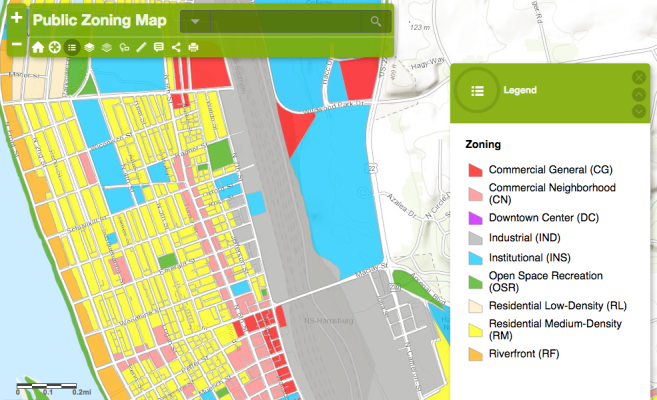
A screenshot of the new interactive zoning map on Harrisburg's planning page.

A screenshot of the new interactive zoning map on Harrisburg’s planning page.

Harrisburg has awarded a contract to a consulting team for the first update in more than 40 years to its comprehensive plan, a document that will guide development across the city for the next two decades.

The $200,000 contract went to a team led by Bret Peters, of the Harrisburg firm Office for Planning and Architecture, that includes designers, planners and engineers from both local and global firms.

Mayor Eric Papenfuse and city planner Geoffrey Knight, sporting ties with street-grid designs from Philadelphia and New York City, respectively, said the update was long overdue and would help speed the city’s recovery.

Papenfuse described the plan as “the vision of the residents, and the business owners, and the stakeholders, and everyone who has a stake in Harrisburg and its future development.”

The mayor added that he expects the plan to be ready for formal approval in April 2016 and that it will probably result in a revision of the city’s zoning code.

Knight said the plan, when finished, would overhaul an existing comprehensive plan dating back to 1974. “So we’re in arrears by about 20 years with updating and adopting a new one,” he said.

Peters is a longtime Harrisburg architect who worked on a redesign of the Broad Street Market in the 1990s and has drafted plans for converting uptown portions of 2nd Street back from a one-way, three-lane street to a two-way road with a median.

His consulting team will include representatives of Arup, a global engineering firm; K&W Engineers and Consultants, a Harrisburg civil engineering firm; Stacy Spann of AB3 Development Advisory, a Washington, D.C.-based expert in housing policy; and Cooltown Studios, which will design a website to solicit public input on the plan.

Peters described his team as “international-caliber consultants” who could inform Harrisburg of “some of the best practices that are happening all over the world.”

Both Peters and the administration said the planning process would be driven by public input, both through the website designed by his team and through public meetings, beginning with a steering committee meeting at HACC’s Midtown campus tonight at 6 p.m.

“People who live in places see them differently than people coming in from far away for a short period of time,” Peters said. “So interviewing folks is one of the best ways to understand the actual fabric of the environment and understand what’s valued in that fabric.”

Harrisburg’s state-sponsored financial recovery plan, adopted in late 2013, had urged the city to adopt a new plan as one of myriad recommendations for improving governance and policy and spurring new development.

But an effort to hire consultants for the plan under Mayor Linda Thompson was scuttled when City Council and residents complained the contract, which had been quietly awarded to the Camp Hill firm Mullin & Lonergan, was not properly vetted.

The Papenfuse administration sidestepped such a controversy this time by sending two resolutions initiating the comprehensive planning process in February and June of last year.

Council passed the first resolution, which authorized the city planning commission and administration to begin the process of soliciting a new comprehensive plan, at a Feb. 25 legislative session.

The second resolution, which council passed on June 24, was primarily for the purpose of appropriating grant funds to repair two city pools, but also authorized the administration to spend up to $245,000 for consultants on the comprehensive plan.

Meanwhile, a 23-member steering committee, which the administration says it selected with input from council, has been meeting over the past year to draft a request for proposals, interview candidates and ultimately award a contract.

Among the committee members are Councilwoman Susan Brown-Wilson, Harrisburg Redevelopment Authority Director Bryan Davis, Capital Region Water CEO Shannon Williams and Dave Botero, the city’s community policing coordinator, all of whom attended a Thursday press conference announcing the contract award.

Papenfuse mentioned the 2nd Street conversion, which his administration petitioned the state to approve earlier this year, as an example of an existing part of the cityscape he would like to see re-envisioned in the comprehensive plan.

Papenfuse and Knight also used the press conference to demonstrate changes to the planning department’s page on the city website, which now includes an interactive, color-coded zoning map showing characteristics of land parcels across the city.

The city website also includes a dedicated link to information on the comprehensive plan.

This story has been updated with information about a City Council resolution in February 2014 that initiated the comprehensive planning process.


Continue Reading

State Takes First Civil Action Over Harrisburg Debt Crisis

The seven-story garage in Harrisburg University's downtown building, at the corner of 4th and Market streets, was the basis of a $3.6 million payment to a Kansas City bank in 2013.

The seven-story garage in Harrisburg University’s downtown building, at the corner of 4th and Market streets, was the basis of a $3.6 million payment to a Kansas City bank in 2013.

The state coordinator overseeing Harrisburg’s recovery served a summons last month on the downtown offices of a national law firm, marking the first effort to seek damages from professionals who worked on the capital city’s borrowings.

The summons names Fred Reddig, the state-appointed coordinator of the city’s financial recovery plan, as a plaintiff acting “on behalf of the city of Harrisburg” in a claim against the law firm Buchanan Ingersoll & Rooney.

The summons was filed in late March in Dauphin County court and served on the law firm on April 16, according to court records.

The one-page summons reveals little about the scope and basis of the claim against the firm, aside from the parties involved, the attorney for Reddig and the fact that the state will seek money damages in excess of $50,000.

Reddig’s office, at the state Department of Community Economic Development, did not respond to several requests over the past week for a comment on the claim. Peter Kreher, listed on the summons as Reddig’s attorney, said he currently had no comment on it.

But sources familiar with the action say it likely stems from legal work attorneys at Buchanan performed on a bond deal in 2006 and early 2007, when the city sought to build a new facility for the year-old Harrisburg University at 4th and Market streets downtown.

That deal planted the seeds of a $3.6 million payment to holders of university-related debt in 2013, as state-appointed officials worked to pull the capital city back from the brink of bankruptcy.

The payment, which came out of the $267 million paid for a 40-year lease of the city’s parking system, was effectively the price for freeing up a garage on university premises so that it could be included in the lease.

“We needed to get the garage in the lease deal,” said Richard Kotz, executive director of the Harrisburg Parking Authority. “We actually had to pay Harrisburg University some money to get the title released.”

In fact, the payment ultimately went not to the university but to UMB Bank of Kansas City, Mo., the trustee for holders of the university bonds. In 2012 and 2013, the university missed two interest payments totaling a little more than $3.6 million—the amount UMB recouped in the garage payment.

“That’s the math I’m sure the bondholders used,” said Harrisburg University President Eric Darr, adding that the price “wasn’t the university’s call.”

Harrisburg doesn’t stand to receive money from any successful suit over the payment, if one is pursued. A 2013 settlement between the city and its creditors stipulates that any awards stemming from the UMB payment will go to bond insurer Assured Guaranty Municipal and Dauphin County.

But it provides a glimpse, however brief, into the state’s strategy for pursuing claims against professionals involved in Harrisburg’s borrowings.

It comes a year and a half after William Lynch, the state-appointed receiver for Harrisburg whom Reddig succeeded, cautiously acknowledged that lawsuits could be a “means to obtain redress” for the decisions that led to the city’s debt crisis.

A small but critical role

It’s not clear how the UMB payment might form the basis of a civil claim. The summons is a minimal, preliminary action and may serve no greater purpose than to extend the state’s timeline for deciding whether to file a complaint in the future.

Nonetheless, the December 2013 settlement agreement between Dauphin County, the city, the Harrisburg Authority and Assured Guaranty Municipal explicitly mentions potential civil claims over the payment to UMB.

Additionally, other publicly available documents, including bond statements, property records and closing documents from the parking lease, chart the story of the small but critical role the Kansas City bank came to play in the city’s debt deal.

The story begins in 2006, when the city sought to build a new downtown home for Harrisburg University, a non-profit school with a focus on science, mathematics and technology that had opened its doors to students in August 2005.

A key piece of the project was the construction of a seven-story, 390-space garage in the 16-story university tower. The Harrisburg Parking Authority agreed to pay $14 million for the garage, providing essential funds for the project, and the university in turn pledged to lease garage spaces back from the authority.

The university never formally transferred the garage, however. In 2010, the parking authority sued the university, claiming it had paid fully for the property. But the university contested the authority had not paid for construction cost overruns and held onto the title.

“The lawsuit just lingered for years,” Darr said.

As a result, university bondholders retained a claim on the garage in 2013, when the city sought to lease its parking system to help pay off its staggering debt load.

UMB Bank, as trustee for the bondholders, didn’t relinquish that claim until December 2013, after negotiating the $3.6 million payment from the parking proceeds.

The bank, through a spokesperson, declined to comment, but did refer to publicly available bond disclosures. Those disclosures say the bank “agreed to release its lien on the Parking Unit upon payment” of the $3.6 million.

Buchanan is linked to the garage because the firm served as bond counsel on the 2007 borrowings for the university project. The firm’s general counsel said Wednesday he had no comment.

Darr, for his part, wonders why the parking authority and the university couldn’t come to an earlier settlement, before the payout from parking lease proceeds was even part of the equation.

“I always labeled it under ‘attorneys,’” Darr said. “Attorneys do things for reasons you’re not always clear about.”

Continue Reading

Derby Day

May 2: Catch the ponies and see the floppy hats at Derby Day 2015, which this year migrates to Linwood Estate in Carlisle. The annual Jump Street fundraiser also features music, food and plenty of mint juleps. For more information, visit jumpstreet.org or the Facebook page: Jump Street’s Derby Day.

Continue Reading

Water Company Flushing City Fire Hydrants

Maynard Gardner, a Capitol Region Water employee, flushes a fire hydrant Monday morning in Reservoir Park.

Maynard Gardner, a Capital Region Water employee, flushes a fire hydrant Monday morning in Reservoir Park.

Harrisburg’s water and sewer authority has begun flushing fire hydrants in the city and in other townships in the authority’s service area, as part of an annual procedure to check water pressure, look for leaks and clear dormant lines of mineral buildup.

Workers will flush all of Capital Region Water’s 1,600 hydrants over a six- to eight-week period, beginning with those closest to the city’s reservoirs and proceeding outward through the system.

The procedure can stir up debris in the pipes, meaning customers may see discolored, brownish-orange water coming from their faucets while the authority flushes hydrants near them.

The discoloration is not harmful and should clear up after affected customers run their faucets for a couple of minutes, an authority spokesman said.

The city flushes the hydrants every year, although it skipped the procedure last year because workers were overextended addressing a billing problem caused by failing batteries in water meters, the spokesman said.

Maynard Gardner, a Capital Region Water employee, demonstrated the flushing procedure Monday morning at a hydrant in Reservoir Park, checking the pressure and taking a sample of the gushing water with a small glass jar.

The water came out clear, but hydrants in areas further from the reservoirs, like Kline Village, tend to be noticeably discolored and can take up to 45 minutes to flush, Gardner said.

The procedure, which improves drinking water quality by clearing lines of stagnant water, also allows the authority to alert firefighters of hydrants that aren’t working properly. The authority covers failing hydrants with orange bags, schedules them for repairs and reports them to emergency dispatchers at Dauphin County.

Continue Reading

TheBurg Podcast, May 1, 2015

Welcome to TheBurg Podcast, a weekly roundup of news in and around Harrisburg.

May 1, 2015: This week, Larry and Paul talk about some hoop dreams on Penn Street, a mystifying exchange over Zumba at City Council, and a surprise reintroduction of tax abatement legislation…right in time for the May 19 primary.

Special thanks to Paul Cooley, who wrote our theme music. You can find his podcast, the PRC Show, on SoundCloud or in the iTunes Store.

TheBurg Podcast can be downloaded by clicking on the date above or by visiting the iTunes store. You can also access the podcast via its host page, here.

Continue Reading

Chasing the Light: In central PA, the spring season has become plein air season.

Screenshot 2015-04-29 00.53.58It’s all about the light.

Capturing sunlight and shadows is the crux of plein air art, which means, in French, “in the open air.”

Plein air painting is about “leaving the four walls of your studio behind” and experiencing the creation of visual arts in a natural setting, according to the website www.artistdaily.com.

It’s not a new idea.

Plein air art goes back centuries but became a true art form in the hands of the French impressionists of the 19th century. Their desire to paint light and its changing, ephemeral qualities, together with the creation of transportable paint tubes and a box easel, gave artists the freedom to create outdoors.

The approach of the impressionists was, at first, considered “outré, even scandalous,” said Carrie Wissler-Thomas, executive director of the Art Association of Harrisburg. “They weren’t doing finished studio pieces and weren’t painting gods and goddesses but a washer woman or people drinking in a café.”

The Joys

Locally, the annual Plein Air Camp Hill Arts Festival, now in its fifth year and to be held later this month, is one example of the popularity of outdoor art.

The festival is increasingly drawing artists from outside the area, such as Delaware resident Jim Rehak, a caricature artist who sometimes works on boardwalks and at outdoor events.

“I love the outside, the solitude,” he said of plein air.

There are, of course, challenges like wind, rain and bugs. But most plein air artists seem to see these as less significant than the joys.

Nowadays, plein air consists not only of painting but also of photography. Jim Whetstone has his own photo business, but has joined the plein air movement.

“A lot of photography is done outdoors anyway,” he said. “Part of the beauty of the Camp Hill Festival is that artists come together to share ideas and creativity.”

Don Uvick is an artistic photographer with a special interest in diner and street photography.

“I like nostalgia and focusing on structures rather than landscapes,” he said, though the latter is much more typical for plein air artists.

It’s up to April Tichenor-Holtzman to inspire younger generations of plein air artists.

An art teacher, she oversees the youth activities of the Camp Hill festival, which include a Youth Paint-Out for kids in preschool to fifth grade; Youth and Young Adult Quick Draws; and a Youth Quick Shoot for budding photographers.

“The competitions, which began five years ago, are fast becoming more regional,” said Tichenor-Holtzman. “All schools in the Capital Area Intermediate Unit can participate.”

Among the special events at the Camp Hill Festival is the Collectors Preview Party on May 29, a catered event with live music. Winners of the juried painter and photographer competitions, as well as student competition winners, will be announced.

Back to Realism

In central Pennsylvania, plein air painting actually dates back quite a bit.

It has been a hallmark of the Seven Lively Artists, a group that has been an integral part of the area’s art community for more than 50 years. Although the Lively Artists’ work encompasses a variety of subjects and styles, they are best known for their plein air passion. In addition, the Art Association of Harrisburg offers classes for drawing and painting outdoors.

“They’re intrepid,” said Wissler-Thomas of the participating artists. “They go in all kinds of weather.”

The Gettysburg Festival, entering its eighth year, includes a component called Plein Air Paintout, which takes place the first day of the three-day June event. And the Harrisburg Symphony Society Showhouse & Gardens, which bridges May and June, includes a robust plein air component.

The region also has an organization devoted to the needs of plein air artists, the Susquehanna Valley Plein Air Painters.

Julie Riker, an active member, is an interior decorator painter, doing faux finishes and murals. But, in between jobs, she loves to paint plein air, sometimes with a group, sometimes alone.

“I took classes at the Art Center and Galleries of Mechanicsburg with Earl Blust (a member of the Seven Lively Artists) and loved it,” Riker said. “I love how the subject makes the colors alive, and I love the challenge of working quickly.”

Indeed, after many years in the wilderness, painting landscapes and other outdoor subjects seems to be back in vogue.

“A lot of artists today want to go back to realism,” said Wissler-Thomas.

 
The Plein Air Camp Hill Arts Festival will be held May 29 to 31. Most festival activities take place at Willow Park, 24th and Market streets. Plein Air headquarters is at Cornerstone Coffeehouse, 2133 Market St. More information is at www.pleinaircamphill.org.

The Susquehanna Valley Plein Air Painters will paint at the Harrisburg Symphony Society Showhouse & Gardens at Lindenwood each weekend from May 23 through June 14. Visit www.harrisburgsymphonyshowhouse.org.

Continue Reading

River Beds: Historic riverfront mansions brought back to life at The Manor on Front Bed and Breakfast.

Screenshot 2015-04-29 00.42.18Michael and Sally Jo Wilson believe the “Mary K” Mansions, along the river in Uptown Harrisburg, were treasures just waiting to be appreciated.

When they decided to attend the auction of the two properties a year ago, they went “just to check it out,” Mike Wilson said. They came home with the keys to their kingdom.

“Most people would advise against making such an impromptu decision,” he said, standing in what is now a newly renovated piece of Harrisburg history.

The couple has spent the past year making the Ledgestone property at 2909 N. Front St., which they have dubbed the Ledgestone building, into a seven-room bed and breakfast as part of their master plan for The Manor on Front Bed and Breakfast. The second building, at 2917, is where the couple lives and where they plan to add more rooms for guests.

As the owner of Integral Construction, Mike had done some work on the century-old mansions in the 1980s, and he admired their historic charm and river views. But, when the couple stepped into their new project a year ago, the road ahead seemed rocky, he said.

The indoor pool in the back of the Ledgestone, protected by glass walls and ceilings, had vines growing from trees through the skylights, stretching towards the dirty water that lingered in the bottom of the pool.

The plaster throughout the entire structure had to be redone because of years of exposure to the elements as rain poured in through the roof and down the staircase, Mike said.

But thanks to good bones, the majority of the structure was safe. Mostly cosmetic work was done to bring the building back to its original glory.

Approaching the front of the bed and breakfast, guests are greeted by a bright red door. Inside, the entryway opens up to a wide staircase. To the right is a living room, where sunlight streams in through original windows and reflects off of the bright white walls. In the back of the room is a raised platform that will be used for music. The Wilsons plan to have a piano added and will host different musicians and artists for each 3rd in The Burg.

“We wanted this place to be something that the entire community can enjoy,” said Sally Jo. “It’s one thing if we had just planned to live here and keep this place to ourselves, but it’s too beautiful for that. It’s something that everyone should see.”

Across the hall from the living room is the dining room, which is attached to a kitchen that features dark stained cabinets and speckled counter tops.

On the first floor is the entryway to the pool, which will be open year-round, as well as a handicap-accessible room. Also on the first floor is a library, where the walls are covered in a rich, dark-colored wood.

“We wanted to showcase the historical significance of this building,” Mike said. “We didn’t change anything we didn’t have to.”

Up the chestnut stairs to the second floor, guests can stay in one of six rooms. Originally all attached, the rooms have been divided to provide privacy, Mike said. Two sets of rooms each share one bathroom, which is ideal for families, Sally Jo added. Throughout the home, there are five full baths and three half baths.

Two of the upstairs bathrooms feature original Pennsylvania tile, which Mike estimates would cost $80,000 to install today. From the front rooms, deep windowsills overlook the Susquehanna River below, and intricate, detailed designs are featured in the plaster, the paneling and the border of some rooms.

A large honeymoon suite in the back of the house has its own bathroom and is set apart from the rest of the rooms, allowing for more privacy.

Even the outside of the structure features unique architecture. The ledgestone walls look like stacked slate, while the sun creates beautiful shadows off of the roof. They couldn’t afford to replicate it if they tried, Mike said.

With an open house planned for May 15 during 3rd in The Burg, the couple plans to start booking rooms now for July. While other details are still being worked out, such as what will be featured on the breakfast menu, the two confess they “love food” and guests can look forward to “more than cereal.”

As the Ledgestone building progresses, the Wilsons plan to start tackling the 2917 property, which will feature four rooms and a check-in office.

“Things are coming along pretty well,” Mike said. “We didn’t have any major snags. Things went pretty well to plan. It’s just a matter of patience.”

The couple’s greatest goal is that the mansions become part of the community again. Until recently, the only life on the property was from the overgrown shrubs and trees that crowded the outside. With all of that gone, Mike said, the buildings are free to boldly greet the community, both those who pass by and those who stop to rest inside.

“It’s important to us that people can enjoy the glory of what these buildings can be,” Mike said. “They won’t be in hiding any longer.”

The Ledgestone building at The Manor on Front Bed and Breakfast, 2909 N. Front St., will be open to the public on May 15 for 3rd in The Burg. As of May 1, guests can book rooms for July. For updates and more information, visit Facebook and search for “The Manor on Front” or call 717-226-2234.

Continue Reading

House of Note: Beauty awaits the discerning eye at Lindenwood.

Screenshot 2015-04-29 00.53.44Close your eyes and imagine this: a master bedroom beyond your wildest dreams staged with a showstopper brass bed, silky shag rugs, linen-covered dressers and walls like purple onyx. Vintage blends with the new, the masculine with the glamorous.

Step outside—a sculpture garden, a flower-shaped birdbath, a 7-foot high red poppy—all combining art and nature.

At Lindenwood, Harrisburg Symphony Society’s Showhouse & Gardens 2015, you can view this transformation of a property dating back to the 1700s. The Symphony Society has been doing the Showhouse every three years, beginning with the Ashcombe house, since 1997. The much-anticipated house tour is a fundraiser to support the activities of the Harrisburg Symphony.

Karen Viscito of Karen Viscito Interiors in Mechanicsburg was in charge of redecorating the second-floor sun porch, along with that magnificent master bedroom, using her imagination to create another reality.

“I imagine my ‘client’ is a well-traveled gentleman who has been collecting items from all corners of the globe,” she says. “This is the space where he surrounds himself with all of his treasures.”

In fact, “treasures” will be everywhere as each outdoor and indoor room comes alive under the care and creativity of more than 30 talented designers using anything from stunning Japanese maples and bubbling water fountains on the outside to unique painting techniques and an antique Steinway piano on the inside.

“Lindenwood is a wonderful historic estate with many mature and natural plantings,” says landscape designer Michael D. Lehman of Mechanicsburg. “A stroll through these gardens will be both inspiring and relaxing.”

Phyllis Mooney, a co-chair for the event, attributes Lehman’s “wonderful vision” of Lindenwood’s outside design spaces for the splendor visitors will first see when they pull up the tree-lined drive.

“Michael Lehman has worked with us to choose the outdoor areas to be re-done and has helped to contact the designers,” Mooney says. “He also designs beautiful metal sculptures that will enhance any outdoor space.”

Fine and decorative artist Julie Riker of Camp Hill chose a charming, third-floor attic space with sloped ceilings and beautiful natural light for her Lindenwood “canvas.” Riker will transform the space into an artist’s studio—a decision that was quite personal yet felt so right.

“I liked that the wood floors in the room were already in very bad shape,” she says. “The plan was to carpet them, but I was able to postpone that until after the showhouse so that I could paint the floors and do some artistic ‘splattering’ suitable for an artistic space.”

Riker’s vision was one of combining the romantic with the rustic. The furnishings are a mix of primitive antiques and pieces she will paint and “age” to appear old and worn. Vintage art supplies and other objects of Riker’s inspiration will form the decorations, and she’ll have her own personal oil paintings on display in the room.

“I plan to, on occasion, do some painting in the room from a still life setup, so visitors may catch me working there,” she adds.

Riker also created a painting of the Lindenwood house and the tree-lined drive, an effort that Caren Schein, another event co-chair, calls “perfect.”

“She captures the mystery of the house at the end of the drive—not quite visible and making us all yearn to follow the drive up to the house and find out what is inside,” Schein says. “The faux painting on the wall of her room has made the room come alive, and I can’t wait to see how she will continue to transform her room into an artist’s studio.”

The Harrisburg Symphony Society Showhouse & Gardens has been called “a labor of love” by those involved. Indeed, it brings together many groups and individuals from the community to help raise funds and awareness for Harrisburg’s own symphony orchestra.

“My favorite parts of this year’s showhouse were working with two amazing co-chairs and our committees for about 1 1/2 years to finally see the work that is being done, then our successful empty house tour,” says Debra Yates, the third event co-chair. “Then seeing the house come alive with the designers, electricians, plumbers and all types of landscapers and master gardeners, who came together towards making the dream a reality.”

Harrisburg Symphony Society Showhouse & Gardens runs May 22 to June 14 at Lindenwood, 210 E. Lisburn Rd., Mechanicsburg. For more information and to purchase tickets, visit www.symphonyshowhouse.org or call 717-612-4970. Tickets are $18 pre-sale and $20 once the Showhouse opens. 

Continue Reading

Back to Its Roots: The world’s best quaffs, a stunning setting for the Harrisburg Wine Festival.

Screenshot 2015-04-29 00.49.21For Harrisburg wine-lovers, this month will be a special one indeed. For the first time since 2006, the Harrisburg Wine Festival is returning to the capital city.

Since the festival started, I’ve attended every year, save one. Personally, I believe it’s our area’s most significant annual wine event and, for fans of the grape, not to be missed.

To get some background on this year’s festival, I spoke with Colleen Jones, expo manager for Journal Multimedia, which is organizing the event on behalf of the Pennsylvania Liquor Control Board.

For years, the festival was held at the Giant Center in Hershey. While the venue had plenty of room, it was more of an atmosphere of a sporting event than a presentation of a beverage that people write poetry about.

It next was held at the Antique Automobile Club of America Museum, which, in my opinion, was cozy and had an interesting vibe. However, I felt it was too cramped for the thirsty crowd.

Colleen told me that, at a planning meeting at the PLCB offices, someone looked out the window across the street to the State Museum of Pennsylvania and wondered about its suitability. After inquiries, the decision was made to have it in this masterpiece of mid-century modern architecture, which, this year, celebrates its golden anniversary.

The festival will be three-tiered this year. The VIP Tasting will start at 5 p.m. and will feature more than 50 wines that are not available to other tasters, such as several super Tuscans, vintage ports and some of the best wines that California has to offer. The Grand Tasting will follow at 6:30 p.m., featuring the variety and quality that attract wine-lovers each year.

This year, for the first time, the Chairman’s Select Seminar will be hosted by the chairman himself, Steve Pollack. The seminar will give folks an opportunity to taste wines that will emerge in stores in a few weeks. Tickets must be bought in advance, and the seminar starts at 5:30 p.m. in the Allegheny Room.

Colleen and I also discussed the food for the festival, as wine and food are natural mates. Honestly, I was a little concerned about who would cater the event. This may sound trite, but long-time festival-goers may remember the switch from the original festival site at the Harrisburg Hilton to the Giant Center. So, I was very glad to hear that the Hilton once again is on board, with the hors d’oeuvres coming from the kitchen of the newly opened Ad Lib Craft Kitchen & Bar.

There is another aspect to this grand event, the on-site silent auction to raise money for the Patient and Family Centered Care program at Penn State Hershey Children’s Hospital. Colleen pointed out that many families arrive at the hospital totally unprepared for an extended stay. So, a portion of every festival ticket sold will go towards benefitting these people in their hour of need.

I hope to see you at the festival. If you spy my nametag, stop by, and we’ll share some wonderful wines.

Keep sipping, Steve.

The Harrisburg Wine Festival takes place May 8 at the State Museum of Pennsylvania, 300 North St., Harrisburg. Tickets start at $75 per person. There will be free parking at the South Street garage, 220 South St., a short walk to the museum. For more information, visit www.harrisburgwinefest.com.

Continue Reading

Love Is the Key: Harrisburg troubadour Josh Krevsky pursues his musical journey.

Screenshot 2015-04-29 00.53.00Josh Krevsky has been singing for as long as he can remember. In fact, some of his earliest memories are singing along with his parents’ records.

“Props to my parents for having an incredible record collection,” the Harrisburg-based singer-songwriter said. “Very eclectic.”

He credits them for laying the foundation for a solid appreciation of music: The Beatles, Fleetwood Mac, Sinatra, Eric Clapton, Bruce Springsteen.

“Then I heard Green Day and R.E.M. and No Doubt,” Krevsky recalled. “And then Nirvana and The Counting Crows, these last two were game changers.”

When he was 15, Krevsky got his first guitar and almost immediately began writing his own music. He didn’t add lyrics at that point, just worked through melodies and chords. He still writes songs in that same order: melody, then lyrics.

“As I played more guitar and put together more melodies, I began to experiment with adding some verses and chorus,” he explained. “Slowly but surely, I started to find a structure from which decent songs were emerging…at least I thought so.”

Krevsky began playing those songs for his friends and family, then at open mic nights, then started booking solo shows.

“The more I wrote, the more I played, and a repertoire soon developed,” he said.

But, like most musicians starting out, Krevsky played a lot of covers in addition to his original tunes, an experience that he retrospectively values.

“When you’re getting started playing live shows, cover songs are part of the deal,” he explained. “When I was learning how to play guitar and sing, covers were the vehicle in helping me eventually find my own style and sound.”

He’s been honing those songwriting skills over the past several years and now is putting the finishing touches on his first solo EP.

“This collection of songs has great meaning to me and chronicles some of the greatest and worst experiences in life thus far,” Krevsky said. “The therapeutic power of that has been profound. Plus, no one else can ever say they wrote those exact same melodies with those exact same lyrics.”

In recent months, he’s shared the results of some of his musical journey at local venues like HMAC Stage on Herr, Midtown Scholar Bookstore and Little Amps, all in Harrisburg, and Battlefield Brew Works in Gettysburg.

“Even if no one else in the world liked a single song I wrote, there’s still something amazing about that accomplishment,” he continued. “The joy and fulfillment that brings me is more than any cover song performance can ever deliver. And it just makes me hungry to write more and more and more.”

When I asked Krevsky what sorts of things inspire his music, he gave me a one-word answer: “Love.”

Then he elaborated.

“I could give you some long, drawn-out answer, but all other answers eventually lead there anyway,” he said. “Whether it’s family, friends, women, work, God…anything. Love is the key to it all.”

You can hear samples of Josh Krevsky’s music on his ReverbNation page, www.reverbnation.com/joshkrevsky. Keep an eye his Facebook page, Josh Krevsky Music, for information on his EP release.


Continue Reading