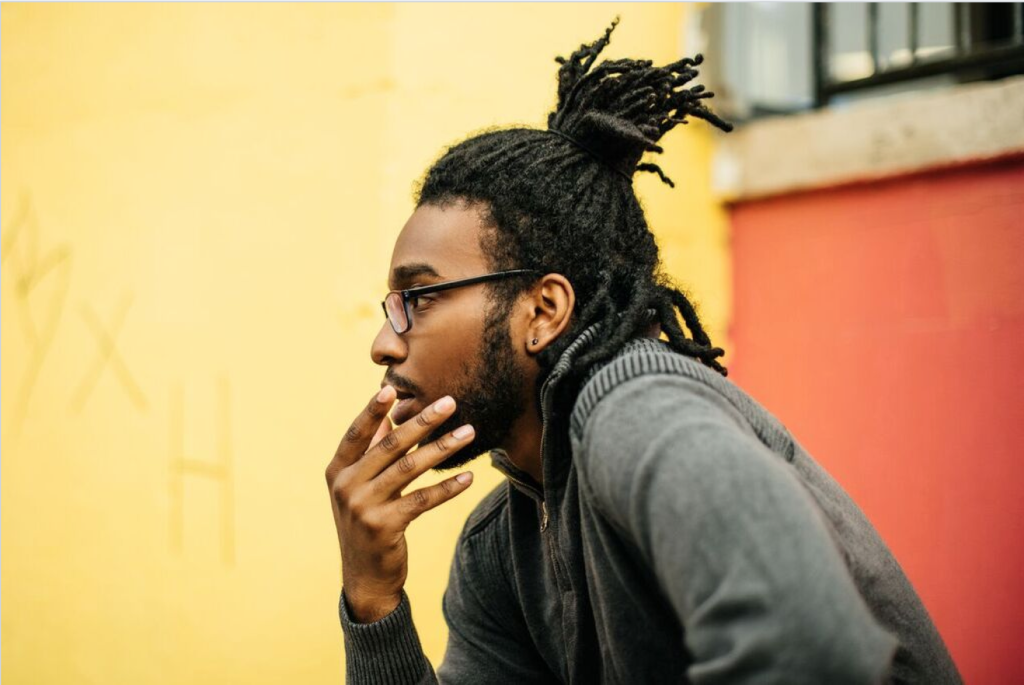
Rich Robin went to high school with Braxton and helped him build a home for the arts in an Allison Hill warehouse.“It was just manpower in the beginning,” he said.
One evening last fall, Rayon Braxton called a meeting with four of his closest associates. They gathered at the place that bore his name—Braxton Hall, the arts center and dance club he’d opened less than a year earlier—to talk about the future.
As a venue, Braxton Hall was both intimate and vast. It spread across an entire floor of the Big Ugly Warehouse, a blue-gray concrete structure on Derry Street, above a Spanish grocery. The entrance was tucked away in a narrow alley, almost invisible from the main road. A ramp blocked the view from the gravel parking lot. The door was not marked, aside from three small stickers with black letters spelling out “B X H.” Through a missing window pane, a dim blue light in the stairwell could be seen from the street. “That was like the light that let you know we was here,” Chance Davis, a friend who helped develop Braxton Hall, told me. “But only the who’s-who knew that.”
The night of the meeting, Braxton seemed determined to get a message across to his friends. “For some reason, he just needed to speak to us,” Davis said. He told them they were the group he trusted the most, and that he wanted them to carry on his vision. Rich Robin, who took photos at Braxton Hall events, and had known Braxton since high school, recalled that Braxton seemed to be preparing them for the next level of responsibility. “There were certain ones of us, it was very apparent, that he was grooming to take those leadership roles,” he said. To Davis, Braxton seemed oddly preoccupied with what would happen when he was gone. More than once, he told them he trusted them to look after his 2-year-old son.
At the time, they didn’t put too much thought into what Braxton was saying. Davis had a son of his own, and Robin’s girlfriend was expecting a child. Taking care of one another’s kids seemed like a given. “If I’m around your kid, I’m going to, you know, look after him,” Davis said. But he later came to view Braxton’s words in almost spiritual terms. It was as if he was “speaking from another dimension,” he said. “It was a hieroglyphic. It was something we needed to decipher.”
A few weeks later, on the Friday after Thanksgiving, a friend of Braxton’s named Tauhidah Palmer arrived at the hall with a girlfriend a little before 7 p.m. They climbed the staircase, passing under the glow of the blue light bulb. But when they reached the third floor, the place looked deserted. They checked in the clothing store, one of Braxton Hall’s latest ventures, where articles by a local designer hung on display. There was no one there, so they headed towards the bar. There, Palmer looked down and saw empty bullet casings on the floor. Then she spotted Braxton.
Normally, by that time on a Friday evening, members of the Braxton Hall crew would have already started arriving. There was a rap battle scheduled for later that night, which Braxton had been promoting all week on Facebook. But for some reason, everyone had gotten delayed. Davis, feeling tired, had gone straight home from work to shower and take a nap. Others were still out Black Friday shopping. When Davis picked up his phone to check a group chat, he saw urgent messages from Palmer and her friend: “Cancel the event, cancel the event. Rayon’s been shot. He’s bleeding out.”
At first, Davis thought they might be overreacting. He’d been shot himself once, in downtown Harrisburg, and he remembered how his imagination had run away with fears that he was going to die. But when he got to Braxton Hall, the street was blocked off, and the girls had been taken in for questioning. He spotted an ambulance parked outside. The paramedic was sitting upright in the back, not showing any sense of urgency. There was no sign of Braxton. Davis thought, Either they already moved him, or he’s gone.
…
Growing up, Braxton had always loved the arts. He was an avid dancer and, at Susquehanna Township High School, a member of the hip-hop club. After graduation, he started to explore the potential for art to be a vehicle for positive change. In 2010, he and a group of fellow Susquehanna alums started meeting in the basement of his family home, forming a collective whose identity centered on the word “impact.” Robin drew the group’s logo. It showed a figure in silhouette punching the ground, with roses growing from the cracks in the pavement radiating outward from the figure’s fist. “The whole concept was just the fact that, when you think about impact, it’s not passive,” Robin said. “In order for you to impact something, you have to come with some sort of force.”
Braxton Hall opened in December 2014. The Big Ugly Warehouse had formerly been home to a surplus-goods retail division of the Hirsch Bros., a commercial liquidations company that sold the property in 2006. When Braxton first took it over, it was a mess. “There was poop everywhere,” Davis told me. “Bird poop, wood, rocks, squirrel poop, metal, you name it.” But Braxton was handy, having worked with his family building houses when he was younger. The group broke apart some wooden pallets lying around the warehouse and used them to build a bar and a stage. They fashioned walls out of drywall scraps they found upstairs. If Braxton didn’t know how to do something, he would look up a YouTube video that could teach him. “It was just manpower in the beginning,” Robin said. “We had a lot of people that were dedicated to coming in here and just spending hours and hours cleaning, moving things.”
In the months that followed, the venue became an incubator of what might have been called, in a different context, a budding DIY scene. Artists met and networked there. Aspiring organizers tried their hands at putting on parties and shows. They held dance classes, open mic nights, photo shoots, even baby showers. Rental rates were cheap; above all, Braxton wanted people to try things out, to get their hands dirty. Even the clothing store was meant to be a place where young people could learn. “There’s a lot of kids that want to do this clothing line stuff, but they don’t know where to go,” one Braxton Hall organizer said. “Braxton Hall would be the platform where you could go to get anything that you needed.”
They also threw epic parties. Starting in the New Year, they launched “Fleek Fridays,” a late-night party series for the over-18 crowd. Braxton, announcing it on his Facebook page, wrote, “Harrisburg will never be lame again (well at least not on Fridays).” To circumvent their lack of a liquor license, they billed events as B.Y.O.B., marking who was 21 or over with stamps or wristbands. They created a VIP section by putting up tents indoors. “All of our decorations were, like, things hanging from the ceiling,” said Alexis George, who taught hip-hop dance classes there. “But still, when people walked in, everybody was like, ‘Whoooaaa.’” Braxton’s dream was to build a self-sustaining arts center, but he had no formal financial backing, and the parties were a way to make quick money. By the summer, they were drawing hundreds of people a night, at $5 or $10 a head.
Initially, Braxton played the role of leaseholder, providing the physical home where artists could do their work. Many were part of Enlite Entertainment, a collective that was looking for a new venue after the restaurant that had been hosting their events was shut down. But Braxton was also a natural leader, and as time went on, he took an increasingly active role in shaping the programs. He could be quiet, even reserved—Nika Jones, who came to Braxton Hall through Enlite, recalled an early meeting where he “was just kinda sitting in the corner, just quiet, watching everything.” At the same time, he was a skilled speaker, good at energizing people and keeping them focused on their vision and goals. “He’s not someone that you could be around and not be motivated,” Davis said. “He’s gonna ask you, ‘What did you do today? Why have you been around me and doing nothing?’” People called him “Bossman,” though Braxton carried the label lightly. “You don’t work for me. You work with me,” he used to tell people.
When Braxton’s friends and colleagues described him, the quality that kept coming to my mind was magnanimity. Time and again, they emphasized how he invited people into his circle and elevated them to places where they could succeed. He motivated people “to be the very best ‘them’ they could be,” said Breanna Lee, a fashion designer who was part of the early days at Braxton Hall. Sharina Johnson, who first contacted Braxton in August, looking for a place where she could put on events, recalled how, right after he gave her a tour, he asked her to stay for a weekly team meeting. “I don’t know why, but you’re supposed to be here,” he told her. Ky’Air Watson, who started there as an events promoter, said that Braxton pushed him to take on more of a management role. “Quite recently, he made me put on a whole event by myself,” Watson recalled. “He, like, disappeared for the night. He was like, ‘The show is yours. And you’re gonna make it through.’”
In May, Braxton formally invited people to join his vision in a manifesto of sorts on his Facebook page. “My name is Rayon Braxton,” it began. “I am 24 years old and I’m from Harrisburg, Pa.” He wrote that it was his vision “to offer something that a lot of cities lack”—a “business built entirely by us for us,” centered on “art, music and nurturing the community.” At the end, he rattled off a series of exuberant hashtags: “#togetherwearestronger,” “#iamyourbrother,” “#comejointhedream.” This gesture of openness and trust was classic Braxton, his friends said. “If you wanted to find Rayon, he was here,” Davis told me, as we stood outside Braxton Hall. “And door open. He didn’t have enemies.” Lee, similarly, said she “couldn’t imagine who would want to do that to him, because he really didn’t have beef with anyone.” If people tried to start something with him, she said, he would turn it back on them. “He would say, ‘You don’t have beef with me. You have beef with yourself.’”
…
Braxton’s murder was one of two homicides in Harrisburg on the day after Thanksgiving. They occurred within an hour of each other. The other, the shooting death of a 25-year-old named Rashaad Gallmon-Queen, took place Uptown, near the intersection of Fifth and Radnor. His death caused some confusion among Braxton’s friends, who arrived at the hospital to find a crowd already gathered there, waiting for news on Gallmon-Queen. He was pronounced dead shortly after arriving. Early the next morning, police charged a 15-year-old boy with his murder.
Together, the deaths brought the city’s homicide total to 17 for the third straight year. For many, the violence seemed to have reached a tipping point. Rafiyqa Muhammad, a community activist who learned about the murders through Facebook, started calling other community leaders, asking them, “What is going on?” They scheduled an emergency meeting for that Sunday, Nov. 29, to talk about ways to respond. The meeting was open to members of the public, who packed a room at the Nation of Islam Mosque on Market Street. Someone had put together a list of those murdered in the city over the past several years, printing them on a large banner beside the words “Enough is enough.”
The Braxton Hall crew wanted to do something, too. Aside from the persistently high murder rate, the fact that the violence had claimed someone like Braxton, a peacemaker and a mentor to so many, left them stunned. “He was a really positive person,” Ky’Air Watson told me. “It was really a blow to the community.” The morning after his death, Watson posted an event on Facebook, announcing a gathering in Braxton’s honor later that day. A hundred people showed up, meeting outside the hall before marching downtown. At one point, Harrisburg police pulled up behind the demonstrators, and “for a slight few seconds, it was like, ‘Oh, my god, they’re gonna stop us,’” Watson said. But instead, the police blocked off the street and helped direct traffic, and an officer explained to them where they could assemble once they got to the Capitol.
The gatherings continued through the next week. During Sunday’s emergency meeting, it had come out that many young people weren’t aware of the existing venues that might support their endeavors. “The community is not connected to its resources,” Muhammad told me. So on Thursday, they held a meeting at Jump Street, an arts non-profit on Cameron Street, to spread information about state arts grants and the tools, like Jump Street’s own tents and sound equipment, that young organizers could borrow for their events.
On Saturday, Dec. 5, Braxton’s friends and family held a vigil at the Big Ugly Warehouse. For the first couple of hours, the mood was buoyant. They stood outside in the gravel parking lot, playing music on loudspeakers, dancing and singing karaoke. Then they migrated to Carlisle Street, forming a half-circle outside the entrance to Braxton Hall. The door and wall were crowded with messages scrawled in marker: “R.I.P. Ray,” “We love you Rayon,” “Rest easy King.” At the base of the door was a small shrine of lit votive candles, stuffed animals, a couple of empty liquor bottles. A somber, quieter atmosphere took hold. People held onto white balloons that they’d covered in remembrances, prayers and names of the dead.
One at a time, people stepped up to say a few words. They gave raw, urgent, often pleading speeches. They weren’t there simply to remember Braxton. They were searching for the public meaning of a private sorrow. They addressed Braxton’s killer, speaking not to an individual, but as if to a force that had taken root in their community. “Get it together,” exhorted one man, a dancer and minister named Darius Howard. “Be men. Be kings. We ain’t gotta be like that, bro. Come on.” Some people hovered on the periphery, mingling and talking. Others sniffed and stood quietly. At one point, a young man who had been singing earlier in the parking lot walked over to the wall, buried his face in his elbow, and wept.
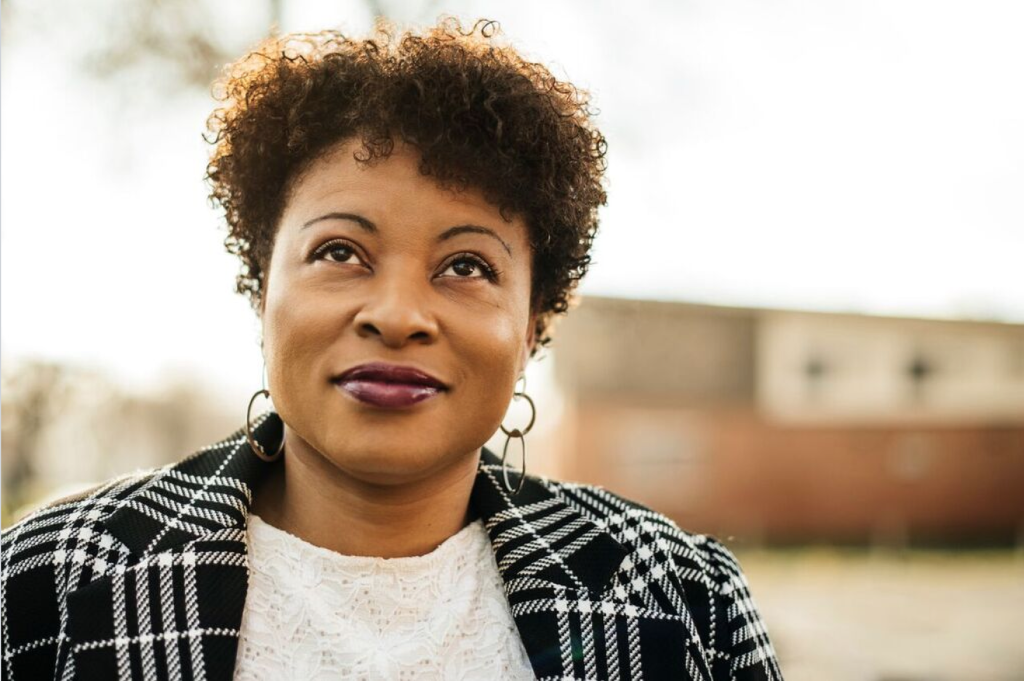
Since her son’s death, Dereasha Leaks has spoken out against the violence plaguing her community. “We are all evil at nature,” she said. “But we choose to be good.”
When Braxton’s mother, Dereasha Leaks, came forward to speak, her voice was soft at first, barely above a hoarse whisper. “I loved my son,” she said, on the word “son” her voice all but vanishing. “And my son loved all of y’all. And all he did was give. And share. And try to enlighten. And somebody let a spirit of envy, jealousy, take over them, and they murdered my son.” She urged them to hold themselves to a higher standard and to resist the “vicious demon thoughts” that could lead them astray. It matters how you live and how you die, she told them, her voice steadily rising. “We choose to be good. We are all evil at nature. But we choose to be good,” she said. “Hold yourself accountable. Hold the people that you keep company with accountable. This is our society. Hold yourself accountable!”
Leaks has been a vocal presence at other gatherings. The day after the vigil, she spoke at a second meeting to address the violence, at the Boys and Girls Club on Berryhill Street. “I already forgave,” she told the crowd. “I’m excited about our future, because we’re saving lives now. We’re on a mission to save lives.” She is working on establishing a community center in honor of her son, who, she told me, had given people “an image of something they could aspire to be.” She said that a reporter had asked her what her son would say if he were still alive. She hadn’t known how to answer, but after sleeping on it, she said, something came to her. “One thing Rayon would be most disappointed about would be leaving his son fatherless,” she said. Though Braxton had a relationship with his father when he was older, Leaks had raised him alone. He wanted his son to have a different experience. “He wanted to be the best father ever,” she said. “He wanted his son every day knowing, ‘Daddy’s here, and daddy’s got you.’”
…
Braxton’s death and its aftermath drew more than the usual share of coverage from the local media. Maybe it was the size of the community response, or maybe it was the story’s resonance with larger themes. Some people, in the wake of the crime, talked about an epidemic of gun violence. Watson, invoking the Black Lives Matter movement, had tagged his Facebook event #RayonBraxtonMatters.
On balance, the coverage gave ample space to people’s affirmations of Braxton and the community Braxton Hall had supported. But there was one story that stuck out to Braxton’s friends, tarnishing all other media by association. It was an article PennLive published the Monday after he died, and it concerned the legitimacy of Braxton Hall as a business. It ran under the headline “Harrisburg man killed inside illegal, after-hours club was days from eviction.” The article was a standard, latest-developments treatment of new information about the venue, released by a police captain at the city’s weekly press briefing. But, to a person, the dozen or so people I interviewed with ties to Braxton Hall were profoundly upset by it. As Watson put it, “That article made it sound so shady.”
The extent to which Braxton operated aboveboard is a complicated question. The “illegal” part of the description had to do with two issues: first, that Braxton Hall held B.Y.O.B. parties in an area not zoned for them, and second, that it had no business license. According to Geoffrey Knight, the city planner, the city learned about the venue at a public meeting over the summer, when some young people, discussing a vision for Harrisburg’s future, said they “would like to have more places like Braxton Hall.” The name was news to officials, who looked into the business and, determining it was out of compliance, sent a pair of cease-and-desist letters. Later that summer, Braxton and a friend visited the tax office and got the papers for registering the business. But the city says they never turned them in.
The “days from eviction” claim is less straightforward. Mike Hughes, the city’s tax enforcement officer, said that he’d spoken in August to both Braxton and a representative of the owner, who confirmed Braxton Hall had been evicted. (Even if the business was gone, the city would still have demanded Braxton file paperwork, to cover his time in operation the previous year.) Because of this, officials pleaded ignorance after Braxton’s death, saying they thought the business had been closed for months. “Normally we don’t find out about these clubs unless there’s a call,” police Capt. Gabriel Olivera told reporters. But that contradicts statements by just about everyone who worked there, who said police routinely stopped by during events throughout the fall. Furthermore, they said, they shared their activities publicly on Facebook; in early August, an event at Braxton Hall on preventing violence was attended by state Rep. Patty Kim. “Nothing was secret,” Nika Jones told me. “It was on top of a grocery store on Derry, the busiest street in Harrisburg.”
Additionally, the property’s owner has been less than forthcoming. On a recent Saturday, I ran into the owner’s representative on record with the city, a man named Mitch Greynolds. Greynolds said he spoke frequently to Braxton, who would call him to talk about business, fathering, and his long-term goals. “He had a great vision, he had a great heart,” he told me. “His downfall was some of the negativity that came from the after-dark events. He was young, it was his first major business endeavor, and unfortunately we learn from our mistakes.”
When I asked about the eviction, he referred me back to city hall, saying it was the city that first raised the issue. He said that, as far as he knew, Braxton had all the licenses and permits he needed. Yet later, the city provided me with a response letter from the owner, a woman named Cindy Wilson, writing from an address in West Virginia. In it, Wilson said that Braxton’s B.Y.O.B. parties violated his lease and that he was being evicted. “I am more than anxious to stop this activity and remove him as a tenant,” she added. It was dated Aug. 18. (Greynolds, after a brief conversation, said he would follow up in a couple of days about a longer interview. I never heard from him, and Wilson did not return a voicemail message.)
In some ways, it seems that in addressing Braxton Hall city officials didn’t know quite what they were dealing with. Mayor Eric Papenfuse, discussing the murder publicly for the first time, linked Braxton Hall to other “problem businesses” that attract crime and need to be shut down. He also said there needed to be more opportunities for youth—apparently not recognizing the number of youth who had found those opportunities through Braxton. Michele Hairston, an educator who helped bring the August event, part of the “Hip Hop Against Violence” series, to Braxton Hall, said Braxton was working on getting registered as a non-profit corporation. “He was walking around the community, trying to get donations from business owners,” she said. Other friends said he wanted to move the venue away from hosting parties, though it seemed the parties were closely linked with the Braxton Hall brand. Alexis George, the dancer who taught classes there, relished the memories of parties last summer. “It was lit,” she told me. “Like, the whole time.”
In a sense, suggesting Braxton Hall had to be one or the other—as if a late-night party venue and a community center were incompatible—seems like a failure of imagination. Couldn’t it have been both? Uptown Harrisburg for years has had the MakeSpace, a set of artist studios on a residential block that hosts community meetings as well as concerts and parties. Fights did occur at Braxton Hall, but only intermittently. When they did, Braxton seemed to find them distressing. The day before he died, he posted on Facebook about a message he’d just gotten, from someone who’d been assaulted in the Braxton Hall parking lot the night before. The news had Braxton “reconsidering everything” he was doing in Harrisburg, he wrote. He announced he would no longer be hosting any parties, then signed off with the hashtags “#happythanksgiving,” “#imdone” and “#prayforharrisburg.”
…
Braxton’s funeral was on Wednesday, Dec. 9. That same day, Harrisburg police charged a 26-year-old man named Jerren Stuckey with his murder. Around 6 p.m., officers spotted Stuckey’s car, a silver Volkswagen Passat, parked downtown. It was unoccupied, so police staked it out until Stuckey reappeared, three and a half hours later, and started to drive off with two passengers. As he came to a stop at a red light, officers surrounded him with their vehicles and ordered him out of the car.
When Robin heard the news, he was at the hospital with his girlfriend, who had gone into labor a few hours earlier. He was struck by the coincidence of the events of that day. “It was almost like it was meant to happen that way,” he told me. At the hospital, he’d still been working through the emotions of burying his friend. “I felt, to a certain extent, that a weight was lifted off of me, to the extent that I could actually focus on what was happening in the delivery,” he said. “It was almost like God knew, that in order for me to welcome my son into this world, and to give him the attention that he needed, that that was something that I needed.”
Stuckey went to high school with Braxton. As of this writing, police had provided only scant details of the investigation, and they had yet to indicate a motive. Friends said Stuckey worked at some events at Braxton Hall earlier in the year, but it had been a while since anyone had seen him there. After his arrest, it came out that he’d had some prior brushes with the law. Last January, he was acquitted on charges stemming from an incident in 2013, in which he admitted to slashing the face of a 17-year-old girl. Stuckey’s father is a retired state trooper, and a few people speculated to me that this connection helped him escape punishment. But court records suggest there were some problems with the state’s case. Key witnesses contradicted each other, and the victim’s own testimony was inconsistent with surveillance video from the gas station where the confrontation started.
The Friday after Braxton’s death, his friends were at a loss. They couldn’t go to Braxton Hall, of course, but they weren’t in much of a mood to do anything else. “I went home and went to sleep,” one friend told me. Sometimes, Davis said, he would drive past the warehouse and “see the blue light on and be spooked.” Braxton had died in the place he’d built, and the place he felt most comfortable—in a way, to Davis, it was “poetic,” as well as “wrong, and weird, and interesting, and bittersweet.” “He would sleep here. He fixed the bathroom,” he told me. “This was his home. This was his place of peace.”
In the weeks since Braxton’s murder, his friends have refused to believe that his death was in vain. Robin had the group consider how, in some sense, what happened had propelled their work onto a larger stage. Now was the time to build something positive out of their loss, he said. But there were questions about where that work would occur. Robin thought the Braxton Hall brand should have a new life independent of any building. He felt it was best to leave the Big Ugly Warehouse behind, and treat it more like a memorial.
On a recent Sunday, he perched on a rail outside the entrance, beside the shrine of candles, drooping paper placards, and messages scrawled around the door. “I can’t work within this building anymore, after what happened to him,” he said. “I can’t do it.”
Photos by Dani Fresh.