Wing Thing: Last year, Harrisburg was named a “Bird Town.” Now, that’s something to chirp about.

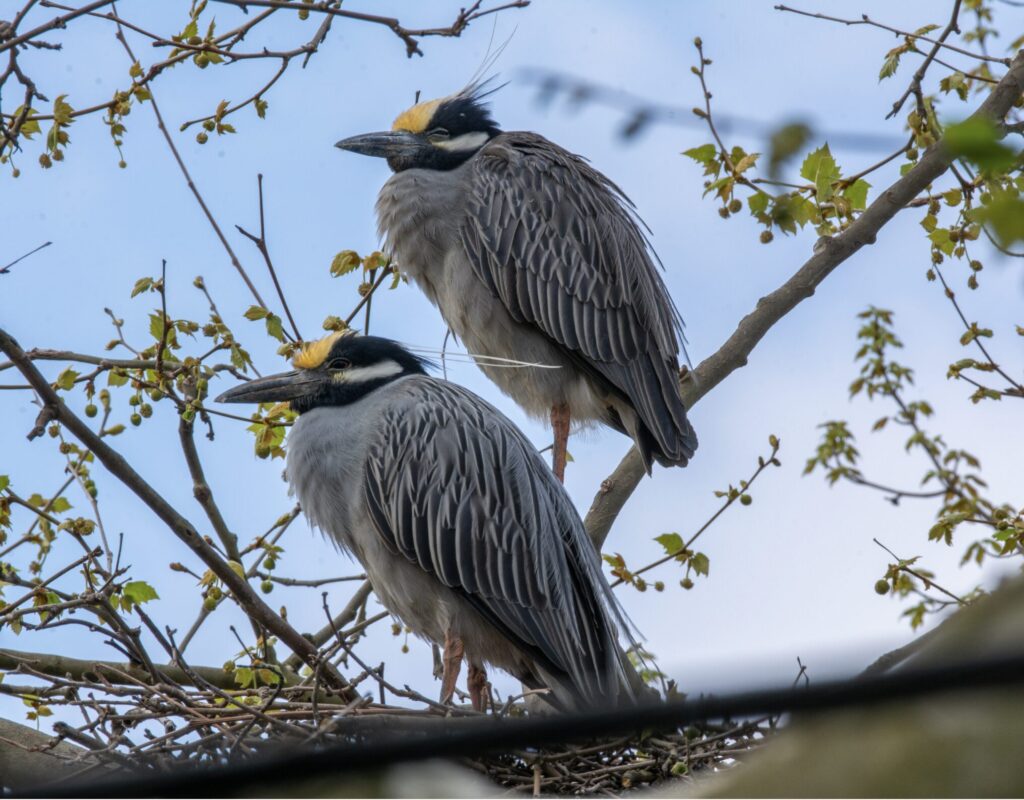
Yellow-crowned Night Herons by Joe Kavanagh

“I just saw two geese going by with seven goslings,” Donna Opuszynski told me when we met at a prime birding spot on Harrisburg’s riverfront—across from the Governor’s Mansion, facing the Susquehanna River.

Harrisburg is now a “Bird Town.” The designation came in 2025, committing the city to promoting community-based conservation, and birders are flocking together to protect their feathered friends.

Feathering the Nest

Opuszynski, a semi-retired massage therapist, has been a birder since childhood in northeast Philadelphia.

“I was just fascinated by their behavior,” she said.

She came to Harrisburg in 2010 and, today, leads some of the city’s Bird Town bird walks.

On a recent, chilly-for-spring morning, we sat on a Front Street bench. Birdwatchers identify behavior and flight patterns as well as markings and calls, Opuszynski explained.

With her eagle eye—I suddenly realize how many bird terms have seeped into our lexicon—she spotted three ducks barely visible in the distance. Probably mergansers, she said, because they were diving.

“They have a serrated bill, and they catch fish,” she said. “They’re fishermen. Fisher-ducks.”

From the front door of her Midtown Harrisburg home, Opuszynski can see a nest woven by a yellow-crowned night heron.

“The ones that everyone complains about,” I said.

“You don’t park under them,” she concurred. “They poop pink. They eat crustaceans.”

Fall and spring amp up the variety as migrating birds follow the Susquehanna River on the way to their destinations. A brown thrasher hung around Opuszynski’s backyard for a week. There have been Eastern towhees and white-crowned sparrows.

“People don’t think, if you have a little 13-by-13 backyard in Midtown, that you get migrants,” she said. “I was getting a common yellow-throated warbler. I miss him.”
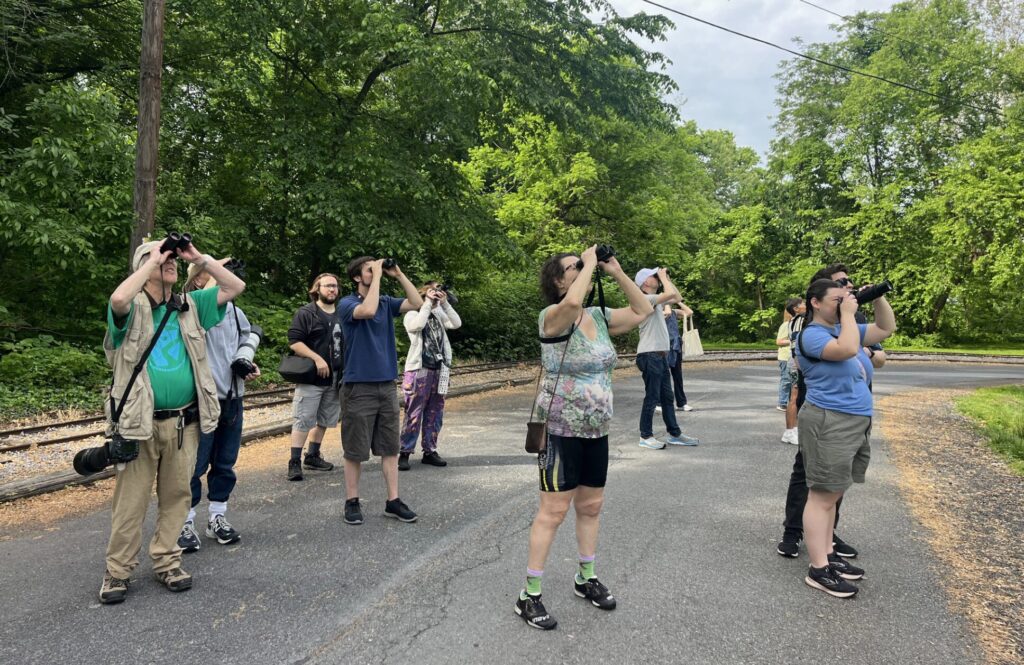
Harrisburg Bird Town and Camp Hill Bird Town Bird & Nature Walk

Bird in the Hand

Why birds? Madelyn Good gets the question a lot.

“Why not birds?” said the city sustainability coordinator. “I think that birds are indicators of climate change because of their migration patterns and breeding habits. You track how those change with the changing environment.”

Harrisburg’s quest for Bird Town designation from the Pennsylvania Audubon Council was underway under Good’s predecessor, Danielle Lewis, when Good joined the city in late 2024. Now extended to about 80 Pennsylvania municipalities, including others around Harrisburg, Bird Town Pennsylvania supports programs and learning that help birds thrive and inspire residents to do the little things that sustain bird life.

Bird Town Harrisburg hosts spring and fall bird walks in city parks. For kids, there are summer-camp bird walks and activities. On June 7, a native plants workshop will offer a tour of Reservoir Park’s new native meadow, with lessons on the plants that feed the insects that mama birds feed to their young.

Good remembers spotting orioles, hummingbirds and bald eagles during a walk in the Capital Area Greenbelt’s Five Senses Garden. On a walk last spring, the experienced birders were excited to see a spoonbill—a rare pink Southern native in the Susquehanna, “which is another indicator of climate change,” noted Good.

“This is a whole world in itself,” she said. “It makes you appreciate what’s going on around you more. I definitely notice that I stop and look up much more often than I used to since I started bird watching.”

Protecting city birds preserves the beauty of nature and its benefits, Opuszynski said.

“If all our trees are gone, we can’t breathe,” she said. “If birds are gone, they’re not keeping populations of other things in check. That’s part of nature. Nature has a certain balance, and we keep interrupting that balance, but it always seems to bounce back.”

Wood duckling by Joe Kavanagh

Bird’s-Eye View

In 2025, 99 birds died from building collisions in Harrisburg—but that’s just the known count. The actual fatality number could be 10 times higher.

Bird Safe Harrisburg does the counting—and the prevention. Through Bird Safe Harrisburg, an Appalachian Audubon Society program, collision-monitoring volunteers hit the streets of downtown, the Capitol Complex, and the HACC campus every spring and fall from 5:30 a.m. until 8 a.m.

These intrepid early birds (see what I mean?) count and collect stricken birds. Other volunteers drive the survivors to rehab at the West Shore Wildlife Rehabilitation Center.

The data collected can pinpoint the species most likely to collide and the buildings needing attention, said Zach Richard, past president of Appalachian Audubon Society.

“All the live birds, we’re giving them a second chance,” Richard said. “Most suffer internal injuries. A bird may seem like it’s recuperating, but it may very well die later.”

Bird Safe Harrisburg is helping building owners retrofit their windows with specially designed, patterned film that makes the glass evident to birds. Homeowners can buy their own window film or use soap to smudge the reflection—but on the outside. I tried suggesting that cat nose prints made my windows bird-safe, but no go.

Bird Safe also sponsors Lights Out Harrisburg, recruiting more than 50 building owners to dim or redirect their migration-season nighttime lighting. There’s no switch to lower the lights on a city, Richard conceded, but residents, officials and business owners can help reduce upglow on the stars that birds rely on for navigation.

Birds perform “a variety of services” for humans, said Richard. They eat crop-destroying pests. Pollinate crops. Add to soil nutrients with their droppings. Even the scavengers reduce rabies transmission and the costs of carcass removal.

And culturally, birds create communities. One adult in three is a bird watcher, said Richard. More children are getting involved, using the eBird app to track their finds.

“It’s kind of like real-life Pokémon Go,” he said.
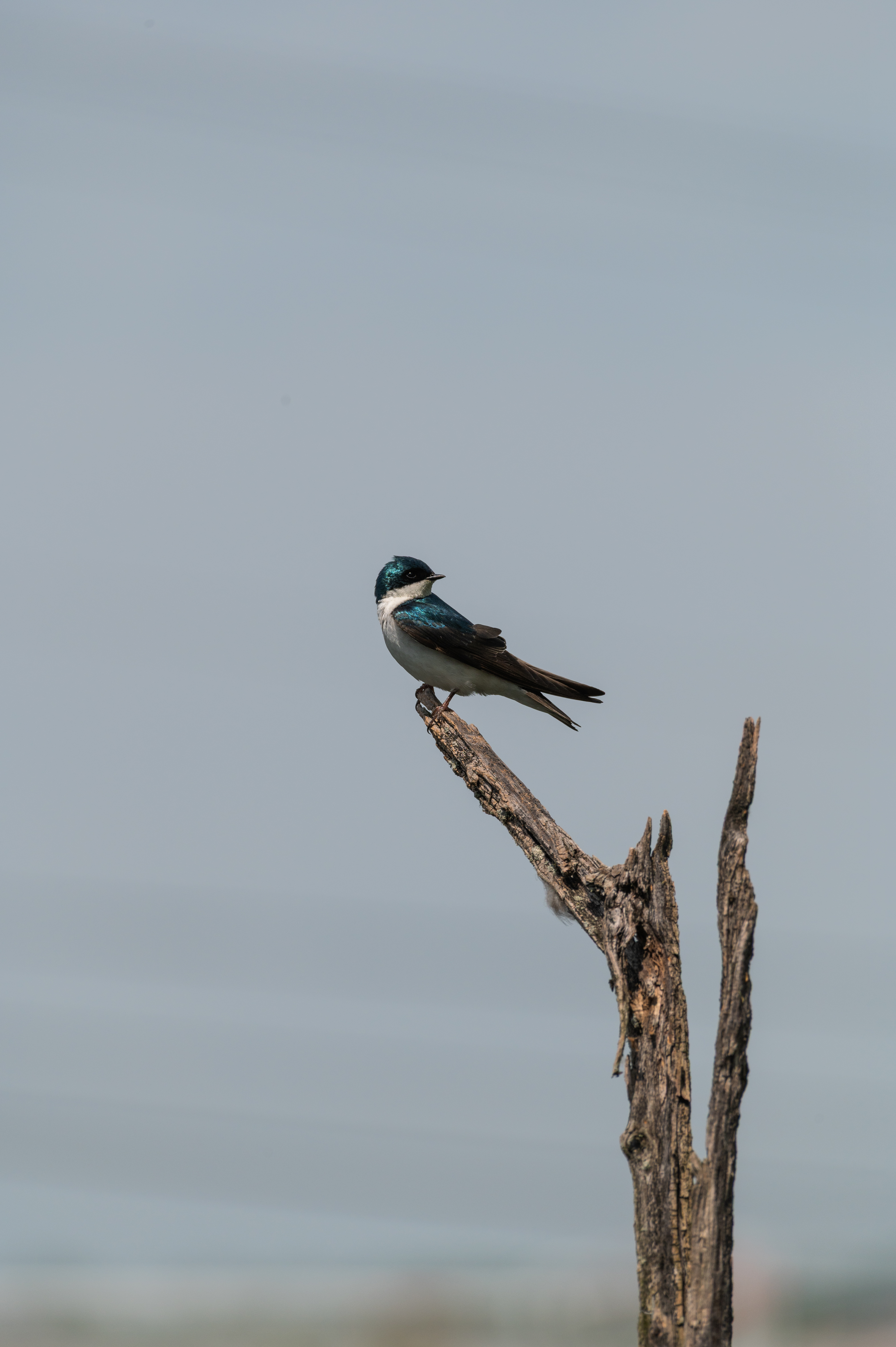
harrisburg bird, tree swallow

Tree Swallow by Joe Kavanagh

City Birds

There’s a new purple martin house and educational signage at City Island, a gift from the Pennsylvania Game Commission to the city.

Purple martins are migratory, social creatures, said PGC Aviation Recovery Specialist Stefan Karkuff. When their nests disappear, so do their colonies.

Next, Good hopes the PGC can help Harrisburg install nests for chimney swifts, whose natural habitat—chimneys, of course—can dwindle as chimneys are capped.

“They really like cities, especially cities that have those brick-and-mortar old chimneys,” said Karkuff, whose office helps conserve Pennsylvania’s non-game birds. “I would say they’re still common in Pennsylvania, but we want to keep those common species common.”

Harrisburg residents love their birds, he added. As his office recently surveyed the yellow-crowned night herons of Midtown, they heard the complaints, but mostly, residents stepped out to express their appreciation for “these big wonky birds that are sitting up in this tree.”

In all of Pennsylvania, yellow-crowned night herons nest only in Harrisburg. They choose their spots and reappear, or not, in successive years, but as to why Harrisburg, “You’d have to ask the birds that.”

“Why are they nesting in these big sycamores when, if they just flew to the middle of the river, there’s huge sycamores out on islands, and they could have a nice peaceful existence out there?” Karkuff said. “They have the answers, and we don’t, but we’re lucky to have them.”

Roseate Spoonbills in Cumberland County by Joe Kavanagh


Happy as a Lark

Birders agree, and I can attest: Cornell University’s Merlin app is the gateway to bird identification. On a beautiful summer evening, I’ll step onto the porch, raise a cocktail in a toast to my late husband, and tap Merlin’s Sound ID icon.

From there, my phone lists the life soaring around me—the robins, gray catbirds, American goldfinches, American redstart, and, yes, chimney swifts.

From there, birding is about learning to listen and watch for yourself, said Opuszynski. As we sat along the riverfront, she singled out the tiny rough-winged swallows, catching bugs as they swooped.

Then she pointed to a nearby robin. Whenever it cocked its head, it was listening for worms.

She remembers a moment in Shipoke during fall migration, when five ospreys were spiraling above.

“They were communicating,” she said. “I think they were saying, ‘Hey, boys or girls, time to go south,’ or wherever they go. It was their last meeting before migration. It was magical.”

And that’s what she loves about birding, “just the sheer joy of seeing them do their thing. And the beauty. Their value. The calm.”

“You sit here long enough,” she said, “and it comes to you.”  

Bird Bits

Would you like more information on the events and organizations named in the story?


Stories on environmental issues are proudly sponsored by LCSWMA.

If you like what we do, please support our work. Become a Friend of TheBurg!          

Continue Reading

June Publisher’s Note

Larry Binda speaks at Strong Towns

Last month, I spoke to a group called Strong Towns Harrisburg.

This organization is the local affiliate of the national nonprofit, Strong Towns, an urbanist group with the goal of making cities “safe, livable and inviting.”

I was honored that they invited me, as I share many of their aspirations and write about them often—things like responsible development, density, walkability and green space.

But what I really wanted to address was another topic, something perhaps less prioritized among the pro-city crowd. As I told them, I’m not an urban planner or a civil engineer or an elected official—I’m the publisher of TheBurg, and that’s where my expertise lies.

In my view, an engaged, high-quality local news outlet can play an essential role both in informing the public and in building community, a primary objective of Strong Towns. So, I centered my discussion around that belief.

I said that “community” was in TheBurg’s very DNA, as I based it, almost two decades ago, on an outstanding hyper-local paper from my old neighborhood in Washington, D.C. I thought that something similar could work in the Harrisburg area and, all these years later, I think I’ve been proven right.

A good community news outlet tries to foster progress and play a positive role in its town or city. It doesn’t hide from hard truths, but, in its critique, emphasizes possibilities and solutions. It also shines a light on the people, organizations and companies that share a common objective to serve others and make life better.

This is the goal that I set out for TheBurg. Maybe we can’t build more housing or make government more responsive or fix freakin’ Forster Street. However, we can offer a space for contextual information, community engagement and positive action—and I hope that’s what we do effectively every day and every month.

I now invite you to flip open our June issue and see for yourself. If you like what you see, visit our website and check out our daily news reporting and our other products, all designed, from the bottom up, with community in mind.

Lawrance Binda
Publisher/Editor

For more information on Strong Towns Harrisburg, visit their Facebook page: StrongHBG.

If you like what we do, please support our work. Become a Friend of TheBurg!   

Continue Reading

Shop Talk: Let’s raise a toast in honor of Harrisburg’s small businesses

Illustration by Rich Hauck

What makes for a “pillar” of the Harrisburg community?

Individuals, churches, even government officials might spring to mind. Personally, I can think of many people and organizations that contribute in big and small ways to the quality of life here.

But I’d like to make a case for Harrisburg’s small businesses—and here’s why.

Stores, shops, restaurants, bars, venues, etc., constitute a central part of the urban fabric and, in fact, are a key amenity of city life. They make living here special, as opposed to (no offense) the strip malls and asphalt sprawl that dominate commerce in the car-centered suburbs.

In Harrisburg, I live within a 10-minute stroll of several dozen restaurants, bakeries, cafés, pubs and clubs. There’s a hardware store, a fabulous grocery, an amazing florist, one of the country’s best bookstores and so many barbers and salons that I’ve lost count (not that this guy requires that particular service).

When I think about quality of life in Harrisburg, do I noodle over whatever City Council is up to? No, but the Broad Street Market immediately comes to mind. It’s a community hub, a gathering space and, thanks to its collection of independent, hard-working vendors, a place that serves up delicious grub. It’s a big reason why I like living here.

Harrisburg’s small businesses, though, never seem to get the recognition they deserve as the important players that they are, for their critical role in our community. To me, this is a glaring and indefensible omission.

Over the years, I’ve heard many small business owners complain that they receive scant support from the city. I don’t think they want much—a little acknowledgement, an ear for their concerns, some promotion maybe. But, as they’ve told me, they hear from the city exactly twice a year: once with a bill for their business privilege tax and once with a bill for their gross receipts tax.

I can sympathize. Last year, TheBurg won a prestigious honor: the Harrisburg Regional Chamber’s “Small Business of the Year” award. This award usually goes to a suburban business, but we accepted it as a proud, Harrisburg-based company that has created a valuable product, full- and part-time jobs and municipal tax revenue. The official response from the city? Well, there was no response.

My personal gripes aside, there’s actually quite a bit the city can do to assist its incredibly important small business community and, in the process, help ensure they don’t decamp for the suburbs, as so many have done before.

Value them. Currently, most small businesses don’t feel valued; they feel unseen. City leaders should tout them, advocate for them and patronize them (very important!). As it stands, business owners don’t feel that city hall has their backs. Nor do they feel that officials appreciate their crucial role in the life of the city. Instead, they feel that the city has an extractive attitude—that they’re valued mostly for their coin.

Engage with them. As I write this, the city’s top business positions are vacant. These jobs need to be filled quickly by competent, energetic people. These new leaders then need to raise their profiles within the business community, as recent economic/business managers have been disengaged and invisible. One simple idea: occasionally stroll down the city’s main business corridors (2nd Street, 3rd Street, Derry Street, etc.). Pop your head in, introduce yourself. Ask them about their businesses; ask them what you can do to help. A little engagement would go a long way.

Ease their burden. Many business owners feel that the city is difficult to deal with, whether that’s getting a question answered, resolving an issue or helping a new business get up and running. The city needs to have a point person for small business owners to contact and who will advocate for them inside city hall.

Prioritize public image. When city leaders squabble over power and prerogatives, when they sue each other, when they deride one another in the press, they damage the image of the city. This makes people less likely to want to be here—as a resident, as a visitor, as a consumer. In Harrisburg, these fights happen regularly, with little evident concern for the broader impact on the city. Simply put, bad headlines are bad for business.

Stress business development. Most cities have a detailed economic development plan—not Harrisburg. For eight years, the state-appointed Intergovernmental Cooperation Authority has urged city leaders to do more to attract business and invigorate the local economy. In particular, the ICA has emphasized the need for a structured economic development plan, which would set priorities and policies.

Focus on services. In my view, Harrisburg does a decent job delivering basic services, such as sanitation and parks maintenance. However, the city needs to go beyond that. People want to visit business districts that are clean, safe, well-maintained and visually appealing. Harrisburg has work to do on all these fronts. Build it—or fix it and clean it—and they will come.

Most Harrisburg small businesses are low-margin, struggling enterprises. In recent years, remote work and the state-managed parking disaster have only made conditions worse, leading to many closures. Now, more than ever, the city’s small businesses need an extra dose of understanding, appreciation and support.

Lawrance Binda is publisher and editor of TheBurg.

If you like what we do, please support our work. Become a Friend of TheBurg!          

Continue Reading

Dock Street Feat: This low-head dam at the edge of Harrisburg has proven deadly—an upcoming analysis will search for a safer solution

Dock Street Dam

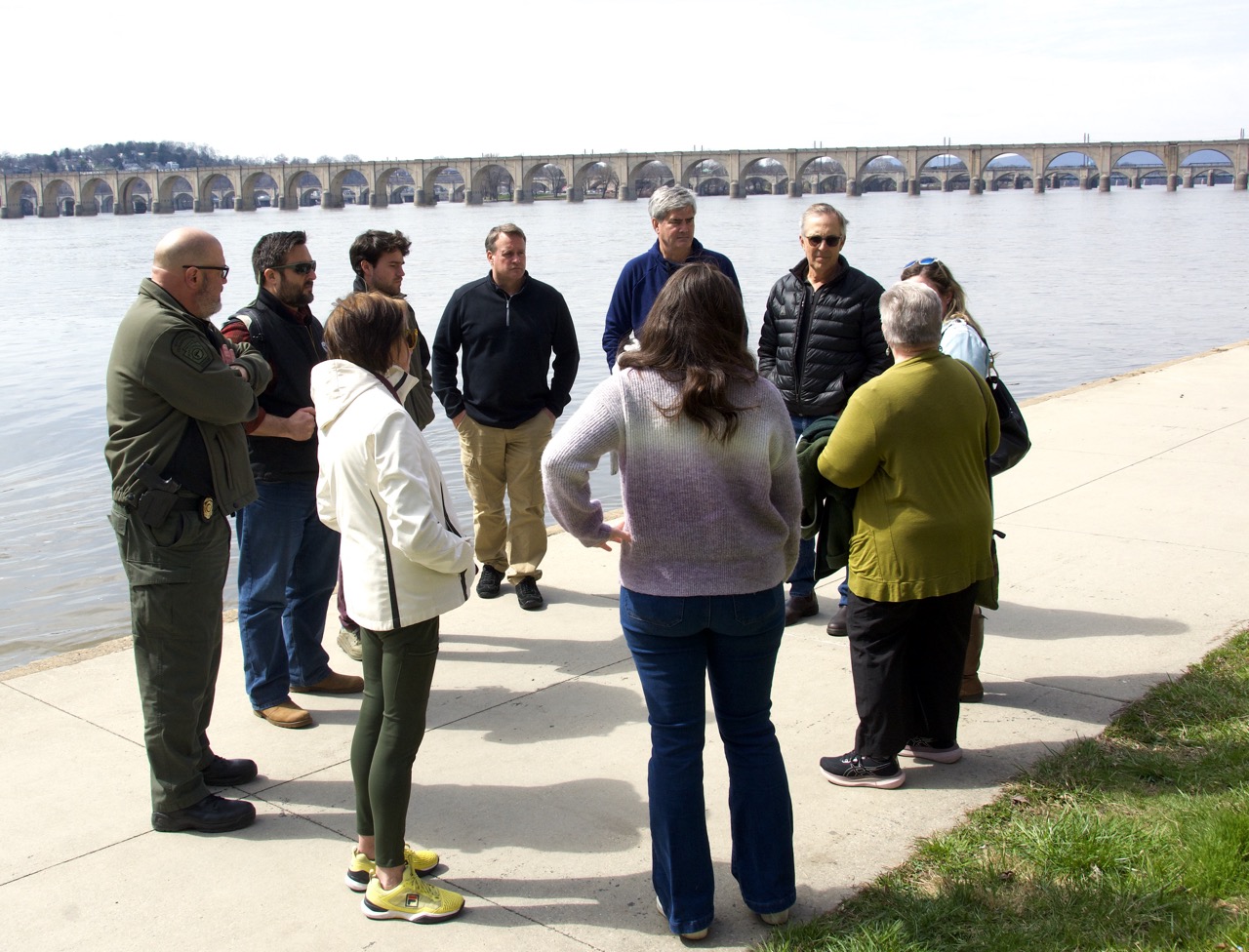
Lisa Hollingsworth-Segedy stood atop the concrete steps of the Susquehanna River on a sunny, high-water day. She pointed at a slight curve in the water, followed by a few feet of white-capped crests.

The Dock Street Dam sat below the surface, but it was virtually invisible with the water level 8 feet high.

“If you’re out on the water,” said Hollingsworth-Segedy, the director of river restoration at American Rivers, “you don’t know you’re in trouble until you’re really in trouble.”

Although it’s safer to go over the dam when the water is higher (and there’s a better chance of shooting across), the low-head dam’s hydraulics make it a danger at all times.

A “drowning machine,” the dam forcibly recirculates water at its base, trapping objects and people. According to Hollingsworth-Segedy, there is no other dam in the country that comes close the Dock Street Dam in terms of fatalities.

Since the dam was installed more than a century ago, at least 31 people have drowned there—the last, a 64-year-old boater in April 2023. His boat engine stalled. The vessel went over the dam, and its backwash trapped him and his friend, who survived, underwater.

Several incidents last year marked near misses.

In spring 2025, two kayakers were saved from the dam by a nearby fisherman after going over by mistake, realizing it was there just before the drop. A few months later, during a thunderstorm and torrential downpour, a near-drowned man in the river was pulled by firefighters as he floated toward the dam.

According to an Association of State Dam Safety Officials report, 30 earlier near-fatalities occurred between 1935 and 2018.

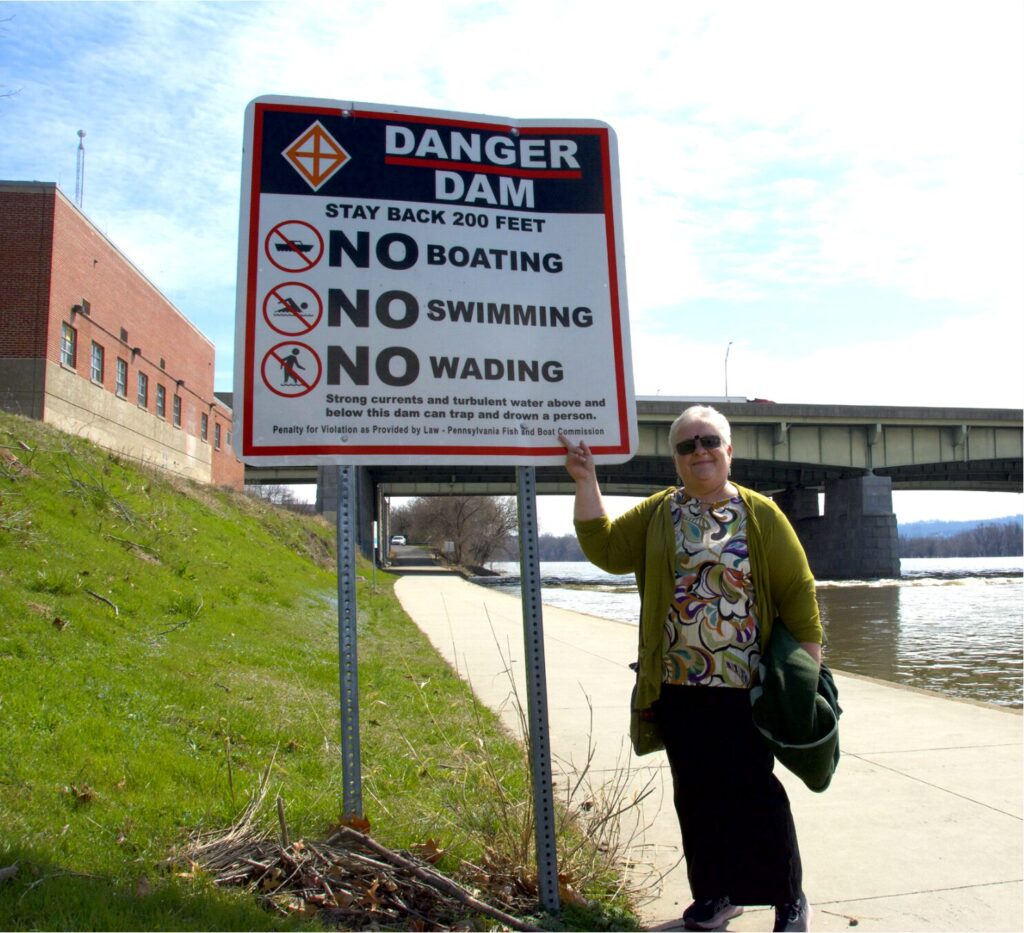
Lisa Hollingsworth-Segedy with sign warning of the dam’s danger.

The vast number of deaths and close calls are what inspired Hollingsworth-Segedy to act.

“Somebody needs to do something,” she said.

She and her team at American Rivers want to figure out what that “something” is.

With support and interest from the city, state and local river-related constituents, the national nonprofit, American Rivers, will be analyzing options for the low-head structure over the next 1½ to two years. They anticipate the study will begin in July.

“Tell us what it’s going to cost if we take the dam out, if we don’t take the dam out, if we do something different—if we put a rock ramp in front of it. Can we take out half the dam? Can we lower the dam by 50%?” Hollingsworth-Segedy said.

The study has been funded by a $75,000 National Fish & Wildlife Foundation grant, which American Rivers is complementing with $35,000 from a private foundation. Additional grants have been applied for.

The analysis will detail community and ecological benefits, drawbacks, and costs associated with full or partial removal of the dam and other options to reduce deadliness as well as no action.

“Up to this point, the local sentiment from my encounters have framed the argument as, ‘If we remove the dam to reduce fatalities at the most dangerous low-head dam in the country, then we will strip away all recreational use of the river in the vicinity of City Island,’” explained Hollingsworth-Segedy. “The point of the study is to use science and technology to determine the veracity of that claim.”

Dock Street Dam in high water

Sanitation to Recreation

A hundred years ago, a low-head dam seemed like the perfect way to keep raw sewage in the river underwater.

That’s why the Dock Street Dam was initially put in.

Installed by the City of Harrisburg in stages between 1913 and 1916, a New York-based contractor charged the city just $65,000, or $2.1 million today, for the project, per the local historian Ken Frew’s book “Building Harrisburg: The Architects and Builders, 1719-1941.”

According to Erik Fasick, author of “Harrisburg and the Susquehanna River,” the builders secured concrete slabs to the riverbed to create the approximately 6-foot-tall structure, which “raised the water level 4 feet at the dam, with a gradual decrease heading upstream.”

The extra water volume did help with sewage odors, but in the 1970s, when the U.S. started treating its wastewater in line with the Clean Water Act, the dam’s original purpose (excluding combined-sewer-overflow instances) became mostly obsolete.

“Now we’re at a point where the dam wasn’t built for recreation, but it kind of provides recreation,” said Hollingsworth-Segedy.

Sarah Dropkin, owner of Blue Mountain Outfitters in Marysville, estimated she puts around 500 to 600 canoers and kayakers in the water every boating season, only sending people as far down the river as City Island.

“It’s a way for people in the city to get away from the city,” Dropkin said.

The problem only comes if the recreation turns dangerous.


American Rivers assembles advisory members to look at the Dock Street Dam

Out of Sight

Mark Sweppenhiser, director of the Bureau of Boating for the PA Fish and Boat Commission, said the dam isn’t visible to boaters on the water “because it’s only a 2- or 3- foot drop.”

“It looks like the water is flowing like it would normally flow,” he said.

While some boaters know the dam is there and take all the precautions necessary to avoid its danger, others overestimate their ability to navigate it—or underestimate the danger, Sweppenhiser said. A smaller subset of new boaters or those from outside the area end up at the dam by mistake.

If someone goes over the dam, they are likely to capsize or roll their boat. From there, other threats emerge.

“It’s highly aerated water,” Sweppenhiser said. “There’s all kinds of strainers on the backside of the dam that catch your clothing and hold you under. They don’t call it a drowning machine for nothing.”

At minimum, boaters should turn back 200 feet before the dam, he said, indicated by several signs placed around the river in accordance with the Dam Safety Act. Pennsylvania law also requires warning buoys to be installed and maintained at a minimum of 200 feet upstream of the dam.

But keeping necessary mid-river signs warning of the dam has proven difficult. According to city spokesperson Mischelle Moyer, Harrisburg has to replace buoys marking the dam in early May each year, as they are often swept away by high water after initial placement.

Even with signage, boaters, paddlers, swimmers or anybody who ends up in the water may not see warnings until it’s pretty much too late to escape.

Tony Reigle, chief of Harrisburg River Rescue, said that his team sees anywhere from three to five calls to the dam per boating season.

Harrisburg Fire Chief Brian Enterline’s department also conducts dam rescues.

Enterline emphasized that boaters should know the dangers of any body of water they put their vessel into.

He likened it to riding a motorcycle with a helmet—the smart move, while not mandated by law. A big reason Dock Street proves so deadly is that it stretches the entire width of the Susquehanna River, almost a mile in length. This means it can be hard to reach either side of the river to escape in an emergency.

“If you’re in the middle and you’re already out of gas, either figuratively or legitimately, that is a very wide river that you have to try and navigate against the current,” Enterline said.

Dock Street Dam waters

Gathering Ideas

Ideas have been thrown around to redo the city’s dam before, although none have worked out.

In the 1980s, Mayor Steve Reed proposed a $254 million inflatable rubber dam near City Island that would have raised water levels by up to 13 feet and generated electricity. Decades later, still under Reed in 2001, the city explored building a $25 million, 8-foot-tall rubber inflatable dam to replace the Dock Street Dam.

The dam, as it exists, was last updated in 1967 and is due for work soon.

“If we do nothing, then chances are, at some point, that the dam is going to start failing,” said Hollingsworth-Segedy.

American Rivers’ analysis will be informed by two advisory teams.

A technical team will give input on technological, infrastructure and life safety aspects of the study. Its members include the PA Fish and Boat, the PA Department of Conservation and Natural Resources, PennDOT, the Susquehanna River Basin Commission, Capital Region Water and city officials.

A community advisory team, made up of community stakeholders, will advise on neighborhood concerns, community river access and recreational use opportunities and review the final report to ensure it properly evaluates local issues.

“We want the city’s input. We want community residents’ input. We want people who use the river. We want people who don’t use the river now, but they would if it was safe,” said Hollingsworth-Segedy.

The timing of the study overlaps with a major infrastructure update—the $1 billion replacement of the I-83 South Bridge, expected to begin within the next year.

Just above Dock Street’s waters, the project will involve placing new bridge pillars in the river, a process for which PennDOT will take measurements of the water that could help with American Rivers’ study.

“We can use PennDOT’s data from the bridge studies to figure out how the river would change if we took the dam out,” Hollingsworth-Segedy said.

According to Moyer, the city is interested in the results of American Rivers’ analysis.

“The mayor is looking forward to working with American Rivers to determine a best course of action to address the safety at the Dock Street Dam,” Moyer said.

Multiple sources indicated that fixing the dam situation could be costly, and that finding an ultimate solution may require outside funding, grants or federal assistance as a solution. Hollingsworth-Segedy said that she is not aware of any funding sources that cover the cost of dam repair, particularly when that dam does not meet the purpose for which it was built.

Sweppenhiser emphasized that the ultimate goal is a solution that best benefits the community.

“Anybody who’s looking at this, or reading it, keep an open mind,” Sweppenhiser said. “We’re trying to find a way to provide recreational boating and make boating safer in Pennsylvania, while balancing some of those other concerns.”

Hollingsworth-Segedy indicated it will be a matter of collaboration among those involved.

“We’re just trying to look at all the potential options,” she said.

American Rivers is a national nonprofit organization that protects, restores and conserves clean water and rivers. For more information, visit www.americanrivers.org

If you like what we do, please support our work. Become a Friend of TheBurg!          

Continue Reading

Charting a Path: Pathways Forward is a critical resource for mental health services in Dauphin County

For Susan Caplinger, Pathways Forward is always there.

Caplinger, of Harrisburg, lives with her daughter, Sky, 19. Life has served them a series of challenges as mother and daughter each bear diagnoses of autism, ADHD, bipolar disorder, learning disabilities and “lots of other things,” Caplinger said recently.

A private, nonprofit organization, Pathways Forward of Dauphin County provides case management services for county residents needing mental health, autism and developmental disabilities support, or early intervention services.

Each client is assigned a case worker who arranges and oversees their care on a continuous basis for as long as necessary. Eligibility is determined on a case-by-case basis.

For Caplinger, Pathways Forward has done more than simply provide her family with access to mental health, autism, developmental delay and other related services. They’re also there for her, she said.

“A caseworker comes to our home to visit each month and makes sure my daughter and I are all right,” Caplinger said. “They helped us find therapy and a new doctor, and now they are getting us into family counseling. They helped us find a new house, too.”

The roots of Pathways Forward trace back to 1990 when Dauphin County initiated the Dauphin County MH/MR Case Management Unit for meeting the service needs of community members seeking help for mental health or challenges surrounding intellectual developmental disability/autism. The organization’s name was shortened to Case Management Unit, then later changed to the acronym CMU before acquiring its current moniker in 2024.

The organization lists its mission as “charting paths and creating opportunity for adults, children and families to live full and inclusive lives in their communities.” Likewise, its stated vision is “to uplift communities, so all individuals and families independently achieve their highest potential.”

Important Need

Pathways Forward CEO/Executive Director Patrick Slattery is the catalyst behind the organization’s 2024 name change.

In fact, the new name and branding process was part of his recruitment by Pathways’ board of directors for accepting the job, he said.

“The name change shows a better representation of what we do,” noted Slattery, of New Cumberland. “CMU was just an acronym and didn’t really mean anything to most people.”

Slattery came to Pathways 2½ years ago after a 30-year career at a KidsPeace mental health facility in Maryland. After that, he returned to the area to care for his parents for a year before they passed.

“It was very difficult, but there were a lot of memories made,” he said.

At Pathways, Slattery oversees assistance programs for 6,000 to 7,000 people per year at its main facility in Harrisburg and a satellite location in Elizabethville. The cooperative is funded at 40% through a county contract, with other funding derived through Medicaid with “some donations and some grants,” according to Slattery. As is, Medicaid funding “always trails behind the rising prices of our services,” he noted.

“Most people we serve are going through the most important time of their lives and need our help to get better,” Slattery said. “When mental health people get into recovery, they’re happier. We also help with early intervention services that help children develop properly.”

Pathways board President Doug Hill was recruited for service after retiring in 2019. “Then (Dauphin County Commissioner) George Hartwick called,” Hill said.

After 36 years as executive director of the County Commissioners Association of Pennsylvania, Hill said he was “already familiar” with how Pathways (then CMU) works. Prior to that, he was director of research and later, chief lobbyist for the Pennsylvania State Association of Boroughs and still serves on several other regional boards.

Hill believes that Pathways Forward is vital to the area because its services “meet an important need in the community.”

“It involves clients, families and caregivers so that clients can thrive in a community setting,” Hill said. “We work with a wonderful staff who are absolutely dedicated to the job they do and the consumers they serve.”

Pathways Forward staffers are just as pleased with the outcomes they’ve helped achieve.

“I love to see them get better,” Slattery said. “That’s the ultimate pride, to see them getting the proper treatment and help that they need.”


Pathways Forward is located at 1100 S. Cameron St., Harrisburg, and 295 State Dr., Elizabethville. For more information, visit
www.pathfwd.org.

If you like what we do, please support our work. Become a Friend of TheBurg!          
 

Continue Reading

Everyone Is Welcome: This month, you’re invited to the 33rd Annual Free Shakespeare in the Park

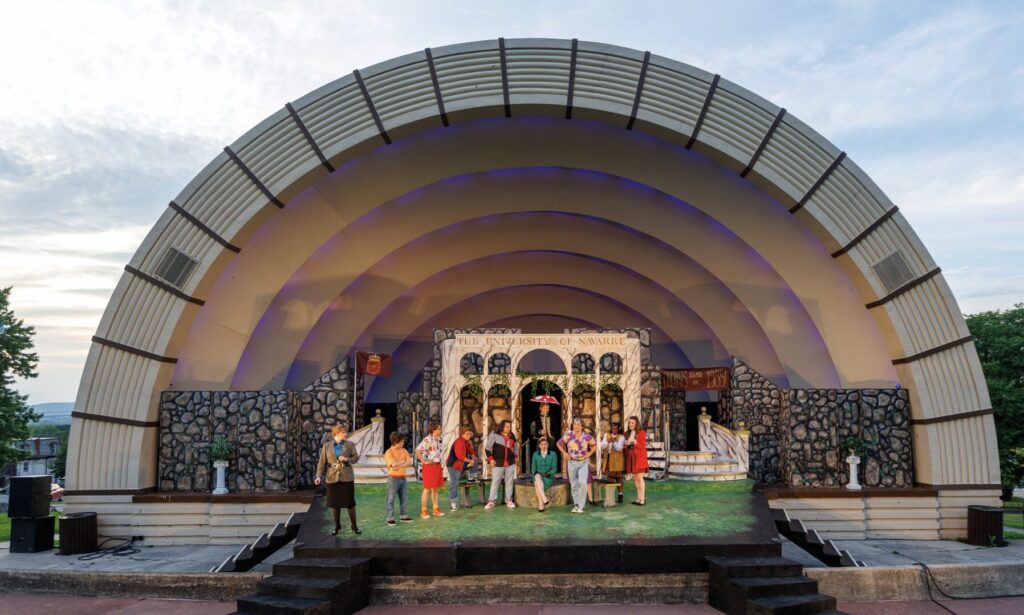
Image courtesy of Gamut Theatre

Gather your picnic blanket, favorite snacks and best friends—Free Shakespeare in the Park is back for its 33rd year.

Since their first production in 1994, the Harrisburg Shakespeare Company has had one mission—to bring the magic of Shakespeare to the heart of Harrisburg, for free. In 2026, that mission is being fulfilled in a fearlessly joyful production of “As You Like It.”

“As You Like It” is a fast-paced comedy known for its witty dialogue, ridiculous clowns and quirky love stories. Follow the journey of friends and lovers escaping from the harsh, tyrannical court to the rustic, inclusive Forest of Arden. As the title of this column teases, this production boldly proclaims that “everyone is welcome in Arden.” Yes, that means you. You are welcome in Arden, and you are welcome at the park.

Having already produced the show multiple times, the Harrisburg Shakespeare Company thought it had seen all there was to see with “As You Like It” until two individuals, with gusto to spare, proposed a fresh, modern take on the Shakespeare classic. Kim Greenawalt and Emily MacLeod, co-directors, are thrilled to share their concept for this show with audiences.

“‘As You Like It’ is the most inclusive play in [Shakespeare’s] canon,” said Greenawalt, expressing her desire to promote radical inclusivity in the show.

Greenawalt and MacLeod’s version of “As You Like It” takes place in a post-apocalyptic, low-tech world where humans either struggle for power in the court or rally together in community in the Forest of Arden. In this production, you’ll experience live song and dance, hilarious clowning, and costumes reminiscent of popular dystopian worlds. The directors drew inspiration from “The Hunger Games,” “Station 11” and other dystopian fiction when developing the concept of this production.

By nodding to these familiar stories, Greenawalt and MacLeod emphasize the importance of community. Similar to many dystopian worlds, “As You Like It” is about a community coming together in joy despite harsh living conditions and governmental oppression.

These directors found that one of the most impactful forms of resistance is joy. So, get ready for music inspired by bluegrass, country and Appalachian folk. Noah Smull, sound designer, composed multiple original tunes to Shakespeare’s lyrics. Company members also collaborated on musical and dance numbers.

“As You Like It” makes us ask, “How can we imagine and create a better world for each other?” MacLeod said.

One way that Greenawalt, MacLeod and the entire company imagine our world becoming a little bit better is by making stories of love, friendship and inclusion accessible to all. We make our world better through the playing of music, the telling of stories, and the making of memories.

“There is nothing more human than sitting on a hillside watching Shakespeare,” MacLeod said.

So, if you want to enjoy a night of community and joy, gather your loved ones and join us at the park. Because, just as everyone is welcome in Arden, everyone is welcome at the park.


“As You Like It” runs June 5 to 20 at the bandshell in Reservoir Park, Harrisburg, with shows Wednesdays, Thursdays, Fridays and Saturdays at 7:30 p.m. Shakespeare in the Park is always free. Gamut Theatre recommends that patrons bring a chair or blanket for seating, remember sunscreen and bug spray, and arrive early to claim a great spot. For more information, visit
www.gamuttheatre.org/fsip.


UPCOMING EVENTS

At Gamut Theatre
www.gamuttheatre.org
717-238-4111

33rd Annual Free Shakespeare in the Park
“As You Like It”
June 5 to 20, Wednesdays to Saturdays
Reservoir Park, Harrisburg, 7:30 p.m.

TMI Improv Comedy Show
Friday, June 26 at 7:30 p.m.

At Open Stage
www.openstagehbg.com
717-232-6736

“The Boys in the Band”
A searing and honest look at friendship and identity
Continues thru June 13

BaRPG
Fantasy meets fun in this live tabletop show
Thursday, June 11 at 7:30 p.m.

Court Street Cabaret
Last cabaret of the season
Sunday, June 14 at 6 p.m.

The Colored Museum”
Back by popular demand
A partnership with Sankofa
June 18 to 21

EFF Live!
Season finale of the fanfic series
Saturday, June 27 at 7:30 p.m.

Open Stage Gala 2026
An evening of celebration and community support
Sunday, June 28, King Mansion

OSHKids Summer: Shrek KIDS
The beloved green ogre sings and dances his way onstage
June 25 to 27

If you like what we do, please support our work. Become a Friend of TheBurg!  

Continue Reading

A Harrisburg Holiday: Summer in Harrisburg can feel like a dreamy vacation, if you make the effort

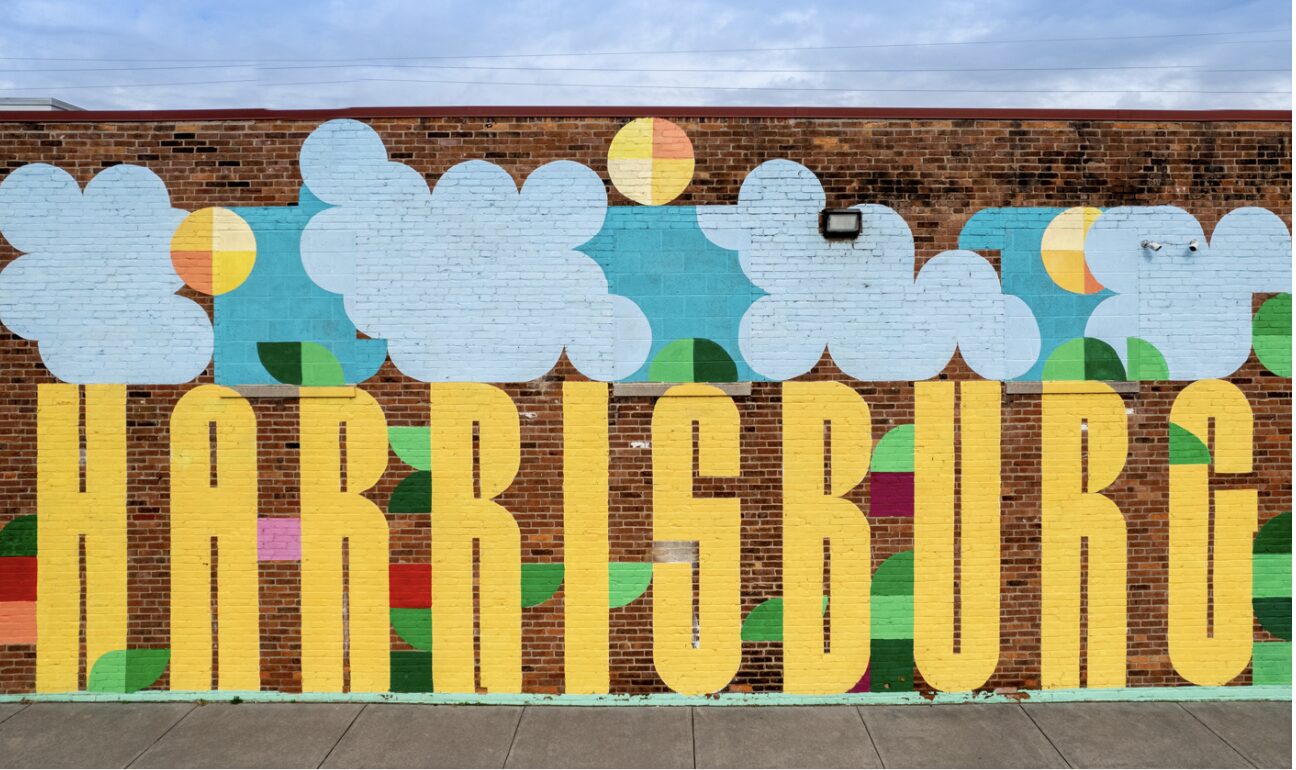
Mural by Sprocket Mural Works. Artist: Susan Rende

In April, my husband and I visited Paris for the first time and fell in love with the city.

Along with the beautiful architecture and delicious food, what stood out was the laidback lifestyle. People lingered at café bistro tables for hours, stretched out on the grass in parks, and hundreds of young people socialized by the Seine on a weeknight.

Well, Harrisburg has its own river, with what may be an even better adjacent park than in Paris. I’ve walked the riverfront many times, but I realized I’ve rarely just sat and enjoyed. Inspired by the Europeans, I grabbed some snacks and hit the Susquehanna for a sunset lounge. It was magnifique!

As I wrote in a similar column last summer, Harrisburg has so many hidden gems—even the unhidden ones are mostly still severely underappreciated. Summer, to me, is the perfect time to be a tourist in my own city. So again, I set out to curate a bucket list perfect for a sunny day.

Little Secret

In Paris, we visited several beautiful parks. Harrisburg has its own roster of green spaces. I still stand by the Capitol Park for being one of the best-kept secrets in the city (a park that, in Paris, would’ve been packed).

Downtown, there’s a new pocket park/event space nestled between buildings. Coronet Park opened in April, already with a slate of summer events. The park puts to use formerly vacant land and makes it the cutest little spot to gather for music and socializing. Attending a gathering at Coronet feels like stumbling upon a private patio party, except it’s open to all.

In May, I convinced my mom and sister to read a book by Philly author Jo Piazza with me, and we attended her pop-up bookshop at Coronet. The sun was out, live music was on stage, a pizza truck served pies and Jo chatted with readers. It was such a fun and intimate event.

There are several upcoming events in Coronet Park, including the Tiny Park Concert Series, a biergarten and game night, so grab a friend and check it out.

Dance performance at the Juneteenth press conference.

Party Time

Another very community-focused event, Juneteenth HBG, takes place over the course of a week this month. I’ve attended several of their events over the years, and my favorite was last year’s block party in partnership with the summer SoMa block parties. A group of friends and I hung out until late, snacking, drinking and dancing. The event was packed—and a great way to feel connected to my community.

This exact event isn’t happening this year, but other similar ones are—like the Taste of Black Harrisburg food and art showcase. Pick one or several events from Juneteenth HBG’s lineup; you can’t go wrong.

Regular SoMa block parties are still on this year too. They’re always a fun time—my favorite is the live music—and it’s inevitable that you’ll either run into a friend or make a new one.

Speaking of parties, if there’s one thing that’s guaranteed in summer, it’s that I’m going to have a celebration to attend. For me, in my 20s, that’s weddings, baby showers, house warmings, birthday parties. This spring, I’ve already gone to two weddings and two bridal showers.

Paper Moon Flowers (conveniently next door to TheBurg office) at 916 N. 3rd St. is the perfect place to find a gift, card or flowers. But even when I don’t have an event to attend, I go for myself.

Summer is the perfect time to freshen up my houseplant collection. The owner, Shawn, always has a selection, plus unique pots and even sometimes soil for potting and cute water spritzers. Shawn will send you with the care tag in case you don’t know what you’re doing. He hit the last plant I bought with what seemed like hairspray, shining it up for its debut in my house. He’s always happy to offer advice and tips.

Mural by Sprocket Mural Works


Summer Stroll

When I first walked out of the metro tunnels and up onto the streets of Paris, I was instantly struck by the beauty of the place and the excitement of being in a new city.

Believe it or not, we’ve had many people stop at our office as visitors to Harrisburg who have shared a similar feeling of being taken aback by the historic architecture, beautiful riverfront or quaint streets.

I came across a video of a social media influencer recently who was in Harrisburg and documented his short time exploring. It seemed like, around each corner, he was wowed by something—a streetscape, the Capitol dome, Cork & Fork downtown. While those of us who live or work here can overlook the beauty or even become cynical about the state of the city, newcomers are often impressed by it.

A huge contributor, literally huge, to the city’s beauty is Sprocket Mural Works. The nonprofit has painted over 100 murals in Harrisburg on walls, electrical boxes, statues, planters and more. There are several areas in the city where you can walk for just minutes and spot several murals.

Well, I see many of these murals several times per week just walking around. One is on TheBurg office’s exterior wall, with many more up and down 3rd Street. I’ve even conducted several mini walking tours myself to show friends and a driving tour with my visiting grandparents. However, I have yet to take an official walking tour with Sprocket to find out the history and meaning behind each wall.

Luckily, Sprocket is offering tours this summer, one each month during 3rd in the Burg evenings. You can reserve a ticket (suggested donation $15) on their website.

Before or after the tour, which begins at the Broad Street Market, take a seat at Honey Bear’s cute ice cream counter, right when you walk into the stone market building. Their vegan scoops are non-vegan approved (by me) and delish.

Honey Bear Ice Cream

Picture Perfect

If it helps motivate you to get out and explore, pick a week and make it your staycation in Harrisburg. Put some things you’ve always wanted to try on the calendar. Even if you work, pick new activities, businesses or parks to check out during the extended summer evenings or on lunch breaks. You could also pick a Saturday. I’d start with a chai from one of our local coffee shops and a cinnamon bun from Salted Butter Bakery. Head for a stroll at either Italian Lake or Riverfront Park and to the Broad Street Market for lunch (get a burrito from Yum, Yum! and a coconut lavender lemonade from Lil’s Pretzels and thank me later). Take the afternoon to relax on a park bench or in the grass before heading to an evening event of your choosing. The perfect Harrisburg day!


Activity List

Come along with me! Check off summer activities as you go:

  • Have a picnic by the river
  • Attend a Juneteenth event
  • Listen to live music at a SoMa block party
  • Attend an event at Coronet Park
  • Buy a gift or treat yourself at Paper Moon Flowers
  • Enjoy a cone at Honey Bear’s ice cream counter
  • Go on a mural tour

For event calendars for Coronet Park and SoMa block parties, visit www.sarabozich.com. For a list of Juneteenth events, visit www.ypoc-hbg.org.

Sign up for mural tours at www.sprocketmuralworks.org.

If you like what we do, please support our work. Become a Friend of TheBurg!    
Continue Reading

TFEC + TheBurg: Partners in Purpose: Beacon Clinic builds health through care, community and collaboration

Located in Uptown Harrisburg, Beacon Clinic for Health and Hope serves uninsured and underserved adults in Dauphin, Cumberland and Perry counties.

The clinic, which opened in 2015, serves about 375 patients per year, many who return quarterly to manage chronic conditions like diabetes.

While Beacon is faith-based, it welcomes patients of all backgrounds.

Debra McClain, executive director, said that patients come from 54 different countries and speak 37 different languages. She tells the story of a 51-year-old man with worsening vision visiting the clinic.

“He was working intermittently in a low-wage job and relied on an interpreter to communicate with the care team,” she said, adding that he delayed medical care for months due to financial concerns.

With the team at Beacon, he created a plan to manage his uncontrolled diabetes.

“He had already lost significant vision in one eye, and, within months, he began actively managing his diabetes and his blood sugar improved significantly,” McClain said.

This is just one case where Beacon has helped. According to McClain, surveys confirm that the Harrisburg area has some of the highest rates of uninsured individuals—70% of whom have jobs and are working hard each day.

Beacon is designed to feel less like a system and more like a relationship.

“We have active practicing doctors and nurses at Penn State Health and UPMC who are all volunteers who are dedicated to providing continuity of care,” McClain said.

Some patients are shocked to learn that they qualify for services, she said.

“Eligibility extends to those earning up to 300% of the federal poverty level—roughly $47,000 a year for an individual, $66,000 for a couple and $99,000 a family,” she said.


Importance of Partners

The Harrisburg-based nonprofit receives funding from a variety of sources: individual donations, churches, foundations and grants, corporate sponsors and fundraising events. One such collaboration ended up being a huge blessing for the clinic and its patients.

“We began paying a membership fee to partner with the Dispensary of Hope in 2019, and this enables us to give people free meds,” McClain said.

Previously those medications cost the clinic $40,000 a month.

“That wasn’t sustainable, but, through the partnership and a collaboration with a local pharmacy, we pay less than $20,000 a year,” said McClain, whose background in insurance and financial services has helped her navigate the sometimes-murky waters that exist when creating a sustainability plan. “That was a huge win for a clinic like ours.”

The clinic also has provided thousands of free medications—5,669 in the most recent count—with many patients receiving multiple prescriptions per month.

Beacon’s list of partners is long, and McClain has been thrilled with how many have stepped up to the plate.

“UPMC helps cover labs and X-rays and Messiah University and York College nursing students visit for clinical training and sometimes return as volunteers,” she said.

In addition, Penn State College of Medicine students and residents shadow physicians, Dickinson students in the Spanish for Health program help as live interpreters, and Penn State Health offers free pathology labs for services like biopsies.

“We have dermatologist volunteers as well, and often we can see patients within just one month,” McClain said.

In 2019, Beacon was able to open up a healthy cupboard as part of its “Food as Medicine” initiative.

“Penn State Health gifted us with a refrigerator, healthy snacks and drinks for our waiting room,” McClain said.

The Foundation for Enhancing Communities provided a grant to buy freezers to add more items like frozen fish, meat, chicken and vegetables.

“Our nutritionist advises patients on how they can use the items, and recipes from Penn State College of Medicine are posted in different languages,” McClain said.


Community Steps Up

 A base of 58 volunteers allows the clinic to operate with a lean staff that includes a nurse, a nurse practitioner, a receptionist, a nursing care coordinator, a clinical director and an executive director.

“This makes it easier for a clinic like Beacon to process new patients within two weeks today when, in the past, it would take between six and eight weeks,” McClain said.

Beacon’s board of directors reflects a similarly broad base of support with members from real estate, healthcare, strategic planning, medicine, financial services and other sectors.

Fundraising is also essential to sustaining operations.

The clinic’s primary event, the “Triple Crown Gala,” takes place in May and is held at the West Shore Country Club. It includes networking opportunities, a silent auction, a live auction, a raffle and more. A cornhole tournament is a more casual, family-friendly event and is held annually in the fall.

Through a combination of clinical care, partnerships and community support, Beacon robustly serves the greater Harrisburg community, while expanding its reach.

“No one can do what we’re doing in a silo,” McClain said.  “If you don’t have people to collaborate with you, you’d be a sinking ship.”

Beacon Clinic for Health and Hope is located at 2626 N. 3rd St., Harrisburg. To learn more, visit beaconclinicpa.org. or call 717-775-1111.

TFEC + TheBurg: Partners in Purpose is a quarterly collaboration spotlighting the vital work of local nonprofits serving Dauphin and Cumberland counties. Through this community-centered initiative, four selected 501(c)(3) organizations receive an in-depth feature in TheBurg’s print and digital publications in 2026—at no cost to them—thanks to the support of TFEC. Together, we’re elevating the stories of those strengthening our region and making a meaningful impact across central Pennsylvania.

This is sponsored content.

If you like what we do, please support our work. Become a Friend of TheBurg!          

Continue Reading

Hand-in-Hand: Juneteenth HBG continues to celebrate freedom, Black culture, confidently

2025 Juneteenth Parade

As the United States celebrates its 250th anniversary this year, it’s important to remember that July 4th was just the start.

In the years following the signing of the Declaration of Independence, the “question of the day” was whether or not all people were equal, as stated in the document, said Dr. Kimeka Campbell, co-founder of Young Professionals of Color-Greater Harrisburg.

“Folks were highlighting the contradictions in real time,” Campbell said of the declaration and the reality of slavery.

It wasn’t until four years after the 1776 declaration that the “Gradual Abolition Act” was passed in Pennsylvania, beginning to free enslaved people. It would be more than 80 years until the last enslaved people in Galveston, Texas, would learn of abolition on June 19, 1865, and be freed.

That day, which continued what Independence Day started, would become known as Juneteenth. And while Independence Day would be formally celebrated by the nation every year since its inception, Juneteenth only became a federal holiday in 2021.

“Juneteenth, and emancipation, is part and parcel to independence, but we don’t treat it that way,” Campbell said.

Campbell and a team of local organizers have sought to change the narrative for the past several years in Harrisburg, hosting a citywide Juneteenth celebration that has drawn attendees from across the region.

As the country turns a special attention to July 4th on America’s big birthday year, Campbell wants to remind people to not wait until then to fire up the grill for celebratory cookouts.

“They should be celebrated and taught together,” Campbell said, of the two holidays. “It’s a history of redemption for a country that once enslaved people, versus a source of shame, which is how I think a lot of people see slavery, and rightfully so, it is a shameful institution. It is an institution that is difficult to reconcile with how we came into power in this country. It’s just difficult to deal with. But there’s so much value in dealing with our history in a way that really helps us move forward.”


For This Moment

The theme of this year’s weeklong Juneteenth programming is “Built for This Moment: Radically Reimagining our Next Chapter.”

“It was a theme that we thought fit the moment, fit the time, fit where we are as a country, as a world. There’s a lot of uncertainty, especially as there are cuts and slashes to DEI,” Campbell said. “We wanted to show that we will be resilient no matter what.”

The reality of funding Juneteenth, a huge event that attracts thousands of people, is that people and corporations may be more, or less, willing to open their wallets depending on the political climate.

After 2020, when George Floyd was killed by police, and around 2021, when Juneteenth was recognized by then-President Joe Biden, people were happy to support the festival. Now, as Campbell noted, with attacks on diversity and greater economic instability, there are more excuses for reining in donations.

It’s a pattern that Campbell said has been well documented—the ebbs and flows of support for Black culture and justice in the mainstream.

But still, the show goes on and will continue to grow year over year, Campbell confidently believes.

Staple Juneteenth HBG events include the Juneteenth Jubilee, in Riverfront Park this year, the Juneteenth Summit at Harrisburg University, and the concert to close out the week, at Capital City Music Hall.

Ashley Smith is the chair of Juneteenth Jubilee, an event that features performances, food trucks, local vendors and activities for kids.

“We are really family focused,” Smith said. “People really enjoy that it’s family focused.”

The summit, chaired by Elyse Irvis, founder of La Cultura and Culture & Commerce, brings professionals, entrepreneurs and community members together for a daylong conference with sessions on economics, tech, business development and equity.

“We are returning economic empowerment to Black and Brown individuals,” Irvis said. “It’s important work.”

New to the summit will be an experience for local youth, with sessions tailored to their age levels.

Another Juneteenth event, Taste of Black Harrisburg at Culture & Commerce downtown, will highlight local restaurant owners and artists, allowing attendees to experience the community’s talent.

In a time where the nation, and even the city’s, divisions can take center stage, Juneteenth organizers are proud of the unity that Juneteenth brings.

“I really enjoy the community that’s been created over the past years,” Smith said.

Campbell hopes that feeling continues to spread and that Juneteenth will continue to be a space of celebration, joy, learning and growth.

“I want people to continue to experience a sense of community,” Campbell said. “Folks get really nervous in times like this—I know I do. Will your community support you when times are rough like this? And my belief is that they will.”

For more information about Juneteenth HBG and Young Professionals of Color-Greater Harrisburg, visit www.ypoc-hbg.org.

If you like what we do, please support our work. Become a Friend of TheBurg!  
Continue Reading

Patriots’ Path: Army Heritage Center Foundation marks America250, launches trail inviting visitors to follow in footsteps of soldiers

Re-enactors teach about Army life.

Each year, the Army Heritage Center Foundation (AHCF) begins its summer on June 14—the U.S. Army’s birthday.

The day is marked with a dinner program (June 13), and, through the month of June, a summer fair typically provides numerous opportunities to celebrate the Army’s many traditions.

This year, however, is different.

Not only is the country celebrating 250 years, but the AHCF has taken this year to undergo its own share of change, growth and evolution.

“America’s 250th birthday has been an opportunity to bring us all back together as a country,” said Julie Germany, president of the AHCF. “Reflecting on our past, we wanted to bring everyone together in whatever way we can.”

According to Germany, part of bringing everybody together is the creation of Patriots’ Path, a trail that runs through Cumberland County. It includes stops in Mechanicsburg, Carlisle, Camp Hill and other locales, inviting visitors to follow the footsteps of soldiers and settlers who paved the way both for this area and for the country as a whole.

The attraction, part of AHCF’s offering for the ongoing America250 celebration, will be formally unveiled only a handful of days before the Fourth of July.

Its concept was formed by a group of volunteers in conjunction with Germany and AHCF Executive Vice President Amanda Neal. According to Germany, it was Neal’s work and intuition that helped get the project across the finish line.

“A lot of the really hard work when it comes to the trail was done by Amanda,” Germany explained. “It was her brainchild.”

There are stories attached to each stop.

“It’s not just a bunch of broken-down buildings and empty structures,” Germany said. “There’s an old public graveyard with incredible Americans buried there. There’s an education center. Along with the wisdom of our volunteers, this couldn’t have happened without Amanda’s guidance and leadership.”

Rendering of the future outdoor pavilion

Singular Resource

The Patriots’ Path project comes as the AHCF continues to welcome change.

About 1½ years ago, the U.S. Army Heritage and Education Center (USAHEC), one of the entities that AHCF supports, appointed Dr. Katie Lemay, an award-winning author and a Fulbright Scholar, as its director.

In April 2025, the USAHEC announced Lemay’s vision for its facility, which included proclaiming the center as “the singular resource for understanding strategic land power and current events through the study of the Army’s past.”

“She is very interesting and unique,” Diane McNaughton, communications specialist at AHCF, said about Lemay. “She is world-renowned for her art experience.”

Indeed, Lemay’s credentials are both varied and abundant. Not only does she serve as a presidential counselor to the National World War II Museum, but she curated “Votes for Women: A Portrait of Persistence” to usher in the centennial of the American women’s suffrage anniversary at the Smithsonian.

At the USAHEC, Lemay has been tasked with creating a new logo for the center, heading up new exhibitions, and refreshing the facility, which includes an expanded outdoor pavilion, for which a ribbon-cutting is planned this summer.

“The entire summer is always a really busy time for us,” Germany noted. “And this summer might be our busiest ever. The pavilion is going to have a huge stage, and it’ll be a great place for community performances.”

The center also will turn its attention to education by hosting teacher workshops.

“We want to teach teachers how to use primary source material from soldiers and incorporate it into their lesson plans,” Germany said. “It’s going to be a busy few months.”

It’s a busy few months on top of what has shaped up to be a busy year for Germany, the AHCF and the USAHEC. It all adds up as one of the many memorable ways the United States will celebrate its semiquincentennial anniversary as a nation.

“I hope people take some of this time to reflect on how America got to where it is after 250 years,” Germany said. “With what we’re doing, we hope people will take a step back into the shoes of someone who lived 250 years ago and pay attention to how far we’ve come.”

She then added, “It really is an opportunity to bring us all back together—but only if we let it.”

The Army Heritage Center Foundation is located at 950 Soldiers Dr., Carlisle. For more information, visit www.armyheritage.org.

If you like what we do, please support our work. Become a Friend of TheBurg!  
Continue Reading