2-Way 2nd: Council action brings major road change nearer.

Under a city plan, N. 2nd Street, currently three lanes one-way, would be converted to two lanes of two-way traffic in Midtown and Uptown Harrisburg.

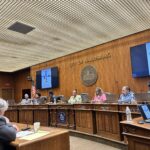
Harrisburg is moving closer to making major changes to N. 2nd Street, thanks to a green light from City Council last night.

Council authorized funding for a traffic study and engineering plans to convert N. 2nd Street from one-way to two-way traffic flow. The new pattern would take effect between Division and Forster streets and reduce the current three lanes of traffic to two.

Mayor Eric Papenfuse began advocating for the lane conversion in 2013, during his first mayoral campaign. He believes that rerouting commuter traffic to N. 7th Street and restoring two-way flow to 2nd Street will benefit homeowners and pedestrians near the river.

“We want to give that neighborhood more of a residential feel and make it safer for pedestrians,” Papenfuse told reporters after last night’s council meeting.

According to reporting from TheBurg’s Paul Barker in 2013, the current iteration of 2nd street – three lanes of northbound traffic flanked by two lanes of street parking – came into being during a 1956 transformation of Harrisburg’s major roadways. That year, Harrisburg also converted Front Street into a one-way, three-lane mini-highway, and widened Forster Street to six lanes.

Those road conversions were Harrisburg’s response to a new problem facing American cities in the mid-century: commuter traffic. After World War II, middle- and upper-class whites relocated in droves from cities to suburbs. Their jobs, however, did not necessarily follow, and cities had to accommodate the flood of drivers coming in for the work day.

Many American cities, including Harrisburg, prioritized the new commuter class at the expense of residents and pedestrians. Today, many 2nd Street residents complain about traffic speed and noise.

“People fly down this road,” said Sotirios Ntzanis, owner of Midtown Tavern, located at the corner of Herr and 2nd streets.

He’s optimistic that the lane conversion will slow down traffic and even benefit small businesses.

“Slower traffic could help with exposure, since a lot of businesses along here get missed,” Ntzanis said.

Other residents worry that the conversion will bring more harm than good. Dave Johnson, who lives on the 1700-block of N. 2nd Street, thinks that his street will get more congested as long as Front Street remains one-way.

“It’s going to get backed up,” Johnson said. “We’ve already got three lanes of constant flow.”

Nicolas Conigliano has lived on the 1000-block of N. 2nd Street for six months. He said that traffic there moves quickly and creates noise, but he’s unsure that a two-way flow would help either problem.

“What I’ve noticed on other streets in the city is people go as fast as they want to go,” Conigliano said.

The resolution approved by council last night also said that the final 2nd Street lane configuration might include bike lanes or a two-way, left-turn lane. Project engineers will also consider the possibility of building a bridge above the railroad tracks at Division Street and Industrial Road.

The city has retained the Maryland-based design firm, Wallace Montgomery & Associates, to perform a traffic study, provide preliminary engineering and final designs. Funding for the project comes from a PennDOT grant.

Papenfuse estimated that six to eight months of planning are necessary before any infrastructure changes could be authorized. During that time, he expects to solicit input from residents and business owners in a series of community meetings.

As part of the changes to 2nd Street, the city also wants to make substantial improvements to several other streets to divert outbound traffic to N. 7th Street and to Division Street.


Continue Reading

And Then There Were 7: Green takes council seat.

Ausha Green

Harrisburg City Council is operating at full complement once more, thanks to tonight’s appointment of a new council member.

Council voted unanimously to appoint Ausha Green, a former school board member, to a three-month term. Green will fill the seat formerly held by Destini Hodges, who resigned from council earlier this month to take a job out of state.

Green is running unopposed for a four-year council seat in the Nov. 7 general election. According to Council President Wanda Williams, council decided to appoint her early since she would inevitably join the seven-member body in January.

By appointing Green, council decided to forego the open application and nomination process customarily used to fill vacancies. The last council person appointed by that process was Dave Madsen, who occupies the seat vacated by Jeffrey Baltimore in August.

Continue Reading

Eye in the Sky: Harrisburg police brief council on helicopter patrols.

Tonight, Harrisburg City Council heard from city police about recent helicopter patrols.

A helicopter hovering over the city last week helped law enforcement officers capture weapons, seize drugs and deter shootings, Harrisburg police officials said tonight.

Police also said that residents should expect additional flyovers in the future.

A helicopter patrolling Harrisburg late Wednesday and Thursday last week drew questions and complaints from many residents. In a tweet, Capt. Gabriel Olivera called it a “proactive policing” technique but offered no other details.

Tonight, police appeared at a City Council meeting to defend so-called “Operation Helicopter” as a means of supporting street crimes officers on the ground.

Police Chief Thomas Carter said that the bureau deployed the helicopter after a spate of shootings in the city, many involving juveniles or shots fired into homes. He said that helicopters can help deter crime and assist ground officers tracking down suspects.

Carter told council that the outcome of the helicopter patrol was “very good.” No shots were fired on streets or into residences on either night of the patrol, and the police were able to seize cash, heroin and firearms from criminals, he said.

He conceded that residents complained about the noise and light the helicopter generated, but said that the outcomes of the operation make it worth repeating.

“Citizens deserve to be policed in the best way possible,” Carter said. “We will see more flyovers.”

Only Harrisburg police, the state police and the mayor knew about last week’s operation in advance, since, according to Carter, announcing patrols makes them less effective.

“We didn’t want to show our hand,” he said.

Mayor Eric Papenfuse explained that the patrols were part of an ongoing partnership with the Pennsylvania State Police, which started a three-month collaboration with Harrisburg’s street crimes unit in September. Papenfuse said that residents can expect to see one or two more patrols before the partnership ends next month.

Olivera said that the helicopter bore no extra cost to Harrisburg or the state police. The fuel costs and wages for last week’s patrols were already included in the state police budget, he said. He did not say how often helicopter patrols will take place in the future.

Olivera also insisted that the aircraft was not actively surveilling activity on the ground. Instead, its pilots responded to calls from ground officers and offered them backup as they investigated incidents.

“It was constantly moving in response to calls,” Olivera said.

Residents were surprised and even frightened to see the helicopter roaming the night skies last week.

At tonight’s council meeting, Uptown resident Kim Jones called the patrols “a nightmare.” She said that the spotlights illuminated the inside of her house until midnight, keeping her infant daughter awake.

Even so, she said she’ll tolerate the patrols if they help to keep the city safe – and if the helicopter moves across different neighborhoods.

“They need a better plan,” Jones said about the helicopter’s flight path. “Don’t have it camped out in one spot. Spread it out.”

On the Nextdoor social media site, which creates neighborhood-specific chat rooms, one Uptown resident said the aircraft made her feel “uneasy,” and others complained about the noise and light.

Papenfuse said that the city has heard from many citizens who want greater police presence in their neighborhoods. He claimed that he got 20 such complaints last week alone, but received no negative correspondence about the helicopter patrols.

“I recognize that this might seem bold or dramatic, but I hope people understand it’s to make the streets safer,” Papenfuse said.

Continue Reading

Ideas Offered, Debated as Market Square Plan Moves Forward

The CAT bus station at Market Square.

A local civic group wants to make over congested Market Square, which could lead to substantial changes to one of Harrisburg’s most historic and visible intersections.

Harrisburg Young Professionals is conducting a master plan study for the intersection of Market and 2nd streets. The organization, which has been eyeing a redevelopment project at that location for more than a year, recently tapped Boston-based design firm Sasaki to lead the planning effort.

Sasaki, HYP and Harrisburg-based K&W Engineers last week held a series of stakeholder meetings at the Harrisburg Hilton, which is located on Market Square. Meron Yemane, former president of HYP, estimated that more than 100 people participated in the eight meetings, which were each 45 minutes long.

At the meetings, stakeholders discussed urban spaces in the United States and abroad that Harrisburg could emulate and debated the merits of adding different amenities – such as green spaces or retail outlets—to Market Square.

Yemane said that urban planners from Sasaki will use the input from those meetings to begin drafting a master plan, which HYP hopes will be finished in spring 2018.

From there, HYP will continue to facilitate discussions with stakeholders, Yemane said, and potentially help identify funding for a large-scale project.

Market Square was part of the original, circa-1785 plan for Harrisburg and was the site of the city’s first market area, dismantled in 1889. It currently is dominated by several large structures, including the Hilton, the Penn National Insurance Building and Dauphin County Administration Building. One corner also serves as a hub for CAT buses.

Yemane said that the area’s proximity to the highway, riverfront and retail and dining establishments make it a potential cornerstone of Harrisburg.

“It has the potential to be a postcard image for the city,” said Yemane.

Beyond that, he was hesitant to offer a vision for what the new Market Square could look like. He said the master plan might recommend beautification measures, such as adding more trees and lighting. The plan will also help stakeholders determine whether Market Square is best suited to retail, residential or leisure amenities, or a combination of the three.

According to Sasaki, relocating the bus station is one option. Last year, PennDOT released concepts for the area around the Harrisburg Transportation Center that included a new home for the bus station.

Yemane said that much of the planning effort thus far has been funded privately and that the business community “really stepped up” when HYP decided to bring in Sasaki.

HYP also hired the economic planning company, Landwise, to evaluate the financial feasibility of different projects that could be outlined in the master plan. Yemane said that the firm has helped HYP evaluate federal grant options, though they expect that any major changes to Market Square will require private dollars.

“We recognize the limited resources of the city, but we want to be good stewards of Harrisburg and work with them to identify what’s possible,” Yemane said.

Continue Reading

Don’t Dump Here: Harrisburg concludes city codes meetings.

A Harrisburg resident asks a question during last night’s meeting about city codes and codes enforcement.

Who do you call when a neighbor is dumping trash illegally? And how do you find out if the apartment next door is an unlicensed flop house?

City officials answered these questions and others in a meeting at Hamilton Health Center last night, where residents were invited to ask about the city’s code enforcement process. A similar event was held one night earlier at Camp Curtin YMCA.

Councilman Cornelius Johnson said the purpose of the meetings was to correct public misconceptions about the codes process and gather ideas for amending Harrisburg’s code handbook. Here’s what emerged as common questions throughout the evening:

Illegal dumping
Dumping trash on city streets and vacant lots is a criminal act that requires response from the Harrisburg Police Bureau. But since Harrisburg’s non-emergency police line routes to the Dauphin County dispatch, some residents said they’ve been referred to the codes office instead.

If you see illegal dumping in your neighborhood, Johnson recommends calling Harrisburg’s 311 number during normal business hours. Ask the switchboard officer to direct you to Harrisburg police and log your complaint there.

Blighted properties
Harrisburg has more blighted properties than it can manage. City codes officials can board up properties that are unfit for human habitation, but residents report that squatters break into the sealed homes and establish residence there.

City Codes Administrator David Patton said that his department is fighting blight with a limited budget. The city maintains a list of condemned properties slated for demolition, which currently has more than 250 properties on it, Johnson said. He estimated that the city’s $120,000 demolition budget only allows it to tackle between 17 and 25 properties a year.

Mayor Eric Papenfuse said that the city hopes to significantly increase the demolition budget for the 2018 fiscal year. Raising it to $250,000 from its current $120,000 would allow the city to demolish closer to 30 or 40 properties, he said.

Patton asked residents to remain vigilant in reporting blighted properties. The codes office triages its demolition list and acts first on the properties that pose the greatest public safety risk. If squatters have broken into blighted properties, file a complaint with the codes office so they can seal it again.

Filing a codes complaint
Johnson said that the city clearly needs an electronic system for submitting codes complaints. Right now, residents can download the paperwork to file a complaint online, but must submit the form in hard copy to city hall. Johnson said that creating an electronic submission system is a long-term goal. He also hopes the city can implement a way for citizens to track the status of the complaints they’ve filed.

Finding property owners and rental licenses
If you want to know who owns a property, you can search its address on www.dauphinpropertyinfo.com. Sometimes, however, the owner listed on the deed is a company that no longer exists or an investor who has changed his contact information. If the property is a rental unit, you can try to search the owner’s rental license through the city’s Mercantile Office.

There is more information about codes enforcement on the city’s website.

Continue Reading

And Now We Wait: HBG Area Application in for Amazon’s HQ2.

An artist’s rendering of Amazon.com buildings on the grounds of Harrisburg State Hospital.

Harrisburg is officially in the running to be the next site of Amazon.com’s new corporate headquarters.

The Harrisburg Regional Chamber of Commerce and CREDC held a press conference tonight to announce the details of the 140-page application they sent to Amazon executives earlier this week.

The application proposes a major renovation to the State Hospital Grounds in Susquehanna Township and extolls the quality of life, workforce and business climate of the south-central Pennsylvania area. The proposal focuses on Harrisburg but includes nine counties as part of the greater metro area, said chamber President David Black.

Black thinks that Harrisburg will stand out among the competition because it can offer a single property as the site of the headquarter campus. The application proposes constructing office towers up to 12-stories high at the State Hospital grounds.

Last month, Amazon issued a request for proposals for its second corporate headquarters site, known as HQ2, which it says will bring upwards of 50,000 high-paying jobs and billions of dollars in investment to the city of its choice.

In its request, Amazon also asked cities to identify incentives to offset building and long-term operating costs.

Black declined to comment on the details of Harrisburg’s incentives package, but insisted that it would be “competitive” with what other municipalities are offering. He said it is too soon in the application process to offer specific incentives, such as tax breaks or credits.

“The goal is to get them here and then go into detail with individual townships,” Black said.

Developing tax incentives across a wide swath of land in Pennsylvania requires the approval of many different taxing bodies, including county commissioners, city councils and school boards. Black said that the chamber did not hold any public meetings with taxpayers or taxing agencies while developing the proposal.

A second rendering.

Black added that the chamber does not plan on making the proposal public, since Harrisburg is in competition with other cities. He did say that it was shared with members of the state Department of Community and Economic Development.

Black spoke to some of the criteria that Amazon listed in its request for proposals, including its requirement that the new headquarters be near leading research universities and an international airport.

The application lists Penn State University as a regional asset, according to Black. He also expressed confidence that Harrisburg International Airport would add direct flights to the West Coast if Amazon expressed interest in the region.

In all, regional leaders think that Harrisburg is a strong contender for the coveted project.

“We have everything people want right here,” said Jackie Parker, director of Harrisburg’s Department of Community and Economic Development.

Amazon says it will review proposals this year and choose a city in 2018.

“In a few months, I hope we’re all back here for a ribbon cutting,” said Dauphin County Commission Chairman Jeff Haste.

A rendering of the overall campus site.

Related: Burg Blog: You Might Also Like Harrisburg.


Continue Reading

Review: “Fun Home” Poignant, Beautifully Rendered at Open Stage

“There’s you, and there’s me. But now I’m the one who’s 43 and stuck. I can’t find my way through. Just like you. Am I just like you?”

“Fun Home” is the true story of Alison, a 43-year-old lesbian cartoonist remembering two distinct periods in her life: at 10 years old, “Small Alison,” and 19 years old, “Medium Alison.”

This musical was adapted by Lisa Kron and Jeanine Tesori from Alison Bechdel’s graphic memoir of the same name. Through flashbacks and musical numbers, she remembers her time growing up in a funeral home, nicknamed the “Fun Home,” her journey of discovering her sexuality and dealing with the conflicting emotions of coming to terms with who she was.

This show is beautifully performed by the cast of Open Stage of Harrisburg. The production is meant to make you laugh, to make you cry, and to make you think about some challenging subjects: family relations, growing up in small-town Pennsylvania, discovering sexuality, rejecting identity, embracing identity, coping with reality, avoiding reality, and coming to terms with death and the guilt associated with it. It is particularly relatable to those who struggle to discover and embrace their own identity.

Most of the musical centers around Alison’s relationship with her father, Bruce, a closeted gay man struggling with his sexuality. At the beginning of the musical, Alison looks through her father’s old possessions, remembering when she was 10, focusing on her father’s obsession with antiques, home projects and cleanliness of the house.

“Sometimes, my father appeared to enjoy having children,” Alison says. “But the real object of his affection was his house.”

Small Alison was an energetic, confident and strong-willed tomboy who would rather wear “boy clothes” than girls’ dresses. She, her two brothers, Christian and John, and her mother, Helen, would often assist Bruce in tidying up the house to make it perfect to his high standards. In the song “Welcome to Our House on Maple Avenue,” Alison recalls the typical frenzy to clean the house before a viewing.

“Everything is balanced and serene, like chaos never happens if it’s never seen,” she sings.

Later in her life, when she’s 19 and in college, Medium Alison begins to explore her own sexuality by hesitantly getting involved with the Gay Union on campus, where she meets Joan, a confident lesbian. On break from school, Medium Alison and Joan travel home to stay with her family for a few days. The awkwardness is palatable as both of her parents are introduced to her “friend” Joan, unwilling to recognize that Joan is her girlfriend. After getting her mother alone for a conversation, Helen reveals her struggle throughout the years to ignore Bruce’s affairs and her attempt to keep their home together despite everything.

Later that day, Medium Alison and Bruce take a drive together. Medium Alison is nervous to bring up their shared experiences of being gay, and Bruce is fearful to talk about it. He reveals a story of a former lover, but quickly changes the subject back to a safer one. Alison looks back on the moment, upset at herself for not having the courage to say something and also remembers it as the last moment she sees her father alive.

Alison, now an adult remembering these moments, feels sadness and guilt over the father’s death.

“I had no idea that my beginning would be your end,” she says.

The start of her embracing her identity left her father no longer able to cope with his. All she has left of her father are his artifacts, her drawings and her memories. In the end, she feels heartache over what happened, but also joy from the time that they had together and their connection throughout their lives.

Beautiful and tragic, poignant and hilarious, this show will touch your heart and stay in your mind long after it is over.

“Fun Home” is playing at Open Stage of Harrisburg until Oct. 29. The production is directed by Stuart Landon and sponsored by Bitner Family Funeral Homes. It is presented with special permission by Samuel French.

Continue Reading

Burg Blog: You Might Also Like Harrisburg

The former Harrisburg State Hospital grounds, which is being proposed as the site of Amazon’s second headquarters.

Today marks the application deadline for what is certainly one of the strangest episodes in American business history—the race among cities, towns and states for the second headquarters of online retail giant Amazon.com.

For a pop culture analogy, one need look no farther than that wacky classic movie, “It’s a Mad, Mad, Mad, Mad World.”

In the 1963 film, a bunch of colorful characters scheme, compete, cooperate and go crazy with greed after a notorious thief, about to die, tells them that he has buried a fortune in a public park.

In the real-life case of Amazon.com, CEO Jeff Bezos put in motion the madcap treasure chase, but among America’s mayors, city managers and county commissioners with the lure of 50,000 high-paying jobs.

And madcap it has proven to be.

New Jersey has proposed $7 billion in tax breaks; Frisco, Texas, has volunteered to turn itself into a company town; and tiny Stoneville, Ga., has proposed renaming a part of itself “Amazon.”

These are the governmental equivalents of renting a sputtering biplane to beat everyone else to a sack of money buried beneath a giant “W.”

So, where does that leave south-central Pennsylvania?

Back in early September, when Amazon unleashed the madness, the company listed several criteria that it wanted for its second headquarters, including an urban center with a population of at least 1 million people, a “business-friendly” environment and the ability to attract and retain technical talent. It’s also believed that Amazon would smile upon access to transit, strong cultural and nightlife amenities and a generally progressive environment—i.e., things favored by a young, educated, IT-savvy workforce.

Given these criteria, the Harrisburg area would seem unlikely to make the cut. However, to me, the fascinating thing is this—our area is actually a great fit for so-called HQ2, if only Amazon were willing to think outside its branded cardboard box.

First, let’s tackle the population requirement, which seems, right off, to knock our area out of competition. Sure, Harrisburg proper is tiny, but, as has been pointed out by local boosters, south-central PA combined does approach 1 million people. However, why does this matter at all?

I think the requirement exists because Amazon doesn’t want to be in the middle of nowhere. That’s understandable. But location is actually one of our area’s strongest draws for people who move here. It’s perfectly situated near several major metros, but also isn’t trapped inside any of them (if you’ve ever been stuck in traffic on the Washington Beltway, you know what I mean by being “trapped” in a city). It’s often faster to drive from Harrisburg to Rockville, Md., than to drive to that suburban boomtown from parts of neighboring Prince George’s County.

There’s also room to grow. Our area has large amounts of available, buildable, affordable land, as well as a city with an enormous quantity of underused, undervalued, ramshackle and even empty housing, much of it historic and potentially beautiful if restored. Harrisburg was built to accommodate about 100,000 people, but today has only half that many.

Certainly, with HQ2, there would be growing pains and a need to improve roads, but that’s true of any metro area that lands the coveted prize. It’s hard for me to imagine how several cities that seem to be leading contenders, such as Boston and Washington, D.C., can absorb 50,000 more workers—and their cars. Meanwhile, Harrisburg also has the benefit of easy access to an underutilized airport and a rail infrastructure that once accommodated hundreds of trains a day.

In addition, Harrisburg has what many major East Coast cities lack—easy, fast ways out. Within a short drive, you can be hiking or camping or at the beach or mountains. Or you’re in the famous Pennsylvania Dutch countryside or at a brewery or winery. Or you’re in Lancaster or York or Carlisle exploring shops, galleries and restaurants in those historic, quaint towns.

But that last point brings me to why, despite a valiant effort, our area won’t be taken seriously as a contender.

No, it’s not a lack of population or insufficient tax incentives or even our dysfunctional state government. Harrisburg’s application won’t be considered because our area is far, far off of Amazon’s radar. There’s little chance that the site selection committee, 3,000 miles away in Seattle, knows much, if anything, about this mystery region along the lower Susquehanna River.

I speak from some experience.

For years, I lived in D.C., which isn’t far away, but I never considered south-central Pennsylvania as a place to go. Then I moved up here and found all this amazing stuff: towns, sites, nature, trails, restaurants. Why didn’t I know about these before?

It shouldn’t be this way. Cities like Harrisburg, Lancaster, York, Carlisle, Lebanon; towns like Gettysburg, Elizabethtown, Hershey, Hanover, Newport, New Oxford; surrounding villages and countryside—all share a history, a geography, a climate, a cuisine and a character. Like family members, each is unique but also pieces of a sensible, natural whole.

Several of our area’s officials, including Harrisburg Mayor Eric Papenfuse, have told TheBurg that, if nothing else, the Amazon application will serve as a great exercise in regional cooperation. Here’s hoping that’s true, that the application process is the beginning of viewing ourselves as an identifiable, even marketable, six-county community, not as isolated pockets of people who just happen to live near each other. We already share a sensibility and spirit; we just now need to build upon it for the greater good, carving out a regional identity in the process.

So, no, we won’t lose the mad scramble for the Amazon fortune primarily because we lack a subway or because Buckhead is cooler, but because of—well, what exactly is south-central Pennsylvania anyway and why should I be there? That’s the problem we need to fix. And it’s fixable. In our case, the sum of the whole is far greater than the individual parts.

Continue Reading

Weekend Roundup with Sara Bozich

Cheers to the weekend!

The Pennsylvania National Horse Show is in town through the weekend — Have you checked it out? Also noteworthy: It’s 3rd in the Burg (check out the Broad Street Market if you don’t often get a chance to get there), and it’s wine trail season! Cornucopia Wine Quest runs Saturday and Sunday at participating wineries.

I have very little on my agenda besides trying to wrap up more work (I’m in denial), and cooking the very last of my tomatoes (more sauce and a sungold jam).

What are you doing this weekend?

(more…)

Continue Reading

Downtown Digs: Another residential conversion planned in Harrisburg.

Harristown Enterprises has this downtown building under contract with plans to turn it into an apartment building.

More residential space is slated for downtown Harrisburg, as Harristown Enterprises is eyeing another worn-out office building for redevelopment.

Harristown has under contract a vacant, 11,000-square-foot office building at N. 2nd and Cranberry streets currently owned by Camp Hill-based CJ2 Group, which has it on the market for $399,000. Harristown wants to convert the space to 12 one- and two-bedroom apartments, with additional first-floor retail.

Most of the building has long been empty, though a restaurant, Arepa City, occupied the ground-floor retail space until fairly recently.

“Upscale apartments in the downtown are in high demand,” said Brad Jones, president and CEO of Harristown. “We want to bring more exciting unique and desirable apartments to the market to grow the number of downtown residents and to support retail and restaurant activity along this corridor.”

Harristown now must shepherd its plan through Harrisburg’s land development process. To undertake the project, Harristown will need a variance from the city’s Zoning Hearing Board, as the building is not zoned for this use.

Several years ago, Harristown dipped its toe into office-to-residential projects by converting a part of Strawberry Square into apartments. Since then, it’s undertaken several other conversions along S. 3rd Street, adding a total of 60 new apartments downtown.

Harristown also recently began to raze a building on the first block of S. 2nd Street. It expects to build a new office building in that space, pending an anchor tenant.

Continue Reading