Coffee Capital: Just across Forster Street, warm drinks, friendly staff, await.

The saying, “out of the mouths of babes,” resonates with Rick Hawtrey, owner of Capital Joe Coffee, right across the street from the Capitol Complex.

It was Hawtrey’s young son who urged him to move from Wisconsin in the mid-2000s, when his job as an information technology consultant had him traveling on a weekly basis to places like Washington, D.C., New York and Harrisburg. So, Hawtrey followed the boy’s advice and moved his family to central Pennsylvania in 2009, putting him closer to work and allowing him more time with his family.

It also set him down a new and unexpected path.

Hawtrey, a native of Milwaukee, purchased the Forster Street building that houses the coffee shop two years ago, using it then as the office for his IT business. But when the state, one of his biggest clients, couldn’t make timely payments for services because of a prolonged budget impasse, it got Hawtrey wondering what to do next. That’s when he realized he was in a prime location, not just for an IT shop, but for a coffee shop as well.

“We love coffee, coffee loves us,” he said. “We weren’t experts, but we put in the time and did the research.”

He approached Square One Coffee in Lancaster. Even though Capital Joe could have roasted its own coffee, Square One brought another dimension as a highly regarded roaster of small-batch coffees. Capital Joe, then, could tap into this established reputation and brand recognition.

Whatever We Can

Capital Joe’s charming 19th-century building sits across from the Keystone Building.

Visitors who walk through the door are hit immediately by the aroma of brewing coffee and treated to an invitingly quaint space with small table and chairs, old photos from around the Harrisburg area, and even a flat-screen TV mounted on the original brick walls. An indoor lounge anchors the back side of the building.

There’s a mission with each cup. Next to the tip jar are jars to support the Bethesda Mission and Morning Star Pregnancy Services. Anyone in uniform—police, firefighters, paramedics—is treated to a discount.

“We do whatever we can for the community,” Hawtrey said.

Mathias Cabell is usually the first face customers see. Cabell, Capital Joe’s general manager, had worked at Hawtrey’s IT company and previously sold cars at Red Lion Chevrolet in York County. Like Hawtrey before him, Cabell also relocated to the area to be closer to work, and his personable style and bright smile attract customers immediately, Hawtrey said.

“I knew nothing about coffee, and it has been a learning experience,” Cabell said. “But I went through the Square One training program, and I’m learning something new every day. I feel comfortable, and Rick believes in me, so that is why I do this.”

In addition to roasted coffees, Capital Joe offers 10 varieties of loose-leaf teas and a small selection of baked goods that are made by Hawtrey’s wife at their second location in the old police station on Main Street in Mechanicsburg. They offer three types of muffins, three kinds of biscotti and two types of cookies. In the fall, many of the treats are infused with pumpkin and seasonal spices. But the pumpkin spiced coffee is always available. Hawtrey and his team also are planning hot caramel apple cider, shoofly pie latte and lavender lemonade and lavender lattes, and soon will introduce a baked oatmeal cake.

“Our staff is always coming up with new ideas for drinks, and we are always looking to expand our menu,” Hawtrey said.

He hopes to open more shops, beyond the Harrisburg and Mechanicsburg locations. His first priority, however, is making sure his staff feels as though they are part of the family, especially as the business grows. For now, the Capital Joe philosophy is simple, Hawtrey said.

“Good drinks to make people happy.”

Capital Joe Coffee is located at 418 Forster St., Harrisburg, and 36 W. Main St., Mechanicsburg. For more information, visit www.capitaljoe.com.

Continue Reading

Musical Notes: November Jumble–this month, something for every ear.

Well, we’re nearing the close of another crazy year. The end of fall is near and, as Jon Snow would say, winter is coming. November’s my birth month, and I’ve always loved fall, so it’s a special time of the year to me.

This month, venues across Harrisburg will host some equally special shows for you to enjoy. This month’s featured shows are a few that I’m pretty excited about. Some pysch rock, some indie rock and some post punk top my list, but be sure to check out the chamber music, festivals and local shows also going on around town. Happy birthday to my fellow November-born readers—and happy listening.

BIRDS, 11/6, 7PM, LITTLE AMPS DOWNTOWN, $5
About a year ago, I saw Birds play a show at Zeroday with a few local bands, so trust me when I say that these dudes are cool enough to see twice. The Brooklyn-based band is a self-described “psychedelic weird pop” group consisting of guitarist/vocalist Duane Lauginiger, drummer Tim Plunkett, guitarist Jess Rees and bassist/vocalist Jessica Reynoza. If you’re a sucker for some energetic psych rock with spacey guitars and dreamy vocals, don’t miss out on this show. Joining them at downtown Little Amps is fellow Brooklyn band Stuyedeyed, specializing in their own brand of “sike garbage spunk” and local beach boys Concrete Beach, bringing you some surfy garage rock. Check out Birds’ latest album, “Running Water,” on Bandcamp if you want a sneak preview. “Coming Up” is definitely worth a listen. 

THE DISTRICTS, 11/18, 7PM, H*MAC CAPITOL ROOM, $20-25
There’s definitely a lot of hype around the city for this show. That’s probably because these Litiz natives have perfected their shoegaze-inspired indie sound throughout their relatively new career. The Districts was started by vocalist/guitarist Rob Grote, bassist Connor Jacobus and drummer Braden Lawrence while they were high-schoolers. After working the local scene, they released their debut, “Telephone,” in 2012 and worked with producer John Congleton, known for his work with acts such as St. Vincent and Kurt Vile. After writing extensively and experimenting with their sound, the Districts have achieved quite the reputation with their newest album, “Popular Manipulations.” Check it out if you get the chance, or check out my favorite album of theirs, “A Flourish and a Spoil.” I get the feeling that this show’s gonna sell out fast, so get your tickets while you can!

RADIAN, 11/27, 7PM, DER MAENNERCHOR, $8
I love a good show at Der Maennerchor, and, luckily, we’ve got a powerful performance coming our way. Near the end of the month, Harrisburg’s art group, Moviate, is hosting Radian, a post-rock/post-punk band from Austria. Moviate is all about bringing unique music and art to Harrisburg, and this group is no exception. Radian is comprised of Martin Brandlmayr on drums and electronics, John Norman on bass and Martin Slewert on guitars, lapsteel and electronics. Together, they create a dynamic electronic experience that you have to hear to understand. They have been reviewed by The Wire and BBC, and called “…a band with impressively original density and texture” by Will Montgomery, a writer for The New York Times. If you want a taste, look up the video for their song “Transistor” for the full art punk experience.

Mentionables
RAQ, Nov. 2, The Abbey Bar
A Night of Chamber Music, Nov. 3, H*MAC Capitol Room
Steven Courtney Band, Nov. 11, River City Blues Club
PennsylMania Music Fest, Nov. 11, H*MAC Capitol Room
Country Music Festival, Nov. 11 & 12, Spring Gate Vineyard
Crystal Haze, Nov. 18, River City Blues Club
Consider the Source, Nov. 30, The Abbey Bar

Continue Reading

Chamber Made: Sempre Dolce reimagines traditional chamber music.

“Are you familiar with Nirvana?” asks Mary Gardner-Firestone, one of two violists in Sempre Dolce.

The quartet—Gardner-Firestone, fellow violist Marie Valigorsky, violinist Greg Glessner and cellist Matt Masek, with guest violinist Sjrsten Siegfried—is rehearsing on a Tuesday evening amid the gymnasium-style Capitol Room of the Harrisburg Midtown Arts Center (H*MAC).

Glessner closes his eyes while trying to identify one of the most famous rock bands of all time.

“I’ve heard the name.”

Glessner, raised on classical music, has only a passing familiarity with the musical culture most others could not avoid if they tried.

“The only pop culture I’m in tune with is old TV shows,” says Glessner, citing “The A-Team” and “ALF” as favorites.

With a prompt from Gardner-Firestone, Glessner lifts his instrument to his chin and sprints into a lively version of “The A-Team’s” signature theme song.

“Well, I think you’ll like this one,” says Gardner-Firestone before passing over sheet music for her own arrangement of “Smells Like Teen Spirit.”

A regular feature at the MakeSpace, Sempre Dolce will have its third performance of chamber music at H*MAC early this month, featuring a combination of original pieces by Valigorsky, arrangements by Gardner-Firestone and selections from a range of canonized composers such as Philip Glass and Johannes Brahms. Largely an invention of Valigorsky, the group is a product of an underground classical music scene kept alive by challenging where classical music does and does not fit.

Arrangements of contemporary works have become a centerpiece of Sempre Dolce’s performances, with Gardner-Firestone shifting the band AWOLNATION, the “Game of Thrones” theme by Damon Djawadi, and the White Stripes into classical notation. Upon seeing “Seven Nation Army” in the set list, cellist Massek bemoans, “Not this one—the Ravens song? They play it at Ravens games all the time.”

It’s a tactic the violist is used to for introducing newbies to the sounds and themes of classical music. Gardner-Firestone regularly creates arrangements on request for a variety of private students—ranging in age from “5 to old enough to be my grandparents”—when she’s not playing for Sempre Dolce.

Early Starts
The group began from a chance meeting between Gardner-Firestone and Valigorsky in 2015 when the latter attended a performance by the former at the MakeSpace in Harrisburg.

“I’ve been playing chamber music and forming groups since graduate school,” said Valigorsky. “It started small but really grew as we went along.”

Gardner-Firestone introduced Valigorsky to Glessner, whom she had met through a private chamber music group hosted by Camp Hill bassoonist Jan Jekel.

Glessner, like most members of Sempre Dolce, began playing as a child. After nursing a jealousy towards an older brother who began piano, Glessner sought out the violin by age 6.

“They so wanted it to be piano,” Glessner said of his parents. “We already had a piano, we already had a teacher. But no, it had to be the violin. From there, I took it up quite naturally.”

Valigorsky introduced the pair to Matt Masek, with whom she had an existing musical relationship. Masek stands out among the group for his experience in the rock band Shadow Scream.

“We actually put out three albums,” said Masek. “The last album was based on Madeleine L’Engle’s ‘A Wrinkle In Time.’”

After the band went bust, Masek began playing for Valigorsky and her original compositions at the MakeSpace.

New to the November performance is violinist Sjrsten Siegfried, whom Valigorsky met through the West Shore Symphony Orchestra.

“My mom started me on the fiddle when I was 5,” Siegfried said. “My first instrument was built my by great grandfather. I went to university on a scholarship and was paid to play for a while.”

The casual setting of H*MAC is nothing knew to Siegfried, who played violin in bars while studying abroad in Beijing.

“They really liked when I played George Michael’s ‘Careless Whisper.’ They liked when I ripped into it like a saxophone.”

The group’s inclusion in H*MAC’s fall lineup (which includes a reunion of punk legends The Dead Boys, a My Chemical Romance tribute band, and the venue’s annual “The Rocky Horror Show” production) might seem strange to some, but not to co-owner John Traynor.

“A lot of people don’t understand exactly what H*MAC really is,” said Traynor. “When we first announced H*MAC as a project back in 2009, it was always to be multi-faceted. We do theater. We do rock. We do classical.”

Traynor cites a joint project with Elizabethtown College to bring opera to H*MAC as well as last year’s performance of the Broadway show and classic rock masterpiece, “Tommy.”

“Partnering with chamber music and classical music is just an extension of all of that,” he said. “The goal is really to offer something to everyone in the community and not just have one genre in our focus.”

In Touch
For most members of Sempre Dolce, working as classical musicians in central Pennsylvania mostly means hunting for the rare opportunity to play with others, thereby raising the complexity of music they can pursue.

“It’s meditative by yourself and that’s great,” said Siegfried. “But there’s just something about making music with other people. It’s like conversation with instruments.”

The connections of private groups, public symphonies and live bands that brought together Sempre Dolce is emblematic of the links that keep the genre alive and well in the midstate.

“It’s mainly through finding a group and networking through there,” said Glessner. “I feel like it’s kind of an underground network of sorts.”

Classical musicians are hidden throughout public life, Masek added.

“The flipside is, for the members of this group, there are fantastic players out there who are probably sitting at home—doctors, lawyers, engineers—who can play these instruments like crazy but haven’t touched them in years,” he said.

“Families know families,” said Gardner-Firestone. “And just staying in touch with people helps.”

Sempre Dolce performs Nov. 3 at the Harrisburg Midtown Arts Center, 1110 N. 3rd St., Harrisburg. For more information, visit www.harrisburgarts.com.

Continue Reading

Mega Mordor: Spend an entire day in Middle Earth.

I will admit it: I had my doubts about “The Lord of the Rings.”

I was a kid. I saw the trailer for the first film in theaters and rolled my eyes. I had never read the books. I had never even heard of J.R.R. Tolkien.

But my opinion changed very quickly when my family rented the first film to watch right before we saw “The Two Towers” in theaters (that’s right—I didn’t even see the first film in theaters). Very suddenly, Middle Earth was a place that I loved and wanted to be a part of.

I wanted to take that journey with Frodo and meet elves in Rivendell and talk with Ents in Fangorn Forest. I read the books shortly after that. And then I read “The Hobbit,” the story that spawned the quest to return the One Ring to the fires of Mordor, and then those movies came out, and the cycle continued…

The point is—it’s not difficult to get lost in Middle Earth. There is so much to get wrapped up in, whether the quaint hobbit holes of the Shire, the Misty Mountains, Rivendell or Mordor itself.

The universe that Tolkien created is rich and epic and captures the hearts of more than just fantasy lovers—because it’s more than just a fantasy world. It’s an opportunity to grapple with evil and fight for good, and it’s a journey into lands foreign even to ardent travelers. It’s a glimpse into a world that struggles to remain close to nature and maintain its innocence in a war-torn, chaotic era, a theme that rings true today.

That’s the beauty of Middle Earth. Even though we focus on the hobbits and wizards and orcs and other mythical things that we don’t get to see in our own world, at the end of the day, there are still humans abiding in the midst of this magic. We can still plant ourselves in Middle Earth’s tales and feel like we belong.

No wonder the Tolkien universe is so beloved. And no wonder there are movie marathons held in his honor.

This month, Midtown Cinema will host its first “Middle Earth Marathon”—more than 20 hours that fit neatly into a single day. It won’t be the first time this task has been attempted, and it won’t be the last. Marathons go ever on, and this day celebrating Tolkien will join the ranks of marathons that have crossed Midtown Cinema’s threshold, including a Harry Potter marathon and slasher film lock-in. There is nothing more effective than a movie marathon in getting a group of like-minded people together and excited about revisiting their favorite stories.

In the end, it’s only a passing thing—every movie marathon must pass, and a new day will come. But there’s something about Tolkien’s stories that stay with you. They mean something. The commitment is arduous, but the result is getting that ring to Mordor.

“The Middle Earth Marathon” takes place Nov. 18, beginning at midnight, at Midtown Cinema, 250 Reily St., Harrisburg. Arrival starts Nov. 17 at 10:30 p.m. For more information, visit www.midtowncinema.com.


MIDTOWN CINEMA
NOVEMBER EVENTS
www.midtowncinema.com

Hola Mexico Festival
Oct. 27-Nov. 2

Down in Front! Presents:
TBA
Friday, Nov. 10, 9:30 p.m.

Middle Earth Marathon
Saturday, Nov. 18, 12 a.m.
(Arrival starts at 10:30 p.m. on Nov. 17)

Moviate Presents
Stephen Broomer’s “Potamkin” on 16mm
Sunday, Nov. 26, 7 p.m.

Continue Reading

Thanksgiving on Ice: You can thank Aunt May for this holiday treat.

I have lots of very happy memories of Thanksgiving at my childhood home—memories as a child and especially memories as an adult with children of my own.

The day always included a flurry of excitable Italians bustling around the kitchen, the same brown sugar candle that sat in the same spot every year and never seemed to burn down, delicious food, and lots of fine spirits to warm us.

My little family was big on tradition, meaning they tended to always do things the same way. That included my Aunt Mary whom my sons referred to as “May.” May made the same three things for Thanksgiving every year: broiled pink grapefruit halves soaked with sherry and brown sugar, celery hearts stuffed with cream cheese laced with Beau Monde seasoning and cranberry orange ice.

The one year I convinced my aunt that nobody needed cream cheese before the biggest meal of the year was the year my younger son, James, asked for the celery as soon as he came through the door. So, tradition had to continue.

In the cranberry department, I have been a little more adventurous, trying numerous cranberry relish concoctions. I have made cranberry sauce with apples, oranges, raisins, ginger, port and Grand Marnier, cooked and uncooked. But, this year, I thought I might return to my aunt’s beloved cranberry ice. It really is good! It is light and refreshing and acts almost like a tangy palate cleanser. May didn’t have a food processor or an ice cream maker back then, so I suspect she used her blender and overhead freezer of her refrigerator to make it.

I looked high and low for a recipe that would be close to what she made in those days. This is what I found.


Cranberry Orange Ice

Ingredients

  • 2 12-ounce bags fresh cranberries
  • 2 cups sugar
  • 1¼ cups fresh orange juice
  • 1 cup fresh lemon juice
  • Grated orange zest from 2 oranges

 Directions

  • In a large pot, add cranberries with enough water to cover. Boil until the berries begin to pop.
  • Drain the mixture, and place the cooked berries in a food mill over a large bowl. Alternately, place the mixture in the container of a food processor. Puree or process until the mixture is smooth.
  • While the berry puree is still warm, add the sugar. (Start with 1½ cups of sugar and test the sweetness according to your liking. Add the rest of the sugar if you like. I prefer a tart ice, but it is a matter of preference.)
  • Add the orange and lemon juices and the grated orange zest.
  • Pour the mixture into a square 8- or 9-inch baking dish and freeze overnight.
  • Take the cranberry ice out of the freezer for about 5 to 10 minutes before serving.

We placed the cranberry ice in little crystal fruit dishes and ate it throughout Thanksgiving dinner. This refreshing treat cuts through the richness of the turkey and the rest of the meal. The leftover ice keeps well in the freezer and is delicious with baked chicken, pork chops and roast beef, as well (maybe save some for Christmas dinner).

I hope my Thanksgiving guests enjoy Aunt May’s cranberry orange ice this year, although our good friends from Virginia will likely still bring their favorite Ocean Spray jellied cranberry sauce in a can. Nothing else will do for them. Tradition continues for everyone!

Continue Reading

Music of Her Life: Jennifer Sacher Wiley takes the helm of the West Shore Symphony.

Jennifer Sacher Wiley

Jennifer Sacher Wiley recalls the lump in her throat that she felt at age 3 while sitting beneath a piano bench and listening to her mother sing “Red River Valley,” a folk tune about heartfelt goodbyes.

Maybe it was hearing her mother’s voice or perhaps the sad lyrics that impacted the toddler, but several years later, Wiley started learning piano and then violin at a nearby public music program.

The music thing seems to have stuck. More years later, after graduating from the Oberlin and New England conservatories and then earning her doctorate in musical arts from the University of Minnesota, she is an associate professor of violin at Susquehanna University in Selinsgrove and was recently hired as the West Shore Symphony Orchestra’s new music director and conductor.

“I’d just started working with the orchestra this summer,” Wiley said. “I stepped in to conduct one of the ‘Summer Pops’ programs, and it was so much fun. I enjoy the whole vibe of the group and audience. I was elated to be chosen for this position.”

The hiring process was a serious and careful one, starting with the formation of a search committee then whittling down interviewees to three finalists. Each finalist conducted a rehearsal session and answered questions from musicians, who then gave feedback to the board.

“She has been an enthusiastic delight thus far,” says Lori Elliott, flutist and orchestra board member. “We look forward to sharing our first concert with her on Nov. 18 at the Carlisle Theatre.”

That concert titled, “Composer Encounter,” is a free, original, scripted family concert written and produced by Wiley, especially geared to ages 5 to 11. It will feature the orchestra along with student actors and guest artists.

“I’m excited about all of our programs, family concerts included,” Wiley said of the orchestra’s 31st anniversary season. “I choose repertoire that I love to play and study, themes that interest me, and soloists/collaborators I’m excited to work with.”

The orchestra’s “Masterworks Series” also begins in November, featuring five eras of music to commemorate the 500th anniversary of the Protestant Reformation. Soprano soloist Corrine Byrne will perform, and audiences will hear the works of Mozart, Mahler, Mendelssohn and others.

In February, audiences will go on a musical tour of Italy, France, Spain and Finland (without leaving their Carlisle Theatre seats) with violin soloist Gregory Fulkerson, who will perform the works of Rossini, Chausson, Sarasate, and Sibelius.

The spring performance in May at the Pollock Center in Camp Hill is titled “Sounds of Our World: Past, Present and Future” and features the compositions of Britten, Beethoven, Respighi and Tan Dun. While this will be Wiley’s first time conducting the Respighi work, “Pines of Rome,” she is also excited about Tan Dun’s “Passacaglia: Secret of Wind and Birds.”

“It’s a fairly adventurous work by this Chinese-American composer,” she said. “It includes a downloadable mp3 that audience members can play during the piece.”

The May concert also will have performances by Hammond Middle School from Virginia under the direction of award-winning teacher, Veronica Jackson, and by Mechanicsburg Middle School under the direction of Margeaux Katz-Sgrignoli, a former student of Wiley’s at Susquehanna University. Additionally, the winner of the orchestra’s January “Concerto Competition” for high school instrumentalists will perform as a featured soloist.

“This kind of endeavor, which combines education, artistic innovation and creating connections, is at the heart of what I try to do in all areas of my professional life,” Wiley said.

It’s that endeavor that she also has duplicated at her university day job, where she founded the Susquehanna University Orchestra and served as its director for 17 years, and privately through her violin studio.

As Wiley begins her new professional leadership with the West Shore Symphony Orchestra, her goal surely will be to hit all the right notes.

“For the musicians, I hope to maintain their sense of pride in the group,” she said. “For the community, I hope to serve the right niche for classical music, partnering with area schools and universities, and serving as a resource for relevant and current topics related to the arts and society.”

For more information on the West Shore Symphony, including a full season schedule, visit www.westshoresymphony.org.

Continue Reading

Across Generations: For 80 years, Neumyer Funeral Home has been an anchor of the Harrisburg community.

These days, you’ll often find funeral homes tucked away in the suburbs, located off of highways and out of direct sight.

But, for a long time, it was exactly the opposite. Located in grand corner buildings, they were highly visible, mainstays of cities, almost as common a sight as the neighborhood church or the corner store.

In Harrisburg, Neumyer Funeral Home is one of the last of the old types, a prominent fixture on the corner of N. 2nd and Calder streets.

Founded in 1936 by Henry S. Fisher, it originally was located just across the street, moving to its current location early on. Over the years, it was passed down through the family and renamed and today is one of the oldest businesses in the city.

In 2015, Nathan Bitner purchased Neumyer from long-time owner Bob Horst. Bitner, the owner of three other Harrisburg-area funeral homes, said that the building was in need of major updating. So, he gutted and renovated it to make it more spacious and modern.

“As the city changed, the business had changed as well,” said Bitner, detailing the work done on everything from the heating and ventilation to the lighting and layout.

Peter Stegman, general manager for Bitner Family Funeral Homes, compared the updates to putting old wine into a new bottle.

“We wanted to be respectful of its history and heritage,” said Stegman. “We looked at things we could do with past generations and present day needs.”

Stegman said that it was important to respect the building’s tradition and architecture, but also to take the next step, giving it a modern feel to keep up with the renaissance of Midtown.

“Today’s families like open space, warmth, natural light and a less institutional feeling,” he said, adding that they renovated nearly all of the facility to “make it a little more in keeping with what today’s families expect.”

To respect the heritage of the business, they chose to feature several tangible pieces of history.

The first was a sign with Henry S. Fisher’s name. Stegman said the Fisher sign once sat outside the funeral home, but was buried in the basement for years, covered in dirt when they found it. Stegman said it’s now on display as a direct link to the business’s roots.

The second historical link is a piece of leaded glass that was originally part of the casket bier, which is the stand where a casket is placed for services and display. The glass was backlit, so would emit light whenever there was a service or viewing.

Stegman said that the funeral home used the casket bier for more than 50 years, but that it had begun to deteriorate. They removed the leaded glass inset, which is now displayed on a wall in the funeral home. Bitner said the glass was such a signature of the business that a man recently recognized and remembered it from when he had attended a service at Neumyer Funeral Home as a young child decades ago.

Another way Bitner decided to pay homage to the history was by keeping the Neumyer name.

“People will know the name,” Bitner said, adding that the goal is to respect the history of the business, just as they did with the renovations and preservation of the sign and glass.

The goal of the renovation was more than merely cosmetic. Bitner believes that personality and service make a business. Part of that service includes ensuring that families are informed about all of their options and the new and different ways they can preserve their family member’s memory.

“We want to understand from a family who a person was and what they meant to the family,” said Stegman.

Bitner said people are personalizing services more than ever before and that technology has allowed that to happen with everything from personalized music to live streaming the service. They also offer keepsakes such as blown glass art preserving ashes and personalized jewelry with a loved one’s thumbprint.

“There are no curtain calls in this business,”Bitner said. “We’ve got to get it right the first time, and you never want to disappoint the families.”

Neumyer Funeral Home is located at 1334 N. 2nd Street, Harrisburg. For more information, call 717-233-7814 or visit www.neumyerfuneralhome.com.

Continue Reading

Student Scribes: “Shirt Collars”

It was a ritual and a sin in the eyes of conventional people. Nevertheless, Sundays were designated for frogs, when the father and his two sons would stroll in darkness down the avenue towards the park. The younger was 6 years old, the eldest 11, and the father unwavering in his step. They walked because they knew that they could, and should, be up before the sunrise.

Whenever a frog croaked in the park at the hour of 5 a.m., there was sure to be a pair of binoculars on it and shallow breathing from the younger boy. The eldest had a net and a notepad, and the father had green eyes the color of building scaffolds. A croak and a swish of a net and flashlights on the lily pads. The younger was best at shining a light in the frog’s eyes; light had a way of freezing frogs, just as they were, something like how a deer uses freeways and speeding cars.

Sometimes, they stopped to watch the sun’s beams, rising slow and steady from behind the hills. The youngest might yawn, looking at his father first before he did. Just once, mid-yawn, he swallowed it. The father’s eyes were not like building scaffolds—in a split moment, they were murderously green.

Dogs.

Snarling, scratching, retching, wild dogs came around the bend. The eldest boy was still staring at the hills. Ripples on the pond and bumps on the skin, knocking knees and palms slick with sweat, the younger felt even younger. Closer and closer the pack advanced, and the father grabbed hold of his boys’ shirt collars.

Upward, away and swung on a branch, the boys gripped and watched on. Their father turned to crouch on his fingers, daring the dogs forward. He was a tall man, at least 6 feet, crouched to the ground sans cape. The boys held their breath and hoped for the best, watching the alpha snap at the air with his fangs.

Charge.

The alpha was a whirl of patched greys and matted black, stinking of subway rats and pinecones. The yellow irises of his eyes saw only the murderous green ones in the tall man, looking more and more by the minute as if there were no irises at all, only black pupils. The boys watched their father’s fingers curl, picking up dirt, bugs and sweat. The alpha heard the crunch of exoskeletons from the palm of the man’s hand, or maybe it was only dead leaves. With an almost audible gulp, the hound skidded to a halt, unsure. With whelps and yelps the others stopped too, waiting for it to charge, or turn away, or howl. The dog took an exploratory, slight step forward.

A guttural engine sound came from the man’s throat. He lunged at the dog, fingernails bared like a saber toothed tiger drawn on cave walls. The curling grey tail on the alpha went rigidly straight—it howled, a sound of terror. It would have meant death to stay where it was; its ragged, still-beating heart told it so. It was afraid of this fangless, clawless man, with two boys in a tree. The pack began to run backwards, following the leader in its flight. But the man wanted death, death for the things that threatened the boys in the tree, death for the thing that made his heart secretly shiver.

The dogs could feel his anger and his fear, combined as a cocktail of lethal intent. The boys saw clouds of autumn dust rise from the lane, watched their father’s hands reaching, stretching, aching to get a hold of a paw. They ran as hunted prey ought to run; the man’s fingers were left clutching a scared and frenzied air, heavy with dog sweat.

He stood to inhale and drank the morning. Timidly, slowly, carefully, the boys climbed down from the tree. Their father bent and smoothed their wrinkled shirt collars.

Sally Choueka is a master’s student in Humanities at Penn State Harrisburg.

Continue Reading

Student Scribes: “Here”

“Two iced teas, and two bagels please.”

The register dings and our eyes tear with relief and gratitude. Four dollars and twenty-nine cents. We can afford it by a quarter. We sit by the window and sip as if it is champagne at the Ritz Carlton. I see the sweat at my sister’s temples start to evaporate and my heart is pumping the tea as if it is blood.

Grace leans against the glass window and breathes on it, making a little face with her finger. The curved parabola stays there, translucent, and slowly fades from view. I see her frown, and I know why.

“We have to be here.”

Do we, really?”

I sigh at my sister and stir the remaining thin tea and globulous ice cubes around with a straw. How does she still not see?

“Grace,” I say, pausing to think. “It relaxes Mom and Dad, to think we’re enjoying it.”

She clicks her tongue, throws up her hands.

“I still don’t see why that means I need to carry around everything I own, each weekend, like some beggar.”

“You are not a beggar.”

“Why can’t Mom just get along with Auntie?”

I shrug, wondering the same thing myself.

“It isn’t worth thinking about.”

But still, we both sit quietly for a moment, thinking. The sprawling house on Elm Court with guest rooms and fresh-smelling sheets swims like an uncatchable fish in our memories. Auntie’s family occupies that house and its many rooms each summer. We cannot stay there, no matter how much she invites us. Mother and she are no longer on speaking terms; it is out of the question.

“But I still wish…”

I slurp loudly through the straw to drown out the unfinished thought.

There is frying sausage and raw coffee, and familiar bright pink table tops as in any other Dunkin’ Donuts. I wonder why I had never noticed it in this seaside town before. We’ve been coming here each summer with everybody we knew for years, and, yet, there is not a soul that I recognize in the place. I catch Grace squinting at the sunlight.

A silver convertible flashes by the window; the girls are laughing. We shift uncomfortably in our seats, wondering if they saw us.

“We’ll get to the beach soon,” I say quickly. “Don’t worry.”

“That’s all you care about.”

“What is?”

“Just being there, right? Just so long as they know you’re here.”

We are dressed in handed-down designer denim and cheap, expensive-looking jewelry. We wore it especially to arrive on the little beach where only our community goes. They will all be there. I want to be there too.

“Don’t you want to go?”

“I’m thinking about it.”

It’s my turn to squint. My sister’s eyes are dull, as if staring into a snow globe full of sand. Somehow, at that moment, I know she is thinking of other places, ready to be done with what has seemingly blocked us out forever.

“We might get the money back, one day.” I whisper it.

She laughs, and it’s like she is shouting.

“What for?” she says. “What is the use of pretending?”

Her leg goes up on the window sill and she lounges her arm over the back of the chair. This Dunkin’ Donuts is her home.

“Here,” I say, “is not where we belong.”

She flares her nostrils and puts up her hand, waving it up and down.

“Little Miss High-and-Mighty,” she says, “Here, is where we are.”

Sally Choueka is a master’s student in Humanities at Penn State Harrisburg.

Continue Reading

War Story: As World War I turns 100, you can learn all about it at the U.S. Army Heritage Center.

World War I is known by many names: The Great War, The War to End All Wars. But none seems more appropriate than what historian George Kennan called “the seminal catastrophe of the 20th century.”

This war introduced the machine gun and the tank, the horrors of gas warfare and the sinking of surface ships by U-boats. World War I began in Europe in 1914, and three years later, in 1917, drew in the United States, profoundly affecting life both for the nation and close to home.

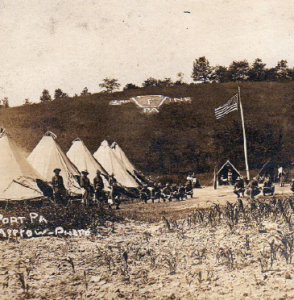
“In the borough of Newport, just northwest of Harrisburg, over 120 soldiers of Company F, 3rd Regiment of the Pennsylvania National Guard, trained on the current site of the Newport High School,” said Glenn Holliman, president of the Historical Society of Perry County. “They guarded Pennsylvania railroads and bridges while sharpening their military skills.”

To mark the centennial of U.S. involvement, the Perry County Bicentennial Committee this month will place a historical plaque at this site to commemorate these soldiers.


No Man’s Land

You can discover a wealth of information about World War I at the U.S. Army Heritage and Education Center outside of Carlisle. It opened its interactive exhibit, “Good-Bye Broadway. Hello France—America in the Era of WWI,” this past April.

“Rather than showing all the campaigns the U.S. Army fought in, we wanted our visitors to experience the war by meeting various soldiers through their artifacts, letters, photographs and their words,” said Curator Kaleb Dissinger.

The first section is titled, “From the Homefront to the Warfront,” and visitors can follow the journey of brothers George and Harry Record as they entered the army and began training. Both brothers survived the war, and you can read about the impact on them later in life.

David Pyle’s letters and artifacts are shown in the next section titled, “Training Under the Experts.” You’ll see his experimental tanker’s helmet, as well as examples of two types of gas masks American troops learned to use. The ”Behind the Lines” section shows how social organizations such as the Salvation Army and the YMCA carried out programs and established canteens to help make soldiers more comfortable.

“Evan Miller was an X-ray technician in Base Hospital No. 8, in Savenay, France,” Dissinger said. “You can read about his experiences as he documented the hospital’s role during the war. You’ll also see the German helmet, belt and bread bag Cpl. Swaim Pearson brought with him when he moved to the rear after raiding enemy trenches.”

Both the Allies and Germans used balloons as observation posts. In “Ordered to the Front,” you can stand in a balloon basket and see how observers looked for various enemy positions.

“Army engineers provided many key services, such as running phone and telegraph lines and repairing roads and rail lines,” Dissinger said.

Included in the exhibit are letters and photos from an engineer and an artillery soldier.

In the “From the First Line” section (the front was also known as the first line), you can sit on the
steps of a trench and watch the enemy through a mirror or peer through a periscope out over no man’s land.

“Because of machine guns and sniper rifles, it was often too dangerous to peek out over the trench because you might get shot,” Dissinger said. “So, soldiers sat with their back to the front and watched though angled mirrors. Also, they used well-concealed periscopes so they could see without being shot.”

Another section is devoted to African-American soldiers who served in the war. These infantry soldiers served proudly, but were assigned to French command, not American command. There also is a section on German weaponry captured by U.S. soldiers, showing the difference between types of weapons.

They Will Hold
The one campaign highlighted in the exhibit is the 2nd Division’s role at Chateau-Thierry from June to July 1918, in which the Americans blunted the last major attack of German forces.

“The Germans had struck through the French lines and pushed toward the Marne River, just 50 miles from Paris,” Dissinger said. “A French lieutenant general questioned whether or not the Americans who were sent to help could stop the German attack. Col. Preston Brown, who was the 2nd Division chief of staff, is quoted as saying, ‘General, these are Americans regulars. In 150 years, they have never been beaten. They will hold.’ And they did.”

The next section is titled the “True Nature of War.”

“We wanted visitors to understand the price of this war, or any war for that matter,” Dissinger said. “Some people may not want to look at these photos, but we should never forget the thousands of soldiers who died in this war.”

The U.S. Army began the war with about 200,000 men, but the numbers soon grew to more than 2 million. About 1.2 million Americans fought in the Meuse-Argonne campaign, which lasted from September to November 1918 and covered the entire western front. The Allied victory there helped end the war, but the casualties in the campaign cost the nation more than 26,000 soldiers’ lives.

One photo that especially caught my attention in the last section was titled, “Armistice, Occupation and Post War.” It was the Nov. 11, 1921, photo of the dedication of the Tomb of the Unknown Soldier in Arlington National Cemetery. This photo, together with a poem by an Italian soldier, “Good Bye Italy, Hello States,” ends the exhibit.

Once you finish with the exhibit, I suggest you hike the 1-mile Army Heritage Trail on the grounds. Here, you will see the trenches that soldiers lived in for days or weeks, along with exhibits from many other wars.

“I hope your readers take time to view the exhibit,” said Outreach Coordinator Lindsay Strehl. “I think it will help them understand the true nature of World War I.”

The U.S. Army Heritage and Education Center is located at 950 Soldiers Dr., Carlisle. For more information, call 717-245-3972 or visit www.usahec.org.

Continue Reading