
Happy Weekend!
Please excuse the abbreviated Weekend Roundup. I have a pretty good reason.

What are you doing this weekend?
(more…)
Continue Reading

Greater Harrisburg's Community Magazine

Happy Weekend!
Please excuse the abbreviated Weekend Roundup. I have a pretty good reason.




Water and sewer rates in Harrisburg are set to increase more than 7 percent next year, as Capital Region Water passed its 2018 budget last night.
The CRW board unanimously passed the spending plan, which will raise drinking water rates 7.5 percent for all city and suburban customers. Sewer rates will go up by 7.1 percent for city customers and vary for suburban customers, depending on their location.
The 2018 full-service rates for water and sewer service are $9.46 and $6.99 per 1,000 gallons, respectively. Under the new rates, an average customer who uses 4,500 gallons of water per month will pay an additional $5.56.
A few months ago, the board was faced with even higher rate increases, in excess of 10 percent, said board Chairman J. Marc Kurowski. However, CRW was able to scale those back to more reasonable levels, he said.
“Nobody’s excited with having to have rate increases, but we’ve kept them manageable,” Kurowski said last night.
CRW has raised rates for several years running. For 2017, the utility increased drinking water rates by 11.6 percent and sewer rates by 7.9 percent over 2016.
In his presentation last night, David Nowotarski, CRW’s chief financial officer, said the rate increases were needed, in part, to pay for ongoing capital upgrades to water and sewer infrastructure.
For 2018, CRW expects to spend about $8.9 million for water system upgrades and about $33 million for sewer projects. CRW has several major initiatives in place to repair and upgrade the city’s aged water and sewer infrastructure.
“Capital Region Water is continuing on the path of making critical investments to our infrastructure that were ignored for decades,” Kurowski said in a statement today. “We don’t take rate increases lightly, and we’ve made tough decisions to keep the rate increases below original projections, but these long overdue investments in our aging infrastructure will go a long way toward preventing service interruptions and higher costs of system failures.”
This was first board meeting following the departure of former CEO Shannon Gority, who left CRW effective two weeks ago. CRW expects to launch a search for a new chief executive, according to Kurowski.




State Street in Harrisburg
The long-awaited draft of Harrisburg’s comprehensive plan was released publicly today, setting out major priorities, concepts and ideas for everything from utilities to economic development.
The city Planning Commission posted the draft plan online, with eight sections tackling many aspects of city life and development.
The plan is thick with ideas on how to improve and revitalize the city, including adding more green space, preserving historic buildings and revitalizing blighted and depopulated areas.
The “Land Use” chapter alone, for instance, contains dozens of separate ideas, including:
The $200,000 draft document is the culmination of about 2½ years of work and frustration, as the city and its consultant, Bret Peters of the Harrisburg-based Office for Planning and Architecture, feuded at various points over scope, resources and payment.
Originally, the city expected a draft in about 10 months, but disputes pushed the project far beyond the original deadline and led the city to try to finish up the draft plan itself. Peters eventually did submit a finished draft to the Planning Commission, and, earlier this month, commission members voted unanimously to use his document as the final working draft.
The commission is now accepting public comments on the draft and will hold a public hearing on Jan. 10. Following the meeting, the commission will make final changes to the document before voting whether or not to accept it. If it passes, the plan will go on to City Council, which will hold its own review and public hearings, before casting a deciding vote.
Ordinarily, cities adopt comprehensive plans for periods of about 10 to 15 years. Harrisburg’s, however, dates back to 1974, making it practically useless today.
Click here to read the draft comprehensive plan and add your comments.

Harrisburg University has identified this site at S. 3rd and Chestnut streets as the location for a new high-rise building.
A new high-rise may soon add to downtown Harrisburg’s skyline, as Harrisburg University of Science and Technology plans to issue a request for proposals tomorrow for a new, mixed-use building.
According to the RFP, the proposed building at Chestnut and S. 3rd streets would house the school’s emerging Health Science Education Center, from which it would offer degree programs in nursing, pharmaceutical sciences and other health programs.
The RFP is asking for bids of at least 200,000 square feet for educational space, plus housing for more than 300 students. The building, currently proposed to be 36 stories, may also contain amenities such as a boutique hotel, restaurant, executive conference center and/or fitness facility.
The school envisions the building as a high-rise on parcels that include 222 Chestnut St., currently a surface parking lot owned by Vartan Enterprises, and 24, 26 and 28 S. 3rd St., which contain small commercial buildings owned by Mechanicsburg-based Dauphin Land Co. Under the RFP, those low-rise, 19th-century commercial buildings would be demolished.
HU President Eric Darr said that the current property owners have agreed to sell their parcels to HU for the project. He added that the proposed location was perfectly situated between UPMC Pinnacle and the university’s main academic building on Market Street.
“Being a block away from Harrisburg Hospital makes all the sense in the world,” said Darr, who estimates the total cost of the project at $120 to $140 million and construction to last about two years.
HU has set Feb. 2 as the deadline for responses, with a proposal selection date of April 10. An evaluation committee comprised of members of the university’s executive staff, board of trustees and outside advisers will evaluate the proposals.
The RFP is flexible in terms of deal structure and financing. It states that the university would consider a variety of options, including purchase, lease, leaseback and lease-purchase.
The RFP broadly states that the building would be a condominium in structure with these separate parts:
Developers are free to include their own additions, such as apartments and residential condominiums.
In fact, Darr said that he views these criteria as mere guidelines and is encouraging potential developers to be “as creative as possible.”
“I don’t want them to think we’re locked into a particular design, because we’re not,” he said.
The design should also include enough parking to meet city requirements for such a building, Darr said.
“To say this is an important project for downtown is a bit of an understatement,” said Brad Jones, president and CEO of Harristown Enterprises, which recently has developed several buildings downtown and plans several more. “We are very excited about it.”
This structure would be HU’s second major building downtown, complementing its current high-rise on Market Street. HU was founded in 2001 and recently has experienced rapid growth.
You can view the RFP here: RFP Health Sciences Project.Nov 16 2017
This story was updated to includes comment from HU President Eric Darr.
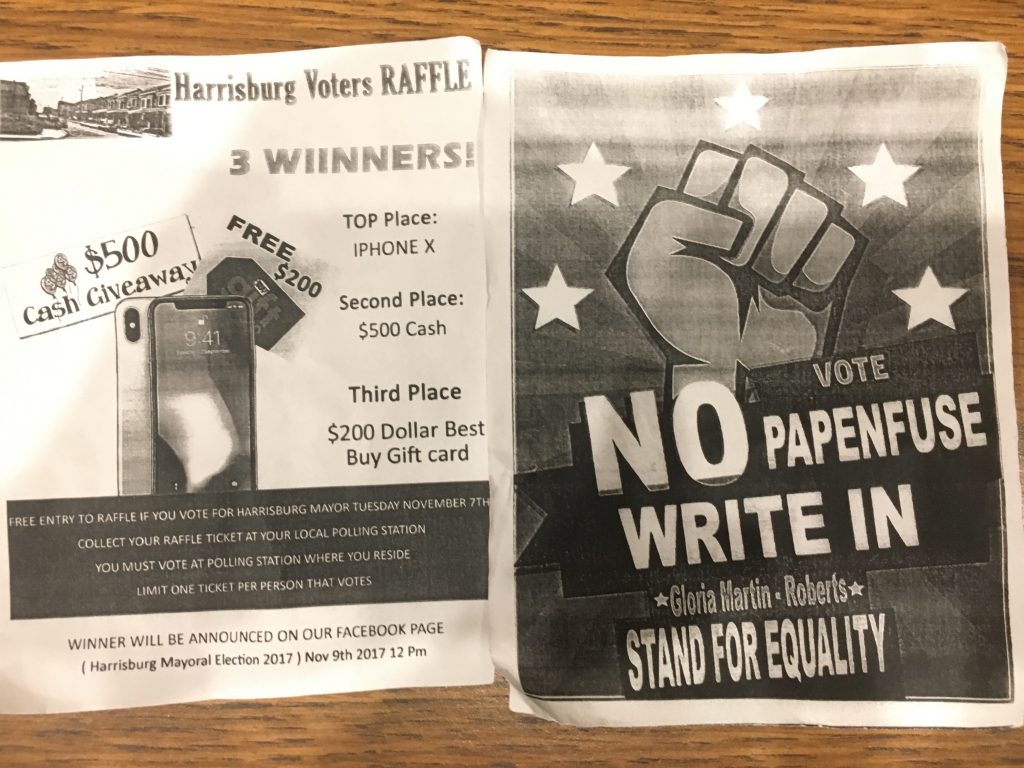
Some of the fliers that Jeremy Hunter paid canvassers and poll workers to distribute during the General Election on Nov. 7. Hunter claimed he did not organize the election day raffle advertised in the flier on the right, but admitted to paying some of the people who promoted it.
A Harrisburg-area developer who reportedly spent thousands of dollars trying to influence Harrisburg’s mayoral race has not yet filed any of his expenses with the Dauphin County Board of Elections—but was denounced today by the write-in candidate he tried to promote.
Jeremy Hunter, a Camp Hill resident who wishes to buy and develop William Penn High School in Harrisburg, paid field workers last week to campaign for Gloria-Martin Roberts, a former city council member and mayoral candidate.
He reportedly disbursed $900 of wages to canvassers and poll workers through an associate late Tuesday, and he told TheBurg himself that he spent $5,000 that night paying canvassers, poll workers, and people who promoted an election day raffle.
He also said he spent $35,000 in the primary season on radio ads attacking Harrisburg Mayor Eric Papenfuse, who was reelected last week.
Pennsylvania campaign finance law allows individuals not associated with any campaign to make independent expenditures to influence the election of a candidate or ballot question.
Any independent election expenditure over $500 made between Tuesday, Oct. 25, and Wednesday, Nov. 8, must be reported to an Election Board within 24 hours. All independent expenditures during primaries must be reported in May.
Hunter said on Monday that his legal counsel did not inform him of any rules regarding independent election expenditures, and confirmed that he had not filed any reports with the Dauphin County Board of Elections.
He did, however, draw the ire of the candidate headlining his campaign.
Martin-Roberts denounced Hunter’s efforts in an interview with TheBurg on Monday, claiming she did not approve of any of the literature he circulated on her behalf. She said she took particular offense to a flier showing a raised fist — an emblem of the black power movement.
“I clearly told Jeremy, ‘do not distribute any of that information with my name on it,’” Martin-Roberts said. “He does not listen to anyone.”
The only action Martin-Roberts took before the general election, she said, was to film a video at the Voter Registration Office instructing people how to cast a write-in vote. The video was posted to her Facebook page.
Hunter told TheBurg last week that he printed 40,000 fliers denouncing Papenfuse and promoting Martin-Roberts before the Nov. 7 elections.
Hunter said that Martin-Roberts knew about his fliers, but claimed he acted “independently of everyone.” He said that he did not have the candidate’s permission but also claimed that she never forbade any aspect of the campaign.
He also recruited and paid scores of people to distribute the literature that Martin-Roberts said she rejected. One of them, Harrisburg resident Betty Wallace, helped assemble a team of canvassers and poll workers for the general election.
Wallace, who previously worked for Martin-Roberts’ primary campaign, added that Hunter did not give her an operating budget, but offered to pay each worker $120.
Elisha Thomas was hired by Wallace to be a poll watcher for Gloria Martin-Roberts. Thomas said she was paid $40, a fraction of what she was promised, by Hunter’s associate, Kyle Myers, on Tuesday night.
She and Wallace watched Myers distribute a total of $900 among more than 20 poll workers and canvassers before he ran out of money, they said. He issued the payments at 1941 Market St., in the offices of Magisterial District Judge candidate Claude Phipps, where some of the field organizers happened to be working.
Hunter told TheBurg he paid campaign canvassers and raffle workers in his office at 308 N. 2nd Street the same night.
“I probably paid out $5,000 of my own money and have it on record,” Hunter said on Wednesday. He claimed that he filmed every transaction he made that night, and had each person on camera state their name and the job they performed.
Wallace said she hired more than 30 people to canvass and work polls for the write-in campaign on Election Day. Hunter personally gave her $700 on Wednesday to pay her team, which Wallace said did not nearly cover everyone’s wages. That payment, which Hunter made on Nov. 8 and acknowledged in text messages shared with TheBurg, also falls within the 24-hour reporting period.
In a Nov. 9 text message sent to Wallace, Hunter claimed that he paid more than $8,000 in wages for canvassers and poll watchers since Nov. 7.
Wallace claimed that Hunter promised her $500 for field organizing; he said he never made that offer. She said she’s received countless phone calls this week from people claiming Hunter owes them money.
Hunter and Myers received criticism for delaying payments to the homeless shelter residents they recruited to hand out raffle tickets at polling places.
Myers claimed responsibility for the raffle, which offered voters the chance to win a free iPhone if they participated in Harrisburg’s mayoral election. He said it was meant to encourage voter turnout.
Hunter helped Myers recruit raffle workers but insisted that the raffle was separate from his own canvassing efforts. He admitted that running both projects out of his 2nd Street office created the perception of collusion between the raffle and the write-in campaign.
But Corby Chester, who was hired by Wallace as a Martin-Roberts canvasser, said that the bag of supplies he received on Election Day contained both campaign literature and raffle materials.
“Jeremy told us to give them out together,” Chester said. Hunter denied the allegation.
Chester, Wallace, and a canvasser named Roynel Reed all said that Hunter told them separately about his plans to develop the former William Penn High School campus in Harrisburg.
“He said he wanted to buy the high school, and Papenfuse is freezing him out,” Reed said.
Hunter told Burg reporters on two occasions that he wishes to buy the school and turn it into a “soft landing” campus for international students studying at American universities. On Wednesday, he said that he does not think Papenfuse supports his development projects.
Harrisburg School Board president Danielle Robinson confirmed that Hunter’s company, William Penn Holdings, expressed interest in the now-empty high school campus.
Dauphin County Property Investors, a subsidiary of William Penn Holdings, owns 14 properties in Harrisburg. DCPI purchased all of the properties at tax sale for prices ranging from $800 to $12,000.
Hunter said on Monday that he would call the county Board of Elections about his campaign expenditures. He also reported that he fired his legal counsel, who he confirmed was James Ellison, the former treasurer of Martin-Roberts’ primary campaign.
This story was updated to include the name of Hunter’s lawyer.

Revered by many to be Tennessee Williams’ magnum opus, “A Streetcar Named Desire” is a classic among theatrical works of the 20th century. The play originally ran on Broadway from 1947 to 1949, winning the Pulitzer Prize for drama in 1948 and New York Drama Critics’ Circle Best Play in the same year.
Gamut Theatre Group has now revived the legendary tragedy in a production directed by Clark Nicholson and starring Amber Mann as Blanche DuBois, Michelle Kay Smith as Stella Kowalski and Sean Adams as Stanley Kowalski. Blanche and Stanley’s conflicts are the centerpieces of the play, and their relationship is powerfully depicted by Mann and Adams.
“Streetcar” tells the story of southern belle Blanche DuBois, who visits her younger sister, Stella, and brother-in-law, Stanley, in New Orleans. Traveling from the family home, Belle Reve, in Laurel, Miss., Blanche is staying with Stella and Stanley for an extended period of time, having taken a leave of absence from teaching English due to her nerves and after losing Belle Reve to creditors. Without her home and with no money, Blanche has no choice but to live with Stella and Stanley in their already crowded apartment in the French Quarter.
Upon entering the Kowalskis’ apartment, Blanche immediately casts a critical eye on the small, simple, two-room space and its lack of privacy. In the first few scenes, it’s easy to understand why Blanche has a problem with her neves. High-strung, anxious and fastidious, she has no problem talking for the two of them and expressing displeasure at Stella’s living situation, among other things. She blames Stella for leaving her with the full responsibility of managing the deaths of their father and other family members, leading to the financial collapse and eventual loss of Belle Reve.
Upon meeting, Blanche and Stanley immediately dislike one another, which forms the basis of their relationship. Blanche repeatedly critiques Stanley for his rough appearance and boorish nature, and, in turn, Stanley despises Blanche for her rudeness and lengthy presence in his apartment. Stanley asks Blanche about her former marriage, and she explains that she was married young and her husband died, leaving out the details because of apparent distress.
Blanche is clearly careful of her appearance, and her vanity is precious to her. She does not step into direct light, self-conscious of her looks in her 30s. Her clothes are luxurious and plentiful, despite her recent economic hardship. Suspicious of her fine clothes and items in her trunk, Stanley believes that Blanche is lying about losing Belle Reve and is cheating Stella out of money. The couple is expecting a baby, raising the already high tensions in the apartment caused by Blanche’s neuroses and stress. As the play unfolds, the fictions that Blanche has been spinning start to unravel, eventually causing her descent into a psychotic break.
The rawness of their emotions and the strong-willed, stubborn personalities of Stanley and Blanche, played with passion and power by Adams and Mann, are complemented by the gentle, warm character of Stella depicted by Smith. The iconic “Stella!” scene was heart-wrenching and intense, and the final, intense performance by Mann capped this tale of poverty, struggle and regret.
“A Streetcar Named Desire” runs through Nov. 26 at Gamut Theatre, 15 N. 4th St., Harrisburg. For more information and tickets, call 717-238-4111 or visit www.gamuttheatre.org.


Clients from Downtown Daily Bread, a soup kitchen and drop-in shelter on South Street, were recruited to promote an Election Day raffle. Some still await payment.
Men from the Bethesda Mission shelter who were recruited for an Election Day raffle scheme have been compensated for their work, but patrons of another local shelter say they’re still being stiffed.
Raffle organizer Kyle Myers, who also uses the name Kyle Schlessman, went to Bethesda Mission on Reily Street Wednesday evening to pay seven men $100 each for their work on Tuesday. Myers had hired the men to distribute raffle tickets and promotional fliers to voters entering Harrisburg polling places.
The raffle offered voters a chance to win a free iPhone if they participated in Harrisburg’s mayoral election. It was ended by a Dauphin County court injunction on Tuesday.
Another raffle organizer recruited workers from Downtown Daily Bread, a drop-in shelter and soup kitchen on South Street. Staff there said on Thursday that patrons were still waiting on paychecks.
Anne Guenin, director of Downtown Daily Bread, was able to confirm that, of the six patrons who were hired to distribute raffle tickets on Tuesday, one was paid $50 – a portion of what she claims she was promised. Guenin said that at least one other woman was still waiting for payment and could not confirm the status of the others.
Tyrone Lewis was napping at Daily Bread on Tuesday morning when a man entered the shelter and shouted an advertisement for paid work. Lewis said the man acted “belligerently” when Karen Fetrow, coordinator of the drop-in shelter, told him he could not recruit patrons.
The man signed into the shelter’s roster as Kevin Brown, according to Fetrow. She said she did not ask him for ID and thinks he used an alias.
Lewis said he left with the man because he needed money and worked all day handing out tickets. He claimed he’s still owed $75.
“I’m not too happy,” Lewis said on Thursday.
On Thursday evening, Myers said he would “absolutely” pay the Daily Bread patrons their wages. He said he would call the shelter on Friday to make arrangements.
Myers went to the Bethesda Mission shelter himself on Tuesday morning to recruit men to promote the raffle. He promised them $10 an hour to distribute the tickets and fliers. After the injunction was filed at midday, some of the men were photographed and interviewed by county sheriffs, who were ordered to seize raffle materials from seven polling places.
By Tuesday evening, Bethesda Mission residents had not been paid for working at the polls all day in freezing weather. They were allegedly told by organizers that they could not collect payment until the county concluded its investigation into the raffle.
TheBurg previously reported that six Mission residents had worked for Myers on Tuesday. Bill Christian, director of the Men’s Shelter at Bethesda Mission, confirmed that seven men had worked.
Christian previously told TheBurg that political candidates and parties often recruit mission residents as canvassers in election season. When Myers came to the mission on Tuesday morning, Christian allowed seven men to leave the shelter with him.
If he had known that the raffle would end in a court-ordered injunction, Christian said he would have never let the men go.

A polling station on State Street in Harrisburg.
On Tuesday night, someone texted me a “face palm” emoji.
That’s a little picture of a guy bringing his hand to his face in a gesture of frustration and exasperation.
I knew where he was going with this.
We had just run a couple of stories about a bizarre Election Day scheme, which began with homeless men standing at polling stations handing out raffle tickets that promised a chance to win big prizes for simply casting a vote, and ended, hours later, with a visit by the Dauphin County sheriff to the hastily assembled downtown campaign office of write-in candidate Gloria Martin-Roberts.
As another friend often says, with a sigh, “Oh, Harrisburg …”
Yes, it was another shameful day for Harrisburg’s political class and, by extension, the rest of us. And now the national press has picked it up, with stories today in the New York Times and Chicago Tribune, among other papers, reminding me of the day the big-city press jumped on the story of former Mayor Steve Reed and his house full of museum artifacts.
As of now, details remained a bit sketchy over the plot to round up men from Bethesda Mission and Downtown Daily Bread and dispatch them, armed with campaign flyers and raffle tickets, to polling stations throughout the city. It’s also unclear if the campaign crossed any legal line or if it will be able to maintain a veneer of plausible separation between the pro-Martin-Roberts (and anti-Eric Papenfuse) flyers and the iPhone/cash/gift card raffle drawing.
But this much is clear—the episode is disgraceful, another black eye for the city doled out by some of its own “leaders.” That’s bad enough. But I’m perhaps even more astounded by the profound stupidity of this half-baked enterprise.
Since I’ve been here, I’ve been told that Harrisburg is a “different” kind of place. Too big to be a town, too small to be a proper city, it exists in an urban netherworld, sometimes exhibiting the worst (sometimes, the best) traits of each.
So, Harrisburg has big-city problems, but these often reside within a small-town political framework more akin to Mayberry than Manhattan, in which the players know each other well, often detest each other and engage in a battle to be the biggest minnow in the pond.
In cities with a more evolved political class, here’s what happens in a primary election. People lose, and then they call and congratulate the winner. The losers graciously bow out of contention and support the party’s nominee in the general election. Serious-minded candidates who want another shot study what went wrong, how they can do better and plot a long-term strategy on how to come back and fight another day.
In contrast, here’s what happens in Harrisburg. A candidate loses in the primary and then, more often than not, whines, complains and makes accusations and excuses. He or she then plots and schemes how to still win in the general election they’ve just been knocked out of.
So, for instance, maybe a lifelong Democrat cross-files and wins on the Republican side, becoming the standard-bearer for a party he loathes. Or maybe he backdoors his way in, earning enough write-in votes to get a spot on the other side of the ballot. Or, absent any other alternative, he mounts a pointless write-in campaign.
In any case, staying in a race despite a primary loss usually says nothing good about a candidate or his chances. When candidates continue to run, they’re usually doing so from a place of profound personal ego and political weakness. They simply can’t abandon the spotlight or the belief that they should be the next mayor or council member or whatever. It also usually confirms the primary result, as they typically run as bad a campaign the second time around as the first.
But, mostly, it’s a just a big waste of everyone’s time and attention, since primary losers rarely end up winning. In Harrisburg, the Democratic victor in the primary wins in the general election almost every time, barring intervening scandal or death.
Harrisburg’s recent mayoral races offer great examples. Four years ago, one of the losing Democrats continued to run after “winning” the Republican primary through write-in votes. At the time, I wrote that he would lose badly in the general election running as a Republican, and that’s what happened. A whole lot of time and money was spent for nothing.
This year, we were faced with an even odder situation. Of the four losing primary candidates, two mounted write-in campaigns in the general election. Write-in efforts almost never succeed, requiring months of intense voter engagement and education for even the slimmest chance. Instead, these candidates declared just days before the election—“campaigning” mostly through Facebook. They then lost by a 7 to 1 margin.
This was simply was not a serious effort. So then what was the point? Ego? Delusion? Coercion? Pique? Honestly, I have no idea.
But here we are, stuck with the Election Day version of the Keystone Kops, a group who raided the city’s homeless shelters to field a workforce to support a hopelessly desperate and strangely executed write-in campaign. Their bizarre scheme is now being examined by law enforcement, which may not take kindly to partisans running a raffle to encourage “voter turnout.”
But that still leaves us, the people of Harrisburg, saddled with a political class that, too often, proves to be embarrassing, incompetent or even corrupt. We must demand better from those who purport to represent us: more maturity, more professionalism, more care for the whole of the city. And they must be able to accept criticism and even loss gracefully.
In the battle over the question—is Harrisburg more a big town or a small city?—I tend to side with the latter. However, I’m still waiting for politicians, as a whole, to show greater competence and thicker skins: to do battle, accept their lumps, shake hands and move on. I believe this city has had enough of their petty squabbles, lingering vendettas, Facebook feuds and crazy, embarrassing schemes.
Lawrance Binda is editor in chief of TheBurg.

Marc Kurowski of Capital Region Water, Harrisburg Mayor Eric Papenfuse and Councilman Dave Madsen officially broke ground today to begin the 3rd Street corridor project.
Harrisburg officials today broke ground on the long-awaited repaving of 3rd Street, though most of the work will wait until next spring to start.
City Engineer Wayne Martin said that crews will begin on the Midtown portion with new curbing and ADA-compliant ramps at each intersection. Work is expected to continue through December, depending on the weather, and will resume in March.
The entire project includes about a two-mile stretch of the main artery from Chestnut Street downtown to Seneca Street in Uptown Harrisburg.
Actual milling and paving of the street will hold off until next year, said Mayor Eric Papenfuse. The project is expected to continue throughout much of 2018, wrapping up in October.
Papenfuse stressed that the project is not just for motorists. He said the improvements will make it easier to walk and bike, as well as drive along the street.
“By the time we are done, this entire area will be returned to the residents of the city,” he said.
Martin said that, when paving begins next year, he expects temporary road closures and detours lasting about three days at a time. He also said that some parking, about 10 spaces at a time, will be occupied by construction equipment.
“There will be times when parking will be an issue on 3rd Street,” Martin said, requesting patience among motorists and residents until the project is done.
The street was last paved in 1999, he said, so, “it’s overdue.”
As part of the project, Capital Region Water will install trees and other environmentally friendly infrastructure, including green “bump outs,” to reduce storm-water flow, said CRW board chairman Marc Kurowski.
He said the project is part of CRW’s City Beautiful H2O program, which is meant to replace outdated infrastructure and improve storm-water flow.
“We’ll have new trees and new ways to manage storm-water,” Papenfuse said. “This will become a showcase for design for the whole region.”
Harrisburg has contracted with Elizabethtown-based Doug Lamb Construction Inc. for the $5.5 million project, a cost split between the city and CRW. The city is paying an estimated $3.5 million, with CRW footing the remaining $2 million.
Most of the project is funded by a grant from Impact Harrisburg, a nonprofit set up as part of the city’s financial recovery plan.
Please excuse the abbreviated Weekend Roundup. I have a pretty good reason.

What are you doing this weekend?