Harrisburg to host first annual “Ice & Fire” winter festival next month.

Mayor Eric Papenfuse was joined by city officials, representatives from Capital Blue Cross and D&H Distribution, and Elsa from “Frozen” at City Hall on Thursday.

Harrisburg may be slick with ice today, but there’s more to come at a new city festival next month.

The first annual Ice & Fire festival will be held on Saturday, March 3 from 1 to 9 p.m. in the city’s downtown business district. All of the events will be free and open to the public.

“We’re celebrating the end of winter,” Mayor Eric Papenfuse said in a press conference at city hall on Thursday.

Attractions will include a 2,400-square-foot outdoor skating rink on Market Street with complimentary skate rentals, an inflatable toboggan slide, and an ice castle with characters from the movie “Frozen.” Festival-goers can also take in ice sculptures, fire dance performances and musical acts by a DJ and live bands.

City officials also hope that festival will bring business to local shops and restaurants. Food trucks will be stationed downtown, and the HBG Flea, a monthly art market, will be held from 10 a.m. to 4 p.m. in Strawberry Square.

The $50,000 event will be funded by sponsorships, Papenfuse said, including significant contributions by Capital Blue Cross and D&H Distribution.

“The city was prepared to provide funding, but I’m really pleased that we covered it with the full support of sponsors,” Papenfuse said.

The mayor noted that Harrisburg’s summer festivals, such as Kipona, bring thousands of regional visitors into the city each year. He said that Ice & Fire will be Harrisburg’s first winter festival. If the event is a success, the city may repeat it in the future as a multi-day festival.

“We’re piloting it as a one-day festival, but we will look to expanding it,” Papenfuse said.

Metered parking will be enforced on the day of the festival. Attendees can enter the coupon code “LUVHBG” in the ParkMobile app to redeem four hours of free parking. The Market Square Garage will offer full-day parking for $10, and parking in City Island garages will be free.

Continue Reading

Weekend Roundup with Sara Bozich

Happy Weekend!

Holla, weekenders. I have zero plans. I think I need to start getting Bo and me out of the house more often, but like, it’s going to rain all weekend, so I think I’m going to hunker down with some Netflix and baby giggles.

I’m missing another Saturday night PSU Wrestling match, but I’m hoping this time Bo doesn’t have a fever, and I can get some QT with the dog and some wine. What else? IDK I need a hobby that isn’t making broth or working.

What are you doing this weekend?

(more…)

Continue Reading

Community Comment: HBG communications director reacts to Burg blog post, defends outreach effort.

Editor’s Note: Harrisburg Communications Director Joyce Davis issued the response below to a blog post published yesterday by TheBurg’s city reporter Lizzy Hardison, “Say What You Mean.” The blog concerned the city’s communication of a “community debriefing” at Hamilton Health Center on Tuesday night, specifically about whether the general public was permitted to attend the event, which addressed recent police-involved shootings. This response originally was an email sent this morning to TheBurg from Davis. She said that this email should be used as her official response. To better understand the context, please read the original blog post. TheBurg welcomes responses to our stories.

Joyce Davis’ response:

You had some inaccuracies in your blog today that I hope you will correct. 

First,  your news colleagues saw the information I  posted information about the community meeting on Next Door and in other Social Media.  The information clearly explained the nature of the meeting and that the media would not be allowed to participate. 

While you indicated we had no direct contact with the media, that is incorrect. I was in direct contact with several news outlets and spoke directly to those who called, including Porcha Johnson, Logan Wilson and Mark Hall.  In fact, Mark had been assigned to go to the meeting, but after speaking to me, explained to his editors that he should not go. Logan talked to me several times about the event. 

Again, these good reporters saw the information I posted on social media and took time to contact me to discuss.  I’m not sure why you didn’t see it, but I would suggest you follow the city’s on Twitter, Next Door and on its Facebook page and that you set up alerts so that you know when things are posted.

Here’s what was posted on social media and that your colleagues distributed to the public,

(I have placed in bold the pertinent information about the event and in red the alert to the news media):


Message from the Harrisburg Bureau of Police

Director of Communications Joyce Davis from City of Harrisburg · 5d ago

In the recent weeks, residents of the area of 17th Street, Mulberry Street, and the surrounding community have been witness to disturbing incidents. The Bureau of Police has invited the Keystone Crisis Intervention Team to Harrisburg.

The Keystone Crisis Intervention Team is a state crisis team that responds to crime related events to support crime victims, witnesses and communities in the recovery of an incident. The Bureau of Police of the City of Harrisburg invites you to a community gathering on Tuesday, February 6, 2018 at 6 pm at the Hamilton Health Center located at 110 South 17th Street.

The purpose of the meeting is to talk about reactions and responses to what has happened in your community. It is to support you and your neighborhood. It is not to investigate, review, or assess the events that have taken place. In addition, a resource table and staff members from several agencies will be there to offer resources. 

Although the media may know about the gathering, they will not be permitted to participate. 

We welcome your attendance.

Continue Reading

Burg Blog: Say what you mean.

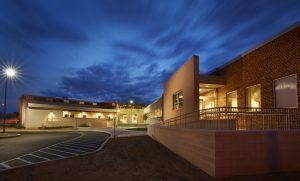
Hamilton Health Center on S. 17th Street.

At their bi-monthly work session in city hall last night, City Council members heard an hour-long presentation from members of Harrisburg’s communications department. Led by Director Joyce Davis, the department’s employees laid out their strategies for connecting with Harrisburg citizens in person and through social media.

I planned to miss the presentation so I could attend a meeting across town. Ironically, that event provided perfect case-study in how not to communicate with city residents.

Last Friday afternoon, city employees began announcing a “community de-briefing” to be held this Tuesday at Hamilton Health Center, following a series of tragic incidents that took place nearby. These incidents included an apparent suicide-by-cop that left Ahmed El-Mofty dead on Dec. 22, as well as a Jan. 18 raid by the U.S. Marshal Fugitive Task Force. That raid ended tragically when police fatally shot Kevin Sturgis after Sturgis opened fired on officers, killing Deputy U.S. Marshal Chris Hill.

Tuesday’s event was billed as a community gathering where residents could discuss the killings and learn about community resources to cope with trauma. The police had invited members of the Keystone Crisis Intervention Team to participate, as well.

It turns out that the crisis team members weren’t just participating in the meeting, but leading it. And the meeting wasn’t so much a “de-brief” as it was a group counseling session for the residents most closely affected by the violent events. That’s a good and admirable mission. But it came as a surprise to some of the 30 residents who attended last night. Those who weren’t Mulberry St. residents were allegedly asked to leave before the meeting began. Some left frustrated, claiming they weren’t informed of the true purpose of the event.

Looking back at messages from official city channels, one can see how those residents misunderstood the purpose of the meeting. These miscommunications ended up clouding a well-intentioned event. Here are three ways that can be avoided in the future.

Call it what it is.

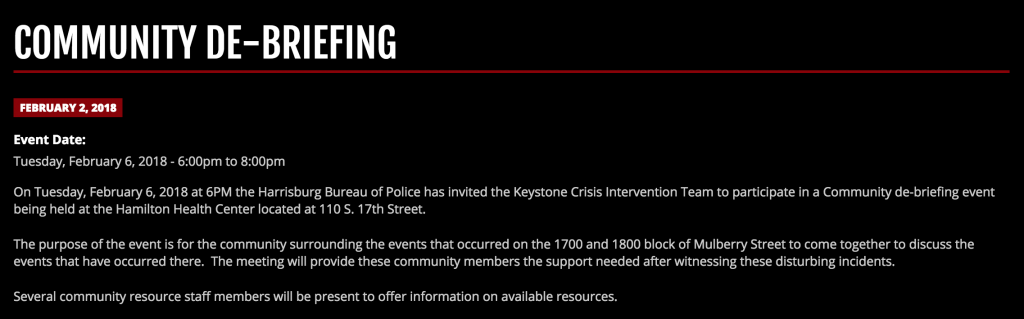
I first learned about this event after a senior police official tweeted out this listing on Crimewatch, a website that police use to make public announcements:

Click to enlarge.

Since I cover city government, I try to attend any meeting announced by a city agency. After I arrived at Tuesday’s event and took a seat, I was asked to leave. Facilitators from the Keystone Crisis Intervention Team informed me it was a private session for the residents of Mulberry Street. Later that evening, after other residents who were asked to leave vented their frustration on Facebook and Nextdoor, I realized I wasn’t the only person who learned this on the spot.

I doubt that any of those residents intended to invade a private event. I’m sure many (including myself) would have stayed home if they knew it was a session for just Mulberry Street residents. But if that were the case, that’s how the event should have been advertised – not as a “de-briefing” or a “meeting,” as a closed-door counseling session. Which brings me to my next point.

If the event isn’t for the whole city, don’t advertise it to the whole city.

If the intended participants were residents of two or three city blocks, knock on their doors or leave them mailbox fliers. Don’t post an event listing to surrounding neighborhoods on Nextdoor or publicize it on Crimewatch. And definitely don’t tweet out reminders like this one, which reads as an open invitation to any resident who sees it:

All of the messages from the city characterized the event as a community meeting — not a closed-door counseling session for specific residents. If the city wants praise for providing these important services to residents, officials should hold the event quietly and release details about it after the fact.

If media aren’t allowed in, communicate with them directly.

City officials publicized the community gathering on different social media platforms, but the messaging wasn’t consistent. The post on Crimewatch said nothing about media access. The press release that Davis posted on Nextdoor hinted at it, but still wasn’t explicit. It said that, “although the media may know about the gathering, they will not be permitted to participate.”

Now we know that media won’t be allowed to “participate.” But are they allowed to enter the event or observe it? For future gatherings like this one, city officials should communicate directly with their contacts at PennLive, TheBurg, WITF and local TV news stations to explain the rationale.

I think everyone commends the city’s effort to help residents cope with trauma. More residents stand to benefit from the services offered on Tuesday night, and I hope that the city continues to sponsor similar events in the future. But I also hope that the city communicates the purpose of those events clearly and to the right people. That would save officials some of the ill will expressed by excluded residents on Tuesday night.

Continue Reading

Rate Debate: More apartments, more talk of rental rates at Harrisburg council.

Thirteen more apartments have been proposed for Strawberry Square in Harrisburg.

Affordable housing was back in the spotlight tonight, as the Harrisburg City Council listened to plans for another downtown apartment conversion.

At their biweekly work session, council members heard from Harristown Enterprises CEO Brad Jones about plans to convert empty office space inside of Strawberry Square into 13 apartments—10 one-bedroom and three two-bedroom units.

Jones’ presentation of the project rekindled a discussion from the prior council meeting two weeks ago, when council President Wanda Williams read a lengthy statement saying that she expected downtown developers to include affordable housing in their plans going forward.

“I certainly will be watching,” she said at the time.

Williams was absent from tonight’s work session, but Councilman Dave Madsen picked up the thread, saying that he had spoken with Williams about their concerns over rental rates for newly renovated, higher-end units in downtown Harrisburg.

“We discussed that pricing has been a concern with these projects,” said Madsen. “But, as I understand with Wanda Williams, we’d like to move this project along, but with future projects, that you consider throwing in a few affordable housing units.”

Madsen said that he’s heard from constituents recently who said that they’re troubled over the issue of affordable housing in Harrisburg given recent higher-end projects downtown. Perhaps paradoxically, he also said that constituents seem to desire the high-quality housing being built by downtown developers like Harristown.

“We’ve seen everything downtown,”said Madsen, relating what residents have told him. “Why aren’t we seeing it in our neighborhood?”

Over the past two years, Harristown has brought about a half-dozen projects to council for approval. Nearly all have been conversions from empty, even dilapidated office space, to higher-end residential units. In all, the company has constructed about 60 apartment units from these projects, Jones said tonight.

Just two weeks ago, council approved a Harristown project at N. 2nd and Cranberry streets, which will convert a long-empty, historic office building to an apartment building with 12 one- and two-bedroom units.

And Harristown now has another downtown project on the boards—the conversion of a six-story office building at 124 Pine St. into a mixed-use project consisting of 25 apartments with retail space on the first floor. That project, which requires a variance, is slated to go before the city’s Planning Commission and Zoning Hearing Board this month.

Jones came to tonight’s meeting armed with data, as he tried to counter the narrative that his company’s apartments are too pricey. He said that about 15 percent of Harristown’s existing units could be rented by someone with an annual income of just $25,000 to $40,000 a year, while another 40 percent could be afforded by someone with an average income of $60,000 a year.

He also emphasized that his projects—and, in fact, most apartment projects in the city over the last decade—rehabilitated existing empty and blighted housing stock and did not lead to displacement.

“The point I want to make tonight is that that has not occurred to this point,” he said. “Could it happen in the future? Sure. We’ve seen it happen in other places.”

Several council members said that they should not single out individual projects or developers in a pursuit of affordable housing. Instead, the city, they said, needs to develop a clearer policy on what it expects from all builders as Harrisburg continues to redevelop.

“This governing body needs to figure out what our policies are going to be,” said Councilwoman Shamaine Daniels. “We just can’t have one investor or one developer solve the affordable housing issue in the city.”

Madsen concurred.

“This has long been a concern,” he said. “It should require legislation on our part or our side.”

Council is expected to take a final vote on the Harristown residential conversion in Strawberry Square at its legislative session next week.

Continue Reading

In With the New: Bethesda Mission to break ground on community center this year.

A rendering of the new community center, left, and existing youth center on Herr Street.

A teen center in North Allison Hill is slated to double in size this summer, bringing with it new programs and amenities for the surrounding community.

Bethesda Mission plans to renovate an old printing plant on Herr Street adjacent to its current Youth Center, adding a full-size gymnasium, classrooms, office space and an event hall with a full-service kitchen.

The end result will be a full-service community center with classes and amenities for all age groups, said Cindy Mallow, director of development at Bethesda Mission. The current youth center only serves children and teens.

“We’re hoping to involve families and expand out into the community even more,” Mallow said.

Bethesda Mission hopes to break ground on the $2.8 million project this summer and finish it by the end of 2018, Mallow said. They’ve obtained the necessary authorization from the Harrisburg Zoning Hearing Board and will seek approval from City Council this month.

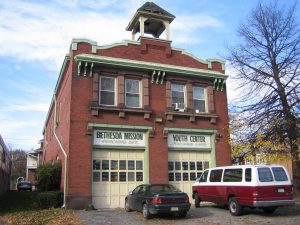
Bethesda Mission converted an old fire station to a Youth Center in 1990.

Bethesda Mission has operated its teen center from a former fire station at 1428 Herr St. since 1990. It purchased the former Kurzenkabe Press facility at 1424 Herr for $275,000 in 2015, according to Dauphin County property records.

The 10,000-square-foot space needs extensive renovations, Mallow said, including an overhaul of its HVAC, plumbing and electrical systems. Contractors will also raise the ceilings to accommodate the gymnasium and construct a connection between the print facility and the youth center.

Since Bethesda Mission announced its plan to renovate the printing facility back in 2015, it has raised more than $1.5 million from the community and private foundations, including $600,000 from the York-based Stabler Foundation. The faith-based rescue mission does not take public funding, Mallow said.

Mission directors hope that donated goods and labor will help offset construction costs. They plan to begin soliciting bids next month, Mallow said, and will consider donation offers before awarding a contract. The mission will also call on volunteer laborers to help with tasks such as painting.

Mallow estimated that the renovation will double Bethesda Mission’s facility space on Herr Street. New programs won’t be announced until after the renovation in complete, but could include GED programs, parenting classes or computer classes. The expansion will also allow the mission to double or triple enrollment in its after-school program and summer programs for youth.

“There’s just a need for a place for the kids to go,” Mallow said. “Our center gives them the opportunity to be with other kids and have a mentor.”

Bethesda Mission currently does not plan to hire new personnel to staff the center, but Mallow said that they will need more volunteers to help with programming.

As construction on the new community center gets underway, Bethesda Mission will also begin fundraising for renovations to the existing youth center. Mallow hopes that they can avoid suspending programs if they complete the community center renovation before they make updates to the youth center. Those renovations will cost at least $1.5 million, she said.

For more information on Bethesda Mission, visit www.bethesdamission.org.

Continue Reading

BurgBlog: Are community schools the solution to Harrisburg’s educational woes?

Benjamin Franklin Elementary School on 6th Street in Harrisburg.

There’s a series in the online newspaper the Philadelphia Citizen that bears my favorite name in media: “Ideas we should steal.” Each column highlights a program or policy making a positive difference in communities across the United States.

I like this series because it relies on a fundamental but underutilized aspect of journalism: the power to identify proactive solutions to local problems. I try to practice this approach in my own reporting, taking notes from outlets like Keystone Crossroads (a great project by public radio stations across Pennsylvania) and the Solutions Journalism Network, which aggregates solutions-based reporting into a searchable database.

It was a story I found through the Solutions Journalism Network that catalyzed my recent feature about high rates of absenteeism in Harrisburg schools. My article, which you can read online or in our February print issue, shows how the current method for tracking student attendance inures schools to high rates of chronic absence. I explain why that can doom other well-intentioned programs in a school district, and highlight initiatives that other schools have used to reduce absenteeism.

Since sending that story to print a week ago, a story in the Philadelphia Citizen alerted me to another educational model that’s gaining steam in Ohio, California and, recently, Philadelphia: community schools. Essentially, community schools host different health and human service agencies directly in school buildings, with the belief that connecting students to these services will make it easier for them to learn.

This approach to schooling acknowledges that a student’s education can’t take place in a vacuum. The stresses of poverty don’t dissipate when a child enters a classroom, and a traditional school staff can’t overcome them on their own. (Consider the appeal by Harrisburg teachers this fall for more trauma-trained aides in schools.) But by inviting health clinics, therapists, social workers and food pantries into schools, teachers and administrators can equip students with everything they need to arrive at school healthy and clear-headed.

The benefits of community schools speak for themselves. Since Cincinnati set out to transform all 55 of its city schools into “community learning centers” a decade ago, test scores have risen uniformly across the district. Cincinnati also became the first urban district in its state to get an “effective” ranking from the Ohio Department of Education. Community schools in New York, Chicago, and Washington, D.C., have also shown encouraging results.

“This has to be the next step in school reform,” Paul Reville, leader of Harvard’s Education Redesign Lab, told the Philadelphia Citizen. “Only when we optimize schools across the country so people come in ready to learn will we really be able to level the playing field—which is what everybody says we want.”

The services that community schools offered aren’t just available to students, but to entire neighborhoods. And it’s up to those neighborhoods to decide what services they want, whether it’s immigration aid, mental health counseling, housing assistance or parenting classes. When one neighborhood in Cincinnati wanted more green space, its school built a roof garden, according to the Citizen.

What’s encouraging is that this kind of model is already in progress in Harrisburg. Capital Area Head Start plans on co-locating with Hamilton Health Center this fall, after Hamilton Health finishes a 25,000-square-foot expansion to its S. 17th Street facility. Jeanine Peterson, CEO of Hamilton Health, explained the reasons for the partnership to TheBurg back in October. Her logic sounded a lot like the arguments for community schools.

“We are a one-stop shop for families to access what they need,” Peterson said. “Co-locating with Head Start eliminates a lot of the barriers that a lot of families have in ensuring that their kids get quality health care.”

The arrangement between Hamilton Health and Head Start also shows that creating community schools doesn’t need to be expensive. It can be as simple as relocating existing health and human service agencies into school buildings. Even so, the Harrisburg school district would need funding to remodel and expand its facilities. A district-wide effort would also require new personnel. In Oakland, Calif., where district officials hope to convert all schools to community learning centers, every school building has a designated staff member to oversee non-educational services.

Most cities opening community schools use a combination of public and private dollars to fund the transition. Cincinnati citizens voted to approve a tax levy to fund renovations for all 55 of the city’s schools. The city also applied for a federal Title 1 grant and obtained private partnership money from United Way and Proctor & Gamble. In Oakland, community schools are funded by a combination of private fundraising and collaborations between individual schools and nonprofits, including the ones that might move in to school campuses. They’ve also consolidated some schools and retooled their budget to accommodate their new priorities.

Education advocates (including the researcher Robert Balfanz, who I interviewed in my February feature) often say that schools alone can’t save children from the ills of poverty. The increasing prevalence of community schools across America shows that more and more policy-makers agree. If it takes a village to raise a child, Harrisburg should join other cities in making schools the new village square.

Read more about community schools in Philadelphia, Oakland, and Cincinnati

Continue Reading

Weekend Roundup with Sara Bozich

Happy Weekend!

I was hoping to go to the PSU wrestling match on Saturday, but all the matches during prime time this season! Not ideal for a baby. I so figured Bo could make it to his first match on a chilly Sunday afternoon this season, but so far no luck.

Instead, I’ll spend a relaxing weekend (no complaints there!) with a trip to the Market, cooking, and maybe binge watch Grace and Frankie.

Plus, football gets one more day! Super Bowl Sunday is this weekend, but I suppose I don’t have to tell those of you who are Eagles fans. I’m debating between Victory Home Grown Lager and Yards Brawler — or just Nugget because it’s already in my fridge — with my game-winning nachos (should’ve made them for the AFC Championship I KNOW).

Other ideas for you to consider this weekend: Start your Valentine’s Day shopping in Camp Hill Borough. The Market Street corridor is chock-full of shops to find unique gift ideas. Little Bits & Pieces Gift Boutique is hosting 20% off all fall and winter merchandise this Saturday. Also this weekend — set-up your 2018 for success with Body IQ Life’s Workshop II: Vision Questing for the New Year!

What are you doing this weekend?

(more…)

Continue Reading

Grant Plan: Harrisburg seeks input for next 5 years of HUD funding

CDBG funds enable neighborhood improvement projects in low- and moderate-income areas.

Is there a nonprofit that’s doing good in your neighborhood?

That’s one of the questions that city administrators will pose at a pair of upcoming public meetings in February and March, as Harrisburg begins to chart its priorities for Community Development Block Grant (CDBG) money over the next five years.

CDBG funds are allocated annually to organizations that help build community and stabilize neighborhoods in low- and moderate-income areas. The city received $1.9 million last year and expects the same this year, according to city communications director Joyce Davis.

The federal Department of Housing and Urban Development (HUD), which disburses CDBG money, requires each municipality receiving grants to have a “consolidated plan” describing its development priorities and goals.

Harrisburg’s current three-year plan is set to expire in September. Roy Christ, Harrisburg’s director of Building and Housing, said that development projects started during Mayor Eric Papenfuse’s first term require a new plan with a longer duration.

“We planted a lot of seeds in these past few years,” Christ said. “We want to drive our roots deeper, because the projects we’re doing now are going to come to fruition in the next five years.”

In past years, CDBG funds have supported organizations such as the Heinz-Menaker Senior Center, Habitat for Humanity of Greater Harrisburg, the Latino Hispanic American Community Center and MidPenn Legal Services.

City departments can also apply for grants. Last year, the Harrisburg Police Bureau received $90,000, which paid for a community policing van and helped launch the police cadet program.

For this planning cycle, Christ said Harrisburg hopes to target projects in “tipping point” neighborhoods.

“These are neighborhoods that need a bit of help to bounce back and become self-sustaining,” he said.

City residents can contribute input at public meetings or through a forthcoming online survey. The meetings will be held on Feb. 20 at the Latino Hispanic American Community Center and March 5 at Jackson-Lick Tower, both at 5:30 p.m.

Christ and Jackie Parker, director of Community and Economic Development, hope that public input will help the department determine which neighborhoods need investment in the next half-decade and which nonprofit groups can help them achieve those goals. The city’s five-year plan won’t dictate which groups will get funding in the future, but it will outline broad development strategies that will guide the city’s allocations.

CDBG funds vary year to year, which can complicate this type of planning exercise, Christ said. Local agencies expect that HUD cutbacks will continue under the Trump administration, which makes the process of allocating money more labored.

Harrisburg also has a significant limitation on its funding—almost a third of it goes straight into debt service. The city is still paying for the crimes of local developer David Dodd, who embezzled federal money while constructing the Capitol View Commerce Center at Cameron and Herr streets.

Harrisburg and Dauphin County awarded Dodd $860,000 in HUD funds to construct the building, which was abandoned halfway through the project and finally completed by another developer in 2015. Both parties also guaranteed loans for Dodd’s $28 million project, bringing the city’s liability alone up to $5 million.

As a result, Harrisburg has diverted as much as $600,000 of its annual CDBG funding to debt service in the years since Dodd’s conviction.

Limited funds have made CDBG allocations an annual point of contention between City Council and the mayor’s office. Nonprofit leaders who apply for grants don’t think that any long-term planning effort will change that.

“It’s the nature of the beast,” said Les Ford, director of the Heinz-Menaker center.

Ford has applied for HUD funding almost every year since he began leading the center in 2012. He said he’ll do so reluctantly this year, despite the shrinking pot of money and the cumbersome application process.

While Ford is ambivalent that a new five-year plan will streamline Harrisburg’s CDBG allocation process, he does hope that it will at least help the city communicate its development goals clearly to applicants.


Continue Reading

TheBurg Crossword Puzzle Solution

Continue Reading