Burg View: End the Road Carnage Now

One of the many crashes last year on Forster Street in Harrisburg.

Harrisburg’s collective patience has been exhausted.

Last week, a video went viral showing a pedestrian getting mowed down by an SUV as she ventured into the crosswalk at the intersection of Front and Herr streets.

Moreover, an epidemic of crashes continues along Forster Street from the bridge past 3rd Street. Up on Allison Hill, four pedestrians and a bicyclist have been killed on State Street over the past 18 months, according to the city.

What is the one thing these streets—Front, Forster and State—have in common? They are all state roads. In addition, they’ve all been widened over the years to accommodate the army of state workers who zip in and out of the capital city every day from the suburbs, as Harrisburg’s erstwhile neighborhood streets have been turned into multi-lane highways.

In other words, the commonwealth holds a unique responsibility for these roads and their safety. And it is failing that responsibility in the most profound and deadly way.

Over the past two years, TheBurg has written repeatedly about the dangers of Front, Forster and State streets. We’ve even offered suggestions on how to reduce speeds and improve safety on the Harvey Taylor Bridge and on Front and Forster streets. So far, nothing has happened.

This isn’t rocket science. Many other states and cities have implemented traffic-calming measures that include more signage, flashing lights and altered road services. Of course, better traffic enforcement also would help, as, currently, there is precious little.

We appeal to Gov. Tom Wolf and the Pennsylvania Department of Transportation to make road safety a priority in Harrisburg. The state must act now before another person is injured or a life is lost. The carnage must end along the dangerous, deadly roads that the state controls within the city’s limits.

Lawrance Binda is editor-in-chief of TheBurg.

Continue Reading

Glass Recycling Returns to Harrisburg

Under Harrisburg’s new program, residents can drop off glass for recycling at the marked areas on the map.

Glass is trash no more.

That was the message of Mayor Eric Papenfuse today, as he announced the return of glass recycling to Harrisburg.

“We are pleased to be able to provide a way for our residents to recycle glass jars and bottles,” Papenfuse said. “This is just another way we’re trying to implement environmentally friendly programs that will make us a green and progressive city.”

Three years ago, Harrisburg suspended glass recycling, citing its high cost and difficulty. At the same time, it began to accept paper products for recycling, which previously had not been allowed.

While glass recycling will re-start, it will not be picked up with other recyclables during weekly curbside collection. Instead, the city has identified areas in the following places where glass can be dropped off:

  • Shipoke
  • Hall Manor
  • Kline Plaza
  • Fire Station Two
  • Fire Station One
  • Fire Station Eight
  • Broad Street Market
  • Uptown Shopping Plaza
  • Harrisburg Department of Public Works
  • William Howard Day Homes

Each location will provide a clearly marked dumpster or bin for recycled glass products, Papenfuse said.

Specific glass products, including jars and bottles without lids or tops, will be accepted. Glass products such a mirrors, windows and drinking glasses, will not be accepted.

Papenfuse said that glass recycling has re-started because the new program will keep glass out of the waste stream of other recycled products. A major challenge for glass recycling has been that broken glass is difficult and expensive to separate and handle when intermingled with other recycled waste.

The city has contracted with Mount Pleasant, Pa.-based CAP Glass, a glass recycler to collect and recycle the glass. Glass recycling is slated to begin on Earth Day, April 22.

Papenfuse said that, since he’s been mayor, recycling in the city has increased three-fold, and he stressed the importance of glass recycling to keep down the city’s cost of burning solid waste at the incinerator.

“Not only are we concerned about the environment,” he said. “We’re also concerned about taxpayer dollars.”

For more information, including drop-off areas for glass recycling, visit the city’s website.

This story has been updated to include information about CAP Glass and additional comments from the mayor.

Continue Reading

TheBurg Podcast: Zombie Edition

On this week’s episode of TheBurg Podcast, Larry and Lizzy cover three topics that, for better or worse, just won’t die: DBE participation in city contracts, affordable housing in downtown Harrisburg, and shakeups in the city’s comprehensive planning process. Stay tuned until the end to hear about new, encouraging research on violent crime in cities.

You can stream the episode on Soundcloud, or subscribe to TheBurg Podcast in the Apple or Android podcast apps.

Read about the topics in this podcast on TheBurgNews.com:

Does Harrisburg need to increase minority participation in public contracts? Council says ‘yes.’

Open for Business: As Harrisburg prepares to spend millions on capital projects, it seeks to re-engage 
with minority and women-owned business.

Apartments OK’d: Harrisburg council approves Harristown, other projects.

Planning Commission “has not served citizens well” and needs to be replaced, Mayor says.

TheBurg Podcast is released semi-monthly by TheBurg Magazine. It is recorded in the offices of Startup Harrisburg and produced by Lizzy Hardison. Special thanks to Paul Cooley, who wrote our theme music.

Continue Reading

“Our First Responders”: Harristown to start workforce housing policy.

Strawberry Square in Harrisburg, where many of Harristown’s employees work

As debates about housing prices swirl in City Council chambers, Harrisburg’s busiest downtown developer is dipping its toe into affordable housing policies.

Harristown Enterprises, the real estate company that has developed dozens of apartments in downtown Harrisburg since 2016, will soon implement a workforce housing policy for its rental units, CEO Brad Jones told TheBurg.

Jones said that Harristown will reserve 10 percent of its downtown units for employees of Harrisburg Property Services, the Harristown subsidiary that provides janitorial, security and maintenance services to its properties.

“These are our folks who clean and maintain buildings, our plumbers, electricians, construction guys,” Jones said. “They’re the people who fix and maintain everything here and keep the place safe and clean.”

Any HPS employee whose household earns $40,600 per year, which is 80 percent of Dauphin County’s median household income, will qualify for the program.

Participating employees will also get a modest reduction on their market-rate rent. According to Jones, prices for Harristown’s downtown apartments range from $750 to $1,500 per month. An apartment that rents for $800 or less will get a $50 reduction, while those renting for more than $800 will be reduced by $75 per month.

Jones said that Harristown followed federal affordability guidelines to set its program criteria and eligibility standards. The rule of thumb set by the Department of Housing and Urban Development (HUD) is that any household spending more than 30 percent of its total income on housing – rent or mortgage plus utilities – is considered cost-burdened. Most affordable housing programs, from the federal to local level, aim to keep housing costs at or below HUD’s affordability indicator.

Jones reported that one HPS employee who already lives in a Harristown unit will have his rent reduced. Other HPS employees will be able to participate in the workforce housing program as units become available.

“We have a lot of turnover in the apartment business,” Jones said. “I don’t anticipate that people will have to wait very long.”

Harristown currently owns 60 apartments clustered in three different housing projects downtown: Strawberry Square, the Fifteen@ Twenty-Two project on S. 3rd Street and SOMA apartments on 3rd Street. All of the units are modern conversions with upscale finishes and in-unit washers and dryers, according to property listings.

Twelve more apartments are currently under development at Harristown’s newest project, “The Bogg” on 2nd and Cranberry streets.

Jones said that the workforce housing initiative was partially spurred by recent discussions in City Council, which grants final approval for any building project in the city.

Since January, council President Wanda Williams has called on Harristown and other property developers to consider low-income residents in their projects.

“I’m very in favor of developers investing in Harrisburg, but until we talk about having affordable housing for everyone–including cashiers and clerks who work in downtown bars and restaurants–in every neighborhood of our city, we have not done our jobs,” Williams said.

At a legislative session earlier this week, Williams cast the sole vote against Harristown’s newest project, which will convert a mid-century office building on Pine Street into 25 apartments. Williams said she would not vote for any development projects until she felt confident that they were providing affordable units.

But Jones also said that Harristown is responding to HPS employees who have expressed interest in downtown units. Harristown executives decided that a workforce housing program could be mutually beneficial to employees and managers.

Jones estimated that only about half of HPS employees live in Harrisburg, and many of them walk or take public transportation to work. But since many security and janitorial personnel work late hours, not all can count on using public transportation for their commutes.

“We do have some employees who have no other way to get home, so this could be a real benefit for them and for us,” Jones said. “It’s nice to have people who work for you and live a block or two away from work. Often, those folks might get called in if there’s an issue in the facility – they’re our first responders.”

Continue Reading

Weekend Roundup with Sara Bozich

Happy Weekend!

Holla. Have you seen this forecast? It won’t last long, so soak in that warm weather while you can. The Harrisburg Senators have to be jazzed. I used to always go to the home opener until I realized I would always be freezing cold by the end of it. Not this Friday! Should be a beautiful night to be out and enjoy City Island. 

We have dinner guests tonight, then the weekend is free. I’m excited to get this baby some vitamin D.

What are you doing this weekend?

(more…)

Continue Reading

Does Harrisburg need to increase minority participation in public contracts? Council says ‘yes.’

Officials from Capital Region Water and the City of Harrisburg break ground on the Third Street Repaving Project in November 2017. City Council members objected to low minority participation rates in the $6.3 million public project.

For months, Harrisburg City Council members have raised seemingly the same question to members of the city’s administration.

How many women and minorities are being hired for public works contracts?

Tonight, they got their first firm answer from Business Director Marc Woolley, who appeared at a legislative session to review the city’s success in hiring disadvantaged business enterprises, or DBEs, for its public contracts.

DBE is a recognized business category that includes minority business enterprises (MBEs) and women business enterprises (WBEs). A business can seek MBE or WBE certification if 51 percent of its ownership is controlled by minorities or women, respectively.

Most large cities across the country have policies aimed at drawing DBEs into public projects. TheBurg reported in March that Harrisburg’s own policies became the subject of scrutiny late last year, when council members grilled city officials on the rate of DBE participation in a major repaving project.

This evening, Woolley confirmed that DBE contracts for the 3rd Street Multimodal project, which will enhance two miles road and sidewalks from uptown to downtown Harrisburg, amounted for just 3.8 percent of the project’s $3.1 million construction budget.

“There’s a lot of room for improvement if we want to increase our participation percentages,” Woolley said.

But Woolley pointed out that there are other ways to quantify economic opportunity for minorities, women and other protected classes participating in public projects. He reported that minority construction workers have performed 47 percent of the work hours for the project’s main contractor to date.

“There are different ways to have inclusion in our contracts,” Woolley said.

Working with colleagues from the Department of Community and Economic Development and the city’s Affirmative Action Office, Woolley set out to determine how many DBEs have participated in city contracts in the past three years and how city departments can reach more through bidding and solicitation.

City officials also appointed LERTA administrator Charles White as the leader of Disadvantaged Businesses for the Community. He’ll assume duties of outreach in Harrisburg’s business community and will assist Woolley and others to implement the city’s DBE program in city hall.

According to Woolley, the program currently under development will have three objectives: removing impediments to business certification, participating in business development, and elevating small businesses and suppliers by moving them up the supplier chain.

Woolley said that Harrisburg’s current process for certifying DBEs is cumbersome, which could discourage businesses to seek DBE certification and, in turn, skew the city’s participation rate.

Woolley and his team plan to simplify the certification standards and are in the process of verifying the DBE status of every vendor that the city has hired in the past three years. The verification process has already revealed some vendors who were not listed as DBEs and who have since been added to the city’s Certified Minority Business Directory, Woolley said.

While some cities try to enforce minimum participation levels for DBEs, Harrisburg’s own DBE program will focus on education and business development, Woolley said.

Woolley told TheBurg in March that most DBE vendors enter city contracts as suppliers, as opposed to prime contractors – the entities that lead projects and collect the most lucrative contracts. City officials hope that hosting business outreach and workshop events will aid in the long-term goal of moving small DBEs up the supply chain.

City officials also plan to bolster outreach efforts by advertising public bidding opportunities on social media and in public service announcements.

“There are a lot of arms, legs, limbs going into this, and the biggest piece of it is education,” said Shaashawn Dial-Snowden, director of Social Equity and Affirmative Action.

Woolley expects to report back to city council later this spring with a complete assessment of the city’s three-year participation rate. So far, he’s analyzed less than half of the city’s vendor base, which revealed that minorities have accounted for just $1 million of $12 million in spending on public contracts.

Some council members expressed disappointment in the preliminary findings, but others said they would withhold full judgement until Woolley returned with updates.

“It’s still very low, we have to do a better job,” said council president Wanda Williams.

Continue Reading

Apartments OK’d: Harrisburg council approves Harristown, other projects.

This downtown Harrisburg office building is slated for apartments.

Another downtown apartment project received the official go-ahead tonight, as Harrisburg City Council agreed to a residential conversion on Pine Street.

Council voted 5-1 to allow Harristown Enterprises to proceed with converting the circa-1952 office building at 124 Pine St. to a 25-unit apartment building with commercial space on the first floor.

The lone no vote came from council President Wanda Williams, who stated that she would refuse to vote affirmatively on future Harristown projects until she was satisfied that they contained what she considers to be affordable units.

“I will not be voting for any of these projects,” she said.

With the affirmative vote, Harristown can move forward with purchasing the six-story, 30,000-square-foot building from current owner Keystone Human Services, which has it on the market for $1.5 million.

Once the sale is complete, Keystone is expected to lease the building until it can find a new home, meaning that the office-to-residential conversion probably won’t begin until early 2019, according to Harristown CEO Brad Jones.

The Pine Street project, Jones has said, will consist of 18 one-bedroom and seven two-bedroom units that will range from about 700 to 850 square feet in size. He expects rents to be about $1,095 to $1,395 a month. The project includes 19 off-street parking spaces, which would be rented separately.

Over the past few years, Harristown has converted several other downtown office buildings to residential use, adding about 60 apartment units in all.

At tonight’s meeting, City Council also approved a resolution that will allow broadcaster ABC27 to construct a 3,500-square-foot addition to its Uptown Harrisburg building. The project entails consolidating three parcels at 3235 Hoffman St. and at 560 and 600 Alricks St., demolishing several existing structures on the Alricks Street parcels and adding to the main building on Hoffman Street.

In other action, council passed an “aerial easement agreement” with Harristown, allowing the company to continue to string about 580 lights over S. 3rd Street between Market and Chestnut streets. Harristown hung the lights last year after receiving temporary authorization from the city. Since then, several evening block parties have been hosted on the street.

Council also approved a $2 million, 10-year loan from the state Department of Transportation Infrastructure Bank to fund the repair and improvement of streets, including accessibility upgrades, in south Harrisburg.

Lastly, council passed a resolution allowing New York-based Smart City Media to install about 25 digital kiosks in downtown and Midtown Harrisburg. The kiosks will display city-based information such as events, businesses, dining options, schedules and history, with Smart City footing the $100,000 cost per kiosk, said Councilman Cornelius Johnson. The displays will contain advertising, with the revenue split between the company and the city, he said.

“This is also a revenue driver for the city,” Johnson said.

Continue Reading

Burg Blog: Sinclair’s Slippery Slope

Piles of newly printed Burgs await delivery on a recent distribution day.

Recently—and rightly—Sinclair Broadcast Group has been hammered publicly for forcing its employees to read an Orwellian, insincere homage to press freedom.

For the most part, the criticism has centered on the threat to 1st Amendment freedoms posed by a powerful corporation supporting and mimicking government propaganda. Although, locally, John Micek, PennLive’s editorial and opinions editor, last week lamented the personal toll it’s taken on some of his broadcast media friends and drinking buddies.

All of this criticism is fair, though it understates the profound magnitude of the crisis we face. This threat has its roots in the consolidation of media and the consequent loss of local control, as shockingly few companies, located in distant cities, now own your “local” broadcaster and newspaper. Therein lies the foundational danger to freedom of the press.

In the town where I grew up (about 18,000 people) in the 1970s and ‘80s, we had numerous news choices. Two free weekly newspapers covered my close-in New Jersey suburb. In addition, two daily newspapers overlapped the town, and many people also read one or more of the large New York papers.

Some of these papers were more liberal or conservative, but nearly all were independently owned, took the news business seriously and tried to cover stories responsibly and objectively. This is no longer the case.

Today, one of the weeklies is dead, the other owned by a big newspaper chain. One of the daily papers merged into the other one, and, a few years ago, the combined entity was taken over by giant Gannett Co.

The broadcast world has experienced similar consolidation, so much so that one behemoth (Sinclair) is now attempting to take over another one (Tribune Media).

In itself, size or even consolidation isn’t necessarily evil. It’s only potentially evil, but, unfortunately, we now seem to be reaching that potential.

Media consolidation actually has been occurring for a very long time. Locally, New York-based Advance Publications took over the Patriot-News in 1947. However, until recently, readers hardly knew that. The Patriot-News continued to operate much as it always had—as a local newspaper, with the corporate parent exercising a light touch. So, almost all operations remained in Harrisburg: the reporters, editors, designers, sales people, back-office staff, etc.

That operating model changed significantly starting in 2012, after Advance mandated that the Patriot-News print just three days a week, yielding to a new “digital-first” entity called PennLive. Since then, it’s pulled back significantly from local reporting, deployed reporters to distant cities, centralized many operations and changed its approach to what gets covered and how.

With Sinclair, we are now witnessing the troubling next step in the centralization and corporatization of “local” news—the risk of distant, gigantic parents mandating not only business and operational models but what is actually said and covered.

What is stopping Advance (which also owns most of the Perry County weeklies) or Gannett (owner of the York and Lebanon papers, among many others) or ravenous GateHouse Media (which two years ago bought the Central Penn Business Journal) from imposing its editorial will? Nothing really. Yes, this is a slippery slope argument, but, as we’ve seen from Sinclair, which increasingly has told its local properties which “packages” to run, it is now a clear and present danger.

The answer is, of course, more local, independent media—more voices, more approaches, more viewpoints. As corporate behemoths increasingly taint and corrupt local media, there must be a revolution from the bottom up throughout this country. As founder of TheBurg, I know how difficult it is to start and sustain a news company, but it is now the only option.

Please know that the news business is not one for the fickle or feint of heart. This is serious stuff, and it will take a Herculean commitment in terms of local capital, leadership, reporting and sales talent and, vitally important today, community support. With the breakdown of the ad-based revenue model, the news business—always tough—has become even harder, and new media outlets will need to be very creative in how to support their operations financially.

However, it is absolutely necessary. To sincerely paraphrase Sinclair’s own insincere corporate-speak: Our democracy itself is at risk.

Lawrance Binda is co-founder and editor-in-chief of TheBurg, the winner of 16 Keystone Professional press awards in 2018, including the Sweepstakes Award. He still wishes Facebook and Google would stop playing games and get serious about helping local journalism.

Continue Reading

Planning Commission “has not served citizens well” and needs to be replaced, Mayor says.

Concept designs for the city’s Comprehensive Plan, which is currently more than a year behind schedule.

The never-ending story of Harrisburg’s comprehensive planning process could soon be in for a plot twist, if the mayor gets his way with City Council.

Harrisburg Mayor Eric Papenfuse told members of council on Tuesday that he intends to replace all seven members of the city’s Planning Commission, a volunteer board that makes recommendations to council on zoning, land use and other planning matters.

The Planning Commission is also tasked with preparing a comprehensive plan and submitting it to council for approval. It’s been three years since Harrisburg launched its comprehensive planning process, and the project is currently more than a year behind deadline due to disputes between a planning consultant and the city.

Papenfuse blames the Planning Commission for failing to furnish a draft plan for review. His solution is to gradually replace the entire board.

“I do not think the current planning commission has served the citizens well,” Papenfuse said recently. “I can only replace two a year, so it will take four years.”

And that’s only if City Council confirms all of his appointments. Council tabled two of his nominations at Tuesday’s work session: Christopher Nafe, a sustainability manager for the city, and Joseph Link, a former city engineer.

Nafe and Link would replace commissioners Anne Marek and Ronnie Shaeffer, whose terms expire this year, said Planning Commission vice-chair Vern McKissick.

Ausha Green, a council member who also serves on the planning commission, said she recognizes the mayor’s right to nominate board members. However, she is reluctant to bring on new members while the commission is in the process of reviewing and editing the comprehensive plan.

“The timing is not right,” Green said. “More time will be spent bringing someone up to speed rather than getting work done.”

McKissick, who is an architect by trade, agreed that the mayor’s efforts to repopulate the planning commission did not come at a good time.

“It’s ill-advised, but we don’t have a say,” McKissick said.

Council members also bristled at the fact that Papenfuse had picked current and former city employees as his nominees.

Harrisburg City Code allows two city employees to sit on the planning commission. Papenfuse argued that Green, as a council member, counts as one city employee. He believes that appointing another will improve communication between the Planning Commission and the city’s planning bureau.

“The advantage of having another city employee on the commission is that he can actually work with the planning director and has time and expertise to get things done,” Papenfuse said.

Green acknowledged that her role on Planning Commission has led to better communication between City Council and the Planning Commission. She also said she will judge any nominees on their own merit, and won’t discount them if they work for Harrisburg.

But Councilman Cornelius Johnson suggested that Papenfuse’s nominees could create the perception of administrative overreach.

The idea that city officials have tried to wrest control of the comprehensive planning process has permeated much of the discourse about why the project has lagged. Bret Peters, the consultant and lead author of the plan, told TheBurg in December that his relationship with city officials dissolved after they asked him to change recommendations in his draft. They also accused him of failing to pay subcontractors (a charge Peters denies.)

Papenfuse and City Solicitor Neil Grover insist that Peters was fired after submitting material behind deadline last year. Peters says he assiduously followed the terms of his contract but suspended it in 2016, after city administrators allegedly failed to provide timely feedback on drafts.

For his part, Papenfuse rejects the idea that city officials could overstep their role in the planning process.

“The problem with our current Planning Commission is that they see the city as an adversary rather than a collaborator,” Papenfuse said. “This false doctrine… flies in the face of all municipal planning efforts throughout the commonwealth, and is why we don’t have a comprehensive plan yet.”

Even so, Johnson thinks it would be inappropriate to appoint more members of the city’s staff to the Planning Commission. He also said that the commission shouldn’t shoulder all the blame for the delays in the comprehensive planning process.

“The administration played an active role in selecting the [comprehensive plan] consultant, so they share a lot of the responsibility on where our current status is now,” Johnson said. “I think it’s unfair to blame solely the Planning Commission and say they are not doing their job. I don’t think the ultimate answer to solve the problem is to replace everyone.”

The mayor still believes that his nominees will add expertise and a sense of expediency to the volunteer board.

“I tried to suggest two individuals who actually have the time, energy and expertise to roll up their sleeves and get a working draft of a comprehensive plan to City Council,” Papenfuse said. “I’m afraid the current group doesn’t have a clue what they are doing.”

Continue Reading

Flower Finds: A burst of color at the Broad Street Market.

Rather poetically, in November of last year, the west end of the Broad Street Market suddenly looked as if summer had shown up half-a-year early.

Credit goes to D. McGee Design Studio, the embodiment of Dolores McGee’s lifelong love of plants. Her stand is now the first thing market-goers see as they enter the courtyard end of the brick building at the market.

“It’s surprising the number of people who come through the doors and say, ‘Wow! Look at all this color! What are these?’” McGee said.

With an arresting display of buckets brimming with vibrantly colored blossoms and greenery, the stand is hard to miss (or resist). As we talk, she shares a colorful and particularly formative experience she had as a child.

“I was lying on the ground in my grandmother’s garden, gazing up through the flower heads waving atop their long green stems,” she said.

The beds, she said, were exploding with irises in blue-violet, dazzling yellow and peach, juxtaposed with white dahlias and zinnias.

In addition to her grandmother, McGee credits former market flower vendor, Margaret Kocevar, and a few other people along the way, for nurturing her love of horticulture.

“My grandmother was really the key to my interest, and I ignored it for decades,” McGee said, laughing. “I think you tend to do that—especially my generation. You tend to not look at the things that make you happy. You look at the things that will make you money, without realizing they don’t necessarily make you happy.”

Following the more traditional track, McGee pursued an HR career that spanned 25 years.

“I mean, how far removed is that?” she said.

But, during this time, she took dozens of horticulture classes—from botany to biology, plant ID, soil development, landscape design and sustainability, to name just a few.

“Had I been smart about it and taken them all from one institution, I’d have another degree,” she said. “But I still had fun.”

Gradually, McGee began sharing her knowledge and love of plants with the world, eventually branching out to events, workshops, weddings, a range of custom floral design. Through this, she slowly built a client book via mostly word-of-mouth referrals.

Along the way, she took classes at Longwood Gardens and attended conventions and seminars to bolster her knowledge of the mechanical elements of elaborate floral design—think 10-foot arches composed of greens bedecked with dangling tendrils of aromatic blooms and exotic varieties of orchids. Sometimes, if you’re lucky, you can spot a custom-ordered, miniature version of this sort of thing sitting at McGee’s stand, waiting for a lucky customer to pick it up.

As her knowledge base grew, so too did her creativity. In the early days, McGee admits it took some time to hit her stride and really develop a signature style.

“I tried to mimic the FTD thing, and that didn’t really work for me,” she said. “But then I started doing what I wanted, and people really loved it. Then my imagination just sort of went wild.”

Since opening, her biggest challenge is one common to many fledgling businesses— figuring out what and how much to stock.

“It’s one thing to do events,” she explained. “You know exactly how many flowers it takes to do x-number of bouquets, centerpieces, etc. But figuring out what people who come to the market will buy? Sometimes what I think will sell just sits there—like red roses!”

She quickly gestured towards a bucket where a few unlucky blooms still lingered, days after Valentine’s. So far, she’s discovered, it’s the more exotic, unusual, varieties that seem to most consistently strike the fancy of market-goers.
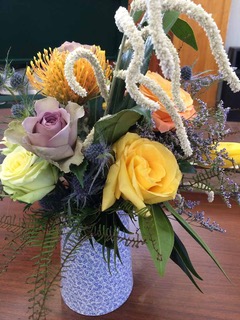
For awhile, development and logistics surrounding set-up and the opening of the stand took the majority of McGee’s focus, but she is gradually getting back into doing workshops and events, which present a great potential for the creativity that she loves.

In addition to all this, each year, she conducts a number of educational presentations for horticulture groups throughout the area. Sustainability—specifically around diminishing the effects of storm-water runoff, preventing soil erosion and combating non-permeable surfaces—is her sweet spot.

“That’s my thing,” she said, grinning. “I am very committed to this effort.”

So, amid the splendor, what are her favorite flowers?

“Tropicals,” she said, without missing a beat. “I love tropicals. They are so wonderful to work with.”

People tend to assume, she explained, that orchids and other tropical varieties are extremely delicate.

“But they aren’t really, especially if processed and handled properly,” she said. “And many of them will dry well—maybe not to their livehttps://www.dmcgeedesignstudio.com. form—but to something that is usable and just as lovely as when they were alive.”

McGee Design Studio is located in the brick building of the Broad Street Market, 1233 N. 3rd Street, Harrisburg. For more information, call 717-756-0503 or visit www.dmcgeedesignstudio.com. 

Continue Reading