Council Roundup: HBG council passes sanitation, funding measures before summer recess.

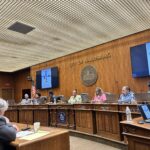
Harrisburg City Council at tonight’s legislative session.

Harrisburg City Council passed new sanitation laws and disbursed more than $2 million in federal grant funds on Tuesday night before adjourning for summer recess.

Over the course of a four-hour meeting, council made sweeping changes to laws governing trash and recycling collection violations in the city. The city’s new sanitation code establishes harsher fines and new enforcement powers, effective immediately.

Despite the lobbying of the city treasurer, council members rejected a provision that would have inaugurated annual trash billing. The city will continue to send homeowners and businesses monthly bills for trash services.

Treasurer Dan Miller said tonight that the proposed billing structure would save the city thousands of dollars in labor costs and increase its collection rate. But Councilman Westburn Majors, chair of the public works committee, said that many residents objected to the provision at public hearings.

Under the annual billing system, residents would have been billed their annual trash collection fee – more than $400 per household – at the beginning of each year. Residents could pay in one lump sum or pay monthly installments via direct deposit from their bank accounts.

Majors said that some residents were worried about the upfront costs of the annual payment or objected to sharing banking information with the city. The provision also did not subject commercial accounts to the same annual billing practice, he said.

“The goal is to treat residents and commercial property owners the same,” Majors said.

Under the new ordinance, owners of vacant properties will no longer be billed for trash services at those parcels. Council added an amendment tonight requiring all vacant property owners to apply for a vacant property exemption, which will be valid for one year pending approval from the city’s Department of Public Works.

The hallmark of the new sanitation code is a new fine and enforcement structure, aimed at curbing illegal trash disposal across the city.

Under the new ordinance, serious offenses – including illegal dumping, accumulation of trash exceeding 1,000 pounds, improper waste disposal and failure to register as a private trash hauler – are considered category 1 violations, punishable by a $1,000 fine or up to 90 days in jail.

Category 2 violations include failure to bag waste, obstruction of streets and sidewalks or interference with enforcement and will be met with fines starting at $100. Fines will increase up to $500 for each subsequent offense.

The ordinance also permits the Public Works Department to designate enforcement officers to patrol public streets for violations, and it authorizes police officers to issue citations and enforce the ordinance.

Council also voted to disburse $2 million in funds from the Community Development Block Grant, a program of the federal Department of Housing and Urban Development.

More than a dozen local nonprofits and city departments will receive grants ranging from $5,000 to $300,000.

Mayor Eric Papenfuse vetoed the allocations that council passed last week. He objected to a last-minute amendment granting $15,000 to Breaking the Chainz, an eligible organization that submitted an incomplete application.

Rather than override his veto, council tonight struck down that amendment and reverted back to the awards proposed by the city’s administration weeks ago. These are:

  • Christian Recovery Aftercare Ministries (C.R.A.M.): $40,000
  • TLC Work Based Training: $45,000
  • A Miracle 4 Sure: $50,000
  • Latino Hispanic Community Center: $25,000
  • Fair Housing Council: $25,000
  • PPL/IN HOUSE: $20,000
  • Shades of Greatness: $15,000
  • Heinz-Menaker Senior Center: $25,000
  • Neighborhood Dispute Settlement: $5,000
  • TriCounty HDC: $250,000
  • Habitat for Humanity: $100,000
  • Housing Rehabilitation Programs (city-run): $321,642

More than $600,000 of the $2 million grant will go to debt service, and $400,000 will reimburse the city for CDBG administration.

Council also approved a new, five-year labor contract with the city’s firefighters tonight, which will lock in 2-percent annual wage increases and establish a new policy to increase retention. Under the new contract, any firefighter who resigns from the city within that five-year period must reimburse the Fire Bureau $5,000 in training costs.

Lastly, council passed a resolution reestablishing Harrisburg’s Environmental Advocacy Council, a seven-member body that will be filled by appointments by council and the mayor’s office.

City council is not scheduled to meet again until Aug. 29. However, it may have to convene a special session once the city receives its Act 47 exit report from the state Department of Community and Economic Development on July 9.

Continue Reading

Wheel Good Health: Cora rolls into town & healthy living follows

Cora arrives at the PA state Capitol in Harrisburg.

“Our goal is to be where the community is.”

So said Darlene Demore, director of regulatory communications for the health insurance company, Aetna, from the back of a 38-foot RV known as Cora.

“We are Aetna Cares,” she said. “We go where the people are.”

Cora is a mobile health clinic, a joint project between Aetna and the marketing/communications firm, Latino Connection. Together, they are taking good health on the road, traveling throughout central PA and the entire commonwealth.

When first stepping into the RV, guests are greeted by a smoothie bar stocked with fresh fruit. To the right is a Wii setup for “Dance Dance Revolution,” “Guitar Hero” and other interactive games. Toward the back of the vehicle is a sitting area with four pairs of virtual reality goggles.

Outside of Cora is a bio-measuring machine. In less than a minute, the machine produces a ticket with with your height, weight, body mass index (BMI) and body fat percentage, as well as your ideal weight and BMI.

“We’re just educating people on how to take better care of their health in a fun and approachable way,” Demore said. “We want to help remove any kind of barriers that stop people from being the best that they can be.”

The name Cora stems from the word “corazon,” meaning heart in Spanish. According to George Fernandez, Latino Connection’s CEO, the name reflects Aetna’s commitment to the health of the community.

“I knew I wanted to name [the RV] something people can relate to,” he said. “This is a way for Aetna to engage not only their members but the community at large.”

The idea of Cora came from Jason Rottman, CEO of Aetna Better Health of Pennsylvania, who wanted the company to bring a healthy experience to the community. That idea grew into a smoothie bar, which grew even further to become the 38-foot vehicle people visit today.

Cora debuted in early June in Lebanon. Today, less than a month later, more than 5,000 people have visited Cora, with more than 1,000 BMIs measured.

“The BMI machine has been very successful,” Demore said. “It’s something about seeing that number on paper that motivates you.”

Fernandez recalled the time that Cora was able to engage a child with autism.

“He was having a bad day,” he said. “It was super hot outside, and he was having sort of a flare up moment where he wanted to just go home. The parents were actually leaving, and a volunteer helped them to come aboard Cora and told them about Cora’s experience.”

In just a few minutes, the child did not want to leave.

“He stayed on for about 45 minutes, a little bit longer than someone who typically comes aboard Cora,” Fernandez said smiling. “But it made his day, and it made his family’s day.”

Cora is at the “Welcome America” festival in Philadelphia until July 4. The event is estimated to bring in over 250,000 people over the course of three days.

Cora has an additional 50-plus stops scheduled until mid-December. Demore is hoping to expand Cora’s stops for another year and add new features such as dental screenings and blood pressure and glucose checks.

“If we can help one person or a million people, it doesn’t matter,” Demore said. “Even if we make one person make a change in their life, one healthy change or have one moment where they think, ‘Maybe I can do this.’ That’s golden.”

To find out where Cora will be next, visit https://aet.na/betterhealthpa

Continue Reading

Another Loss: Long-time owner gets OK to demo 2 blighted buildings in downtown Harrisburg

HARB last night gave permission to raze these two buildings in downtown Harrisburg.

Another slice of historic Harrisburg seems fated for the wrecking ball, as a long-time property owner has received permission to raze two small downtown buildings.

By a 4-1 count, the Harrisburg Architectural Review Board (HARB) last night voted to allow retired area attorney Gilbert Petrina to demolish 512 and 514 N. 2nd St., a commercial building and an apartment building, respectively, that he has owned for at least 35 years.

Petrina’s son, Gilbert Petrina Jr., attended the meeting, saying that his father, who is in his 80s, was too ill to attend.

The younger Petrina told the board that he and his father wished to tear down the buildings, following receipt of a city condemnation notice for the long-vacant properties.

“My goal is to get these down as quickly as possible,” Petrina said. “They’re a blight. They’re a hazard.”

Several board members pointed out that the properties were blighted only because they had been neglected for so long by the owner.

“I’m disappointed the properties have reached this point,” said member Jeremiah Chamberlin. “Ten years ago, they would have been restorable.”

Chamberlin, who lives nearby, pointed out that, over the years, several people had tried to buy the buildings in order to save them, but Petrina was not responsive to those overtures.

“I don’t know why my dad held onto them,” the younger Petrina said.

Indeed, the buildings are in terrible shape, with broken windows, boarded-up back ends and a distinct lean.

Attorney Jeffrey Clark, who owns the building next door, said he fears the buildings could collapse, damaging his property.

“The building is a complete blight,” he said of 512 N. 2nd St., a late 19th-century, two-story, 1,500-square-foot commercial building. “It’s a fire hazard, it’s a safety hazard, and it’s an aesthetic nightmare.”

The second property, a three-story, circa-1920 apartment building, larger at about 2,000 square feet, seems to be in slightly better condition.

Petrina said that, someday, he’d like to build a new structure on the site. Until then, he proposed using the lots for parking and said that he already had interest from the Pennsylvania AFL-CIO, which occupies the historic Gannett Fleming building on the opposite corner. He said he hoped that parking revenue would help offset the cost of the demolition.

That proposal led to pushback from both residents and the city.

Several members of the neighborhood group, Capitol Area Neighbors, were in attendance, and they objected to any proposal for another surface parking lot.

“When we get more temporary parking, people get used to it and keep it as temporary parking,” said member Kathy Speaker MacNett. “I don’t want more property to become parking.”

Assistant city Solicitor Tiffanie Baldock said the city could not allow additional commercial parking in that area anyway because doing so would violate its agreement with Park Harrisburg/SP+, which runs the parking system under a long-term lease with the city.

“From the city’s position, a temporary parking lot would not be possible,” she said.

Nonetheless, Petrina, who lives in Virginia, said he still would proceed with the demolition and reiterated that, someday, he hoped to build on the site, though he lacks a plan to do so. He said that he wanted to start demolition as quickly as possible and told his engineer, who attended the meeting, to solicit bids.

“I just need it down flat, and we can go forward from there,” he said.

Continue Reading

Take 2: HBG mayor issues CDBG veto, council to reconsider allocation

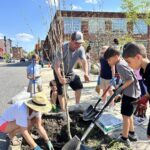
Habitat for Humanity and TriCounty HDC, which together sponsored a “building blitz” last week on Allison Hill, are proposed recipients of CDBG funds this year. Photo: Diane McNaughton.

For the second time in his administration, Harrisburg Mayor Eric Papenfuse has vetoed City Council’s allocation of federal housing grants.

Papenfuse overturned a bill disbursing $2 million in grants to more than a dozen nonprofit organizations and city programs. The source of the money was the Community and Development Block Grant (CDBG), a program from the federal Department of Housing and Urban Development.

Papenfuse today said his veto was due to council’s decision to award a $15,000 grant to Breaking the Chainz, a mentorship program that works with at-risk youth. Council granted the organization money even though it submitted an incomplete grant application.

Fifteen organizations applied for funding this year, according to Dave Madsen, chairman of council’s Community and Economic Development Committee. Last week, council passed a bill awarding grants ranging from $5,000 to $320,000 to 13 of those applicants, including Breaking the Chainz.

The city’s Department of Community and Economic Development screens and ranks grant applications according to a formal system every year. They did not recommend Breaking the Chainz for any funding. Even though the program met CDBG eligibility guidelines, its incomplete application meant that it ranked below other eligible organizations.

But council voted last week to reduce a proposed grant to TLC Work Based Training from $45,000 to $30,000, freeing up $15,000 for Breaking the Chainz.

Some council members expressed concern about veering from the ranking system, but the amended bill passed 4-3.

Papenfuse said the decision took money away from a deserving applicant and set bad precedent by breaking with the accepted grant-screening procedures.

“Their actions raise questions of fairness and transparency,” he said. “We have gone out of our way to establish an independent and trustworthy scoring process.”

Papenfuse has used his veto power once before, when he overturned CDBG allocations in 2016.

On Monday, Madsen said that both TLC and Breaking the Chainz provided valuable services in helping to keep residents out of the criminal justice system. TLC provides workplace training for formerly incarcerated people entering the workforce, while Breaking the Chainz reaches at-risk youth through mentoring, he said.

“Something we’re currently struggling with in the city is a high population that ends up in the criminal justice system,” Madsen said. “We wanted to do a full-court press in addressing the issue.”

Council is set to vote on a veto override at a legislative session tomorrow, according to a meeting agenda. But Madsen said that council members don’t plan to award any money to Breaking the Chainz anyway.

In the week since council passed its CDBG funding bill, Madsen learned that the organization may have trouble fulfilling administrative requirements tied to the federal funds.

Barring any last-minute amendments from council members, the body will likely revert back to the allocations recommended by the city Department of Community and Economic Development.

According to city Solicitor Neil Grover, council doesn’t have to override the mayor’s veto – it could simply vote to amend the bill it passed last week.

If the override vote does not pass, the entire CDBG bill dies, Grover said. Council members would have to introduce a new bill and publicly advertise it before voting to allocate funds.

Council adjourns for summer recess after its July 3 legislative session. But Madsen said that the break won’t start until council finishes its CDBG business.

“We have to get this done before we go anywhere to meet federal requirements,” he said.

Continue Reading

TheBurg Podcast: “From Boom to Gloom” Edition.

TheBurg Podcast is back after a short hiatus! The Harrisburg news cycle has kept us busy in the past few weeks, but we’re breaking down the most important developments in the city in our newest episode.

We start by discussing the city’s so-called “fiscal crisis” and then recap a chaotic school board meeting. We wrap up on a more hopeful topic – the groundbreaking of the new federal courthouse at 6th and Reily Streets, which took place earlier this week.

You can stream the episode here, or subscribe to TheBurg Podcast in the Apple or Android podcast apps.

Read more about the topics covered in this podcast at TheBurgNews.com:

Harrisburg imposes austerity measures, hopes for legislative action as it faces hard realities of Act 47.
Mayor’s communication on Act 47 “irresponsible,” HBG councilman says, as 14 jobs affected by hiring freeze.
“I’m done:” School board members threaten walk out, exchange barbs over spontaneous action on superintendent contract.
Mandate or Suggestion? State calls on Harrisburg school district to seek new financial managers
Speeches & Shovels: After years of delays, officials break ground for new federal courthouse in Harrisburg.
Burg Blog: The “Right” Stuff.
Harristown to purchase, renovate historic property that once housed iconic Harrisburg hotel, restaurant.
Facing ouster by PennDOT, newsstand owner fights for his right to stay in the Harrisburg train station.
Following public outcry, PennDOT rethinks plan that would oust train station newsstand.

TheBurg Podcast is released semi-monthly by TheBurg Magazine. It is recorded in the offices of Startup Harrisburg and produced by Lizzy Hardison. Special thanks to Paul Cooley, who wrote our theme music.

Continue Reading

Line Men (and Women): Thousands brave the heat to meet Super Bowl MVP Nick Foles

A small portion of the long line of people waiting to get into Midtown Scholar Bookstore to meet Nick Foles.

They came to Harrisburg from throughout central PA: Annville, Manheim, Perry County. Every borough and township on the West Shore seemed to be well represented.

One guy said he drove up from Washington, D.C.; another came down from upstate New York.

These passionate Philadelphia Eagles fans were here to see the Super Bowl MVP, their personal football hero, Nick Foles.

“I wouldn’t miss this, no way,” said Ben Adams, a self-described “Eagles nut” from the Mechanicsburg area. “I’ve been waiting all my life for the Eagles to win the Super Bowl.”

Foles, though, wasn’t in Harrisburg just to say “hi” to a few fans. He stopped into Midtown Scholar Bookstore to sign and sell copies of his new autobiography, “Believe It: My Journey of Success, Failure and Overcoming the Odds.” All comers had to have a ticket, a $30 brush with fame, long sold out.

Foles settled into his chair at about 2 p.m. and basically didn’t move for the next 2 ½ hours, a blur of happy faces passing before him.

Outside, people couldn’t believe the extent of the line, which ran down Verbeke Street then made a sharp right onto N. 2nd, extending as far as the eye could see. Up and down the line, a few freelance businessmen hawked chilled bottles of water from a cooler, as fans sweated copiously on the first day of an extended summer heat wave.

“Oh, it’s damn hot,” said Claudia Evans, wearing an Eagles jersey that looked better suited for a cool, damp November day. “But it’s worth it.”

On N. 3rd Street, at the exit side of the store, folks tightly gripped their freshly signed copies of “Believe It.” One man mentioned that he was disappointed that Foles wouldn’t sign his jersey, while a young woman commented on the surreal, fleeting moment of meeting her favorite football player.

“It all happened so fast,” said Megan Burillo. “You walked in, and he was there, and then you were gone.”

For a post-signing reward, some fans trickled across the street to the Broad Street Market, where Adam Brackbill, owner of Urban Churn ice cream, seemed a bit overwhelmed by the sudden demand for his frozen treats.

“I’m selling out pretty fast,” said Brackbill, as he scooped up dish after dish. “If I had known about this, I would have prepared.”

Back outside, Bill Akers and a few pals had a long walk back to a downtown parking garage. Asked if he planned to read the book, Akers, who had trucked in from the Philadelphia suburbs, seemed non-committal.

“I can’t say I’m much of a reader,” he said. “I really just wanted to meet the guy. And now we’ll go out and have some fun.”

Pictured above: Nick Foles signs books inside Midtown Scholar Bookstore.

Continue Reading

Taste of Freedom: Harrisburg sets riverfront food truck fest, fireworks for July 4

Last year’s “Taste of Independence” Food Truck Festival brought in 35,000 attendees to Harrisburg’s riverfront.

Even with the forthcoming heatwave, Mayor Eric Papenfuse predicts the festival will pull in even more guests.

“I am excited and very hopeful that we are going to break that 35,000-people record from last year,” Papenfuse said. “It will be an extraordinary day and an extraordinary event.”

Next week’s festival on July 4 will feature more than 40 food trucks including Soul Burrito, The Potato Coop, Brazil on Wheels, Mad Sandwiches and more.

New this year is a “foodies map and guide,” which lists all food vendors and their items as well as a map outlining where the trucks will be located.

“[The guide] allows you, from the comfort of your own home, to plan how you are going to attack this festival,” Papenfuse said.

For music lovers, Maudlin Moon, Strangest Hearts, D-BO, Nearly York, Alex Allegra and Keith Goldstein will perform on the Market Street Stage and on the acoustic music stage in Kunkel Plaza

The Children’s Festival will include glitter tattoos, caricatures, lawn games and activities. Superheros and princesses will meet and pose for pictures, and children can create their own hero masks for $5.

Also new to the festival is an outdoor film screening presented by Midtown Cinema. Following the fireworks, there will be a showing of “Moana” between Market and Walnut streets. The wayfinding princess will pose for pictures during the screening, as well.

“I’m really excited this year about the children’s festival activities,” Papenfuse said. “There will be lawn games and activities and all sorts of things for children.”

The fireworks produced by ZY Pyrotechnics will begin around 9:15 p.m. and feature a 15-minute show of over 1,000 shells launched from City Island.

Street parking on July 4 will be free. For $5, guests can park at City Island, and there will be $10 parking in the Market Square Garage from 10 a.m. to 10 p.m. Cyclists can drop their bikes off at Recycle Bicycle, which will then check bike brakes and air pressure while attendees roam the festival.

“As you can see it’s going to be an incredible day this July 4,” Papenfuse said. “I’m hoping everyone will come and join us at the Riverfront this Wednesday and, even after, stick around for that movie under the stars. It’s going to be a wonderful day celebrating the Taste of Independence Food Truck Festival.”

The Taste of Independence Food Truck Festival is July 4, 3 to 9 p.m. at Harrisburg’s Riverfront Park between North and Market streets. For more information of the festival and to get your foodies guide, visit harrisburgpa.gov/july4th.

Continue Reading

Music on the Mountain: Tuning up for the Susquehanna Folk Festival.

Rory Block

Shane Speal was rushing to fix a broken string on his cigar box guitar in between sets at a recent concert when I sat down with him to get the lowdown on the upcoming Susquehanna Folk Festival.

“I can’t believe we’re going to be part of that fest,” said the York-based blues singer. “The more I look at the lineup, the more I wish I could clone myself so I can attend every show and workshop.”

He laughed at the thought as he wound a guitar string around an instrument cobbled from a cigar box and broomstick.

Speal is known as the “King of the Cigar Box Guitar” and fronts the jug band, Shane Speal & the Snakes. He has also become the unofficial spokesman for the Susquehanna Folk Fest, a two-day event in late July at Roundtop Mountain Resort, featuring dozens of musical acts and workshops.

Q: You’ve played a lot of festivals around here. What’s so different about the Susquehanna Folk Fest?

Speal: I’ve never seen one with so much diversity. I’ll be honest, when I think of folk music, my mind goes to Bob Dylan, Woody Guthrie—you know, somebody strumming a guitar and singing revolution. However, these organizers, the Susquehanna Folk Music Society people, are hardcore fans of all kinds of folk music. They’ve booked blues icons, Celtic legends, African dancers and everything in between.


Q: Which blues icons?

Speal: David Bromberg and Rory Block will be there. I’ve done shows with Rory before, and she’s the real deal. She learned to play slide guitar at the feet of Son House, the guy who taught Robert Johnson how to play. And Bromberg is a fingerpicking monster who learned from Rev. Gary Davis.


Q: Bromberg also had some hits in the ‘70s.

Speal: Yeah, and played with everyone from George Harrison, Bob Dylan to a host of others. He’s an absolute legend. There’s going to be a Q&A workshop with him before his Sunday evening set that I’ll be attending.

Q: Is that part of the workshops you mentioned?

Speal: Yes, and Rory Block is giving a slide guitar workshop before her Saturday evening set. Unfortunately for me, I’ll be performing with my band on another stage at that time. I should see if they can move my stage time so I can learn to play like her [laughs].


Q:
What are your personal picks for this fest?

Speal: Oh wow, let me see. There’s going to be an emerging artist competition on Saturday. I’ve played shows with many of the acts in there such as The Wild Hymns and Indian Summer Jars. All top notch. Don’t miss Olds & the Absolution in that one. Olds Sleeper is one of my favorite songwriters out there. He writes like John Prine and plays a mean guitar.

There’s going to be a jug band workshop by Slim Harrison and the Sunnyland Band on Saturday. I think that one’s for kids, but I’ll probably attend it anyway because I play in a jug band and maybe I can steal some ideas.

Q: So, there are things for kids to do?

Speal: Yeah, they thought of everything with this fest. Kids stuff, concerts, crafts. It’s like a two-day cultural explosion [laughs].

Q: What other shows will you go to?

Speal: The Quebe Sisters will be there both days, so I’ll probably catch at least one of their shows. They do that classic country swing music where they sing rich harmonies around one microphone. They’re fantastic fiddlers, too. I’m a big Hank Williams, Sr., fan, and they’re version of “Cold Cold Heart” gives me chills.

Q: Country swing at a folk festival?

Speal: And swing dance lessons, too! They’re bringing in a dance instructor from Victrola Swing Dance Club in York to teach people how to swing dance.


Q:
Will you be dancing?

Speal: Oh, god, no. I once took swing dance lessons, but I failed miserably. You don’t want to see Shane Speal dance. Trust me.

Hold on. Let me look at the schedule on my phone because I know I’m missing a bunch of acts. There’s so much good acoustic music here. The Irish band, Trian features Daithi Sproule on guitar. He was one of the original innovators of Celtic DADGAD guitar. I think he’s doing a workshop, too. David Holt and Josh Goforth are an incredible duo that do a lot with old-time instruments and even hambone knee-slapping.


Q:
Any other recommendations?

Speal: There’s so much. There’s a few jam sessions happening throughout the weekend, so I’ll probably stick my head in there for at least one. There’s gonna be bluegrass, blues and other styles, but I’d like to sit in with the Irish session because I love that music and never get to play it.


Q:
People can bring their own guitars and instruments?

Speal: Hell, they’re encouraged to bring them. The Ski Roundtop people will have a secure instrument check-in area, too. That way, you can walk around without lugging your guitar the entire time. Quite honestly, some of the greatest magic will probably happen on the hillside as musicians start their own jam sessions.

Q: What about your concert at the festival? What can we expect?

Speal: Just imagine Motorhead as a jug band [laughs]. Expect our wild show of cigar box guitars, washtub bass, homemade drums and more, but we’re also pulling out some of our storytelling folky stuff.


The Susquehanna Folk Festival will be held July 28 to 29 at Roundtop Mountain Resort, Lewisberry. For tickets and information visit
www.susquehannafolkfestival.org.


Continue Reading

Beer Frontier: On Allison Hill, three men are on track to open PA’s first black-owned craft brewery.

Burg in Focus: Harris Family Brewery from GK Visual on Vimeo.

Shaun Harris was watching TV in his Harrisburg home when he caught an episode of “Moonshiners,” a show about illegal whiskey production in the Appalachian Mountains. As he witnessed scofflaws in rural Virginia distill liquor from giant drums of hog feed, Harris thought to himself, “You can do that?”

As it turns out, you can’t. A quick Google search told Harris that brewing liquor in America is illegal without a license. Brewing beer, on the other hand, is fair game. Harris promptly bought a simple home-brewing kit, made his first batch of beer and “was immediately blown away.”

Harris roped his friends JT Thomas and Tim White into joining him for a daylong home-brew session. They brought one of their first kegs to a summer barbeque, where they offered it to a dozen friends with a disclaimer—they didn’t know how it would taste.

“Six gallons were gone in like, 20 minutes,” said Thomas. “People had one and wanted another and another and another.”

Harris describes that barbeque as a light-bulb moment. He didn’t know yet what craft beer was, but he did know that the ingredients and production that went into his keg didn’t cost much.

“Where we’re from, you try to monetize everything—it’s called being a hustler,” Harris said. “We thought, we can do something here.”

That was four years ago. Since then, Harris, White and Thomas started making beer as the Harris Family Brewery, and they just secured a location for a taproom on 13th and Market Streets, in South Allison Hill. They still need to obtain a brewer’s license and retrofit the empty space with brewing equipment and seating, but they’re hoping to sell the first beers over their 10-seat bar in early 2019.

When it opens, Harris Family Brewery will be the first craft brewery in Allison Hill and likely the first black-owned brewery in Pennsylvania. Harris hopes that the business will inject new life into its neighborhood and broaden Harrisburg’s craft beer scene beyond its downtown and Midtown epicenter.

Shaun Harris, Tim White and JT Thomas.


Untapped Potential

The guys at Harris Family Brewing don’t just see their new business venture as a way to do what they love—it’s also an opportunity to bring a new base of consumers into a lucrative market.

Craft beer sales in the United States topped $26 billion last year and account for 13 percent of the country’s total beer industry. But African Americans, who make up 14 percent of the country’s total population, only consumed 4 percent of its craft beer in 2014, according to a Nielsen study.

Mike Potter is the editor of Black Brew Culture, a Pittsburgh-based online magazine dedicated to advancing African Americans in the craft beer industry. Potter said that people of color haven’t traditionally been exposed to craft beer, in part because the industry hasn’t invested in marketing to minority customers.

Craft beer consumption among blacks is on the rise, but Potter said that fewer people of color enter the industry as brewers and brewery owners.

“We’re getting to a point where there are more and more of people of color in craft beer, but they’re not getting the same amount of exposure due to lack of resources,” Potter said. “We’re playing a bit of catch up.”

Since national brewer associations don’t track the demographics of brewery owners, Black Brew Culture keeps its own tally. Potter estimates that people of color own roughly 50 of the country’s 2,800 craft breweries, and he’s certain that Harris Family Brewery will be the first in Pennsylvania.

Harris says he’s used to being one of the only black people at craft beer tastings and breweries. To him, that’s not a problem so much as a sign of untapped potential. Shortly after they brewed their first successful batch of beer, White pointed out to Harris that they would have a niche market for their product.

“I thought, ‘You’re telling me that we have a whole market that doesn’t know there’s a product out there that is this big?’” Harris said. “I say, ‘Let’s open that market up.’”

To that end, their brewery location will be key. Though the brewers initially had their eyes set on property in Steelton, serendipity led them to their spot above a laundromat at 13th and Market. It’s snug, but Harris said they hope to open “a nano-brewery in the truest sense,” meaning that all of the small-batch beer they produce will be sold on site. The space is just big enough to accommodate their current home-brew set up and a 10-seat bar. They don’t plan to serve any food, but do anticipate a busy carryout business once they start selling bottles and cans.

Harris Family Brewing will start small, but its proprietors are already charting plans for growth. They’ll start with an off-site canning facility once the taproom on Market Street takes off. They then hope to distribute their beer across the state and grow their presence through festivals and industry expos. They’ve already sampled their beers during Harrisburg Beer Week and also held a pop-up tasting in Strawberry Square with local event organizer and promoter Sara Bozich.

They’ll also bring kegs to Steelton Community Day on July 23 and will hit the road for the Aug. 11 FreshFest, a black brewing festival in Pittsburgh hosted by Black Brew Culture.

Strangest Industry
If you already own a brewery in Harrisburg, it could be easy to see a new one as competition. But that’s not the case for Brandalynn Armstrong, co-owner of Zeroday Brewing Co. on Reily Street. Armstrong, who’s also on the board of the PA Brewers Association, thinks that expanding the craft beer market into a new neighborhood can only help Harrisburg’s existing breweries.

“Bridging neighborhoods is incredibly important, as long as it’s done through responsible development,” Armstrong said. “And what better way than using craft beer to link our neighborhoods together?”

She and Harris also think that each individual brewery in the city benefits from customers having more options. Harris hopes that Harris Family Brewery will introduce many of its customers to craft beer, encouraging them to “expand their palates” and try other beers in the city.

Harris, who works full-time in corporate IT when he’s not brewing beer, called craft beer “the strangest industry you ever saw—it’s more like kids on a playground than corporate America.”

He’s been shocked by his company’s warm welcome into the local brewers’ network, which he described as more collaborative than cutthroat. Harris Family and Zeroday recently held a joint brew day to develop a collaboration beer, which they’ll debut on July 3 during a screening of “Poured in PA,” a documentary about the statewide craft beer industry.

Harris, White and Thompson learned to brew by watching YouTube videos and have honed their craft through trial and error. They developed some of their favorite recipes through pure experimentation, like when they made a Christmas stout (which they dubbed “Black Santa”) by fermenting the ingredients for fruitcake—currants, raisins, sour cherries and ginger spice.

Now that they’ve secured seed funding for their site and begun renovations, the trio is focused on perfecting their recipes and setting a menu for the taproom. Since they’re playing the long game, they’re already thinking about potential businesses that they could spawn by bringing craft beer to a new neighborhood and customer base.

“In five or six years, I want to look back and say, ‘We blew the scene up,’” Harris said.

Potter agreed that Harris Family could inspire other people of color to pursue careers in brewing or brewery ownership.

“I think it’ll be a huge blueprint for brewers across the country trying to get into the game,” Potter said. “Being the first is a big deal.”

For more information Harris Family Brewery, visit www.harrisfamilybrewery.info or the Facebook page.

Continue Reading

A Loss, a Purpose: Hershey woman advocates for greater newborn screening laws.

Lesa and Brennan Brackbill with Tori. Image by Katie Bingaman Photography

Lesa and Brennan Brackbill of Hershey have endured something no parents should—the death of a child.

Their daughter Victoria (“Tori”), born in July 2014, passed away on Easter Sunday 2016, 14 months after being diagnosed with a severe neurological condition called Krabbe (“crab-ay”) disease. Even though Tori’s time on earth was short—fewer than two years—her mother Lesa is determined to create a lasting legacy by advocating for changes to Pennsylvania’s newborn screening laws that could have prevented Tori’s death.


Even So, Joy

One in every 100,000 people is diagnosed with Krabbe. One in 125 people carry a gene mutation for Krabbe. Carriers only pass the disease to children when both parents carry the mutation.

Unbeknownst to Lesa and Brennan until Tori’s diagnosis at Hershey Medical Center, they are both carriers. According to the NIH, if Krabbe is caught at birth through newborn screening tests, it can be treated. If the disease is allowed to progress, children rarely survive past the age of 2. These statistics roll off Lesa’s tongue easily. She says that, before this experience, she had no medical knowledge, nor did she consider herself a writer.

“Unfortunately, we aren’t going to be the only ones to ever lose a child, or lose a child to Krabbe,” she said. “So, we felt like we owed it to people to write about how to survive the worst loss.”

Her book, “Even So, Joy,” was published earlier this year and chronicles her family’s experience with Krabbe.

“The first months after diagnosis, we were in a daze, and we grieved the most as we struggled with what the diagnosis meant,” she said. “But then we came to the decision that we weren’t going to cry every day and make her life miserable. We were going to choose to be joyful and make her life as full of joy as possible. That’s where the title comes from.”

Lesa cites the legacy of Milton S. Hershey as one of her greatest sources of inspiration. Her husband, Brennan, is employed by Hershey, and she has worked at The Hershey Story. The couple serves as relief house parents for the Milton Hershey School.

“When we first learned about the school and why it was created, we learned that Mr. and Mrs. Hershey couldn’t have children of their own and, instead of wallowing in that, they used it to start a school,” Lesa said. “Sometimes, you’re put into a situation to act for the greater good. It’s inspiration for us to further Tori’s legacy by making a difference.”

She is donating a portion of the book proceeds to Hunter’s Hope, a foundation established by NFL Hall of Famer Jim Kelly and his wife Jill, whose son Hunter also had Krabbe. The foundation is dedicated to awareness of the disease, support for families like the Brackbills, research and advocacy. According to Hunter’s Hope, only five states currently screen all newborn babies for Krabbe.


Like a Victory

Currently, Pennsylvania hospitals are mandated to screen for nine dried blood spot conditions—tested by a simple heel prick—all paid by state funding. However, the technology exists to test for additional diseases. So, some Pennsylvania hospitals test for as many as 32 conditions with hospitals or insurance absorbing the additional cost.

“Hershey is the only hospital that screens for Krabbe in the state,” Lesa said. “In Pennsylvania, if you have one of these diseases, your zip code literally determines life or death. The inconsistency is mind-blowing. My goal has been to change this. The average [number of diseases on newborn screening panels] is usually in the 40s for other states.”

Rep. Angel Cruz (D-Philadelphia), Democratic chair of the House Human Services Committee, has become a champion for newborn screening laws. He introduced Act 148, named “Hannah’s Law,” for a Philadelphia-area girl diagnosed with Krabbe in 2013. Hannah’s Law, signed by Gov. Tom Corbett in 2014, called for the expansion of the state’s mandatory newborn screening list, including Krabbe.

However, according to Cruz’s staffers, the legislation has yet to be enacted due to two key issues. First, it mistakenly bypassed the Newborn Screening and Follow-Up Technical Advisory Board (TAB), mainly comprised of state medical experts who provide guidance and recommendations to the state Department of Health. And, secondly, implementation requires a funding source.

“What really needs to happen is creation of a dedicated funding source that would not need to be part of the budget process that would fund the program every year,” said Rachel Romanofsky, research analyst for the Human Services Committee.

House Bill 1081, introduced by Cruz in April 2017, would impose a fee on “birthing facilities,” paid to the state for every baby’s screening tests, including those identified under Hannah’s Law, as well as future tests recommended by the TAB. Romanofsky says 47 states already have such a fee system in place.

At the latest TAB meeting, held in Harrisburg in May, some of the state’s brightest medical minds discussed funding and advocacy. That’s because Department of Health officials say the program needs $6 to 7 million to launch.

“The [newborn screening] program is in a difficult position,” said Chairman Jerry Vockley, a physician at Children’s Hospital of Pittsburgh. “There are things we are mandated to do but cannot [due to lack of funding].”

Despite the continued delays, Lesa is positive.

“Today was encouraging because it’s no longer a matter of whether or not the advisory board feels that screening for Krabbe has merit, but rather a matter of how to pay for it and for any other diseases that may come along in the future,” she said. “That validates our fight and feels like a victory.”

While the fate of newborn screening in Pennsylvania remains cloudy, the Brackbill family recently announced happy news. Lesa gave birth to twin baby boys on April 24—and they are both Krabbe-free and healthy.

To learn more, visit www.HuntersHope.org. Lesa Brackbill’s book “Even So, Joy” is available through Amazon.

Continue Reading