Trash Talk: City treasurer asks council to consider annual billing for waste collection

Harrisburg Treasurer Dan Miller talked trash billing at tonight’s City Council meeting.

Unpaid trash fees are costing Harrisburg an average of $200,000 a month – a problem that city Treasurer Dan Miller thinks can be fixed by billing residents once a year for disposal services.

Miller proposed an annual trash billing structure earlier this year as part of an overhaul of Harrisburg’s sanitation laws. But City Council nixed the measure, saying it would stress the cash flow of low-income and fixed-income residents.

The city currently bills residents $32 a month for trash collection. It also has a monopoly on commercial accounts in the city.

Miller appeared before council on Tuesday night to renew the case for annual billing. He’s proposing that Harrisburg include a line item for trash fees on every property’s annual real estate tax bill, which is mailed out in January. The trash collection fee would be subject to the same 2 percent, 60-day discount period as the real estate tax.

The city currently has a 98-percent collection rate on its real estate taxes. Miller hopes that trash fee collections would increase by streamlining the two bills into one. It would also save an estimated $100,000 a year in mailing costs.

Collecting up-front payments is key, Miller said, since the treasurer’s office doesn’t have many means to pursue delinquent accounts.

According to Miller, Harrisburg lost enforcement authority over delinquent trash bills when it restructured under the Harrisburg Strong Plan, the financial recovery plan it adopted in 2013.

Before the Strong Plan, Harrisburg had an in-house collections arm in its Operations Revenue Department (ORD). When the department could not collect bills from delinquent accounts, it could turn off the water at those properties to spur a payment.

But the Strong Plan dissolved the ORD and transferred Harrisburg’s water assets to Capital Region Water. As a result, the city lost the ability to terminate water services at delinquent properties.

“People discovered that, if they didn’t pay their bill, their trash was still collected and nothing else happened,” Miller said. “Maybe their bill went up [from interest], but nobody was doing anything about it.”

Today, the city treasurer’s office doesn’t have the enforcement “teeth” it needs to collect delinquent payments, Miller said. He believes that a new billing structure will mitigate the monthly bleed of unpaid bills.

“We just want council to give us the tools to do our job in an effective and efficient manner,” Miller said. “From my perspective, there is very little drawback to this.”

In all, Miller’s office calculated that the city has lost out on $12 million over a multi-year period. Miller isn’t confident that the city will see any of that money, which, he said, is why it’s important to move to a new billing system sooner rather than later.

If low-income residents have a hard time making an annual payment, Miller said, council could develop a program to waive or reduce fees for eligible residents.

Miller is also proposing that residents be allowed to opt in to monthly auto-payments. He stressed that, while billing practices may change, the cost of trash services in Harrisburg would not.

Council members seemed amenable to that proposal tonight. Miller was hopeful that they could implement a change to take effect in 2019, but Mayor Eric Papenfuse said that’s unlikely.

“We’re probably looking at 2020 at this point,” he said.

Councilman Westburn Majors, who chairs the Public Works Committee and spearheaded the sanitation ordinance overhaul earlier this year, said he would be open to talking about Miller’s proposal more as the city moves into its 2019 budget cycle.

Continue Reading

City Council to consider home rule ordinance as Act 47 deadline nears.

Is Harrisburg on its way to home rule?

Tomorrow night, City Council will consider an ordinance to initiate home rule proceedings, kicking off what could be a years-long process to write a new charter for the city.

The ordinance will be read into the record for the first time at council’s Sept. 11 legislative session. From there, it will likely go into administrative committee.

If it passes, Harrisburg residents will be asked to vote on whether or not the city should form a Government Study Commission – an elected body of citizens that will study forms of local government and decide whether or not a home rule charter is advisable for the city.

The members of the commission would also draft Harrisburg’s home rule charter and put it up for another referendum vote.

In Pennsylvania, a municipality may pursue home rule to gain autonomy from the state charter, which prescribes tax rates and government structures for cities, boroughs and townships. A home rule municipality can convene its own government structure or authorize tax limits beyond what is allowed under state code.

Mayor Eric Papenfuse told TheBurg in July that he wanted to explore home rule as a way to ease Harrisburg’s exit from Act 47, a state oversight program for financially distressed municipalities.

A home rule charter would allow Harrisburg to keep its earned income tax (EIT) at its current 2 percent rate. The state tax code only allows Harrisburg to assess a 1 percent EIT, but Act 47 law allowed City Council to double the rate in 2012.

But home rule charters must be passed by the municipality’s residents in a referendum vote, and Papenfuse isn’t optimistic that it would get enough support in Harrisburg.

“It’s not a foregone conclusion that it would be successful,” Papenfuse said on Monday. “Home rule is something I’ve supported for Harrisburg for a long time, though I know it would be very difficult to achieve.”

Papenfuse still hopes that the city will be allowed to exit Act 47 this year, pending the passage of a bill by the PA General Assembly. That bill would allow Harrisburg to keep its current EIT and local services tax (LST) indefinitely.

The taxes generate a combined $12 million in annual revenue for Harrisburg. Both would revert to their pre-Act 47 levels if the city exited the program under the current state tax code.

That prospect has forced city officials in recent months to devise strategies to avoid a gigantic revenue loss and budget cuts when the city is forced to leave Act 47 in 2021. The city has been lobbying the state legislature for special taxing privileges since January, when it retained the services of local lobbying firm Maverick Strategies.

A measure to preserve Harrisburg’s taxing power blew up in June, after House Speaker Mike Turzai prevented the measure from coming up for a vote.

If the legislature fails to act on Harrisburg’s behalf again this fall, the city will adopt a three-year Act 47 exit plan.

The details of that plan are still subject to revision by the state Department of Community and Economic Development, but the latest draft calls for substantial property tax increases in 2021 to offset EIT and LST reductions.

Papenfuse hasn’t given up on the possibility of passing a heftier commuter tax as part of the city’s Act 47 exit plan. He and his counterparts on City Council have repeatedly said they will oppose a plan that increases taxes on Harrisburg residents.

The mayor expects that home rule proceedings could take at least three years, giving the city “just barely enough time” to complete it before exiting Act 47. But even if the city does pass its own unique charter, it would still have to find new sources of revenue.

A home rule charter would not allow Harrisburg to keep its current LST rate, since such charters only apply to residents of the home rule municipalities. The LST is paid by every employee in the city of Harrisburg, including commuters.

That tax brings in $6 million a year, according to Harrisburg finance director Bruce Weber. About $4 million goes to the city and the remainder to the Harrisburg School District.

There are currently 71 home rule municipalities in Pennsylvania, the closest being Carlisle in Cumberland County. Harrisburg would be the first home rule municipality in Dauphin County if its charter passes.

Have questions about Harrisburg’s Act 47 status? Check out TheBurg’s guide to Act 47.

Continue Reading

Salvation Army breaks ground on new $12 million regional headquarters

Local officials and local children grabbed shovels to officially break ground on the Salvation Army’s new regional headquarters.

After a 10-year planning period and a $12 million fundraising drive, the Salvation Army of Harrisburg broke ground Monday on a new regional headquarters, joined by 150 community members, a brass band and elected officials from the local to the federal level.

The 39,000-square-foot facility will house the Salvation Army’s education and human services programs, which reach more than 18,000 adults and children in Dauphin, Perry and Cumberland counties.

“After 132 years of service in Harrisburg, the Salvation Army is writing a new chapter in its book of doing the most good,” said Richard Jordan II, director of the project’s capital campaign. “This project will have an unprecedented, life-changing impact on the community.”

Jordan was one of a dozen stakeholders who spoke at the groundbreaking ceremony on a rainy morning, held under a tent at the construction site on 506 S. 29th St.

The Salvation Army of Harrisburg has maintained a headquarters at 1122 Green St. in Midtown Harrisburg since 1954. Officials began toying with the idea of an expansion 10 years ago, as demand for their services grew, according to Harrisburg corps officer John Griner.

They paid $1.25 million for the seven-acre site, situated at the corner of Rudy Road and S. 29th Street near Kline Village. They razed two dilapidated buildings to make room for new construction.

A three-year fundraising campaign followed, during which time more than 100 donors contributed to the $12 million project.

The bulk of the project’s funding came from a $10 million New Market Tax Credit awarded through the nonprofit lender Community First Fund. The Salvation Army is also eligible for up to $500,000 in construction reimbursements through a state-funded Redevelopment Assistance Capital Program (RACP) grant.

The nonprofit Impact Harrisburg granted the project $500,000 in 2016, and Dauphin County contributed a $100,000 gaming grant this year.

Construction plans call for a full-service kitchen, gymnasium, playgrounds and classroom and meeting space. The facility will also house staff offices and a worship center.

Building will continue for 10 to 12 months, and the Salvation Army staff hopes to move out of its Green Street headquarters by September 2019, said Kathy Anderson-Martin, director of resource development at The Salvation Army.

The new headquarters will be command central for all of the Salvation Army’s family services programs, adult self-sufficiency and spiritual ministries. It will also house educational programs for children, including after-school and summer camps and two pre-K classrooms.

More than 2,800 of the Salvation Army’s 18,000 clients are children, according to advisory board chair Jeffrey Piccola.

Mayor Eric Papenfuse, who also spoke at this morning’s ceremony, said that the city is committed to working with the Salvation Army to find an “adaptive reuse” for its current Midtown space. The main building is listed for sale at $560,000.

Papenfuse thanked the Salvation Army for keeping its headquarters in the city and for repurposing a blighted stretch of 29th Street in the process.

“Among this sea of blighted and abandoned buildings, you saw something that will completely transform one of our neighborhoods,” Papenfuse said. “We’re extremely excited that you’re going to be part of the activity that we’re seeing in each and every corner of this city.”

Continue Reading

Park Work: Sewer project shuts down stretch of Riverfront Park

Sewer work has closed a portion of Riverfront Park in Uptown Harrisburg to visitors.

A large swath of Riverfront Park in Uptown Harrisburg will be closed until the end of October for a major sewer project, Capital Region Water announced today.

Andrew Bliss, community outreach manager, said that CRW has closed a five-block stretch of the park between Shamokin and Emerald streets to rehabilitate the Front Street sewer interceptor in that area.

Park users will be detoured to the sidewalk across Front Street, Bliss said. He said that “Road Work Ahead” signage has been posted on Front and Division streets to warn users.

This project will install 2,000 feet of new pipe liner, called “cured-in-place” pipe, to rehabilitate the 30-inch diameter clay sewer pipe, according to CRW. Aboveground pipes will be placed along the park in the project area to bypass flows during the cured-in-place pipe installation.

The 105-year-old Front Street sewer interceptor carries an average of 2 million gallons of wastewater every day from Harrisburg and Susquehanna Township, said CRW.

“Capital Region Water is committed to protecting public safety and the environment by properly maintaining our wastewater collection system,” said CRW board Chairman Marc Kurowski. “We appreciate everyone’s patience during construction while we address critical and aging infrastructure.”

Continue Reading

State grant earmarked for HMAC could be jeopardized by bankruptcy filing, CREDC president says.

HMAC’s owners hoped to use RACP grant funds to expand the property’s Capitol Ballroom. The lengthy process of applying for construction reimbursement funds could be complicated by the business’s recent Chapter 11 bankruptcy filing.

The news that the House of Music, Arts and Culture (HMAC) recently filed for Chapter 11 bankruptcy came as a surprise to some members of the Harrisburg community, especially since the business was awarded a $1 million public grant less than a year ago.

But the grant’s sponsor says that HMAC hasn’t seen a dime of the money — and now that its owners have filed for Chapter 11 bankruptcy and putting it up for sale, it’s possible it never will.

David Black, president and CEO of the Harrisburg Regional Chamber and CREDC, said that HMAC hasn’t drawn any money from the $1 million Redevelopment Assistance Capital Program (RACP) grant it was awarded in December. HMAC’s owners must complete projects first and then submit a detailed reimbursement application to claim funds.

“No money has been delivered,” Black told TheBurg. “CREDC has been working with [HMAC] to prepare details for submission, but things have been on hold of late.”

CREDC is the designated recipient of grant funds as an accredited chamber of commerce. It also helped HMAC prepare the initial grant application for a nominal service fee, Black said.

RACP grants, which are intended to improve infrastructure and create jobs in redeveloping communities, aren’t cash awards. They’re “eligible reimbursement” grants, meaning that a recipient must first invest money in a project and prove compliance with grant guidelines to get repaid.

RACP reimbursements can only be applied to building and infrastructure improvements. They can’t be used to cover wages, programs, or business supplies and services.

An RACP award is also contingent on the project matching the grant funds twofold. For every dollar of the $1 million grant HMAC received, Black said, its owners must invest $2 in infrastructure improvements that raise the value of their building.

The significant up-front investment costs and complex documentation process make RACP grants anything but fast money, Black said.

“RACP is one of the most complex grant processes in state government,” Black said. “Sometimes it can take three to five years to get full reimbursement. It’s not a process for the faint of heart.”

“Uncharted Territory”

HMAC’s owners weren’t considering a sale or Chapter 11 filing when they applied for the competitive grant program, HMAC managing partner John Traynor said.

Bartlett, Traynor & London LLC, the company that owns HMAC, filed for Chapter 11 bankruptcy in the U.S. Middle District Court of Pennsylvania on Aug. 23, one month after a social media storm reportedly cut into the business’s revenues.

According to Black, the bankruptcy and anticipated sale could complicate the process for receiving RACP funds.

Black said that many RACP recipients apply for bridge loans to make infrastructure improvements that they can later claim for reimbursement. A business under Chapter 11 may have a hard time securing private financing, he said.

He also isn’t sure that the $1 million set aside for HMAC would stay with the project if it changes hands.

“It’s uncharted territory,” Black said. “It will be interesting to see if [HMAC] can meet the requirements of the [next] application.”

If HMAC can’t complete the next phase of its application by the end of 2018, it could become ineligible to receive any RACP funds. The $1 million earmarked for the project would go back into the pot of grant money, Black said.

In that event, Black said that CREDC would lobby the state Office of the Budget, which administers the RACP program, to award the same amount to another project in Harrisburg.

Traynor acknowledged that the bankruptcy filing complicates the grant process, but said that HMAC’s owners continue to forge ahead. Their next step, he said, is to submit a schedule of construction projects and funding sources.

HMAC’s owners hope to expand the Capitol Ballroom and renovate the property’s basement to accommodate a music school.

Traynor noted that HMAC can exit Chapter 11 voluntarily, at any time. If their restructuring goes smoothly and they exit before the end of the year, they may have an easier time financing projects, he said.

He also hopes that HMAC’s new owner would continue the RACP grant process if they’re deemed eligible.

RACP was the first public grant HMAC’s owners pursued, Traynor said. The project did receive a $100,000 loan from Harrisburg’s now-defunct revolving loan fund, but Traynor says it was paid back with interest.

Barlett, Traynor and London LLC, the company that owns HMAC, has already sunk some $5 million into the project, including $2 million in personal cash, Traynor said. Most of that money went to rehabilitating HMAC’s once-derelict structure at 1110 N. 3rd Street.

The 34,000-square-foot building once housed Harrisburg’s first Jewish Community Center before becoming the Harrisburg Police Athletic League in the 1970s. It sat vacant for years before Traynor and his partners bought it from the Harrisburg Redevelopment Authority in 2007.

The $187,000 purchase price reflected the renovations that HRA made to the building under former-Mayor Stephen Reed, Traynor said. HMAC’s owners weathered the Great Recession of 2008 and opened their first bar and performance venue, Stage on Herr, in 2009.

The property went to sheriff sale five times in the next four years, Traynor said.

“I’ve always said this project has been a difficult one, and I’ve never said it didn’t have financial issues,” Traynor said. “But we overcame a lot of those.”

He said that the cost of renovating the historic property wildly exceeded anything he and his partners predicted. He cited construction costs as the single greatest stressor on HMAC’s finances.

At times, cost overruns ate into the business’s cash flow, Traynor said. He admits that HMAC had a hard time balancing books some months.

“Were checks returned? Absolutely, but there’s no shame in that and no intent to defraud anyone,” Traynor said. “It’s just part of business when you’re trying to keep the doors open, keep people employed, and bring great music to the city.”

Based on the documents that Bartlett, Traynor and London have provided in their bankruptcy filing, it’s hard to get a full picture of the business’s financial condition.

“Right now, there’s not much you can glean from the filing at all,” said Juliet Moringiello, an associate dean and bankruptcy law expert at Widener University Law School.

She said that more details will emerge when HMAC provides a full schedule of assets and financial affairs statement on Sept. 27 – the same day that HMAC’s partners will convene a meeting with more than three dozen creditors.

The filings do show that the business has $770,000 in unsecured liabilities. It also has a $2.6 million mortgage on its 3rd Street property, Traynor said.

Its property and merchandise assets total more than $5 million. A four-month budget that HMAC submitted with the filings shows that the business expects to turn a profit through the end of 2018.

Continue Reading

Following online outrage and revenue hit, HMAC files chapter 11 bankruptcy as a prelude to sale

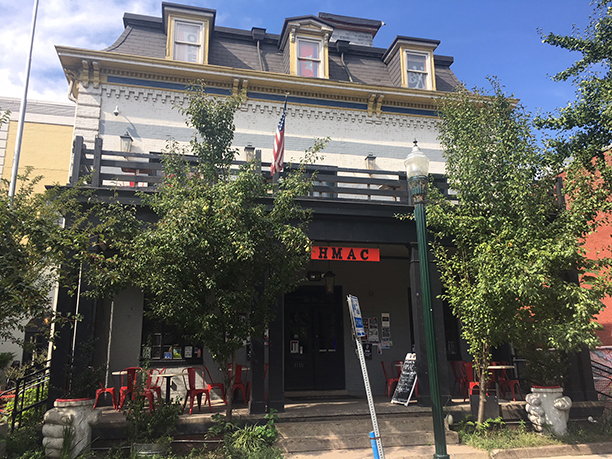
The House of Music, Arts & Culture in Midtown Harrisburg

One month after a sexual assault allegation engulfed the House of Music, Arts & Culture (HMAC) in a social media maelstrom, its owners have filed for bankruptcy and plan to sell their business.

HMAC (formerly the Harrisburg Midtown Arts Center) will continue its normal operations as its owners restructure debt obligations to more than three dozen creditors, said John Traynor, who owns HMAC with his husband, Gary Bartlett, and two other partners.

Their company, Bartlett, Traynor & London LLC, last week filed for Chapter 11 bankruptcy in the U.S. District Court for the Middle District of Pennsylvania. They believe that they have a buyer for the business, according to the filing documents. HMAC listed more than $5 million in total assets, chief among them the sprawling, historic building at 1110 N. 3rd Street.

Traynor hopes to transition to new management and ownership by 2019.

“This allows us to reorganize, take a breath, and work with creditors,” Traynor said. “I think HMAC could use a fresh start, and Chapter 11 will help facilitate that.”

Traynor and his partners have developed HMAC for a decade and, in 2009, opened the first phase, Stage on Herr, a bar and concert venue. In all, they’ve since spent millions of dollars renovating the 34,000-square-foot property, which served as the city’s Jewish Community Center starting in 1924 and later housed Harrisburg’s Police Athletic League.

Today, HMAC comprises three separate performance venues, as well as a full-service bar and kitchen. It hosts shows by local and national performance artists, corporate events, weddings and community gatherings.

According to Traynor, it’s one of the largest privately funded development projects in Midtown Harrisburg.

Crimes and Consequences

Traynor said that that HMAC’s finances were healthy until July, when an HMAC customer claimed that she was drugged inside the bar and later beaten and raped. On social media, she said that HMAC’s staff failed to recognize her as a victim of date rape drugs and left her vulnerable to her attacker when they asked her to leave the bar.

She posted those allegations on HMAC’s public Facebook page on July 28 and deleted them within an hour, Traynor said.

But a screenshot of her post, along with a sensational article from the Philadelphia-based site YC.news, circulated in other online community groups. A conversation in the Midtown Harrisburg Facebook group generated hundreds of comments from people both excoriating and defending HMAC.

The Harrisburg Police Bureau investigated the woman’s assault and quickly debunked her allegations against HMAC. Chief information officer Gabe Olivera told the press that the woman left the bar premises with her attacker, voluntarily, after it closed. The assault occurred later that night in a home in Uptown Harrisburg.

Michael Ray Wright was charged with the woman’s rape on July 30. But Olivera said that HMAC could not have prevented the assault.

“We were totally vindicated by the police,” Traynor said.

He said the claims that the bar mishandled the incident were the work of “disgruntled ex-employees who work for a competing venue.”

The accusation sparked a firestorm nonetheless. Traynor says that the woman’s refuted allegations were “conflated” with other grievances against him and his business.

On Facebook, some community members said that reports of racism, predation and poor working conditions at HMAC long ago led them to boycott the establishment. Traynor denies their claims wholesale.

“I’ve heard them all,” he said. “I’ve heard that I’m a sexual predator, that I drug people, that I cultivate a [bad] culture, but it’s so ridiculous. Some of the people that are maligning me worked for me for seven, eight years. I think they don’t understand the ramifications of what they’re doing. The whole advent of social media and how easy it is to pile on and make false statements is a new phenomenon.”
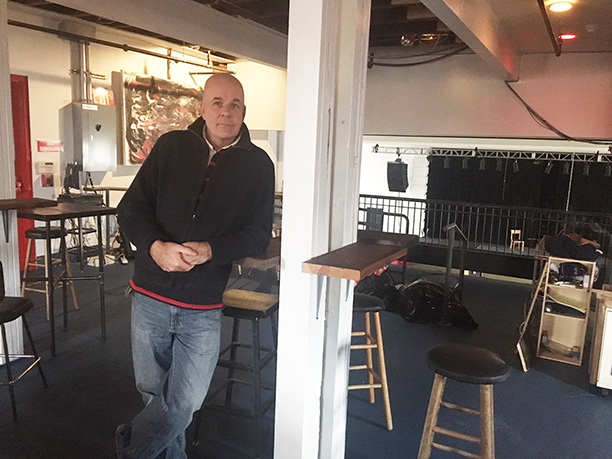
John Traynor, inside HMAC, from December 2017

Traynor admits that Stage on Herr had a freewheeling reputation in its early days but said that HMAC’s management became more professional as the business grew. He claims he didn’t take the social media “bashing” personally.

But he said he won’t forgive the critics who allegedly contacted national booking agents and convinced bands to back out of HMAC gigs.

In all, the firestorm cost HMAC a dozen shows and some $200,000 in revenue, Traynor said.

“We were operating on cash flow, and our cash flow was severely impacted,” Traynor said.

Under Chapter 11, HMAC will be able to rebuild its events calendar and renegotiate debt payment schedules, Traynor said. He said that the company did not have any problems fulfilling its debt obligations until recently.

In the coming weeks, Traynor said, HMAC’s owners will also prepare a case against a dozen people who he claims defamed the business and interfered with its performance contracts.

He said that he and his partners have collected evidence to press charges for tortious interference of contract – the act of intentionally damaging a business agreement and causing financial harm.

Traynor said that the Dauphin County District Attorney’s Office is investigating the claims of interference. That office could not be reached for comment on Wednesday.

He expects that a dozen people could be named in a civil complaint.

“They’ll all pay,” Traynor said. “They can’t do what they did without consequences.”

Not Going Away

It’s unlikely that HMAC’s patrons will notice that the business has filed for bankruptcy.

Filing under Chapter 11 of the federal bankruptcy law grants debtors temporary relief from liabilities while they reorganize their assets. Unlike a Chapter 7 filing, it does not mean that the business will liquidate and close.

“A company doesn’t have to be insolvent to file for bankruptcy,” said Juliet Moringiello, an associate dean and bankruptcy law expert at Widener University Law School. “Chapter 11 was designed as a process for a company with a good business model to pare down its debts and renegotiate contracts.”

According to bankruptcy filings, HMAC has less than $10 million in liabilities. The documents indicate that the company will be able to pay its debts in full once it emerges from restructuring.

Twenty of HMAC’s creditors – including business vendors and utility providers — are unsecured, meaning they wouldn’t be guaranteed money in a liquidation. Peggy Grove Enterprises is the largest unsecured creditor, with $170,000 invested in the project.

The City of Harrisburg is a secured creditor due to its status as a taxing entity, according to city Solicitor Neil Grover. Property records show that HMAC owes $19,000 in local property taxes, including $4,700 to the city of Harrisburg and more than $11,000 to the Harrisburg School District.

Even though a Chapter 11 filing may indicate that a business is in distress, it usually doesn’t hamper its services, Moringiello said. She pointed to America’s airline industry as an example.

“Every legacy airline in America has filed Chapter 11, but as far as passengers are concerned, the planes keep flying,” Moringiello said. “Filing for bankruptcy doesn’t mean a company is going away.”

That’s good news to Jeb Stuart, a lifelong Harrisburg-area resident and preservation advisor to the Historic Harrisburg Association. He said that HMAC’s multi-use spaces have enriched Midtown Harrisburg and preserved an important historic structure.

“It’s very contemporary and animated and innovative,” Stuart said. “To have a space for public assembly with a huge auditorium and stage capabilities, that’s a major contribution to North 3rd Street.”

Traynor said that HMAC will continue its normal program of musical shows, weddings, corporate events and fundraisers through the end of the year. But its owners are also planning new projects.

The project received a $1 million state Redevelopment Assistance Capital Program (RACP) grant in December, which will finance infrastructure improvements. Traynor hoped to use the money to expand the Capitol Ballroom and refurbish the basement to accommodate a music school.

He insists that the grant is the only public money HMAC has received.

Traynor said he wants to see HMAC endure for years to come, which is one reason he wants to find it a new owner, he said. He hopes that the restructuring under Chapter 11 will facilitate a sale.

“What I would hate to see is for this project to close,” Traynor said. “We put a lot of money and sweat equity into it, and now it’s time for a transition.”

The owners’ desire to sell pre-dates the social media firestorm, Traynor said. They’ve been negotiating with national entertainment agencies for the past three months, he said.

HMAC’s assets include more than $5 million in property, $44,000 of inventory and approximately $22,000 in accounts receivable, according to its bankruptcy filings.

Among those assets are HMAC’s liquor license, which it will defend in a Pennsylvania Liquor Control Board hearing later this month.

The PLCB put HMAC under a conditional licensing agreement (CLA) in 2014. It placed additional requirements on HMAC’s license, namely that the owners install soundproofing systems and perform additional security checks every night.

Traynor said that the CLA arose from noise complaints. He is confident that the business will retain its license after the hearing.

He also denied that the PLCB hearing had any influence on the decision to file for bankruptcy.

If the PLCB yanks the license, however, the value of HMAC’s assets would depreciate significantly, Moringeillo said. She thinks it unlikely that the Chapter 11 filing will influence the PLCB’s decision.

Wednesday, Sept. 6: This article was edited to correct the name of a Philadelphia-based news site. It is YC.news, not YC.com.


Continue Reading

Harrisburg playgrounds to open soon after months-long renovations

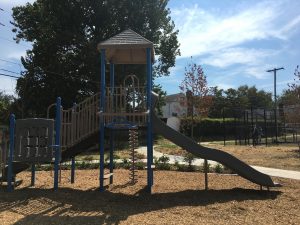
Mayor Eric Papenfuse was joined by students from the Sylvan Heights Science Charter School today as he cut the ribbon on a new playground at Cloverly Heights Park. The playground features all-new equipment, a rain garden, a pavilion, and a permeable pavement basketball court.

Summer break may be over, but playtime is just beginning in Harrisburg.

Mayor Eric Papenfuse today cut the ribbon on the newly renovated Cloverly Heights Playground, one of four play areas that were recently revamped with new equipment and green infrastructure.

After being closed all summer, playgrounds at Cloverly Heights, Norwood and Holly streets, Penn and Sayford streets and Royal Terrace soon will be open to the public.

Penn and Sayford and Cloverly should be open in about two weeks, the others sometime in October, Papenfuse said.

The four sites have been outfitted with all-new play amenities, and each one has unique features, Papenfuse said.

Three of the sites also have storm water management enhancements thanks to Capital Region Water.

“Our parks are the city’s greatest assets,” Papenfuse said during a sweltering press conference this afternoon, where he was joined by representatives from each of the project partners. “I’m glad we’re bringing all of our playgrounds up to the level that our community would like to see.”

The city will complete renovations at a fifth playground, at 4th and Dauphin Streets, next year.

The citywide playground renovations were part of a $2 million partnership among Harrisburg, Capital Region Water, Impact Harrisburg, the state Department of Conservation and Natural Resources and the state Department of Community and Economic Development.

Today’s ribbon cutting represented the culmination of a project three years in the making. The five playground sites were first targeted for renovations in 2015, but renovations stalled while the city pursued funding and collected public input.

Sheila Dow-Ford, executive director of Impact Harrisburg, said that the project was an obvious pick for a grant from her nonprofit organization, which was founded in 2014 with proceeds from the sale of the Harrisburg incinerator.

“Everyone remembers spending time on a playground,” Dow-Ford said. “My board thinks this project is very high priority, because our children are high priority.”

Students from the neighboring Sylvan Heights Science Charter School also attended the ribbon cutting. They helped showcase the new storm water management amenities at Cloverly Heights, including a basketball court made with permeable pavement. The students poured buckets of water on the asphalt to show how it absorbed liquid.

They also helped plant a rain garden, which will collect rainwater runoff from impervious surfaces.

This story has been updated with additional information about the openings for each playground.

Click to enlarge more pictures from today’s playground ribbon cutting. 

Continue Reading

Harrisburg’s economic director leaving; no plans to fill open position

Jackie Parker, second from left, at the ribbon-cutting for MulDer Square in February.

A senior Harrisburg official is leaving her post to work in the private sector, she confirmed today.

Jackie Parker, who has headed the city’s Department of Community and Economic Development (DCED) since 2014, will report for her last day in city hall on Sept. 14.

Parker told TheBurg she is taking a job with a medical marijuana company.

Parker joined the city administration when Mayor Eric Papenfuse took office in 2014. She previously served as the mayor of Lebanon, Pa., and as deputy secretary of the Pennsylvania Department of Community and Economic Development.

As the city’s DCED director, Parker was the point person for economic development projects, Papenfuse said. She managed employees in the bureaus of housing, planning, business development and parks and recreation.

Papenfuse said today that he does not plan to replace Parker. The mayor announced a city hall hiring freeze in June, but he also hopes to reorganize DCED in the wake of Parker’s departure.

He expects to prepare a reorganization plan ahead of his 2019 budget presentation in November.

“She’s been a wonderful, committed leader for the city,” Papenfuse said. “I think she’s irreplaceable.”

Parker’s duties will be split between other senior administrators in city hall, Papenfuse said. Some of them will be formally redistributed in the department’s restructuring.

The future of Parker’s department will also depend on the city’s fate in Act 47, the state oversight program for financially distressed municipalities. Harrisburg officials are currently deliberating a three-year Act 47 exit plan.

Meanwhile, the state House of Representatives is considering a bill that would allow Harrisburg to leave Act 47 and retain its current taxing authority.

The House will hold a joint public hearing on the bill later this month. But with the city’s financial future in limbo, Papenfuse does not plan to hire a new senior administrator before the end of the year.

“She’s irreplaceable, but this gives us the opportunity to restructure and create new systems,” Papenfuse said. “It will all depend on what happens in the next few months.”

One of Parker’s most significant accomplishments, according to the mayor, was her ability to leverage state agencies as partners in city projects. As an example, he pointed to the ongoing renovation of playgrounds across the city – a $2 million undertaking that was made possible by collaborations with the state Department of Conservation and Natural Resources and the state DCED.

Parker was also instrumental in producing the Reservoir Park master plan, Papenfuse said, which will guide redevelopment in that park over the next decade.

“This is a legacy that will last for a long time,” he said.

Continue Reading

Weekend Roundup with Sara Bozich

Happy Weekend!

It gets a little trite to preface every WR with a recap on the forecast, but HI, IT’S COOLING DOWN. That’s worth celebrating right? Oh what, you don’t want it to rain? I’m cool with it, but that’s because the apex of my weekend plans is FOOTBALL (as in, watching comfortably from my couch — I’m already picking out my sweatshirt).

FOOTBALL IS BACK, FRIENDS. REJOICE.

Hey, also, Big Bottom Brewery in Dillsburg is celebrating its Grand Reopening on Saturday, and you should check that out. It was Al’s Pizza, and then they added the brewery last year, but now they’ve fully renovated into a brewpub, and I’m pretty excited for them. Good people, Steelers fans. What is everything about football with me??? (Yes.)

I hope you’re still with me because there is loads to do that ISN’T football.

What are you doing this weekend?

(more…)

Continue Reading

Harristown plans to purchase Skarlatos building, as law firm relocates to Strawberry Square

The two downtown parcels that make up Harristown’s redevelopment project.

A downtown Harrisburg building project has changed significantly, as a developer now has plans to purchase and renovate the building next door.

Harristown Enterprises expects to close this fall on the purchase of 17 S. Market Sq., currently the home of the SkarlatosZonarich law firm, said Harristown CEO Brad Jones. A full renovation of the century-old, 33,809-square-foot building will follow.

“We’re still evaluating the uses of that building,” Jones said. “We think it’s going to become a mixed-used project.”

Last year, Harristown bought the neighboring building, a small, dilapidated, early 19th-century office and retail building at 21 S. 2nd St., which notably once housed the Coronet restaurant.

It razed that building, with expectations to construct a new office building and attach it internally to the SkarlatosZonarich property. However, according to Jones, the plan changed after continuing discussions with the law firm.

“As we began to talk more, they indicated they were more interested in selling the building,” Jones said.

As a result, SkarlatosZonarich now will sell their Market Square building to Harristown and relocate to the Bowman Tower in Strawberry Square, which is also owned by Harristown.

“We are excited to be a part of a new era of businesses in the Bowman Tower in Strawberry Square—an environment that will enhance the quality of legal services we deliver to our clients as well as the lives of our employees,” said John B. Zonarich, a partner with SkarlatosZonarich.

In January, the firm’s 35 employees will move into about 11,000 square feet of office space, about double their current footprint, following a $1 million renovation, Jones said. After the relocation, Strawberry Square will have an office vacancy rate of only about 5 percent, he said.

Jones said that plans are still in flux for the redevelopment project at Market Square, but he expects a mixed use of residential, office and retail, with residential more likely for 17 S. Market Sq. and office more likely for 21 S. 2nd St.

Last month, the project received a $1 million grant from the state’s Redevelopment Assistance Capital Program.

Jones declined to state the purchase price of 17 S. Market Sq. Harristown bought 21 S. 2nd St. last year for $150,000, but that building was far smaller and in much worse shape than the adjacent building, which SkarlatosZonarich bought in 2004 for almost $1.9 million, according to Dauphin County property records.

Continue Reading