School Board: Harrisburg superintendent qualifies for performance-based pay raise

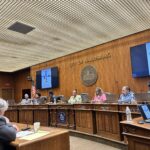
Superintendent Sybil Knight-Burney speaks at a community event in June.

Harrisburg superintendent Sybil Knight-Burney has received a satisfactory performance review from a majority of the school board, its solicitor announced tonight, a decision that qualifies her for a pay raise and a bonus.

Five board members deemed Knight-Burney’s performance over the past year exemplary or proficient, according to board solicitor Samuel Cooper. One member deemed her “in need of improvement” and two said her performance was unsatisfactory.

The review was completed by eight board members since the board had a seat open when it was finalizing the evaluation, Cooper said. The vacancy was filled on Aug. 6 with the appointment of former board member Lola Lawson.

The review is based on nine performance standards, including educational leadership, community and board relations, and resource management. Reviews from past years are posted on the district’s website.

Cooper did not provide category-specific grades in his report to the board tonight, nor did he say how each individual board member voted.

The full evaluation will soon be shared on the district’s website, Cooper said.

Knight-Burney received exemplary ratings on all nine performance standards during the 2016-2017 and 2015-2016 school years. Under her contract, which the board extended for a three-year term in June, a positive review could net Knight-Burney a 3-percent pay raise and $5,000 performance bonus.

Knight-Burney currently earns a $179,208 base salary, according to data obtained through a Right to Know request. A 3-percent raise and $5,000 bonus would bring her total pay to almost $190,000.

Community members commented on Knight-Burney’s performance at the board’s meeting tonight. Richard Soto implored the board to think twice about awarding Knight-Burney a raise, given that school taxes increased by 3.6 percent this year.

Gerlad Welch pointed to the district’s stagnant academic performance as evidence that Knight-Burney should not receive a positive review.

Harrisburg High School received 44 out of 100 possible points on Pennsylvania’s academic performance scoring system, according to a ranking methodology that is set to change this fall.

“I’m trying to wrap my head around what is exemplary about that performance – it doesn’t make sense to me,” Welch said. “I don’t like to get in the way of people getting their meat, bread, and eggs… but the constant bombard of confusion and chaos does not demonstrate effective leadership.”

Welch then pointed to a number of scandals that have plagued the district in the past year, including a grading investigation that led to the reassignment of a high school principal, a hiring fiasco that allowed 37 unbudgeted teaching positions to be filled, and criminal charges against a transportation administrator who allegedly embezzled $180,000 from the district.

The district also drew criticism in August when it asked 65 teachers that it hired at the wrong salary step to pay back wages. The administration later rescinded the request.

Earlier this year, the board vacillated over whether to re-hire Knight-Burney or seek new applicants for her position. The nine-member body frequently splits on a 6-3 or 5-4 margin, particularly on matters that concern the superintendent.

The board ultimately voted 5-4 in April to renew Knight-Burney’s contract.

Three of the members who voted to replace her – Carrie Fowler, Brian Carter and board president Judd Pittman – also cast dissenting votes in recent appointments to fill vacant board seats. All voted against appointing new board members Lola Lawson and Patricia Whitehead-Myers, who replaced board directors Tyrell Spradley and Percel Eiland, respectively, after they resigned earlier this year.

The board is still negotiating the terms of Knight-Burney’s new contract, which will run at least through June 2021. The new terms could alter her base pay and her performance based-incentives.

In other business, the board awarded a new contract tonight to interim Chief Financial Officer James Snell, who earns $12,000 a month overseeing the district’s finances.

The contract retains Snell’s services through October, as the district seeks a permanent candidate for his role. Pittman said that the district began advertising his post in June but has not yet found a qualified replacement.

The Pennsylvania Department of Education asked the district in June to replace Snell with a full-time, permanent CFO. (Snell, a retired school administrator, works for the district 30 hours a week.)

PDE also asked the district to replace Acting Business Manager Bilal Hasan, who lacks professional certifications for his role.

The board also voted 5-4 to approve a salvo of personnel actions, including the reassignment of former Harrisburg High School Principal Lisa Love.

Love, who was placed on leave this summer as the district investigated allegations of grading misconduct, will serve as assistant principal on assignment at Benjamin Franklin Elementary School, where she will provide coaching and professional support to administrators, according to Human Resources Director Curtis Tribue.

Her building assignment may change depending on personnel turnover in other schools, he said.

Continue Reading

Senior Housing Ahead: Officials gather to break ground for Paxton Place

Local officials and Paxton Ministries broke ground today on Paxton Place.

Senior citizens in Harrisburg will soon have a new option for affordable housing in the city.

Paxton Ministries broke ground today on Paxton Place, an $8.6 million development project on S. 20th Street near the Harrisburg-Penbrook border. The center will create 37 new, affordable apartments for senior citizens, along with common spaces and other amenities.

The project was financed by a federal tax credit through the Pennsylvania Housing and Finance Agency (PHFA.) Paxton Place was one of 39 recipients of a PHFA tax credit award this year, out of more than 100 applicants. It is the first project for low-income senior citizens that PHFA has financed in Harrisburg.

Paxton Place will sit directly across from the Paxton Ministry headquarters, where the agency provides housing to 100 low-income residents, many of whom have intellectual disabilities. Paxton Ministries also runs Paxton Cleaning Services, a workforce training program.

The plans for Paxton Place began six years ago, according to Paxton board chair Dale Laninga, at a time when the organization was looking to expand its ministries in Harrisburg. They focused on the issue of senior housing and decided to develop new homes and social spaces for elderly citizens on low incomes.

“We wanted this to be something special that would serve a large scope of needs,” Laninga said. “We learned what seniors need to stay active and healthy. Paxton Place will help them age in place and maintain an active and healthy lifestyle.”

Paxton’s board began to secure financing in 2015. They obtained contributions from Mid-Penn Bank, Impact Harrisburg, Messiah Lifeways, UPMC Pinnacle and others, as well as loans from Lancaster Housing Opportunity Partnership and the Dauphin County Housing Trust Fund.

The Central Pennsylvania Food Bank also made a contribution from its endowment, according to CPFB executive director Joe Arthur. CPFB will host cooking demonstrations in the Paxton Place kitchen to show residents how to prepare healthy, nutritious meals on a low budget.

According to Harrisburg Mayor Eric Papenfuse, Paxton Place is joining a number of new, desperately needed affordable housing projects in the city.

This summer, Papenfuse joined other local leaders at the ribbon cutting of the HUB veteran housing complex in Uptown Harrisburg. Meanwhile, the city continues work on the MulDer Square revitalization project, which will renovate single-family homes and apartments near Mulberry and Derry streets in Allison Hill.

“We have a bit of a housing crisis in the city of Harrisburg, and there’s not enough quality, affordable housing in any of our neighborhoods,” Papenfuse said today. “Projects like this one give people options they didn’t have before.”

Construction on Paxton Place is expected to conclude in fall 2019.


Continue Reading

TheBurg Podcast: “The Show Goes On” Edition.

TheBurg Podcast is back following a summer hiatus.

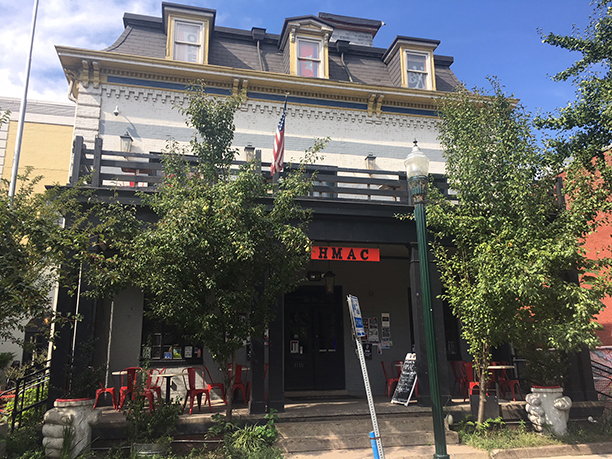
This week, we recap the latest developments in Harrisburg’s Act 47 saga, including an effort to lobby the state legislature and the impending deadline to adopt a state-approved Act 47 exit plan. We also discuss HMAC’s recent bankruptcy filing and what the business means to midtown Harrisburg.

Stream the episode here, or subscribe to TheBurg Podcast on iTunes.

Read more about the topics covered in today’s Burg Podcast at TheBurgNews.com.

City Council to consider home rule ordinance as Act 47 deadline nears.

Papenfuse eyes three-year commuter tax as Harrisburg prepares for Act 47 exit.

Following online outrage and revenue hit, HMAC files chapter 11 bankruptcy as a prelude to sale

State grant earmarked for HMAC could be jeopardized by bankruptcy filing, CREDC president says.

TheBurg Podcast is released semi-monthly by TheBurg Magazine. It is recorded in the offices of Startup Harrisburg and produced by Lizzy Hardison. Special thanks to Paul Coolley, who wrote our theme music.

Continue Reading

Mayor “strongly against” AutoZone store coming to vacant lot on Maclay.

AutoZone will purchase the vacant lot at 645 Maclay Street from Harrisburg-area developer The Vartan Group, pending approval of its proposals by the city.

A national auto-parts chain is poised to build a new location on a vacant lot in Uptown Harrisburg, much to the chagrin of Mayor Eric Papenfuse.

Memphis-based retailer AutoZone is in the final stages of purchasing a 1-acre lot at 7th and Maclay streets from the Buonarroti Trust, a subsidiary of the Vartan Group development company, confirmed Nicole Conway, Vartan executive vice president and general counsel, on Thursday.

AutoZone plans to build a full-service retail location on the lot, which has been vacant since the 1970s.

AutoZone already operates franchises in the Harrisburg suburbs, including in Lemoyne and Swatara Township. A new location in Harrisburg would make it the city’s first national retailer for car parts and accessories.

The sale of the lot at 645 Maclay St. is pending the approval of project proposals, Conway said. She did not disclose a price.

AutoZone has already petitioned the city to vacate unnamed alleys on the property. Eliminating these “paper streets” – so called because they exist only on maps and not actually on the site — would consolidate two tax parcels into one, developable tract.

The measure could come before City Council by the end of the month.

AutoZone must also submit a land use development proposal for approval by the Harrisburg Planning Commission and council.

The project would give new life to a long-vacant property and bring jobs to the city. But Mayor Eric Papenfuse stands strongly against it.

“It’s inappropriate, in my opinion, for the gateway to Harrisburg,” Papenfuse said.

The city’s “Northern Gateway” encompasses the area east of Midtown Harrisburg, close to the interchanges to I-81 and state route 22. Its proximity to major highways lends the area high visibility from motorists travelling in and out of the city.

Vartan founder John Vartan began buying property in the area in the 1980s, hopeful that it would become a prime target for development. Today, however, much of the corridor remains either empty or blighted.

“Unfortunately, there has not been much interest in development on that corridor,” Conway said.

The most recent developments in the Northern Gateway area have been government projects closer to Midtown – the federal courthouse at 6th and Reily and the state archives building at 6th and Harris. The Vartan Group also developed the mixed-use 1500 Condominium project on 6th Street in 2012.

Conway said she was “confused and a little disappointed” by the mayor’s opposition to the AutoZone project. She disagreed with his claim that an auto parts retailer was a poor fit for the location, where neighboring businesses include gas stations and industrial properties.

She also said that AutoZone would be the first national retailer to undertake new construction in Harrisburg since the 1970s.

“The fact that a national retailer wants to come in and build new is big,” Conway said. “It says to another retailer that [Harrisburg] is a good place to locate, and we hope it will bring additional business into the area.”

Conway added that the project would not use any public subsidies, such as local tax abatement or state grants.

“This is straightforward, market-rate construction with no giveaways from the city,” she said.

AutoZone approached Vartan about the property in late 2017, Conway said. It was the first serious inquiry about the lot that the developer had received in years.

Even if the mayor opposes the project, there’s not much he can do to stop it. The project would conform with the “commercial general” zoning designation, and Conway said that AutoZone has complied with the city’s planning process.

The mayor could theoretically veto any land use development proposal that council passes. But, since if the proposal complies with city zoning code, it would be subject to a costly legal appeal.

AutoZone did not respond to requests for comment for this story.

Mayor Eric Papenfuse submitted the following comment after this article was published: “The city of Harrisburg is most assuredly open for business. I support all responsible development projects. This is a gateway corridor for the City and deserves something extraordinary that will help spur the adaptive re-use of the nearby abandoned Hudson Building. This particular design is much better suited for a suburban strip mall than a growing, progressive City looking to emphasize neighborhoods and safe streets over cars and commuters.”

Continue Reading

Weekend Roundup with Sara Bozich

Happy Weekend!

I’m at Rebels, Renegades, and Pioneers this morning, so this will be a brief intro. My weekend is (shocker) low-key, but Andy and I do have a date afternoon Saturday at The Hershey Food & Wine Festival!

What are you doing this weekend?

(more…)

Continue Reading

Trash Talk: City treasurer asks council to consider annual billing for waste collection

Harrisburg Treasurer Dan Miller talked trash billing at tonight’s City Council meeting.

Unpaid trash fees are costing Harrisburg an average of $200,000 a month – a problem that city Treasurer Dan Miller thinks can be fixed by billing residents once a year for disposal services.

Miller proposed an annual trash billing structure earlier this year as part of an overhaul of Harrisburg’s sanitation laws. But City Council nixed the measure, saying it would stress the cash flow of low-income and fixed-income residents.

The city currently bills residents $32 a month for trash collection. It also has a monopoly on commercial accounts in the city.

Miller appeared before council on Tuesday night to renew the case for annual billing. He’s proposing that Harrisburg include a line item for trash fees on every property’s annual real estate tax bill, which is mailed out in January. The trash collection fee would be subject to the same 2 percent, 60-day discount period as the real estate tax.

The city currently has a 98-percent collection rate on its real estate taxes. Miller hopes that trash fee collections would increase by streamlining the two bills into one. It would also save an estimated $100,000 a year in mailing costs.

Collecting up-front payments is key, Miller said, since the treasurer’s office doesn’t have many means to pursue delinquent accounts.

According to Miller, Harrisburg lost enforcement authority over delinquent trash bills when it restructured under the Harrisburg Strong Plan, the financial recovery plan it adopted in 2013.

Before the Strong Plan, Harrisburg had an in-house collections arm in its Operations Revenue Department (ORD). When the department could not collect bills from delinquent accounts, it could turn off the water at those properties to spur a payment.

But the Strong Plan dissolved the ORD and transferred Harrisburg’s water assets to Capital Region Water. As a result, the city lost the ability to terminate water services at delinquent properties.

“People discovered that, if they didn’t pay their bill, their trash was still collected and nothing else happened,” Miller said. “Maybe their bill went up [from interest], but nobody was doing anything about it.”

Today, the city treasurer’s office doesn’t have the enforcement “teeth” it needs to collect delinquent payments, Miller said. He believes that a new billing structure will mitigate the monthly bleed of unpaid bills.

“We just want council to give us the tools to do our job in an effective and efficient manner,” Miller said. “From my perspective, there is very little drawback to this.”

In all, Miller’s office calculated that the city has lost out on $12 million over a multi-year period. Miller isn’t confident that the city will see any of that money, which, he said, is why it’s important to move to a new billing system sooner rather than later.

If low-income residents have a hard time making an annual payment, Miller said, council could develop a program to waive or reduce fees for eligible residents.

Miller is also proposing that residents be allowed to opt in to monthly auto-payments. He stressed that, while billing practices may change, the cost of trash services in Harrisburg would not.

Council members seemed amenable to that proposal tonight. Miller was hopeful that they could implement a change to take effect in 2019, but Mayor Eric Papenfuse said that’s unlikely.

“We’re probably looking at 2020 at this point,” he said.

Councilman Westburn Majors, who chairs the Public Works Committee and spearheaded the sanitation ordinance overhaul earlier this year, said he would be open to talking about Miller’s proposal more as the city moves into its 2019 budget cycle.

Continue Reading

City Council to consider home rule ordinance as Act 47 deadline nears.

Is Harrisburg on its way to home rule?

Tomorrow night, City Council will consider an ordinance to initiate home rule proceedings, kicking off what could be a years-long process to write a new charter for the city.

The ordinance will be read into the record for the first time at council’s Sept. 11 legislative session. From there, it will likely go into administrative committee.

If it passes, Harrisburg residents will be asked to vote on whether or not the city should form a Government Study Commission – an elected body of citizens that will study forms of local government and decide whether or not a home rule charter is advisable for the city.

The members of the commission would also draft Harrisburg’s home rule charter and put it up for another referendum vote.

In Pennsylvania, a municipality may pursue home rule to gain autonomy from the state charter, which prescribes tax rates and government structures for cities, boroughs and townships. A home rule municipality can convene its own government structure or authorize tax limits beyond what is allowed under state code.

Mayor Eric Papenfuse told TheBurg in July that he wanted to explore home rule as a way to ease Harrisburg’s exit from Act 47, a state oversight program for financially distressed municipalities.

A home rule charter would allow Harrisburg to keep its earned income tax (EIT) at its current 2 percent rate. The state tax code only allows Harrisburg to assess a 1 percent EIT, but Act 47 law allowed City Council to double the rate in 2012.

But home rule charters must be passed by the municipality’s residents in a referendum vote, and Papenfuse isn’t optimistic that it would get enough support in Harrisburg.

“It’s not a foregone conclusion that it would be successful,” Papenfuse said on Monday. “Home rule is something I’ve supported for Harrisburg for a long time, though I know it would be very difficult to achieve.”

Papenfuse still hopes that the city will be allowed to exit Act 47 this year, pending the passage of a bill by the PA General Assembly. That bill would allow Harrisburg to keep its current EIT and local services tax (LST) indefinitely.

The taxes generate a combined $12 million in annual revenue for Harrisburg. Both would revert to their pre-Act 47 levels if the city exited the program under the current state tax code.

That prospect has forced city officials in recent months to devise strategies to avoid a gigantic revenue loss and budget cuts when the city is forced to leave Act 47 in 2021. The city has been lobbying the state legislature for special taxing privileges since January, when it retained the services of local lobbying firm Maverick Strategies.

A measure to preserve Harrisburg’s taxing power blew up in June, after House Speaker Mike Turzai prevented the measure from coming up for a vote.

If the legislature fails to act on Harrisburg’s behalf again this fall, the city will adopt a three-year Act 47 exit plan.

The details of that plan are still subject to revision by the state Department of Community and Economic Development, but the latest draft calls for substantial property tax increases in 2021 to offset EIT and LST reductions.

Papenfuse hasn’t given up on the possibility of passing a heftier commuter tax as part of the city’s Act 47 exit plan. He and his counterparts on City Council have repeatedly said they will oppose a plan that increases taxes on Harrisburg residents.

The mayor expects that home rule proceedings could take at least three years, giving the city “just barely enough time” to complete it before exiting Act 47. But even if the city does pass its own unique charter, it would still have to find new sources of revenue.

A home rule charter would not allow Harrisburg to keep its current LST rate, since such charters only apply to residents of the home rule municipalities. The LST is paid by every employee in the city of Harrisburg, including commuters.

That tax brings in $6 million a year, according to Harrisburg finance director Bruce Weber. About $4 million goes to the city and the remainder to the Harrisburg School District.

There are currently 71 home rule municipalities in Pennsylvania, the closest being Carlisle in Cumberland County. Harrisburg would be the first home rule municipality in Dauphin County if its charter passes.

Have questions about Harrisburg’s Act 47 status? Check out TheBurg’s guide to Act 47.

Continue Reading

Salvation Army breaks ground on new $12 million regional headquarters

Local officials and local children grabbed shovels to officially break ground on the Salvation Army’s new regional headquarters.

After a 10-year planning period and a $12 million fundraising drive, the Salvation Army of Harrisburg broke ground Monday on a new regional headquarters, joined by 150 community members, a brass band and elected officials from the local to the federal level.

The 39,000-square-foot facility will house the Salvation Army’s education and human services programs, which reach more than 18,000 adults and children in Dauphin, Perry and Cumberland counties.

“After 132 years of service in Harrisburg, the Salvation Army is writing a new chapter in its book of doing the most good,” said Richard Jordan II, director of the project’s capital campaign. “This project will have an unprecedented, life-changing impact on the community.”

Jordan was one of a dozen stakeholders who spoke at the groundbreaking ceremony on a rainy morning, held under a tent at the construction site on 506 S. 29th St.

The Salvation Army of Harrisburg has maintained a headquarters at 1122 Green St. in Midtown Harrisburg since 1954. Officials began toying with the idea of an expansion 10 years ago, as demand for their services grew, according to Harrisburg corps officer John Griner.

They paid $1.25 million for the seven-acre site, situated at the corner of Rudy Road and S. 29th Street near Kline Village. They razed two dilapidated buildings to make room for new construction.

A three-year fundraising campaign followed, during which time more than 100 donors contributed to the $12 million project.

The bulk of the project’s funding came from a $10 million New Market Tax Credit awarded through the nonprofit lender Community First Fund. The Salvation Army is also eligible for up to $500,000 in construction reimbursements through a state-funded Redevelopment Assistance Capital Program (RACP) grant.

The nonprofit Impact Harrisburg granted the project $500,000 in 2016, and Dauphin County contributed a $100,000 gaming grant this year.

Construction plans call for a full-service kitchen, gymnasium, playgrounds and classroom and meeting space. The facility will also house staff offices and a worship center.

Building will continue for 10 to 12 months, and the Salvation Army staff hopes to move out of its Green Street headquarters by September 2019, said Kathy Anderson-Martin, director of resource development at The Salvation Army.

The new headquarters will be command central for all of the Salvation Army’s family services programs, adult self-sufficiency and spiritual ministries. It will also house educational programs for children, including after-school and summer camps and two pre-K classrooms.

More than 2,800 of the Salvation Army’s 18,000 clients are children, according to advisory board chair Jeffrey Piccola.

Mayor Eric Papenfuse, who also spoke at this morning’s ceremony, said that the city is committed to working with the Salvation Army to find an “adaptive reuse” for its current Midtown space. The main building is listed for sale at $560,000.

Papenfuse thanked the Salvation Army for keeping its headquarters in the city and for repurposing a blighted stretch of 29th Street in the process.

“Among this sea of blighted and abandoned buildings, you saw something that will completely transform one of our neighborhoods,” Papenfuse said. “We’re extremely excited that you’re going to be part of the activity that we’re seeing in each and every corner of this city.”

Continue Reading

Park Work: Sewer project shuts down stretch of Riverfront Park

Sewer work has closed a portion of Riverfront Park in Uptown Harrisburg to visitors.

A large swath of Riverfront Park in Uptown Harrisburg will be closed until the end of October for a major sewer project, Capital Region Water announced today.

Andrew Bliss, community outreach manager, said that CRW has closed a five-block stretch of the park between Shamokin and Emerald streets to rehabilitate the Front Street sewer interceptor in that area.

Park users will be detoured to the sidewalk across Front Street, Bliss said. He said that “Road Work Ahead” signage has been posted on Front and Division streets to warn users.

This project will install 2,000 feet of new pipe liner, called “cured-in-place” pipe, to rehabilitate the 30-inch diameter clay sewer pipe, according to CRW. Aboveground pipes will be placed along the park in the project area to bypass flows during the cured-in-place pipe installation.

The 105-year-old Front Street sewer interceptor carries an average of 2 million gallons of wastewater every day from Harrisburg and Susquehanna Township, said CRW.

“Capital Region Water is committed to protecting public safety and the environment by properly maintaining our wastewater collection system,” said CRW board Chairman Marc Kurowski. “We appreciate everyone’s patience during construction while we address critical and aging infrastructure.”

Continue Reading

State grant earmarked for HMAC could be jeopardized by bankruptcy filing, CREDC president says.

HMAC’s owners hoped to use RACP grant funds to expand the property’s Capitol Ballroom. The lengthy process of applying for construction reimbursement funds could be complicated by the business’s recent Chapter 11 bankruptcy filing.

The news that the House of Music, Arts and Culture (HMAC) recently filed for Chapter 11 bankruptcy came as a surprise to some members of the Harrisburg community, especially since the business was awarded a $1 million public grant less than a year ago.

But the grant’s sponsor says that HMAC hasn’t seen a dime of the money — and now that its owners have filed for Chapter 11 bankruptcy and putting it up for sale, it’s possible it never will.

David Black, president and CEO of the Harrisburg Regional Chamber and CREDC, said that HMAC hasn’t drawn any money from the $1 million Redevelopment Assistance Capital Program (RACP) grant it was awarded in December. HMAC’s owners must complete projects first and then submit a detailed reimbursement application to claim funds.

“No money has been delivered,” Black told TheBurg. “CREDC has been working with [HMAC] to prepare details for submission, but things have been on hold of late.”

CREDC is the designated recipient of grant funds as an accredited chamber of commerce. It also helped HMAC prepare the initial grant application for a nominal service fee, Black said.

RACP grants, which are intended to improve infrastructure and create jobs in redeveloping communities, aren’t cash awards. They’re “eligible reimbursement” grants, meaning that a recipient must first invest money in a project and prove compliance with grant guidelines to get repaid.

RACP reimbursements can only be applied to building and infrastructure improvements. They can’t be used to cover wages, programs, or business supplies and services.

An RACP award is also contingent on the project matching the grant funds twofold. For every dollar of the $1 million grant HMAC received, Black said, its owners must invest $2 in infrastructure improvements that raise the value of their building.

The significant up-front investment costs and complex documentation process make RACP grants anything but fast money, Black said.

“RACP is one of the most complex grant processes in state government,” Black said. “Sometimes it can take three to five years to get full reimbursement. It’s not a process for the faint of heart.”

“Uncharted Territory”

HMAC’s owners weren’t considering a sale or Chapter 11 filing when they applied for the competitive grant program, HMAC managing partner John Traynor said.

Bartlett, Traynor & London LLC, the company that owns HMAC, filed for Chapter 11 bankruptcy in the U.S. Middle District Court of Pennsylvania on Aug. 23, one month after a social media storm reportedly cut into the business’s revenues.

According to Black, the bankruptcy and anticipated sale could complicate the process for receiving RACP funds.

Black said that many RACP recipients apply for bridge loans to make infrastructure improvements that they can later claim for reimbursement. A business under Chapter 11 may have a hard time securing private financing, he said.

He also isn’t sure that the $1 million set aside for HMAC would stay with the project if it changes hands.

“It’s uncharted territory,” Black said. “It will be interesting to see if [HMAC] can meet the requirements of the [next] application.”

If HMAC can’t complete the next phase of its application by the end of 2018, it could become ineligible to receive any RACP funds. The $1 million earmarked for the project would go back into the pot of grant money, Black said.

In that event, Black said that CREDC would lobby the state Office of the Budget, which administers the RACP program, to award the same amount to another project in Harrisburg.

Traynor acknowledged that the bankruptcy filing complicates the grant process, but said that HMAC’s owners continue to forge ahead. Their next step, he said, is to submit a schedule of construction projects and funding sources.

HMAC’s owners hope to expand the Capitol Ballroom and renovate the property’s basement to accommodate a music school.

Traynor noted that HMAC can exit Chapter 11 voluntarily, at any time. If their restructuring goes smoothly and they exit before the end of the year, they may have an easier time financing projects, he said.

He also hopes that HMAC’s new owner would continue the RACP grant process if they’re deemed eligible.

RACP was the first public grant HMAC’s owners pursued, Traynor said. The project did receive a $100,000 loan from Harrisburg’s now-defunct revolving loan fund, but Traynor says it was paid back with interest.

Barlett, Traynor and London LLC, the company that owns HMAC, has already sunk some $5 million into the project, including $2 million in personal cash, Traynor said. Most of that money went to rehabilitating HMAC’s once-derelict structure at 1110 N. 3rd Street.

The 34,000-square-foot building once housed Harrisburg’s first Jewish Community Center before becoming the Harrisburg Police Athletic League in the 1970s. It sat vacant for years before Traynor and his partners bought it from the Harrisburg Redevelopment Authority in 2007.

The $187,000 purchase price reflected the renovations that HRA made to the building under former-Mayor Stephen Reed, Traynor said. HMAC’s owners weathered the Great Recession of 2008 and opened their first bar and performance venue, Stage on Herr, in 2009.

The property went to sheriff sale five times in the next four years, Traynor said.

“I’ve always said this project has been a difficult one, and I’ve never said it didn’t have financial issues,” Traynor said. “But we overcame a lot of those.”

He said that the cost of renovating the historic property wildly exceeded anything he and his partners predicted. He cited construction costs as the single greatest stressor on HMAC’s finances.

At times, cost overruns ate into the business’s cash flow, Traynor said. He admits that HMAC had a hard time balancing books some months.

“Were checks returned? Absolutely, but there’s no shame in that and no intent to defraud anyone,” Traynor said. “It’s just part of business when you’re trying to keep the doors open, keep people employed, and bring great music to the city.”

Based on the documents that Bartlett, Traynor and London have provided in their bankruptcy filing, it’s hard to get a full picture of the business’s financial condition.

“Right now, there’s not much you can glean from the filing at all,” said Juliet Moringiello, an associate dean and bankruptcy law expert at Widener University Law School.

She said that more details will emerge when HMAC provides a full schedule of assets and financial affairs statement on Sept. 27 – the same day that HMAC’s partners will convene a meeting with more than three dozen creditors.

The filings do show that the business has $770,000 in unsecured liabilities. It also has a $2.6 million mortgage on its 3rd Street property, Traynor said.

Its property and merchandise assets total more than $5 million. A four-month budget that HMAC submitted with the filings shows that the business expects to turn a profit through the end of 2018.

Continue Reading