Dauphin County moves to extend existing Harrisburg tax abatement program

The Dauphin County Administration building.

Dauphin County voted to extend a Harrisburg tax abatement program on Wednesday.

At their weekly meeting, the Dauphin County commissioners unanimously approved the extension of the city’s existing Local Economic Revitalization Tax Abatement (LERTA), which incentivizes development and property improvements within the city of Harrisburg.

The move follows Harrisburg City Council’s December vote to extend the program for another year.

First implemented in 2015, LERTA offers a 100%, 10-year tax abatement to developers for residential renovations and construction. Under LERTA, commercial and mixed-use projects are also eligible for 50% to 100% abatement.

When city council passed the extension in December, Jason Graves, the city’s then-director of business development and LERTA administrator, said Harrisburg had drafted new LERTA legislation that was awaiting the Harrisburg School District’s review and, in the meantime, recommended extending the current LERTA program for another year. 

The district has yet to pass an extension for the program.

Graves’ position as director of business development and LERTA administrator has since been defunded, alongside several others, by city council, a move that prompted a lawsuit from Mayor Wanda Williams. While a judge ruled Tuesday that council had the authority to defund the positions, Williams said she plans to appeal the decision.

If you like what we do, please support our work. Become a Friend of TheBurg!   

Continue Reading

At Harrisburg council meeting, residents protest ICE; apartment projects approved

Residents spoke during public comment at Tuesday’s City Council meeting.

At a meeting on Tuesday night, Harrisburg City Council approved new apartment projects and heard concerns from residents about ICE.

The double-header meeting—a legislative session followed by a work session—began with over an hour of public comment during which residents said they wanted the city to develop a policy against working with federal ICE agents.

A group of a few dozen protestors also gathered outside city hall at the start of the council meeting with signs that read “ICE out of Harrisburg” among other messages.

“The community gathered outside this building is frustrated; some are scared; many are ready to defend their neighbors,” said resident Brian Kiesling, of the Harrisburg Palestine Coalition, during public comment.

Protestors outside city hall on Tuesday evening.

Kiesling and others said that they were upset by Police Commissioner Tom Carter’s remarks about ICE at a previous council meeting, when he said that residents confronted by ICE should comply with the officers.

“We all felt him dismiss the gravity of the situation,” Kiesling said. “We are talking about basic safety and the responsibility of the city to protect its residents, whoever they are, from any threat, even if that threat comes from the government.”

Police Deputy Chief Kenny Young previously told TheBurg that the bureau does not collaborate with ICE and is not alerted when they’re in town. The only points of contact, he noted, would be when police are called to the scene of an incident involving federal agents. The police are also required to report to ICE if they come across someone who has an immigration warrant against them.

Council member Jocelyn Rawls said that council is in the process of drafting legislation that would limit the police bureau’s ability to work with ICE.

“If this bill is passed, I want assurance that the mayor, our police chief and our district attorney will support the provisions proposed in this bill,” said another resident during public comment.

Also on Tuesday, council unanimously approved the second phase of a project to adaptively remake the former Polyclinic Hospital building, at 2601 N. 3rd St., into apartments and commercial space.

Former Polyclinic Hospital, the site of Pennmark’s adaptive reuse building. Phase two targets the large building on the far right.

The entire project includes renovating all three buildings on the property and constructing over 250 market-rate apartments. Council in November approved the first phase, which outlines renovations to the former nurses’ quarters, the northernmost building.

The second phase targets the largest building on the property and includes creating 130 units with studio, one-, two- and, possibly, three-bedroom configurations. There will also be commercial space. Developer Pennmark Harrisburg Holdings, an affiliate of Montgomery County-based Pennmark Management Company, is in talks with a local grocer who is interested in occupying one of the spaces.

Rent will likely start around $900 for studio units and cost closer to $1,400 for one-beds and $1,600 for two-beds.

Council members said they were impressed with Pennmark’s extensive community outreach on the project. The developer has hosted several meetings with neighbors and has made tweaks to the project based on feedback. Some neighbors even attended council meetings to speak in support of the project.

“It’s refreshing,” council member Ralph Rodriguez said at council’s previous work session. “A lot of times, we ask for this feedback. We ask for, you know, ‘have you done the outreach?’ You’ve come with a whole table and shown how it goes on. It’s very appreciated.”

Another adaptive reuse project also received the green light from council to renovate a former funeral home at 1332 N. 2nd St. into apartments. The project will add eight units to the existing five that already exist on upper-level floors.

Developer Breneman Properties plans to construct one-bedroom units with one studio and one two-bed. Prices will range from around $1,000 to $1,800, a representative for the developer said.

Construction is slated to begin in March and last about eight months.

Council voted 6-1 to approve the project, with President Danielle Hill voting against it, citing a lack of affordable units.

Additionally, council approved the submission of a grant application to the state Department of Conservation and Natural Resources (DCNR) for $19,500 to fund design services for renovating Vernon Street Park, at 15th and Vernon streets.

During a work session following council’s legislative session on Tuesday, council also discussed a grant application submission to the U.S. Department of Transportation (DOT) for $3 million to fund design services for road safety projects. Work would include sections of Division, N. 6th, Market and S. 17th Street.

City Engineer Joel Seiders explained that the improvements to the corridors would look similar to safety upgrades made to N. 2nd Street in recent years. Grant funding would support the planning stage, while construction, he said, is still several years away.

Seiders also highlighted a need for council to ratify a $387,380 grant application that the city submitted to the DOT for safety upgrades to Market and 17th Street in Allison Hill. The project would focus on retiming traffic signals and improving pedestrian infrastructure.

Council is slated to vote on the grant applications at its next legislative session.

If you like what we do, please support our work. Become a Friend of TheBurg!          

Continue Reading

Harrisburg mayor to appeal ruling that defunded key city posts

Harrisburg city hall (file photo)

Harrisburg Mayor Wanda Williams plans to appeal a ruling that allows City Council to defund several top city positions.

In a brief statement tonight, Williams stated that she would appeal Tuesday’s decision by Dauphin County Court of Common Pleas Judge Jeffrey Engle, who ruled against her in a lawsuit she brought against council.

“Voters did not vote for government by litigation,” she said. “I have to defend the city and its operations, and I will appeal!”

Williams’ lawsuit claimed that council overreached its power when defunding several top city positions as part of the 2026 budget. However, on Tuesday morning, Engle dismissed Williams’ claims, allowing council’s budget decision to stand.

As part of the 2026 budget, council defunded the business administrator role, saying that the interim director had remained in the position without council’s approval, past the allowed time for a temporary employee. They reduced the salary for the interim director of building and housing development for the same reason. They also zeroed out the salary for the project director for business administration/LERTA and for the police bureau’s director of community engagement and relations. Williams vetoed those budget changes, but council overrode the veto.

On Jan. 8, Williams filed a complaint asking for an emergency injunction and declaratory ruling, in an attempt to reallocate salaries to four city officials, three of whom had been fired because their salaries were zeroed out.

In his memorandum opinion, Engle agreed with council that it was within its rights to make budgetary changes to salaries. He spent over three pages discussing the business administrator position, and refuting Williams’ argument that it is a statutory, legally required position.

“I want the residents of Harrisburg to know that your mayor did not lose today,” Williams said, in her statement. “The damages are to the citizens of the city. I agree with the court that there will be “severe consequences for city government” because of council’s actions.”

If you like what we do, please support our work. Become a Friend of TheBurg!   

Continue Reading

Judge sides with City Council in Harrisburg mayor’s lawsuit over defunded positions

Dauphin County Courthouse

A Dauphin County judge has sided with City Council in a lawsuit filed by Harrisburg Mayor Wanda Williams.

Court of Common Pleas Judge Jeffrey Engle on Tuesday dismissed Williams’ lawsuit against council, in which she claimed that council overreached its power when defunding several top city positions as part of the 2026 budget.

On Jan. 8, Williams filed a complaint asking for an emergency injunction and declaratory ruling, in an attempt to reallocate salaries to four city officials, three of whom had been fired because their salaries were zeroed out.

On Tuesday morning, Engle dismissed Williams’ claims, allowing council’s budget decision to stand.

Council’s attorney, Casey Coyle, told TheBurg over the phone that council was “pleased with the outcome,” but that they were “disappointed that precious taxpayer dollars had to be expended in the first place.”

As part of the 2026 budget, council defunded the business administrator role, saying that the interim director had remained in the position without council’s approval, past the allowed time for a temporary employee. They reduced the salary for the interim director of building and housing development for the same reason. They also zeroed out the salary for the project director for business administration/LERTA and for the police bureau’s director of community engagement and relations. Williams vetoed those budget changes, but council overrode the veto.

Coyle said the mayor’s lawsuit was an “analogue” of national discussions of who holds which powers and that it confirmed the meaning of legislative versus executive powers.

In his memorandum opinion, Engle agreed with council that it was within its rights to make budgetary changes to salaries. He spent over three pages discussing the business administrator position, and refuting Williams’ argument that it is a statutory, legally required position.

During an evidentiary hearing on Jan. 21, Williams’ attorney, Renardo Hicks, argued that the business administrator, which acts as a chief of staff for the city, was a mandated position under the Optional Third Class City Charter code, which Harrisburg adheres to. Williams also emphasized the importance of the position in the daily operations of the city.

In his written opinion, Engle said the office is “not specifically mandated as a required department” and that it may be “necessary perhaps, however, the position is not mandatory.”

For all of the positions, Engle said, “The City Council may fund or defund positions it deems necessary, subject to the lawful veto of the mayor and its override […] We do not find here that the budgetary process was in violation of the Charter Law or any other statutory scheme.”

Coyle said that, had the judge ruled in Williams’ favor, it would have “opened a can of worms” on how much council could reduce salaries and where the line would be drawn.

Williams, in her complaint, also argued that, if council wanted to get rid of the business administrator, it should have enacted an ordinance repealing the city code that created the position. Engle ruled against that notion, saying the position is not mandatory.

While much of the discussion during the evidentiary hearing focused on the validity of “interim” positions, Engle declined to state an opinion on that matter.

Williams had argued that interim business administrator Sam Sulkosky and interim director of building and housing development Gloria Martin-Roberts were not under the same restrictions as “acting” department heads, who may only serve 120 days without council approval.

Sulkosky was appointed to his position in October 2024, but council later denied affirming him in his role, leading Williams to make him an interim director. Martin-Roberts was appointed as an interim director in 2024.

Council argued that there is no language for “interim” directors in the city code, with their attorney Casey Coyle calling the concept “imaginary.”

Coyle told TheBurg that council wished the ruling would have cleared up the “interim” versus “acting” dilemma, but he said that council could potentially explore ways to address that with legislation in the future.

“Council is not going to look the other way on this matter anymore,” he said.

In a footnote to his opinion, Engle added an encouragement that council and the mayor work towards a resolution that may refund the positions.

“Our legal opinion, however, does not contemplate the immediate need for any of the four positions to be funded and filled,” he said. “We have little doubt that the failure to properly fill these positions, especially that of the Business Administrator, may soon have severe consequences for City Government. We would urge both parties to engage in immediate and meaningful negotiations regarding their future course.”

Williams was not available for immediate comment Tuesday morning and her attorney could not immediately be reached.

Williams has 30 days to appeal the decision.

Coyle said that Engle’s decision is backed by precedent, which he believes would make it difficult for Williams to argue against in an appeal.

“We hope further precious tax dollars aren’t expended on this,” Coyle said.

If you like what we do, please support our work. Become a Friend of TheBurg!           

Continue Reading

Ryan Riley Joins Members 1st Federal Credit Union As Senior Vice President of Marketing

Members 1st Federal Credit Union is pleased to announce that Ryan Riley has joined the organization as senior vice president of marketing. Riley brings more than two decades of leadership experience across higher education and the nonprofit sector, with a strong record of strategy development, partnership cultivation and organizational growth.

Riley joins Members 1st from Harrisburg University where he led marketing, communications and global partnerships. During his tenure, he secured more than $60 million in philanthropic support since 2021 and played a key role in expanding the university’s regional and international presence.

In his new role, Riley will oversee the Marketing, Relationship Management and Investment Services teams. He will help guide the organization through its next phase of growth, bringing a fresh and experienced perspective to the work ahead.

“Ryan is a mission‐driven leader with a proven ability to build partnerships, elevate organizational visibility and drive strategic growth,” said Michael Wilson, President & CEO of Members 1st. “His experience and vision will be invaluable as we continue to deepen our community impact and move confidently into our next chapter. We are thrilled to welcome him to our team.”

Riley is also deeply engaged in the community, serving as Chairman of the Pennsylvania Partnership for Culture, Health, and Education, a board member of CREDC and co‐founder of The Hill Society in Harrisburg.

About Members 1st Federal Credit Union:
Members 1st Federal Credit Union is a member-owned, not-for-profit financial institution with over 625,000 members and $8 billion in assets. With its administrative headquarters is based in Enola, PA, Members 1st serves its members and communities through its network of nearly 60 branch locations throughout Adams, Berks, Cumberland, Dauphin, Lancaster, Lebanon, Lehigh, Lycoming, Northampton, Perry, Union and York counties, as well as its robust digital banking and call center channels. To learn more about Members 1st, visit members1st.org 

Sponsored Content

Continue Reading

Faith leaders to host peace walk this week in response to national, local division

Grace UMC (file photo)

City faith leaders are encouraging people to practice peace with an upcoming event.

The Downtown Clergy, a group of Harrisburg Protestant and Catholic pastors, has organized a Peace Pilgrimage for Wednesday, hoping to inspire unity in the midst of national and local division.

“We’re so inundated with anger and fear and that can really eat away at folks. There’s this hunger for peace,” said Matthew Best, pastor of Christ Lutheran Church on S. 13th Street. “We were talking about things going on in the country and said, we really want to do something.”

The walk will begin on Wednesday at 3 p.m. at Market Square Presbyterian Church and travel to Salem UCC, Zion Lutheran Church, Soldier’s Grove, Messiah Lutheran Church, St. Patrick’s Cathedral, Grace UMC and Pine Street Presbyterian Church.

At each stop, pastors will share scripture with themes of peace, hold a moment of silence and pray.

Best emphasized that this is not a protest or political event and is open to everyone.

The group of clergy was inspired by the Buddhist monks walking for peace from Texas to Washington, D.C. They decided to do a small local walk due to the national division, as well as local division, as evidenced through a lawsuit between Harrisburg’s mayor and council.

And while Best hopes that the walk gives people a chance to settle their hearts and minds, he noted that the faith leaders don’t see peace as a passive state, but an active one of restoration.

“Here’s something we can do to settle our hearts and prepare to deal with these things,” he said.

Best advises people to bundle up for the weather and estimates that the walk will take around one and a half hours. For those who are unable to walk the whole route, people can participate in a portion of it.

If you like what we do, please support our work. Become a Friend of TheBurg!          

Continue Reading

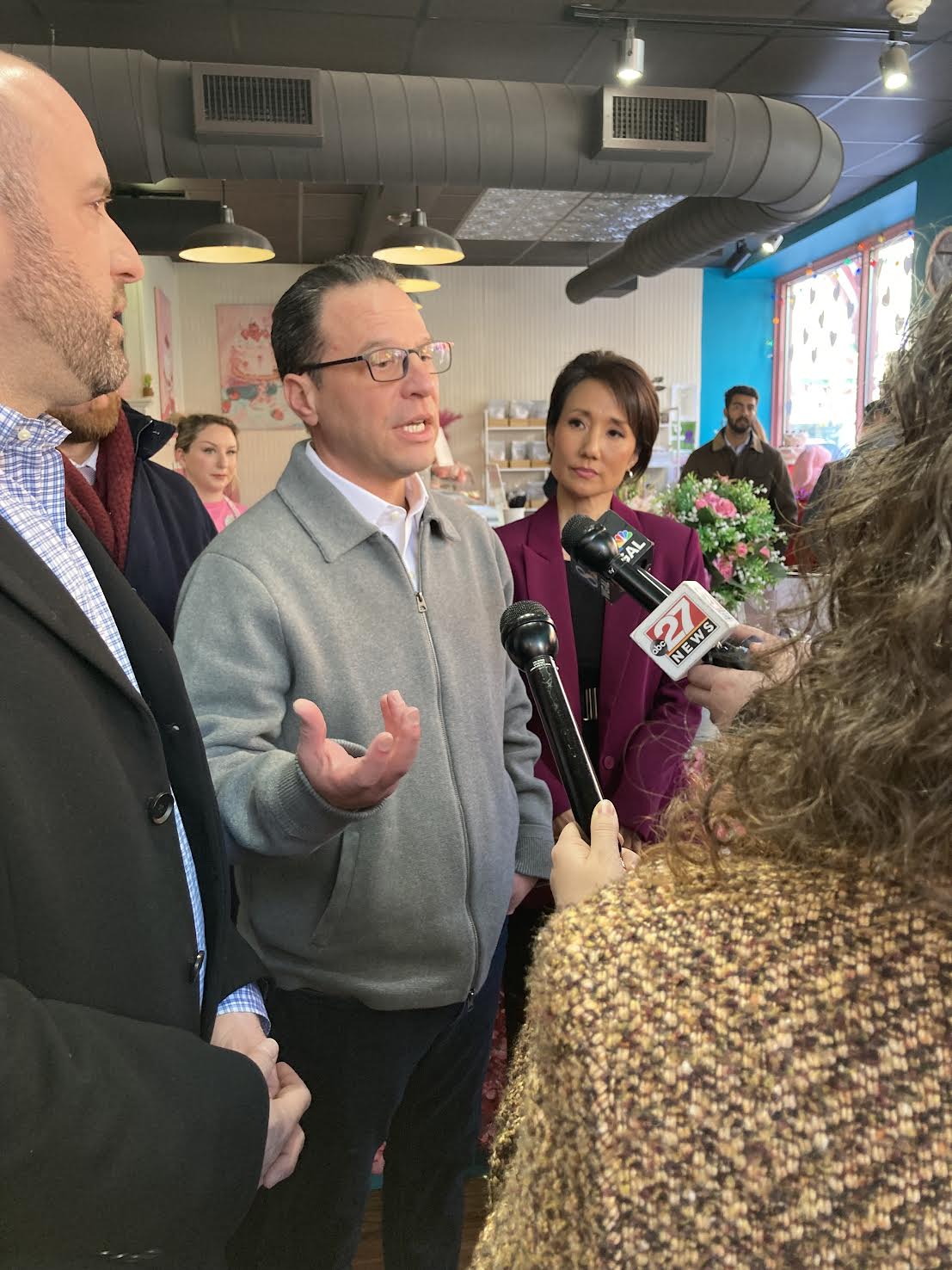
Gov. Shapiro visits downtown businesses, vocalizes support for Harrisburg revitalization plan

Gov. Josh Shapiro talks with Anna Rose Bakery owners Riley and Zach Madar.

Gov. Josh Shapiro paid a visit to several small businesses in Harrisburg on Monday, chatting with owners about the state of the downtown.

The event followed Shapiro’s recent meeting in January with city leaders over what to do about Harrisburg’s struggling central business district.

“I care a lot about our capital city, and this capital city deserves better,” said Shapiro, who held a small press conference inside Anna Rose Bakery on N. 2nd Street. 

He said he is working with city officials and private industry leaders to create a comprehensive plan to revitalize downtown and plans to release more details on the subject in the next few months.

“If I can convene all these folks together to make an investment and to begin a resurgence here, that’s something I believe is a responsibility of mine,” Shapiro said.

He added that he cares about the city as someone who has spent time in it for more than 20 years—first as a state lawmaker, then attorney general and now as governor—and that he has dollars “available” to put toward revitalizing Harrisburg’s downtown.

“What we need is a comprehensive plan and it needs to involve—not just state dollars—but it needs to involve a commitment from the local government,” he said. “And most importantly, it needs to involve private sector capital as well.”

When asked about how confident he was that Harrisburg’s mayor and City Council would be able to work together on such a project, considering the ongoing lawsuit between the two, Shapiro said he made clear to the parties that he was not “going to tolerate any political nonsense.”

“I don’t know the specifics of what they’re battling about,” he said. “I do know that we all care about downtown, and both the council president, the other elected leaders there, and the mayor all made clear that we were going to be working together on this and rowing in the same direction. Whatever other issues they have need to stay outside the context of this plan that we’re putting together.”

Shapiro was joined by state Sen. Patty Kim, and state representatives Dave Madsen and Nate Davidson, who he said have been pushing hard for the downtown revitalization initiative.

“From one resident to another in Harrisburg—we care. We are here. We want to see the city business owners do well and we want the residents to have their input in. It’s incredibly important,” said Kim, promising that people will begin to see change later this year.

Rick Siger, secretary of the Pennsylvania Department of Community and Economic Development, also in attendance, noted that his team has been “looking really closely” at downtown’s sky-high parking rates, the result of a 40-year lease between the city and a state agency.

“It’s part of really an all-of-the-above look at what it’s going to take to help downtown Harrisburg move forward, and we’ll have more to say about that,” Siger said.

Gov. Shapiro and PA Sen. Patty Kim order cupcakes and cookies from Anna Rose.

Zach and Riley Madar, owners of Anna Rose, told the governor that parking was a big issue for their business.

“It’s a constant issue, and it really just scares people away,” Zach said, adding that while the store has two 15-minute parking spots out front, they aren’t enough for many potential customers who’ve grown used to free parking in the suburbs and are “afraid of downtown” due to the cost.

He also also told Shapiro that about 70% of Anna Rose’s customer base consists of state workers.

“If you want to support a local economy, especially in a city like Harrisburg where it’s so commuter-focused, you have to have a working downtown,” Zach said.

Shapiro said Monday he has increased the state’s commitment to bringing those workers back to the office five days a week. 

“We certainly recognize the commonwealth has a responsibility there,” Shapiro said.

Riley expressed another concern to the governor.

“There’s a lot of people who come in and say, ‘What’s there to do down here?’ and I really don’t have a good answer for them,” she said. “There’s not a ton of activities, there’s not a ton of shops, there’s just Strawberry Square.”

She told the governor that she’d love to see more “family friendly” festivals in the city, like Artsfest and Kipona, which usually bring in a flux of customers to the bakery.

Shapiro addresses the press at Anna Rose Bakery.

Shapiro also spoke Monday to McGrath’s Pub owner Adam Sturges.

Shapiro’s involvement with the plan for downtown revitalization comes after the Intergovernmental Cooperation Authority announced this December that it would be giving $50,000 of its own money to the Capital Region Economic Development Corporation (CREDC) toward a downtown revitalization plan.

At an ICA meeting last Wednesday, the state-created agency’s chair, Doug Hill, said that the Pennsylvania Downtown Center will manage the revitalization project, which will now garner commonwealth dollars as well, and that the goal is to have a plan in place in “about six months.”

Shapiro said Monday that his office has “brought together the private sector in a way where they’ve not been organized before” to leverage investment and that the next  step will be putting together a funding package that addresses downtown’s needs.

If you like what we do, please support our work. Become a Friend of TheBurg!

Continue Reading

Harrisburg reminds residents of street sweeping, will continue snow removal

City street

Harrisburg is reminding residents to move their cars during street sweeping hours this week.

City spokesperson Mischelle Moyer said that cars will be ticketed this week if they do not adhere to street sweeping regulations, beginning today.

Capital Region Water will be sweeping streets, and the city plans to use the opportunity for curb-to-curb snow removal as well.

This week is the first of the month and will follow normal street cleaning for the corridors on the 1st and 3rd week of the month corridors.

For a full street sweeping schedule, click here.

If you like what we do, please support our work. Become a Friend of TheBurg!          

Continue Reading

The Week that Was: News and features around Harrisburg

A city worker removes snow from N. 3rd Street in Harrisburg.

Hope you’re all staying warm in our cold, snow-capped city this week. If you make it out and about, be sure to pick up TheBurg’s new February issue, which honors Black History Month, at one of our distribution stands. What’s more, catch up on all our latest news coverage below:

Dauphin County announced Tuesday that it is drafting a 10-year comprehensive plan that will guide land use planning, asking for resident input. Learn more here.

Dauphin County is entering a 20-year intergovernmental cooperation agreement with several neighboring counties for a new Multi-County Regional Youth Detention Center agency, our online story reports.

Harrisburg is looking for a new principal for John Harris, its main high school. Our online story reports that the district is searching for a candidate who can commit to being in the post for at least three years. 

Harrisburg gave residents until Tuesday morning to remove cars from parking garages offered for free during Sunday’s snowstorm, our online story reported. What’s more, Park Harrisburg and SP Plus held off ticketing cars on the street until Thursday

Harrisburg School District received praise from an independent auditor Tuesday at a board meeting who reviewed its financials from 2024-2025. He said the district had a “good start” for its first year back in board control, our online story reports.

HBGVIBE is a new app that uses AI to create itineraries and make recommendations locally for people looking for things to do around the city. Read more in our online story.

Historic Harrisburg announced its top five preservation priorities for 2026, putting the Broad Street Market at the top of its list. Check out the other historical structures identified in our online story.

Matthew Robinson, a late, beloved member of St. Patrick’s Cathedral who passed away suddenly in September, will be honored at a memorial concert next month at the downtown church. Read more about the event in our online story.

Mechanicsburg’s Tower Hill neighborhood boasts a new short-term stay destination, thanks to a local couple. Find the full story here.

Our editor honors late community member Lenwood Sloan in his February issue publisher’s note, as seen in our February magazine.

Our Adventure Together columnist recommends starting the year off right with positivity jars. Read more in our January magazine story.

Our arts blogger recommends upcoming arts events in the area. Read more here.

Penn State professor emeritus John Dattilo provided tips on how to combat loneliness, as seen in our January issue.

Sara Bozich has compiled the best events of the weekend in her Weekend Roundup, including a Plant Palooza at Ashcombe Farm & Greenhouses and Sunday Night Trivia at McGrath’s Pub. Check out the full list.

If you like what we do, please support our work. Become a Friend of TheBurg!

Continue Reading

3 Best Banks for Business Accounts in Pennsylvania

If you’re wondering what the best bank is for opening a business account in Pennsylvania, the answer depends on your business size, cash flow needs, growth plans and a preference for local service versus broad capabilities. Selecting the right bank can help streamline daily operations, provide access to lending when you need it and support your long-term growth strategy. Below is a curated list of top banks for Pennsylvania business owners to explore.

1.   Mid Penn Bank

Mid Penn Bank has been a trusted financial partner in Pennsylvania and New Jersey since 1868, providing comprehensive banking solutions for individuals, businesses and nonprofit organizations. With a strong local presence and community focus, it combines traditional service with modern digital tools to support business growth.

Business banking at Mid Penn Bank includes checking and savings accounts, commercial loans, lines of credit and financing tailored to industries such as real estate, construction and agriculture. Cash management, merchant services and fraud protection help companies operate efficiently while maintaining financial control.

Digital and mobile banking platforms give business owners 24/7 access to account information, payments and transfers, while local advisors provide personalized support and guidance to help businesses thrive.

The bank also offers trust, wealth, and investment management services to help companies and individuals plan strategically for the future. Recognized by Newsweek and American Banker, Mid Penn Bank combines stability, innovation and community engagement to strengthen Pennsylvania businesses.

2.   PNC Bank

PNC Bank provides comprehensive financial services to businesses across Pennsylvania and the United States, combining national reach with digital innovation and local expertise. Its business banking solutions include checking and savings accounts, credit cards, lines of credit and commercial loans designed to support startups, small businesses and growing enterprises.

The company equips business owners with tools to manage cash flow, reconcile payments, and track expenses through digital platforms like Cash Flow Insight and mobile banking, enabling convenient, real-time access to financial information. Payment processing solutions, including point-of-sale systems and online card acceptance, help businesses serve customers efficiently across channels.

Entrepreneurs and established companies receive guidance through resources on starting, financing and expanding a business, supported by advisors who provide strategic insights and operational support.

A commitment to corporate responsibility, sustainability and ethical governance reinforces trust with stakeholders, while a robust national network of branches ensures accessibility, stability and long-term partnerships for Pennsylvania business owners.

3.   Penn Community Bank

Penn Community Bank has been serving eastern Pennsylvania for over 150 years, providing personal and business banking solutions with a strong commitment to local communities. As the largest independent mutual bank in the region, it combines the capabilities of a larger institution with the flexibility to focus on long-term customer success.

Business banking services include checking and savings accounts, flexible financing options and cash management solutions designed to support companies of all sizes. Digital and mobile tools provide 24/7 account access, while local advisors deliver personalized guidance to help businesses manage growth efficiently.

The bank is deeply engaged in community development through volunteerism, charitable contributions and programs that strengthen local economies, support entrepreneurship and promote financial literacy. Its mutual structure allows decision-making to prioritize customer needs over short-term profits.

With $2.9 billion in assets, over 25 banking centers and more than 300 employees, Penn Community Bank combines stability, expertise and a relationship-focused approach to empower Pennsylvania businesses.

Comparing Business Banking Features

When selecting a bank for your Pennsylvania business, it’s essential to evaluate offerings beyond basic checking and savings accounts. Business owners benefit from considering fees, transaction limits, financing options, digital tools and community support. The following table highlights key features of Mid Penn Bank, PNC Bank and Penn Community Bank to help you assess which aligns best with your business needs.

Feature Mid Penn Bank PNC Bank Penn Community Bank
Business Checking Options Multiple tiers from basic to advanced, tailored for small to midsize businesses Tiered accounts for startups to growing enterprises, including specialized accounts for manufacturers Multiple tiers, including Basic, Advantage and Enterprise, and supports small businesses to high-volume operations
Minimum Balance / Fees Flexible balances, low to no fees for most accounts Varies by account tier, monthly fees may be waived with balance requirements Low or waived fees, Advantage and Enterprise accounts offer fee reductions with balance or earnings credits
Cash Management / Merchant Services Comprehensive services including fraud protection, credit/debit cards and mobile solutions Cash Flow Insight dashboard, online payment processing, point-of-sale systems Robust cash management, Automated Clearing House (ACH) origination, online wire services and discounts for high-volume accounts
Financing and Lending Commercial loans, Small Business Administration (SBA) and agricultural loans, and real estate and construction financing Commercial loans, lines of credit, startup financing, guidance for business growth Flexible financing options, including small business loans and lines of credit, and local decision-making
Digital Tools and Mobile Banking Online and mobile banking, mobile alerts and card management Mobile banking, online dashboard, integrated expense tracking Online and mobile banking, 24/7 account access, transaction monitoring and financial education
Community Engagement Long-standing community focus, volunteer initiatives, and environmental, social and governance (ESG) programs Corporate responsibility, sustainability programs, small business and minority support Deep local involvement, foundation support, volunteer programs, economic and business development initiatives

Key Features to Consider When Choosing a Business Bank

Choosing a business bank is about more than just convenience. It’s about ensuring your financial institution can scale with your business, provide reliable support, and offer tools that save you time and money. Here’s what to evaluate when comparing options.

Minimum Deposit and Fee Structure

Consider the initial deposit required to open an account and any monthly maintenance fees. Some banks offer low or no-minimum-balance accounts, which can help startups and small businesses manage cash flow. Review fees for extra transactions, wire transfers or ACH payments. Small charges can add up quickly if your business handles high transaction volumes.

Transaction Limits and Account Flexibility

Most business accounts limit the number of free monthly transactions. Check how your bank defines a “transaction” — such as deposits, withdrawals, checks or online transfers — and whether additional charges apply for high-volume activity. Also, look for flexible account options. For example, tiered accounts that grow with your business or allow bundling of checking, savings and merchant services.

Digital Tools and Online Banking

Robust online and mobile banking capabilities are essential for modern businesses. Features to look for include mobile check deposit, real-time account alerts, invoicing integration, payment processing and application programming interface (API) access for accounting software. These tools save time, reduce errors and help you manage cash flow efficiently.

Local Branch Access and Customer Service

If your business relies on cash deposits, checks or face-to-face banking, branch availability matters. Community banks often provide personalized service and faster problem resolution, while larger banks may offer extended hours and more ATM locations. Evaluate whether your bank provides dedicated business banking representatives who understand your industry and can offer advice.

Lending and Growth Support

Consider the bank’s capacity to provide business loans, lines of credit or SBA loans. Banks that actively support business growth can be partners in expansion, offering financial guidance and favorable lending terms when you’re ready to scale.

Reputation and Stability

Review a bank’s financial stability, local reputation and customer reviews. Reliable institutions reduce the risk to your deposits and ensure the continuity of your operations. Check whether they have been recognized for small business support or community development, which can indicate a bank that prioritizes business partnerships.

Specialized Services

Some banks offer industry-specific solutions, like nonprofit account management, healthcare practice banking or construction business services. If your business has unique needs, seek banks with specialized offerings that simplify accounting, compliance and payroll management.

Finding the Right Bank for Your Pennsylvania Business

Selecting the best bank for opening a business account in Pennsylvania is a strategic decision that can affect your company’s efficiency, growth and financial stability. Local community banks provide relationship-based service and personalized attention, while larger institutions offer extensive digital tools and nationwide support. Evaluating account fees, digital banking features, branch convenience, financing options, and tailored services helps you select a bank that strengthens daily operations and fuels long-term business growth.

Sponsored Content

Continue Reading