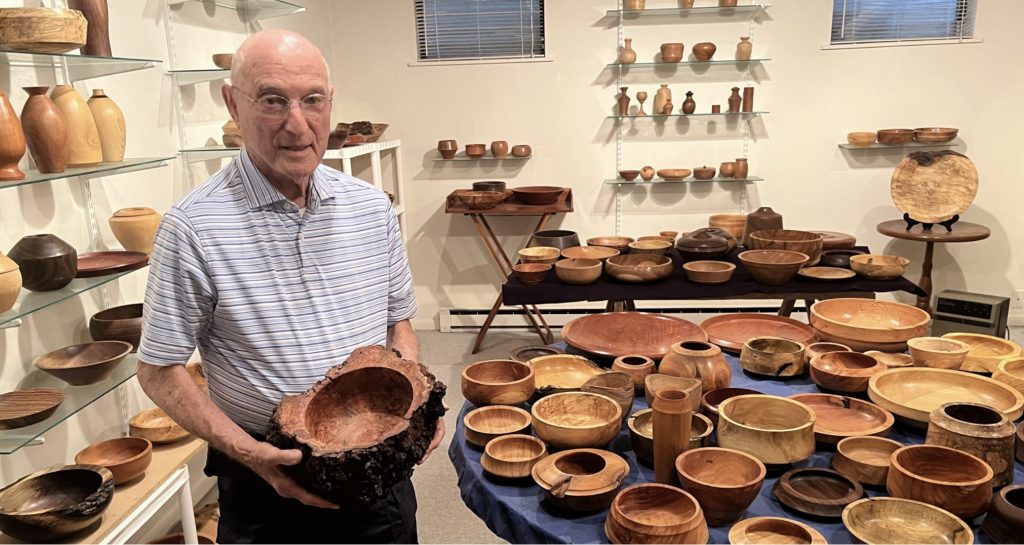
 Ninety-two-year-old Robert Gaynes escapes to his garage almost daily, carving new life into dead trees while re-energizing himself.
The former salesman has been turning discarded wood into bowls, vases and candleholders since he retired more than 30 years ago.
Turning provides Gaynes with instant gratification, allowing him to transform a piece of rough wood into a beautiful bowl in about two hours. He believes it can also be a stress reliever but quickly adds that he does not have much stress in retirement.
“I am addicted to it, I really am,” Gaynes said. “I just love it.”
Turning is an ancient art form. Every piece begins as a log mounted to a lathe. Gaynes, like most turners today, uses an electricity-powered lathe, but turners in the 1600s used foot-powered lathes controlled by a large wheel and twine. Human-powered lathes faded away during the Industrial Revolution to make way for water- and gas-powered machines.
Gaynes dons a smock and safety glasses as he carefully uses a bevel to smooth edges and create shapes as the wood rapidly spins in circles. Once a piece is complete, he applies a lacquer finish to make it shine. Occasionally, the wood breaks, and a piece gets tossed into the scrap pile.
Hundreds of bowls sit on tables, counters and bookshelves in every room of Gaynes’ home in his Colonial Park neighborhood.
“The question is, when does a hobby stop becoming a hobby and become an obsession?” quipped Gail, Gaynes’ wife of 55 years.
She supports his craft but is always quick to give pieces to visiting family members.
“This is the first time I have seen our dining room table in a while,” she said after hosting guests recently. “It is usually covered in bowls.”
Gaynes started turning about 30 years ago when he retired from full-time work. He wanted to stay active but was not interested in typical retirement hobbies like cards and golf. He spotted a lathe in the window of a Sears store while shopping with his father. He purchased it and started a woodshop in his basement.
“The learning curve was terrible,” Gaynes said.
He was determined to excel, so traveled to Utah and Vermont to learn from masters of the craft.
Armed with knowledge, Gaynes’ new hobby took off. He eventually moved his lathe and tools into his garage and turned his basement into a showroom. He encourages all new turners to take lessons and not waste time trying to learn on their own.
“It has been a constant learning process,” he said.
Each type of wood has its own challenges, depending on type and dryness. Gaynes’ pieces are made from walnut, mulberry, sassafras, cherry and what Gaynes jokingly describes as, “I-don’t-know” wood. He has also tried his hand at cabinetmaking, a slow and meticulous process.
Gaynes rarely sells his pieces but often donates them to fundraisers. His biggest donation, much to Gail’s delight, is in the works.
Gaynes plans to give his entire collection of hundreds of pieces to the Jewish Federation of Greater Harrisburg. The federation is opening the Alexander Grass Campus for Jewish Life in Uptown Harrisburg. The six-acre, six-building campus will include a pool, fitness center, senior services, an educational facility, social services and community programs.
Gaynes’ work will be displayed and sold on the campus, with proceeds benefiting the center as well as other nonprofit organizations important to him, such as the United Way and Susquehanna Service Dogs.
Marty Rogoff, Jewish Federation vice chair, recently visited Gaynes’ home and is excited how the sale will boost fundraising efforts. Details are still being finalized, but a spring 2023 date is possible.
“Bob’s work is incredibly beautiful, and the thought that he would be willing to donate proceeds of the bowls to us and other charitable organizations is amazing and heartwarming,” Rogoff said.
To learn more about the art of woodturning, visit the American Association of Woodturners at www.woodturner.org.
If you like what we do, please support our work. Become a Friend of TheBurg!