
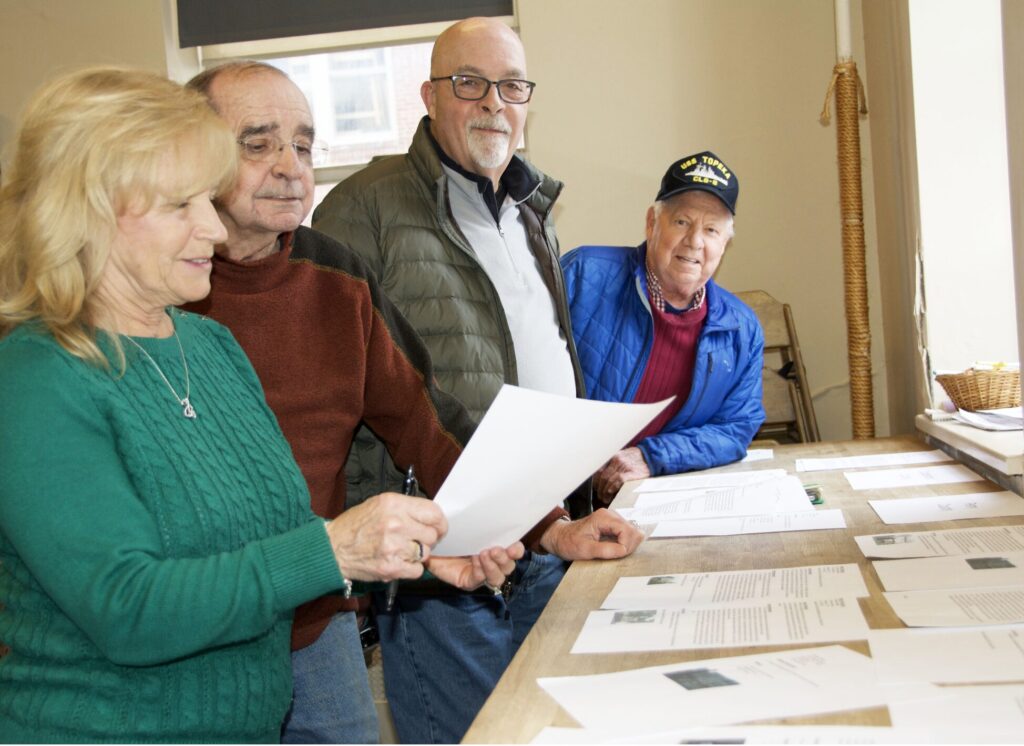
Sue Gebhart and house captains
At the start of March, a group of handy volunteers gathered at Second City Church on a weekday afternoon.
They stood over a row of tables, blanketed by a few dozen project options, eyeing the details of each, eager to choose tasks for Rebuilding Together’s annual “Event Day,” which helps repair houses in Cumberland, Dauphin and Perry counties on the last Saturday in April.
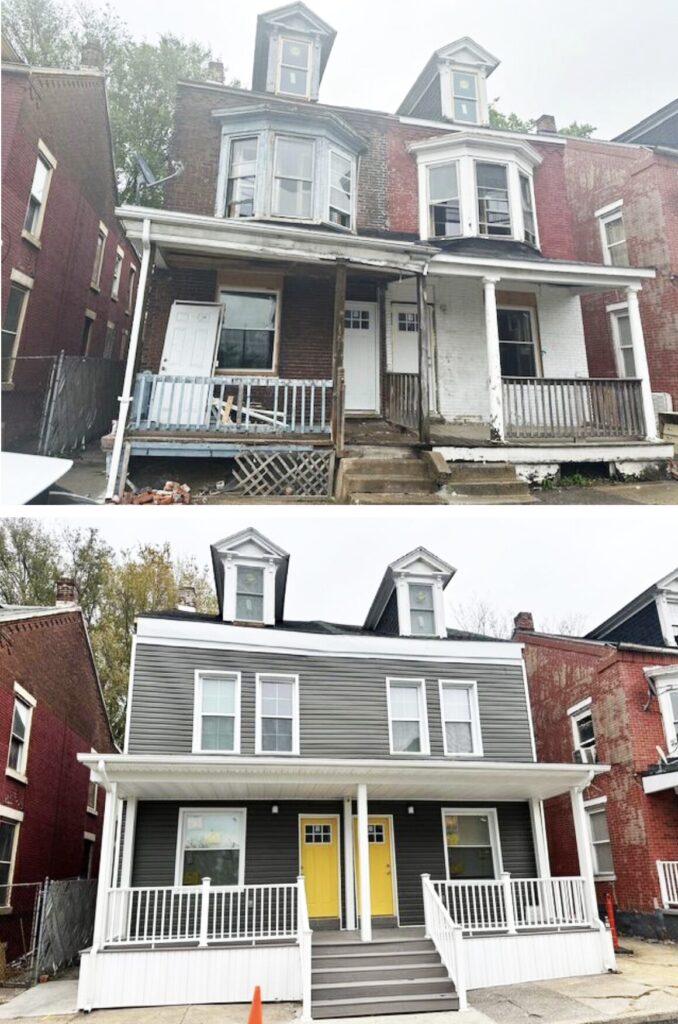
There’s a lot of work to be done and the scope of projects vary. Assignments include repairing soft spots in floors, installing handicap bars, and sealing ill-fitting doors and windows.
The homeowners they’re helping are seniors, veterans, people with disabilities or families with children. They also qualify as low-income. In 2026, this means individuals earning less than $15,960 per year or less than $33,000 for a family of four. Such financial restrictions mean they may struggle to complete home renovations on their own, putting them in a situation that may jeopardize their ultimate wellbeing.
“When a homeowner lacks the financial resources to maintain their home, unhealthy and dangerous situations increase,” explained Sue Gebhart, part-time executive director for Rebuilding Together’s Greater Harrisburg chapter. “No one should have to call an unsafe place home.”
Gebhart, of Mechanicsburg, is the only employee of the nonprofit, which boasts an 11-person board of directors that meets monthly in Harrisburg at Second City Church—the church of the board members who founded the group 31years ago.
Gebhart has worked for Rebuilding Together for roughly two decades, first as program director before assuming her current role. She said the job is special in that it gives her the opportunity to help others, utilizing not just grants and donations but volunteer power.
“We’re supposed to be giving back. We’re supposed to be helping one another,” she said. “That’s pretty much what life’s all about.”

Rebuilding Together volunteer
Leading the Charge
According to Gebhart, Rebuilding Together’s Event Day is its biggest day of the year for projects, putting to work upwards of 150 volunteers.
The keys to the success of the program, she said, are the “house captains”—who take charge organizing their fellow volunteers, as well as preparing a plan of attack for requested repairs.
Bob Brightbill, 55, a building construction technology instructor at Dauphin County Technical School, is one of those house captains. He has been volunteering in the role for the last 25 years.
Last year on Event Day, he led a team that built a 30-foot ramp onto a wheelchair-bound homeowner’s Perry County home, complete with vinyl railings.
The work was done on a cold, windy, rainy day.
“If I was getting paid to work, I’m pretty sure I would have taken the day off,” Brightbill laughed.
Nevertheless, he and around a dozen volunteers from the school—instructors, teachers, students and a bus driver—showed up. Despite the poor weather he said that everybody was happy to pitch in and complete the job, which ultimately took two days.
“It was a beautiful ramp when it was all said and done,” Brightbill said. “It really accented the house. Instead of looking like a handicap ramp that was put on out of necessity, it looked like it was something that was planned and put there—and it was all built by pretty inexperienced volunteers in very harsh conditions.”

Rebuilding Together volunteers
Anyone Can Help
This year, Brightbill will be leading a team to build a set of stairs between the ground and a homeowner’s door for a neighbor located across the street from last year’s ramp.
While he is uniquely qualified for the gig, in that he teaches building construction for a living, Brightbill emphasized that this kind of background is not necessary.
“The necessity to be a house captain is to be organized, to put together your team, and to rely on your team to help you, to help the family improve their situation,” he explained. “Not every house captain that I’ve come across has been extremely skilled in the world of construction. Most of the time, they’re just very willing to put together a team that is very skilled.”
Gebhart added that volunteers working under house captains don’t necessarily have to have building experience—just the ability to be directed.
“The volunteers show up, and they’re advised, ‘OK, this is what we’re going to be doing,’ and they get to it,” Gebhart said.
According to Brightbill, almost any task can be made easy with careful guidance.
“No matter how big the project is, if you break it into small pieces, each of those small pieces is an easy thing to do,” he said.

Executive director Sue Gebhart
Money & Maintenance
House captains come well-prepared to worksites. Before Event Day, each visit their site to evaluate which repairs they can do and scope out how much they’ll cost. They send the prices to Gebhart, who purchases a gift card for the estimated amounts that they can use to buy needed supplies in the days before.
Gebhart said that she applies for grants specific to each project to secure funds, in addition to securing funding through individuals and foundations.
“If we have more grant money, we can do more homes,” she said.
She estimated that Rebuilding Together sees roughly 50 project applications per year. Applying homeowners may be referred by governments, hospitals, schools, insurance companies or local churches. Or sometimes neighbors will find out from neighbors about the program.
In addition to Event Day, the group does projects on a rolling basis for homeowners year-round. It can also help them with emergency situations, if need be. Examples might include burst pipes, broken water heaters, or furnace or air conditioning repairs.
“It can really impact the health and safety of the person,” Gebhart said of such conditions.
Sometimes, repairs also help homeowners with generally unsafe situations—like not being able to access their toilets or to wash dishes in their kitchen sinks or living with moldy carpets.
Gebhart added that aging individuals will often request walk-in shower and grab bar installations.
Other accommodations can make a difference, too. For one elderly homeowner, Gebhart recalled how volunteers completed floor and ceiling repairs, improving lighting in her home in the process.
“She was more excited about the lighting than anything else,” Gebhart said. “Because it’s amazing how when something’s really bright, it just changes the whole atmosphere and your attitude in your home.”
Power of Kindness
Aside from the repairs, Gebhart noted that homeowners also love the camaraderie they experience when the volunteers come to their home.
“We have very caring volunteers,” Gebhart said.
Teresa, a Dauphin County homeowner who received assistance from the organization last year, said that she could attest to this.
“These people made a tremendous difference in my life, and they did it with a smile and laugh,” she said.
A team of volunteers from the Greater Harrisburg Association of Realtors worked on her house in the fall of 2025. She said that she was touched by their kind nature as they replaced window screens, installed smoke detectors, and added a grab bar and no-slip strips in the bathroom for her—all renovations that she emphasized have made her day-to-day life much easier.
“This might not seem like a lot to somebody, but to me, it made a tremendous, tremendous difference,” she said.
In between projects, the volunteers even helped hang Christmas lights on the front of her house.
Which, while it wasn’t necessary, did make her day.
“I remember sitting and watching them and thinking, ‘These are incredible people,’” she said. “I don’t think people realize how much small gestures can impact someone’s life in a grandiose way.”
To volunteer with, donate to, or find more information on Rebuilding Together Harrisburg, visit rtgh.org.
If you like what we do, please support our work. Become a Friend of TheBurg!








 Let’s face it—the process of buying or selling a home can seem overwhelming at times.


 I always thought of my mother as a harbinger of spring.
 On our way to visit friends in Richmond, Va., recently, my kiddo and I spontaneously turned right, transforming our day into an adventure.