Downtown Turnaround: Marking its golden anniversary, Harristown reflects on where it’s been, where it’s going

Construction of Strawberry Square, 1977

In mid-2022, Ashley Crist got a sneak preview of the Menaker Apartments while Harristown Development Corp. was renovating them. When she saw the top-floor unit with the 180-degree views of Market Square, she immediately claimed it as her own. 

“Oh my gosh, it’s beautiful,” Crist said. “Now, I host New Year’s Eve every year because we’re right there by the strawberry drop. I entertain all the time. I’m on the Candlelight House Tour with Historic Harrisburg and let people walk through and get the views. It’s fantastic.” 

In 1974, Harristown was created to help restore a city gutted and unrecognizable from its Bedford Falls heyday. This year, it celebrates 50 years of evolving with the times and, once again, helping lead Harrisburg’s recovery from the upheaval of the global pandemic. 

“Together, we’re making this an interesting downtown that’s a place people can access and enjoy for work, recreation, leisure and residential,” said Brad Jones, Harristown’s president and CEO. “Harristown has brought half-a-billion dollars’ worth of assets to this downtown in the last 50 years, and each project continues to help that get a little bit better.” 


Founded in Crisis 

Carol Cocheres came to Harrisburg in 1975, a young lawyer working for the then-Department of Community Affairs.   

There was nothing going on in Harrisburg in 1975,” said Cocheres, a bond attorney and Harristown board member. “The stores were closing. There was no hotel. It was sort of a dump at that point.” 

Downtown Harrisburg of the 1950s and ‘60s buzzed with activity. Department stores. Boutiques. Movies. But by the late ‘60s, racial protests fueled white flight. The steelmaking and railroads that powered the economy were faltering. In 1972, the floodwaters of Hurricane Agnes made buildings uninhabitable. 

In 1974, civic leaders created an independent, nonprofit organization to renew roughly 50 acres from Chestnut Street to Locust Street. Inspired by the New Town Movement of the era, they named it Harristown Development Corp. 

“The first thing I saw in improvements was Strawberry Square,” said Cocheres. “It was full of shops and the food court. There was even a night club.” 

After building and buying parking garages, Harristown built Strawberry Square in 1980. First-floor retail was designed to lure customers away from suburban shopping malls. Forty-year leases with the Shapp administration to house state workers generated cash flow.  

As Cocheres notes, the lease agreement helped the state compensate Harrisburg for the tax-exempt properties that deprived the struggling city of much-needed revenue. The creation of Harristown “was essential to the commonwealth helping Harrisburg after the difficult times the city was having in the late ‘60s and ‘70s,” she said. 

Projects that followed included:  

  • City Island cleanup. The rundown ballpark where legends Babe Ruth and Josh Gibson once played became the home of the Harrisburg Senators. 
  • Strawberry Square Phase II, a complex puzzle that enclosed alleys and restored streetside retail. “That was a very cutting-edge project,” said Historic Harrisburg Association Executive Director David Morrison. “That was part of the saving of Strawberry Square, giving it a historic feature.” 
  • Facilitating construction projects that changed the face of downtown Harrisburg, including Penn National Insurance, Whitaker Center, Harrisburg University and the UPMC Health Sciences Tower at HU.
  • Construction of a long-envisioned grand hotel in Market Square—the Hilton Harrisburg, completed in 1990. By forging a financing deal with the city and stepping in to manage, Harristown kept the hotel from succumbing to early struggles.  

Of course, there were controversies and lawsuits, as well. State lawmakers and officials questioned the 40-year lease. Competing developers claimed Harristown monopolized downtown redevelopment. The Patriot-News forced compliance with state right-to-know and public meeting laws. Harrisburg City Council members balked at handing over control and bond issues to an entity outside their oversight. 

“The city should have been the dog and Harristown the tail,” said early opponent and City Council member Herbert C. Goldstein.

But Harristown was learning. Frosty relations with city officials thawed and, Jones said, remain positive. Partnerships—a key to initial success—gained importance. In the last decade, private sector investors have seen steady returns on their money and “have a sincere interest in helping the city,” said Harristown board Chair David Black. The thoughtful leadership from 1999 to 2014 of President Russell Ford, a professionally trained planner, laid the groundwork for the visionary style of Jones and prepared Harristown for the COVID pandemic that cratered American downtowns, he said.  

“Office occupancy still isn’t back to where it was, but without the residential downtown, it would be a much different place today post-pandemic than it is,” Black said. 


Here Comes Housing 

“Eds, meds and beds.” That’s the focus of today’s Harristown, said Jones, meaning education, health care and residential. In contrast, retail, once a mainstay of Strawberry Square, has ebbed, a trend that started over a decade ago and accelerated following the pandemic. 

“Nobody’s building new card stores, right?” Jones said.  

Now, anchors include Harrisburg University’s Center for Innovation & Entrepreneurship, the Capital Area School for the Arts, Best Friends Day Care, and one of downtown Harrisburg’s only doctor’s offices.  

And on the floors above, those former state offices now house 22 units of The Flats at Strawberry Square. Today, Harristown has developed, owns and manages about 250 apartments carved out of former office, restaurant and retail spaces.  

In hindsight, early Harristown can’t be faulted for the “somewhat regrettable” demolition of historic buildings in the name of urban renewal, said Historic Harrisburg’s Morrison.  

“They evolved rather promptly in the direction of revitalizing and repurposing historic buildings and taking advantage of the existing building stock that surrounds Strawberry Square,” he said. “They began to see it as an asset rather than a liability in center city.” 

Facing dire need, Harristown was meant to “rebuild faith in the private sector in doing business in downtown Harrisburg,” said Black.

He was on the board for the “monumental moment” when the Hilton flipped to private ownership in 2012. Harristown’s “what next?” conversations led to apartments opening six years before the pandemic made work-from-home a truth universally acknowledged. 

“People from all walks of life are living downtown,” Black said.  

Here in 2024, office tenants are downsizing as employees “are waking up and staying in their pajamas and working on their laptops from home,” Jones said. Harristown can’t convert every vacant office to residences, but “our city, like so many cities, is going to need a reimagining of the use of buildings,” he said.

“That will take a lot of capital. It will take partners. It’ll take creativity. In the end, I think it’ll be good for the downtown,” he said. 

Adding residential units spreads a ripple effect of growth and development throughout the city, including affordable housing and tax-credit projects, said Crystal Brown, board member since 2018 and former director of Brethren Housing Association.  

“While its footprint is restricted, its impact isn’t,” she said. “If there are more businesses and people moving into the city, that helps increase the tax base that allows the city to do more things. It absolutely is a win-win, and Harristown serves a great role and a great purpose in helping others do more of what they do.” 


Future Focused 

Jones has been in the top post at Harristown for nearly a decade now. He’s nearing retirement age, but has no immediate plans to do so. Why? There’s too much “unfinished business.” 

“There are a lot of big projects in pre-development that I would like to help move this company to achieve,” he said. 

The SoMa project revitalizing the blocks of 3rd Street south of Market Street is nearly complete. On Market Street, watch for new uses of the former CVS and Rite Aid stores. “And, hopefully, we’ll be announcing another big new project that will have everyone on the edge of their seats,” he said. 

Harristown plans a 50th anniversary celebration on May 16—in Strawberry Square, of course. Other anniversary events include SoMa block parties from May through October.  

Through awareness of opportunities, Harristown will evolve as the city’s needs evolve, said Black. 

“You don’t always know what’s ahead, but it’s good to keep your eyes forward, and that’s what Brad and the team do,” he said.  

Ashley Crist counts her Menaker Building apartment, the one she rented on the spot, as “by far my favorite” of her city apartments. She crosses the river to walk the City Island loop. She enjoys 3rd in the Burg craft beer tastings in SoMa.  

“Harristown has done so much,” she said. “I feel like every time I turn around and I’m at a cool new spot or something new to check out in Harrisburg, it’s Harristown that’s doing it. They have their hands in a lot of really great things with the city.”

For more information on Harristown Development Corp., visit www.harristown.net.

On April 13, starting at 10 a.m., Historic Harrisburg Association will hold a walking tour of Center City Harrisburg, including a look at Harristown’s 50 years of impact. For more information, visit www.historicharrisburg.org 


Plants + Pints

In the 1970s, many cities built enclosed malls to try to compete with suburban shopping centers, most long gone.

In downtown Harrisburg, Strawberry Square has survived through constant adaptation and renewal, including as an events space. In fact, Harristown Enterprises recently completed the “Clock Box,” a colorful, modern-style meeting and lounge space that juts over the atrium.

This month, Strawberry Square will host one of its largest annual events, Plants + Pints Harrisburg, a family-friendly event highlighting local vegetarian and vegan vendors, craft beverages, wellness and other plant-based products in the community.

Proceeds benefit Downtown Daily Bread, which helps to feed Harrisburg’s unhoused population. The event is presented by Members 1st Credit Union and produced in partnership with Harristown and Sara Bozich Events.

“We so appreciate the Plants + Pints event,” said Corrie Lingenfelter, executive director at Downtown Daily Bread. “With Sara’s efforts, this fun event will bring much needed funds and support to our hungry and homeless populations through Downtown Daily Bread.”

Guests will be able to sample and purchase food and drink from local restaurants, food purveyors and breweries, and shop from vendors who promote locally made and plant-based products.

“We’re excited to return Plants + Pints to Strawberry Square,” said Brad Jones, president and CEO of Harristown. “We’ve seen how interest in a healthy or plant-based lifestyle has grown, and the Harrisburg area has so much to offer.” 


Plants + Pints Harrisburg will take place on April 14, 1 to 5 p.m., at Strawberry Square in downtown Harrisburg. Tickets are $20 (adults) and $10 (under 21; kids under 12 are free) at www.sarabozich.ticketleap.com/plants–pints-2024. A full list of vendors can be found at www.sarabozich.com/event/plants-pints-2024.  

If you like what we do, please support our work. Become a Friend of TheBurg!  

 

Continue Reading

Roses & Resilience: Palmyra Greenhouse owner launches children’s book, grows floral and flower truck business

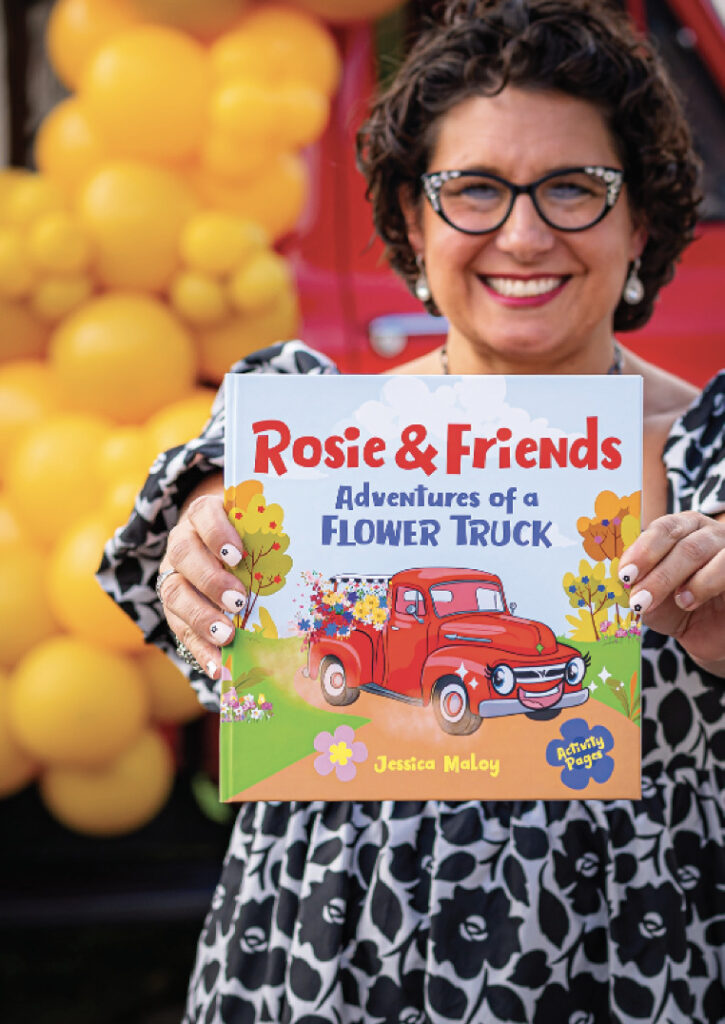
Jessica Maloy. Photo courtesy of Michael Choate Photography.

If you’ve ever passed a red 1953 Ford F-100 oozing florals out of the truck bed in or around Palmyra, you likely know the feeling of joy that Rosie the Flower Truck brings to passersby. 

Rosie may be more than 70 years old, but she’s undeniably making the most of her third act as a product of Palmyra Greenhouse. She’s even the face of a recently published children’s book, “Rosie & Friends,” by Jessica Maloy. 

Owned and operated by Maloy with help from her husband Patrick, Palmyra Greenhouse may seem like a quintessential pandemic-hobby-turned-career on the surface, but it goes much deeper. 

Maloy began her journey by building a greenhouse to protect her plants from critters. Its aesthetically pleasing look and holiday decorations quickly drew crowds, and Maloy began charging people to use the spot as a professional family photo location in 2020.

“We ended up raising over $2,000 and bought Weis gift cards for local families in need of a holiday meal,” Maloy said. 

While she did her best to go through the bureaucratic hoops to make it all a legitimate business, the borough eventually shut the photoshoot operation down. Instead of appealing to the zoning board, Maloy used her precious energy to transform Palmyra Greenhouse into something even more impressive—a fully operational floral service offering various types of arrangements, bouquets and even wearable flowers. 

Stronger Than 

The iconic flower truck is a distinguishing addition to the business.

Maloy’s husband Patrick is wildly handy. He built the greenhouse and selected the vehicle that would become Rosie. By day, he works in logistics for The Hershey Company, but he grew up in a family of antique car hobbyists and general tinkerers. When his wife needs him, he’s right there with his toolkit. 

“What’s going to be the next thing she wants to do is always on my mind,” he said. 

“I think I have him scared,” Jessica Maloy responded in jest. 

The reality is that Maloy has become a go-getter in life, perhaps stemming from her confidence-building experience as a competitive powerlifter.

“I didn’t realize that I was strong until I was in my late 30s,” she said.

Maloy often heard phrases like, “you’re strong for a girl,” but found that to be minimizing.

“Actually, I’m stronger than a lot of the guys,” she said. “So, it’s not just ‘strong for a girl.’” 

Maloy’s children’s book, “Rosie & Friends,” centers around Rosie the Flower Truck but also features family members (pets included). 

The book, ideal for ages 4 to 7, holds a motif that marries the notion of floral-loving femininity and independent strength.

“I wanted to put that in there, for boys and girls who would read the book to know that girls can be strong,” Maloy said. 

In her powerlifting, Maloy can back squat 350 pounds, a feat that helped her gain confidence in other aspects of life. Last October, she quit her job and went full time with the greenhouse operation. This year, she’ll be on the road with Rosie, which has a supply of tools underneath the driver’s seat in case of a breakdown (which has happened, an unsurprising fact for a vehicle of Rosie’s age).  

Maloy and Rosie launched the season with an Easter event at The Star Barn in Elizabethtown. They’ll be at Hershey-based café and bakeshop, Desserts Etc., the second Sunday of each month during the warmer months, giving people the opportunity to treat themselves in more ways than one. In April, the truck will be at a brunch-themed happy hour at the SoMa Pop-Up bar for a Gals That Brunch event. Clearly, Maloy and her family—Rosie included—will be busy this season. 


Bringing Joy

A continuous theme of strength has permeated Maloy’s life, one that will continue to transform her business ventures in unexpected ways. After all, she never anticipated becoming a business owner, let alone a children’s book author.

“I have to be on my toes,” Patrick Maloy said about his wife’s grand adventures.

But he knows it’s for a good reason. 

“What I love about my job is bringing joy to others,” Jessica Maloy said.

Rosie, too, brings joy simply by driving past people. She gets honks, thumbs up and smiles. “Rosie & Friends” also touches on the theme that it’s important to bring joy to others in any way you can. 

Whatever Maloy cooks up next, her tribe will be right beside her, ready to make it happen. In the meantime, the “Rosie & Friends” children’s book, Rosie the Flower Truck events and floral orders from the Palmyra Greenhouse website are plenty to keep smiles on more faces than one.

“When I make flowers and deliver them to somebody, the look on their face is just awesome,” Maloy said. 

For more information on the Palmyra Greenhouse, visit www.palmyra-greenhouse.com or their Facebook or Instagram pages. 


If you like what we do, please support our work. Become a Friend of TheBurg! 
 

Continue Reading

Seeds of Change: Recently, the commonwealth entered a warmer growing zone, some citing climate change. What does that mean for local gardeners?

Photo courtesy of Angela den Hoed

For years, Harrisburg-area resident Cynthia Hogeman has led a group in a monthly bike ride on the Capital Area Greenbelt. In the spring, that has often included spotting the newly bloomed daffodils, hundreds of which she planted herself, in Harrisburg.  

Hogeman has gardened since she was young and, once she retired, studied to become a master gardener through Penn State Extension’s program. Naturally, she loves plants.  

But she started to notice, during the group’s bike rides, that the flowers were blooming earlier and earlier each year. She had once considered hosting a special spring ride just to see the daffodils, but realized their arrival had become too inconsistent for scheduling.  

“I remember when we would do the ride right around tax day and see them,” she said. “But it gradually got earlier and earlier.” 

It wasn’t just the daffodils that she took notice of, but the many plants that were budding out and blooming earlier as the warmer spring weather seemed to arrive sooner each season. 

“If you’ve been a gardener for the long haul, you’ve seen the changes,” she said. In November 2023, new information released by the U.S. Department of Agriculture (USDA) appeared to confirm what Hogeman and many other gardeners were already seeing. In central Pa.—like in much of the nation—temperatures were warming.

Eleven years after its previous edition, the agency updated its Plant Hardiness Zone Map, a tool that gardeners use to determine which plants will thrive in their region, based on the average annual lowest temperatures.  

That update showed that about half of the country shifted up to the next-warmer half zone. Much of central Pa. moved from zone 6b to 7a, meaning that the average annual extreme minimum temperature moved from a range of -5 to 0 degrees to 0 to 5 degrees. 

When the new map was released, the USDA specifically cautioned the public from attributing the warming to global climate change. They cited the highly unpredictable nature of annual extreme minimum temperatures and the use of increasingly detailed and specific mapping methods as possible reasons for the zone changes. The map, which relies on 30-year averages, pulled from data recorded at 13,412 weather stations. The 2012 map only used information from 7,983 stations. 

However, PennFuture, a Harrisburg-based nonprofit environmental advocacy group, linked the changes directly to global warming. In a December editorial response to the map update, they stated that it was “a stark, full-color depiction of the progress of climate change.” 

While many local gardeners and growers aren’t necessarily expecting to see big immediate changes in terms of which plants will or will not thrive in central Pa. with the zone shift, most have their concerns about the long-term effects of warming temperatures.  

Angela den Hoed, owner of Carlisle-based landscape design company Soil + Ink, said that her clients are starting to notice small, incremental changes in the weather too and are wondering what it means for their home gardens. 

“My clients ask me all the time what to expect,” she said. “I say, expect it to be unpredictable.” 


Adaptability Possibility 

Ember Jandebeur, of Susquehanna Township, is a self-proclaimed “plant nut.”  The Dauphin County master gardener and former environmental lawyer, maintains a garden at her own home, while also volunteering at Wildwood Park, the state Capitol’s Hunger Garden and the Harrisburg Cemetery, among other places.  

She has used the zone map to determine which plants would work best for her region and expects that, with the map update, there may be some that previously didn’t grow well that will do better and others that thrived that will begin to struggle. 

The spider lily is one type of flower that Jandebeur said she may “take a chance” on now. The flower typically does best in zones 6 to 10, previously a stretch for growing in Harrisburg, according to the 2012 map, but now may be more reasonable based on the 2023 update. 

For the most part, Jandebeur sticks to native plants, which she believes will generally fare well even with the changing weather. While the definition of “natives” can be different to different gardeners, depending on how broad or specific of a location they look at, Jandebeur plants anything native to North America. Because many natives are already accustomed to the local temperatures, a few degrees difference likely won’t make a significant impact on the plant, she said. 

However, she predicts that the warmer temperatures will fuel the spread of invasive species, those that are not native to this climate.  

According to the North American Invasive Species Management Association, invasive plants are shifting north and taking advantage of the earlier spring warmth by sprouting before the natives do, monopolizing soil space and sunlight.  

Invasive insects are also becoming an increasing threat as the warmer weather allows them to live longer, Jandebeur said. 

For as much as she loves plants, Jandebeur loves birds just as much, especially hummingbirds, or “hummers” as she lovingly calls them. A lot of what she plants, such as salvia flowers, is catered towards attracting pollinators—birds and insects. 

“I’m trying to make a bird way station in the middle of Harrisburg,” she said.  

However, she’s worried that the hummingbirds will not adjust to the unusual blooming times and therefore not get the nutrients they need. According to Jandebeur, only a very small percentage of hummingbirds and songbirds survive to their second year, and without adequate nectar, that could lower their chances of survival even more.  

“They may get caught up without blooms to feed up on before migration,” she said. “Climate change will play havoc, and we don’t know if they will be able to adapt or not.” 


So Unpredictable 

Ultimately, it seems that the new plant hardiness zone map won’t have a huge immediate impact on plant supply, although growers and landscapers are seeing incremental changes, too. 

Local growers and plant centers likely won’t be quick to add or remove plants from their greenhouses. Bryan Benner, the head perennial grower at Quality Greenhouses, a wholesale grower in Dillsburg, said that, because of the highly variable nature of the weather, his work won’t change much due to the new zone map. 

“You can still have some nights that are colder than what the zone says,” Benner said. 

He also said that the company already grows some plants that are in zone 7, as the greenhouse distributes outside of the state, as far as southern Virginia.  

However, if it keeps getting warmer, he does foresee certain cold weather plants dying off. That has already started to happen with plants like the sugar maple tree, he said. But those shifts “don’t happen fast,” he added.  

If the map changes anything for Quality Greenhouses, it may be that an earlier spring brings customers to the greenhouse sooner, which would be good for business, he said. But, that doesn’t negate his concern about climate change, he stated. 

Business will likely remain strong for Harrisburg-area native plant landscaping company, Green Gardner, as well. Owners Jes and Ian Gardner work with residential and commercial clients to plant species that are beneficial to the local ecosystems. As a result of milder winters, last year, they were able to work with clients almost year round, they explained.  

Intentionally utilizing native plants—the Gardners use ones specific to the U.S., often native to the county or region—can actually help ecosystems navigate climate change. Like Jandebeur said, the Gardners explained that the updated zone map doesn’t really affect natives, since they are already well adapted to the local environment. Natives also help make the air and water cleaner, they said. 

“The fact that we need hardiness zones is because we are planting non-natives that are killing our environment,” Ian said. “If we are able to support nature, we can limit the impacts of climate change.” 

Ian did, however, say that he’s concerned about the weather becoming too warm for certain types of native birch trees. 

But maybe even more harmful than the slightly warmer temperatures is the inconsistent and extreme weather—for example, going from a period of drought to heavy rain and flooding, the Gardners said.  

Like den Hoed of Soil + Ink said, expect the unexpected. 

When helping clients with landscape design, den Hoed said that she works to build in resilience. She recommends some plants that will survive drought better and some that can withstand flooding, among others. That diversity can help a garden survive. 

She’s also making sure that, when clients choose plants with long lifespans, like trees, they select species that can weather the warmer temperatures in the coming years.  

“It’s just so unpredictable,” she said. 


To learn more about Soil + Ink, visit www.soilandink.co. 

For more information on Green Gardners, visit www.greengardnerdesigns.com 

Quality Greenhouses is located at 250 Union Church Rd., Dillsburg. For more information, visit www.qualitygreenhouses.net. 

To learn more about the Penn State Extension’s Master Gardeners of Dauphin County, visit www.extension.psu.edu/programs/master-gardener/counties/dauphin or call their hotline at 717-921-8803 to speak with a master gardener.  

Stories on environmental subjects are proudly sponsored by LCSMWA. 

 If you like what we do, please support our work. Become a Friend of TheBurg! 

 

Continue Reading

Special Bond: Mike Strohl and Laura Woltz were neighbors and colleagues—then came a life-saving connection

Laura Woltz & Mike Strohl

There are good neighbors—and then there’s Laura Woltz. 

Woltz, of Silver Spring Township, is an exceptionally good neighbor.  

In September 2023, she donated one of her healthy, functional kidneys to her down-the-street neighbor, Mike Strohl. This, in turn, gave Strohl a new lease on life. 

“My quality of life has greatly improved since the transplant,” Strohl said. “I know it’s a hard decision for someone to make to become a living donor like Laura did. I’m in awe that some people even want to do this.” 

Strohl, 58, was born with only one kidney that, before the transplant, was quickly deteriorating and close to requiring dialysis. He actually didn’t learn that he lacked a second kidney until age 31, after his doctor examined “odd test results,” he said. However, he didn’t notice any related health problems until his mid-40s, when his lone kidney “began to wear out.” 

By early 2023, he realized that he and his kidney were running out of time.   

“The decline was so slow, so it really didn’t affect my life for a while. Until last year, I played ice hockey, I golfed, I fished,” he said. “When it’s close to the end, though, it goes down rapidly. I felt like I needed a nap all the time and just didn’t have any energy.” 

In March 2023, after a series of further tests, Strohl was listed on the National Kidney Foundation’s waitlist, seeking a donor within a 200-mile radius. 

Strohl and Woltz first met in June 2021 through their jobs at UPMC Carlisle. Woltz works at the Carlisle campus’ Hillman Cancer Center where Strohl, who works at the Carlisle location’s blood lab, often delivered blood for patient transfusions. Soon, they became friends, realizing that they lived just nine houses away on the same street. 

Woltz learned about her new friend’s health condition while leisurely scrolling through Facebook one day. She then stumbled upon a post by Strohl’s wife, Melissa, seeking a kidney donor for her husband. Not long before, Strohl had revealed to Woltz that he was living with only one kidney. 

As it turned out, Strohl’s brother, sister-in-law, niece and “two or three other people” also tested as potential kidney donors, but only Woltz was determined to be compatible.  

“I always thought about being an organ donor, but I had never thought about being a living donor until then,” Woltz said. “I was thankful to find out that I was a match for Mike.” 


Saved His Life 

According to the National Kidney Foundation, about 100,000 people currently are waiting for kidney transplants, while a total of 660,000 people live with kidney failure. Besides transplants, treatment options include palliative care or dialysis, a time-consuming process that removes wastes and extra fluid from the blood when one’s kidneys are no longer able to do so. 

In central Pennsylvania, around 103,000 people are on the area’s waiting list for kidney transplants, according to UPMC Dr. Danielle Ladie, who served on Strohl’s transplant team. Of available options, receiving a kidney from a living donor like Woltz is preferable than from a deceased donor. 

“Many people have always thought that you have to be related to donate, but that’s not always the case,” Ladie said. “(Strohl’s) case was really nice. He was very, very close to needing dialysis before the surgery. (Woltz) did an amazing thing. She saved his life.” 

Ladie said that Strohl’s case was unusual because only one in a thousand people are born with only one kidney. In total, 61 kidney transplants took place in 2023 at UPMC Harrisburg Hospital, where Strohl’s surgery was performed. UPMC also performs heart, lung, pancreas, liver and other multi-organ transplants at its Pittsburgh facility. 

“We had six transplants (in Harrisburg) during one week just before Christmas,” said Malini Mattler, media relations manager for UPMC Central Pa. Region. “It was like giving the recipients the best gift they ever had.” 

Strohl’s transplant procedure began on Sept. 8. Woltz was first in the operating room for removal of her donated kidney. Next, it was Strohl’s turn on the table, to remove his deficient kidney and receive Woltz’s gift. 

“It went pretty quick,” Woltz recalled. “I had very minimal pain afterwards. I just couldn’t drive for four weeks after that and had lifting restrictions.” 

Woltz stayed in the hospital just overnight following the procedure, but Strohl remained there for four days. Although his full recovery took a month or so, Strohl said that he “felt like myself by the following weekend.” 

For now, Strohl must continue taking immune suppressant medication for the remainder of his life or the new kidney’s life.  

“I take 20 pills in the morning and another 18 pills at night for now, but I will get to quit the antibiotics in March,” Strohl said. 

While there’s always a chance of rejection, some transplanted kidneys can last for up to 40 years, Ladie said. 

Since the transplant, Woltz said that she feels “an emotional connection” with Strohl. They now “spend a lot of time together” with their families. 

“I’m thankful for how well Mike is doing now,” Woltz said. “I think that I was most worried about how he would do and whether his body would accept the kidney.”

For more information on UPMC in Central Pa., visit www.upmc.com/campaigns/southcentral-pa.   

If you like what we do, please support our work. Become a Friend of TheBurg! 
 

Continue Reading

Different Flavors: Dauphin County tailors its libraries to neighborhood character, needs

Dwana Pinchock

There is so much to unpack at the library. As a little girl learning to read, I would hold my mother’s hand and talk about what we would look for once we arrived.

For me back then, it was always a new book or two to read, in awe of the shelves filled with possibilities. She taught me at a young age that, if I could read, I would be able to go anywhere and do anything I wanted to. It’s something I still often think about because it’s true.  

Today’s library offers these same book resources—but so much more. I recently met Dwana Pinchock, the marketing and public relations manager for the Dauphin County Library System (DCLS), and my eyes were opened to a whole new world.

The system has eight branches, Pinchock explained, and each branch features “a different flavor to meet the community needs.”

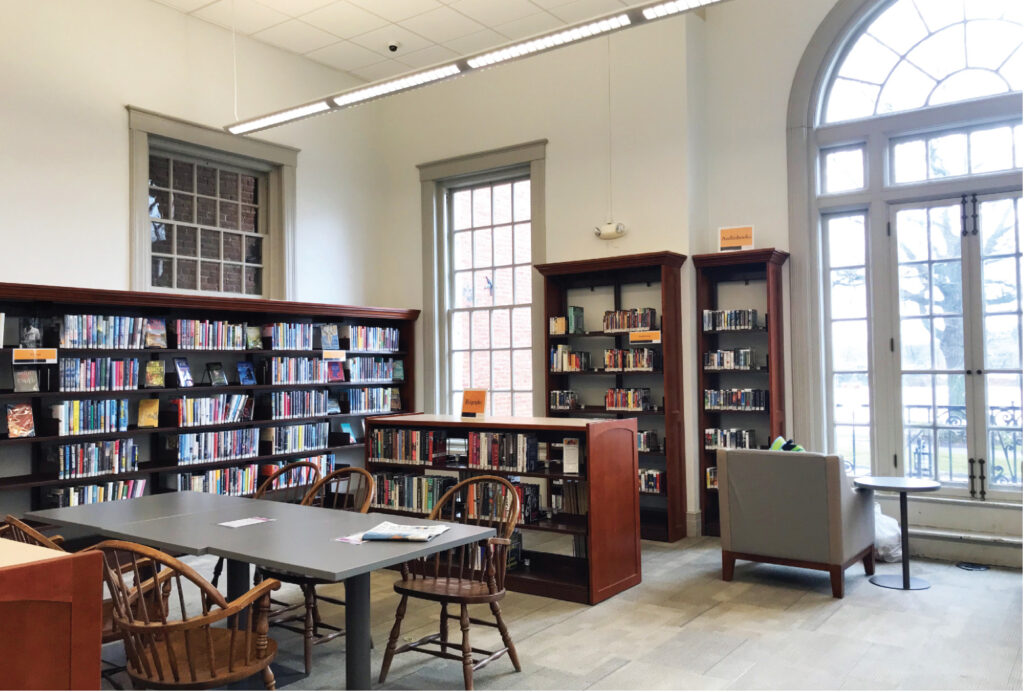
Located downtown, the McCormick Riverfront Library appeals to those exploring the history of Harrisburg, among other interests. The East Shore branch, in Colonial Park, contains an art gallery and offers a safe and comfortable space for teens to hang out. That area will be completely revamped with newly installed gaming consoles sometime this month. In addition, those teens “screen a film monthly” by the famous Japanese production company, Studio Ghibli. Taking that one step further, they get to learn the ins and outs of podcasting.

The Northern Dauphin Library, located in Lykens, is home to a community of quilters and gardeners who love the library’s community garden, complete with a seed bank. It also incorporates children’s programs into the mix.

This spring, the Kline and Madeline Olewine Memorial libraries, both in Harrisburg, will offer crafting and coloring programs for adults, with writing groups in place at the East Shore Library and Alexander Family Library, located in Hummelstown. In addition, there is an ongoing Spanish language conversation group available through Zoom, Pinchock said.  

Soon, the library system will offer more resources to help people help those they love. It’s not easy when those we hold close begin to age and need care. It can be daunting to find information on what steps to take to keep them safe, often with a desire to keep them home, in familiar surroundings. So, DCLS is working to implement “Family Caregiver Resources.”

“We can all agree that our loved ones deserve quality care,” Pinchock said.

Pinchock also spoke of partnerships regarding the “digital equity plan,” intended to make the library’s website accessible to all, including those with vision impairment. She and her team are also advocating for “transcribers” for the hearing impaired. “I am so proud to work with this team at Community Relations for DCLS,” she said.

Pinchock spoke of the library’s emphasis on “diversity, equity and inclusion for all, no matter your background or color.”

“And the outreach extends to all areas, be it rural, urban or suburban,” she stated. 

Among the other “good things” happening at the library: education, workshops, meetings and literacy initiatives, in addition to offering resources to help homeless individuals. 

McCormick Riverfront Library

Personally, Pinchock had a rich upbringing with strong women who mentored and showed her, by example, how to be resourceful, determined and brave, advocating for what is right. So, perhaps her greatest strength is being a compassionate person with a heart to help others. She shared a quote from her grandmother: “A closed mouth doesn’t get fed.” Therefore, she doesn’t shy away from asking for what she needs.

A dear friend once told her she had the gift of language and to fight for those who don’t, saying, “Give people a voice.” In her public relations role, she makes it her mission to advocate for those who are voiceless.  

“Words are so powerful, and the library is a cathedral of words where you can find anything you need from people who will help you find anything you need,” Pinchock said.

For more information on the Dauphin County Library System, visit www.dcls.org.  


If you like what we do, please support our work. Become a Friend of TheBurg! 
 

Continue Reading

People Over Parking: Harrisburg’s parking obsession stands in the way of its progress

Illustration by Rich Hauck

In Harrisburg, car space often is more valued than people space.

I’ve said this for years, my awkward way of pointing out that people often seem more concerned with parking than with adding badly needed housing to the city.

Every housing proposal seems to run up against “the ‘P’ word” (as I call it), as even projects that satisfy the city’s minimum parking requirements inevitably get slammed for not providing enough parking. And my sympathies to projects that don’t conform.

In late February, this parking obsession reached a new low when the city’s Zoning Hearing Board rejected limited parking relief for a proposed 144-unit apartment building, potentially endangering the project.

To be clear—the developer wasn’t asking for much. For a project of this size, the city mandates a large number of off-street spaces, 191, and the developer had 160 on two adjacent surface lots. So, it needed a special exception for the remaining 31 spaces. The zoning board’s answer: “no.”

At this point, I should offer some context.

The project’s location, at 320 Reily St., is currently a vast, sparsely used surface parking lot. It abuts other vast, sparsely used surface parking lots to the north and to the east. So, currently, there are acres of empty, abandoned asphalt, creating a massive dead zone for about five city blocks.

Currently, a stroll up Reily Street is about as welcoming as a stroll through an abandoned ghost town. Once, there were houses and other buildings on these blocks, but they’ve been gone for decades. In its place: blocks and blocks of blacktop.

Further context—back in 2021, the city zoning board gave this same project a much larger parking exception. However, the builder never proceeded with it, so needed to get the project reapproved after reviving the proposal.

So, what changed over the past three years? What made the zoning board refuse a special exception for 31 spaces when it granted an exception for 120 spaces just a few years ago?

Well, first, the personnel on the board changed, so different people with different viewpoints are making the decisions. And, secondly, I fear that, in this city, parochial parking concerns increasingly are overwhelming other, more important priorities.

We saw this two years ago when the city stopped work on badly needed safety and design improvements to State Street, specifically to preserve the parking status quo there. And now we see it on Reily Street, where blocks of empty lots cry out for housing and residents.

Harrisburg, which once had nearly twice the population it has today, has thousands of empty lots. So, there’s plenty of room to build. These buildings would not only add badly needed housing, but would help the city’s struggling businesses, strengthen the tax base and allow the city government to fund more and better services.

According to a 2023 study from the Housing Affordability Institute, parking minimums do the opposite. They reduce housing affordability and availability, as developers need to devote large sums of money and space to parking. Providing parking can dramatically increase a project’s cost, which leads to fewer and higher-priced units, if they’re built at all.

And an empty lot, especially when it’s not even being utilized for general public parking, as in this case, offers essentially no value to the city, its people, its businesses or its future.

At this point, I should lay my cards on the table. To me, a city is people, not cars, so I’m no fan of parking minimums. The world’s greatest cities share a common trait: they have human density, not parking density. To me, vast parking lots are blights on the landscape, making cities less livable, walkable and economically viable. 

In fact, my biggest knock on the Reily Street project is not that it has too little parking, but too much. It preserves two enormous surface lots in order to approach the city’s parking requirement. I understand the need for this right now, but at some point, those lots should be developed, too.  

At the zoning board meeting, one Harrisburg resident who lives near the site spoke in favor of the project and the requested parking relief.  

“I think it’s better that we move in the direction where we can contribute to a dense, livable urban core and walkable neighborhoods that are safe for people who wish to walk places, to bike places, or for any other potential means of transportation,” he told members of the zoning board. “So, I think having a higher density of people compared to cars in the urban environment we have is going to be better for livability.” 

I agree. And, according to an NPR story from January, some cities are reaching the same conclusion. Increasingly, they’re abandoning parking minimums in favor of density, walkability, convenience, affordability and access to amenities.
Harrisburg should consider following this lead. 

Lawrance Binda is publisher/editor of TheBurg. 


If you like what we do, please support our work. Become a Friend of TheBurg!       

 

Continue Reading

Peak Performance: Music is back on tap at the Abbey Bar

Photo courtesy of Moon Peak Productions.

It seems like a lifetime ago, but the Abbey Bar was once one of the hottest places in Harrisburg for live music.

The large space, above Appalachian Brewing Co. on N. Cameron Street, hosted numerous bands a week—local, regional and even national.

Thanks to one emerging production company, those good times are back on the bill.  

Moon Peak Productions, spearheaded by the husband-and-wife duo of Pat and Sarah Combs, struck up a partnership with ABC last year after the regional brewery started exploring ways to bring music back. The first set of collaborative concerts began in February with a show by one of Harrisburg’s favorite funk bands, The Dirty Sweet.  

“We started reaching out to different people in different music production companies in the Harrisburg area who would want to work with us, and what that would look like,” said Samantha Brenner, director of communications at ABC. “We met [Sarah and Pat] through our head brewer [Bruce Tanner], who works with them on the side.”  

The venue, long considered a stronghold for bluegrass and jam bands, will continue to serve as a destination for the music community in those genres while adding a greater variety of acts, said Danny McCoy, Moon Peak’s talent buyer and creative director.

Those new types of shows might include “electronic and DJ shows… psychedelic rock and jazz fusion,” McCoy said. Brenner described the planned band schedule as “eclectic.” 

“We’re trying to stay true to people who know the Abbey Bar for what it is, and was before, but we also want to get to the current vibe in Harrisburg,” Brenner said.  

McCoy also emphasized the organization’s commitment to giving back to the community.

Moon Peak Productions is dedicated to putting together shows and experiences that are produced as sustainably as possible and with charitable components whenever possible, he said. For instance, the company has committed to donating $1 per ticket sold to an area nonprofit, according to McCoy. 

“Having a positive impact every way that we can is a huge part of our mission,” said Sarah Combs. “[We’ll] continually switch it up and circle back. So many groups out there could use a little boost.” 

For now, the organization has been choosing different nonprofits to partner with nearly every quarter, with more than $400 raised for Domestic Violence Services of Cumberland and Perry Counties in 2023. In 2024, the organization plans to make donations to the Chesapeake Bay Foundation, Valley Youth House, Special Olympics Pennsylvania and American Foundation for Suicide Prevention. 


Coming Back 

Physically, attendees will find that the space looks a bit different, as the team has removed all of the pool tables and the venue is standing room only, now capable of holding as many as 400 people.

Lighting and sound have been improved to state-of-the-art designs, and the stage has been modified to make it an easier, better experience for performers, Brenner said. 

But don’t worry about the most important aspect. This reporter confirmed that the space’s beloved giant disco ball still hovers over the middle of the room. 

The Combses, who also are the team behind Mountain Laurel Catering, are taking control of the rental operations of the venue, as well, to keep logistics organized between performances and private parties. The staff working behind the bar during shows will still be ABC employees, though.  

“Coming back to this room has significant meaning to me,” Sarah Combs said, adding that it’s held a special place in her heart for 20 years. “We’re very, very excited to be a part of this reopening.”

Brenner said that the Abbey Bar’s comeback has brought new excitement to ABC itself, which, in 1997, opened as Harrisburg’s first brewpub.  

The whole restaurant is buzzing, the staff are excited, and we’ve had so many people reach out about how wonderful it is,” Brenner said. “We really feel grateful that the community is rallying behind us with this.” 

The Abbey Bar is located on the second floor of Appalachian Brewing Co., 50 N. Cameron St., Harrisburg. For a show schedule and more information, visit www.moonpeakproductions.com. 


If you like what we do, please support our work. Become a Friend of TheBurg! 

Continue Reading

Little Tree Life: Jim Doyle has spent a lifetime dedicated to the art of Bonsai

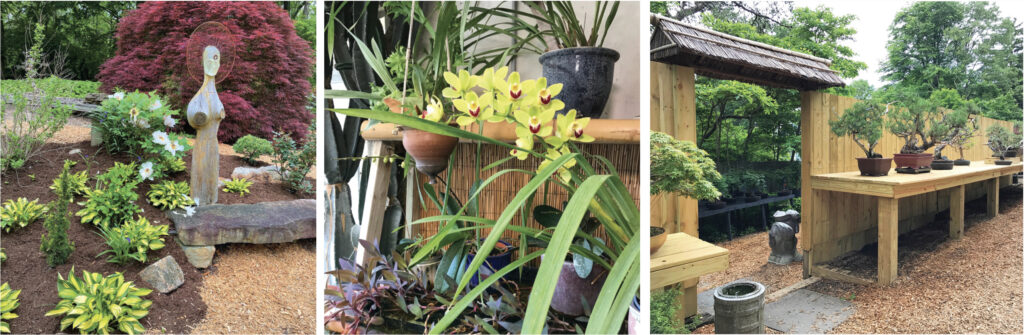
Scenes from Nature’s Way Nursery

Spend a few hours with Jim Doyle, owner of Nature’s Way Nursery in Linglestown, and you may find yourself looking at trees in a whole new way. 

Not just as something that provides shade, cooling and refreshing you on the hottest summer day. Not just breaking up the monotony of buildings and blacktop, or absorbing water falling from the sky or rushing across the ground. 

Beyond all this functionality, every tree has a design. Most of us may not even notice it, or if we do, we are content to let nature shape the design, what the sculpture will become. We are onlookers. 

For 51 years and counting, Doyle has been an active participant in the sculpting of trees—the ancient art form known as Bonsai. 

Bonsai done right means that the intervention of man—or woman—is not apparent in the sculpting of the tree. 

Now 72, Doyle was a dancer for 30 years. That experience shapes what Doyle sees when he considers a tree—in its simplest terms, the trunk as the torso of a body, the branchings as the arms and legs. 

Most works of art—a painting, for example—have a start and finish. At some point, the artist puts down his or her brush and says, “That’s it.” 

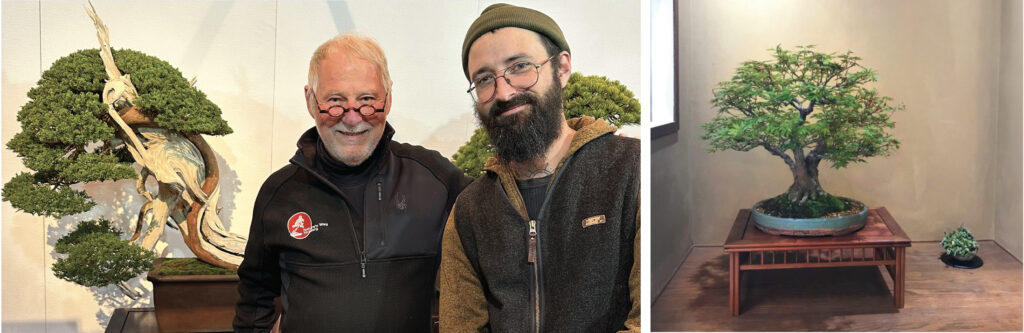
Jim Doyle with his son, Max Doyle

Not so with Bonsai.  

“Bonsai is never done. It’s a living art; it is continually growing,” Doyle said. “It’s the only living art that I know of that is continually growing.” 

Bonsai does not end, even when a tree dies. The lessons learned are passed on. 

“I’ve killed a lot of trees,” Doyle said. “I’ve always said that, through death, there is knowledge. Each time a tree dies, I hope to learn something so I keep the next tree alive.”  

Bonsai started as a hobby for Doyle. It then became a passion, one from which he has made his living.  

He tells his wife Libby he is going to work, when actually he’s going to play. Bonsai keeps him active, mentally, physically and creatively. 

“When something is bothering me, I escape in a tree,” he said. 

He’s also very good at it. Doyle is sought after to give presentations on Bonsai throughout the United States, Canada, Europe and elsewhere. 

The soft-spoken Doyle isn’t one to sing his own praises. He’s needed a little coaxing at times, such as when Libby—a lecturer in her own right as a distinguished professor at Penn State—invited him to accompany her while she was teaching at universities in Ireland and in New Zealand. 

“Before I knew it, I had a little tour in Ireland and a little tour in New Zealand,” he said. “It was a great experience, and they threatened to have me back, so I guess I did something OK.” 

Jim’s daughter, Nell Leaman


Never Stops 

Before Doyle could teach Bonsai, he had to learn it. 

First exposed to the art at Longwood Gardens in 1973, Doyle sought out Chase Rosade, who had a Bonsai nursery in New Hope and became his mentor. 

Rosade let Doyle shadow him as he worked on trees. One was a 50-year-old Japanese maple—2½ feet tall.  

Later that day, a college classmate taught Doyle tree climbing. Seventy feet above ground in another 50-year-old maple, Doyle had an epiphany: the proportionality, movement and branching of the two trees were the same. The only difference was their size. 

By then, Doyle and a partner had started Nature’s Way. The name comes from the 1970 song by the rock band, Spirit.  

Horticulture degree in hand, Doyle spent his first year in business living in a tent with his dog, Life, clearing land to plant trees and shrubs for his nursery. 

His passion took him to China, where the art started about 2,000 years ago, then to Japan, where Bonsai migrated from Korea about 800 years ago. 

Doyle has had an enduring fascination with Japan, visiting the country about 15 times since 1984 to attend the world-renowned Kokufu-ten Bonsai exhibition, held annually in Tokyo. 

His most recent pilgrimage to Japan was in February, accompanied by his son, Max, who lives in Alaska. 

Doyle and another Bonsai enthusiast started Susquehanna Bonsai Club in 1980. The club grew to 200 members before spawning other clubs throughout the midstate. 

Interest in Bonsai grew “tremendously” following the 1984 movie, “Karate Kid,” Doyle said. 

Bonsai also became more popular during the COVID-19 pandemic. People trapped inside needed a new hobby. With Zoom, they could learn Bonsai from Doyle and other experts without leaving home. 

These days, Doyle is back doing in-person instruction at Nature’s Way and elsewhere. If you see a class you like, Doyle suggests you sign up early as classes fill up fast, testimony to Bonsai’s popularity in the Harrisburg area. 

Doyle is also excited about the region hosting the Mid-Atlantic Bonsai Society Show April 19 to 21 at the Holiday Inn Harrisburg-Hershey in Grantville. 

Doyle isn’t among featured presenters, but he will be there soaking up knowledge. At 72 years young, the learning never stops. 


Nature’s Way Nursery is located at 1451 Pleasant Hill Rd., Harrisburg (Linglestown). For more information and to sign up for Bonsai classes, visit www.natureswaybonsai.com. 


If you like what we do, please support our work. Become a Friend of TheBurg! 

 

Continue Reading

April News Digest

Affordable Housing Project Breaks Ground

Developers have begun work on a new affordable housing project in Harrisburg. 

Former NFL player LeSean McCoy and his development company, Vice Capital, ceremonially broke ground last month on JMB Gardens, which will provide low-income housing on N. 6th Street. 

“It’s a celebration for our community,” said McCoy, a Harrisburg native. “We are here to be the difference and make a change.” 

JMB Gardens will consist of four rowhome-style buildings built on several currently vacant plots of land on the 2200- and 2300-blocks of N. 6th Street. In total, the project will provide 41 affordable units, consisting of one-, two- and three-bedroom apartments, as well as a community center. 

The entire project cost is around $16.7 million, including funding from the Pennsylvania Housing Finance Agency (PHFA). 

Construction on JMB Gardens is expected to take 12 to 14 months, according to Ryan Sanders, vice president of development for Vice Capital. 

McCoy and Vice Capital are also currently working on another housing development on N. 6th Street, on the 1500 block. The “Savoy 48” will include 48 apartment units, 10 of which will be affordable by federal standards. 

While that project broke ground in June 2023, Sanders said that construction has been delayed, but will likely begin in the coming months. 


Harrisburg District Approves School Reconfiguration

The Harrisburg School District’s building configuration will look different in the coming academic year. 

At a recent board meeting, Receiver Dr. Lori Suski approved the opening of some school buildings, the closing of others, and the moving of several grades to different buildings for the 2024-25 school year. 

At a meeting in November 2023, Superintendent Eric Turman presented several options for reconfiguration, which he said would help balance student populations at each building, create neighborhood schools on the elementary level, and allow the district to prioritize facility improvements. 

Suski approved the plan, which includes removing students from Scott Elementary School and repurposing the building. Additionally, the Lincoln Administration Building will be used as an elementary school. The plan also includes phasing out Rowland Intermediate School over three years and moving those students to Camp Curtin Middle School. 

In addition, the plan includes enrolling only sixth- through eighth-grade students at Marshall Math Science Academy, which currently includes the fifth grade. Cougar Academy, now housed in the Lincoln building, will move to the Hamilton building on N. 6th Street, replacing the Specialized Services Education, Inc. program, which will move to Scott temporarily. 

Also wrapped up in the reconfiguration is the re-opening of Steele Elementary School, a long-vacant building that the district has been renovating. Steele will contribute to creating more neighborhood-based schools on the elementary level, Turman explained. 

Historic Status for Zembo Shrine 

A notable Harrisburg building has received national recognition for its history. 

Zembo Shrine, on N. 3rd and Division streets, recently announced that it is now on the National Register of Historic Places. The Shriners hope that the new designation will offer opportunities for growth. 

“It’s something we are very proud of,” said Mike Smith, former Zembo potentate. “It shows the community what we are about.” 

Several years ago, the fraternal organization had put Zembo, which was built in 1929, on the sales market, stating that maintaining the building had become too costly. However, in February 2022, the Zembo Shriners pulled the building off the market, opting to retain and restore it as an event space. 

“Just talking to people who aren’t even Shriners, I’ve seen what Zembo has meant to them,” Smith said. “People love Zembo and want it to stay in our hands.” 

Once they decided to keep the building, the Shriners moved forward with the process of registering it as a National Historic Place, citing its unique Moorish Revival-style architecture. Zembo partnered with the Historic Harrisburg Association (HHA), which helped the organization raise donations for registration process costs. 

“We are delighted that HHA was able to provide technical and administrative assistance to Zembo in the challenging process of seeking and successfully securing a National Register listing,” said HHA President Jeb Stuart. 

With the designation, Smith said that Zembo can now apply for certain grants that are only made available to properties on the register. The organization has also been working to make upgrades in the building, recently replacing the HVAC system and completing roof work. 

And while membership has been on the decline over the years, Zembo still has about 1,350 Shriners who meet in the building. 

To celebrate Zembo and its addition to the National Register of Historic Places, HHA will host “A Toast to Zembo Shrine!” at the Shrine on Friday, May 17, from 6 to 9 p.m. The event will also honor recipients of HHA’s 2024 Preservation Award. 


East Shore Y Weighs Remodel, Expansion 

Big changes may be coming to the East Shore YMCA as the organization is taking a step forward in the planning process.  

Last month, the Y issued a Request for Expressions of Interest in hopes of finding a developer partner to play a role in the proposed renovation of its N. Front Street facility.  

A year ago, Y officials told TheBurg that they were in the preliminary stages of a plan to upgrade and possibly expand on the aging, historic building. According to Harrisburg Area YMCA President and CEO David Ozmore, the East Shore Y has faced significant financial challenges due to the pandemic and the age of the building, which was built in the 1930s. 

“It’s a costly infrastructure,” Ozmore said. “Our facility needs to be modern.”  

While most of the exterior of the building can’t be changed, due to guidelines for historic properties, the Y is interested in possibly remodeling inside its building, the wellness center and its adjacent administrative office building.   

In total, the Y owns 2.16 acres of land that could be utilized for the project.   

Through the request for interest, the Y hopes to find developers that are interested in partnering with them to help design, fund and execute the project, Ozmore said. A developer could also potentially help connect the Y with other organizations interested in operating in the renovated facility.  

“We’d love to collaborate and work with other nonprofits under one roof and share costs and share expenses,” he said. “That would be a much more efficient way to operate.” 

That could include clinics, mental health providers, nonprofits, social service providers and retailers sharing space inside the new Y building.  

However, if the Y doesn’t receive interest from developers, the organization would move forward with taking on the project by itself, which Ozmore said would likely be more costly, up to an estimated $30 million, for the Y.  

The Y will solicit interest from developers for the next several months, with a goal to conduct interviews with developers and deliberate at the end of the summer. Ozmore said that he hopes to have a site plan ready by next year.  

The total project construction is expected to take around five years to complete.  


Home Sales, Prices Higher 

Home sales inched up as prices recorded strong gains in the Harrisburg area in February, according to the latest report on previously owned houses. 

For the three-county area, sales totaled 373 homes, compared to 368 in February 2023, as the median sales price rose to $264,000 from $234,950, said the Greater Harrisburg Association of Realtors (GHAR). 

In Dauphin County, 171 homes sold, eight fewer than a year ago, but the median sales price increased to $220,000 from $205,000, GHAR stated. 

Cumberland County had 185 home sales, versus 157 in the year-ago period, as the median sales price rose to $299,900 from $270,000, GHAR said. 

In Perry County, 21 homes sold, a decrease of two sales, as the median sales price went up to $260,000 from $215,000 in February 2023, according to GHAR. 

The pace of sales was nearly unchanged from a year ago, with 31 “average days on market” compared to 30 days in the year-ago period, GHAR said. 


So Noted

Allison Kierce was promoted last month to president and chief operating officer of Junior Achievement of South Central PA. Tom Russell will continue in his role as CEO, according to the organization. 

 Ellen Min has been named senior vice president and chief equity officer of the Central Pennsylvania Food Bank, according to the organization. Min previously served as a manager for Reach Cyber Charter School, an adjunct professor at Elizabethtown College and head of school at St. Stephen’s Episcopal School.

John Clare last month was named artistic director for Gretna Music, known for its summer series at Mt. Gretna Playhouse. Clare has been programming classical music for radio audiences for 29 years, including at WITF, and most recently hosted Sirius XM’s Symphony Hall, where he will continue as the morning host.

Kedar Revankar has been named the chief operating officer for Mechanicsburg-based West Shore Home, according to the company. In this role, he will oversee operations, warehouse and inventory, bringing 20 years of supply chain management to the company.

Penn State Health last month cut the ribbon on a new outpatient practice, the Penn State Health Medical Group—Millersville. The medical clinic offers primary care, sports medicine and on-site lab services to patients in the community from the location at 15 Shenks Lane, Millersville.

Changing Hands 

Bailey St., 1188: R2 Investors LLC to 371 Chelsea Street LLC, $100,000

Bigelow Dr., 14: R. Love to VAB Investments LLC, $98,000

Chestnut St., 1918: A. Smith to D., A., C. & S. Pittman, $65,000

Chestnut St., 1961: Normans Realty Service Inc. to F. Olivo, $98,500

Derry St., 1429: P. Sisemore & K. Hugo to D. Keech, $96,684

Derry St., 1952: Malesic Group Inc. to SNB Real Estate Solutions LLC, $130,000

Emerald Ct., 2456: J. Seelbinder to D. Tamang & R. Bhandari, $159,000

Evergreen St., 23: A. Giambanco to Destiny Harrisburg LLC, $144,000

Forster St., 1831: Progressive Retirement Solutions to W. Quezada, $62,000

Forster St., 1839: GZL Corp. to D. Henderson, $63,500

Forster St., 2002: R. Speece to D. Illanes, $86,000

Geary St., 613: P. Briseno to 613 Geart St LLC, $70,000

Green St., 1011: J. Umble to JM Thrift & Vintage LLC, $115,000

Green St., 1303: D. Reinhart to J. Johnson, $175,000

Green St., 1310: K. & K. Daczka & A. Johnson to K. White, $205,000

Greenwood St., 2113: Parcview 135 Corp. to Wisechoice USA LLC, $52,000

Hoerner St., 113: L. Palmer to Balaci Properties LLC, $95,000

Hoerner St., 115: L. Palmer to Balaci Properties LLC, $95,000

Hoerner St., 125: L. Palmer to Balaci Properties LLC, $95,000

Hoffman St., 3214: D. & C. Harmon to Honest Home Solutions LLC, $117,700

Holly St., 2020: First Choice Home Buyers LLC to F. Berrun, $127,000

Kelker St., 235: D. Robinson & J. Vu to S. Swanson, $217,500

Kelker St., 315: C. Nicassio to Roar 315 Kelker LLC, $138,995

Kensington St., 2259: Lansanah Home Services Group to J. Fernandez, $131,000

Luce St., 2350: J. Yohn to E. Vega, $145,900

Maclay St., 331: J. & S. Compton to D. Joseph, $184,900

Manada St., 1928: B. Do to B. & V. Doan, $60,000

Market St., 1220: Upscale Properties LLC to E. & N. Footman, $240,000

Market St., 1808: W. Chavez & K. Flores to M. Perez, $135,000

Mulberry St., 1844: Custodian FBO Ray Dunkle IRA Trust to J. & B. Vergis, $107,000

N. 2nd St., 1337: I. & R. Bloser to Calcor Holdings LLC, $135,000

N. 3rd St., 2206: Grentals LLC to Golden Property Holdings LLC, $250,000

N. 4th St., 2312A: G. Smith to R. Elliott, $157,500

N. 4th St., 2430: Nationstar Mortgage LLC to M. Wassef, $68,900

N. 4th St., 3301: Invariant Real Estate II LLC to Z. Porter & N. Everston, $163,000

N. 6th St., 2533: D. & R. Wieand to 371 Chelsea Street LLC, $121,000

N. 6th St., 2724: J. & A. Fabre to 248 S Quince St LLC, $85,000

N. 7th St., 2642: Integrity First Home Buyers LLC to J. Lapp, $72,000

N. 13th St., 131: F. Contreras to PACC HBG 2 LLC, $120,000

N. 14th St., 231: Bedrock Capital Management Inc. to D. Boyle, $59,000

N. 15th St., 220: J. Medina & F. Morocho to L. Figueroa, $135,000

N. 15th St., 917: M. Sadi to JTA Consulting Group LLC, $60,000

N. 16th St., 900: T. Casteel to I. Ahmed, $252,000

N. Cameron St., 101 & 109 and 111 Hancock St.: R. & S. Otto to RS3 Ventures LLC, $227,000

N. Front St., 1117 & 1119: R. Laguna & L. Maloney to R. Laguna, $100,000

Paxton St., 1631: M. Doeur to EA Capital LLC, $80,000

Penn St., 1824: BCR-1 Properties LLC to R. Arambiges, $250,000

Penn St., 2126: J. & S. Compton to Lift Legacy Partners LLC, $110,000

Radnor St., 411: R. Gillis & K. Baran to 2020 Real Estate Ventures LLC, $75,000

Randolph St., 1511: Culcay Remodeling & Gaugua Remodeling LLC to R. Cespedes, $180,000

Reel St., 2417: JRHeller.com LLC to 2417 Reel Street LLC, $59,000

Reel St., 2423: D&L Development Group Inc. to EA Capital LLC, $84,900

Reily St., 109: K. Bardon & E. Cameron to S. & E. Harris, $230,000

S. 17th St., 415: A&K Investment Partnership LLC to A. Caceres, $145,000

S. 17th St., 542: G. & M. Garcia to Figueroa Enterprises LLC, $75,000

S. 18th St., 159: M. Ayyad & A. Abdel to Val de Vie Estate Investment LLC, $64,000

S. 18th St., 1224: L. & C. Guzman to A. & E. Castillo, $195,000

S. 20th St., 19: W. & M. Kharalah to CJ Good LLC, $90,000

S. Front St., 611: F. Barton to Vaugh Real Estate & Investment and Colon Investments LLC, $200,000

S. Front St., 705½: S. Jackson & C. Colon to A. Harris, $206,000

State St., 211: State Capital Property Holdings LLC to Z. Herbert, $485,000

State St., 1522: L. Marquez to J. Pownall, $178,000

State St., 1907: DTJ Associates LLC to K. & S. Collins, $181,050

State St., 1918: Faraone Properties LLC to M. & A. Cottrell, $217,000

Susquehanna St., 1627: H. Dana to J. Case, $110,000

Thornwood Rd., 204: J. Schimmel to New Holland Enterprise Management LLC, $190,001

Whitehall St., 2031: C. & N. Bickel to Dem Estate Investment LLC, $63,500 

Harrisburg property sales, February 2024, greater than $50,000. Source: Dauphin County. Data is assumed to be accurate. 


If you like what we do, please support our work. Become a Friend of TheBurg!       
 

Continue Reading

April Publisher’s Note

When I started TheBurg, I never imagined that we’d be contributing to our area’s
horticulture. But, weirdly, that’s turned out to be the case.

You see, every month, we get a massive quantity of new issues delivered to our
office. These copies are piled high, on strong pallets, before our incredible
distribution team fans out across seven counties to bring them to the coffee shop,
diner, library, store, etc., near you.

This is when TheBurg goes from being a news product to an agricultural product.
After our delivery team loads up their vehicles, they leave behind a bunch of stuff,
most of which is then claimed and repurposed.

So, our wooden pallets have been used to build gardening beds, chicken houses and
other infrastructure. Gardeners love our large, heavy blocks of cardboard (which we
use to separate rows of bundled copies) for weed control. One avid gardener even
calls them “Binda boards,” though I can take no credit for them other than
temporary possession.

People have told me they’ve shredded old copies of TheBurg for animal bedding,
which brings to mind the old “birdcage lining” joke, but is actually fine with me. And
our local grocery store, Radish & Rye, often uses our heavy paper to protect its
glassware. This is another great use of old copies, though I find it surreal unpacking
my milk or juice only to discover my own words wrapped around a bottle.

As community advocates, we’re delighted to know that these products have a
second life and that we contribute in a small way, and, admittedly, by accident, to
the local food chain.

I bring this topic up because April is our annual “Home and Garden” issue. This year,
we’re a bit heavier on “garden” than usual, but that seems appropriate with so many
people today growing their own vegetables, fruit, flowers and plants.

So, enjoy all of our content—agricultural and otherwise—and, once you’re done
reading, maybe you can find a novel and environmentally friendly way to repurpose
and reuse your own copy of TheBurg.

Lawrance Binda
Publisher/Editor

If you like what we do, please support our work. Become a Friend of TheBurg!
Continue Reading