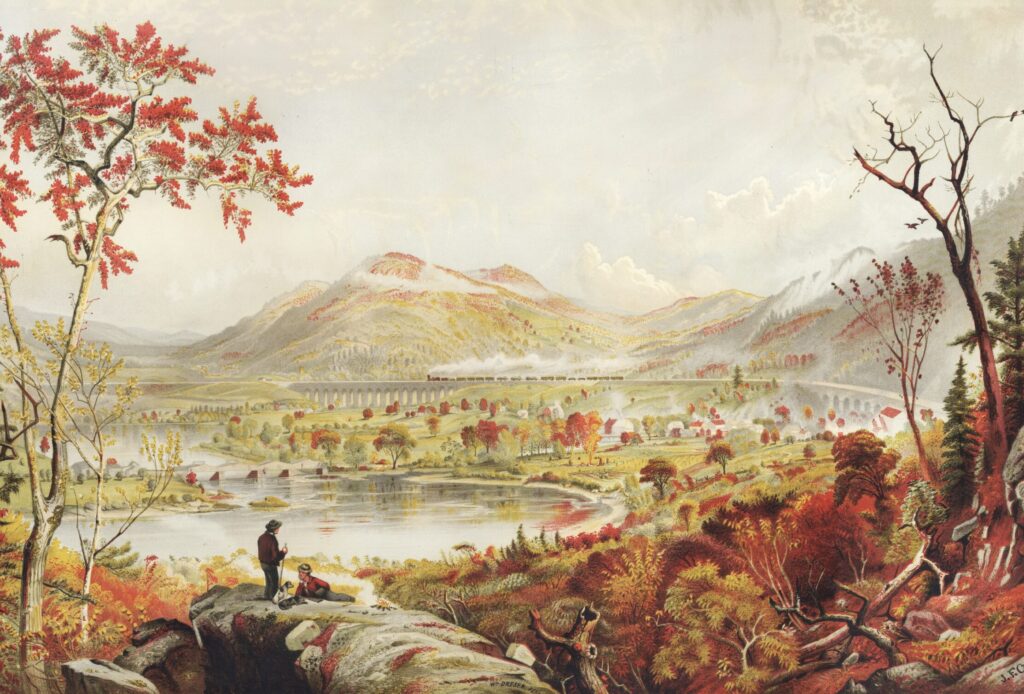
Image courtesy of Susquehanna Art Museum
Our identity as Americans is intertwined with the place where we live and its impact on our daily lives. So many things in our area owe their name to our best-known landmark, the Susquehanna, even a museum.
In Harrisburg and locales close by, the Susquehanna River plays a role so vital that it is far more than just a body of water. It is a constant reminder of how beautiful life is along the river, no matter the season or time of year. “American Identity: Restoring the Susquehanna River’s Artistic Legacy” opened on March 14 at the Susquehanna Art Museum (SAM). It unveiled a far-reaching survey of art that encompasses 400 years of assembled works across a wide variety of mediums.
Mounted by collectors and curators Rob Evans and James Snyder, the exhibit became a team effort by SAM’s leaders to bring it to Harrisburg for an extensive run through June 28. Now in her first full year as the director of exhibitions, Rachel O’Connor has a passion for this exhibit partly because its subject matter, the Susquehanna River, is in our own backyard and is a major focal point stretching for miles along Front Street.
“This survey should resonate with everyone who calls the Harrisburg area home,” she said. “To think that our river has inspired so many artists categorically and stylistically is remarkable. Art truly does imitate life.”
Sets the Tone
With its existence over 325 million years, the Susquehanna River originated in the Paleozoic era, making it one of the oldest river systems in the world, even older than the Nile. At 444 miles long, it holds the distinction of being the longest commercially non-navigable river in the United States. The Susquehanna plays a crucial role as the Chesapeake Bay’s largest tributary, supporting communities across states and diverse ecosystems that benefit from its wildlife corridors and habitats. When one views its beauty, both “scenic” and “wild” come to mind.
I have always been fascinated with cartography, the art of mapmaking. One truly exceptional map commands center stage in the exhibit as it is one of the original renderings of Virginia charted by Capt. John Smith. It fires the imagination, a spectacular piece of art that undeniably sets the tone for the rest of the show. The map from 1612 is titled, “Virginia: Discovered and ‘Discribed,’” and is the first detailed accurate illustration of the Chesapeake Bay region. It covers Virginia, Maryland and parts of neighboring states featuring over 200 Native American towns. It includes portraits of a Susquehannock warrior and Powhatan, the paramount chief. Stunning in its detail, it reveals an America that owes many of its place names to the original inhabitants who revered nature and found all things sacred.
The stunning breadth of the exhibit draws from two major private collections of art. Both are collaboratively built by artist/curator, Evans, and arts patron and collector, Snyder.
Together, they have amassed one of the largest collections of Susquehanna-related art and objects in the world.
Spanning over four centuries and boasting more than 100 works, the collection includes paintings, drawings, engravings, lithographs, etchings, books, maps, ceramics and vintage printing plates and tools.
In addition, included are contemporary works from the “Visions of the Susquehanna Art Collection,” the core of which was acquired from its namesake touring exhibit that Evans organized and curated in 2005. The ultimate goal is that eventually the “Visions of the Susquehanna Collection” and “Susquehanna Art Collection” will be housed under one roof in a new art museum being planned for the Susquehanna River Discovery Center and Heritage Park, developed at the historic Mifflin Farm in Wrightsville.
Grand Appeal
To say that the collection is diverse would be an understatement in this visually stunning survey. Viewing it as a complete body of work speaks to the world class education the viewer will receive as each work illuminates the next, encompassing history, geography and, certainly, the arts.
As a writer, I hold a special place in my heart for James Fenimore Cooper’s first edition, “The Pioneers—Or the Sources of the Susquehanna,” published in 1823. Hitting closer to home is a hand-colored lithograph in the style of Abner Reeder, “An Attempt to Burn John Harris,” done in 1839. Other standouts include a ceramic pitcher and soup plate illustrating scenes of the river, fired in Staffordshire, England, in the 1840s. John James Audubon’s hand-colored engraving, “Canvas backed Ducks,” captures the smallest details showcasing his artistry. Female authors are also represented, including Emma Catherine Embury’s first edition, “Nature’s Gems—American Wildflowers in Their Native Haunts.”
Even the curator of this monumental exhibit, Rob Evans, contributes a visually arresting mixed-media work, “Migration,” from 1997 of the Susquehanna National Heritage Area. The survey’s grand appeal is discovering the amazing legacy that our beloved Susquehanna River has made through a kaleidoscope of artistic lenses, both personal and as broader arts movements. It solidly grounds the river’s rightful place in American art history as a formative influence vitally linked to what would become our nation’s first truly American faction of landscape painting.
“We are honored to contribute this timeless exhibition about our beloved Susquehanna River as the museum’s part in the ‘America 250’ celebration,” said Alice Anne Schwab, SAM’s executive director. “That artists over hundreds of years have made the Susquehanna a subject of concentration, creating an entire genre of art built around a glorious river, is worthy of our attention. After viewing ‘American Identity’ at SAM, no one will question the validity of the claim that those Hudson River School painters were inspired by artists from south central Pennsylvania, the Susquehanna River School.”
“American Identity” provides a fascinating journey through 400 years of life along the Susquehanna, winding its way down and around the main streets of time. If you only see one exhibit this year, this is the one to see. When a river this old has existed for over 300 million years, it has rightly earned the title, “Old Man River.”
“American Identity: Restoring the Susquehanna River’s Artistic Legacy” runs through June 28 at the Susquehanna Art Museum, 1401 N. 3rd St., Harrisburg. For more information, visit www.susquehannaartmuseum.org.
If you like what we do, please support our work. Become a Friend of TheBurg!