Tag Archives: Sean Adams

Burg Review: Revenge is served hot, creatively, colorfully in Gamut’s “King Lear”

Gamut Theatre takes us to ancient Britain for Shakespeare’s tempestuous, epic tragedy, “King Lear,” spearheading themes of love, betrayal and revenge.

The Gamut cast and crew, directed by Thomas Weaver, bring us a stage version so gory and graphic that I’ve been asked to keep its three most brutal scenes a secret.

But I CAN tell you the visceral way those scenes made me feel, in all their forbidden grotesqueness, like a teen watching a horror movie alone in the basement after curfew. And with over three action-driven hours of “King Lear,” there’s plenty more I can share. So shut up your doors for the storm. You’re in for a wild night.

Gamut’s main stage turns itself tribal, set with makeshift wicker furniture and tattered coverings (scenic designer, Andrew Nyberg; props designer, Karen Ruch; scenic painter, Ian Potter), possibly symbolizing the temporary and delicate nature of King Lear’s power.

The contenders’ costumes (costume designer, Callie Lythgoe; assistant costume designer, Jen Kilander; costume crafts artisan, Rebekkah Hurlbert) give a nod to the movie “Braveheart,” with animal remnants splayed across tartan, and face paint smeared everywhere.

“King Lear” (Clark Nicholson) features a house divided as the main character holds a contest of love, pitting his daughters Goneril (Rachel Landon), Regan (Gabriella DeCarli), and Cordelia (Weimy Montero Candelario) against each other, competing for his love.

He transitions his kingdom to them – but only to the love contest victors, while the other daughter holds her own contest of love between the King of France (Marcus McGhee) and the Duke of Burgundy (Calian Byard).

Then there is the Earl of Gloucester (Jeff Wasileski), whose illegitimate son Edmund (Elizabeth Hood) intends to take the inheritance from the legitimate son, Edgar (Alex Winnick), who is pretending to be someone else.

Vicious conflict ensues as competing family dramas play out (fight director, Hood; fight captain, Sean Adams). You may want to wear a poncho if you sit in the front row (blood designer, Brianna Dow).

After King Lear retires, he goes mad. Nicholson expertly arcs this character from a ruler akin to the boss level of a video game to a loon clearly losing his faculties. (This sentiment hits home as my own parents dwell within that same life season, and I watch them spend my inheritance like dandelion seeds on a windy day.)

During Lear’s descent into madness, he spends more time with The Fool (Hope Mackenzie), who gives this play lissome flair with her nature-inspired dancing.

As rival sisters Goneril and Regan, who are sometimes each other’s advocates, I can’t decide which manipulative wench plays nastier, Landon or DeCarli. Both ladies approach their roles with delicious force, like each chomping at opposite ends of a juicy underbelly, both trying to eat the biggest share.

The way they run their husbands Albany (Diego Sandino) and Cornwall (Robert Campbell) inspires me to assert myself more fiercely within my own marital dynamic. As Edmund, Hood rivals the sisters’ intensity, wielding the bastard moniker like a verbal weapon, emerging as a powerful antagonist.

I’m not sure if Shakespeare originally wrote a dance number into this play, but it is one of my favorite scenes. Reminiscent of the aggressive haka dance, the onstage Gamut players channel their most belligerent ancestors with rhythmic, ritualistic dancing to penetrative music, vibrating and palpitating under the skin. (music composer, David Ramón Zayas; sound designer, Mike Banks).

In rivalry for my favorite scene is of the otherwise dignified Kent (Adams) insulting Oswald (Brennan Dickerson) in a spewing fountain of obscenities like Chevy Chase vilifying his boss in “National Lampoon’s Christmas Vacation” after opening his jelly of the month Christmas bonus.

If you’re a fan of overly violent stories where only a few characters live until the end, and the remaining characters are missing a few body parts, get thee to Gamut Theatre to see “King Lear.” If ye fret about following The Bard’s iambic pentameter, known to be overly poetically flowery, ye need not understand word by word by word.

The actors use gestures, facial expressions, and stage movements to help you catch on why they’re fighting each other. You can also tune in to the digital program for a scene-by-scene synopsis. And if you didn’t like this review, bring your mace and club to my neighborhood and fight me.

“King Lear” runs March 7 to 29 at Gamut Theatre, 15. N. 4th St., Harrisburg. For more information and tickets, visit https://www.gamuttheatre.org/lear.  

If you like what we do, please support our work. Become a Friend of TheBurg!

Continue Reading

Burg Review: Buckle up for a night of throwback romance at Gamut’s “Pride & Prejudice”

Serendipitously timed with spring flowers bursting forth from the ground, Gamut Theatre brings us the 18th century romantic comedy soap opera “Pride & Prejudice” by Kate Hamill, based on the novel by Jane Austen.

The classic story is couched within the bygone era when women dropped their handkerchiefs, required chaperones when traveling, and courting was a relentlessly pursued business. Back then, being an accomplished woman meant excelling in embroidery, music and languages. Although societally weakened during that time period, addressing their husbands formally as “Mr. So-and-So,” strong women characters emerge throughout the play. And while the romantic costumes and setting hint at a cozy kind of love about to bloom, the courtships instead seem rushed and desperate.

Although not the protagonist, the main character responsible for setting the mood is Mrs. Bennet (Amber Mann), as “ma-mah” a high-strung, overdramatic, “vulgar country mother.” While obsessively matchmaking, she reduces her five daughters to their attributes, as one would do when selling a horse, jewelry, or any other commodity. In contrast, her husband, Mr. Bennet (Jason Samarin), purposefully back-seats his involvement. They are the epitome of a mismatched pair, shipped hurriedly, long ago. Throughout the play, ma-mah push-push-pushes toward repeating the pattern five more times. Mann creates a powerful matronly figure who takes over the stage whenever she steps on it.

The lone daughter who mostly resists the idea of matrimony is Lizzy (Grace Hoover). While she plays the sensible sister, Lizzy doth protest too much, until the formulaic “will they or won’t they” of rom coms inevitably gives in to “they will.” And she does, with the disagreeable, perfectionistic Mr. Darcy (Sean Adams), whose character develops as broodingly heated in that taciturn manner of the “strong but silent” archetype. Bluntly honest, Mr. Darcy’s words dig into Lizzy’s skin until they hit the bone. (His backhanded proposal reminds me of my beloved husband, Mr. Kopp. There’s something so hot about the unattainable and emotionally unavailable, no?) While all others are hurriedly pairing off, Mr. Darcy is the lone one wondering, “How does one ever know if they’ve made the right match?”

The obvious onstage chemistry between Hoover and Adams progresses, with telling body language that pauses a little to gather momentum, building each time they interact, then finally spilling over at the end.

But I’m getting ahead of myself – putting the wedding before the “I love you,” as it were, much like the characters in Austen’s world.

Although you may need a dance card to track who’s who within the large-ish ensemble cast, all the actors performed well, and those who twirl through the choreographed ballroom dancing in frilly costumes (Jen Kilander) score extra points with me. If you listen closely to the notes of the ballad, you may recognize a contemporary hit or two. If I’m honest, (and I am), I would have traded several scenes of the giggly gaggle of squabbling Bennet girls to see more of that elegant dancing. When together, the girls sounded shrill and chaotic, like a pre-teen girls’ sleepover. It’s no wonder Mr. Bennet relegated himself to reading his paper.

In lively sub-plots, Mrs. Bennet engages in a constant rotation of schemes to marry off her five girls. Erin Shellenberger plays the diffident Jane as a steady character, trying to win the affections of the wealthy Mr. Bingley (Kevin Willis). A constant target of her mother, Mary (Maggie Haynes) reminds me of Ally Sheedy in “The Breakfast Club,” bringing a grunting, off-putting intensity that keeps other people at bay. She stands out from her younger sisters Kitty (Allie Willhouse) and Lydia (Alexandra Fazzolari), the latter of whom plays a convincing alcoholic.

To add to the sisterly commotion, Mrs. Bennet needs one of the sisters to marry their cousin, Mr. Collins (Matthew Hogan), an eloquent preacher who knows his way around a thesaurus. Lt. Wickham (Dom Hernandez) appears as a charming and attainable option for the Bennet sisters. I think Lizzy might have considered him if Mr. Darcy hadn’t kept showing up every few scenes to annoy her.

The Bennet sisters aren’t the only choices for the suitors of the day. Charlotte Lucas (Abby Carroll) presents a weird rivalry as all the girls assume their marital places. I admit, it threw me off when Mrs. Bennet called her “horse faced.” Ms. Carroll is quite lovely, and I had trouble picking her out of the lineup.

Although Lady Catherine (Gabriella DeCarli) has a small role, she makes her presence big as the most objectionably wicked of all the cast members. DeCarli infuses her character with enough haughtiness to make me want to reach down from my seat in the balcony and smack her makeup off her face. In the same vein, Miss Bingley (Erika Eberly), more subtle in her nastiness, made my plus-one wonder aloud, “Who does she think she is?”

Some soap operas span over years, but this play only lasts a little over two hours. During your theater immersion, make time to read the director’s note in the program. Francesca Amendolia penned a thoughtfully written essay about perfection and love – not love as a complete ideal, or even an aspirational goal, but as a forgiving verb. Take those paragraphs home with you, and allow the timeless theme that is love to penetrate your senses. Never thee mind if your head’s senses don’t quite align with your heart’s sensibilities.

P.S. If you go, Gamut Theatre has a small request of you. Because one of the cast members has severe allergies, they request that you please leave any items containing mint, menthol or lavender at home. This may include perfumes, cough drops, tiger balm and chewing gum.

“Pride & Prejudice” runs March 9 to 24 at Gamut Theatre, 15 N. 4th St., Harrisburg. Find more information at https://www.gamuttheatre.org/pride-and-prejudice.

If you like what we do, please support our work. Become a Friend of TheBurg!

Continue Reading

Raised by Wolves: “The Jungle Book” and growing up with Gamut’s Young Acting Company

Anjali Mishra as Mowgli in “The Jungle Book”
Photo courtesy of John Bivins Photography

Think you know what “The Jungle Book” is all about? If you’ve only seen the Disney movie, think again.

Rudyard Kipling’s 1894 stories about a “man-cub” abandoned in the jungles of India and raised to adulthood by the animals who live there are darker, richer and more complex than the animated film (or the live remake). There’s no lazy Baloo the bear teaching Mowgli about the bare necessities or King Louie singing about how he wants to be like “you-oo-oo” (you’re welcome for the earworms). Instead, there are real dangers, important lessons to learn about the “Law of the Jungle,” and bullies to face down.

Kipling’s Mowgli stories explore what it means to be “civilized,” the importance of found family, and the pain and exhilaration of growing up. It’s these stories that local playwright Sean Adams first adapted in 2012 for Gamut Theatre’s Young Acting Company (YAC), a script he has revised for the 2023 production, which will be the first full-blown, 50-young-actors YAC show since 2020, when COVID shut down “Cinderella.” (That show was turned into a podcast that you can still listen to).

After last year’s “Panchatantra Tales,” directors Melissa Nicholson and Rachita Menon were eager to extend a collaboration that both artists had found rewarding and invigorating. That production, which told several of the stories sometimes described as the Indian equivalent to Aesop’s fables, combined Gamut’s tradition of classic theatre with classical Indian dance and music. The result was a beautifully rendered synthesis of cultures, talents and energies.

Looking for another project that would benefit from their diverse training, expertise and cultural backgrounds, they decided upon “The Jungle Book,” a story set in India and one that draws, according to Kipling, on the Panchatantra.

Nicholson, executive director of Gamut Theatre, wanted to do a few things differently from the 2012 production. First, Mowgli would be a girl—not just the actor, the character.

“I wanted to see what happens if you change the gender of this character,” said Nicholson.

Turns out, it doesn’t change much—it’s still a complex coming-of-age fable about figuring out who you are and where you belong.

A more pervasive, if subtler, change was giving Mowgli a stronger voice.

“I noticed, in the first version, people spent a lot of time telling Mowgli who he was and where he belonged,” Adams said. “This time around, people do a lot more listening.”

That’s important, Nicholson and Adams agree, because young people—the people telling this story—are very invested in figuring things out for themselves.

“It’s also funnier,” said Adams, which gives the actors (whose ages range from 6 to 18) something to dig their comedic teeth into.

There are several other rewarding challenges for this cast, Nicholson points out—there’s dance and movement and vocal work. How can actors use their voices to create distinctive animal calls? How can they stand or move like a wolf, a monkey, a snake, a tiger? Actors must tell the stories with their bodies as well as their voices.

That’s also true for the dancers in “The Jungle Book,” whether they’re classically trained or just beginning to learn. Menon, founder and artistic director of the Rasika School of Dance, explains how, in Bharatanatyam, a classical form of Indian dance, there are specific hand gestures to describe the natural world: vines, flowers and trees. Her choreography also echoes the various jungle inhabitants: tigers, bears, snakes, peacocks, deer and so on.

While certain dances (such as the opening piece) will be performed by trained Bharatanatyam dancers, Menon is also teaching the young actors two Indian folk dances: Kurathi Attam from south India and a north Indian dance called Garba, where dancers use colorful skirts to create patterns and formations. Accompanying the dancers (and adding weight to their steps in the Elephant Dance) will be a trio of djembe drummers from Studio Solomon.

Stories and plays about people figuring out who they are and where they belong are enduring for a reason—self-discovery is a journey everyone takes. Mowgli discovers that she fits in nowhere—not in the jungle with her wolf family or bear teacher but also not in the village with humans. To grow up, she realized that she will have to create her own definition of family, that what matters most is not who you were born to be but rather who you choose to become.

“The Jungle Book” performed by Gamut Theatre Group’s Young Acting Company, runs March 31 to April 2 at Gamut Theatre, 15 N. 4th St., Harrisburg. For more information, call 717-238-4111 or visit www.gamuttheatre.org/yac.


UPCOMING EVENTS At Gamut Theatre
www.gamuttheatre.org
717-238-4111


“The Jungle Book” 
Young Acting Company
April 1 to 2


“Macbeth”
April 14 to 16


The Gamut Gala
April 23


“Rollicking Ripsnorters”
Popcorn Hat Players
April 29 at 1 p.m.


If you like what we do, please support our work. Become a Friend of TheBurg! 

Continue Reading

Burg Review: Raise the sails of adventure, fun with Open Stage’s swashbuckling “Treasure Island”

Open Stage opens its 37th season with the classic epic adventure “Treasure Island,” full of murder, mutiny and marauding misfits. Directed by Stuart Landon, the show holds a boatload of swashbuckling drama, slicing swordplay and overhaul mayhem.

The quest for treasure anchors the tale, which actually begins long before we meet our naïve hero, Jim Hawkins (Gabrielle Dina). Long John Silver (Sean Adams) has been risking life and limb searching for Captain Flint’s treasure map, hauling along his crew, a rough bunch of salts. In this leg of the journey, Silver manipulates his crew onto a ship—with the map—already setting sail for Treasure Island.

Adams plays the blackguard pirate with disarming, subtle charisma, adding just a dropper-full of smarm so that the audience has no trouble rooting against him when we decide we no longer like the cut of his jib. The reactions of Silver’s multiple enemies and friends grow his iconic status, both before and after he takes the stage. (Bravo Zulu to Christopher Robert Ellis, who went full sail on his portrayal of the intense, grog-filled Bill Bones, heightening Silver’s legendary reputation in the wake of his performance.)

Dina takes her character seamlessly through Jim Hawkins’ growth arc, transforming her from a wide-eyed waif into a badass lass who can right her own ship and take command. Full of well wishes for fair winds and following seas, she instead encounters mild misogyny, multiple counts of mutiny, and she learns the hard way who she can trust.

“Treasure Island” is chock-a-block with about 20 simpler characters who provide running gags that carry through the show, tacking between both knotting the tension and then washing waves of comic relief flotsam and jetsam, both on the high seas and back on land. But these seas are rough, and many of the crew didn’t make it to the end. (I can’t tell you which characters, but all keeled over convincingly.)

One standout sailor is literally a lone voice on a deserted island. Ben Gunn (Josh Miccio) is an abandoned shipmate on Treasure Island who’s described as “smart as paint.” Although he is a late-add to the pirate band, he has no trouble fitting right in with the rest of the misfits. Miccio brings Gunn to life as purposefully indecisive and sniveling, yet weirdly endearing, salting his character interpretation with strange idiosyncrasies. He contorts his body, nimbly making use of all his available space, yet still finds time to comedically nibble on newcomers.

With all the dirt-caked costumes, tattered hemlines, and scraggly hair everywhere, I have only one note… all the actors’ teeth are faarrrr too pretty. Everyone has impeccable dental work for being British pirates in the mid-18th century. To be truly “unfair of face,” someone could have blackened, browned, or even yellowed a tooth or two. Other than that detail, the actors were perfectly outfitted as the loose cannons they were meant to portray.

You and your own crew have permission to come aboard Open Stage’s yar voyage. Hobble in on yer peg leg, get in close quarters with the rest of the audience, and become stowaways as the Open Stage crew sets sail for “Treasure Island.”

“Treasure Island” is underway Oct. 8 to 29 at Open Stage, 25 N. Court St., Harrisburg. For more information and tickets, visit www.openstagehbg.com or call 717-232-6736.

If you like what we do, please support our work. Become a Friend of TheBurg!

Continue Reading

Burg Review: Take a surreal, madcap journey into Gamut’s Wonderland

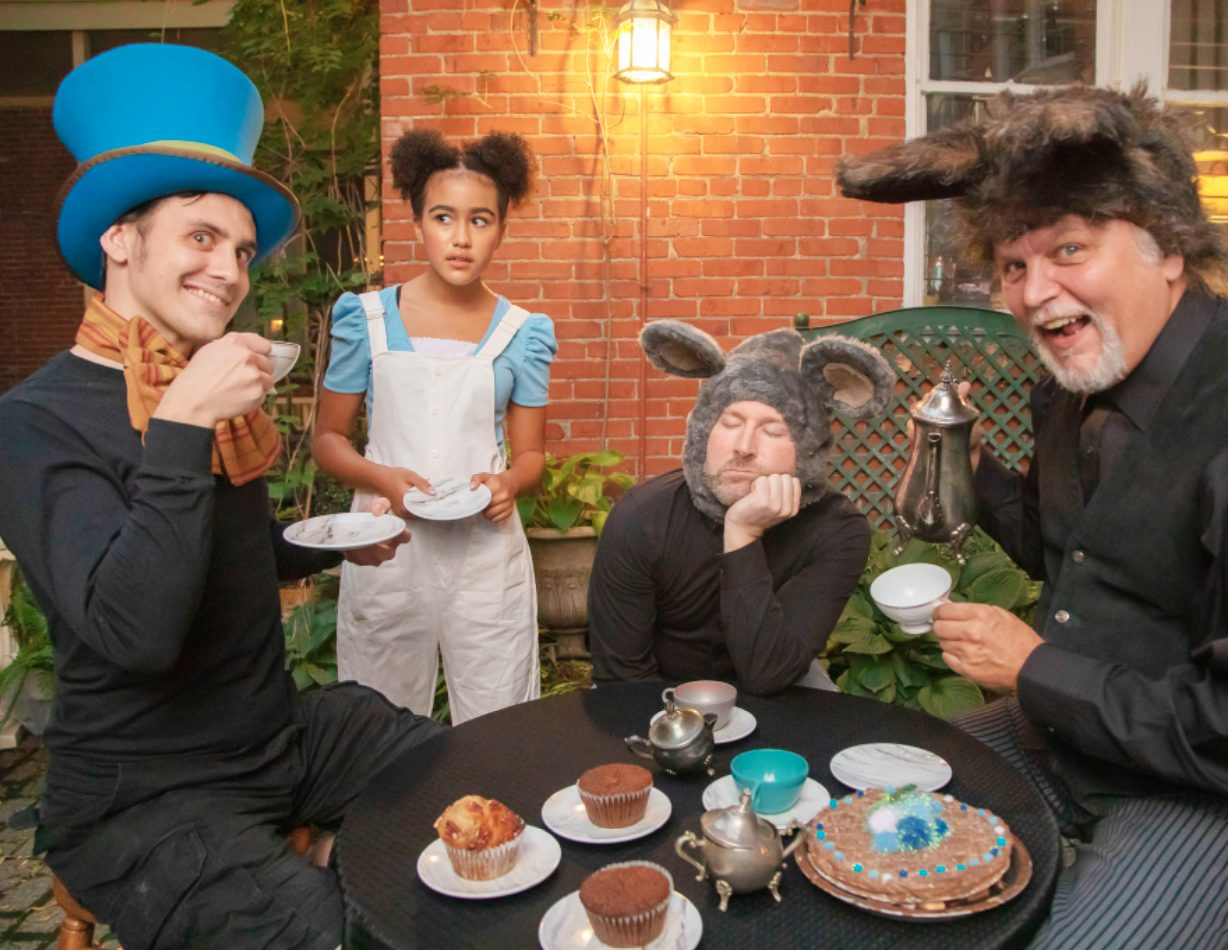
Gamut Theatre’s rendition of Lewis Carroll’s “Alice’s Adventures in Wonderland and Through the Looking Glass” (interpreted by Sean Adams) is a dive into the mystical, exotic, twisted time and space of Victorian England that holds true to the original books.

If you consider the stories as curiouser and curiouser political satire during the author’s lifetime, you will surely find it. Both stories are rife with British humor, a healthy dose of absurdity and psychedelic influence. One wonders whether 7-year-old Alice (Kennedy Commissiong) is dreaming or whether her toys came to life. That is a riddle with no answer. Whether in Wonderland or through her looking glass, both would be true simultaneously. Imagine if the cast of Monty Python stole everything in your kid’s toy box and set them loose at the Renaissance Faire.

Commissiong delivers the audience a sensible, plucky Alice who isn’t afraid to speak up for herself when faced with characters who chastise or try to behead her. Alice struggles to learn the rules and sometimes tries to assimilate. Every attempt to socialize is met with characters who weaponize their wordplay to ensure Alice is kept in her place. Most of them seem to be irrationally angry at odd things and motivated by intense missions that swirl around royalty’s whims.

Throughout her adventures, Alice continues to encounter glib strangers who are strange themselves to any onlooker outside of Wonderland. Like a Fellini film, the costumes (Jen Kilander) alone tell a story cobbled together with hookah pipe smoke. Particularly inspired in the sartorial sense—the Cheshire Cat, the Jabberwocky and Tweedledee and Tweedledum.

Despite the macabre undertones of the overall play, Director Melissa Nicholson said, “This has been a joyful experience for us.”

Part of the joy stems from the eclectic musical pieces.

“Originally, this play did not have music,” Nicholson said. “When we auditioned the actors, we asked them if they had any special skills. We didn’t know we had so many musicians.”

Much like Alice’s heroine’s journey, the song selections don’t confine themselves to any one theme, yet they all huddle together under a large mushroom umbrella. After all, in what other play can you find a ukulele-wielding minstrel bestowing British history lessons (Francesca Amendolia), operatic arias (Benjamin Krumreig), and a keyboardist (Marc Lubbers) playing Jefferson Airplane’s “White Rabbit?” And it somehow all works.

Something else that works is the improv routine smack in the middle of a scene, chosen by the audience at the beginning of the play. So subtly interwoven into the action, it snuck up on me, its only giveaway the little ding of the bell to change the direction of the dialog.

Don’t make the same mistake I did and think the play is over when the first book ends (intermission). Although not as popular as Lewis Carroll’s first story, “Through the Looking Glass,” Act II contains just as many outlandish characters, purposefully clashing costumes, and ridiculously backwards situations. In this land, up is down, and left is purple, but you’d better paint it red.

Come and join the audience. We are all mad here.

“Alice’s Adventures in Wonderland and Through the Looking Glass” runs Nov. 6 to 28 at Gamut Theatre, 15 N. 4th St., Harrisburg. For more information and tickets, visit www.gamuttheatre.org.


Continue Reading

Wacky Wonderland: Gamut introduces an “Alice” for all ages

This month, Gamut Theatre opens their signature fall play, “Alice’s Adventures in Wonderland and Through the Looking Glass,” an original play by Sean Adams.

The role of Alice is played by student Kennedy Commissiong, while her wacky counterparts are played by adults, many with decades of comedic acting experience. As per Gamut’s new show ratings system, this nonsensical thrill ride is great for all ages.

I have the opportunity to bring you a look behind the scenes at the upcoming show.

Melissa Nicholson, director of this whirlwind production, is excited to share the story with audiences.

“I love directing this play,” she said.  “The challenge with ‘Alice’ is that it is such a bizarre story when you stay as true to the books as we have, and we want that strangeness to be inviting, not off-putting.  We’ve added original music, dance and movement to keep things rolling, and our multi-talented ensemble cast has created a truly unique play that is fun for all ages, whether you’re 5 or 105!”

Nicholson has actually directed this story, and, more specifically, this script before. Playwright Sean Adams adapted the play from the books by Lewis Carroll, initially intending it to be performed by students.

In 2014, that’s exactly what Gamut’s Young Acting Company did. Erin Shellenberger, who played Alice in that student production, joins the current cast for this reimagined telling of the story.

“That first production of Alice in 2014 was a pivotal moment in the development of my confidence as an actor, and I couldn’t be more delighted to return to Wonderland with Gamut Theatre,” she said.

Nicholson and Adams revisited the script together during the pandemic and decided they could make it a full-scale mainstage production fairly easily. One shared vision and several rounds of edits later, they had a script that was both adult and student friendly. And amazingly, many parts didn’t have to change—where it was adorably lovable to see little faces in lobster costumes singing and dancing, it’s hysterical to see those parts filled by grown adults.

While Gamut promotes the play as being family-friendly, that doesn’t mean parents will sit back and snooze while their kids are entertained. Always aiming to make their shows accessible to all ages and all types of people, Gamut has hit the mark again with this interpretation of a child’s epic adventure. You’ll laugh, you’ll empathize… you and your kids will be on the edge of your seats wondering what happens to Alice next.

Alice puts it quite plainly: “I shouldn’t like a romantic story—I’d much prefer a silly one.”

“Alice’s Adventures in Wonderland and Through the Looking Glass” runs Nov. 6 to 28 at Gamut Theatre, 15 N. 4th St., Harrisburg. For more information, call 717-238-4111 or visit www.gamuttheatre.org.


UPCOMING THEATER EVENTS
AT HARRISBURG’S PROFESSIONAL
DOWNTOWN THEATERS


At Gamut Theatre
www.gamuttheatre.org
717-238-4111

“Alice’s Adventures in Wonderland and Through the Looking Glass”

By Sean Adams

Based on the books by Lewis Carroll

Nov. 6 to 28

Fridays and Saturdays at 7:30 p.m.

Sundays at 2:30 p.m.

Doors and bar open one hour prior to the performance.

Tickets are “pick your price.” You can choose the recommended $38 ticket, or a discounted ticket price of $26 or $14.

TMI Improv

Thursday, Nov. 18 at 7:30 p.m.

Doors and bar open 45 minutes prior to the performance.

Tickets are $10


At Open Stage
www.openstagehbg.com
717-232-6736

“Violet Oakley Unveiled”

Nov. 12 & 13 at 7:30 p.m.

Harrisburg Black NewsBeat with Dr. Kimeka Campbell

Nov. 10 & 24 at 8:30 p.m.

Noxious Live

Nov. 7 at 7 p.m.

The Obstructed View

Nov. 6 & 20 at 9:30 p.m.

Court Street Cabaret

Nov. 20 & 27 at 7:30 p.m.

“Who’s Holiday!”

Nov. 26 to Dec. 22 at 7:30 p.m.

If you like what we do, please support our work. Become a Friend of TheBurg!

Continue Reading

Burg Review: Goofiness, joy await as Theatre Harrisburg reopens with “The SpongeBob Musical”

“The SpongeBob Musical” is Theatre Harrisburg’s first production after the widespread venue shuttering of March 2020. With its talented cast to bring general (and admiral) nautical nonsense, this comeback production was well worth the wait.

Broadway’s 12-time-Tony-nominated comedy script, based on the Nickelodeon cartoon, features original songs by 15-plus artists, including David Bowie, Aerosmith and Cyndi Lauper. I’m too “seasoned” to know who the other artists are, but my eye-rolling teenager assures me they’re all groovy. They must be, because the songs are as infectious as SpongeBob SquarePants (Nik Olson) himself. His optimism, high energy and silly gags all infuse themselves into the music and the story.

But the tale is more than just silly fun.

“The message of SpongeBob is all about the power of optimism,” Theatre Harrisburg’s Artistic and Production Director Kristi Ondo said. “It’s about how anyone with the right mindset can pull a community together.”

In Theatre Harrisburg’s rendition, Director Matt Spencer guides us through an undersea journey full of heart, with a can-do message of confidence that’s wildly inclusive and encouraging of everyone reaching higher, regardless of their intelligence, skills or whether they need a bubble and oxygen pack to breathe under water.

The fantasy experience starts immediately upon entering the Sunoco Theater at Whitaker Center, ahem, Bikini Bottom. Much in the same way the absurdity in the SpongeBob cartoon series starts with the theme song, we are greeted with mischievous characters and the setup of running gags while the audience filters in. The bright colors of the settings, props, costumes and decorations swirling around the audience feel like being inside a kaleidoscope or a circus (thankfully, minus the usual animal smells).

Our mainstage story starts out as just another day in Bikini Bottom. Fry cook SpongeBob aspires to be manager of the Krusty Krab, but the greedy and cantankerous Mr. Krabs (Bryden McCurdy) underestimates his cook’s abilities. Squidward’s (Sean Adams) prowess on the clarinet is also overlooked, and smart, sassy Sandy Cheeks the squirrel (Becky Mease) is shunned for being a land mammal. Then the friends hear urgent news–a volcano is about to erupt all over Bikini Bottom. What follows is a heroes’ journey, in which all must overcome their perceived limitations and work together to save their community.

Ondo said of the script, “The author’s notes read, ‘Embrace joy.’ No other notes.”

It’s clear that the actors blew life into that suggestion through their nose flutes. You don’t have to be 7 years old to enjoy the antics. Along with lots of lessons for the kids in the audience, the show has endearing moments and innuendo to draw in the adults. The action moves quickly, so you might need to swivel-chair to any corner of the theater to see where the actors may pop up and surprise you.

Although the songs aren’t sing-alongs you’ll recognize, they are seaworthy–packed with amusing slapstick, incorporating a range of musical genres. All–and I do mean all–the onstage players belt the score out with heart and flair during the production’s steady flow of dance numbers.

My only grief in the reef about attending opening night: not enough kids in the audience. So bring yours.

The SpongeBob Musical” runs Oct. 22 to Nov. 7 at Whitaker Center, 222 Market St., Harrisburg. For more information on show times and tickets, visit the Theatre Harrisburg website or Whitaker Center website.

Continue Reading

Burg Review: Zoom into Open Stage’s virtual “Angels in America.”

Welcome back to 1985, when Ronald Reagan took office a second time, AIDS was a little understood pandemic, and people felt free to be politically incorrect.

“Angels in America” is a multi-award-winning drama by playwright Tony Kushner presented in two acts: “Millennium Approaches” and “Perestroika.” Each part spans several hours over several days. Absorbing the full weight of the marathon story is impossible if only watching a portion.

But, really, where else are you going? Launch your Zoom app, shake yourself a quarantini and settle in for an absorbing, interwoven saga from Harrisburg’s Open Stage—presented in the new, social distancing-appropriate format of online theater.

A sophisticated slant marks this script, introducing an ensemble cast of city slickers and transplanted Mormon archetypes from Salt Lake City. For example, men with AIDS talk through the gravity of their own mortality, characters un-closet themselves, and unlikely friends come together despite their opposing political leanings. Every character is tormented in some way—by their sexuality, by AIDS and by the politics surrounding these issues, all intertwined in the midst of Reagan-era America.

The play’s religious symbolism is weighty, from Jacob wrestling an angel, interacting with heavenly figures and voices, to Jewish elders speaking plainly. Any humor in this tragedy is caustic and likely unintentional.

I’m not convinced that the script truly captured the fear associated with AIDS back then, when people seemed unsure how it was transmitted. It was only later, after the U.S. government poured billions into research and treatments, that people began to relax somewhat, as AIDS no longer meant certain death.

In 1985, we certainly would not have had the luxury of viewing a live theater production over our Commodore 64Ks. Even if Zoom had existed, our AT&T modems never would have had enough bandwidth. The irony grips thicker with the fact that we’re watching a character drama about a pandemic during another cloistered world pandemic.

The old saying holds true: “The show must go on.” Open Stage Director Stuart Landon said that using this alternative medium is the “best chance to understand this epic story.”

Live theater is always better, but the actors resiliently found ways to tell the story, taking care to arrange backgrounds in their living rooms, implement fun costumes and props within their head frames, and adjust lighting to shift focus. I had to imagine special effects like snow or angel wings flapping.

A narrator explained the stage direction that became lost in translation, like dancing or fistfights. To have that same narrator glaze over uncomfortable sex scenes—thank you, Zoom!

Zoom theater provided an intimacy normally lost from the cheap seats. I could see facial expressions in the Brady Bunch-like squares that would have been exaggerated onstage. Sometimes Zoom even froze them for me.

You will need to give the actors a certain amount of grace, the same way you forgive your co-worker who forgets to hit their un-mute button before talking. And the shouting scenes made me wish I had not opted for headphones.

Yet, the format offered some advantages, too.

For example, Stacey Werner, who played multiple roles, did not miss the quick changes between scenes.

Another multiple role-player, Karen Ruch, said the home venue, “allowed me to be vulnerable in my safest place, which is where I live.”

Sean Adams, who played Louis, said the format, “helped shake me out of old habits and try new things.”

Landon filmed himself in the same spot where he goes night-night.

“I think focusing on the work has been a morale boost for all of us,” he said. “We all love the theater, and we love this show. Having this goal, even as the target keeps moving, has been life-giving.”

No matter the media, it’s exciting to connect to live theater. You can watch in your jammies, with no usher tapping you on the shoulder if you crinkle your candy wrapper.

You can also hang around for the interactive portion, eavesdropping on the rest of the “audience.”

 “Angels in America” runs through the Zoom app April 17 through May 10. Tickets and all access information are available through Open Stage’s website, https://www.openstagehbg.com/.

Continue Reading

“Streetcar”: Passion and Power at Gamut Theatre

Revered by many to be Tennessee Williams’ magnum opus, “A Streetcar Named Desire” is a classic among theatrical works of the 20th century. The play originally ran on Broadway from 1947 to 1949, winning the Pulitzer Prize for drama in 1948 and New York Drama Critics’ Circle Best Play in the same year.

Gamut Theatre Group has now revived the legendary tragedy in a production directed by Clark Nicholson and starring Amber Mann as Blanche DuBois, Michelle Kay Smith as Stella Kowalski and Sean Adams as Stanley Kowalski. Blanche and Stanley’s conflicts are the centerpieces of the play, and their relationship is powerfully depicted by Mann and Adams.

“Streetcar” tells the story of southern belle Blanche DuBois, who visits her younger sister, Stella, and brother-in-law, Stanley, in New Orleans. Traveling from the family home, Belle Reve, in Laurel, Miss., Blanche is staying with Stella and Stanley for an extended period of time, having taken a leave of absence from teaching English due to her nerves and after losing Belle Reve to creditors. Without her home and with no money, Blanche has no choice but to live with Stella and Stanley in their already crowded apartment in the French Quarter.

Upon entering the Kowalskis’ apartment, Blanche immediately casts a critical eye on the small, simple, two-room space and its lack of privacy. In the first few scenes, it’s easy to understand why Blanche has a problem with her neves. High-strung, anxious and fastidious, she has no problem talking for the two of them and expressing displeasure at Stella’s living situation, among other things. She blames Stella for leaving her with the full responsibility of managing the deaths of their father and other family members, leading to the financial collapse and eventual loss of Belle Reve.

Upon meeting, Blanche and Stanley immediately dislike one another, which forms the basis of their relationship. Blanche repeatedly critiques Stanley for his rough appearance and boorish nature, and, in turn, Stanley despises Blanche for her rudeness and lengthy presence in his apartment. Stanley asks Blanche about her former marriage, and she explains that she was married young and her husband died, leaving out the details because of apparent distress.

Blanche is clearly careful of her appearance, and her vanity is precious to her. She does not step into direct light, self-conscious of her looks in her 30s. Her clothes are luxurious and plentiful, despite her recent economic hardship. Suspicious of her fine clothes and items in her trunk, Stanley believes that Blanche is lying about losing Belle Reve and is cheating Stella out of money. The couple is expecting a baby, raising the already high tensions in the apartment caused by Blanche’s neuroses and stress. As the play unfolds, the fictions that Blanche has been spinning start to unravel, eventually causing her descent into a psychotic break.

The rawness of their emotions and the strong-willed, stubborn personalities of Stanley and Blanche, played with passion and power by Adams and Mann, are complemented by the gentle, warm character of Stella depicted by Smith. The iconic “Stella!” scene was heart-wrenching and intense, and the final, intense performance by Mann capped this tale of poverty, struggle and regret.

“A Streetcar Named Desire” runs through Nov. 26 at Gamut Theatre, 15 N. 4th St., Harrisburg. For more information and tickets, call 717-238-4111 or visit www.gamuttheatre.org.

Continue Reading

Beautiful Pain: Difficult truths, complex characters board “A Streetcar Named Desire.”

“A Streetcar Named Desire” is one of the most iconic plays of all time, made especially popular by the 1951 movie, in which Marlon Brando played the character of Stanley Kowalski.

Sean Adams, who plays Stanley in Gamut Theatre’s production of the 1947 play written by Tennessee Williams, grapples with the reputation of both the character and the assumptions about the play. He describes the importance of seeing the point of view of the character, regardless of the terrible things that he does.

It is not enough to classify any character as good or bad, or even evil. Adams plays a character who is abusive, domineering and, as he explains, “more unlike me than any character I’ve ever played.”

These complicated characteristics are exactly what Williams was getting at as he shows the honest life of a destructive family unit: Stanley, the World War II veteran with an explosive temper and increasingly aggressive tendencies (played by Adams); Stella, his pregnant wife who confuses destruction with love (played by Michelle Kay Smith); and Blanche, Stella’s sister, who has come to stay with the couple after some personal struggles in her life and who has a tense, antagonistic relationship with Stanley (played by Amber Mann). The story unravels as these characters live and breathe with each other, with all of their dysfunction, through extreme heartache, pain and loss of innocence.

Although most people know the play because of Brando’s film portrayal of the character, Adams believes that it is actually Blanche’s story and encourages audiences to seek an experience with live theater that is far different from film. He describes the play as, “the tragic and beautiful attempt by a fading southern belle to cling onto something to save herself,” and Williams shows us how truly difficult this can be in the America where old-money stories are being replaced with the fresh ideas of upward mobility by a new, post-war working class.

Trying to live up to an iconic portrayal helps no one, Adams explains.

“Really, I can’t do what Brando did,” he said. “Nobody could do what Brando did. So, all I can do is my own thing.”

That is exactly what Adams intends to do. His aim is to get to the bottom of Stanley’s character—to explore how he can do terrible things and yet still be human.

“He is not just this monster,” Adams said. “He is a real living human, and Tennessee Williams wrote these incredible characters for a reason.”

That is, Stanley is not only there to do horrible things and cause destruction without end, which has been his reputation.

If we are to trust Adams when he says that, in his eyes, this is really Blanche’s story, then we have to trust that his particular portrayal of Stanley will do right by the play—that it will highlight how dangerous it can be for a woman to be in a situation in which not only viewpoints clash, but where there is also a power dynamic that silences her impact, both as a character within the play and as an observable character, by the dominating force that is Stanley Kowalski.

Adams makes clear that a role is not defined by the actors who play them, and it is in his best interest to make his character as true and as honest as possible—and really make it his own.

All of this proves that the play is more than just a characterization of abuse or toxic family relationships. Adams states that the play addresses what most actors are looking for “to get that really ugly kind of moment—to play that and find the truth in it.”

The ugly truth is a primary reason why this play, and Tennessee Williams plays in particular, is fascinating to audiences, Adams said.

When it was first performed, and for some even today, it is a different kind of acting— a different kind of story— where the characters try desperately to do right and still do wrong. We like it because, above all, it demonstrates beautiful pain, in the realest sense, where sometimes there isn’t a hero, and sometimes there isn’t a happy ending.

“A Streetcar Named Desire” runs Nov. 4 to 26 at Gamut Theatre, 15 N. 4th St., Harrisburg. For more information and tickets, call 717-238-4111 or visit www.gamuttheatre.org.

Upcoming Theater Events
At Harrisburg’s Professional
Downtown Theaters

At Gamut Theatre
www.gamuttheatre.org
717-238-411 

“A Streetcar Named Desire”
By Tennessee Williams
Nov. 4 to 26
Fridays and Saturdays at 7:30 p.m.
Sundays at 2:30 p.m.
Doors and bar open one hour prior to performance.

TMI Improv Show
Nov. 16
Doors and bar open at 6:30 p.m. and remain open throughout the event.
Tickets are $10 and can be purchased online or at the door.

The Popcorn Hat Players Present
“A Popcorn Hat Christmas Carol”
Nov. 29 to Dec. 16
Saturdays at 1 p.m.
Wednesdays and Thursdays at 10 a.m. available by request for groups of 20 or more.
Tickets are $8 online or by calling the box office

At Open Stage
Of Harrisburg
www.openstagehbg.com

Court Street Cabaret: Jukebox Edition
An evening of song from Broadway and beyond!
Nov. 3 and 4

“A Christmas Carol”
A dazzling new production of the classic Dickens tale
Dec. 1 to 23

“The Santaland Diaries”
David Sedaris’ irreverent one-man-show
Dec. 3 to 22

Continue Reading