Tag Archives: Philadelphia

So What? Writer Jack Veasey has spent a lifetime answering a simple, two-word question.

Screenshot 2014-12-29 09.11.41Poet Jack Veasey writes stories—hard, nitty-gritty, ironic, heartfelt stories. And, after he’s finished with each one, he thinks about the advice he received years ago from a poet/novelist friend in Philadelphia. Writers, the friend said, must ask the question, “So what?”

“He was the person who taught me the most important lesson ever—how to give myself the ‘so what’ test,” Veasey says. “If, after you’ve written something, you read it and ask yourself, ‘So what?’—there better be a good answer.”

Veasey has come up with hundreds of good answers in his years of living the creative life, and they’re apparent in his dozen or so published poetry collections, his music and his plays. The Philadelphia native, who has lived in Hummelstown for the past 20-plus years, is a force in the Harrisburg poetry scene. Say the name “Jack Veasey,” and the first word that comes to mind is “poetry” and the group, the Almost Uptown Poetry Cartel, where he is an active member. Despite the image many have of the solitary writer chained to a desk while tapping at the keys, Veasey explains that poets need the camaraderie and support of other poets to continue to be inspired and to keep the art form alive.

“Throughout the history of the form, we’ve tended to clump together like cat litter,” he says. “You need to see what’s happening with and to the art form and to share your work with other poets. It’s the same reason painters establish art galleries and musicians form orchestras.”

Many of Veasey’s poems exhibit his struggles of growing up gay in the tough Fishtown neighborhood in Philadelphia, where Archie Bunker-types ruled and where the nuns in his Catholic school were tougher than old meat. It also didn’t help that Veasey had the attitudes and values of a hippie and that being gay in this place and at this time “was about the most despised thing you could be.”

“I had plenty to struggle against in Fishtown, and the neighborhood’s old atmosphere still pervades a lot of my work,” Veasey says. “I was a target for bullies, and that gave me an outsider’s perspective and made me identify with the underdog, which I still do. That colors a lot of my choices of subjects, and the viewpoints from which I write, even when they aren’t my own.”

Two poems from Veasey’s soon-to-be-published book, “The Dance That Begins And Begins,” illustrate that point. One poem is titled “Mr. Martin,” who was Veasey’s high school typing teacher and whom Veasey describes as the first man he ever loved. This narrative poem relays that yearning, the “pangs,” the loss after the teacher marries. Despite the pain, it offered Veasey evidence of being alive.

Another poem in this collection, “And Then Came The Plague Of Frogs,” tells the Catholic school story of Veasey freeing frogs that were about to undergo dissection in his biology lab. His action resulted in a suspension, a punishment he considers worth it. He writes:

“I may never have been/Popular, but, for a few years later/I’d be/Legendary.”

Legendary, indeed.

Veasey called his prior poetry collection “Shapely,” an autobiography in verse that sections his work by a particular form, such as sonnets and the Japanese 17-syllable forms of haiku and senryu.

“Some poets claim that writing poems in forms are limiting, but I found they enabled me to write about a much broader range of subjects, including some that had been too big to tackle or even to face,” he explains. “It pulled insights out of me. Sometimes, I’d articulate something in a form and then realize, ‘My God, I never knew I saw it that way.'”

Veasey has a lot more “So what’s?” to answer. Despite now being disabled with back issues resulting from spina bifida, he’s examining his entire body of work—from 1973 to the present—to see what remains to be brought out. And, of course, he’s always writing, always exploring. There’s possibly a collection of stories on the way, a murder mystery about Catholic priests, a full-length musical with new songs he’s composed.

Ah, but poetry.

“Poetry is my life,” Veasey muses. “I continue to write for pretty much the same reason as I continue to breathe. I need to. It’s how I make sense of being in the world.”

You can catch Jack Veasey and the Almost Uptown Poetry Cartel every Thursday, 7 to 9 p.m., at Midtown Scholar Bookstore, 1302 N. 3rd St., Harrisburg. His next book, “The Dance That Begins And Begins,” published by the Poet’s Press, is slated for release this year. All of his books are available at www.amazon.com.
Continue Reading

Relax, Rejuvenate, Renew: Need to de-stress? Reiki may be just the ticket.

Screenshot 2014-12-29 09.04.08Ask any Reiki practitioner to explain the practice, and you’ll quickly learn that it doesn’t fit neatly into one descriptive little box.

The non-invasive, benign healing technique, is, in my opinion, a bit ethereal in nature, which is why categorizing it is as difficult as clutching a cloud. What I can tell you is that I walked into Rickie Freedman’s office recently in my “wound-too-tight” default mode and sat up from the table an hour later, relaxed, rejuvenated and ready to take on the day.

I even kept my cool when someone cut me off as I was pulling out of the parking lot after my session. For me, that’s progress.

To better understand the relaxing practice known as Reiki, it’s helpful to know that the word is actually composed of two Japanese words—Rei and Ki. Rei can be defined as a higher intelligence, while Ki is the non-physical energy that animates all living things.

According to Reiki practitioners, negative feelings have an adverse effect on our health since they block the Ki that flows through and around us. While Western medicine doesn’t necessarily embrace Reiki, doctors do concede that there is a mind/body/health connection. During sessions, Reiki practitioners use a light touch to restore balance to the body and mind of those who seek its healing properties.

A Call

Rickie Freedman was born and raised in the Philadelphia area and faced unique challenges due to her name throughout her youth.

Every year, she was enrolled in boy’s gym and choir and, as a teen, received mail from the Army and Navy. Later in life, she ended up thanking her parents for the appellation. “I believed it was a call to my purpose,” she said.

Freedman’s interest always gravitated towards the healing arts.

“One of my teachers tried to talk me into going into med school at one point,” she said.

As a person with a nurturing, caregiving personality, Rickie eventually decided upon physical therapy, practicing at a nursing home in Lewisburg. In the mid ‘90s, friends introduced Freedman to Reiki.

“They took a class, and, when they came home, they practiced on me,” she said. “I had been going through a challenging, stressful time and had a big detoxification release afterwards, so I began studying it for my own emotional healing.”

She later would pay it forward by sharing the practice with others.

“I helped employees at the nursing home cope with the stresses of that kind of work and began incorporating the technique into my physical therapy,” she said.

Several years later, Freedman received a Reiki table as a gift. She offered her services to friends and word spread, so, when one co-worker opened up a wellness center, she asked Rickie to join her.

“I felt like it was an opportunity, so I gave it a try, and what I learned is that, when you believe in something with every fiber of your being, it radiates,” she said. “People feel that and are attracted to it. In a short amount of time, more people were coming there for Reiki than anything else.”

Eventually, this led to her decision to practice Reiki full time. In 2008, Freedman moved to Harrisburg, where she worked at establishing her expertise and reputation in the area. By 2013, she was ready to create her own space.

Swears By It

Freedman’s current base of operations, located off Linglestown Road, is comprised of an office, two healing rooms, a comfortable waiting room and an event area.

The new space has enabled her to expand her practice to offer more services like Indian head massage, chakra foot massage and the popular REIKIssage—a blend of Reiki and therapeutic massage.

Classes and workshops are held throughout the year and include topics like meditation, stress management and aromatherapy, to name just a few.

Tessa Shaffer travels from Liverpool to benefit from Freedman’s services.

“I met Rickie at an event she was doing and signed up for a 15-minute mini session and, in that short time, it alleviated a headache and some of my back pain,” she said adding that she was so intrigued that she decided to study the practice herself after contracting Lyme disease.

Thanks to Freedman’s instruction, Shaffer is now a practitioner.

“There are three levels, and Rickie holds monthly classes for the different levels,” said Shaffer. “Anyone can do it, and it has aided in improving my energy and managing my pain. It’s amazing, and you don’t really need to understand how it works for it to work.”

Kris Shulenberger has been undergoing Reiki sessions for about a year and swears by it.

“I have more energy and vitality,” said the Carlisle resident. “The first thing I noticed is that I didn’t have the winter doldrums last year, and the other thing I noticed is that I have a different level of energy in dealing with issues and problems. It’s a deep form of relaxation, and you come out energized and feeling better.”

For those considering Reiki, Freedman recommends scheduling the first three sessions a week apart.

“They work together in a series to get you to a better place of balance,” she said. “By the end of the third session, clients have a better sense of the good it does.”

In choosing this line of work, Freedman said she has found the “perfect peace,” which she lives to share with others.

“Every single day is awesome because I get to witness people’s transformations as they come into the fullness of who they are and are able to let their light shine so they can go out into the world and bring that to others,” she said. “That’s awesome, with the emphasis on the awe. I love my work, every single day. I love teaching, and I love sharing this.”

Reiki by Rickie|ReikiSpace & Learning Place is at 2793 Old Post Rd., #10, Harrisburg. Call 717-599-2299 or visit www.reikibyrickie.com.

Continue Reading

Rail Revival: Regional rail would greatly improve the quality of life in the Harrisburg area.

Screenshot 2014-10-30 14.38.27Imagine riding your bicycle to a regional rail stop. After a short wait, a sleek, self-propelled, articulated railcar arrives. Its double doors open, and you board. While locking your bike to the on-board rack, the railcar glides towards your destination.

For quite a few American cities, this is a reality—a transportation connectivity in an urban core featuring light rail or streetcar service that encourages intermodal transfer by pedestrians, bicyclists and autos. The national trend towards building and/or expanding rail transit coincides with a current demographic shift back to urban living. Harrisburg should take advantage of that movement by building a rail transit line, thereby improving the region’s attractiveness to present and future residents.

Downtown streetcar service, for example, was a major factor in the selection process for the Republican Party’s 2016 National Convention site. The GOP dropped from consideration Columbus, Ohio, which has no passenger rail service of any kind. Both Cincinnati, Ohio, and Kansas City, Mo., which are building new streetcar lines, put in vigorous bids. But the winner was Cleveland, which has both light rail and a metro line. By the way, ArcelorMittal’s plant in Steelton supplied rails for Kansas City.

There are four cities in Pennsylvania that currently provide rail transit: Philadelphia, Pittsburgh, Johnstown and Scranton (seasonal). Harrisburg should be next on the list. Crisscrossing rail lines built by former Pennsylvania and Reading railroads intersect major trip generation points. Railroad roadbeds are wide enough to accept additional trackage for commuter purposes so as not to interfere with current operators’ (Norfolk Southern and Amtrak) daily turns.

This writer is cognizant that rail transit has been the subject of study at various times since 1979, but policymakers were reluctant to “break new ground.” This was understandable as studies recommended expansive civil works with huge costs to match.

Most cities that have implemented rail transit have started small, adding on as systems gained popularity. Tucson, Ariz., and Charlotte, N.C., began their light rail systems with small, vintage trolley operations. CapMetro, Austin, Texas’ single-line diesel railcar operation, is planning expansion. Harrisburg, with Capital Area Transit as the operator, can and should follow those examples with a modest construct. A viable first line, covering major ridership points, might be as follows:

West Shore Transfer Center (West Shore Plaza), 3rd & Hummel (Lemoyne), City Island Parking Garage (accessible by the CAT-owned trans-Susquehanna bridge), PinnacleHealth, Amtrak Transportation Center, State Government Complex (7th & Herr streets), Pennsylvania Farm Show and Harrisburg Area Community College.

On May 2, I attended a day­–long conference at Delaware Valley Regional Planning Commission’s headquarters in Philadelphia. Speakers and panelists described how rail transit can and does improve the quality of urban life. Research cited at the conference stated that millennials (young adults) and the elderly are gravitating to cities for the convenience of proximity to jobs and access to walkways, bike lanes, bike tracks and transit. Many young people are postponing the rite of passage of buying cars after college.

Quality of life is critical to the vibrancy of conurbation. Harrisburg needs this vitality in order to attract people who right now really want to live in an urban setting.

Establishing a regional rail system, even the starter line described, will require significant capital funding. Federal and state sources are first options, but there are creative financing packages that are available to augment conventional government grants. Options include CMAQ grants (Congestion Mitigation Air Quality), Federal Transit Administration’s New Starts funding, state and county funding matches, and private participation through development rights.

Oregon successfully used the latter by leveraging development rights along Portland’s light rail downtown-to-airport line to contractor Bechtel Corp. Private foundations have also contributed to rail transit projects. Both Cincinnati and Detroit, for example, are foundation grantees for their downtown rail lines.

Capital outlay for any transportation project may seem daunting. However, rail transit earns its keep by delivering the following benefits:

  1. Construction and operation will return to the community at a ratio of $4.25 (wages, taxes and purchases) for each dollar invested (i.e. $100 million paid out would ripple through the local economy at $425 million; source: U. S. Department of Labor, Bureau of Labor Statistics).
  2. In energy savings, a rail car can move more people per BTU than any other transport mode.
  3. A rail line takes up less land than a highway; therefore, more land can go on the tax rolls, which, in turn, broadens the region’s property tax base.
  4. A rail line provides a transport redundancy for emergency management, which can be critical for disaster relief. Plus, motive power is a handy source for emergency electricity. One 3,000-horsepower, diesel-electric locomotive can power up 1,000 homes.
  5. Best of all, research by Dena Belzer of Strategic Economics, Berkeley, Calif., cites that improved health outcomes accrue to regular users of rail transit.

Let’s get Harrisburg into the big leagues of Cincinnati, Kansas City and Austin. But to get from imagination to actuality, policymakers must champion the cause. I hope they do because rail transit would deliver a major economic and lifestyle boost for Harrisburg.

Sloan Auchincloss is a principal of the Auchincloss Family Fund.

Continue Reading

What’s in “God’s Pocket?”: First-time director takes a bleak view of life in South Philly.

Illustration by Liz Laribee, lizlaribee.com

Illustration by Liz Laribee, lizlaribee.com

The world is made up of firsts, and the film reviewed here is no exception.

John Slattery, who has directed a handful of episodes of “Mad Men,” has taken his first crack at a feature film with “God’s Pocket,” an adaptation of another first, a novel by Pete Dexter. “God’s Pocket” depicts a section of South Philadelphia where uneducated, brawl-happy people are the norm, and everybody knows everybody’s business.

Renowned columnist Richard Shelburn (Richard Jenkins) narrates, “Everyone here has stolen something from somebody else, or, when they were kids, they set someone’s house on fire… And no matter what anybody does, they’re still here. And whatever they are is what they are. The only thing they can’t forgive is not being from God’s Pocket.”

Except for Mickey Scarpato (Philip Seymour Hoffman). Mickey only came to the Pocket through his wife, Jeannie (Christina Hendricks), but has fitted himself quite well into society, mostly because he’s just a plain decent guy. He scrapes up a living, albeit a slightly illegal living, selling meat out of the back of a truck, and Jeannie… well, Jeannie looks out of place, being the prettiest woman around, and doesn’t do much with her time other than serve as a blue-collar trophy wife. Her son, Leon (Caleb Landry Jones), works at a local construction site, and his tendency to pick fights and sling racial slurs leans toward the sociopathic. When Leon threatens a coworker, the man retaliates and lays a fatal blow to the back of his head. Choosing to side with anyone over Leon, the other construction workers cover for the man, claiming that “something fell” and struck Leon.

Jeannie becomes ill with grief at the news of her son’s death, leaving Mickey to make the funeral arrangements. But, when she hears the claims that his death was an accident, she won’t believe it—she just knows that something’s not right. She asks Mickey to investigate. Richard Shelburn has also been sent to get the real scoop on Leon, having become something of a local legend in God’s Pocket. But Shelburn is not the put-together writer he used to be; he passes the time nursing his alcoholism and traipsing after women, and, upon arrival in the Pocket, he immediately becomes infatuated with Mrs. Scarpato.

And so the plot unfolds. Mickey gets his friend, Arthur (John Turturro), to try to scare some details out of the boys at Leon’s work, and Shelburn tries to woo Jeannie into sleeping with him. Meanwhile, Mickey has financial troubles that cause some awkward things to happen at the morgue.

The tone of the film differs greatly from the book, which is a dark comedy. Not that the film doesn’t have its darkly comedic and absurdist moments, but it would be better described as a harsh glimpse into a whirlpool of hopelessness. Hopefully, this switch in tone was a conscious decision, and I almost wish that the film had carried the theme all the way to the end, but, instead, it ended with a moment of minute happiness, trying to wrap things up for our man, Mickey. The clinch of the story is how the inhabitants of God’s Pocket are continually pulled into the whirlpool, and the ending detracts from that somewhat.

The problem with a story whose characters internalize their bleak outlook is that the cast doesn’t quite have the chance to show off its theatrical prowess. It is almost a shame that the likes of Philip Seymour Hoffman and Christina Hendricks didn’t have more emotional range to work with. That being said, each character is very much realized and has the potential to tug at your heartstrings.

All in all, I’ve got to give Slattery credit for his first feature.God’s Pocket” is definitely worth watching, and I’ll be interested to see what lies in store next for him.

“God’s Pocket” will be playing at the Midtown Cinema in May. Come experience it for yourself.

Sammi Leigh Melville is a staff member and film reviewer at the Midtown Cinema.


May Events at Midtown Cinema

1st Sunday Brunch & a Movie
5/4 10:30 a.m. brunch and 11:00 screening of Mel Brooks’ “Spaceballs”

1st Sunday Foreign Series
5/4 7 p.m. Jean Cocteau’s 1946 French romantic fantasy “La Belle et la Bête” (“Beauty and the Beast”)

2nd Saturday
5/10 Saturday Morning Cartoons 9:30-11:30 a.m.

2nd Sunday AFI Top 100 Series
5/11 7 p.m. “Psycho”—watch the Hitchcock classic for Mother’s Day. Bring your mom or dress up as Norman to get a prize!

3rd in the Burg $3 Movie
05/16 9:30ish “Blazing Saddles” celebrates its 40th anniversary! BYOB

5/17-5/21 Jewish Film Festival

3rd Sunday Down in Front! Comedy riffing w/Jennie Adams
5/18 7 p.m. “The Horror of Party Beach” (1964) BYOB

4th Sunday Documentary Series
5/25 7 p.m. “Paper Clips” (2004)

5/29 7 p.m. Oliver Stone’s “JFK”—watch the 1991 docudrama to celebrate John F. Kennedy’s birthday

Continue Reading

The First Capitol: Harrisburg’s original statehouse had a very different look.

Screenshot 2014-02-28 08.37.50From 1682 until the late 1700s, Philadelphia had served as the commonwealth’s capital city. By 1799, the center of population had shifted and, after citing disease and the unfair influence of city and national politics, the legislature voted to move the seat of government to Lancaster.

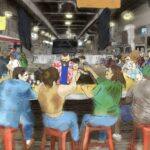
State government first met in Lancaster in April of 1799. Because Pennsylvania contained 30-some counties, many of them to the west of the Susquehanna, almost immediately the debate began about when and where to again move the government seat.

In 1801, there were calls to move to the Susquehanna Valley, but the measure failed to get the necessary votes. In 1809, the citizens of Northumberland County sent a surprise petition to the Senate, asking that the capital be transferred there. This petition seemed to open a wide-ranging debate with Philadelphia, Lancaster, Pittsburgh, Harrisburg and Middletown all vying to be the new capital city.

By 1810, the House and Senate seemed to come to an agreement that the new and, hopefully, final capital should remain somewhere in the central portion of the state. Harrisburg was eventually selected, voted and agreed upon, but only after Northumberland, Lancaster, Bellefonte, Carlisle, Columbia, Reading and Sunbury had all been rejected. It may be that John Harris Jr.’s 1785 gift of four acres of land for the commonwealth’s use prompted the legislature to select Harrisburg. In any event, on Feb. 21, 1810, Gov. Simon Snyder signed the act moving the seat of government to Harrisburg, on or before October 1812.

As part of this 1810 act, Robert Harris, George Hoyer and George Zeigler were appointed as commissioners to supervise the removal of all state documents to Harrisburg and to find suitable lodging and accommodations for the legislature. The cost of the move was estimated at $2,000. The commissioners also hired master builder Stephen Hills to build two “fireproof” buildings on Harris’ tract and arranged with Dauphin County to use the courthouse, which Hills also renovated, for legislative sessions. The legislature would meet in the old court house from December 1812 until the completion of the Hills Capitol in 1822.

In 1816, the legislature, partly through the sale of Independence Hall to the city of Philadelphia, began funding the construction of a new Capitol building in Harrisburg. Hills began stockpiling materials on the site and, after winning the design competition of 1819, started building the structure.

Work progressed fairly rapidly for the size and scale of the project and was completed in less than two-and-a-half years. The Hills Capitol measured 180 feet along its front and was 80-feet deep. The front portico had 56-foot-high Ionic columns measuring 4 feet in diameter. The red-brick, Federal-style building was dedicated on Jan. 2, 1822 and served the commonwealth for 71 years before it was consumed by fire, creating the need for a new Capitol, which was completed in 1906.

Jason Wilson is an historian for the Capitol Preservation Committee. 

Continue Reading

Community Spirit: New magazine sets out to look for America.

Daniel Webster is a tall, angular young man who exudes a sense of purpose. One afternoon in his studio apartment along Front Street, he described a publication that he’s been raising money to produce this fall.

“Journalism isn’t my profession,” the 25-year-old said, relaxing on his sofa. “It’s always been a sincere interest.”

Sincere enough that this Messiah College graduate – where he earned a degree in English followed by a graduate degree in creative writing at Vermont’s Bennington College – pursed an idea, a journal capturing the people of the land where he lives.

His pursuit brought him in 2011 to create “Local: A Quarterly of People and Places.” The pitch on its website – www.localmag.org – is: “Local is seeking out the overlooked American narrative, chronicling one town per issue.”

It follows in the tradition of such periodicals as the Utne Reader. Webster explained, “We do everything a traditional magazine does – investigative reporting, humor columns, features, etcetera – just from the vantage point of a single place.”

In June, Webster and his editorial team raised more than $20,000 on Kickstarter, a web-based campaign program to help fund creative projects. With the money, Webster hopes to launch the first of four issues per year in October.

Eventually, said Webster, “We’d like enough advertising to support us.”

The issues also include a special section called Annexed, which looks at the state and region Local is reporting from. Webster said the initial coverage area is Philadelphia, Williamsport, and Harrisburg, but the aspirations are national.

The first issue will feature Pennsylvania’s Jersey Shore, a misnomer of name for a town nestled in the mountains of the Keystone State. Webster said the town has a history of rich characters such a Prince Farrington, a popular bootlegger in the 1920s.

“They said he was one of the best whiskey makers on the East Coast,” Webster said, chuckling.

As with all places Local will feature, Webster said, the Jersey Shore story delves deeper; how the community began, what life is truly like there, its relevance to American culture. “To show there’s a lot going on, you got to dig a little bit,” he said.

Local is a collaborative effort done voluntarily.

The editorial team, 10 friends and associates, come from varied backgrounds: Webster, the editor-in-chief, is sustainability projects coordinator at Dickinson College, while Allison Davis, the managing editor, is an editorial assistant at Elle Magazine.

As a new journal in search of America, Local’s mission statement, here in part, is simple: “We will explore why Main Street still matters, communicate curiosities without cynicism, and report on serious, germane issues, preserving heritage where it’s dying and thriving.”

Visit Local at www.localmag.org.

Continue Reading