Diane McCormick
Carey DuRand called for the girl alpacas to be released into the field. Then came the boys.
Santoro, a cream-hued boy with a remarkable resemblance to Sam the Snowman of “Rudolph the Red-Nosed Reindeer,” ambled to the fence, hoping for treats.
“He’s got a full mustache and beard,” DuRand said. “Cracks me up.”
Looking for a fun and educational summer getaway? One with fuzzy animals with irresistibly soulful eyes?
Try a nearby alpaca farm. Get out in the fresh air. Enjoy the countryside views. Let the kids romp, phone-free. Give a boost to Pennsylvania agriculture, and meet some of the cutest animals on the planet.
“They’re kind of funny looking,” said Karen Nace, president of the Pennsylvania Alpaca Owners & Breeders Association. “They’re furry. People flock to them. Most kids have seen a sheep and a goat and a cow, but they’ve not really seen an alpaca.”
Origin Stories
Alpaca farmers just seem to fall into the business.
Carey DuRand and her family wanted animals suited to their new farm, and they found them at the Pennsylvania Farm Show. After volunteering for nearby Alpacas of York to learn the ropes, they grew a herd of seven—that ballooned to 37, in part, when Alpacas of York asked to board its herd at DuRand’s Shear Heaven Alpaca Farm near Emigsville.
Scott and Cindy Johnston of Starry Night Alpacas, Lewisberry, accompanied a friend to an auction, just to look. When auctioneers led in the adorable Jackson, Scott’s hand went up, “and we bought an alpaca,” said Cindy. Then came the kicker.
“You know they’re pack animals,” someone said, “so you need to have at least two.”
Today, they have two dozen.
Angie Grove, looking for an activity for her daughter, found it on a visit to an alpaca farm. Now a 4-H leader, Grove opened Angie’s Alpaca Paradise in Enola in August 2024. There, I was first greeted by two personable boys, the beautifully spotted Bomber and the sleek black Griffin popping their heads over their stall.
Every week, Grove’s farm hosts 4-H members who tend to assigned alpacas and train for agility competitions.
Tending livestock teaches children how to take responsibility for the health and well-being of animals, including pets, and that there are “good days and bad days, because just like us, animals wake up in a bad mood, and they’re like, ‘No, I’m not doing that today,’” said Grove.
“Kids are our future, whether they want to own a farm in their lifetime or not,” she said. “Working with animals teaches them responsibility. It teaches them that it doesn’t matter what the weather is. They’re coming to the farm. The animals still need fed, and the poop needs cleaned up.”
Alpaca farmers cherish their roles as educators and PA agritourism ambassadors.
“Most of all, I love bringing kids from the city here that don’t really know grass and trees,” said DuRand, whose farm offers stunning views. “The experience and the joy is absolutely what fuels me. It’s even more important now with people being so glued to technology and phones and social media. It’s so important to have opportunities to get people away from that and to be outdoors and see God’s creation.”
What I Learned
Yes, alpacas spit. But usually, only if they’re fighting over food, so don’t get between them.
Don’t walk behind them or touch their rear ends, either. They can kick.
They are native to the Andes Mountains of South America, mostly in Peru, Bolivia and Chile. They came to the U.S. around 1980.
As prey animals, they would naturally shy away from humans, but if you have treats, they’re happy to meet and greet.
They are communal poopers. They do their business in one place in the field, which allows farm visitors to walk around freely, as long as they avoid the restroom areas.
Sure, they’re cute, but they are livestock—living beings that require food, water, shelter, treatments against parasites and annual shearing.
Those googly eyes come from their mountain origins. Grove told me that their three eyelids expand their peripheral vision to spot predators like mountain lions.
Boys and girls have separate quarters because they mate year-round. When DuRand, leading a Shear Heaven tour, shared that female alpacas are pregnant for 11½ months, the women there—a Maryland group that takes excursions around the region—groaned.
Alpaca fleece is hypoallergenic, wicking for year-round comfort and, they say, seven times warmer than wool.
Alpacas come in 16 natural colors, from white and fawns to browns, grays and blacks. At the Johnstons’ Starry Night Alpacas, Rachel has a pronounced underbite but a stunning coat.
“If the sun was shining, you’d see how she was a red-mahogany color,” said Scott as rain pelted the barn roof. “She’s really beautiful.”
Up Close
Like humans and pets, each alpaca has a personality. From his side of the fence, Shear Heaven’s Beau likes to race four-wheelers and visitors.
“He’s Mr. Competitive,” said DuRand.
Some are shy or skittish. Others are friendly. DuRand’s “super-chill” Frodo calmly poses for photos with guests, including a giggling little girl who exclaimed, “He didn’t even bite me!”
Which, actually, is impossible. Alpacas have only bottom teeth. They grind their food with their hard palates.
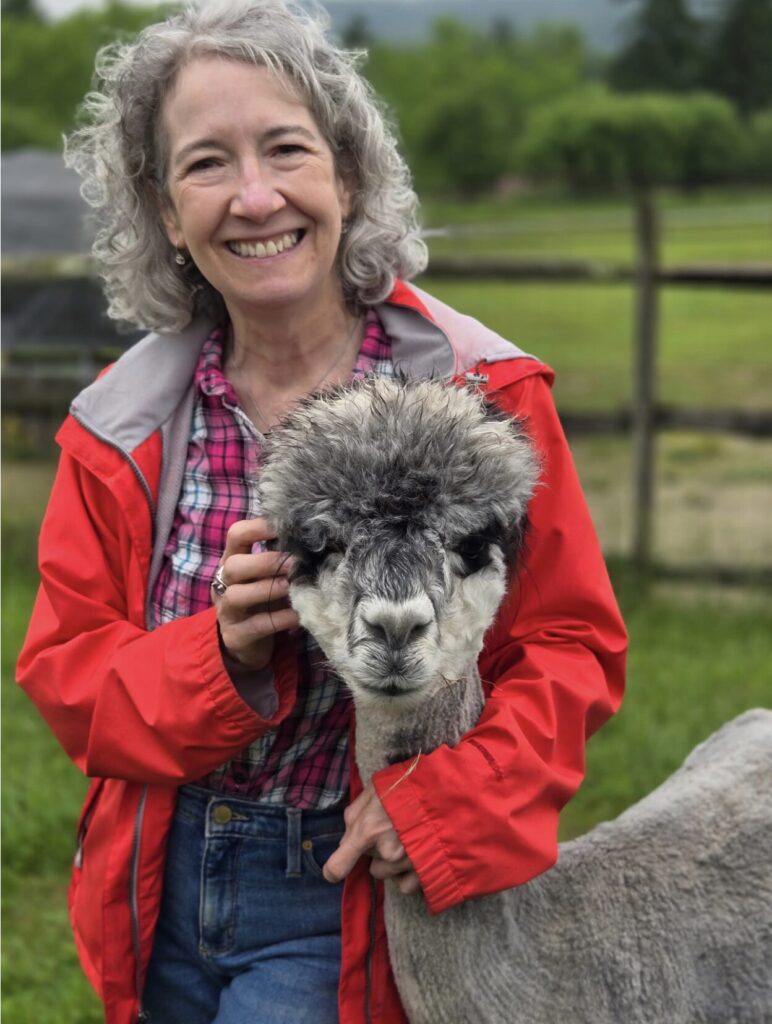
I learned, however, that I should have clung tightly to Frodo’s neck for my photo. When he bolted from me, DuRand calmly instructed the visitors to form a human fence.
“You guys are all alpaca farmers now,” she said.
At Shear Heaven, Jen and Jon Bosley, recent transplants from Maryland to Red Lion, York County, were at “A” on their A-to-Z list of Pennsylvania experiences. As the tour wrapped up, DuRand recruited them to lead Frodo and Sammy to the barn.
“We’re getting the full alpaca experience,” Jen said. “Then we’re off to Hershey to build a candy bar.”
“There’s so many things to do up here that you don’t realize,” said birthday-boy Jon. “We love Pennsylvania. It’s a different pace of living.”
World Away
Since their introduction to Pennsylvania, alpacas have become agritourism mainstays.
“We’re PA Preferred at the Farm Show, and a lot of our members sell beautiful things made with PAOBA yarn,” said association President Nace. “I don’t think any of us are making a lot of money. Agritourism helps bring in some extra income and keep the farm running.”
Nace hosts alpaca yoga and summer camps at her Crimson Skye Farm, Schwenksville, Montgomery County. DuRand holds Alpaca U classes for adults ready to learn. Farms typically have gift shops, including Starry Night, featuring yarn spun and pieces woven by Cindy Johnston. Grove sells $5 bags of alpaca poop—it’s odorless!—for fertilizer, while her 4-H students raise funds by making alpaca-fleece nesting balls for birds.
“We try and use everything,” Grove said. “We don’t let anything go to waste.”
The alpaca appeal is in the animals themselves, say the Johnstons.
“I just feel comfortable around them,” Scott said. “They’re very relaxing.”
Cindy likes to set a chair in the middle of the pasture “and just sit there.”
“There’s something about them, especially their eyes,” she said. “If you’re depressed, they just have some kind of chemistry that makes you feel good.”
At Angie’s Alpaca Paradise, Grove names the babies after Disney characters. I bonded with Stitch as we walked the barn at an easy pace—until we turned, and he was anxious to run back to his buddies in the pen.
Alpaca visits offer a way to de-stress or give the kids a day out, said Grove. Her fall event, Oct. 4 this year, lets kids walk and feed an alpaca and play alpaca games—all for $5 per child.
Life is expensive, Grove said, “and if we can bring some family time together and still pay our bills, that’s our goal.”
You never know what people are going through, she adds.
“If we keep our costs down to the public, they can come and enjoy, and we can put that smile on somebody’s face,” she said. “That’s, you know, our purpose.”
Alpaca Action
Tours, fees and events differ by alpaca farm. For more information on the farms and resources in this story:
Angie’s Alpaca Paradise, farm and store, 6844 Wertzville Rd., Enola. Open for free walk-in visits Sunday, 1 p.m. to 4 p.m., other tours by appointment. www.angiesalpacaparadise.com
Crimson Skye Farm, 704 Camp Wawa Rd., Schwenksville, www.crimsonskyealpacafarm.com
Shear Heaven Alpaca Farm and Store, 3841 Trout Run Rd., York. Scheduled tours Wednesdays and Sundays, www.shearheavenfarm.com.
Starry Night Alpacas and Store, 653 Observatory Rd., Lewisberry. Tours by appointment, 717-938-6898, [email protected].
Alpaca Fiber Designs, www.alpacafiberdesigns.com
Alpaca farm finder, www.paoba.org
If you like what we do, please support our work. Become a Friend of TheBurg!