Tag Archives: Market Street Bridge

House Call: One of Harrisburg’s oldest buildings undergoes “paneful” examination

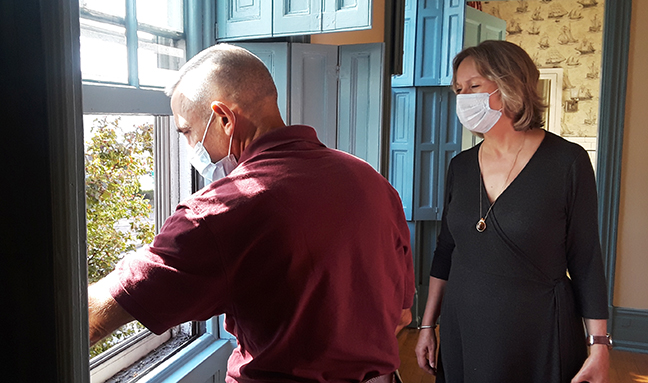
Restoration expert John Lindtner examines a window in the Haldeman Haly House as Karen Cullings, executive director of the Dauphin County Library System, looks on.

John Lindtner raised the question: Does it make sense to replace a window that has survived 200 years with one that might last 30?

“They say, in my world, that the greenest window is the window that’s already built,” he said as he diagnosed the health of a 200-year-old window. “It doesn’t make sense to fill up the landfill with these windows.”

The window restoration expert did, though, have a word about the storm windows that appeared to be approaching the half-century mark.

“You have my blessing to replace the storm windows, because I believe the storm windows can be improved,” he said.

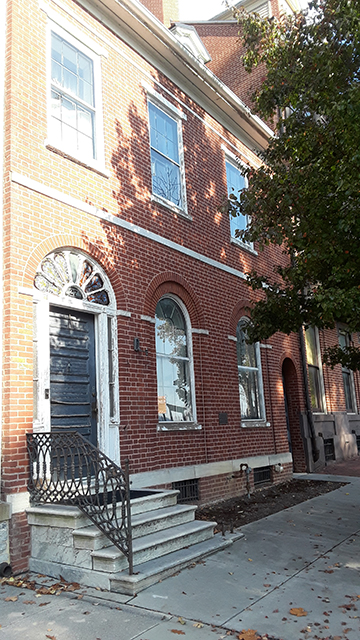
Lindtner was inside the library of the Haldeman Haly House (pictured), the Governor’s Row home called by architectural historian Ken Frew one of Harrisburg’s top-five most historic buildings.

Lindtner’s visit on Wednesday was a “house call” sponsored by Historic Harrisburg Association, funded with a gift from the Auchincloss Family Fund. He was there to advise Dauphin County Library System on the feasibility of restoring the windows of the circa-1812 home that the library acquired in 2019 to expand its programming, community, and administrative space.

The 5,458-square-foot house at 27 N. Front Street was built by Stephen Hills, architect of the first Pennsylvania State Capitol, and was home to Sara Haldeman Haly, whose bequest in 1896 seeded the Dauphin County Library System. The library system is running a capital campaign to raise $3.5 million to renovate and link the building to its McCormick Riverfront branch next door–the original branch built on the site of Sara Haldeman Haly’s garden.

“This building came to us like manna from heaven in a lot of ways because not only is this, obviously, right next to our library, but there’s a really important shared history here,” said Dauphin County Library System Executive Director Karen Cullings.

The Haldeman Haly House’s soaring, arched front windows face the Susquehanna River, Market Street Bridge and City Island. The north-facing side windows overlook the library roof, buildings along and behind Walnut Street, and–peeking above it all–the dome of the state’s 1906 Capitol, the second replacement of Hills’ creation, burned in an 1897 fire.

With the exception of a north-side sill rotted by water damage from broken spouting, the windows definitely merit restoration, said Lindtner, founder of Chester County-based Building Preservation Services.

“There’s absolutely nothing wrong with this window,” he said. “There’s just a lot of paint on it from close to 200 years.”

With weather stripping and good storm windows, which can be custom-made to fit unique shapes such as the Haldeman Haly House’s arches, a restored window can achieve respectable energy efficiency, he said.

Historic windows endure because they were built with old-growth timber, he added. “To replace these windows would be very much a mortal sin.”

The library has been advised to cover the windows for the winter, said Cullings. Lindtner concurred–with one caveat. Don’t seal too tightly.

“You want to have some opportunity for it to vent in the event it gets wet,” he said. “If it gets wet and can’t dry out, you’re creating a bigger headache.”

When panes need to be replaced, the “wavy glass” of the handmade age can be replaced with salvaged historic glass or even glass new-made with characteristically wavy touches. As Lindtner and Cullings investigated a top-floor room under the home’s dormered windows, Lindtner decided not to try to open one that housed a wasp nest.

“See what you inherited?” he asked Cullings.

“I know,” she said. “It’s lovely.”

Historic Harrisburg Association Executive Director David Morrison called the Haldeman Haly House the most historic house on Governor’s Row for its history across multiple centuries.

Cullings declared the building in “not that bad” shape, in need of cosmetic work but otherwise stable. She promised to “make it beautiful again,” like the historic library next door. Restoring the windows suits that theme.

“We definitely want to be able to preserve as much of it as we can,” she said. “Obviously, we have to deal with budgets, and we’re a nonprofit, but we’re hoping we’ll be able to preserve all of it, if we can. I like to feel like I’m honoring the heritage of it. I don’t want to be doing things to it that are going to make it look asymmetric and out of whack with what the original designers had in mind.”

The Harrisburg Architectural Review Board will Zoom-meet at 6 p.m. Nov. 2 to consider the library’s request to remove some non-original additions and build a connector between the Haldeman Haly House and the McCormick Riverfront branch library.

Support quality community journalism. Become a Friend of TheBurg!

Continue Reading

A Tour and a Pour: Are you a history nerd AND a beer nerd? Consider yourself served.

Photo by Dani Fresh.

It’s not exactly “Drunk History,” that long-running Comedy Central program that melds, well, drinking and history.

Nonetheless, that show kept running through my mind as several friends and I ventured forth with Eugene Showers, the amiable, knowledgeable owner of The Lost Pint.

Through his tours, Showers offers a unique, fun type of interactive education, as he puts brewing in context with local history, agriculture, geology, transportation—even the migratory patterns of animals. With a few tasting stops woven in.

The tour’s surplus of obscure trivia hints at a Harrisburg that once was, while the behind-the-scenes stops infuse a mix of modern and museum.

Showers is uniquely qualified for this job, as he has worked both as a teacher and at various distilleries and breweries. He also brews beer at home.

“I’m not looking for people who just want to drink and not learn anything,” Showers said. “I appreciate smart and cultured people on my tours. This tour is an interactive conversation, and we all learn from each other.”

Showers started The Lost Pint after sharing the region’s history with a group of visiting Europeans.

“I felt certain that others would appreciate the Susquehanna River and Harrisburg if they could see it the way I do, from a different perspective,” he said. “Visitors always enjoy stopping to grab a pint. So, conversations always include beer styles, beer tastings and beer-making education.”

Tastes Amazing

The Lost Pint offers a step-on tour. You bring the vehicle. The tour guide rides shotgun, navigating and narrating.

You have your choice of tours lasting from two to six hours, whether you want to learn about the Underground Railroad, local historic ruins or historic and modern brewing venues.

I arranged a tour for a random Saturday, bringing along five readers of TheBurg who are interested in local history and have toured breweries and distilleries. The guest list included Harrisburg residents Lora Ball, Greg Follett, Sara Sitz and Robyn Sitz and Mechanicsburg resident Marcia Peterman.

Showers recommended to us his popular, four-hour “Susquehanna River Valley Tour” and “Harrisburg Tour.”

Although the website offers standard tour packages, Showers can customize an itinerary, adding a vineyard here and a brewery there. And he can easily change it on the fly. Even before our group assembled, he showcased his flexibility. Our tour date overlapped with a downtown parade, closing off several streets on our original itinerary.

The first stop on our improvised agenda turned out to be a crowd favorite.

Because Showers is tapped in (pun intended) with local brewers and historians, he offers a glimpse behind the barrels. At The Millworks, master brewer Jeff Musselman took us into the brewery he designed from scratch. The tour’s brewing process explanation threw us back to chemistry class, but in a much better way.

Unlike my chemistry teachers, Musselman provided samples. First, we tasted one of the raw ingredients, barley malt that smacked of crackers from a hippie bakery. Then he tapped a new barrel to allow us a rare sample of his black raspberry imperial stout.

“That never, ever happens,” said Robyn Sitz, who has toured numerous breweries and distilleries worldwide.

Showers agreed.

“For a brewer to tap his barrel is a rare happening,” he said. “But where do you go to get a beer like this? Just imagine 150 pounds of black raspberries being incorporated in that barrel. It tastes amazing.”


Like Friends

En route to our next stop, Showers pointed out historic landmarks that we all drive past daily, but never before stopped to truly consider.

Highlights included the ruins of a speakeasy entrance, the chronicles of Charles Dickens’ visit through Harrisburg, and the pillars at the Market Street Bridge entrance, complete with fascinating stories behind them.

Another trivia opportunity awaited us at our next tour stop.

Pre-prohibition, Highspire was home to Highspire Distillery, manufacturer of Highspire Rye Whiskey. The unassuming, 7-foot, brick warehouse, with “H. A. Hartman & Son” painted on the side, sits tucked on a back road along the main drag. You have to squint in the sunlight to see “Highspire Distillery” blacked out and painted over.

The young owner, Rich Lawson, runs a storage facility in one section of the warehouse and showcases relics from the distillery’s heyday in another part. He proudly claims to “resurrect legacies.” The distillery’s most remarkable legacy, Highspire Rye Whiskey, is now produced out of state (this forgotten rye goes down smooth, by the way).

“That kid was cool, and the warehouse was amazing,” Follett said.

Ball enjoyed this part of the tour most.

“I must have driven past this building a thousand times,” she said. “But I didn’t realize what it was.”

The next stop took us along the Susquehanna River, past TMI, to canal ruins at Collins Lock. Showers made history come alive, putting the canal ruins in context with historic trade and topography.

Looking at locks and history about the canal proved to be a favorite for Follett.

“I’m still unclear about how it all fits together, but it will give me something to Google later,” he said.

Our last stop, Tattered Flag Brewery & Still Works in Middletown, provided a self-guided tour, appetizers and unusual brews—plus edifying conversation about the local, hidden gems uncovered throughout the tour.

“I’ve lived here for 20 years, and I didn’t know most of the stuff I learned on this tour,” Peterman said.

Follett may have summarized our Lost Pint tour best.

“The owner gave us a personal tour,” he said. “And he treated us like friends.”


For more information about The Lost Pint, visit www.thelostpint.com or the Facebook page.

Continue Reading

Here Comes Santa: Harrisburg unveils details of Saturday’s holiday parade

Officials from both Harrisburg and Christmas announced the details of Saturday’s holiday parade today.

Food trucks, marching bands and live reindeer will flood the streets of downtown Harrisburg this weekend for the city’s annual holiday parade, which will take place rain or shine on Saturday.

Mayor Eric Papenfuse announced details of the parade at a press conference this morning in city hall, where he was joined by performers and corporate sponsors.

“Events like this bring people to the city in droves,” Papenfuse said. “The city has improved so much in the past few years, and this is an opportunity to come together and celebrate the holiday.”

The $20,000 event budget was funded entirely by sponsorships, Papenfuse said.

The parade will begin at the Market Street Bridge at noon, traveling its customary route up 2nd Street to North Street, before continuing to Front Street and concluding on City Island.

This year’s theme is “A Storybook Season,” Papenfuse said. More than 90 parade entrants will provide entertainment, including marching bands, local celebrities, vintage and classic cars and costumed performers.

The procession will also feature giant inflatables, including a gingerbread man that requires 24 handlers, Papenfuse said.

Event highlights this year include a photo station with two live reindeer at State and 2nd streets.

Free carnival games will be stationed on Market Street between Front and 2nd streets for the duration of the parade, along with 10 food trucks offering everything from Brazilian cuisine to crab cakes.

A food guide with a complete list of menu items is available on www.harrisburgpa.gov.

The afternoon’s festivities also will be broadcast on Channel 20. Residents who don’t want to brave the cold can join the after-party at Strawberry Square beginning at 3 p.m.

There, revelers can take photos with Santa, enjoy complimentary cookies and hot chocolate, and watch encore performances from step teams, drill teams and marching bands.

The best teams as picked by a panel of judges will receive cash prizes, which range up to $500 and help performing groups purchase uniforms and instruments, Papenfuse said.

A new prize for the “best in theme” parade entry will also be awarded this year.

The Market Square garage will offer a $10 flat rate special for parade day. Motorists can also redeem four hours of free parking by using the promo code LUVHBG on the ParkMobile app.

The forecast is looking good for Saturday, Papenfuse said, currently calling for sunny skies and temperatures in the mid-40s.

Continue Reading

City Island opens earlier than expected following flooding

This shot of the Market Street Bridge was taken at near-peak flood level yesterday.

Harrisburg’s City Island will reopen today at 4 p.m., earlier than previously anticipated, the city announced late this afternoon.

Water Golf, the miniature golf course on City Island, will open at 4 p.m. But the Harrisburg Senators game that was originally scheduled for tonight will still be postponed until 6 p.m. tomorrow, according to a team spokesperson.

“We already cancelled the game, and we can’t [reverse] that,” said Jessica Moyer, senior sales director with the Senators.

Tonight’s forecast calls for scattered thunderstorms, but Fire Chief Brian Enterline does not expect them to significantly impact the river’s water level.

Enterline added that, at this point, his greatest concern was that high winds accompanying a thunderstorm could knock down water-logged trees.

“We have crews ready to quickly clean up fallen trees or debris that might block roadways,” he said.

Two days ago, the National Weather Service forecast that the Susquehanna River would peak at almost 20 feet, which would have inundated much of the island. However, in the end, the river peaked yesterday afternoon at 17.32 feet, which is just above flood stage in Harrisburg.

Since then, the water level has fallen rapidly and now stands at about 13 feet. The National Weather Service predicts that it will fall below the “action” level of 11 feet by Sunday afternoon.

This story was corrected to reflect that the Harrisburg Senators will be playing on Saturday, not Friday night as Harrisburg officials previously announced. 

Continue Reading

You Got This! A runner recalls the exhilaration–and exhaustion–of the Harrisburg Marathon.

Photo by Rosie Turner

On a wonderfully cool day recently, people on lunch break enjoyed the fresh air of the Walnut Street Bridge, the Susquehanna River meandering below them.

As I stood at the end of the bridge, just short of City Island, I was brought back to five years earlier when 2,000 fellow runners started a 26.2-mile race. Back then, the Harrisburg Marathon finished on the Walnut Street Bridge, and I was standing near the spot where I once collapsed into a wheelchair.

Run Forever
I’d started to run, casually at first, at the age of 40.

Running, like some other things in life, can cascade, and it soon became my addiction. I’m still not sure why it felt so good, but it might have had something to do with creeping middle age, endorphins and a little hole developing in my soul after 15 years in middle management.

The first marathon I entered was a pancake-flat race in York, which proved catastrophic. I trained for it in earnest, pretty much doing everything wrong, heeding no advice and training too fast and too short. My longest training run was 16 miles. In the race I “bonked” (hit the wall) at, you guessed it, mile 16. I heard a spectator say, “I didn’t know people walked these.”

My lower back had started hurting by then, sometimes bad enough that it was tough getting out of bed. After therapy, I started running again. I read an article in Runner’s World about a growing obsession, among some, to qualify for what might be the greatest race, the Boston Marathon.

I increased mileage gradually, my back held, and, in April 2012, I decided to train, a day at a time, for Harrisburg, which had gained a reputation as a well-organized, small-town race. I studied running websites, talked to local track coaches, stretched after runs, ordered chia seeds online, and religiously followed a training program. I stopped short of high altitude training in Colorado, but considered it. By November 2012, I felt like I could run forever.

Nov. 11, 2012, the date of the race, started cold and clear. By 3 a.m., I couldn’t sleep, and I walked my dog down the farm lane. The air from Canada was bracing; a meteor shot against the sky in front of us, too rare to believe.

I reached the parking lot on City Island around 5 a.m. I sat in my car, queasy but encouraged that others also saw fit to arrive so early. I walked around and picked up my packet inside a building. Everything was organized well, and the people were friendly, talking quietly in small groups. I really had nothing to say except for an inner monologue, and I walked back through the parking lot, telling myself I’m not nervous, and why should I be when I’ve put in the miles. A marathon is two races, someone had told me—the first 20 or so, and then the rest.

Before I returned to my car, I saw another man, maybe 30, in his car eating a thick hamburger. Red meat on race day? First the meteor, then this.

Are You OK?
It was finally nearing race time, and we lined up on the Market Street Bridge, which was choked with runners. Super Storm Sandy had hit several weeks before, wiping out the New York Marathon, and the overflow was hitting smaller races. Pace groups distinguished themselves with raised signs, and I went to the fastest group I saw: 3:25 (three hours, 25 minutes).

I’ll run with the group, I said to myself, and then take off, maybe at mile 18. Standing on the bridge facing the city, the sun was up, sweats were off, and it felt good. Announcements were made, and I wanted to run so badly. Two days ago, during my taper, my boss had said, “I bet it’s painful not to be able to run today.” Yes, boss, thanks.

A blond woman in our group, maybe 10 years my junior, said something to me. She was from Australia, living in northern Jersey, very pretty and outgoing. Absently, I pictured myself cheering her on at the finish.

The gun sounded—or maybe it was a horn. I don’t remember. I do remember feeling strong, curbing the temptation to abandon the group. I talked to the pacer as we ran, a friendly, helpful man in his early 30s named Jamie, sporting a hydration pack and yellow shirt. His personal record was 2:53, and he’d done Boston seven times.

Every two miles, there was a table with small water cups. I slowed down at each, took two cups and drank. The group pulled ahead each time, and I scampered after them, probably catching up too quickly. At mile six, I said something to Jamie about feeling so good and asked if it was too early to take off. We still had about 40 or so people in our group, and others heard me and must have thought I was obnoxious.

At mile 18, I said to Jamie, “If I still feel good by now, I have this, right?

Soon afterwards, we hit three short, but sharp hills. A man staggered down one, and Jamie said, “You got this! Stay with us!” But he pulled to the side and stopped, head down. I was still standing and chose this moment to inch ahead. A half-mile later, in an instant, I felt weak, a little sick. Jamie and a group of about 10 came up on me. He said, “Are you OK?”

Under my breath, I said, “Yes, it will be OK.” He offered a gel, strawberry banana. It made me nauseous and worried. I knew how quickly pace can slow, double, even go to stop, and I knew we were just 60 seconds ahead of a 3:25 finish.

We hit the last stretch, a winding path along the Susquehanna back to our bridge. The sun was up in the sky now, piercing in the dry atmosphere. Jamie announced that we had three miles to go, and a bit after, said, “There’s our bridge!” This was the bike section of the Catfish Triathlon that I’d done just a few months earlier, and I knew where I was. The next bridge, now close to us, was the Harvey Taylor, decidedly not Walnut Street. I hated that fact but was glad to know it as we continued past.

By now, I was finished, as if a virulent flu had taken hold. In any circumstance outside of a dire emergency, or, it turned out, a Boston Marathon qualifier, I would collapse and not move for hours. The human body can hold about 2,000 calories of glycogen, and a marathon, on average, requires much more energy than that. It is unbending math, and if you don’t heed it, you’ll bonk. I had ingested gallons of water and pounds of carbs in the days leading up, but intra-race nutrition was the one crucial item I’d left out of race day.

My mind went back to the catastrophe in York, two years before, but my eyes were fixed on Jamie’s yellow shirt, and, for the life of me, I wouldn’t let it recede. We continued, now four of us, along the path’s too-warm cement.

The last hill on this course was the path up to the Walnut Street Bridge. I braced for it, mentally preparing for the effort as a weight lifter might for a deadlift. On top, we saw the finish beyond the edge of the bridge, and Jamie stepped aside, cheering us on. “Mark, go, go. That’s the finish! You got this!”

I wondered how he could be so confident, because every step felt like my last. I lurched over the finish line, and a woman, a smiling volunteer, an angel, pulled up a wheelchair and pushed me to the medical tent. “Someone died at this last year,” she said.

As I looked around the tent from under my blanket, a nurse took my pulse and pushed Gatorade. I saw others in varying states of disrepair. A fit man in his early 30s was on his stomach next to me, a massage therapist teasing out lactic acid. He smiled at me. I grinned drowsily back and said, “I almost didn’t finish,” and he nodded, knowing what I meant.

The 2017 Enders Harrisburg Marathon is scheduled for Nov. 12. The course changed in 2015 and now finishes in downtown Harrisburg. The new finish, according to Tom Gifford, the race director, “allows more spectators, cheering and excitement.” For more information, visit www.ymcarun.com.

Continue Reading

Burg View: Retain the proper, historic name of the Market Street Bridge.

Harrisburg’s historic Market Street Bridge

In Harrisburg, there once was a guy named Harvey Taylor.

Old Harve, as he was generally known, rose up from a rough childhood in Shipoke (back when the neighborhood was known for steelworkers guzzling rotgut, not lobbyists sipping mojitos) to become a leader of the state Senate and a formidable Republican power broker.

And he got a major bridge named for himself.

Back in the 1940s and ‘50s, Taylor and his minions often ran roughshod over the people of Harrisburg, pushing through unwise and unpopular legislation that favored state workers over city residents.

That’s how once-quaint Front, 2nd and Forster streets turned into dangerous, auto-choked atrocities. And that’s how Taylor ended up with his namesake bridge, one that dumps multiple lanes of high-speed traffic into the heart of Harrisburg.

Taylor’s “gift” to his people arguably did more damage to his native city than all the floods of the 20th century combined. Much of Harrisburg was suddenly unlivable, and it became far easier to flee to the suburbs, where you could cross the street without the risk of death.

Those were the bad old days, right?

Yes, they were. But an unfortunate reminder emerged this week as the state Senate voted to insert language into a bill that would change the name of the historic Market Street Bridge, which runs almost exclusively through Harrisburg, adding the name of the late state Sen. Harold Mowery.

Now, Mowery was, by all accounts, a conscientious civil servant, and, in today’s hyper-partisan environment, the state legislature could use more like him, a man known for putting the public ahead of his party.

However, that’s not the point.

The state Senate took its 49-1 vote without bothering to ask the people of Harrisburg if they wanted the name of the bridge changed. Yes, it’s state-owned, but it’s also a beloved, historic and beautiful structure that is an essential part of the city, sharing a name with one its key thoroughfares. The picturesque, century-old stone span bridge—and its name—is as much a part of the city’s historic fabric as St. Patrick’s Cathedral or the Broad Street Market, and, in fact, is on the National Register of Historic Places. It’s a staple of Harrisburg postcards, photos and, now, Instagram pics.

Yet the Senate, led by Cumberland County Sen. Mike Regan, pushed through the bill without any apparent regard for this history or the people who live here. In fact, the lone “no” vote came from Harrisburg’s own state Sen. John DiSanto, influenced by opposition from his constituents.

Harrisburg residents, I’m sure, don’t have a problem with a bridge being named for the late Sen. Mowery. I’m equally certain that there are plenty of deserving spans in sprawling, watery Cumberland County, which Mowery represented for 30 years, which could bear his name. But this isn’t Cumberland County, and it isn’t the senator’s hometown of Camp Hill. It’s Dauphin County, and it’s Harrisburg.

The Senate vote smacks of the type of high-handedness that we hoped we’d left behind years ago. It’s a return to the bad old days when the state enacted unwanted and counterproductive policies without the participation, much less the consent, of the people most directly affected.

We urge the legislature to strip this language, which would change the given name of the historic Market Street Bridge, from its final bill.

Author: Lawrance Binda

Continue Reading

Treasured Island: Many people have high hopes for the future of Harrisburg’s City Island. But can its players paddle in the same direction?

Screenshot 2015-06-01 08.41.10One evening in March 1986, Mike Trephan was at the reception for his own wedding, at Catalano’s bar and lounge in Wormleysburg, when he got a call from then-Mayor Steve Reed.

“He says, ‘Michael, the river’s coming up,’” Trephan recalled. “‘You’ve got to move—’” Trephan knew what Reed was talking about: the hull of what was to become the Pride of the Susquehanna riverboat, a hulking metal frame that was perched on a City Island beach, unmoored. For the past year, Trephan and a group of local businessmen had been working to build an old-fashioned passenger boat to augment the city’s riverfront attractions. Trephan, who had recollections of taking a ferry to City Island as a child, called it “an old memory becoming a new dream.” He got off the phone and, along with his wife, headed for the island.

Rising waters had imperiled the project once already. Months before the wedding, the river had torn the boat from where it was docked on the west shore, wedging it against a pier of the Market Street Bridge. The disaster prompted a Patriot-News reporter to liken the riverboat to the Titanic—a display of hubris that was doomed to failure. But the hull was rescued and relocated to the island, and Trephan, after coaxing more positive coverage from the paper, kept the project and its capital campaign alive. On his wedding night, he got to the boat before the swelling river did. “And who shows up and helped us? Mayor Reed,” Trephan said. “We were all dressed up, but we got the boat tied up. I think he’s the one that brought ropes over, if I’m not mistaken.” The boat stayed anchored to the island.

The riverboat was just one piece of City Island’s transformation under Reed. For nearly a century, the island had been a recreational site for city dwellers, following the 1890 construction of the Walnut Street Bridge. According to Eric V. Fasick’s “Harrisburg and the Susquehanna River,” a collection of images of the river published earlier this year, the newly granted access led the city to develop bathing beaches, playgrounds and baseball diamonds there. By the time Reed took office, however, in 1981, the island had fallen out of use and acquired a reputation for prostitution and cruising. Trephan called it “disheveled,” though, he hastened to add, it “wasn’t as bad as people say it was. It just wasn’t developed.”

All that changed under Reed. In 2010, giving an interview for a local history project, Reed recounted his search for an enterprise that would have a “catalytic effect on changing the image and perception of the city.” “You needed something that had universal appeal,” he said. Waterfront investments, he went on, were “almost no-brainer types of developments. Once you do them, people will come. You build it, they will come.”

Trephan got involved after talking to the mayor during Kipona, the city’s riverfront festival over Labor Day weekend. Trephan had charted helicopters for the festival, and, as he and the mayor observed the long line of people waiting for a ride, Reed asked about other ways to improve the riverfront. Trephan ventured a suggestion for a ferry. That idea blossomed into the campaign for the riverboat, which Trephan spearheaded, along with other acquisitions—a railroad circuit and steam train, purchased from a bankrupt Vermont millionaire; an antique carousel. The crowning achievement was the construction of a new ballpark and the acquisition of a minor-league franchise.

Trephan, now in his seventies, looks back on the redevelopment of City Island as an emblem of Reed’s vision and follow-through. “He was a doer,” he said. “People knew that if he said he’d get something done, he would.” More than that, though, he recalls it as a story of political and geographical unity. The mayor “didn’t give a shit what your political party was,” he said. In the case of the Pride of the Susquehanna, he “probably got that done with 80 percent Republican help.” Trephan wanted the boat to be a project of both shores, and, when it came time to incorporate a nonprofit to manage it, he lobbied for the name to include “Harrisburg Area,” as opposed to just “Harrisburg.” (In a history of the riverboat, which Trephan put together in 2007, he wrote that it “might have been the first time that the east and west shores ever came together on a community project.”)

The renaissance on the island has largely endured. The Senators still play ball in the stadium, now dubbed Metro Bank Park. The Pride of the Susquehanna is paddling into its 27th year. But in recent months, both the private sector and local officials have begun looking to improve its offerings. Much as it did in 1986, when its mayor showed up to save a stranded boat, the city is considering what sort of businesses can flourish there, and how the government should help.


Last November, a group of land-use experts met over two days in downtown Harrisburg to contemplate City Island’s future. The Urban Land Institute, a global nonprofit, had convened them to tackle a question: was the island was being used to its full potential?

Urban Land Institute panels are meant to provide planning advice, as the institute puts it, “in an atmosphere free of politics or preconceptions.” Susan Baltake, the executive director of its Philadelphia council, which oversaw the City Island panel, told me the institute “gives cover to elected officials, who don’t want to be the ones telling constituents what to do.” The panel, which included lawyers, engineers, designers and real estate and construction professionals, among others, toured the island and interviewed 51 “stakeholders” representing the various constituencies with interests there. The result was a report that George Asimos, a local real estate attorney for the law firm Saul Ewing, and the panel’s co-chair, said he hoped would be “an informed, open-minded, no-agenda catalyst for action.”

The report affirmed the island’s present recreational use, while highlighting its immense potential. It called for a form of centralized management and urged the city to develop a long-term master plan. Among other ideas, it recommended pursuing additional programming at the island’s sports facilities and exploring winter activities and a year-round restaurant. It strongly urged the city to work with the City Islanders, a professional soccer team, to improve their stadium, which is underwhelming, despite the view of the Harrisburg skyline from its bleachers. The report also included a few of what Asimos called “blue-sky ideas,” including a “Museum of the Susquehanna” to celebrate the river’s ecology.

“City Island is a well-loved place,” Asimos told me. “It is unique and tremendous in its location, and in the fact that you can walk and drive to it.” But, he noted, the island’s amenities are “not planned in a uniform way.” The island didn’t have a consistent signage system, and the natural resources were integrated haphazardly. “It’s crying out for a unified master plan,” he said. Brad Jones, the president of the downtown development nonprofit Harristown, which led the request for the Urban Land Institute study, said the panel learned that vendors shared more or less the same wish list. They wanted the island to be “clean, safe and beautiful,” and they would like “maybe a little more marketing.”

Where does city government fit into these objectives? In 1984, before the rapid development of the island under Reed, the city petitioned the Urban Land Institute for a similar report. This time, the request came not from the city but from Harristown, with the backing of the Dauphin County commissioners and the regional tourism bureau. The difference is small, but it may say something about a divergence in priorities. Since Mayor Eric Papenfuse took office, he has clashed with these entities over spending on development and tourism. Though he was interviewed for the report, he took little interest in it. “I don’t think it told us anything we didn’t already know,” he told me, describing it as “one of those things the county likes to spend money on.” (Dauphin County paid $15,000 for the study.)

More to the point, Papenfuse has begun his own examination of the island, focusing less on potential for future development and more on the status quo. The city recently engaged a contract lawyer to go through the city’s permits with island vendors. The Urban Land Institute report recommended giving vendors longer permits, to encourage investment—yet the city recently notified vendors that their permits would be extended provisionally, for one year only. Jackie Parker, director of the city’s Department of Community and Economic Development, which encompasses the parks division, said she expected ultimately to renew them. But, she added, “We’re taking a look, because they’ve been on the books for a very long time, so we felt, and so did the vendors, that there were some things in there that they’d like to discuss and, you know, make some changes.”

Opening the permits may simply be about ironing out wrinkles; most of them date back a decade or more. But it may also reflect a deeper reconsideration of the vendor-city relationship. Under some permits, the city pays the vendor’s electric bill. Many contain a profit-sharing provision—if the vendor earns above a certain figure in a given year, a percentage of those profits goes to the city. But the city has rarely, and perhaps never, collected money under the provision. (One city official suggested such profit-sharing was never meant to be enforced, but rather was a way of making permits for private use of city-owned land more politically palatable.) Vendors, meanwhile, have found the one-year term puzzling. “As a business owner, how do you take a one-year permit to the bank to get a loan?” one vendor asked me.

These concerns are especially prevalent in the case of the asset that dominates the island—the minor-league baseball stadium. The city renovated the ballpark in 2007, matching an $18 million state grant with $18 million in borrowed money. (Around the same time, Reed sold the Senators to a private investor for $13 million, representing quite a coup, as the city had paid less than $7 million for the team a decade before.) Reed claimed that, under the deal, the city should expect ongoing revenues from the ballpark of $500,000 per year. In fact, the city now loses money on the stadium, largely because annual debt payments on it exceed the year’s rent and tax revenues by around $200,000. One city official described the arrangement as a “naked put—the city has all the downside.”

More worrying to Papenfuse, the stadium permit requires the city to pay for facility upgrades, potentially at very high cost to taxpayers. “You have a major scoreboard outage, you have an elevator go down, and you could suddenly have a million dollars in a year that the city’s on the hook for,” he told me. The Senators are supposed to pay the city a portion of parking revenues and stadium naming rights, but the city hasn’t received the money for about a year now, because it’s been siphoned off to pay for repairs. Papenfuse has been meeting with Mark Butler, a local businessman who bought the team earlier this year, and said he feels optimistic about the negotiations. He called the team “good partners” and pointed to its nearly $400,000 annual lease payment, which he acknowledged was costly. “From their perspective, they have the highest lease payments of any team in the league,” he said. “But from our perspective it doesn’t work, and the city can’t fill the gap.” (Butler did not respond to requests for an interview.)

The Urban Land Institute aspires to apolitical advice, but it is difficult to sever political considerations from the use of public land. Asimos, though he said the mayor’s task force didn’t come up during the panel, said the “fact that City Island is still costly to the city” did. In the fall, absent a renegotiated ballpark permit, Papenfuse will go before City Council and ask members to budget for the stadium’s capital repairs—and thus balance the city’s island subsidy against other spending priorities. I asked him what his long-term goal was for the island. “I’m not sure we can achieve it, but the goal is to get it to be—it doesn’t need to make any money for the city, but it shouldn’t be a financial liability to the city,” he said. “And right now, it’s a huge financial liability, with a sort of question mark for how high it can go.”


On a Thursday in early May, around noon, three men in red T-shirts and matching pants left a small, gray shed on the island, near the Walnut Street Bridge, and climbed into a Department of Corrections van. An escort drove them past the stadium towards the beach at the northern end. There, behind the putting greens of a miniature golf course, they spread out at a picnic table for lunch.

Jeff Palkovic opened Water Golf in 1990, making him one of the island’s longest-running attractions. A few years ago, when the city was nearly bankrupt, Mike Trephan organized Palkovic and several other businessmen into a loose committee to help take care of the city’s parks, including the island. A fellow board member of Trephan’s worked in corrections, and she connected the group with a community work program at the Camp Hill prison. Since then, Palkovic said, he has spent hundreds of hours working with the prisoners to maintain the island—cutting back overgrowth, painting facilities, even clearing a walking trail on the west shore.

These efforts raise the question of what the proper relationship is between city government and private businesses, particularly private businesses that rely for their livelihood on public land. The island is a city park, and it falls to the city to maintain the public areas. When the city can’t afford the maintenance, how far should businesses go to keep up appearances on their own? Trephan, who approached former Mayor Linda Thompson with the offer to help early in her term, said she initially seemed suspicious of his motives. Trephan told her he wanted to help because the parks were “what our forefathers left us, and it’s up to us to keep them going.” “All of a sudden, she completely changed her demeanor,” he recalled. “I only had 10 minutes with her—we sat there for an hour, hour-and-a-half talking.” After their meeting, he said, Thompson “helped me anywhere she could.”

Vendors have more recently taken the initiative in marketing and promoting the island. For the past year, they have held monthly meetings to discuss issues ranging from the island’s appearance to branding, signage and security. They meet either on the riverboat or at a ballpark conference room and are typically joined by the city’s parks and recreation director, at least for part of the time. Jackie Parker compared it to a downtown merchant’s association—“they really are starting to work together as a group, which is cool,” she told me. But the businesses also seem to want to ensure their insights and experience are respected. “I want to work as partners with the city,” Steve Oliphant, who owns Susquehanna Outfitters, which rents watercraft and offers river tours, told me. At the same time, he added, the parks administrators were newcomers, while most of the vendors had been on the island for 10 years or more. “They should be coming to the businesses that exist and working as partners. We want to help, too. Have input. Not feel like decisions are made in our absence, and they’ll tell us how that works out.”

“I think the city and the mayor are so overwhelmed with trying to fix things,” Palkovic told me. “There’s a hundred things to do and they can do 10 things.” Still, he reminisced about an earlier era of cohesion, when the island, under aggressive city management, seemed to pick up momentum. Each new vendor drew visitors to the island, and, as a result, everyone’s business improved. Tina Manoogian-King, the longstanding parks and recreation director under Reed, “ran it with an ironclad fist,” he said. “But you know what? You knew what to expect and you knew it was gonna be really, really good.” She was especially ardent about vendors cleaning up trash. To this day, after fireworks displays on the island, Palkovic goes around with a blower to clean up fallen debris. “And I have no problem with that,” he said. “Because I want the island looking good, so when you come, you’re impressed.”

Speaking to vendors and city officials, I wondered how much Papenfuse’s approach to the island was informed by his views on Reed’s legacy. His approach to the National Civil War Museum set one kind of precedent. When he asked the county to cut its funding, he described the museum as a financial waste that should never have been constructed. What Reed saw as a worthy investment, Papenfuse now saw as a crippling obligation. I asked him—did he feel the same way about the stadium and the Senators? “I think it’s distinct,” he told me. “Because there’s no question the Senators bring a benefit, and that perhaps at one time you could make an argument that a city or municipality could subsidize a sports team.” When it came to City Island, it wasn’t that he didn’t see the value of the investment. It was that he believed he had a more pressing obligation to the bottom line. “When we have debt that we absolutely have to pay, and we’re hundreds of thousands of dollars short on a yearly basis,” he said, “we don’t have the luxury of looking at the soft economic impact of that. We have to come up with real numbers.”

Last month, on a nearly perfect spring night, I went to a Senators game. I was early, and while I waited for my wife and our friends, I stood near the gates and watched a crowd stream in from the parking lots and over the bridge. The first time I’d seen the Senators play, before I moved here, I found the experience charming—the kids’ contests between innings, the ads for local businesses on the Jumbotron, the lights strung up on the Walnut Street Bridge. Now, though, it struck me as an emblem of a much more complex legacy.

I thought of something Mike Trephan told me. We’d been talking about the uniqueness of Harrisburg’s riverfront, and the beauty of the island, but had gotten sidetracked on his estimation of the Reed years. He was aware of the incinerator and related borrowings that, late in Reed’s tenure, wrecked the city’s finances. He would entertain the suggestion of bad governance, but he didn’t doubt for a second the mayor’s motives. “Everything he did, he did for the city,” Trephan said. He paused a moment, then set these thoughts aside. “Ah, it’s a great place, City Island,” he said, as if it was all that mattered.


 

Continue Reading

Groups Agree to “Adopt-A-Park” in Harrisburg

Harrisburg today announced participants in its “Adopt-A-Park” program, an effort aimed to help restore and maintain the city’s parks and recreational facilities.

More than a dozen individuals and corporations have pledged funds and/or projects to help keep the city’s parks attractive and safe, said Mayor Eric Papenfuse. Adopt-A-Park projects and activities include:

· The Kunkel Foundation pledged a $50,000 donation for conservation and creation of Kunkel Plaza.

· Gwen and Dave Lehman pledged donations through Physicians for Social Responsibility. The Lehman’s have maintained and developed the Peace Garden at Riverfront Park for the past 25 years. 

· United Way of the Capital Region will sponsor a beautification youth service project on April 4 on City Island. 

· Messiah College will sponsor a  “Day of Service” on April 10 and has recruited volunteers to assist with beautification, modification and/or restoration of select playgrounds.

· Harrisburg Young Professionals has pledged to adopt one park each season, including City Island, Riverfront Park, Italian Lake and Reservoir Park.

· The Italian Lake Coalition has pledged $2,000 to help maintain Italian Lake.

· The Jewish Community Center will perform maintenance on the Holocaust Monument  at Front and Verbeke streets on May 2 to 4.

· The Boy Scouts and Pride of the Susquehanna will work on a “Fallen Heroes” memorial starting in April at Riverfront Park.

· Inspirations Bath and Kitchen Studio by Hajoca has pledged to continually maintain the entrance to Market Street Bridge.

· Pennsylvania State Fraternal Order of Police is preparing a feasibility study for a memorial statue and garden to fallen soldiers in Reservoir Park.

· Jump Street is coordinating efforts from area Eagle Scouts to maintain the  drummer boy statue near the garden at the Civil War Museum.

In addition, Riverfront Park was accepted into Macy’s “Heart Your Park” campaign in partnership with National Recreation and Park Association during March. Macy’s matched money that shoppers donated to the fund and will present it to the city in June. 


Continue Reading