Tag Archives: marc woolley

Does Harrisburg need to increase minority participation in public contracts? Council says ‘yes.’

Officials from Capital Region Water and the City of Harrisburg break ground on the Third Street Repaving Project in November 2017. City Council members objected to low minority participation rates in the $6.3 million public project.

For months, Harrisburg City Council members have raised seemingly the same question to members of the city’s administration.

How many women and minorities are being hired for public works contracts?

Tonight, they got their first firm answer from Business Director Marc Woolley, who appeared at a legislative session to review the city’s success in hiring disadvantaged business enterprises, or DBEs, for its public contracts.

DBE is a recognized business category that includes minority business enterprises (MBEs) and women business enterprises (WBEs). A business can seek MBE or WBE certification if 51 percent of its ownership is controlled by minorities or women, respectively.

Most large cities across the country have policies aimed at drawing DBEs into public projects. TheBurg reported in March that Harrisburg’s own policies became the subject of scrutiny late last year, when council members grilled city officials on the rate of DBE participation in a major repaving project.

This evening, Woolley confirmed that DBE contracts for the 3rd Street Multimodal project, which will enhance two miles road and sidewalks from uptown to downtown Harrisburg, amounted for just 3.8 percent of the project’s $3.1 million construction budget.

“There’s a lot of room for improvement if we want to increase our participation percentages,” Woolley said.

But Woolley pointed out that there are other ways to quantify economic opportunity for minorities, women and other protected classes participating in public projects. He reported that minority construction workers have performed 47 percent of the work hours for the project’s main contractor to date.

“There are different ways to have inclusion in our contracts,” Woolley said.

Working with colleagues from the Department of Community and Economic Development and the city’s Affirmative Action Office, Woolley set out to determine how many DBEs have participated in city contracts in the past three years and how city departments can reach more through bidding and solicitation.

City officials also appointed LERTA administrator Charles White as the leader of Disadvantaged Businesses for the Community. He’ll assume duties of outreach in Harrisburg’s business community and will assist Woolley and others to implement the city’s DBE program in city hall.

According to Woolley, the program currently under development will have three objectives: removing impediments to business certification, participating in business development, and elevating small businesses and suppliers by moving them up the supplier chain.

Woolley said that Harrisburg’s current process for certifying DBEs is cumbersome, which could discourage businesses to seek DBE certification and, in turn, skew the city’s participation rate.

Woolley and his team plan to simplify the certification standards and are in the process of verifying the DBE status of every vendor that the city has hired in the past three years. The verification process has already revealed some vendors who were not listed as DBEs and who have since been added to the city’s Certified Minority Business Directory, Woolley said.

While some cities try to enforce minimum participation levels for DBEs, Harrisburg’s own DBE program will focus on education and business development, Woolley said.

Woolley told TheBurg in March that most DBE vendors enter city contracts as suppliers, as opposed to prime contractors – the entities that lead projects and collect the most lucrative contracts. City officials hope that hosting business outreach and workshop events will aid in the long-term goal of moving small DBEs up the supply chain.

City officials also plan to bolster outreach efforts by advertising public bidding opportunities on social media and in public service announcements.

“There are a lot of arms, legs, limbs going into this, and the biggest piece of it is education,” said Shaashawn Dial-Snowden, director of Social Equity and Affirmative Action.

Woolley expects to report back to city council later this spring with a complete assessment of the city’s three-year participation rate. So far, he’s analyzed less than half of the city’s vendor base, which revealed that minorities have accounted for just $1 million of $12 million in spending on public contracts.

Some council members expressed disappointment in the preliminary findings, but others said they would withhold full judgement until Woolley returned with updates.

“It’s still very low, we have to do a better job,” said council president Wanda Williams.

Continue Reading

Open for Business: As Harrisburg prepares to spend millions on capital projects, it seeks to re-engage 
with minority and women-owned business.

Employees from Dr. Roof roofing company at residential job sites in Harrisburg. Owner Dean Carter knows that his MBE status could qualify him for many jobs with the city, but says it’s easier for his small business to take private, residential jobs instead. Photo provided by Dean Carter.

When Harrisburg officials broke ground on a vacant parcel on 3rd Street in November, they hailed it as a landmark day for the city.

The Public Works Department and Capital Region Water were finally starting a long-awaited repaving project, which would improve the heavily trafficked artery for a two-mile stretch from downtown to Uptown. It was the first such undertaking on that street since 1999.

But where many saw progress, Councilman Cornelius Johnson saw a problem. The project had a budget of $5.5 million, but less than 5 percent* of the funds were pledged to go to businesses owned by women and minorities.

“3rd Street was an eye-opener,” Johnson said last month. “We have to be able to divide up work to make sure it’s fair and equitable to everybody.”

Since the 3rd Street repaving began, Johnson has forced a conversation among council members and city officials about Harrisburg’s commitment to hiring disadvantaged business enterprises (DBEs)—a recognized business category that includes minority business enterprises (MBEs) and women business enterprises (WBEs). A business can seek MBE or WBE certification if 51 percent of its ownership is controlled by minorities or women, respectively.

Most large cities across the country have policies designed to draw DBEs into public projects. Harrisburg has its own ordinance, passed in 1983, that sets minimum rates for DBE participation in city contracts. The ordinance established reporting procedures for each city department and appointed a DBE coordinator to enforce them. In the decades since it passed, however, Harrisburg’s finances collapsed to the point of near-bankruptcy. The city halted its capital improvement spending, and the systems put in place to track DBE participation 
also deteriorated.

In December, as City Council considered a budget that included $6.5 million in capital improvement projects, Johnson brought the issue back to the fore. He wanted to know how many DBEs partook in city projects as contractors and sub-contractors, and what share they formed of the city’s total vendor base.

As it turns out, answering those questions wasn’t so easy. Due to a lack of data, it’s not clear if the city is in compliance with the rates set forth in its own ordinance. City officials also doubt whether it holds up to current affirmative action law. Marc Woolley, the city’s new business administrator, said he’s in the process of rebuilding the systems that encourage DBE participation.

“I think people have been trying to adhere to the ordinance as written, but it’s been really decentralized,” said Woolley, who started his job in city hall last October. “Right now, I’m trying to get my arms around it and centralize it.”

As the city prepares to spend millions of dollars on capital projects, Woolley thinks it’s imperative that Harrisburg markets itself to local DBEs. But some small business owners say that, without more opportunities for vocational training and professional enrichment, the pipeline might be short.

A Fair Shot
Both Johnson and Woolley know that Harrisburg’s ability to hire more DBEs is constrained by supply in the local labor force.

The city currently maintains a list of certified MBE/WBE vendors, who offer services from welding and bricklaying to architecture and consulting. Though the majority are based in the Harrisburg metro area (including York and Lancaster), a handful hail from Pittsburgh, Philadelphia, New Jersey and Delaware. The roster reveals a tradeoff that might face the city in the short term: Should departments keep their contracts close to home, or award them to certified DBEs that will boost participation rates?

Woolley favors keeping business local. He said that Harrisburg’s years of financial hardship led to some attrition in its business network, but he’s optimistic that the city can reach more DBEs without going far afield. It’s a matter of seeking out local firms, adding them to the city’s Rolodex, and informing them of opportunities for work, he said.

“We know these businesses are out there, but we have to turn on the ‘open for business’ sign,” Woolley said. “We have more lucrative projects coming up, which will increase some interest, and we want to make sure everyone has a fair shot.”
Woolley is currently verifying the DBE status of every vendor that the city has hired in the past three years—a list of more than 400 firms. He hopes to wrap up the “painstaking” process by April, at which point he can update the DBE directory and calculate the city’s participation rate. As Harrisburg taps back into DBE networks, Woolley hopes he will encounter new businesses to add to its directory.

Even so, both Woolley and Johnson know that adding a DBE to a city roster won’t necessarily net them contracts. Public entities are required by law to award a contract to the lowest responsible bidder—the qualified company that proposes the smallest budget for a project. Affirmative action and employment laws constrain a city’s right to give preference to a DBE over another bidder. City Solicitor Neil Grover said that affirmative action hiring policies are under constant evaluation in city halls across the county. Oftentimes, he said, a city won’t know the limits of the law until it finds itself as a defendant in a lawsuit.

“It’s an issue of competing rights,” Grover said. “You may want to give the job to an MBE, but the lowest responsible bidder may say ‘you have to give that to me.’”

If Harrisburg wants to raise DBE participation in public projects, it will also have to work with businesses to make them more competitive bidders, and encourage prime contractors—the large firms that lead major projects—to hire DBEs as service providers. Johnson hopes that process will start on March 7, when the city will host a DBE workshop with Capital Region Water. The free event will brief participants on bidding practices, DBE certification options, and upcoming project opportunities within the city. It will also instruct DBEs how to seek out work as subcontractors.

“We have to make sure we’re developing an environment where all of our clients are mixing and mingling with minority subcontractors, so they know who’s in the game and who does what,” Johnson said. “Then, when it comes time for a project, people are already connected.”

Faster Money
Dean Carter is exactly the type of businessman that Harrisburg wants to hire. He’s an African-American man who has run Dr. Roof, a roofing company in Harrisburg, since 1989. He’s included in Harrisburg’s DBE directory but generally doesn’t advertise his MBE status “unless someone asks.” He knows that what makes him attractive for public projects could preclude him from getting jobs in the private sector.

“Ninety percent of the time, when someone calls me on the phone, they can’t tell if I’m black or white until I get to the job site,” Carter said. “But numerous times, I’ve been in situations where I get to the job, and I can see the apprehension.”

Carter did a roofing job for the city at Hall Manor last year, but doesn’t bid on many public projects. He tends to favor private, residential jobs instead.

“When you’re dealing with a homeowner, you can get going right away,” Carter said. “It’s faster money.”

He contrasted that with his experience at Hall Manor. During that project, he recalled waiting two or three weeks to get his down payment, due to the city’s schedule for cutting checks and allocating grant funds. Carter also explained that public projects can carry risk for small businesses, since firms are always trying to shave their prices to produce the lowest bid. He said that he’s lost money on some bids because he didn’t budget a large enough profit margin.

Since Carter runs the company himself, he also can’t always justify the time and energy required to prepare bids for public projects. He thinks he would bid more often if he had an in-house administrative team to help him prepare the paperwork. He hopes that this month’s DBE workshop will give him insight on how to navigate more public projects and produce professional, competitive bids.

A graduate of now-closed William Penn Technical High School, Carter learned his trade as an apprentice to Bill Jackson, who owned Jackson Roofers and Siding in Harrisburg until his death last year. Carter relies on a small corps of contract employees to help out with jobs, many of whom are in their 50s and 60s. His workforce illustrates another problem that Harrisburg will have to overcome if it wishes to create a pipeline of tradespeople.

“There’s not that many younger people to hire with roofing skills,” Carter said. “These older guys have been doing it a long time, but I’ve learned the skill level is not there with the younger guys. They’re not happy with them.”

Johnson and Woolley both recognize that their efforts to empower DBEs will only succeed if they cultivate the next generation of entrepreneurs and tradespeople through education, guidance and mentorship. Johnson said the city may look to Capital Region Water as an example.

In 2016, CRW launched its diversity business partners program, which aims to diversify CRW’s pool of vendors and encourage women and minorities to enter the trades and start businesses. According to Marc Kurowski, chairman of CRW’s board, this means marketing Harrisburg and the surrounding region as a profitable business climate.

“There’s going to be a lot of money flowing through the city pretty soon,” Kurowski said. “Just from CRW projects alone, if someone wanted to start a business in the city, they could kill it.”

Kurowski was referring to the $315 million in sewer upgrades that CRW has planned for the next two decades, part of an effort to bring the system into compliance with federal environmental standards. It’s one of many large-scale building projects expected to inject jobs and dollars into Harrisburg’s economy in the coming years.

The city is also slated to be the site of new federal courthouse and state Archives buildings. Harrisburg’s own city government plans to spend millions in 2018 renovating Reservoir Park, repairing roofs on fire stations, paving roads, and installing ADA ramps on sidewalks. In the private sector, Harrisburg University has proposed building a $150 million downtown skyscraper.

In short, Harrisburg has a string of promising investments on the horizon. According to Johnson, that makes it even more important for the city to build a diverse business network today.

“We have a lot of money that will be spent locally, and, if we’re not thinking about [DBEs] now, it’ll be business as usual,” Johnson said. “This is an issue where the city can be a leader.”

*City Engineer Wayne Martin pointed out that the 2 percent figure only included contracts that were committed at the start of the project, not potential contracts that were still in negotiation. As a result, the total participation of MBE/WBE businesses could be higher than 2 percent by the time the project is completed. Eight percent of funds disbursed to date have gone to MBE or WBEs, though Martin said that number could drop as the project continue.

Continue Reading

October News Digest

Eastern Deal Rejected

Harrisburg City Council last month voted 4-2 to reject a proposed lease agreement with Eastern University, a Christian college that wished to renovate and rent space in the city government center.

Council’s objection to the agreement, in which Eastern offered to spend $600,000 renovating city hall’s dilapidated basement, centered on the university’s religious affiliation and its requirement that its employees sign a doctrinal faith statement.

In remarks before the vote, Councilman Ben Allatt said he was deeply conflicted about the prospect of ceding public space to a private, religiously affiliated institution.

“The university would not hire someone like me,” said Allatt, who is gay. “I recognize they can do what they want, but they want to come into our city hall, which is a building of the people.”

Council previously pressed Eastern representatives on their commitment to the city’s nondiscrimination ordinance, which outlaws employment discrimination based on sexual orientation. Eastern embraced the non-discrimination policy in a letter to council.

In the same letter, however, Eastern affirmed its right to hire faculty who “fully embrace” the school’s religious mission. Members of council feared that exercising that right would translate into discrimination against LGBT applicants.

Mayor Eric Papenfuse lobbied in favor of Eastern during the meeting, saying that the deal would save the city “real, significant money” by paying for necessary renovations. After the vote, he blasted council’s decision and accused them of squandering a one-of-a-kind opportunity.

“We’re going to have to take taxpayer dollars and devote it to fixing a building instead of fixing a pothole or fixing a park,” Papenfuse said. “To me, it was a no-brainer to move forward in a partnership with Eastern.”

Green to Take Council Seat

Ausha Green will be Harrisburg’s next councilwoman, as City Council plans to appoint her to an open seat.

Council President Wanda Williams announced last month that council will name Green to the seven-member body, forgoing a competitive process that has marked recent council vacancies.

Williams said that council reached a consensus to appoint Green, who had served on the Harrisburg school board.

The seat became vacant after the resignation of former Councilwoman Destini Hodges, who left Harrisburg to take a job out of state.

Come January, Green would have assumed a council seat anyway, as she won the Democratic nomination for council in May, along with incumbents Wanda Williams, Shamaine Daniels and Ben Allatt. There is no Republican opposition for the four, four-year seats.

A two-year council seat also will be on the ballot this month following the resignation in August of former Councilman Jeffrey Baltimore. Councilman Dave Madsen, appointed a month ago by council, is running unopposed for that seat.


Bike Share Launched

A local nonprofit and community sponsors officially launched Harrisburg Bike Share last month, putting 55 communal bicycles on Harrisburg’s streets.

The program is modeled after bike share systems that have sprouted up in recent years in cities like Philadelphia and Pittsburgh. Paying members use a smart phone app or text messages to unlock a bicycle from a docking station and then ride and return it to any docking station in the city.

A $25 annual membership gives riders free access to bikes for periods shorter than two hours and then charges $2 for each hour after that. “Pay as You Go” members will be charged $2 for each hour they use a bike.

The program is spearheaded by Communities in Schools Pennsylvania (CIS), a dropout prevention organization, and sponsored by organizations including Highmark insurance and the Dauphin County commissioners. CIS outsources bike share management to Zagster, which operates more than 100 city bike shares across the country.

The bike share includes 11 docking stations in the city’s Uptown, Midtown and downtown neighborhoods and on City Island.

Riley hopes to add more docking locations in the future, but said that user trends will dictate how the program grows. Bike share sponsors will watch ridership data to see who is using the bicycles and for what purposes.

“We need to know if this will be a leisure [service] or if we have people who want to use these bikes to get to employment areas,” Riley said. “We need to see success to know where to expand.”

In conjunction with the launch, Mayor Eric Papenfuse said that the city will establish two bike boulevards in the spring on low-speed, low-traffic streets. A boulevard on Aberdeen Street will connect the Capitol Complex and the Harrisburg Transportation Center, and another on North Street will extend from the Capitol to Riverfront Park.

The city will paint both roads with “sharrows,” road signs indicating a shared lane for cyclists and motorists. The signals do not designate the roads as bike-only lanes.

City Buys Sinkhole-Ravaged Homes

More than 3½ years after a sinkhole erupted on the 1400-block of S. 14th Street, Harrisburg has started to relieve homeowners of their worthless properties, though some residents say that they still have nowhere to move.

Harrisburg last month bought the first of 52 homes on the block, Mayor Eric Papenfuse said, adding that the city is on track to purchase all 52 affected properties by Dec. 31.

“It’s been a very complicated and drawn-out process,” he said.

Papenfuse reported that the purchasing program is the first of its kind in the nation, since sinkhole events are not usually covered by natural disaster relief dollars.

A few years ago, the situation along S. 14th Street seemed dire. However, the city was able to secure about $4.7 million in federal and state disaster relief funding to purchase all the homes at their pre-sinkhole market value.

Despite the announcement, some residents said that they weren’t prepared to move by year-end.

“I’m not ready to move,” said resident Ronald Cook. “We’ve got nowhere to go.”

Papenfuse and Jackie Parker, director of the city’s Department of Community Economic Development, said that the city has been in continual contact with S. 14th Street residents ever since the sinkhole opened in 2014.

Parker also said that the Dec. 31 closing deadline was negotiable, since each property sale is highly individualized. The grants funding the home purchases technically expire on Dec. 31, but Parker said that homeowners do have the opportunity to extend.

“Nobody has to move by any particular time,” Parker said. “Every property owner has a unique situation and unique closing opportunity and paperwork. No two are the same.”


Off-Leash Dogs at Issue

Citations for off-leash dogs are on the rise in Harrisburg, but some residents want the city to do more to enforce leash laws in the city.

As of last month, animal control officers working for the Harrisburg Police Bureau had cited 22 dog owners in 2017 for letting their animals run off-leash. That figure is up from 14 in 2016, 15 in 2015 and zero in 2014, according to data from the Harrisburg Police Bureau.

But many dog owners say that off-leash dogs remain a problem in certain neighborhoods of the city, particularly Italian Lake and the former William Penn High School. Dogs must be restrained on a leash in all public places, including parks, according to ordinance.

The issue surfaced at a City Council meeting last month. One resident said her service dog was attacked by unrestrained dogs at the State Hospital grounds in Susquehanna Township, where she started going to avoid off-leash dogs in Harrisburg.

“I don’t think this problem is being taken seriously,” she said, adding that an attack like the one her service dog suffered could ruin its training.

City Councilman Cornelius Johnson said that one possible solution is increased cooperation between animal enforcement officers and the city park rangers, who are responsible for patrolling Harrisburg’s 26 parks.

Mayor Eric Papenfuse said that the city hopes to budget for another park ranger in 2018, bringing the total rank to three.

Park rangers cannot write tickets, but they make ticket referrals to the police or report stray dogs, Papenfuse said. Animal enforcement officers are also responsible for collecting stray animals and have picked up 78 this year.

Above all, Johnson said, communication is key. He asks residents to report off-leash dog violations when they see them.

“The best thing a resident can do when they come across an issue is call it in,” Johnson said on Thursday. “When we get calls, there’s accountability.”

New Business Administrator

Mayor Eric Papenfuse announced last month that Harrisburg has hired a new business administrator, concluding a two-year search to fill the grant-funded position.

Marc Woolley, an attorney who has worked as general counsel at the Hershey Trust and the Pennsylvania Housing Authority, will direct the city’s Department of Administration and help the mayor manage the city’s budget and finances.

One of Woolley’s major responsibilities will be helping the city determine its next steps in the Act 47 process, a state program for financially distressed municipalities.

His $115,000 salary is funded for three years by an Act 47 grant from the state.

Papenfuse said that he had been performing most of the duties of business administrator himself. He hopes that filling the position will allow him to focus more on strategic planning and community outreach.


More Apartments Downtown

More residences are slated for downtown Harrisburg, as Harristown Enterprises is eyeing another worn-out office building for redevelopment.

Harristown has under contract a vacant, 11,000-square-foot office building at N. 2nd and Cranberry streets currently owned by Camp Hill-based CJ2 Group, which has it on the market for $399,000. Harristown wants to convert the space to 12 one- and two-bedroom apartments, with additional first-floor retail.

Most of the building has long been empty, though a restaurant, Arepa City, occupied the ground-floor retail space until fairly recently.

“Upscale apartments in the downtown are in high demand,” said Brad Jones, president and CEO of Harristown. “We want to bring more exciting unique and desirable apartments to the market to grow the number of downtown residents and to support retail and restaurant activity along this corridor.”

Harristown now must shepherd its plan through Harrisburg’s land development process. To undertake the project, Harristown will need a variance from the city’s Zoning Hearing Board, as the building is not zoned for this use.

Several years ago, Harristown dipped its toe into office-to-residential projects by converting a part of Strawberry Square into apartments. Since then, it’s undertaken several other conversions along S. 3rd Street, adding a total of 60 new apartments downtown.

Harristown also recently began to raze a building on the first block of S. 2nd Street. It expects to build a new office building in that space, pending an anchor tenant.

Home Sales, Prices Up

Harrisburg-area home sales continued their recent upward trend, with both purchases and prices on the rise.

In September, sales increased 3.3 percent and the median price rose 3.2 percent from the year-ago period, according to the Greater Harrisburg Association of Realtors.

In Dauphin County, 268 units sold versus 256 in September 2016, while the median price increased to $159,950 compared to $155,000. In Cumberland County, sales fell to 289 units from 314 a year ago, though the median price went up to $195,000 versus $179,250 in September 2016, GHAR said.

Perry County had 40 home sales, a decrease of 10 units. However, the median price rose to $166,450 versus $146,950 a year ago.

GHAR covers all of Dauphin, Cumberland and Perry counties and parts of York, Lebanon and Juniata counties.

So Noted

Brittney Parker has been elected to the board of directors of the Commonwealth Foundation, a Harrisburg-based think tank. Parker is a manager of donor relations for the State Policy Network and, prior to that, served on the staff of the Commonwealth Foundation and the LIBRE Initiative.

Capitol Express Grille opened last month at the corner of N. 2nd and North streets in Harrisburg, offering a variety of sandwich and entrée options, with a focus on Middle Eastern dishes. The storefront last housed Aleco’s, which moved up the block to N. 3rd and Briggs streets.

Eight Oaks Craft Distillers began pouring samples last month in the Broad Street Market’s brick building. The stand sells products such as vodka, rum, gin, applejack and whiskey from the Lehigh County-based spirits company.

Changing Hands

Boas St., 209: V. Padilla to W. Lee, $116,500

Cameron Terr., 1513: Clover Court Investments LLC to M. Lewis, $43,000

Cumberland St., 1725: T. McGarrity to PA Double Dels LLC, $34,500

Emerald St., 218: H. Buda & N. Brown to K. Page, $90,000

Fillmore St., 620: L. Kent to C. Austin, $57,000

Green St., 1008: J. Peirson to J. Iole, $120,000

Green St., 1913: WCI Partners LP to B. & K. Cavanaugh, $129,900

Green St., 2026: A. Brett to Fratelli Property Investments LLC, $119,000

Green St., 2102: J. & N. Fodor to C. Watson, $39,900

Green St., 2104: B. & S. Woodard to 2104 Green Street HBG LLC, $44,000

Hamilton St., 226: J. Shoop to J. Rosado, $159,900

Herr St., 1507: Mussani & Co. LP to P. Akhter, $66,000

Lewis St., 237: M. Horgan & Innovative Devices Inc. to N. Reist, $135,000

Market St., 1918: JPM Property Holdings LLC to Round Rock Investments LLC, $70,000

N. 2nd St., 909: R. & D. Miller to C. Simmons, $55,000

N. 2nd St., 1009: Bricker Boys Partnership to J. Kok, $148,000

N. 2nd St., 1509: Vortex Properties LLC to R. Joseph, $109,000

N. 2nd St., 1616: D. McCord to M. Smith & D. Root, $190,000

N. 6th St., 2352: E. Waters to E. Wright, $50,000

N. 15th St., 1429: K. & R. Thames to J. Ewell & G. Jones, $41,900

N. 16th St., 907: A. Graves to A. Pollard, $110,000

N. Front St., 1525, Unit 505: L. Bublin to G. & C. Francis, $177,000

N. Front St., 1525, Unit 608: R. Murray Jr. to W. Nugent, $182,500

N. Front St., 1525, Unit 609: N. Borreli to C. Yastishock, $161,500

N. Front St., 2301: J. & V. Zarkin to 2301 North Front Street LLC, $362,500

Penn St., 1524: A. Olives to J. Recordon, $122,500

Regina St., 1434 & 1438: M. Naranjo to J. Gutierrez, $30,000

Revere St., 1615: A. Navarro to S. Wolfe, $74,900

Showers St., 584: W. Jenkins to J. Chacko, $67,500

S. 13th St., 914: D. & N. Martin to Archie Group LLC, $635,000

S. 16th St., 434: T. Hong to N. Newman, $36,500

S. 17th St., 1033: Mortgage Equity Conversion Asset Trust 2011-1 to D&F Realty Holdings LP, $40,900

S. 27th St., 806: PA Deals LLC to M. Cole, $85,000

S. Cameron St., 830: Cameron Street Associates & Select Capital Corp. to Statewide Enterprises LLC, $100,000

S. River St., 309, 311, 318 & 326: Historical Society of Dauphin County to Allilin LLC, $130,000

State St., 231, Unit 402: LUX 1 LP to LUX Rentals LLC, $124,900

State St., 231, Unit 604: LUX 1 LP to LUX Rentals LLC, $154,900

Susquehanna St., 1712: J. Pittman to W. Sweet, $127,000

Swatara St., 2140: G. & J. Trump to Equity Trust Company, $43,000

Swatara St., 2324: SWM Properties LLC to W. & L. Smith, $125,000

Swatara St., 2413: PI Capital LLC to T. Cooper & R. Stern, $138,900

Tuscarora St., 117: W. Morgan & M. Ford to K. Yesilonis, $157,000

Vineyard Rd., 218: S. & J. Clark to J. Pittman & T. Dierolf, $195,000

Wayne St., 1720: M. Kurtz to Round Rock Investments LLC, $34,000

Harrisburg property sales for September 2017, greater than $30,000. Source: Dauphin County. Data is assumed to be accurate.


Continue Reading

In With the New: City hires business administrator

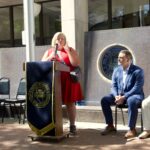
Harrisburg mayor Eric Papenfuse and business administrator Marc Woolley appeared in the mayor’s briefing room on Monday.

Mayor Eric Papenfuse announced on Monday that Harrisburg has hired a new business administrator, concluding a two-year search to fill the grant-funded position.

Marc Woolley, an attorney who has worked as general counsel at the Hershey Trust and the Pennsylvania Housing Authority, began his first day of work with the administration this morning. He will direct the city’s Department of Administration and help the mayor manage the city’s budget and finances.

One of Woolley’s major responsibilities will be helping the city determine its next steps in the Act 47 process, a state program for financially distressed municipalities. His $115,000 salary is funded for three years by an Act 47 grant from the state.

Papenfuse said on Monday that he had been performing most of the duties of business administrator to date. He hopes that filling the position will allow him to focus more on strategic planning and community outreach.

Woolley joins city hall just in time to for budget negotiations, which will ramp up in November. Speaking from the mayor’s briefing room on Monday, Wooley said that he’ll spend the intervening weeks acclimating himself to his new role and getting to know the city’s current budget and financial recovery plan.

Papenfuse praised Woolley’s “reforming spirit” and broad experience in public and private administration.

“Marc Woolley brings significant experience in public housing, compliance and financial management that will be a real plus for our city and its residents,” said Papenfuse. “He is enthusiastic about bringing his considerable intellect and talents to help us continue to move our city into a more prosperous future.”

Continue Reading