Tag Archives: harrisburg

Pedaling Problems: Can Harrisburg catch up to the growing urban biking culture?

In many U.S. cities, the once-ignored, even derided, bicycle is fast becoming a legitimate, preferred form of transportation.

Traffic-choked New York just implemented a bike-sharing program, following in the footsteps of many other cities, including Washington, D.C.

In our state, Pittsburgh and Philadelphia are listed as bronze and silver communities, respectively, according to The League of American Bicyclists, the 35th and 17th top bike-friendly cities for the year of 2012, according to Bicycling Magazine.

Can Harrisburg follow suit?

The answer seems to be a qualified “yes,” but only with a dedication to make it happen, the same commitment that much larger, more congested cities increasingly are making.

“We know that people want to ride bicycles. It’s an up-and-coming hobby,” said Dick Norford, an avid cycler and founding member of Bike Harrisburg, a cycling advocacy group for the Harrisburg region.

With proper signage, bicycle racks and marked cycling routes throughout the city and over the bridges, more cyclists would emerge in Harrisburg, he said.

“We are working on it,” said Ross Willard, a cycling advocate and founder of Recycle Bicycle, a non-profit that helps the in-need community repair and obtain bicycles. “Harrisburg has great potential. It’s a cycling-friendly city if you know where to ride and can avoid the bad areas.”

Something as simple as adding proper bike racks could encourage more people to swap their cars for a more environmentally friendly option. “When you ride your bike downtown, what do you do with it? There’s not enough safe places to park the bikes,” said Norford.

Willard described a scene of a couple who rode their bikes downtown to get sandwiches, and the man entered the shop. “The woman was outside protecting their bikes because there weren’t bike racks,” said Willard. “[And] if we have a bike rack, it’s the wrong design.”

For roads large enough, such as Reily Street, adding a bike lane would be as simple as painting lines and adding correct signage. With properly signed bike lanes, cars would be more alert to their two-wheeled friends and cyclists would feel more comfortable on the road.

“The more people see bicyclists, the more they do it,” said Willard. “I ride up 2nd Street, and I keep up with traffic. By doing so, it tells people that, ‘Wow, a bicyclist is doing what we are doing.’ Gridlock means nothing to a bicyclist, generally.”

While avid cyclists like Willard will continue to lead the vanguard, obstructions remain for the more occasional commuter.

For example, our bridges and their surrounding highways may be the largest impediment to commuters wishing to bicycle to work from the West Shore. Two of the four bridges are highways, making it illegal and unsafe for cyclists to ride on them. The Harvey Taylor Bridge and the Market Street Bridge are legal for bicycles, but they lack adequate signage.

Then there are the city’s roads, which are in terrible shape. Yes, we’re blessed with a continental climate, a great riverfront and a fair amount of flat land, but Harrisburg is missing a key component to becoming a great cycling city—decent infrastructure.

Harrisburg’s roads were never designed to accommodate bikes, a situation made worse when major thoroughfares (Front, 2nd and Forster streets) were turned into urban highways in the 1950s. In addition, the roads are poorly maintained. Fading lane lines, a large number of potholes and lots of bumps and divots make the roads more of an obstacle course than a safe medium for travel.

One ray of hope: until recently, cities now regarded as models for biking suffered from similar conditions–with terrible fiscal situations to boot.

In 1990, Pittsburgh was listed as one of the three worst cities for cycling, according to Bicycling Magazine. Government incentives for businesses and infrastructure development transformed its hilly neighborhoods, small roads and bridges into a safer, happier cycling community.

This translated into Pittsburgh’s local government creating properly signed bike routes and racks. It also worked with the business districts and the community-at-large to offer a better biking environment, while providing monetary incentives for employees to commute to work through a federal tax benefit that reimbursed cycling commuters through their employers. Lastly, the city held many bicycle-related events to educate and encourage bicyclers.

To ascertain ongoing needs, the city even employs a bike/pedestrian coordinator to oversee the development of the city from a bicycler’s perspective, making driving conditions safer for everyone.

So, can Harrisburg follow in the (bike) path of these other cities?

Willard is optimistic.

“Those employees [who cycle to work] are happier, less stressed and have less heart attacks. Pedaling works off their anxiety, and they can do the extra mile through the park on their way home,” said Willard.

In addition, cycling is environmentally friendly, less harsh on our roads and creates healthier residents.

“[Cycling] makes a friendlier community,” said Willard. “It’s more social.”

Continue Reading

The Attack that Never Was: Lee came very close to descending on his target—Harrisburg.

June and July of this year mark the 150th anniversary of the Confederate invasion of the North, culminating in the epic battle of Gettysburg, which arguably stands as the turning point of the American Civil War. For this reason, it seems fitting to talk about Harrisburg’s role during the war, especially its importance as a strategic focal point of the Gettysburg campaign.

Harrisburg numbered close to 15,000 permanent residents in 1863, but it was already an important transportation hub and river crossing, with three railroad and one wagon bridge spanning the river in the immediate vicinity. In addition, it was the closest Union capital city to the Mason Dixon line.

So, it was a primary focus of Gen. Robert E. Lee’s Confederate invasion of 1862, which ended at the battle of Antietam. It again became Lee’s objective in early summer of 1863. Despite the unsuccessful invasion of 1862, Harrisburg was still under-defended by the following year, especially surprising since Camp Curtin, the North’s largest mustering camp for soldiers, was in the city. There seemed to be little worry that Lee’s troops could ever penetrate so far into northern territory.

When news of Lee’s advance came, Gen. Darius Couch, commander of the Department of the Susquehanna, hired laborers to dig trenches and build several small forts along the western side of the Susquehanna at Lemoyne and Camp Hill in an attempt to keep the Confederates from gaining access to the bridges that led to the city.

On June 28, Union troops under Maj. Granville Haller and Col. Jacob Frick burned the bridge crossing the river downstream at Wrightsville, and, the next day, Confederate and Union troops skirmished in Camp Hill and attacked the earthen-built forts outside of Harrisburg. On June 30, a skirmish between Confederate cavalry under Gen. Albert Jenkins and Union militia at Sporting Hill became the northern-most battle of the Civil War. On the evening of June 29, Lee issued orders for all of his troops to concentrate around Cashtown in Adams County.

Gen. Richard Ewell had already formulated a plan of attack after probing the Harrisburg defenses and most likely would have begun assaulting Harrisburg in force on June 30 or July 1. Had the city been truly assaulted by a large Confederate force, all the bridges crossing the Susquehanna, including the first Rockville bridge, Northern Central bridge, Cumberland Valley railroad bridge and Camelback bridge would have been burned and troops on the West Shore evacuated into Harrisburg.

Fortunately, Lee’s orders saved the state capital from the bleak prospects of burning bridges, being shelled and possibly surrendering to overwhelming Confederate numbers. However, Lee’s orders were not so favorable for the small south-central town of Gettysburg, where 150,000 men fought for three days, culminating in the most famous battle of the American Civil War. Given a few more days to plan and attack, Harrisburg’s Civil War history might have been a vastly different story.

Jason Wilson is a historian for the Capitol Preservation Committee.

Continue Reading

Coming to HBG: Americana, the Beautiful

Americana ambassadors fill up the calendar for the celebration of our country’s birth month. I’ve decided to extend it beyond the weekend. Joining us in July is Pokey Lafarge’s old-time sensibilities; the Harrisburg Symphony’s annual Negley Park concert that gives proof that our flag is still there; and Glenn Jones’ steel-string guitar picking, which will deliver the ruminative sides of the American folk experience. Each will aim to penetrate the rambling tale of America, albeit in a variety of ways and means.

Glenn Jones, Sanctuary (Second City Church), July 5

Glenn Jones is categorized under the American Primitivism category, a style most easily understood as the solo guitar genre that plays with melding instrumental guitar with blues, country and classical music. John Fahey was its founder and Jones, his favorite son and the successor to his untimely death.

Jones makes Harrisburg a dutiful stop along his show route, and, if you’re into this recipe of experimental, folk, guitar-based music, Jones is like the Phillip Glass of this approach. Meditative, nuanced repetition and a toying with maximalism and minimalism dominate his vocal-less tunes. He’s been highlighted on NPR’s Tiny Desk Concert series and in the Washington Post due to his mindful and moving musical stories that are dense and deliberate—the stuff of real artistry.

The Harrisburg Symphony Orchestra, Negley Park (Lemoyne), July 6

Stuart Malina and the Harrisburg Symphony Orchestra donate their talents and fanfare for the common man by performing a compilation of classical Fourth of July sounds in Negley Park. Bring a blanket, some friends and family and come ready for Copland, Sousa and, of course, our adopted favorite, Tchaikovsky’s “1812 Overture,” a song about Russia’s defense against Napoleon’s army. Don’t forget the sparklers when the latter composition reaches its climax.

Pokey LaFarge, Stage on Herr, July 26

Pokey LaFarge, a St. Louis-based artist, is a multi-genre genius and dips his creative, musical toes across the American roots. Blues, ragtime, early jazz and western swing are all present in his four-album career. Last month, he released his self-entitled album on Third Man Records, Jack White’s label, and recently collaborated with White on his album, “Blunderbluss,” while also being featured on HBO’s acclaimed show, “Boardwalk Empire.” Pokey’s reputation is rising and is a fresh pick if you like music that sounds as if it might be coming from a bygone era.

Mentionables:

July 8, The Mantles, MakeSpace, 8 p.m.

July 25, Joy Ike, Stage on Herr, TBA

July 27, Larry & His Flask, FedLive, 8 p.m.

Continue Reading

Harrisburg Wants Fighters: Voters sided with reform in City Council election.

While the Harrisburg mayoral race has another leg, barring any atypical occurrence, we  know what the next City Council will look like.

In this Democrat-heavy town, only Democrats have run for council in the past few years, so it’s the primary election that determines the winners and the losers.

This year, there were four seats up for grabs, and of the ten candidates who ran, there were three incumbents—Wanda Williams, Eugenia Smith and Kelly Summerford.

Summerford lost, and two fresh faces were elected to office. In fact, one of those newbies, Shamaine Daniels, garnered more votes than anyone else, which was a surprise to many and, most certainly, to the incumbents.

Aside from the fact that a relatively unfamiliar newcomer succeeded above the rest, it’s worth noting who lost, most especially Summerford, who was considered a Linda Thompson defender and upholder.

When looking back on City Council votes since 2010, when Summerford took office, his voting record indicates an alignment with Thompson and her positions. He was not alone. His comrade was former City Council President Gloria Martin-Roberts. In 2011, she retired from council at the end of her term, choosing no longer to run for local government, but rather tried to make the jump to state. In 2012, she ran for the 103rd PA House of Representatives seat, coming in last in the primary.

She also has stood out as a fervent Thompson supporter.

On the other hand, we have City Council incumbents who have been re-elected. And whether it was this run or the last, what we know is that the “Fabulous Four” made it, while the others have not.

Who are the Fabulous Four?

In a long story made short synopsis….

Back when Linda Thompson was on council, she and Mayor Stephen Reed engaged in a fight about whose right it was to appoint members to the Harrisburg Authority (THA) board—the mayor’s or council’s. The issue headed to the courts, where it went as high as it could. However, there was no final ruling until Thompson defeated Reed and took the office of mayor.

On May 26, 2010—as City Council-appointed members of THA were making progress on the organization of chaotic files and setting terms of negotiations with creditors in the incinerator debt matters—the state Supreme Court came down with its ruling on the matter.

It ruled that the mayor has the right to appoint members to THA’s board, not City Council. Thus, by law, THA’s board was immediately dismantled. Work on a plan to face the incinerator crisis and on a much-discussed forbearance agreement stopped.

Despite a lot of public pressure to do so, Mayor Thompson refused to re-appoint the board members so they could get back to work. It could have been done. The next day. The irony, of course, was that Thompson as city councilor fanatically claimed it was council’s prerogative to appoint the THA board. Hence, the lawsuit with “Linda Thompson” explicitly named as one of the parties involved, meaning she believed so full-heartedly that City Council should appoint the board, not the mayor, that she was willing to spend public money and time to prove her righteousness of principle.

Yet, when the tables turned and she was mayor, instead of returning the council-appointed board back to business, she delayed and then began to send down a list of new candidates who either withdrew themselves before they came before council or caused strife amongst city councilors.

This is the first time we saw the so-called “Fabulous Four,” as the media began to refer to them. There were four members of City Council who stuck together and demanded a re-appointment of the old board—Wanda Williams, Susan Brown-Wilson, Eugenia Smith and Brad Koplinski. They stood strong despite the mayor and City Council President Gloria Martin-Roberts calling them “obstructionists,” “hypocrites” and “children.” This is when Summerford was noted to side with Martin-Roberts and Thompson.

Why does this matter? Because, looking back on that summer of 2010, reflection easily demonstrates how bad of a move it was for Harrisburg to have an inactive THA Board.

It gave creditors power and ultimately contributed to Thompson’s application to the state for the Act 47 program in October 2010, which led to a state takeover and the appointment of a receiver.

The “Fabulous Four” stuck together for a long time. They formed a bloc that voted down various Thompson administration initiatives, including premature asset monetization moves, high-interest financings and the Act 47 program and plans. They even fought receivership and never failed to call Thompson out in unity if there were a questionable claim or deal on the table.

They were publicly applauded. They were voted back into office.

Gloria Martin-Roberts and Kelly Summerford were not. Even Patty Kim, who continuously teetered in the middle of the two sides, won the 103rd seat by a very slim margin.

Apparently, Harrisburg wants fighters. Voters have indicated they want elected officials who seem to understand the complexity of the issues at hand, who have noble opinions and who express perspective for the common good.

The electorate wants representatives to fight the fights that matter the most and not the ones that don’t.

If anything, this election seems to reflect that.

For the two newcomers—Daniels and Ben Allatt—they’ve been given a chance to show who they will listen to and what they’re made of. Clearly, the standard has been set.

Continue Reading

News Digest: A roundup of news events from the prior month.


New COO for City

Robert Philbin will fill the post of Harrisburg’s chief operating officer/chief of staff until the end of Mayor Linda Thompson’s term, it was announced last month.

Philbin served as Thompson’s spokesman for almost two years before leaving in February to accept the post of marketing/communications officer for Capital Area Transit (CAT). He said he plans to return to CAT after his stint as COO.

The COO post was open after the sudden departure of Ricardo Mendez-Saldivia, who served about one year. Mendez-Saldivia was the city’s first COO, a position created as part of Harrisburg’s financial recovery plan in an effort to bring more professional management to city operations.

During his six-month tenure, Philbin said he would focus on continuing to implement the city’s financial recovery plan, crafting a budget for 2014 and helping with the transition to a new administration. The job pays an equivalent of $110,000 annually.

“I’m honored to serve the city during this historic period of fiscal recovery and transition, and I look forward to working closely with Mayor Thompson and her administration in the coming months,” Philbin said.

Philbin’s career with the city has been a rocky one. He took the communications director post in 2011, the fourth person to hold that job in over 2½ years, soon becoming a close aide to Thompson. City Council struck the job from the 2012 budget, leading him to work without pay all of last year. Council reinstated the position in 2013 only to have Philbin leave for CAT shortly afterwards.


Fee Hikes on Tap

The Harrisburg City Council last month boosted fees for a variety of services, such as answering false alarms, taking out building permits, renting park space and hanging banners.

The hikes, approved unanimously, were in response to suggestions made last year by Maximus Inc., one of several firms assisting the city in its financial recovery. In many cases, the fees had not risen in more than a decade, said Councilman Brad Koplinski.

For instance, the fee for a second false burglar alarm goes from $10 to $50; for a fourth false burglar alarm from $35 to $100. The permit fee for a plumbing fixture and trap increases from $15 to $25.

City Council members said they didn’t want to raise fees, but that the city needed to consider every option to increase revenue. Raising long-stable fees is part of the receiver’s financial recovery plan for the city.


Harrisburg Threatened with Fund Cut

The state House last month passed a budget plan that would slash the amount of direct state funding Harrisburg receives from $2.5 million to $496,000.

That money flows into the Fire Bureau budget for compensation to protect the Capitol complex. The bureau estimates that it costs Harrisburg about $4 million annually to provide emergency fire service to the Capitol complex.

State Sen. Rob Teplitz (D-Dauphin County), state Rep. Patty Kim (D-Harrisburg) and Mayor Linda Thompson all said they would work hard to restore the funding for the cash-strapped city before the state budget is finalized.

“At a time when the city is already struggling to maintain safety, this painful cut to fire protection funding further jeopardizes the safety of Pennsylvanians and adds to the burden of the city’s fiscal crisis,” said Kim.

Harrisburg already faces an operating budget deficit of around $3 million this year. The proposed funding cut would widen that gap considerably.


School Unions Agree to Cuts

Harrisburg’s two school unions have signed off on a plan to cut staff salaries as part of the financial recovery package for the debt-laden school district.

Both the Harrisburg Education Association (HEA) and AFSCME Council 13 last month tentatively agreed to salary and benefit cuts of 5 percent, said school Chief Recovery Officer Gene Veno. Already, Harrisburg school district personnel have not received regular raises for the past two years.

AFSCME, which represents non-instructional staff, originally rejected the offer, leading Veno to plan layoffs. The union later reversed itself, stating that members objected more to tougher evaluations and performance standards than to the salary and benefit cuts.

At press time, the memberships of both HEA and AFSCME had yet to ratify the agreements.

A third group representing school administrators also agreed to the cuts, said Veno.


Vacant Lot Ignites Dispute

A dispute over the use of a vacant lot at the corner of 6th and Herr streets could come to a head this month.

Bethel AME Church had run a commercial parking operation out of the lot until 2010, when its temporary variance to the zoning code expired. In May, the church applied for another temporary variance, but some members of the Fox Ridge neighborhood near the lot raised objections.

Ted Hanson, whose house abuts the southern edge of the lot, said the church falsely claimed “community support” for the commercial parking plan.

“Not one of the signatories on the church’s petition resides in Old Fox Ridge,” he said.

He added that the church historically has not made any effort to develop the lot appropriately, as past variances have required. On a website, foxridgeneighbors.org, Hanson also called into question Bethel’s appeal to make the lot tax-exempt, saying the church already owes nearly $6,500 in back taxes on the property.

Bethel AME declined to comment.

The application was to be considered at a meeting of the Zoning Hearing Board on June 17, but the meeting was cancelled at the last minute due to an error in the public announcement. The board’s next meeting is July 22, though Geoffrey Knight, the city’s zoning officer, said an earlier date is being sought to review the application.


Harrisburg Again without Health Officer

Harrisburg lost its Health Officer last month after the city, acting on the instruction of receiver William Lynch, declined to raise the position’s annual salary from $40,000 to $50,000.

The officer, Cornelius Johnson, left the post to accept a $50,000-per-year offer for the same position in Susquehanna Township.

The Health Officer conducts routine inspections on Harrisburg restaurants and food vendors to ensure they are complying with health codes. The city is currently seeking someone to fill the position at a starting salary of $42,000. In the meantime, inspections will be conducted by other codes officers employed by the city.

City Council President Wanda Williams expressed regret over Johnson’s departure and criticized Lynch and Mayor Linda Thompson for not ensuring the position offered competitive pay.

“City Council did everything it could to try to retain him,” she said.

Recently, Harrisburg has had trouble filling that position. The health officer post was vacant for more than a year before Johnson took the job.

Councilwoman Susan Brown-Wilson praised Johnson’s abilities, adding that he was Susquehanna’s “number one choice” for the job.

Lynch, however, pointed out that all other city employees are experiencing a pay freeze and stressed that making an exception for one employee would have a “corrosive” effect.


Another Independent for Mayor

Air Force Staff Sgt. Nate Curtis last month announced his candidacy for Harrisburg mayor, the second independent in the race.

At a press conference in the Pennsylvania State Museum, he said his political party affiliation will read “Curtis for Mayor” on the Nov. 5 general election ballot.

Curtis grew up in Harrisburg, where his mother worked at a number of restaurants around the city. His father, whom Curtis said he met when he was a teenager, was a homicide detective with the police department.

Curtis recently returned to the city after a tour in Afghanistan and said he was distressed to find “my hometown at war with itself.” In 2007, his brother Dax was murdered in the foyer of his apartment on Woodbine Street.

His priorities as mayor, he said, would be addressing education and blight and cutting the city’s budget, including a 10 percent pay cut to the mayoral salary and a dismissal of the mayor’s security detail.

The race to replace Mayor Linda Thompson has grown increasingly crowded. Midtown Scholar Bookstore owner Eric Papenfuse captured the Democratic nomination for mayor in May, and Uptown resident Nevin Mindlin also is running as an independent.

City Controller Dan Miller, who lost the Democratic primary, narrowly won the Republican primary based upon 196 write-in votes. At press time, he had not announced his intentions for the general election.


Broad Street Market Loses Manager

Harrisburg’s historic city market is again without a manager as Dennise Hill left after less than a year on the job.

The board of the Broad Street Market confirmed Hill’s resignation, saying that Market vendors were informed of the departure, but refused further comment on this personnel issue.

The Market has had great difficulty retaining top staff, with the past three managers all serving very short stints.


Restaurant Roundup

Harrisburg-area foodies got a triple treat last month as two long-promised eateries and a café made their debut.

The month started out strong as Little Amps Coffee Roasters opened its second location at the corner of N. 2nd and State streets on June 1. Little Amps first rocked Harrisburg’s gourmet coffee market in October 2011 with a storefront in Olde Uptown, and its new downtown spot offers the same fresh-roasted coffee along with a selection of goodies and sandwiches from Yellow Bird Café.

In mid-month, Taco Solo began serving tacos and salads from a central location at the corner of N. 2nd and Locust streets. The downtown taqueria is the inspiration of Juan and Lisa Garcia, owners of the popular Mexican restaurant El Sol, who wanted to bring their cuisine to the takeout crowd.

About a week later, owner Sri Kumarasingam gave a culinary nod to Midtown in the form of Pastorante, a new pasta-themed restaurant at 1012 N. 3rd St. The completely renovated space features an open kitchen, homemade pastas and numerous creative Italian dishes and pizzas. The storefront has been empty for years, last housing the greatly missed Italian Market.

Speaking of Midtown: Fine diners will be delighted that Char’s Tracy Manor will begin to serve Sunday dinner starting July 7. Until now, Char’s only served Sunday brunch, which will be suspended. Also, the beautiful riverside restaurant at 1829 N. Front St. now features live outdoors music on Friday and Saturday nights, 7 to 10 p.m.


Changing Hands: May Property Sales

Briggs St., 1608: T. Simmons to Fannie Mae, $61,911

Capital St., 1007: 3rd Street LLC to CJ Good LLC, $125,000

Cumberland St., 216: D. Maguire Trust to P. Wambach III, $117,500

Derry St., 1711: J. Mendoza to D. Patel, $36,432

Green St., 1628: C. Lex to M. & A. Collins, $90,000

Hale Ave., 433: T. Bryant to G. & C. Speroff, $72,500

Hanna St. 110: Donna C. Flath Trust to M. Knouse, $150,000

Harris St., 625, 641, 643 & 1521, 1523, 1525, 1527 Wallace St.: J. Close to

U.S. GSA, $63,600 each

Harris Terr., 2481: PA Deals LLC to S. Hill, $66,000

Hoffman St., 3028: V. & C. Piatos to J. Hull & L. Downs, $140,000

Holly St., 1849: B. & K. Kreps to D. Reed, $69,900

Hudson St., 1256: J. Fabiankovitz to Lemoyne Land Corp. Inc., $45,000

Hummel St., 224: V. Mainardi to Brethren Housing Assoc., $48,500

Kensington St., 2135: S. Orfanelli to A. Segin, $45,000

Kensington St., 2147: PA Deals LLC to J. Gaidos, $67,900

Liberty St., 1404, 2021 Holly St, 2651 Jefferson St. & 1826 Briggs St.:

Shokes Enterprises & R. Shokes Jr. to R. & D. Requa, $201,000

Locust St., 103 & 105: Front & Locust LLC to Browser Properties, $150,000

Maclay St., 524: W. Grannison to 524 Real Estate Holdings LLC, $100,000

Manada St., 2003: D. Barrick to M. Jackson, $63,000

N. 2nd St., 1225: J. Van Allen to M. & L. Day, $120,000

N. 2nd St., 1404: Kyzer Rentals LLC to Tang Liu Realty LLC, $100,000N. 2nd St., 2405: PBE Companies LLC to M. & R. Lindquist, $140,000

N. 2nd St., 2533: J. & V. First to K., C. & E. Meisinger, $120,000

N. 2nd St., 2619: R. Davis Jr. to D. Skerpon & C. Baldridge, $225,000

N. 15th St., 17: B. Miller to Wofford Enterprises Ltd., $50,000

N. 15th St., 1217: PA Deals LLC to A. Plowman, $79,900

N. Cameron St., 101, 101 Rear, 109 & 111 Hancock St.: C. Green to R. & S.

Otto, $269,000

Oakwood Rd., 2309: M. & S. Gruin to M. Knopf, $245,000

Penn St., 1523:  K. Thralls to E. Jones & J. Lindgren, $134,000

S. 12th St., 1442: Beneficial Consumer Discount Co. to N. Sanchez, $42,500

S. Cameron St., 1119: River Rescue to Statewide Enterprises LLC,

$385,000

Verbeke St., 210: K. Leitner to R. Katsifis, $90,000


Sales data is collected from Dauphin County records and is assumed to be accurate.

Continue Reading

Safe Spaces

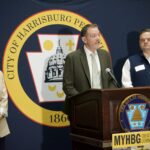
Police Chief Pierre Ritter, COO Bob Philbin, and Mayor Linda Thompson at this morning's press conference.

Police Chief Pierre Ritter, COO Bob Philbin and Mayor Linda Thompson at this morning’s press conference.


The city will begin cracking down on crime and blight in Safe Zone 6, Mayor Thompson announced this morning at a press conference in City Hall.

The Neighborhood Safety Zone program, launched in February, aims to reduce crime by directing the efforts of a team of officials—including cops, code officers, social workers and sanitation workers—at specific neighborhoods.

Safe Zone 5, which was announced on May 20, centered on Hall Manor, a housing project at South 17th and Hanover Streets. Since Zone 5 was announced, the mayor said, 11 traffic citations were issued and 33 warrants were served in the area for misdeeds ranging from parole violations to theft by unlawful taking and public drunkenness.

Thompson also reported that 1 1/2 tons of garbage were removed from the area, 44 streetlights repaired and 13 properties inspected.

“No firearms were removed this time, which was surprising,” Thompson said. “Not that there are none, but none were confiscated.”

The Neighborhood Safety Zone program has at times had something of a confused execution. Safe Zone 2, for instance, at 14th and Vernon Streets, was erected one afternoon in late March and dismantled an hour and a half later. In addition, the targeted areas were initially announced in advance, but are now concealed from the public, to maintain an “element of surprise,” according to Thompson.

But now, she said, the program is running smoothly. “It works. It’s a new and improved way of building and rebuilding the neighborhood.”

Asked about recent trends in violent crime—the city saw its 11th homicide of 2013 last Saturday—Thompson suggested that she was not overly concerned.

“Some of our homicides are unpreventable,” she said. She pointed out that this year’s homicides so far have involved victims and perpetrators who knew each other and often were the result of domestic disputes. She cited one murder that was the outcome of a fight inside a home. “No amount of cops would have prevented that,” she said.

Continue Reading

Same-Sex Marriage & the Urge to Localize

Two decades ago, when I was a young pup in the journalism biz, an editor gave me an assignment that I thought the height of absurdity.

I was told to “localize” the Rodney King riots.

I should mention that, at the time, I worked nowhere near Los Angeles or even in a city. I was at a newspaper in north-central New Jersey in a suburban county that was probably 99 percent white.  Essentially, I was being told to go find some black people to talk to.

“I think that this event is as historic to blacks as the JFK assassination was to the country,” said my overly confident, middle-aged white editor, as if he knew what in the world he was talking about.

Since then, I’ve scoffed at the old journalism nugget of localizing national stories, so was hesitant this morning to join the media throng, which was assembling in full force at the LGBT Community Center of Central Pa., to hear the Supreme Court’s decisions on the Defense of Marriage Act and California’s Proposition 8.

By the time I got there, satellite trucks already lined N. 3rd Street in front of the center in Midtown Harrisburg. Inside, a large bank of cameras peered onto the rows of folding chairs that the Center’s Executive Director Louie Marven had hurriedly put out. In front, he had set up a screen with a Twitter feed that gave real-time updates of the decisions.

As the 10 a.m. announcement neared, most of the seats were occupied. I sat in the front row chatting with Center board President Stuart Landon about this and that. Then someone said, “Quiet, quiet,” and the buzz in the room silenced.

The decision was in: a split court ruled DOMA to be unconstitutional. A loud cheer went up. People hugged. “Of course, it’s unconstitutional!” one woman called out, expressing her personal belief more than the inevitability of the decision.

For the next 10 minutes, people huddled in groups to discuss specifically what this meant in Pennsylvania. Not too much at the moment, they agreed. Still, it was necessary, they said, both in terms of the continuing battle for equality and for ensuring that Pennsylvania couples are not denied federal benefits once the commonwealth approves same-sex marriage, which they vowed to work hard to make happen.

In contrast, the subsequent decision over Prop 8, which basically sent the matter back to Californians to decide for themselves, was something of a letdown, but generally didn’t surprise the crowd.

“This is what I expected to happen,” said City Treasurer John Campbell, who viewed the day’s decisions as another step forward in the fight.

I can’t say that the day’s events changed my mind about the value (or lack thereof) of localizing national stories. I still think it’s cheap, brainless journalism, such stories assigned by editors who rarely leave their cubicles and know nothing about the communities they allegedly serve.

But, on this day, there actually was a story — and a good one at that — as a roomful of people rejoiced together, believing momentum was on their side, that, some day soon, gay couples in the Harrisburg area would enjoy legal equality in their relationships.


Continue Reading

Dead Dads & the Liquor Biz

I hereby declare the battle over privatization of Pennsylvania’s liquor business to be over.

I reached this conclusion in, of all places, Aleco’s, a tucked-way gem of a sandwich shop at the corner of N. 2nd and North streets in Harrisburg that doesn’t even serve alcohol.

No, I didn’t overhear any legislators and lobbyists speaking of a done deal (though I have overheard these Capitol types loudly discussing their business here before and, in fact, Aleco’s used to be a favorite hangout of former city receiver David Unkovic).

I was waiting on the arrival of my Aleco’s salad (a delicious concoction of pasta salad meets garden salad meets chicken salad), when an advertisement came on one of the two TVs hung on the walls. Sponsored by United Food and Commercial Workers Local 1776, the ad showed a sad little girl at the funeral of her father who, we’re told, has just died at the hands of a drunken driver.

The girl recounts all the life events that her dead dad will miss: her high school graduation, her send-off to college, her (where’s the Kleenex?) wedding. It then credits “current laws” and state liquor store employees for Pennsylvania’s allegedly low death rate from drunken driving.

“Tell your state senator to say ‘no’ to liquor privatization,” the commercial concludes. “We don’t want other children to lose their parents.”

The ad never explains exactly how liquor store employees save the lives of the parents of Pennsylvania’s children. We’re just supposed to know that, without these guardians supervising our booze purchases, it would be open season on the open road.

The Senate just narrowly voted a privatization bill out of committee, and a final vote by the full Senate might take place later this week. Pundits expect the vote to be very close. However, when an organization resorts to debased fear tactics, the exploitation of children and the threat of slaughter on the roads in order to save the current system, you can be pretty sure that it’s all over but for the counting.


See the advertisement for yourself here.

Continue Reading

“Why Not Me?” Capital City Syndrome, Part 2

Awhile back, I wrote in my monthly Burg column about a potentially debilitating condition that I had identified called “Capital City Syndrome.”

This is a sickness that causes people who live or work in a state capital to think that they’re more consequential than their positions may actually warrant. Some folks in these capital cities have easy access to legislators and governors and lobbyists and grand buildings and suddenly think to themselves: “Heck, why not me?”

Well, Harrisburg City Hall should be quarantined and everyone there inoculated pronto because this illness is spreading at an alarming rate.

Today, Brenda Alton, the city’s director of Parks, Recreation and Enrichment, became the second Harrisburg official to declare for the Democratic nomination for lieutenant governor, joining Councilman Brad Koplinski in the quest. 

That’s right: two people from this tiny, troubled city believe they can become the commonwealth’s next second-in-command.

Standing in the Capitol rotunda, a spectacular, ornate space just blocks away from a municipal building subject to water leaks and faulty air conditioning, Alton looked impressive as one does standing before the grand center staircase. 

“Some may ask, ‘why you and why now?'” Alton read from her prepared remarks after being introduced by former City Council President Gloria Martin-Roberts. “The real question is: ‘why not me?'”

Alton then proceeded to invoke an unnamed Chinese philosopher, the Rev. Jesse Jackson, Dr. Martin Luther King Jr. and Mother Teresa.

“I am Brenda Marie Alton,” she said, capping off this litany of notables. “I have the shoulders of great forerunners to stand upon. I am confident, courageous, informed and diplomatic enough to run this race and win.”

Alton

Brenda Alton announces her candidacy.


After the speech, the assembled press asked just three questions. Two of them were mine.

Q: Do you expect to continue to serve as Harrisburg Parks and Rec director while seeking the nomination as lieutenant governor?

A. Yes.

Q. You have some name recognition in Harrisburg, but how do you expect to increase your name recognition throughout the state?

A. Who says I don’t have name recognition?

Alton then went on to shut me down by saying she has name recognition in New York City and throughout the nation, without specifically mentioning this state. 

(Note to Alton’s political advisers, the correct, non-defensive stock answer is: “Over the coming year, I will campaign hard throughout the commonwealth to earn the respect and the vote of all Pennsylvanians.”)

When I first coined the term “Capital City Syndrome,” I was actually referring to former Mayor Steve Reed and current Mayor Linda Thompson, who, surrounded by marble and gilding and rich people at swanky affairs, both seemed to get caught up in exaggerated notions of the importance of this small city and of their own positions, in the process getting both into deep trouble.

However, this illness now seems to extend to the level of City Council and the Department of Parks & Recreation. Was declaring municipal bankruptcy such an astounding success on the part of council — or has the Thompson administration been such a model of municipal efficiency and pride — that either now should serve as the bases of huge promotions for their members? 

Recently, I went to the cashier’s office to pay a parking ticket and found the clerk’s service to be both efficient and pleasant. Please, someone gauge his plans for 2014.


Continue Reading

Unity Triumphant

Talk about burying the hatchet.

Last night’s Unity Rally for area Democrats at Midtown Scholar Bookstore was pretty much as expected: lots of pols and their supporters; party activists; candidate speeches; plenty of kudos for Eric Papenfuse, the Democratic nominee for Harrisburg mayor.

But there was one surprise. Lewis Butts Jr. was in attendance, saying he now supported the candidate. This is the same Butts charged by Dauphin County with defacing banners just before May’s primary, spray-painting over the now-nominee’s large, roadside signs to read PapenPuss.

When asked about his change of heart, Butts replied, “It’s all about economic development, about my ideas for economic development.”

Evidently, Butts believes it’s better to be inside the tent so he can push his pet projects like the Harrisburg International Aquarium, a hydroelectric dam and PennDOT Plaza, a shopping and restaurant center.

He seemed hopeful that Papenfuse would embrace his agenda, even though his ideas sound like they could come from the one man the nominee is loath to imitate — former Mayor Steve Reed.

The long-elusive Reed, of course, wasn’t there, nor was Mayor Linda Thompson or Controller Dan Miller, showing that, in Harrisburg, even unity has its limits.

Continue Reading