Tag Archives: harrisburg

Proposed Convenience Store Gets First OK

CornerStoreFB

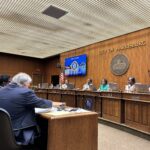
The Harrisburg Planning Commission tonight gave unanimous approval to a planned convenience store at the corner of Green and Kelker streets.

By a 4-0 vote, the commission recommended that a special exception be granted to allow a convenience store to operate at the site and to waive the four-vehicle off-street parking requirement. The commission only mandated that the property pass a health inspection and follow city-mandated rules for signage. Commission members also recommended that a trash receptacle be located outside the store, which is slated to operate from 6 a.m. to 8 p.m. daily.

Otherwise, the commission asked few questions of the applicant, Mohamed Ahmed Ahrar, or of the representative of property owner Michael Goldberg Properties. Despite some opposition in the Olde Uptown neighborhood to the proposal, not a single member of the public attended the meeting.

The commission did read a letter in opposition submitted by Historic Harrisburg Association, which claimed the proposed store was incompatible with the neighborhood, but quickly dismissed the reasoning.

The commission’s recommendation now goes to the city’s Zoning Hearing Board, which will meet on Monday to consider the application. The board has the final say over whether to grant the special exception. 

The century-old property at 224 Kelker St. most recently housed a barbershop, though, over the years, has served many uses, including as a corner store, a drugstore and a tea shop.

Continue Reading

Firefighters Agree to Cuts, Health Care Cost Sharing Under New Labor Contract

Photo credit: Brian Bastinelli, BrianBastinelli.com.

Photo credit: Brian Bastinelli, BrianBastinelli.com.

The Harrisburg chapter of the International Association of Firefighters has agreed to a new labor agreement, Mayor Eric Papenfuse announced on Tuesday. The agreement, which the union approved by a 38 to 15 vote, includes reductions in scheduled salary increases, an increase in employee health care contributions and salary cuts for new hires. It also represents the final concession from the city’s labor unions required as part of the state-appointed receiver’s recovery plan.

“I think the important thing to note here today is that a tremendous number of sacrifices are being made by the members of the firefighters’ union in an effort to allow this city to move forward,” Papenfuse said. In meetings with the firefighters, he said, he had tried to convey that, without contract modifications, “the budget would not be balanced and the city would stay mired in the financial difficulties that had gotten us first into Act 47 and then into receivership.”

The mayor’s proposed budget for 2014 already included the expected savings under the new agreement, projected to be around $1.6 million, or around $20,000 for each of the 79 bargaining-unit positions in the fire department. This figure is somewhat misleading, however, as the direct effect on an individual firefighter depends on his or her time of hire, family size and consumption of health care.

Some of the savings are achieved through the elimination of scheduled pay raises, previously set under a contract extension signed by former Mayor Stephen Reed. The raises, which had been set at 3 percent per year beginning in 2013, will be zeroed out in 2013 and 2014 and replaced with a 1-percent raise in 2015.

A sizeable portion of the projected savings—around $485,000 per year, according to Susan B. Friedman, a lawyer for the receiver—will come from a change in firefighters’ health care plans. Formerly, the majority of firefighters contributed nothing to the cost of coverage beyond their co-pays. Under the new agreement, their health care plans will now include partial contributions from each paycheck, at a rate of $40 for individuals and $90 for family care, as well as deductibles, out-of-pocket maximums and a change in co-payments for prescriptions.

The largest chunk of the savings, around $520,000, is expected to come from a reduction in numbers manning each shift, from 16 to 14 firefighters.

On Tuesday, Mayor Papenfuse attributed the union vote, in part, to a pair of “behind-closed-doors meetings” he held with firefighters in January, during which he tried to restore trust between the city and its public safety personnel. “We met right where they sleep, right inside their quarters,” he said. “I extended a hand of partnership, of trust, and I am pleased to say I was met with a hand from the other side.”

Glenn Sattizahn, the local union president, also acknowledged the mayor’s role in bringing the new agreement to a vote. “The turning point, I would venture to say, was after the meetings with the mayor,” Sattizahn said. “He’s quite persuasive.”

But, Sattizahn added, continued pressure from the receiver’s office, which could eventually compel the firefighters to comply through the courts, also played a role. “There wasn’t really a whole lot of compromise,” he said. “We were, for the most part, forced into this.”

Continue Reading

Harrisburg Declares Snow Emergency

Harrisburg Mayor Eric Papenfuse today declared a snow emergency for the city, beginning at midnight and requiring the removal of all vehicles from snow emergency routes. The full text of his statement is below.

MAYOR ERIC PAPENFUSE DECLARES SNOW EMERGENCY EFFECTIVE MIDNIGHT TONIGHT

HARRISBURG – Mayor Eric Papenfuse is declaring a snow emergency effective midnight tonight, requiring city residents to move their cars from emergency snow routes.

By special arrangement with Standard Parking, residents can park without charge at the Locust Street Garage. Free parking is also available on City Island, the Fire Museum at 1824 N. 4th St., and at the Farm Show Complex (Maclay Street side near Front Entrance).

Through special arrangement with the Capital Area Transit (CAT), shuttle service from the Locust Street Garage, City Island and the Farm Show, will be extended until 8 p.m. Wednesday. The shuttles will resume at 6:45 a.m. Thursday, if weather permits.

Mayor Papenfuse is also urging people to voluntarily move cars parked on Penn, Allison and Zarker Streets to facilitate plowing, salting and access by emergency vehicles.

The National Weather Service is warning the winter storm could dump an estimated 8-12 inches of snow on the region.

To qualify for free parking in the Locust Street Garage, drivers will need proper ID or documentation.  Residents may enter the garage from 4-10 p.m. Wednesday, Feb.12, 2014 or from 8 a.m.-7 p.m.  Thursday, Feb.13, 2014 to qualify for free parking.

To gain access to the garage, residents will pull a ticket at the entrance.  To exit residents will need to show a driver’s license with a Harrisburg address or proof of residency.  

To help accommodate residents, garage hours have been extended three hours – to 10 p.m. on Wednesday, Feb. 12.  After 10 p.m. vehicles in the garage will not be accessible until 8 a.m. Thursday, Feb. 13.  The garage will then remain open and accessible to everyone until 7 p.m. Thursday.

Unless further notice is given, all residents will need to exit the Locust Street Garage by 6:30 a.m. Friday, Feb. 14 to avoid being charged for parking in the garage during this period. Residents wishing to park their cars after 10 p.m. Wednesday should chose City Island, the Fire Museum or the Farm Show. Cars must be removed from the Farm Show parking lot by 6:30 a.m. Friday.

If poor conditions persist, free parking times may be extended.  Please monitor www.parkharrisburg.com. www.harrisburgpa.gov  or local media for communication of extended time.

SNOW EMERGENCY ROUTES INCLUDE:

·         Division Street – Front Street to 7th

·         Second Street – Paxton St. to Division St

·         Maclay Street- Front to 7th St.

·         Seventh Street – Division to Fisher Plaza St.  (Fisher Plaza is between Forster and Walnut Streets at the Capitol Complex, to the immediate east of the Main Capitol Building. The city has no responsibility for streets within the Capitol Complex)

·         Walnut Street – Fisher Plaza to Front St.

·         Paxton Street – Cameron to City/Swatara Township line

·         Derry Street- Mulberry Street Bridge to City/Paxtang Line

·         Market Street – Cameron Street  to 25th St.

·         State Street – Fisher Plaza to City/Susquehanna Twp. Line

·         Herr Street – Cameron Street to city/Susquehanna Twp. Line

·         Seventeenth Street – Sycamore Street to Arsenal Boulevard

 On Thursday, Standard Parking will restrict their ticketing to cars parked on Snow Emergency Routes.  The Mayor will hold a press briefing at noon Thursday to update the public on weather conditions. City Hall will remain open during the Snow Emergency, but city employees are being allowed liberal leave.

 For more information, contact Joyce M. Davis at [email protected]; or call (717) 255-3015.


Continue Reading

The High Cost of (Cheaper) Parking

“Stop the parking meter hike! Make the rich pay, not the workers! Don’t squeeze workers and small business. This is a tax on the people!”

If you poked your head into the public sphere during the past two weeks, you probably encountered a complaint about Harrisburg’s parking fee hike, adopted in the fall as part of the receiver’s recovery plan and taking full effect this month.

The new rates at on-street meters—$3 per hour in the central business district, $1.50 per hour outside it—and the extension of hours to include Saturdays and weekday evenings, from 5 to 7 p.m., have prompted angry reactions from just about every corner. Complaints that the changes are “draconian” or “sudden,” or that they’ll spell doom for downtown businesses, could be heard at Tuesday’s parking forum at the Hilton, arranged by Roxbury News. If you missed that, you could find them on TheBurg’s Facebook page, or in the PennLive comments section, or in an online petition drawn up by a local entrepreneur.

The quote at the top of this article, though, isn’t from Harrisburg and isn’t from this year. It actually comes from a flyer handed out in the fall of 2009, at a meeting of the Municipal Transportation Authority in San Francisco’s city hall. At the time, the San Francisco MTA was beginning to undertake a parking meter study that would lead to expanded hours, increased enforcement, and—in many places—increased rates. A group of activists who opposed the study, from the ANSWER Coalition (for “Act Now to Stop War and End Racism”), handed out the flyers as people entered the room. During the meeting, a representative from ANSWER took to the microphone and issued warnings about a “tax that is disproportionately put on the poor, the working class and small-business owners.”

What the activists didn’t seem to realize was that the parking study was actually designed to achieve goals that ANSWER, several of whose members opposed the Iraq war under the mantra “No Blood for Oil,” might have shared. The MTA study was based on the principles outlined in “The High Cost of Free Parking,” a landmark text in urban planning by Donald Shoup.

In his book, Shoup, an economist and urban planning professor at UCLA, argues that the wide availability of underpriced parking in America has had devastating consequences for the environment and for our cities. For decades, urban planners sought to make cities accessible to cars—for example, by requiring new developments to provide adequate off-street parking. The result, according to Shoup, is that people now expect to find parking everywhere they drive, which in turn encourages them to favor cars over every other form of travel. “Free parking,” he writes, “helps to explain…extreme automobile dependence, rapid urban sprawl, and extravagant energy use.”

To correct this, Shoup suggests, cities should embrace three remedies. First, they should match the price of curb parking to demand, which usually means increasing it. Second, they should stop requiring new developments to provide ample off-street parking for potential customers. Finally, they should direct any additional parking revenues to projects in the neighborhoods where they are collected. The ultimate goal is to eliminate the expectation of cheap and abundant parking everywhere we travel, thereby encouraging more people to walk, carpool, and use public transit and reducing the number of cars on the road.

I thought of Shoup’s work this week and last, when the public reaction to the new rates in Harrisburg reached fever pitch. Harrisburg differs from San Francisco and other cities in that the demand for parking has never been so great as to produce congestion. But Harrisburg has also suffered the ill effects of cheap and abundant parking. People who live in the city often drive when they could bike or walk, and people outside the city drive alone when they could carpool or use public transit. This has obvious environmental costs, but it also has social consequences. Much of the city looks the way it does because its planners, for several decades running, have operated on the assumption that everyone will drive everywhere they go. As a result, we have wide urban highways slicing up neighborhoods and surface lots and multi-story garages dotting our downtown.

I now wonder whether the reaction to the parking hike is really a knee-jerk resistance to changes that city residents would have readily embraced if they’d been presented in a different frame. No one likes to pay more for things, of course, and there are plenty of reasons to be wary of increased fees in a city whose management of money has been, shall we say, less than sterling. (Where those fees will be going under the new arrangement, and whether that’s an improvement, will be the subject of a second parking column next week.)

But I think that a long view of the new parking system should acknowledge several potential upsides. For one, daily commuters who previously dodged garage rates will now, as a result of higher on-street rates and increased enforcement, be pushed into the garages. That may not seem obviously good for the city, except that, under the new arrangement, a portion of the higher revenues will flow into the city’s general fund. If City Council and the mayor take Shoup’s advice, and direct some of these revenues towards the improvement of the district producing them, I suspect downtown businesses will come to see the rate hike as less of a threat.

City residents, for their part, will have an incentive to walk, bike or carpool where previously they drove. That’s good for the environment, and though it may require a change in ingrained habits, I suspect such a change is more likely to occur than not. Last week, several business owners expressed a worry that their customers would flee for venues with free parking. That may be true for some suburban customers, but I’d wager that businesses have nothing to fear from city residents, who locate here in part because they want proximity to urban amenities. We’re more likely to walk or share the cost of parking with friends than to ditch Federal Taphouse and Little Amps for the Olive Garden and Starbucks. Federal Taphouse and Little Amps are part of why we moved here.

That brings me to the suburban customers. It may be the case that downtown businesses will lose some of their customers who drive into Harrisburg expressly for weekday happy hours and Saturday events. But here, again, I’d urge business owners to take the long view. In the short term, they may have to work to keep some suburban customers with incentives like rewards for carpooling or parking validations. But in the long term, these patrons will be replaced by new urban ones, as easy access to urban amenities becomes increasingly dependent on actual proximity to them.

A recent comment on our Facebook page is a good demonstration of this point. Last week, we posted the photo above, of a new downtown meter, on our wall. Below it, a reader from Mechanicsburg lamented that, because of the addition of Saturday parking charges, what was once a free afternoon in the city for the film and art festival “will now be an approx $20 expense.” “I’m sure this will be changing my plans,” he added.

When I read that, I thought, Which plans? The ones to live outside the city but have free and easy access to its amenities? It’s a well-worn point that the rise of the automobile contributed to the decline of many an American city, including this one. Our continued deference to car ownership, in the form of cheap parking, has helped to artificially devalue what cities have to offer. As Shoup writes, “Free parking is an invitation to drive wherever we go.” Parking in Harrisburg wasn’t free, but it was cheap and abundant—and as a result, it was an invitation for people to enjoy the amenities a city can offer without paying city property taxes or sending their children to city schools. To the extent that it’s an invitation to live here, rather than simply park here, the fee hike in Harrisburg may not be such a bad thing.

Continue Reading

Great Jump Forward: From a single program, Jump Street has become a connecting point for the arts.

Shailen Vines, Xavier Farrow & Ayat Muhammad in period costume after training to become docents for the Bethel Trail.

Shailen Vines, Xavier Farrow & Ayat Muhammad in period costume after training to become docents for the Bethel Trail.

Bob Welsh, Jump Street’s impressive executive director, wasn’t always at the helm of a top-notch non-profit that provides creative opportunities for youth and adults. Back in the day, he was just an ordinary city resident who was unhappy about what he saw happening in the city school’s music programs.

“Music education was really in terrible shape,” he said. “Not that the teachers weren’t great, there were just not many resources.”

Wanting to do something about it, he came up with the idea of starting an instrument donation program.

“I went to Mayor Reed to see what he thought, and he basically told me I have lots of energy and good ideas but no clue how to execute. He told me that I needed to go out and find some agencies that do this kind of work and find out how this work gets done. It was the best advice I ever got.”

Welsh found a kindred spirit in Metro Arts, where he was able to learn about non-profit management and how to write grants. One of the grants that he got allowed him to start the fledgling “Gift of Music Program.” Welsh served as a volunteer, a board member and then was hired as executive director of Metro Arts. A year later, in 2000, the organization changed its name to Jump Street.

Now, Jump Street is a thriving organization providing multiple programs for youth, teens and the community at large. It operates a facility on N. Cameron Street that includes the Thrive Art and Fitness Center for Seniors, teaching and rehearsal space, arts business incubator/office space, gallery space and administrative offices.

The following is a spotlight on three of Jump Street’s programs.

The Gift of Music

The Gift of Music is Jump Street’s oldest program. Through the program, band and orchestral instruments are collected, restored and distributed to students interested in learning to play an instrument. It’s not the first time that organizations have collected instruments, but Welsh has come up with some ideas that have streamlined the process.

“We decided not to get involved with trying to determine if individuals qualify for an instrument,” Welsh said. “Instead, we qualify programs.”

Accordingly, Jump Street works with 40 or 50 schools, community organizations or churches.

“They let us know what they need, and then they take responsibility for determining which students should get the instruments,” he said.

Repair of the instruments is done in local repair shops and typically costs about $100.

“In a former life, I repaired instruments, so that helps,” said Welsh. “So that’s one place that we have a leg up because I can identify what will probably get out into the field.”

Welsh says that he has a rule of thumb that, if the repair is more than one-third of the value of the instrument, check with him. If it doesn’t, the shop can just go ahead. “That saves time and cost,” he said.

During the 12 years of the program, Jump Street has refurbished and distributed around 500 instruments in the Harrisburg region, but the program expanded several years ago and now operates in four other cities. “All across the state, we’re probably pushing towards a distribution of 5,000,” Welsh said.

Jump Street accepts instrument donations at its offices in Harrisburg or at any area Classic Cleaners.

AND Magazine

One of Jump Street’s major literary projects is the publication of a magazine for teens written exclusively by teenaged journalists.

AND Magazine (which stands for “A New Diversion”) has been in publication for seven years and, since its inception, has had about 150,000 readers. The magazine was conceived as a way to provide opportunities for regional teens to participate in all phases of the magazine publishing process, including writing, editing, graphic design, photograph and marketing.

“Most magazines [geared towards teens] are people our age writing what we think and what wisdom we can offer to teens,” said Welsh. “It occurred to me that it might be more interesting to mentor young writers or just be with them to facilitate their own process.”

So far, the project has involved around 100 dedicated writers and about 100 more who may have contributed one or two stories, poems or photographs. One of the magazine’s most famous graduates, and its first editor, is Annie Stone, who is now editor of teen books with Harlequin. Many other students also have benefited from working on the magazine by being able to include stories they have written in their college portfolios. Welsh notes that the literary work of AND Magazine writers has helped them to net scholarships to many prestigious schools, such as Point Park University in Pittsburgh, Temple University, the University of Pennsylvania and Shippensburg University.

Every year, the project attracts a core of roughly half-a-dozen students from local school districts, many of whom travel to Jump Street’s offices on a daily basis as part of their school’s senior project programs, during a free period or after school. Working together as a team gives these students an opportunity to learn to work with people who have different backgrounds and skills.

“We may have a Harrisburg High School student sitting next to a Boiling Springs student so, for the first week or two, they may as well be from different galaxies,” said Welsh. “They won’t know very much about where each other is living, but it’s personally been a joy for me to watch those barriers dissolve—and they almost always do.”

Jump Street staff also goes out to schools to work with groups of students, tasking them to create pieces around a particular editorial thread, such as young people’s attitude towards voting during election time. Teens also can contribute work remotely on their own or through their teacher, counselor, community organizations or probation officer.

“Some of the most interesting work in one issue was from a kid in lock-up,” said Welsh. “He actually received a small scholarship from what he submitted to AND Magazine while incarcerated.”

The Speak Team

Besides its regular staff, Jump Street pulls in other professionals to help develop and facilitate creative projects for area teens.

Currently Lenwood Sloan, an actor, playwright, director and self-described “catalytic agent,” is the lead resident artist. Under the direction of Jump Street, he spent this past school year heading up an intensive theater lab program at Susquehanna Township High School, where students learned everything from basic acting skills to set design, lighting and make-up. The theater lab is part of the high school’s new School of the Performing Arts, which also focuses on the visual arts and fashion.

When some of the students asked to continue working with Sloan during the summer months, Welsh created a program that trained the students to be historical actors and docents in Harrisburg. Modeled after a decade-old tourism model called the “Past Players,” the young members of the “Speak Team” were trained to portray civilians and military personnel from the 19th century and went out as an ensemble to the city’s historical places such as the train station, the Capitol building and the Broad Street Market. There, they engaged tourists and school groups with renditions of period stories, poetry, dances and songs.

“They were scheduled on Tuesdays and Thursdays to appear in different places,” said Welsh. “They would start at the market and stroll through a scripted batch of locations while another Past Player might be going in the opposite direction. The two teams might meet up in the Capitol, one heading north and one heading south. It was very, very well received.“

At times, group members portrayed composite or generic people of the era, but, more often, they reenacted actual Pennsylvanians that they had studied. The message was mostly focused on African American history, which is where Sloan’s professional experience lies.  In a typical day, passersby would be able to hear stories of the Underground Railroad and African American life during war and Jim Crow. The goal was to get history to come out of the books and celebrate the lives of people in Pennsylvania who made a change, one person at a time, one neighborhood at a time.

During the inaugural year of the “Speak Team,” members of the ensemble received more than 100 hours of training. In addition to learning historic songs, stories, poetry and dances, they took elocution lessons and received tips on how to adopt mid-19th century postures.

“The cool thing for the kids is that they are working with a total pro,” said Welsh. “Lenwood Sloan is a treasure. We are lucky he hangs out with us.”

Moving forward, Jump Street is looking towards continuing to serve the community.

“Much of our success has been based on assessing needs in our sector,” says Welsh. “Then we train up our staff in certain responsive skill sets and take reasonable risks to grow toward the opportunities. “

Welsh says that he’s sure that Jump Street can meet any challenge that the community throws at them. “I have one of the best non-profit staffs around,” he said.

To learn more about Jump Street, visit www.jumpstreet.org.

Continue Reading

Road to Freedom: Harrisburg served as an important stop along the Underground Railroad.

Tanner’s Alley, from South Street looking towards Walnut Street, 1904. Credit: Historic Harrisburg Association.

Tanner’s Alley, from South Street looking towards Walnut Street, 1904. Credit: Historic Harrisburg Association.

Harrisburg’s location as the closest northern capital to the Mason-Dixon line—and the numerous roads, canals, ferries and railroads that converged here—led to its importance as a hub for the Underground Railroad prior to the Civil War.

As early as 1836, Harrisburg formed an antislavery society to demand the immediate emancipation of all slaves held in captivity. The next year, a statewide antislavery convention was held in the city.

By 1850, the year that the notorious Fugitive Slave Act was passed, the free black population of Harrisburg was around 900. A decade later, it would nearly double, likely a testament to escaped slaves who chose to remain in the city. For those runaways who made it to Harrisburg—and due to the heinous nature of the fugitive slave law, which required local authorities to assist in recapturing slaves—runaways often were forced to go on further.

From Harrisburg, routes led east to Lancaster and Philadelphia, as well as north to Sunbury, Williamsport, Elmira and Rochester, N.Y. In Harrisburg, there were various houses and churches throughout the city that were likely used as hiding spots.

An especially well-known location was the area near Commonwealth and Walnut streets, an African-American community then known as Tanner’s Alley. Here, several houses, including those of free blacks Joseph Bustill and William Jones, were stops on the journey northward. Bustill was a schoolteacher, and Jones was a doctor and a merchant, both men highly active in the anti-slavery movement.

According to one source, Bustill wrote several letters to William Still of Philadelphia informing him of the operations of Harrisburg’s Fugitive Slave Society. Bustill, however, was very careful to always refer to “passengers” on the railroad metaphorically, one time mentioning the passage of “four large and two small hams” traveling to Philadelphia.

Bustill, Jones and Tanner’s Alley are three of the more familiar names associated with the Underground Railroad in Harrisburg, but secrecy was what made the railroad a success. Many families, businesses, farms, churches and organizations, some known, and some that will forever remain unknown, formed the web of the Underground Railroad throughout the Keystone State—with the city of Harrisburg as the nexus.

Jason Wilson is an historian for the Capitol Preservation Committee.

Continue Reading

Reaching Normalcy: Mayor’s first goal–a normally functioning city.

Screenshot 2014-01-31 09.30.47

Over the past few years, my out-of-town friends and family have let me know whenever they’ve heard or read something about Harrisburg. It happens often and, when it does, I immediately brace myself, prepared to bat down questions having to do with:

Financial crisis. Even my casual news-following friends have read all about the lowlights of Harrisburg’s fiscal ignominy.

Scumbags. I don’t know why a silly, flip remark from the mayor of Harrisburg garnered international attention, but it did.

Wild West artifacts. An Old West museum in Harrisburg, Pa.? In Harrisburg? Really? This one took A LOT of explaining.

Mostly, their questions have been sincere (Hey, what’s the deal with that incinerator?), with a few bad jokes tossed in (So, you really burned through your money, huh?). Ha-ha.

When I visited friends and family over the holidays, I received several questions about our latest contribution to the national conversation: the poor, shattered New Year’s Eve strawberry. Evidently, National Public Radio and a few other news outlets thought their audiences would enjoy a good, seasonal chuckle at our expense.

I was asked how it broke, to which I could just say that they hauled it a few stories up the Harrisburg Hilton—then ker-plop. And then I was asked, “why a strawberry?” with folks eager to learn some interesting historical link between Harrisburg and that wonderful springtime fruit. When I responded that, well, there’s this alley called Strawberry Street with an enclosed mall called Strawberry Square built over it, they seemed not impressed at all.

But, ah, then I saw my opportunity.

“This is how I look at it,” I said. “It’s a new year, with new leadership for the city, so I see the shattered strawberry as a symbolic break from the past.”

A stretch?

Maybe, but I’m reasonably confident that Harrisburg is about to change considerably, and I’m hopeful that this change will be for the better. I don’t expect Harrisburg to turn overnight into a paradise (or even Pittsburgh), but I think that it can become what I might call a “normal city” relatively quickly.

So, what is a normal city?

A normal city is a place that lives within its means, can pay its bills and isn’t always dodging creditors.

A normal city is a place with conscientious, caring leadership, where residents don’t nervously await the mayor’s next miscue, intemperate remark or conflict.

A normal city is a place that provides solid, if not always spectacular, basic municipal services.

A normal city is a place where people like to be and don’t worry excessively about their safety.

A normal city is a place with enough stability that people feel confident planning for the future and doing business.

In “City Contented, City Discontented,” an excellent collection of columns about Harrisburg, journalist Paul Beers tells of Steve Reed’s first months as mayor. Already, he wrote, both the promise and the peril of Reed’s leadership were evident. He was ambitious, smart and had some creative ideas, but he also was imperious, overly confident and pugnacious, showing early signs of his ends-justify-the-means approach to governance. 

Similarly, former Mayor Linda Thompson set the tone for her mayoralty early on. Within six months, she had shown herself to be domineering and confrontational, often personalizing issues to the detriment of good governance. While she showed some capacity to improve over her term, the basic tenor of her leadership never changed. 

Therefore, to know whether Mayor Eric Papenfuse can make Harrisburg function as a “normal city”—or what to expect from him—we should pay close attention to his first six months in office. By mid-year, we should have a decent idea of his leadership style, his priorities, his capabilities, his strengths and his weaknesses. 

In many places, normalcy would be judged as a low bar to aim for. However, in Harrisburg, it would represent an improvement, an end to years of uninterrupted crisis. Stability and predictability need to return to life here, a clear break from the recent past, as symbolized (if accidentally) by our broken strawberry. After that, we can start thinking greater thoughts.

Lawrance Binda is editor-in-chief of TheBurg.

Continue Reading

Used Goods, New Homes: Harrisburg’s ReStore helps Habitat for Humanity fulfill its mission.

Screenshot 2014-01-31 09.32.46Harrisburg residents were distraught when Tröegs announced that the successful, homegrown brewery was relocating to Hershey—and rightfully so.

Tröegs had become not only a social hub of the capital city but a beacon of hope for Harrisburg—a symbol that a small business can thrive within the city limits. Then, just a few months ago, the former Tröegs brewery and bar became a different symbol of hope for those who call central PA home, one of a comfortable life at an affordable price.

The Habitat for Humanity of Greater Harrisburg’s ReStore is a dream to your average weekend warrior or homeowner. Although Harrisburg’s ReStore only opened in late August, ReStores have been established all over the country for the past 15 years.

“The Habitat affiliate here in Harrisburg started putting together a capital campaign to get their ReStore open about two years ago. They also started accepting donations at their building at 13th and Walnut,” explained Bill Wood, ReStore manager.

A Habitat affiliate can be compared to a chapter of the national Habitat for Humanity. Each operates individually but under the national umbrella and guidelines. Wood moved from Lexington, Ky., with the sole purpose of opening the Harrisburg ReStore.

After finding the location, recruiting volunteers and having conversations with those who had the potential for corporate involvement, Wood and his team began to build the ReStore from the ground up. Tröeg’s recognizable bar still stands, but it now serves as a display area.

“While working on the building itself, we were securing donations from people to make sure donors are aware that we’re a presence in the community—that we’ll come out and pick up something if you want to donate it and give you a tax receipt,” Wood explained. “That way, when we opened, we already had that donor base going.”

In ReStore’s fourth month of serving Harrisburg, the store had too many donations and a lack of space—a good problem to have. To move some old merchandise out of the store, Wood and his team had a storewide sale.

“That’s a really good feeling to me. It shows that the community is hearing us,” Wood said. “They’re donating things that they no longer want, and we’re turning them into funding for our programs.”

Those programs help fulfill Habitat’s mission of providing housing for lower-income people. The ReStore even serves as an inventory for Habitat’s construction crew.

“If we’re doing a rehabilitation, and the home is in need of a vanity, if we have a vanity here that fits and is in good condition, we’ll use that for the home,” Wood said. “We also get paint and other building supplies donated. One of our construction guys came by to get six tubes of drywall caulk for $1 a tube. He would pay quadruple that in a store. It’s small, but on a larger scale, we’re saving 75 to 90 percent.”

Many customers don’t expect the ReStore to supply items such as caulk, but, walking in to the warehouse, customers will see modern furniture alongside antiques, dishwashers and ovens, maple and cherry cabinets, paper weights, lighting fixtures and even an antique clawfoot tub. ReStore customers range from do-it-yourselfers to people in need of new items for their homes at an affordable price.

“We have one customer whose home was completely destroyed and has been waiting to put in a new kitchen but could never afford it. She’s been coming in week after week and getting these cabinets piece by piece and putting it together herself,” explained Lindsay Kirkwood, ReStore assistant manager. “She came in a few weeks ago with pictures of it all done. We got to see her every week and watch that process come together. It’s really great. I’m glad we can be that resource for people out there.”

Kirkwood worked with Wood at a ReStore during her college years in Lexington.

“I rode around on the truck and, once I graduated with an English degree, I thought I should probably go move some more furniture for a while,” Kirkwood laughed.  “I fell in love with the mission and what we do. It’s one of those jobs where you get to go home exhausted most days knowing that you got a family in a new home or put a new roof on someone’s house and that’s good enough for me.”

Others come in looking for furniture that they can recover or paint to use in their home. Harrisburg Councilwoman Sandra Reid, for one, is a ReStore frequent shopper. Prior to the opening of the Harrisburg location, she traveled to Lancaster or York almost every week to check out their inventory for her ongoing home remodel.

“I work on my own home, and I believe that, if we recycle things and repurpose things, you can get some more use out of them. If you’re into DIY, this is where you need to be,” Reid said. “It benefits the DIY-ers, the residents, the people working on their own homes; having the ability to come and get high-end fixtures and high-end ceramic, paint, stains—it’s wonderful!”

Reid’s favorite find so far was an antique mirror that matched a 100-year-old dresser. She was able to replace the broken mirror with one she found during ReStore’s opening weekend, and, to her delight, many who see the piece believe it to be the dresser’s original.

Other customers are attracted to ReStore because of the price point. Wood and his team set the items’ prices before featuring them on the floor. To ensure accurate pricing, they sometimes will get the opinion of antique dealers who are experts in determining value.

Customer Stephanie Eshenour heard about ReStore and the good prices and decided to stop in for counter sealant.

“We’re doing a home remodel and trying to do it on a budget. We heard they have a lot of good things at good prices,” Eshenour explained. “We found a sink we’re going to buy for $35. Otherwise, it would be over $100 for the same sink. ReStore is really beneficial to everyone; we would buy a tool or sealant and use it one time and never use it again. This way, you can get it at a cheaper price, and I think people will want to improve their homes more if they realize it doesn’t have to cost tens of thousands of dollars.”

ReStore collects a wide range of items, but not everything in the store is used. Some of the merchandise is donated directly from the warehouses, sometimes due to overstock, but other times because there was a logo or packaging change. A seemingly small change such as a switch in packaging material requires all new products on store shelves. The products with the out-of-date packaging are often delivered to ReStore in new condition. 

“Anderson Windows actually called me to pick these up,” Wood said, referring to a long line of brand new windows. “These were all windows that were sent out to job sites and returned because they were the wrong size or the architect changed designs.”

Other merchandise that ReStore had available included chairs donated from Bob Evans; a bank deposit box; full sets of cherry and maple kitchen cabinets; office desks and chairs; paint, stain and sealant; ceramic tile and doors.

Wood estimates that 75 percent of the donations coming into the store are from individuals, with the remaining 25 percent from corporate or construction environments. The items leaving the store reflect this same balance. Most customers walking into ReStore are there for their own homes, while smaller numbers are shopping for a corporate or construction environment.

“We recently opened an account with a fire department. If they’re looking to remodel a fire station and need a new dishwasher, they can come here and purchase it. It saves the municipality a lot of money and helps us out, too,” said Wood.

Although ReStore’s doors have been open for less than six months, Wood and his team are already looking into the future. One way ReStore will continue to positively impact the community is through a new conservation program called The Toyota Together Green project, sponsored by The Audubon Society. Wood is one of 40 fellows across the country chosen to receive training, networking support and funding to conduct a conservation project.

“The Audubon Society and Toyota Together Green will be giving us money to complete volunteer recruitment with groups that are typically left out of the conservation movement. Low-income families, LGBT groups and others that are generally left out of the equation,” Wood explained.

The project will make the conservation movement reflect the diversity of our society. Wood and his team at ReStore hope that, by spreading knowledge of Habitat for Humanity and spreading their passion for conservation, the Harrisburg ReStore location will see an even greater influx of volunteers and donations.

“This is an opportunity to get more active salvage projects going, so we can go out into the community when a building’s getting torn down and take the stuff out on location so it doesn’t get thrown away,” Wood said. “That will bring us in more material to sell and allow us to do our job better of providing funding for Habitat. We’ll also be able to do a little waste reduction by keeping usable furniture out of the landfill.”

A personal passion of Wood’s, waste reduction, is also actively happening in the store. In ReStore’s first three months, the staff and volunteers filled only one dumpster—a huge achievement for the store and for waste reduction goals. Wood hopes that the Toyota Together Green project will also spread the word about ReStore while reducing waste throughout Harrisburg.

“When we get this architectural salvage program started, I hope we’ll be able to go into people’s homes that are getting remodeled and pull cabinet sets,” said Wood, who explained that cabinets are one of ReStore’s best sellers. “It saves the homeowner a bit of money because they’re not paying for a contractor to tear them out. We’ll come in and do it for free, or for a very nominal fee, and the homeowner gets the tax write off.”

Like any 501(c) 3 charitable organization, ReStore relies heavily on volunteers. In any given week, the store’s paid staff of three employees sees volunteers moving items, doing pick-ups at donors’ homes or working on the administrative side of things.

“You can come in and clean the store or serve on a committee,” Wood laughed. “There’s a wide spectrum of volunteer opportunities available.”

To learn more about the ReStore, or to donate or volunteer, please visit https://harrisburghabitat.org/restore.


Continue Reading

Inspired by the People: No longer docile, Harrisburg’s residents helped guide the financial recovery plan.

David Unkovic, former receiver of the City of Harrisburg.

David Unkovic, former receiver of the City of Harrisburg.

“I think part of why Harrisburg has succeeded to this point is because of the people who live there.”

So said David Unkovic, former receiver of the City of Harrisburg, during a talk to McNees, Wallace & Nurick law firm colleagues, various elected officials, and other interested persons who gathered in a room last month at the Hamilton Club in Lancaster to hear him give a presentation entitled “Harrisburg: A National Model for Addressing Municipal Distress.”

He called the story of Harrisburg remarkable. He said the sequence of events of Harrisburg’s debt crisis were serendipitously just right despite the strife, fight and controversy that encompassed the saga.

In fact, he believes all of that was perfectly part of what happened.

As someone who closely watched and engaged with the unfolding events over the past five years—and studied the story much farther back—I agree. The strife reflected the complexity of the situation.

The fight pushed for substantive solutions.

The controversy attracted attention.

Without all of it, Pennsylvania’s capital city would be much worse off.

Now, not everyone concurs, and Unkovic acknowledged that.

He spoke of the contingent who believe the city should have been permitted to file for Chapter 9 bankruptcy, convinced that was the only correct answer to solve Harrisburg’s incredible fiscal crisis. “There are some people who think the city would have been better off in bankruptcy, but I don’t think that’s true.”

Aside from the cost and the unfortunate stigma, he pointed to the certainty that nothing is guaranteed in bankruptcy. “Everything is tested in the court,” he said.

However, such a position is not acceptable to those who think the city’s current path to recovery is bogus. Some citizens feel the so-called Harrisburg Strong Plan is the wrong plan for the city’s betterment, designed for the creditors and not for the people.

Unkovic sees it differently. “The plan for Harrisburg really got it right.”

What he didn’t say outright is that the plan only works if the citizens make it work. It’s all about the citizens. But, of course, he did say Harrisburg has some pretty special citizens.

For far too long, the citizens of Harrisburg were encouraged to disengage. Okay, so this may not have been the exact message that leaders splayed on flyers, declared in public service announcements or proclaimed in the media, but, all the same, the sentiment was loud and clear. For 28 years, Mayor Stephen Reed took care of things. He didn’t require citizens to give input or involve themselves in the business he conducted on behalf of the city. He didn’t need them to ask questions or offer suggestions. He merely needed them to listen to the pontifications he famously expounded.

Then came Linda Thompson. She modeled the reign that she observed for years, the reign she pined for and seized. When she became mayor, she adopted the attitude of power that separated her from the citizens. Rather than partner with people and their attempts to contribute, she had a tendency to appropriate projects and call them her own, cutting out the credit where credit was due.

Receivership changed all of that. Just as the state usurped the authority of the city, so could the citizens. For the first time in decades, the people of Harrisburg had the capacity to be heard and effective. And the strife, fight and controversy helped the cause along.

Our jobs have only begun, though.

Last month, the state filed a motion to end Harrisburg’s receivership. It is deemed no longer necessary. The plan is accepted, the debt is paid off, and, theoretically, the potential for stability has been set in place.

With the receiver soon to be gone, the onus is now on the citizens to make the city’s success happen. It is up to the citizens to engage, participate in the plan’s implementation, sit on boards, offer counsel and hold leaders accountable.

Sure, there are people frustrated, people still apathetic, and people not happy with how the events unfolded. Yet, it’s difficult to dispute that the citizens didn’t have an influence.

Unkovic said it was the citizens who impressed him the most during his time in Harrisburg. What he didn’t say—or really need to—is that it was the citizens who inspired him to do what he did for Harrisburg.

It hasn’t been an easy road for anyone involved, nor does it look like the challenges will disappear anytime soon. The virtue, though, is that we’ve gotten this far.

It’s not a bad place to be, and the next steps are essentially ours to take.

That means the future is filled with possibility and promise because, after all, the citizens of Harrisburg are pretty remarkable.

Tara Leo Auchey is creator and editor of today’s the day Harrisburg. www.todaysthedayhbg.

Continue Reading

January News Digest


Harrisburg Receivership to End

The state last month submitted a petition to end Harrisburg’s 26-month-old receivership, stating that “critical components” of the city’s financial recovery plan had been completed.

If the petition is approved by the Commonwealth Court, the receivership would conclude on March 1, concurrent with the end of the state-declared “fiscal emergency” for the city. At that time, an Act 47 coordinator would replace the receiver to oversee and help guide implementation of the rest of the Harrisburg Strong Plan.

Just last November, the receiver’s term was extended for two years.

“The receiver is no longer vital and necessary to successful implementation of the remaining components of the Harrisburg Strong Plan in the absence of a fiscal emergency, and the remaining components of the plan can be successfully implemented by a coordinator appointed by the secretary (of DCED),” according to the petition by C. Alan Walker, secretary of the state Department of Community and Economic Development.

While most of the plan has been implemented—including the sale of the incinerator and the long-term lease of the city’s parking assets—a few parts remain unresolved, such as a new labor agreement with the city’s firefighters’ union.

The state imposed receivership on Harrisburg in November 2011 after the squabbling city government could not reach an agreement to resolve its financial crisis. Bond lawyer David Unkovic served several months in the post, drafting the initial recovery plan.

After Unkovic resigned, Air Force Maj. Gen. William Lynch took over as receiver, overseeing the creation of the final recovery plan and its implementation to date.


Officials Sworn In

The leadership of Harrisburg’s municipal government changed dramatically last month as several recently elected officials took the oath of office.

Eric Papenfuse became the city’s 38th mayor at a brief swearing-in ceremony in City Hall, replacing one-term Mayor Linda Thompson in the office.

At the same event, Charles DeBrunner took the oath as the new city controller, and Ben Allatt and Shamaine Daniels were sworn in as new council members. Returning Councilwomen Wanda Williams and Eugenia Smith also began four-year terms.

Following the ceremony, City Council held its reorganization meeting. Williams was re-elected council president, while Sandra Reid became council vice-president.

In addition, council made committee assignments. The new committee chairs are:

  • Administration Committee: Wanda Williams
  • Budget and Finance Committee: Ben Allatt
  • Building and Housing Committee: Shamaine Daniels
  • Community and Economic Development Committee: Brad Koplinski
  • Parks, Recreation and Enrichment Committee: Susan Brown-Wilson
  • Public Safety Committee: Eugenia Smith
  • Public Works Committee: Sandra Reid 

Each committee is made up of three council members except for the administration committee, which includes all council members.


Papenfuse Announces Cabinet

Mayor Eric Papenfuse last month announced his choices for most of the top administrative posts in city government. These include:

  • Neil Grover, who took over as city solicitor from Jason Hess. An attorney in private practice, Grover had served recently as special counsel to City Council.
  • Aaron Johnson, who replaced Kevin Hagerich as director of the Public Works Department. Johnson, previously the department’s deputy director, ran against Papenfuse as a write-in candidate for mayor in November, garnering about 17 percent of the total vote.
  • Bruce Weber, director of budget and finance, a post last held by long-time director Bob Kroboth. Weber formerly served on City Council.
  • Joyce Davis, a key Papenfuse advisor, as director of communications.
  • Jackie Z. Parker, a former mayor of Lebanon, as director of community and economic development.
  • Roy Christ, former president of the Harrisburg school board, as director of building and housing.
  • Lenwood Sloan as director of the newly named and reorganized Department of Arts, Culture and Tourism.
  • Carlesha Halkias, former deputy city solicitor, as director of human resources.

In addition, Karl Singleton was named as senior advisor on education and youth and Catherine Stetler as scheduler. 

The Harrisburg Regional Chamber and Capital Region Economic Development Corp. (CREDC) will fund Parker’s position in full for the first year and at 50 percent for the second and third years. The city will take over full funding of the position in year four.


Budget Revisited

Harrisburg City Council last month reopened the 2014 budget to better reflect the spending priorities of the Papenfuse administration.

The $78.5 million budget is about $280,000 more than the budget passed in December, reflecting a slight increase in projected revenues from the earned income tax and intergovernmental transfers.

The greatest changes came on the spending side.

Mayor Eric Papenfuse proposed abolishing the post of chief operating officer, which paid $110,000 a year. Instead, he wants to establish the position of chief of staff/business administrator at an annual salary of $79,500. A new post of community services coordinator, paying $50,000 a year, would replace the position of assistant to the COO, which paid $41,000 annually.

Other proposed changes included:

  • Creation of several new posts, including director of arts, culture and tourism, director of sustainability and director of planning.
  • Raises for a number of management-level positions, including for the director of building and housing development, the director of financial management, the director of human resources, the police chief and the communications director.
  • Consolidating certain positions, decreasing salaries for others and not filling several vacant posts.

The council’s first budget review committee hearing is scheduled for Jan. 30. A final vote on the new budget is currently slated for Feb. 11.


Transition Report Released

The Papenfuse administration last month released a report with dozens of recommendations on how to improve government performance.

The 17-page report contained suggestions ranging from aggressively seeking grant money to making greater use of technology to tighter integration and communication between segments of government.

A few of the recommendations include:

  • Adequately staffing the finance unit by filling vacant positions and completing financial reporting on a timelier basis.
  • Appointing or designating an arts, culture, heritage and tourism liaison officer to oversee programs, activities and events.
  • Developing and implementing a plan for upgrading the city’s website, improving content and implementing social media.
  • Negotiating public/private partnerships to supplement resources.
  • Creating a new department focused on education, youth, recreation and related matters, hiring a qualified director and staff and securing new funding and partnerships.
  • Adopting a “broken windows” law enforcement approach to reduce crime and preserve order in targeted neighborhoods.
  • Conducting an independent feasibility assessment of alternative ways of providing sanitation service.

More than 70 people served on Mayor Eric Papenfuse’s transition teams and contributed to the report, which was compiled by consultant Robert Melville.

“This report represents hours of hard work from very dedicated people who want to see Harrisburg rise out of its problems and become the model capital it should be,” Papenfuse said.

The report contains many more ideas to improve the city government’s functions and operations. Read the entire report on TheBurg’s website, www.theburgnews.com, under the “News” category.


Brewery Eyes Midtown Building

If all goes right, a new brewery will debut in the heart of Midtown Harrisburg in the early fall.

Alter Ego Brewing Co. hopes to open a brewhouse in long-vacant space at the corner of Susquehanna and Boyd streets, at the rear of Midtown Cinema. The 3,500-square-foot brick building would house a beer-making operation, in addition to a tasting room with a limited menu featuring small plates, paninis and finger foods, said Brandalynn Armstrong, who operates Alter Ego with her husband, Theo.

The Armstrongs have numerous hurdles to overcome before they can open, including securing a liquor license and probable land use approvals. The building also requires a complete renovation, which should begin in late spring.

The couple took their first step late last month, holding a community meeting at Midtown Cinema, where they presented their plan and answered questions.

“We want to be good neighbors and an active member of the community,” said Brandalynn. “We think it’s a good fit for Harrisburg and that Harrisburg is a good fit for us.”

In addition to offering Alter Ego beers and a limited menu, the Armstrongs will feature local Pennsylvania wines and art gallery space. No liquor will be served.

The building is owned by Lift Development LLC, which includes two partners of GreenWorks Development. A couple of years ago, the state tried to relocate the former Midtown magisterial district justice’s office and courtroom to the building, but an agreement could not be reached.

More information on Alter Ego Brewing is at www.alteregobrewing.com.


Changing Hands

Berryhill St., 1940: PA Deals LLC to S. Maurer, $75,000

Briggs St., 1823: Wells Fargo Bank NA to S. Dial, $99,000

Brookwood St., 2420: P. White to M. Rodriguez, $63,900

Chestnut St., 2403: H. & L. Miller to L. & M. Walton, $149,000

Green St., 1703: Wells Fargo Bank NA & J. Landis to PA Deals LLC & J. Etzle, $116,500

Green St., 2013: WCI Partners LP to L. Binda, $209,000

Green St., 2135: D. Boyle to V. Brown, $35,000

Green St., 2233: R. Shokes Jr. & Shokes Enterprises LLC to R. & D. Requa, $60,000

Kelker St., 213: J. Henning to M. Porter, $124,500

Lewis St., 228: D. Hartman to C. Moss, $59,000

Manada St., 1903: PA Deals LLC to M. & D. Graeff, $90,000

N. 2nd St., 606: D. Brown Jr. to 606 Dalmatian House LP, $754,000

N. 2nd St., 1311: Susquehanna Bank to J. Feldman, $36,000

N. 2nd St., 1313: Brick City Investments LLC to 1313 Real Estate Holdings LLC, $245,000

N. 2nd St., 1522: T. & A. Magrory to J. Cantarell & A. Meck, $168,900

N. 2nd St., 2731: Sierra Real Estate LLC to T. & N. Schmitt, $240,000

N. 6th St., 2667: J. Vogelsong to G. Di Bosco, $31,500

N. 15th St., 1603, 249 Maclay St., 438 Muench St. & 614 Wiconisco St.: R. Shokes Jr. & Shokes Enterprises to R. & D. Requa, $266,000

N. Cameron St., 1817: Integrity Bank to 1817 Cameron St. Associates LLC, $100,000

N. Front St., 1721: Susquehanna River Basin Commission to Hersha H. & Hasu P. Shah Family Foundation, $875,000

North St., 263: B. Josephs to B. Minner, $84,000

North St., 2009: J. & C. Mills to K. Snoke, $42,000

Paxton St., 1638: T. & A. Ferguson to CNC Realty Group Inc., $55,000

Penn St., 1612: J. & E. Rosentel to A. La Laz, $152,500

Penn St., 1703: Fannie Mae to B. Swisher Houtz, $63,000

S. 13th St., 342: K. & S. Probst to B. & R. Lehman, $53,000

S. 13th St., 502: PA Deals LLC to J. & A. Garbanzos, $45,000

S. 15th St., 446 & 141 N. Cameron St.: G. Neff to San Pef Inc., $45,000

S. 17th St., 325: R. Ekvall to J. Tran & D. Nguyen, $50,000

S. 18th St., 1115: K. & W. Watson to M. Kaman & A. Phatimah, $68,000

S. 19th St., 1670: The Harrisburg Authority to the Lancaster County Solid Waste Management Authority, $121,898,000

S. 28th St., 806: DML Properties LP to AWK Consulting Engineers Inc., $225,000 

Swatara St., 2025: Mussani & Co. to I. Fernandez, $65,000 

Valley Rd., 2301A: F. & J. Haas to S. Thornsley, $195,000

Vine St., 114: F. Hutchinson to J. Robles, $135,000

Walnut St., 407: J. Brown & Graci LaPorta Partnership to J. & C. Bowen, $50,000

Harrisburg property sales for December 2013, greater than $30,000. Source Dauphin County. Data is assumed to be accurate.

 

Continue Reading