Tag Archives: harrisburg

John Campbell: “I Am Sorry”

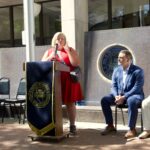
City Treasurer John Campbell, who resigned Thursday morning following allegations that he stole from a charity unaffiliated with city government, at his swearing-in ceremony in January of 2012.

Former city Treasurer John Campbell at his swearing-in ceremony in January 2012.

Former Harrisburg Treasurer John Campbell issued a lengthy statement late this afternoon, apologizing for taking money from two non-profit groups.

In his statement, the 26-year-old Campbell repeatedly apologized for his alleged thefts from Historic Harrisburg Association, where he served as executive director for four years, and from Stonewall Democrats, where he served as treasurer. In explaining his actions, he cited the burden of overwhelming debt and the immaturity of youth, but said these should not excuse his behavior.

“My decisions were selfish and without thought of repercussions,” he wrote.

He added that his achievements at such a young age blinded him to the consequences of his behavior.

“While I was fortunate in my accomplishments, I was also struggling with the challenges that come with aiming so high,” he wrote.

Yesterday, Campbell waived his preliminary hearing and now is due to stand trial on two felony counts of theft and one misdemeanor count of fraudulent conduct. He is charged with writing checks to himself totaling $8,500 from the account of Lighten Up Harrisburg, a charity associated with Historic Harrisburg, and $2,750 from the account of the Stonewall Democrats political action committee.

Following his arrest early last month, Campbell resigned his elected post as city treasurer. An audit of the office revealed no wrongdoing by Campbell, according to the city.

The full text of Campbell’s statement follows:

“The most important thing I can say right now is that I am sorry. I am ashamed. I am regretful. I’ve made poor choices for personal reasons and that have wrongly affected those who trusted me as an employee, an elected official, a community member, an advocate, a friend, and a family member.

I apologize for the disappointment, anger and grief I have caused. Most significantly, I apologize to the members and directors of the Historic Harrisburg Association who instilled their confidence in me as a 21-year-old Executive Director five years ago.  I apologize to the members and officers of the Capital Region Stonewall Democrats who reelected me to four terms as Treasurer and expected me to safeguard the organization’s financial position.

I have confessed to my wrongdoing and have fully cooperated with the authorities. As I continue to make full restitution to Historic Harrisburg and the Capital Region Stonewall Democrats and accept responsibility for my actions, I have not given up on myself.  I have sought counsel from my pastor, therapist, friends, and family throughout this difficult time so that I may learn from this unfortunate situation I caused. I refuse to settle into the failure I created, for it implies that we do not learn from our mistakes.  Instead I believe that new beginnings come only after our most difficult times, light after dark. It’s hard, sometimes very hard, but new beginnings, light, and learning all come in time.

Some have wondered how this lapse in my judgment could occur. I have thought long and hard about my actions and there are no excuses that can justify them nor shall I offer any. While trying to cloak my actions under a veil of college tuition, unexpected medical expenses, and burgeoning debt might be easy, these are simply symptoms of my decisions, not the causes. My lapse in judgment is ultimately my burden to bear.

Over the past year, while finishing my degree, I made damaging decisions that ultimately hurt me. More importantly, the organizations with which I have worked closely to help restore hope, faith, and trust in Harrisburg were injured. My decisions were selfish and without thought of repercussions. These decisions betrayed the trust I have worked so hard to instill and bring to Harrisburg as a young voice for change and accountability.

Historic Harrisburg is still an organization I hold closest to my values, beliefs, and vision for the future of Harrisburg. It was the organization in which I invested over five years of my life both as a board member and executive director. Together the Board and I built an organization that has become a leader within the community on issues of economic development, community building, and connecting Harrisburg’s past with its future. Just five years ago, the organization had five board members, struggled operationally, and lacked executive leadership. Today the board boasts 23 members, has experienced exponential programmatic and financial growth, and built a staff of six dedicated individuals.

While my tenure at Historic Harrisburg was filled with many successes, it now will be shrouded with doubt and confusion due to mistakes I made that hurt both the organization and me personally. I hope that my actions will not mar the reputation this organization has built.

There has been an impression—one that I fostered and encouraged—that I was a young man superbly succeeding in my ambitions, skills, and goals. Over the past eight years I put myself through both community college and undergraduate school, helped rebuild a struggling organization, reconfigured and modernized a city government office, and gave my time and resources to the community I deeply love. While I was fortunate in my accomplishments, I was also struggling with the challenges that come with aiming so high.

One of the most unfortunate consequences is that I betrayed the public’s trust. While my actions did not pertain to that of the City Treasurer’s Office, as a public official I am held to a higher standard.  Of course that is why I resigned my position in the best interest of the residents of Harrisburg.  My actions have far reaching consequences of betrayal and dishonesty at a time when Harrisburg needs unity, vision, and confidence. For this, I am eternally sorry to the residents of Harrisburg.

I do not expect nor wish to receive sympathy or pardon but instead ask for your compassion, grace, and forgiveness. I hope in time that those I have wronged will forgive me for my mistakes. Again I am deeply sorry for my actions and the ramifications they have had on my community.”


Continue Reading

Report: Harrisburg On Track For Balanced 2014 Budget

With three months left in 2014, a year that included two on-time debt payments and the end of state receivership, Harrisburg is on course to meet projections of a balanced budget, according to a quarterly status report filed this week by the state-appointed coordinator of the city’s recovery plan.

In his report, Fred Reddig, of the Department of Community and Economic Development, projects the capital city will end the year with a surplus of $43,297 out of total revenues of $58,820,013.

The projection reflects about a $1.2 million increase over revenues projected in the revised budget City Council approved in February, offset by a nearly equivalent increase in projected expenses to $58,776,716.

Steve Goldfield, a financial advisor working closely on the recovery plan, said Friday that the report represents “very positive news” for Harrisburg, though he also described the surplus as “slight” and the city’s finances as “still in the fragile stage.”

“I wouldn’t want anyone to think that an urban municipality can be fixed and then you wouldn’t have to worry about it,” he said.

The projections in the report, which DCED filed with the Commonwealth Court on Sept. 30, assume a significant decline in revenues in the final quarter of the year, with the city having already collected most of its taxes and all of the $5 million pledged by the state this year for public safety services.

The projections also assume relatively constant expenditures, including an average bi-weekly payroll of around $900,000, which will spend down the city’s cash through the remainder of the year.

As of Sept. 30, the city had a cash balance of $7.3 million, the report says.

The report also notes that, although the city closed on a $2 million tax and revenue anticipation note in March, officials have “effectively managed their cash flow” and did not need to draw on it, thereby allowing the note to expire without incurring interest costs.

The note, a short-term line of credit that would have helped cover operational expenses in the event of a cash shortfall, represented the city’s first successful financing since a 2012 parking revenue bond transaction and was a “very positive step in its recovery,” the report says.

Additionally, the report notes, Harrisburg made both of its 2014 general obligation bond payments on time, with the second payment, $3 million to the Bank of New York Mellon, being made earlier than the Sept. 15 due date.

The balanced budget required restraint from the administration of Mayor Eric Papenfuse, as the revised 2014 budget included several positions which, if filled, would have increased the year’s expenses to around $2.5 million in excess of revenues.

The positions were among several potential costs offset by a $3.9 million “negative expenditure,” a line item that Goldfield acknowledged at the time was an “unconventional” method for matching revenues to expenditures.

But the current administration, Goldfield said Friday, had done a “pretty good job” managing the budget month to month to avoid a deficit, in part by leaving these positions vacant. He said he did not expect the city to use a “negative expenditure” to balance the budget in future years.

Reddig was appointed coordinator of Harrisburg’s recovery plan on March 1 of this year, following a Feb. 25 court order to end the period of receivership under Maj. Gen. William B. Lynch.

As coordinator, Reddig continues to meet regularly with city officials as well as a team of professional advisors that had consulted the receiver, including the Novak Consulting Group, the Pennsylvania Economy League, Public Resource Advisory Group and the law firms of Stevens & Lee and McKenna, Long & Aldridge, according to the report.

The full text of the coordinator’s report can be downloaded here.

Continue Reading

Crossing the Great Divide: East Shore boys, West Shore girls.

Screenshot 2014-09-30 00.22.17I grew up on the West Shore. That’s where I lived all of my life until eight years ago, when my husband and I bought a house in the city. Then we became East Shore people.

Even to this day, though, we think nothing of making the crossing. I’d grown up travelling over the river to visit family, go shopping, work and play.

Since I grew up around here, I know my willingness to make the trip back and forth is not one that everyone shares.

A lot of people on the East Shore scoff at going to the West Shore, and many on the West feel the same about heading to the East. To the opposing view, the other place is alien and confusing except for maybe a few key destinations like Wegman’s or Hersheypark.

To point out that it’s less than a mile from shore to shore is enough to invite scorn. People feel discomfort, distaste and dislike at the mere thought of making the passage. So, unless they have to, they never do.

It’s called the East Shore, West Shore divide.

This is a phenomenon that initially confounds people who are not from around here. For one, they have no inherent understanding of it. Secondly, from the outside looking in, the short distance over the river is really an insignificant interference.

No matter, though. Transplants to this region quickly learn that East Shore, West Shore is a very real thing.

Quite literally, the East Shore is made up of the municipalities located along the east bank of the Susquehanna River, and the West Shore is the boroughs and townships situated along the west.

Sometimes, it’s misunderstood that East Shore means Dauphin County and West Shore means Cumberland County. Yes, technically those territories are correct. But the “East Shore, West Shore thing” isn’t that widespread throughout the counties.

People in the northern tier of Dauphin County and those in Shippensburg (the first settlement in Cumberland County) probably don’t think of themselves as East Shore, West Shore in the same way as people from Derry Township and Hampden Township do.

The farther away you get from the river, the less apt you are to hear the term.

East Shore, West Shore. So what does it mean?

Well, if you’re born and raised in the area like me, you’re expected to innately know what the division means. However, when asked to define the great divide, most people are hard-pressed to articulate the distinctions between the two shores.

If you do press them, though, you may get mumbled responses about the different airs of “those people” over there. There are distinct impressions that one side is better than the other and that the people who live “on that side” are better or less than, too.

The West Shore tends to have a stigma for elitism and conventionalism, newer homes, box stores and chain restaurants built on diminishing farmland. The East Shore is thought to be stagnant and outdated, a network of curved highways and stale malls.

The East Shore has the added dynamic of including the City of Harrisburg.

Regardless of the benefits the city indisputably contains, its recent fiscal woes, continued dramatized politics, and dilapidating infrastructure have tainted the East Shore’s reputation.

The gap of river and county allows the West Shore to act distant from the region’s urban core, and, in several aspects, even pull away from it.

Of course, that has exacerbated the East Shore, West Shore divide.

When I ask my grandparents about the “East Shore, West Shore thing,” they tell me it’s how it’s always been, although not as antagonistic as it came to be today.

They both grew up in the region. They bought their first house on Greenwood Street in Allison Hill in 1953. They lived there with their four children before moving to Susquehanna Township in 1966 in a house they still live in.

They’ve seen a lot of Harrisburg in their time. They’ve seen the city’s evolution over 70 years. They’ve seen the area expand and the region grow.

They talk about living in the city so long ago. They talk about the neighborhoods, businesses and people who used to be here. They talk about the development of the suburbs.

They also talk about racial tensions, Hurricane Agnes devastation and the blight of a neglected city.

They say it has all exacerbated the East Shore, West Shore divide.

“The East Shore, West Shore thing has a lot to do with the city more than anything else,” my grandfather says.

He may be right about the divide that exists today.

But, at one time, more people thought nothing of travelling east to west and west to east, coming and going through the city. The relationship of the sides of the river was one of fluid reciprocity.

If it was like that once, it can happen again.

In fact, it seems the reconstruction of Harrisburg could help make that occur. If we focused positively on the city again, we’d probably see a good bit of the “East Shore, West Shore thing” disappear.

Tara Leo Auchey is creator and editor of today’s the day Harrisburg, www.todaysthedayhbg.com.

Continue Reading

State To Rent in Downtown Verizon Tower, Helping Relieve Unfunded City Debt

The so-called Verizon Tower in downtown Harrisburg, which the phone company plans to vacate in early 2016.

The so-called Verizon Tower in downtown Harrisburg, which the phone company plans to vacate in early 2016.

The state Department of General Services signed off this week on a 17-year lease of office space in downtown Harrisburg, in a deal that is expected to relieve the city of most of the $41.6 million in debt obligations associated with the facility, state officials confirmed Friday.

The office space, in the so-called Verizon Tower in Strawberry Square, threatened to become vacant upon the expiration of the phone company’s lease in early 2016, leaving the city on the hook for payments on the bonds issued to acquire the building.

The new lease, between DGS and the Harristown Development Corporation, the developer of Strawberry Square, is for a base amount of $65 million over the 17-year term, said Troy Thompson, a DGS spokesman.

That amount will rent office space for close to 900 workers to be relocated from what is known as the DGS Annex, an office complex occupying the grounds of the former state hospital above Cameron Street, Thompson said. Among the state workers to be relocated are employees from the Department of Public Welfare, the Department of Transportation, the state police and DGS itself, he said.

Though DGS signed the documents yesterday, the lease still requires the signature of the attorney general’s office to be fully executed. Thompson said Friday he did not know when the AG’s signature was expected. A spokesman for the state Board of Commissioners of Public Grounds and Buildings confirmed Friday that the board had approved the lease, pending the AG’s approval.

Steve Goldfield, a financial advisor who worked on the lease negotiations, said on Thursday that the rental agreement was made possible in part by the city’s parking deal last fall, which served as the keystone of the state-sponsored plan to resolve Harrisburg’s historic debt crisis.

“The state doesn’t usually do this, because parking usually kills the deal,” Goldfield said of the commonwealth’s decision to move workers downtown. But, after factoring in savings from a discounted parking contract that DGS signed as part of the recovery plan last fall, the state stands to save significantly on the office rentals, Goldfield said.

That contract, a 30-year agreement to lease 4,306 parking spaces in the downtown parking system, was a critical component of the recovery plan’s parking deal, a long-term lease of city parking assets that Goldfield also worked closely on as an advisor to Harrisburg’s state-appointed receiver.

Under the contract, the state agreed to pay an increasing amount per month for each space, starting at $130 per month early this year and climbing to $180 per month in 2016. But the contract also includes the automatic addition of 765 spaces by 2016, of which 344 will be rented at a discounted rate of $100 per month.

Those rates, according to Goldfield, helped achieve the savings realized in the DGS lease, which he estimated at around $1.6 million per year. Other factors in the cost savings are the rental price itself as well as a guaranteed energy savings contract that will accompany the lease, he said.

The current cost of housing employees at the DGS Annex is around $6.3 million per year, according to Thompson, the DGS spokesman.

Thompson described the DGS lease Friday as “mutually beneficial” for the state and the city, noting that, in addition to saving tax dollars on office rental costs, the lease also moves the state closer to being able to sell the old state hospital grounds.

Harrisburg is exposed to the office building’s debt because of how its acquisition was financed. In 1998, the Harrisburg Redevelopment Authority issued $23.6 million in revenue bonds to fund the purchase from the city of land and facilities in Strawberry Square.

Of these, $6.9 million, the Series A bonds of 1998, were to be repaid solely with rents paid for office space in the building. But the city also guaranteed the debt, such that if rents were insufficient to cover debt service, the city would be obligated to make up the difference.

Debt service on the Series A bonds starts coming due in the fall of 2016, with an initial payment of $930,000. The semiannual payments climb thereafter, from a total of $1,880,000 due in 2017 to $2,320,000 due in 2032. A final payment of $6,175,000 must be made on Nov. 1, 2033.

With the departure of Verizon, whose lease expires on Feb. 28, 2016, the Harrisburg Redevelopment Authority would have no way to meet the debt service, and the city would be left holding the bag for $41.6 million, Goldfield said.

After operating costs and other expenses are taken out, rent paid under the DGS lease will not provide total coverage of the debt obligation, Goldfield acknowledged. Those expenses include about $1 million per year in real estate taxes, $900,000 per year in utilities and $800,000 per year in common-space charges applied to occupants in Strawberry Square, according to Neal West, senior vice president and legal counsel for Harristown Development Corporation.

These costs leave about $750,000 per year for debt service under the DGS lease, West said. When asked why, even with its offices full, the building could not adequately cover debts as anticipated in the 1998 bond issue, West said he could not speculate about the calculations made at the time. He did observe, however, that the downtown real estate market had remained essentially flat since the late 90s, whereas the bond financing may have rested on the assumption it would grow.

Goldfield also noted Thursday that the DGS lease includes an option to purchase the building at the end of the term, at a price of around $4 million. If the state exercises the option, he said, the deal would bring the city’s total exposure down below $10 million. The debt can then be refinanced, in part through negotiations with Assured Guaranty, which insured the 1998 bonds, he said.

A 2012 report by the Patriot News described the city’s use of proceeds from the 1998 sale as follows: $10.3 million was used to repay hotel bonds previously issued by HRA; $4.7 million was placed in a “capital projects fund” for projects across the city; and $501,861 was used to repay bonds from the Harrisburg Leasing Authority.

The city’s then-finance director, Robert Kroboth, could not account for how the remaining $4.7 million in proceeds was spent, according to the report.

Continue Reading

Programs Launched to Boost Homeownership in Harrisburg

HousesWeb

These houses in Uptown Harrisburg are looking for buyers.

Attention renters: Two new programs were announced today to encourage homeownership in Harrisburg for people who work in the city.

PinnacleHealth announced “Home in Harrisburg,” which will provide up to $5,000 in financial assistance to encourage its employees to purchase homes in the city. Funds would be payable at settlement on the home purchase.

“The program was launched to our employees earlier this month, and we’ve already had several employees interested in participating,” said Michael Young, PinnacleHealth’s president and CEO.

In addition, the Papenfuse administration presented its “Walk to Work” initiative, which will offer $2,000 to municipal employees to help with a down payment or with closing costs for home purchases. Under the program, the Pennsylvania Housing Finance Agency will provide up to an additional $8,000 in 10-year, no-interest loans to city workers.

Mayor Eric Papenfuse said the city had enough money budgeted to allow as many as 50 of its employees to participate in the program.

The programs are limited to workers who don’t already own houses in Harrisburg. Papenfuse said he hopes other businesses will offer their employees financial help to buy homes in the city.

At the same press conference, PinnacleHealth presented Papenfuse with a PILOT (Payment in Lieu of Taxes) check of $300,000, about double its annual contribution in recent years. PILOTs are paid on a voluntary basis by nonprofits that are not required to pay property taxes.

Continue Reading

Capital Region Water To Share Costs of Next Sinkhole Study

Capital Region Water, Harrisburg’s water and sewer authority, will split with city government the costs of an expanded sinkhole survey in the area of S. 14th Street, following a 2-1 vote Wednesday morning that marked the first non-unanimous vote of the authority’s current three-member board.

Board members Bill Cluck and Westburn Majors, who voted in favor of the spending, said that, although they both wrestled with the decision, they ultimately came to view the expense as an investment to protect authority assets—namely, water and sewer pipes that could be damaged by further sinkhole activity.

“This is not the same as buying artifacts,” Cluck said, referring to the often-criticized expenditure of authority dollars on Civil War and other museum artifacts during the administration of former Mayor Stephen Reed. “I think this is a shared responsibility to address an unprecedented situation.”

So far, the authority has dedicated about $271,000 to help deal with the effects of the sinkhole that opened last March, displacing residents from at least nine homes and imperiling the homes and finances of several more. The money was directed towards street repair and towards repairing a water main that the authority says was crushed in the sinkhole collapse. It also paid for half the costs of an initial $38,200 study of the street’s sinkhole activity, board chairman Marc Kurowski said.

Kurowski cited the commitment of these funds in explaining what he described as his “tough” decision to vote against the measure.

“‘Tragic’ is not too strong a word for what folks are dealing with down there,” he said before casting his vote. But, he added, he felt a “little bit nervous” about spending any additional Capital Region Water funds, which ultimately come from ratepayers and are meant to be spent providing water and sewer services.

The study is expected to cost $43,700 and will cover a larger area than the original geologic investigation, completed last week by the Camp Hill-based engineering firm Gannett Fleming and unveiled at a City Council committee meeting last Thursday.

That investigation, which focused on the 1400-block of S. 14th Street between Magnolia Street and Cloverly Terrace in south Harrisburg, identified five potential fractures in the limestone and 11 potential voids in the soil beneath the surface of the street. It concluded there was a high probability of future sinkhole activity in the area, which city engineer Wayne Martin described Tuesday as having one of the worst sinkhole problems he has seen in his 20 years as an engineer.

Following the Gannett Fleming report, Mayor Eric Papenfuse indicated last week that his administration would seek state and federal aid to help cover the cost of mitigating the area’s sinkholes, which would far outstrip the city’s ability to pay. “This will take millions of dollars, and the city doesn’t have that,” he said. Martin has estimated the cost will be between $1 and $3 million, though he said the estimate was preliminary and could change substantially depending on the results of the expanded survey.

Where the city would find such outside assistance is not clear. Joyce Davis, the mayor’s spokeswoman, said Tuesday that Papenfuse meets routinely with both state and federal lawmakers with whom he is exploring possible routes to receiving aid. Among these lawmakers is state Sen. Rob Teplitz, who said by phone Tuesday that he had put in a $24 to $25 million capital request to address sinkholes across the city, although this did not include the recent development on 14th Street.

The state, however, has funding problems of its own, and Teplitz acknowledged that it might not want to set the precedent of helping Harrisburg when other local governments also face sinkhole-related problems. “I have the request in,” he said. “I’m not necessarily holding my breath waiting for it in the short-term.”

A governor can also petition the federal government for aid with natural disasters, though that prospect looks even less likely. To qualify for aid under federal law, a disaster must surpass the capacity of both state and local governments to address it, a spokesman for the Federal Emergency Management Agency, or FEMA, explained. He was unaware of any case of a sinkhole being declared a natural disaster, thus qualifying for federal aid, in the past four years.

The potential threat of sinkholes has led to increased interest recently in sinkhole insurance, according to Andrew Enders, a third-generation insurance professional at Enders Insurance Associates in Harrisburg.

Sinkholes have long been identified as an issue in the central Pennsylvania region, but the concern for insurers was traditionally focused on areas outside Harrisburg, including Palmyra, Hershey, Annville and Hummelstown, Enders said.

Sinkhole insurance is excluded from a typical homeowner’s insurance policy and must be “bought back” in an addendum to the policy, Enders said. In addition, coverage typically only applies in the event of structural damage to a home—and not in the case of a sinkhole simply opening on a property, which an owner may be required to remediate himself.

In the Harrisburg housing market, sinkhole insurance typically costs an additional $60 to $150 in premiums per year, Enders said. (Enders Insurance Associates is one of TheBurg’s community publishers.)

In addition to the expanded survey, the city has sought to fund a $16,900 preliminary-design study to come up with options for mitigating the area’s sinkhole problems. On Tuesday, the Capital Region Water board declined to vote on a motion to fund half of this third study, which Cluck described as “premature.”

“If we’re gonna do fact-finding, let’s do that first,” Cluck said, explaining his preference to see a completed second study before funding an additional inquiry into mitigation options.

The motion, initially tabled by the board, was ultimately removed from the agenda completely after a procedural question was raised by the board’s legal counsel.

Harrisburg City Council was expected to take up the question of spending on the sinkhole surveys at its legislative session Tuesday night, following a statement to that effect by council members at last week’s committee meeting. But, as of this writing, the relevant legislation had not been sent to the city clerk and would possibly not make the evening’s agenda, according to the clerk’s office.


Continue Reading

City Modifies Repair Plan for Flood-Damaged River Walk

Harrisburg submitted paperwork today to expand the scope of repairs to a section of sidewalk along the Susquehanna River that was damaged three years ago by Tropical Storm Lee, the city engineer’s office said Monday.

The repairs, one of several projects for which the city was awarded federal and state aid, are focused on a section of the river walk near the Shipoke neighborhood downtown, between I-83 and the railroad bridge.

Originally, the city planned to repair select parts of this stretch of the walk in a patchwork fashion, said Wayne Martin, the city engineer. But after discovering that soil beneath part of the walk had eroded, the city expanded the scope of work to include filling in the missing dirt and replacing the stretch of sidewalk in its entirety.

Rogele, Inc., a Harrisburg-based construction company, will still complete the project at the price quoted in their original bid, Martin said.

In January 2012, city officials under the administration of former Mayor Linda Thompson applied for about $2 million in aid to help mitigate the damage caused by Lee, whose rains severely flooded the Susquehanna the previous September.

The Federal Emergency Management Agency, or FEMA, ultimately approved 45 projects totaling $1,947,077, according to Ruth Miller, the deputy press secretary for the Pennsylvania Emergency Management Agency, which assists local applicants in the process of seeking aid.

In addition to the repairs to the river walk, those projects included replacing stacked rock in 18 separate locations along the riverfront embankment, performing electrical work on Sunken Gardens in Riverfront Park and replacing a set of concrete steps and railings at Locust Street that were washed out in the flood, among others.

The aid money was awarded as a mixture of cash advances for small projects and pledges for reimbursement upon the completion of larger ones. So far, the city has received $878,754 of its awarded funding, representing $671,741 from FEMA and $207,013 from the commonwealth, according to figures Miller provided.

Martin said Monday that the river walk repair work would be paused while the city waited for FEMA to approve the project’s change in scope. Despite the delay, all of the approved repair projects are expected to be completed by the end of October, he said.

Continue Reading

Harrisburg Sinkholes Could Cost Millions to Fix

The news for some South Harrisburg residents was not good last night, as an engineering firm provided its initial assessment of sinkhole activity along S. 14th Street.

Speaking before the Public Works Committee of City Council, engineers with Camp Hill-based Gannett Fleming said that a seismic study of the area revealed five fractures in the ground, some 40 to 50 feet deep.

“Despite backfilling of past sinkholes, areas of subsidence continue to develop, and the potential for future sinkhole activity is high,” said the Gannett Fleming study.

City Council will consider resolutions at its Tuesday meeting to fund two follow-up projects. The first is an extension of the seismic study to surrounding areas; the other is a report that will provide the city with options and cost estimates.

The cost to fully remediate the sinkhole problem along the street easily could exceed $1 million, said Richard Lee, principal geophysicist with Quantum Geophysics, a division of Gannett Fleming.

Council members and the administration both stated that the cash-strapped city does not have that kind of money available.

“This will take millions of dollars, and the city doesn’t have that,” said Harrisburg Mayor Eric Papenfuse.

Securing funds will require a fight for state and federal grants, an uncertain process that could take a long time.

“There are funding sources out there, but they are not easy to get,” said Papenfuse. “We’re going to go to work.”

Nine homes have been condemned on the 1400-block of S. 14th Street since March, when a water main broke, loosening ground and causing sinkholes to appear. The area long has been prone to sinkhole formation.

Numerous residents attended the meeting last night, and several shared heartbreaking stories of having their houses condemned or, if not, living under the threat of sinkholes forming. Sheena Mosley said she is struggling to pay rent after her house, which has a sinkhole beneath it, was deemed unfit for habitation.

Nikole Stewart recently moved out of the area to Georgia. However, she still owns her S. 14th Street house.

“What are we supposed to tell the mortgage company?” she said, urging the city to buy out homeowners along the street. “What are we supposed to tell our creditors?”

While sympathetic to the plight of residents, council members admitted there was little they could do to permanently fix the situation.

“The answers that you need, we cannot provide you with right now,” said Councilwoman Sandra Reid, chairwoman of the Public Works Committee.

To download a copy of the Gannett Fleming sinkhole study, click here.


Continue Reading

Some Very Good Numbers

The National Civil War Museum in Reservoir Park.

The National Civil War Museum in Reservoir Park.

In a report before the Dauphin County commissioners Wednesday morning, representatives of Harrisburg’s National Civil War Museum made a detailed case for the museum’s continued receipt of a county subsidy that has funded between one-quarter and one-third of its budget for the past six years.

CEO Wayne Motts, reciting what he referred to at one point as “some very good numbers,” told the commissioners that museum visitors spent an estimated $5.7 million in the region last year, representing a nearly 2,000-percent return on the museum’s $296,000 share of county tax dollars.

Where did these numbers come from? It’s a well-worn truth that numbers, manipulated in just the right way, can tell whatever story you want them to. As the British Prime Minister Benjamin Disraeli is supposed to have said (he was quoted, quite possibly apocryphally, by Mark Twain), “There are three kinds of lies: lies, damned lies, and statistics.”

The statistics in the museum’s report this week are not lies, but they aren’t the whole truth, either. They were obtained by a series of simple calculations, performed on a relatively small set of figures from three main sources.

The first two sources come from the museum itself. One is the museum’s annual visitor tally, which clocked in at 38,688 in 2013-14. (The museum reports figures corresponding with its fiscal year, which runs from July 1 to June 30.) Of these, 4,664 were school-age visitors who came in groups, and another 472 were people who self-reported as having come from Harrisburg zip codes.

The second source is survey data collected and tabulated by the museum from a subset of visitors. Last year, according to Motts, 601 visitors responded to the museum survey; over the past four years, there have been a total of 2,099 respondents. Of last year’s 601 respondents, 39 percent said they had stayed in a hotel, which matches pretty closely the figure for respondents who stayed in hotels over the past four years (36 percent).

In its report, the museum filters these visitation numbers through a third source, provided by an outside party—the most recent “Economic Impact of Travel and Tourism in Pennsylvania” study, performed by the consulting company Tourism Economics. The study, which is commissioned each year by the Pennsylvania Tourism Office, aims to give a detailed picture of how tourism impacts the state economy. Last year’s study, released in December, analyzes data from 2012.

Using these sources, the museum calculates what is meant to be its “direct economic impact” on the region. Here’s how it works. The museum subtracts school-age visitors and Harrisburg residents from the raw visitor total, arriving at an estimated number of tourist visitors of 33,552. Then, using the percentages from its in-house surveys, the museum sorts these visitors into “day-trip leisure” visitors (20,326) and “overnight leisure” visitors who stayed in a hotel (13,226). Finally, the report multiplies each of these subgroups by average spending data from the Tourism Economics study, which is conveniently already sorted along the same lines ($111 per day-tripper, and $265 per overnight visitor per trip).

Based on these calculations, the report arrives at a “direct economic impact” for the museum of $5,761,076: the sum of the $3,504,890 and $2,256,186 spent by overnight visitors and day-trippers, respectively, in 2013-14. The visitors spend their money, the Tourism Economics study tells us, on lodging, food and beverages, retail, entertainment and transportation.

How reliable are these figures? Christopher Pike, the director of impact studies at Tourism Economics, told me that, for the most part, the museum’s calculations were reasonable. He noted that the museum used average spending figures from 2012, which, preliminary research shows, were likely 1 to 3 percent lower than the corresponding figures for 2013. Combined with the decision to exclude school-age visitors, this meant the museum’s estimates “maintained some conservative-ness,” Pike said.

On the other hand, the museum’s calculations assume that the museum—and not other regional attractions—is the primary draw for tourists who walk through its doors. “If you wanted to be an academic stickler, you’d want to break out visitors they attracted to Harrisburg,” as opposed to people for whom the museum was merely a side attraction, Pike said.

Nonetheless, it was Pike’s conclusion that the museum’s report presented, on balance, a respectable analysis. “It’s much more detailed than what I’ve seen from a lot of other places,” he said. Given that museum staff did the calculations themselves, “they’ve not done a bad job.”

There is one notable exception, however. That is the museum’s purported rate of “return on investment,” which the report tabulates at an eye-catching 1,942 percent. The museum arrived at this figure by dividing the $5.7 million it says it generated last year by the $296,646 in hotel taxes it received. (These taxes come out of the $500,000-or-so portion of hotel taxes designated for marketing the city—which, speaking of numbers, is not “one-quarter of one percent” of hotel tax revenues, as is often cited elsewhere, but one-quarter of about one-fifth of them, or about 5 percent.)

Returns on investment, or ROIs, “can be calculated in many, many ways,” Pike said. He declined to give an opinion on the “right” method, though he did laugh when the museum’s reported figure was quoted. Another way to come up with the museum’s ROI would be to compare the hotel taxes it receives with the hotel taxes it generates—which, if you follow the assumptions of its other calculations, comes out to around $36,801. That leads to the rather dismal return of 12 cents for every tax dollar received, meaning the museum cost the county nearly $260,000 last year.

On Thursday, Motts responded to the suggestion of this less flattering figure by saying the museum had followed the ROI-calculation method of the Hershey Harrisburg Regional Visitors Bureau, the county tourism promotion agency which serves as a pass-through for the museum’s tax funding and to which the museum reports on its marketing activities each year. The museum should be “held to the same standard” as other regional tourist draws, which calculate their impact the same way, he said. (Motts also reiterated Pike’s points about the comparatively high level of detail in the museum’s visitor data and the conservative nature of its estimates.)

But there are yet other ways to measure return on investment—ways that have less to do with tourism money today, and more to do with history. The museum began receiving its dedicated share of hotel taxes from the county in 2008, when its annual visitor base was nearly 44,000. The money was to be spent on marketing and promotions, which the museum says it is, although Harrisburg Mayor Eric Papenfuse, who catapulted the museum’s tax funding into headlines by asking the county to freeze it, has challenged this. In any case, despite the boost to marketing, the museum’s visitor total this year represents a decline of 5,000 people—and that’s in a year that included the sesquicentennial of the battle of Gettysburg.

Or what about another measure of return on investment, which would compare the city’s share of the costs of the museum’s creation with the city’s share of its rewards? The building itself, as museum leadership likes to point out, was paid for with $16.2 million in state money. But the state money required a city match, which was supplied by at least as many millions in Civil War artifacts acquired on the city’s dime. The museum now leases those artifacts—and the building, whose fair market rental value is estimated at $633,000 per year—at an annual rate of $1.

There are other numbers to consider, too. Seven, for instance, which is the number of City Council members (that is to say, all of them) who voted last month to back Papenfuse’s request to cut the museum’s funding. Or 25, which is the number of years on the museum’s lease, extended by former Mayor Stephen Reed in the last two months of his 28-year reign. Or how about 1.2 million—the number of dollars the city has paid the museum directly since 2000, for employee benefits and construction costs and any number of other things.

These numbers, not surprisingly, were not part of the museum’s presentation to the county commissioners this week. Yet they tell an important part of the story, too. It’s for the commissioners—and for city residents, in assessing whose interests the commissioners represent—to decide how many of the numbers to listen to. Will it be some of them, or all of them, or none?

An earlier version of this article referred incorrectly to the museum’s proportion of hotel taxes. The figure “about 5 percent” refers to the portion of county hotel tax revenue designated for marketing the city, not only the portion spent on the museum.

Continue Reading

Kipona: A Review

With Kipona 2014 located on City Island, the Native American pow wow took its rightful place as a centerpiece of the Labor Day weekend celebration.

There were canoe races, a pow wow, fireworks. There were vendors, food, music.

The things that make up Kipona were at Kipona again this year, though people most wanted to talk about something apart from the chili cook-off, the martial arts demonstration and the basketball tourney. The number-one topic of discussion: the relocation of most activities from Riverfront Park to City Island.

I spent much of last weekend at Kipona, helping to man the information table for 3rd in The Burg. When I wasn’t chatting up Harrisburg’s monthly arts event, I listened to people opine (at length) on how they thought things were going. For the most part, attendees and participants seemed positive about the annual Labor Day weekend festival. That said–they were not shy in sharing with me possible areas for improvement.

I agreed with much of what I heard. In my opinion, the city got many of the big things right. Most activities went off well, and attendance was solid. The relocation to City Island was (sorry, Kipona traditionalists) a very pleasant surprise. Before last weekend, I regarded under-utilized, under-visited City Island as a huge surface parking lot, a baseball stadium and a random smattering of other stuff that seemed only loosely connected. Now I know the potential that City Island has.

I’ll admit to not much liking Kipona’s old format. Yes, there are uniquely Kipona activities, but, over the years, it came to closely resemble Harrisburg’s other summer festivals along the river. By the time Labor Day rolled around, did you really want to trudge up that narrow, asphalt path one more time, hemmed in on all sides by booths, battling sweaty crowds and having largely the same experience that you did over the Memorial and Independence Day weekends?

I found City Island to be tailor-made for hosting Kipona. It had close-by, ample (free!) parking, a variety of landscapes, open spaces, refreshing breezes, easy access to the river and beautiful views of the city. The loop around the island seemed to be a perfect length and format, and the permanent structures–from the stadiums and restrooms to businesses and pavilions–anchored the festival and provided necessary amenities. Larger-scale events, such as the fascinating and funky Festival of India parade, were easily accommodated.

City Island also allowed more natural groupings, so that children’s activities, for instance, were all together, arranged comfortably, and there was ample spacing between festival booths and themes. In addition, the excellent and interesting Native American pow wow fittingly became a centerpiece of the celebration, not the hidden, out-of-the-way event-in-exile it was before. And kudos to Capital Region Water, which hosted a variety of educational and creative activities. Who knew that learning about water and waste could be so much fun?

It’s understandable that downtown bars and restaurants would prefer Kipona to remain in the park, closer to them. However, based solely on the festival-going experience, City Island is a better place–much better.

Now that I’ve gotten all the accolades out of my system, let me turn to some of the shortfalls. I don’t mean to gratuitously criticize the organizers, who were working within very tight budget and organizational restrictions. However, even several administration officials told me that, while certain things went well, others did not. Here are, in my mind, the areas that most need to be improved.

Arts Walk. For two days, I was trapped inside the stifling Carousel Pavilion with my fellow arts hostages. There were a couple of photographers, two wood craftsmen, an author, another arts group–about a dozen people total–stranded inside a cavernous space that can hold many hundreds. On Sunday, Appalachian Brewing Co. gave away free beer samples, but even that brought in only a trickle of takers, as thousands walked past just outside, seemingly oblivious that people were within the forbidding building. A stage was set up there, and a lineup of talented musicians played to an audience of two or one or zero. Strangely, that stage was maybe 50 feet from the main music stage just outside the pavilion, which led to a cacophony of competing sounds, complaints from the musicians and the shutting of several pavilion doors, adding to the stifling heat. In my opinion, the Arts Walk, with little art, few patrons and nothing much to walk to, was the weakest part of Kipona.

Traffic. Cars, trucks and vans motored around City Island all weekend long, weaving in and out of crowds of people. For the duration of Kipona, Riverside Drive should have been pedestrian-only, the only exceptions for festival staff on golf carts and for emergency workers. Lax enforcement, however, led to something of a vehicle vs. walker free-for-all and created a very dangerous situation on the island.

Signage. Signage was almost non-existent, and the poorly designed Kipona program–if you could find it at all–did not identify several major venues, had no schedule of performers and didn’t say where most acts would be. More people seemed to wander into the Carousel Pavilion to ask us for directions, or if we knew what the music schedule was, than actually wanted to see art.

Fireworks schedule. Fireworks are a highlight of Harrisburg’s festivals, with people often organizing their evenings around going to the waterfront to watch them. The Kipona schedule said the fireworks would go off at 9:30 p.m, but they actually started about 45 minutes earlier. Rain or no rain, you just can’t do that.

Riverfront Park. The split festival between Riverfront Park and City Island did not work. People complained about walking across the bridge, park vendors complained about weak customer traffic, and City Island had empty spots that could have used more vendors to create a critical mass. The city needs to choose a single location and stick with it.

This year, Kipona turned 98 years old, so you would think Harrisburg would have it down by now. Kipona 2014 showed that this is not the case, and, in fact, all of Harrisburg’s summertime festivals have been in flux for years now. At least one good thing, though, seemed to come from this turmoil–the rediscovery of the wonderful resource that is City Island. It’s my hope that, now found, this beautiful, accessible and festival-friendly place will stay found.


Continue Reading