Tag Archives: harrisburg

Craft Cuisine: Christian DeLutis leads a kitchen perfectly paired with Troegs’ beer artistry.

On Good Friday this past March, Troegs Independent Brewing in Hershey was bustling as families and friends embraced the beginning of spring.

The malty aroma of brewing beer filled the echoey tasting room and the modestly named “Snack Bar.” Despite its location in an old warehouse, Troegs has a warm and welcoming atmosphere, a quality in which head chef Christian DeLutis takes pride.

“I feel like the room’s inviting,” he said. “It’s comfortable. It’s a place where you can sprawl out a little, even if it is busy.”

DeLutis, who is celebrating his fourth year at Troegs, grew up in Hummelstown in a big Italian family. Homemade food and wine were priorities and dining out was not.

“I didn’t have a good scope of what good food was outside of my grandmother’s cooking,” he said. “But I understood that food was important to bringing people together and happiness in life.”


Food Around Beer

DeLutis didn’t enter the profession right out of high school, as so many chefs do. He went to college in Pittsburgh with a goal of becoming an English teacher.

Meanwhile, he cooked for friends and worked in a restaurant, where he discovered his true passion for food. When a friend mentioned he should go to culinary school, DeLutis didn’t realize the option even existed.

He eventually enrolled at the Pennsylvania Culinary Institute in Pittsburgh and, after finishing school, took an internship at the five-star Harbor Court Hotel in Baltimore, where he was immersed in every facet of the restaurant industry. The hotel was large and semi-corporate but still privately owned, a setting that appealed to him. Over the course of five years there, he “went from putting a tomato at 12 o’clock on a salad for 5,000 plates in a wedding to being executive chef.”

DeLutis stayed in the Baltimore-Washington area for a little more than a decade, working in fine dining and learning about wine and craft cocktails. He came back to central PA for what he thought would be a pit stop on the way to another big city, taking a job at the now-closed Brew 22 in West Hanover Township.

“That was my first real exposure to craft beer,” he said.

In the process, he became familiar with Troegs, which, at the time, was outgrowing its Paxton Street location in Harrisburg and planning a move to Hershey.

During a phone interview for a position in Philadelphia, he received another call from Delaware restaurateur Matt Haley, whom the Troegner brothers had hired to help develop a new dining concept for the Hershey brewery, which had opened with scant food options.

Sixteen interviews with Haley and four years later, DeLutis can say he knows a bit more about craft beer now.

“I look at our beers as ingredients,” he said. “I try to create food around it.”

While he and his team occasionally cook with beer, the main goal is to pair the brews with complementary and contrasting foods. For example, a hoppy IPA would go well with a ripe peach, a combination that was on DeLutis’s mind lately as he planned dishes for the spring menu.

“I don’t use ‘farm-to-table’ very often or preach that, but we just do that,” he said. “I kind of create these pantries for each season that we always refer back to. And not only are they ingredients-based, but they might be feelings-based or nostalgia-based.”


Core Values

DeLutis prioritizes food that is made from scratch and is seasonal, although popular dishes like the brown butter popcorn, soft pretzel and five tons of French fries per week have become year-round staples.

“I think the rest of our menu is kind of always being sketched about and things erased and things penciled in and—just always open for discussion really,” he said.

DeLutis’s dishes also fit the time constraints of the Snack Bar’s fast-casual style, but don’t limit quality or creativity. That was an adjustment from his slower-paced fine dining background. He shifted his thinking to paper boats instead of ceramic plates, fewer garnishes and letting the ingredients speak for themselves, leaving room, of course, for the beer to shine.

DeLutis also feeds off of the enthusiasm of customers, as well as the greater philosophy at Troegs.

“What we grow towards really is cultivated by what people have to say about who we are,” he said. “I think it’s important, but we also really have our core values.”

DeLutis, who doubles as the company’s food and beverage director, said he values communication among everyone, from his five sous chefs to the in-house baker and butcher to the marketing department—and, naturally, to Chris and John Troegner themselves. He has his hands in many aspects of the Troegs operation—he designed the kitchen with special ovens to accommodate the extra-tall bread loaves.

Weekdays are spent doing behind-the-scenes office work, but, when Friday night comes, he’s on the floor, whether that means in the kitchen, interacting with guests, cleaning tables or pouring beer—wherever he’s needed.

An open kitchen and a facility that is designed for roaming and observing remind customers that Troegs doesn’t take itself too seriously. DeLutis wants the experience to feel like one where everyone is invited, from the family looking for a casual meal to the beer snob whose brain he can pick.

“Cooking is truly when I’m the happiest,” he said. “I try to be here a lot because I’m happy to be here.”

Troegs Independent Brewing is located at 200 E. Hersheypark Dr., Hershey. For more information, visit www.troegs.com.

 

Continue Reading

An Educator of Health: An online message prompts a recollection of one of our area’s most celebrated doctors.

Screenshot 2016-04-28 13.13.32Recently, I received a Facebook message from a woman named Suzanne, living in North Carolina, who had been searching for her father’s obituary for several years to no avail.



Suzanne knew about my work with the historic Midland Cemetery, an African-American cemetery just outside Steelton. Former slaves are buried there, along with black soldiers from conflicts dating back to the Civil War. Suzanne knew, from the cemetery’s website and Facebook page, that I occasionally do genealogy research for people looking for information on their ancestors. She was looking for a George Albert Jones, a doctor who’d once had an office in downtown Steelton. I asked her a few key questions and, in a matter of minutes, located the obituary. She was thrilled.

The conversation pulled at a memory of my own, from many years ago, when I visited Dr. Jones to get a physical for my driver’s permit. I learned to drive on my dad’s car, an old black Rambler with push buttons, and I would later take the exam in my brother’s old ‘58 Pontiac Bonneville. Back then, the state police administered the test—and of course, the officer who got in the car seemed like the meanest person alive, his deep voice causing your heart to pound to the point you thought someone was blowing a horn.

My parents sent me to Dr. Jones by myself, as if to help usher me through the gateway to young adulthood. His office was in a beautiful, gray stone building on N. Front Street, behind an iron gate that opened on a pathway leading to a large wooden door. When he asked why I was there, I quietly explained that I needed a physical to get my driving permit paper signed. He checked my heart with the black tubes of the stethoscope, then my lungs, and then signed my paper and sent me on my way. That was not too bad, I thought, on my way back up to Bessemer Street on that hot June day. But I was so glad it was over.

I love finding out about people and their connection to my little town of Steelton. When I started to research Dr. Jones, I quickly realized what a life he had. He affected the lives of thousands, yet he remains unknown to many in the area, especially the young.

George Albert Jones was born in New York in December 1904. His family moved to Harrisburg some time after his mother died. His father, James, owned James’ Restaurant on Pine Street downtown, where George would work as a waiter for years. He attended the Harrisburg Technical High School for boys, where he played the cornet in the orchestra and band, but, at some point, he abandoned thoughts of being a musician and focused his efforts on a medical career. He may have been inspired by Dr. Charles Crampton, a well-known Harrisburg doctor and one of the physicians for the school’s sports teams. When he graduated, in 1924, his high school yearbook noted that he “expects to enter Howard University, at Washington, D.C., where he will pursue the study of medicine.”

At that time in America, in the era before the Civil Rights movement, to go to college, let alone to become a doctor, was a dream many blacks did not entertain. Slavery was a not-too-distant memory, and Jim Crow laws still reigned in the South. But George was surrounded by eager, aspiring peers. He spent his undergraduate years at Lincoln University, in Chester County, Pa., an institute designed for people of African descent with the motto, “If the Son shall make you free, ye shall be free indeed.” Among his classmates were Thurgood Marshall and Langston Hughes.

After graduating from Howard University Medical School in 1935, George went on to an internship at Freedman’s Hospital. Freedman’s had been established in 1862 as the “Contraband Hospital,” serving slaves and people seeking freedom in the D.C. area. Students of color could only practice on people of color, and Freedman’s gave students a place they could spend their internships, working with the hospital’s African-American patients. Jones became a licensed physician in Pennsylvania on Jan. 22, 1937.

I found notice after notice of Dr. Jones’ civic involvement. He joined a group of African-American doctors in the area who sought to curb the problem of tuberculosis in the black community. They tested children at schools and workers at restaurants and hotels. Dr. Jones was also an avid speaker, constantly seeking to enlighten the community on health issues. He spoke at the Hygienic Civic Club and during Negro Health Week at the Phyllis Wheatley Branch of the Y.W.C.A. In 1938, he orchestrated a drive for diphtheria prevention.

He also advocated for social justice in the schools. He tried to get the Steelton school system to let his daughter—Suzanne, the woman who would call me all those years later—attend the mainstream Felton School. Other schools in Steelton had already embraced integration, yet Dr. Jones, despite several attempts, was unsuccessful. Around the same time, he became involved with the Non-Partisan League, which wrote, in an open letter to the school board, that it seemed “very strange that we of Harrisburg should allow segregation and discrimination to exist in our educational system when the radio, the press and liberal-minded commentators throughout the country are bitterly protesting the same.”

One of Dr. Jones’ most notable projects was to raise money for the United Hospital Building Fund for the benefit of Polyclinic Hospital and Harrisburg Hospital. The funds were to be donated in memory of the great African-American scientist George Washington Carver. At the time, Jones said it was the project committee’s aim “to have every Negro resident of the region represented in the fund which will perpetually honor Dr. Carver in the hospitals which are dedicated to the health protection of all.” With the help of area churches and fraternal organizations, he exceeded the campaign’s $10,000 goal.

Jones died Feb. 26, 1992, and is buried at William Howard Day cemetery. His daughter Suzanne told me that he wrote his own obituary, which mentioned he was the first African-American doctor appointed to the medical staff of the former Polyclinic Hospital. Through his lectures, his civic involvement and his practice, Dr. Jones laid the foundation for equal rights in education and health in our community.

Barbara Barksdale is the founder of Friends of Midland, a nonprofit devoted to maintaining the grounds and records of Steelton’s Midland Cemetery.

Continue Reading

Stocked Market: So–have you been to the Broad Street Market lately?

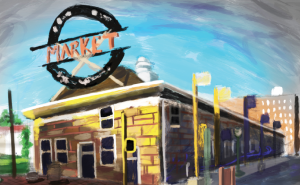
illustration by Rich Hauck.

illustration by Rich Hauck.

“This market is rocking!”

A few weeks back, on a Saturday afternoon, an enthusiastic Ryan Hummer gave me his assessment of the action at the Broad Street Market.

The thing is—I hadn’t asked him.

My wife and I were at his stand, Hummer’s Meats, collecting our usual provisions for the coming week, when he spontaneously shared his excitement over the crowds of people elbowing their way through the narrow aisles of the brick building.

“Quite a change,” I said.

“Day and night,” he responded.

Hummer’s Meats is a market stalwart, and the family traces its roots there back to the 1920s. Ryan is the fifth generation to cut meat and, for a while, it looked like he might be the last of his family to sell anything inside Harrisburg’s only city market.

“I’m just about out of here,” he told me four years ago, after an infestation of bugs and rodents forced the market to shut down, the second time it had closed in two years for basically the same reason.

Back then vendors were at wit’s end—angry with management, with the board, even fighting with each other. The market still had its regulars, but, on many market days, more people seemed to be working there than shopping there.

The 150-year-old market was in the same funk as the rest of Harrisburg—a once great place now dirty, depopulated and struggling.

Then something happened—or, more accurately, a series of somethings.

Ask vendors what that was, and you’re likely to hear a trio of reasons: better management, a better mix of vendors and a better neighborhood.

Two years ago, Ashlee Dugan was appointed market manager followed, last year, by Beth Taylor. The vendors I spoke with described both women as caring, committed and competent, with a hands-on, problem-solving style of management. They also praised them for helping to bring stability to a market long plagued by turmoil.

Importantly, Dugan and Taylor put recruitment of new, high-quality vendors near the top of their priority lists, and that effort has born fruit.

On a typical Friday or Saturday, large crowds huddle around three newcomers that have their stands in a row in the brick building: Radish & Rye Food Hub, Evanilla doughnuts and Elementary Coffee Co. But it’s not just the newbies. Long lines often greet the hungry at long-timers like Fisher’s Deli, Lil’s Pretzels and Peach Ridge Produce. The newer vendors, though, clearly have injected life and brought fresh faces into the market.

Lastly, the neighborhood in general—and the Millworks in particular—deserve some credit, vendors told me.

For years, Midtown Scholar Bookstore was about the only complementary business to the market. But, over the past year, Zeroday Brewing, H*MAC (especially the Kitchen and the monthly HBG Flea), the Susquehanna Art Museum and the Millworks have recruited people into Harrisburg. Several vendors singled out the Millworks not so much for generating pedestrian traffic across Verbeke Street (though there is some of that), but for introducing—or reintroducing—folks to Midtown, some who return to shop at the market.

Interestingly, not one vendor I spoke with cited the once-ballyhooed Broad Street Market Task Force as a player in the improvement. More than two years ago, the city formed the task force to make recommendations on how to improve the market and, last year, the group issued its report.

Perhaps most significantly, the task force suggested changing the market’s complex management structure, currently a multi-tiered mess consisting of the city, the Broad Street Market Corp. and Historic Harrisburg Association. Instead, the report said, the market should become a nonprofit entity, which would better enable it to raise money and operate smoothly.

That hasn’t happened yet, nor have the report’s other suggestions been implemented (with the possible exception of slightly expanded market hours). Still, progress—substantial progress—has been made, judging by the large crowds and seemingly satisfied vendors. So then what’s the lesson?

Well, leadership matters a lot and, by leadership, I mean committed, every day, on-the-ground (not board-level) leadership. Secondly, synergy matters a lot. It was tough to get outsiders to venture into a desolate Midtown but got easier once several new businesses created a buzz and more options in the neighborhood, allowing people to walk from one place to another.

What doesn’t matter so much? Bureaucracy, reports, endless meetings. Perhaps, one day, the market will shed its layers of overseers. But, until then, it clearly can make headway regardless. As for the task force’s other recommendations—heck, we already knew the market needed infrastructure improvements, better hours and a focus on good food.

The Broad Street Market, like Midtown itself, has been struggling for decades, and numerous administrations and consultants have devised plans to fix it. Nothing seemed to work. All the reorganizations and master plans could not solve its two greatest problems: a dearth of high-quality, focused leadership and, most importantly, a lack of customers.

After years of almost nonstop woe, people have been returning to the market. It seems so sudden and unexpected, but perhaps it shouldn’t be any surprise that, as Midtown goes, so goes the Broad Street Market.

Lawrance Binda is editor-in-chief of TheBurg.


Continue Reading

River Saver: Bill Cornell has dedicated his life to the Susquehanna River–and he’s just getting started.

Screenshot 2016-04-28 13.02.50Every morning when Bill Cornell wakes up, he looks out the window of his Wormleysburg home, and it’s there.

Some days, it’s flat and placid; others days it’s windswept and wavy. Nonetheless, the Susquehanna River is always there, just across the road from his front porch.

“Our river is truly a national treasure, something we need to save and protect,” said Cornell, a past president of the Harrisburg Riverboat Society.

Cornell’s river reverence involves more than just words. He is founder and director of the Susquehanna River School, a floating classroom for students of all ages focusing on the history and natural wonders of the Susquehanna, which runs a total of 444 miles between Cooperstown, N.Y., and the Chesapeake Bay.

He also initiated the Save Our Susquehanna, or SOS, campaign, an effort involving like-minded people, businesses and non-profit entities seeking greater protection of the river.

For Cornell’s work with SOS, the Pennsylvania Fish and Boat Commission recently awarded him its first-ever “Resource First Award.”

“Bill was an easy choice for this award,” said John Arway, the Fish and Boat Commission’s executive director. “He’s been a staunch supporter of the bass in the river. ‘Resource First’ is shorthand for our mission. It really means ‘protect, conserve and enhance our community’s resources.’”


It’s Not Enough

Two years ago, Cornell launched an SOS online petition drive to encourage state officials to clean up, save and protect the Susquehanna River.

The effort’s main goal is getting the state Department of Environmental Protection to list the river as an impaired waterway “so that real clean up can begin,” as the SOS website states. It also suggests using funds from a fracking severance tax for cleanup and protection of the river and its tributaries.

“After 20 years, I came to realize (the Susquehanna River School) is not enough,” said Cornell, explaining why he started SOS.

Arway was so impressed with Cornell’s SOS that he initiated a sister branch of the operation through the Fish and Boat Commission last June. The commission’s goal is to raise $50,000 in private donations that it plans to match. So far, $30,000 has been raised, Arway said.

The Fish and Boat Commission’s SOS project has several goals, including identifying possible contamination sites and working with willing farmers and colleges and universities to test soils and reduce nutrient and sediment runoff into the river. This could control nuisance algae blooms that produce low oxygen levels and high pH conditions harmful to young bass.

Another goal is to work with physicians and hospitals throughout the river basin to keep pharmaceutical drugs and other endocrine-disrupting chemicals out of the river because of the harmful effects on fish.

Coincidentally, it was Arway who snapped the notorious photo of a locally caught smallmouth bass bearing a large cancerous tumor in November 2014, an image that went viral. The Susquehanna’s young bass population has been plagued over the last decade by illness and elevated mortality rates due to river contamination, he said.

“The stuff that’s really hurting our rivers now you can’t see,” Cornell observed. “This used to be a bass fishing hot spot. Now it’s catch and release.”


Warming Up

Besides SOS, Cornell may be best known for starting the Susquehanna River School, a river-based environmental classroom that operates during the summer.

“The best way to learn about this is to get out on the river,” Cornell said. “It’s not something that’s taught in our schools.”

In fact, the River School was developed for Harrisburg school students, but now is open to anyone who wants to learn about the river.

“This is the longest river in the eastern United States,” Cornell said. “It has a tremendous history. Archeological digs have uncovered all sorts of artifacts. It proved that Native Americans lived on the shores of our river 10,000 years ago.”

Until now, all of the River School’s 75-minute cruises have taken place aboard the Pride of the Susquehanna riverboat, but that is scheduled to change in June, Cornell said. Earlier this year, the Riverboat Society purchased a sister boat from the Cedar Point Amusement Park in Sandusky, Ohio. Cornell found the 34-foot Sea Ark aluminum launch for sale on eBay.

“This can operate in 13 inches of water,” said Cornell. “It will be used for eco tours because it can go to places that the riverboat can’t.”

He then paused a minute to reflect on this new chapter of river exploration.

“I’m excited as all get-go,” he said. “I’m 63. I’d like to think that, at an age when other people would be consumed with retirement, I’m just warming up.”


To access Bill Cornell’s Save Our Susquehanna petition, visit www.sospennsylvania.org.

For information about the Pennsylvania Fish and Boat Commission’s Save our Susquehanna program, visit www.fishandboat.com/sos.htm.

For information about the Susquehanna River School, call 717-234-6500, visit www.harrisburgriverboat.com/riverschool or email [email protected]. You also may visit the Facebook page: The Susquehanna River School.

Continue Reading

April News Digest

Road Plan Revealed

Harrisburg last month unveiled a plan to make major improvements to 6th, 7th and Division streets.

City Engineer Wayne Martin, along with consultant Craig Bachik, presented the results of a study to improve traffic flow and safety along those three major city arteries, a plan that includes adding traffic circles, building pedestrian bump-outs and increasing green space.

Martin said the plan was designed with pedestrians, bicyclists and motorists in mind, in that order.

The study was funded by a $27,000 grant from the Harrisburg Area Transportation Study, with an $8,000 matching grant from the Pennsylvania Higher Education Assistance Agency (PHEAA). It came about because PennDOT requested a study before the city proceeds with a plan to return N. 2nd Street to two-way traffic from Forster to Division streets, said Martin.

The proposed improvements include constructing a series of roundabouts at busy intersections, including at N. 7th and Division, N. 7th and Reily and on N. 6th Street in back of the Broad Street Market. Division Street would be redesigned as a boulevard, with a strip of green space in the middle of the road.

The proposal was created with input from “major impactors” along those roads, such as PHEAA, D&H Distributing and Vartan Group, said Bachik of New Cumberland-based Navarro & Wright Consulting Engineers. Neighborhood groups were not consulted, but the public will be able to have a say once the plan is presented to City Council this month, he said.

The improvements would cost about $30 million, said Martin, though the work likely would be done in pieces as transportation funding was secured.

Besides easing traffic, the improvements would help beautify the corridors, while boosting pedestrian safety, especially on N. 7th Street near PHEAA, said Martin.


 City Nominates 2 for CRW

City Council last month considered two city residents nominated by the Papenfuse administration to the board of Capital Region Water.

Garvey Presley Jr. and Charla J. Plaines appeared before council April 19 to discuss their qualifications to serve on the five-member board.

A confirmation vote was scheduled for April 27, after press time. If confirmed, Presley would fill one open seat while Plaines would fill a seat currently held by Bill Cluck.

Cluck, an environmental attorney whose five-year term expired in January 2015, urged council to think twice before replacing him, pointing to Capital Region Water’s financial turnaround and investment-grade bond rating under his tenure.

His plea seemed to find favor with some council members, such as Westburn Majors, who served with Cluck on the board before taking office this past January. “I think it would be a complete disservice if we don’t keep him,” Majors said.

Yet Mayor Eric Papenfuse, who is empowered to nominate board members with the advice and consent of council, said it was time to add fresh faces to the board to achieve greater diversity in membership and help with community outreach.

Plaines, a reentry coordinator at the Pennsylvania Commission on Crime and Delinquency, said she felt her skills were suited to making sure diverse voices in the community were more fully engaged in the authority’s decisions.

Presley, an equipment operator at the Derry Township wastewater treatment plant, said he had been interested in environmental work for most of his life and that his employment history made him a “natural fit” for the board.


Recovery Plan Brought to Vote

City Council scheduled a major vote on an updated Harrisburg recovery plan last month, setting the stage for the most comprehensive agreement to date on the mix of tax policies, personnel goals and government reforms needed to stabilize the city’s finances.

The state has asked the city to adopt the 115-page update in time for negotiations with its police and municipal employees unions, whose current labor contracts expire at the end of the calendar year.

An affirmative council vote would mark the first time the body has endorsed a comprehensive recovery plan, as opposed to the piecemeal votes for related legislation while the city was under state receivership in 2013.

The updated plan would count on increased revenue from a local services tax hike affecting residents and commuters and would have the city weigh a home rule charter initiative that could make recent earned income tax hikes permanent.

It would also direct a greater portion of any money recovered in lawsuits over incinerator-related borrowings to paying down the city’s current debt load.

The vote was scheduled for April 27, after press time. But Fred Reddig, the city’s coordinator under Act 47, said he was “optimistic that the plan is going to move forward” and that his team would be able to take it to court for approval.


Demolitions Begin

Harrisburg began razing condemned houses last month, vowing to accelerate the pace of demolitions.

The city is on pace to remove about 30 blighted structures this year, far more than in recent years due to a beefed-up sanitation staff. In past years, demolitions were often delayed as workers were pulled off jobs to assist in trash pickup.

Most demolitions are slated for properties in the Allison Hill and Uptown neighborhoods. In all, Harrisburg has several hundred condemned properties.


March Home Sales

The spring real estate market was off to a solid start in March, as sales ticked up compared to last year.

Regionally, sales totaled 647 units in March, 10 more than in the year-ago period, according to the Greater Harrisburg Association of Realtors (GHAR). The median price was down slightly to $155,000, but average days on the market plummeted to 86 from 106 last year.

Sales rose to 233 units from 202 on a year-over-year basis in Dauphin County. They fell slightly in Cumberland and Perry counties.

The median sales price in Dauphin County fell a bit compared to last March, to $136,000 from $139,000, though rose by about $5,000 per unit in both Cumberland and Perry counties, to $179,950 and $139,950, respectively, said GHAR.


So Noted

Harrisburg last month was awarded a $155,522 federal grant to help reduce crime in the Camp Curtin neighborhood. The Byrne Criminal Justice Innovation Grant will allow the city and several community partners to launch an initiative to lessen crime as part of a larger revitalization effort in the area, according to Tri County Community Action.

Harrisburg Area YMCA has purchased the historic Millers Mutual Group building at Forster and Front streets for $750,000. The Y made the purchase mostly to acquire land for more parking for the East Shore Y next door, but also plans to move its headquarters into the building, according to a joint press release. Millers Mutual stated that it will lease back the building from the Y until it can relocate to larger offices.

Park Harrisburg began booting vehicles last month to better enforce parking penalties on motorists with three or more outstanding warrants. The parking operator long planned to start a booting program, but was delayed until it could develop technology that would allow it to access city parking records, said the company.

Journal Multimedia, a homegrown, Harrisburg-based company that publishes the Central Penn Business Journal, was purchased last month by industry behemoth GateHouse Media, the owner of hundreds of daily, weekly and specialty newspapers. In addition to its flagship publication, Journal Multimedia publishes Central Penn Parent, Lehigh Valley Business and several other titles. It also has related custom publishing and events businesses.


Changing Hands

Briggs St., 225: S. & C. Aichele to B. Brock, $179,500

Brookwood St., 2619: R. Santangelo to B. Sweger, $57,500

Derry St., 1323 & 1325: U. Patel to T. & K. Yameogo, $85,000

Duke St., 2435: J. Smith to F. Zeray, $45,000

Fulton St., 1738: Secretary of Housing & Urban Development & Information Systems Network Corp. to PA Deals LLC, $65,250

Green St., 1925: W. Gonzalez to B. & A. Christensen, $216,500

Green St., 2416: F. Seidlich to J. & P. Manjon, $150,000

Green St., 3113: C. & B. Stone to B. Baker, $159,900

Green St., 3121: J. Meadowa to 8219 Ventures, $70,000

Logan St., 1619: L. Blanton & R. Parr to C. Grim, $89,000

Manada St., 1924: B. Vazquez to P. & T. O’Connell, $36,000

Market St., 1912: Secretary of Housing & Urban Development to Rogue Enterprises, $36,500

N. 2nd St., 2215: V. & J. Books to T. & J. Whye, $229,500

N. 2nd St., 2615: Secretary of Housing & Urban Development to TBF Properties LLC, $75,000

N. 2nd St., 2842: Arthur A. Kusic Real Estate Investments to T. Cook, $60,000

N. 3rd St., 3005: D. Bartolet to G. Dutson, $40,000

N. 4th St., 3015: D. Travitz to F. Gresson, $86,000

N. 5th St., 1738: CNC Realty Group to M. Meads, $85,000

N. 6th St., 3138: M. Naranjo to J. Crossett & M. Hochstetler, $50,000

N. 15th St., 1328: L. Mitchell to A. Rodriguez, $38,000

N. Front St., 805: Millers Capital Insurance Co. to Harrisburg Area YMCA, $750,000

N. Front St., 1013: M. Santalucia to B. Rota, $148,000

N. Front St., 1525, Unit 206: J. Feather to C. Wilson & K. Thompson, $85,000

N. Front St., 1525, Unit 604: Riverview Manor Association LP & Brickbox Enterprises Ltd. To D. Baker, $230,000

Paxton St., 1000: Sutliff Enterprises & K. Damitha to PinnacleHealth System, $3,600,000

Rose St., 933: F. Clark to GKX LLC, $235,000

Showers St., 581: R. Ross to M. Terry, $97,000

Showers St., 624: K. Hood to K. Kearn, $86,000

S. 13th St., 243: E. & A. Martinez to N. Srayi, $32,000

S. 18th St., 1117: Vanderbilt Mortgage & Finance Inc. to J. Frias, $30,535

S. 29th St., 630: P. Over to J. Guzman, $46,600

State St., 124: C. Smith to TKP Investments LLC, $175,000

State St., 1520: Federal National Mortgage Association to A. Moore, $31,000

Susquehanna St., 2136: Secretary of Housing & Urban Development to L. Marrazzo, $31,125

Swatara St., 2142: G. & J. Trump to R. Chowdhury & A. Nasrin, $49,500

Verbeke St., 232: K. Bentzel to Afterkey Property Solutions LLC, $60,000

Wyeth St., 1406: PA Deals LLC to J. & Y. Oskam, $113,900

Harrisburg property sales for March 2016, greater than $30,000. Source: Dauphin County. Data is assumed to be accurate.

Continue Reading

Independence Day Festivities Set

FireworksWeb

A rocket explodes during last year’s fireworks display in Harrisburg.

Harrisburg will celebrate the July 4 holiday with a one-day event that will include food trucks, children’s activities and music, ending with two fireworks displays, the city said today.

The “Independence Day Food Truck Festival and Fireworks Show” will take place in Riverfront Park on Monday, July 4, starting at 3 p.m., according to the city.

“The Food Truck Festival is sure to be one of our most popular events this year,” said Mayor Eric Papenfuse. “People will be able to enjoy a variety of great food and reasonable prices. We urge everyone to come out and enjoy the fun!”

Musical groups will entertain throughout the event on a live music stage. Children’s activities will include face painting, caricaturists and a bounce house.

Two fireworks shows will conclude the day’s celebration. The Harrisburg Senators fireworks will precede the city’s fireworks festival.

Street parking will be free, and parking will be available for $4 on City Island.

Sponsors of the Independence Day celebration include the Hershey Harrisburg Regional Visitors Bureau, the Pennsylvania Housing Finance Agency and the Harrisburg Downtown Improvement District.

The city’s Independence Day celebration has changed greatly from year to year. For many years, Harrisburg held a three-day music and arts festival along the riverfront. More recently, the city experimented with formats, reducing the celebration to a single day and emphasizing food and family activities.

For more information, visit www.harrisburgpa.gov/July4.

Continue Reading

Story Time: Untitled tells of life in Harrisburg, one person at a time.

Screenshot 2016-03-30 00.41.16In May 2013, people started coming together in Harrisburg to tell stories.

They did not come to perform for each other or debate one another. Untitled was formed to give people the chance to share true stories. Guests will not hear hot takes or sound bites but uninterrupted testimony from Harrisburg residents.

“Hearing true stories, whether they’re written or whether they’re live, is popular because, sometimes, the craziest stuff is true,” said Caitlin Copus, one of the founders.

Organizing a regular event series in which people are allowed to speak before an audience might, for some, count among that crazy stuff. But, to Copus, the need for people to hear other people share their experiences is undeniable. That’s why Untitled keeps its storytelling live and local.

“You don’t really stop and listen to someone tell a whole story very often,” she said.

But that’s what you hear at Untitled, now in its fourth year thanks to Copus, host Paul Barker (the same Paul Barker who is the senior writer for TheBurg), sound designer Douglas Weaver, graphic designer (and Copus’ husband) Jeff Copus and professor Janet Bixler of Central Penn College. The whole committee works together to organize and plan every event, including finding storytellers.

“For some of our events, we’ve had everyone enter the drawing at the event, and then, at some of our events, we’ve had all pre-selected storytellers,” said Copus. “Now we do half and half—half of our storytellers know ahead of time that they’re going to tell a story, and the other half of our storytellers enter when they’re there.”

The mix keeps the events community-focused and leaves room for surprises.

The most memorable event, Copus said, was one of the first Untitled organized.

“The theme was ‘Fathers,’” she said. “It was June, so it was close to Father’s Day. We had someone tell a pretty powerful story about struggling with a poor relationship with his father who passed away. We had someone talking about how his wife had given birth to a stillborn child.”


Only in Harrisburg

Untitled strives to keep slots open for eight storytellers per event, each of which run roughly for an hour and a half.

When Untitled started, events were held monthly, but that became increasingly difficult for the small team to organize. So, the schedule is now quarterly, which, Copus said, has made them more special.

“We didn’t always have as many stories when we were doing [the events] monthly,” she said. “We’re hoping, with the quarterly format, that we’ll get a full evening of stories at each event.”

Untitled also has a new home at Zeroday Brewing Co. after outgrowing the intimate art space, The MakeSpace, and, for a time, roving every month through various places in Harrisburg.

Every Untitled event has a theme, and it was fitting that, after a transient 2015, Untitled debuted at Zeroday with “Journeys.” Before that, events like “Revolutions” took them to the Susquehanna Art Museum, “Race” was held in the Harrisburg Brethren in Christ Church, and they stopped at the LGBT Center of Central Pennsylvania for “Crush.”

“It was fun to go to different places and to try to bring in different audiences, but I wasn’t sure if it was the easiest thing for people who enjoy our events to follow,” said Copus.

It makes sense that a community bar would be a good fit for some organized storytelling, and Zeroday has been “gracious and accommodating” to Untitled, said Copus. It was in their new home that Untitled held Copus’ favorite event they have organized yet, “Only in Harrisburg.”

“The best themes are the ones that can be interpreted different ways so we get a really wide variety of stories,” she said.

The audience votes one story per event the winner, and the winner of “Only in Harrisburg” was a girl who recounted her experience of being catcalled and then calling out and educating her catcaller.

“Now, she still sees him all the time, and he tries to say all these respectful things that she told him to say,” said Copus.

The reason she and her fellow organizers are still doing Untitled “is probably the same reason that we started it. It’s a really nice community event,” said Copus. “Storytelling is a powerful way to connect with people and for people to connect with each other.”

A lot has changed in the past three years, and Copus is prepared to take forthcoming, inevitable changes in stride. For now, Untitled events are planned for the rest of 2016.

“Storytelling events are getting to be fairly popular,” Copus noted, citing Story Slams that have taken off in York and Lancaster. “It’s really neat that we can be a part of that storytelling community and have that right here in Harrisburg. It’s a great thing to be able to offer to people. Come out to this free event, and you can hear people and meet people.” 

Learn more about Untitled Harrisburg, including the event schedule, at www.untitledhbg.com.

Continue Reading

News Digest: April Fool’s Edition

GeeseFB

Under a new proposal in Harrisburg, this family will pay more in taxes.

Line Divides Market Street

The Dauphin County commissioners last month painted a solid white line down the middle of Market Street, just daring Mayor Eric Papenfuse to cross over it.

“I got the idea from ‘The Brady Bunch,’” said Chairman Jeff Haste. “You know, the episode where Peter and Bobby divide their bedroom in two?”

Haste laid claim to everything on his side of the line, including the Citizens Bank branch and the bus station. Papenfuse immediately retaliated, saying that Bacco and the Pita Pit belonged to him.

“Let’s see him try to get a chicken wrap now!” said the clearly excited mayor.

At last report, Haste and Papenfuse were making faces at each other from across the street, occasionally running up to the line like they were going to go over it, but then scurrying back at the last moment.


Budget Talks Start 

Pennsylvania legislators began work today on the 2017 state budget, vowing to complete it before all life on Earth ceases to exist.

Sen. John DeSantos, R-Beaver, made a bold pledge that a bipartisan budget agreement would be reached by the time our sun expends all the hydrogen fuel in its core and swells to 166 times its current mass.

“Mark my words: This will be done before our planet becomes a stark, lifeless desert,” said DeSantos.

Sen. Joshua Tyrell, D-Allegheny, said he would “up the stakes,” setting a timeline for a preliminary budget accord while vast seas of lava were still melting down the Earth’s mountains.

“The other side wants to delay until the sun runs out of helium,” he charged. “Our side will wait only until the Earth is a burnt-out cinder.”


Pa. Something Something 

A horrific, yet offbeat and hilarious crime occurred recently somewhere in Pa., PennLive reported today.

A Pa. man and a Pa. woman committed their dark, if comical and somewhat lewd, act in Pa.

The Pa. couple’s felonious, kinky hijinks occurred nowhere near Harrisburg, in a Pa. county that may be near Bradford or maybe Ohio—no one really knows. Still, it made local Pa. readers feel superior to what are clearly total pieces of Pa. trailer trash.

“It happened in Pa., Pa., Pa., Pa., Pa., Pa., Pa.,” remarked the writer-robot before someone hit the on/off switch to reboot it.


Everyone’s a Winner

Every person in the greater Harrisburg area will receive an award this year, according to a joint announcement last month by the Central Penn Business Journal, Harrisburg Magazine and Susquehanna Style.

The three publications have expanded their annual awards deluge to include 631,000 people in 55,000 categories, including “Best of” and “People’s Choice” awards for notable achievements in cutting the grass, watching TV and driving.

“My plaque points out how I usually pass on the left,” said Sheila Wyler of Mechanicsburg. “I’m so happy that someone finally noticed.”

Wyler’s 8-month-old son, Evan, is himself a proud recipient of a “10 under 10 Months” award.

“He would say he was honored,” Wyler said, “if he could speak.”


Goose Tax Passed

Harrisburg’s Canada geese will pay more in taxes under a new Goose Services Tax (GST) passed last month by City Council.

“These birds use our city to eat, mate and excrete, but don’t pay their fair share,” said Council President Wanda Williams.

The GST is aimed at the city’s migratory geese, though resident geese also will see their taxes go up.

Council is also said to be considering several other revenue enhancement proposals, including a groundhog tax, a squirrel tax and a tax on the garbage that drifts by the city on the river each day.

“Honk,” said some random goose in Riverfront Park before flying off to hunt for roots and grubs in a different municipality.


Chief Talks Down Lightning

Catastrophe was averted during a storm last night, as Harrisburg Police Chief Thomas Carter talked an impending lightning strike out of the air without incident.

“Think about your electrons,” Carter could be heard calling calmly towards the sky, where a dark cloud floated menacingly with a dense load of electric charges. “You don’t want things to go any worse than they have to.”

Officials said the ball of static energy was initially ready to lash out at random, but that the police chief’s courteous tone and gentle assurances convinced it to proceed safely down a distant plasma channel and into an uninhabited patch of ground.

“I grew up with these storms,” Carter said with a shrug, as officers moved to surround the site of the discharge. “They know I’ll treat them with respect.”


Stadium To Be Shared

FNB Field on City Island can expect a lively month, as its owners have announced plans to share the stadium with additional sporting and entertainment events as part of a plan to make the venue more financially sustainable.

Rugby, field hockey and a three-ring circus are expected to draw additional fans to the island ballpark, which is already being shared between the Harrisburg Senators minor-league baseball team and the City Islanders professional soccer team.

Skeet shooting, gladiator fights and the modern pentathlon will round out the packed schedule, increasing ticket sales and helping to pay back the city for its investment in the facility.

“Obviously, the occasional overlap will take some getting used to,” said groundskeeper William McGowan as he loaded up the clay pigeons that will be launched from an elephant’s back in the outfield during scrums. “We are hopeful the gladiators and circus will at least share their tiger.”


Museum Exhibit Opens

The National Civil War Museum last month announced plans to open a second exhibit sponsored with grant money from the National Rifle Association.

The exhibit, called “Cold Dead Hands,” will combine the museum’s collection of antique firearms and the lifeless, desiccated hands of Civil War soldiers from which visitors are tauntingly encouraged to try to pry them.

“Total coincidence,” said museum board member Gene Barr, when asked about the overlap between the exhibit’s title and the famous NRA slogan regarding the right to gun ownership. “We came up with it ourselves.”

The guns will be shown for three months or until stolen, whichever comes first.


City Recriminalizes Vices

The administration of Mayor Eric Papenfuse last month made it a summary offense to engage in previously-legal vices, including cigarette smoking, drinking, swearing and adultery, as part of a sweeping upgrade to the city’s criminal code.

The reform efforts began with plans to reduce the penalty for marijuana possession from a misdemeanor to the lower-grade summary offense.

But they quickly expanded when observers noted that the consuming the drug was no more harmful than many other behaviors.

From now on, it will also be a minor crime to tell a white lie, take the Lord’s name in vain, exchange lusty glances with a member of the opposite sex and play poker except for the purpose of wholesome bonding during family game nights.

“This is about internal consistency,” Mayor Papenfuse said, as he approached a young woman dancing suggestively at a downtown bar and slipped a citation into her pocket.


Monument Erected

A monument to honor Harrisburg commuters was unveiled last month, recognizing decades of unsung contributions by non-residents to the capital city.

Four square residential blocks were flattened to make way for the memorial, which consists of a giant sculpture of a frowning man in an SUV pointed towards the closest exit from the downtown.

“Finally, a little gratitude,” said local commuter John Friedberg, speaking from one of several suburban viewing towers that were built so honorees could appreciate the memorial from a safe distance.

The monument is slated to be open Monday through Friday, 8 a.m. to 4 p.m.


Crazy Shit Day

All the crazy shit that happens in Harrisburg over the course of a year will be condensed to a single day this year, the city announced last month.

Harrisburg Police Chief Thomas Carter is asking all ISIS wannabes, fraudulent Ukrainian high school students, wilding youth and museum robbers to wait until Crazy Shit Day, which will be June 17.

“Do you plan to have sex on the roof of an office building? Do you want to harass someone about your stolen valor? Are you a former mayor with a house full of Wild West artifacts?” asked Carter. “We’ve reserved one day just for you.”

A lawsuit against the resolution was immediately filed by former mayoral candidate Lewis Butts.


Editor’s Note: All the crazy shit examples in this story actually happened. We made up everything else on this page. Happy April Fools!

Continue Reading

Student Scribes: How to Celebrate an Anniversary on Amtrak

Screenshot 2016-03-30 00.42.02My husband and I are taking a five-year anniversary trip courtesy of my father-in-law’s Amtrak rewards. It’d be faster to fly from Harrisburg to Boston, even drive, but a free ride where passengers can sleep, read, eat, stretch is an easy choice.

Everyone is plugged in thanks to free WiFi. Heads are buried in phones, tablets and gaming gadgets. Tweens wearing Kentucky University tees text each other. They laugh in synchronicity. I wonder what’s so funny, but I probably wouldn’t understand their coded text-speak. I’m way too old. If you’re not attached into the dual, 120-volt plugs then you’re a snoring grandpa, Sudoku granny or a boring mommy enjoying the scenery while scribbling in a notebook.

I believe there are few better, more satisfying and relaxing places to write than on a train. Constant inspiration with movement is unbeatable. Flow—it’s impossible not to race along with the speeding locomotive, jotting down as much scribble as fast as possible for fear of losing even one thought to the tracks behind you.

The conductor routinely passes, inspecting tickets. He never makes eye contact or cracks a smile. Maybe his malformed right ear has made his life hard, and he’s detached because of it. Or maybe, like most people, it’s Friday and he’s ready for the weekend and has no desire to be on the job. He scans my e-ticket, places it above the seat, and sluggishly continues down the aisle.

The click and clack of the nine-car vessel against the tracks lulls some and invigorates others. My husband, Chris, is sleeping or pretending to. The window seat holds my attention. I can’t doze or drift, only briefly looking away from the changing scenery. Picking up speed as we leave the Paoli station, my eyes strain to focus. The horn blares, a warning call for anyone or anything in our path. Heading east, the sun breaks through the fog, revealing changing leaves hiding the subdivisions and used car lots. Maples, oaks, asters—I download an Audubon app to decode the varieties of trees and flowers I might see along the eight-hour trip. That makes me the biggest nerd on the 642.

Closer to Philly, graffiti holds my attention instead of trees. Random tags remind me of childhood. Trips on the Metro downtown with Grandaddy and Abuelita, to the Smithsonian. Eating in the members-only restaurant was muy especial. Abuelita always commented on the ugliness of the graffiti, but, to me, it was a voice to the voiceless. Art to be appreciated. Maybe not to the same extent as the fine works in the museum but art nonetheless. Philly graffiti is bright. There’s even a colorful tag of Amy Winehouse hanging with Stevie Wonder. I’d believe they’re friends. I can’t decipher most of the meanings because they look like my daughter’s crayon scribbles.

Massive freight trains pass, carrying materials that build or destroy our country. As we pull into Philly, the myriad of wires overhead seem within arm’s reach. How do all these wires stay above the lines? Maybe I should wake the electro-mechanical technician to my left. I won’t poke the bear. He deserves some extra shuteye, working 10-hour days and often mandatory overtime on top of that. This trip is supposed to be relaxing for both of us.

After a brief stop, we leave the 30th Street Station, heading to New York City. The ATF agent and his K-9 occasionally stop next to unsuspecting passengers, scaring the crap out of young and old alike. Chris is happy he opted not to bring anything. I told him that, with the added ISIS threat, there’d definitely be more security. Damn those militants, harshing everyone’s buzz.

West Philly looks like a war-torn, post-apocalyptic nightmare. It could be the backdrop for an episode of “The Wire,” reminiscent of South Baltimore in the early 1990s, just waking from a crack-fueled slumber. I see seemingly endless blocks of deteriorating row homes, empty lots filled with used tires, burned sofas and dogs roaming for scraps. This section of Philly could be Baltimore, the District, New York or Boston. Traveling at ground level offers close-up views of the real situation, which in this case is poverty.

The gentrified suburbs re-emerge but only for a few stops. A slick suit sits across the aisle with greasy, thinning hair, loafers without socks, and a deep tan. He’s conversing with his much younger associate about a 2 o’clock meeting in Midtown. I don’t care about quarterly earnings reports or break-even tables. Dear woman sitting behind me, please stop smacking your gum! It could only be worse if she were biting her fingernails, too. I wonder if maybe we should move to the quiet car.

Entering Jersey, my Irish family is in the front of my mind. “Hardscrabble” is the term of choice Nanny used to describe her Northern Irish immigrant parents and her 11 older brothers and sisters. The Connellys lived hand-to-mouth under the shadow of Campbell’s Soup and NJ Power & Light. Five of Trudy’s brothers and her father were county linemen. I see their silhouettes in the glare of the train window. Two died the cruelest deaths imaginable, including patriarch Pat, by high-voltage electrocution. What a way to meet St. Peter. Fifty dollars from Power & Light was all the family received in compensation, and, sadly, there was in-fighting over the small sum. Nanny speculated it’d be spent at O’Malley’s down the block by her “grieving brothers.” Their wives would be happy they’d be drinking someone else’s paycheck for a change. These were the days before mandatory life insurance for high-risk industries and advertisements for worker-injury attorneys vying to help you “get the compensation you deserve.” Newark, you pit of disparity—wasteland, dirty depressing midway point on a journey to somewhere else—somewhere better. Closed warehouses with broken windows and overgrown lots lost to time litter the landscape as the 642 gets closer to Penn Station.

Penn Station at last. A brief, 90-minute stop, then on to Beantown. We decide to leave the train for the layover. Air. Not fresh air, as we are in the guts of NYC, but it’s better than train air and the sun’s out. We book it to Lenny’s across from Madison Square Garden. Chris has never been there, and I want pastrami piled high with coleslaw and Thousand Island on fresh rye bread. And pickles, lots and lots of pickles. Count it as the first official pregnancy craving for baby Smolinski II. After shooing away the aggressive pigeons, we reluctantly head down the gigantic escalator where another four-hour train ride awaits. We’ve decided that, for this leg, however, we will ride in the quiet car.

A young Spanish couple and their toddler follow us to platform W10. We load in a somewhat orderly fashion. “Single file,” squawks the conductor. “86 to Bah Stun now boardin’.” A middle-aged woman snaps at the couple just as they place their stroller in the overhead bin. “This is the quiet car.” They don’t speak English, or not enough to make a confident reply. My heart sinks. Should I repeat the phrase in Spanish? Chris tells me to stay put and keep quiet. They leave the quiet car.

The horn blares and train 86 emerges slowly from the bowels of NYC. The clicking of cell phone cameras overtakes all other sounds as we catch a glimpse of the Brooklyn Bridge and Empire State Building. We snap some because the light is great and it’s NYC. The high-rises fade, skyscrapers of industry capitalists are long gone as the scenery mutates, revealing uniform apartment buildings. Still stretching high, these neatly spaced modern tenements showcase a vast array of international flags, laundry and other paraphernalia lining the barred windows, microscopic patios and open-air hallways where children play. Raising my children on a farmette in Lancaster County, I just can’t imagine living in those conditions—especially with children.

The quiet car is aptly named. Most people read, snooze, watch and re-watch episodes of “Friends,” “Girls” and “Modern Family”—even tackle the occasional Sudoku. We stare out the window, moving farther away from our child, Lucy, by the second. Leaving a child for the first time for more than an overnight—what were we thinking? She’s not ready, we’re not ready. Nanny and Pappy aren’t Mama and Daddy. This damn quiet car is too quiet. I need some non-recirculated air. I need a refill, but if I go to the cafe car again, I’ll have to use that horrible blue chemical potty—no thanks.

We pass the beautiful seaside towns, and then Providence and Pawtucket are in the dust— we’re almost in Boston. I can’t wait for the street clatter and the posh hotel room of the Hilton Back Bay.

We leave the train, and we’re almost skipping as we reach the corner of Dalton Avenue, where the hotel’s 26 stories beckon two tired travelers. A smiling face greets us as we take our hotel room keys. “Swanky. Dad doesn’t disappoint,” Chris comments as we take the elevator to the 25th floor. A charmed view of the city emerges as we gaze out the panoramic windows. Getting comfortable isn’t difficult. Taking off our train traveler clothes, we laugh, because life with a toddler limits our amount of alone time.

Just as we fall into bed (it is our anniversary getaway)—there’s a knock at the door. A man with a thick accent says “room service,” as I leap to put on the robe hanging on the back of the bathroom door and Chris hides underneath the covers. The clean-cut young man wheels in a cart with red wine, chocolates and fresh fruit. Turning a deep shade of red, the server doesn’t make eye contact or attempt to leave the cheese tray but books it for the door. As soon as the door shuts, we burst into laughter. I put the do not disturb sign on the door handle and draw the curtains over the panoramic windows. Chris remerges from underneath the sheets to say, “Happy Anniversary.”

Alison Smolinski is a graduate student in communications at Penn State Harrisburg.


Continue Reading

March News Digest


Pot Hearings Held

Harrisburg last month held two hearings on proposed legislation to reduce penalties for possession of small amounts of marijuana.

City officials, including the mayor, police chief and several council members, listened attentively as dozens of residents testified for and against a proposal to change simple possession from a misdemeanor to a less-serious summary offense and ease penalties to $100 for a first conviction and $200 for a second. After a third offense, possession again would be considered a misdemeanor crime.

Several opponents claimed that marijuana served as a gateway drug to harsher drugs or that prolonged use could be harmful. Supporters said that marijuana is mostly benign, less dangerous even than alcohol use. Some speakers advocated making cannabis a legal substance, though state law currently prohibits that.

City council’s Public Safety Committee sponsored the hearings, which were held at the HACC Midtown 2 building on Reily Street and then, two weeks later, at the Public Works Department facility on Paxton Street. A final council vote on changes to the law is expected this month.


Strong Plan Revisions Debated

Harrisburg held several workshops and a hearing last month on proposed changes to the city’s financial recovery plan.

The city’s Act 47 recovery team is urging the modifications, which notably would include adopting a Home Rule Charter, which would empower the city to make changes to its governmental structure.

Mayor Eric Papenfuse and Act 47 coordinator Fred Reddig told council that, if the city didn’t adopt Home Rule, it could not retain hikes to its earned income and local services taxes once it exited Act 47, potentially leading to large property tax increases.

Several council members seemed cold to the idea of Home Rule and argued that, instead, the state should make a larger contribution to the city for services rendered.

Separately, city council also is considering a tripling of the local services tax to $3 per week for all city workers.


Report Splits Local Officials

An independent review of the Harrisburg treasurer’s office has split elected city officials, after City Controller Charles DeBrunner last month released a preliminary internal report on the findings over objections by the city solicitor and mayor.

The review, which encompassed the treasury’s general practices as well as specific activity during the 2014 calendar year, found the office lacked certain written policies and that aspects of its operations left it more vulnerable to fraud.

DeBrunner said that the 20-page report, by the New York consulting firm Alvarez & Marsal, found “numerous serious accounting problems” encompassing both the treasury and the city’s finance bureau, as well as a “culture at the city where errors are accepted and expected.”

But Mayor Eric Papenfuse sharply critiqued that characterization, saying it was politically motivated and misquoted the report’s actual findings. He further accused DeBrunner, who published a redacted version of the report on his official website, of “short-circuiting” an ongoing investigation that was still in its early stages.

In its report, Alvarez & Marsal found that a lack of internal controls in the treasury in that period and perhaps earlier resulted in “an environment where the opportunity for fraudulent activity exists.”

The report also said that the deputy treasurer, Celia Spicher, performs “too many” functions, including both initiating and approving outgoing wire transfers and reconciling monthly bank accounts, a practice that “weakens checks and balances and negatively affects operations of the office.”

Though the review found no specific instances of suspicious activity, DeBrunner said, the state of the city’s controls and records made it “less likely” that such activity would be detected by the firm’s limited review.


Conservation Plan Proposed

Harrisburg’s water and sewer authority announced plans last month for a $9 million conservation agreement that would permanently restrict development on its 8,200-acre property in Clarks Valley, a pristine, forested watershed in northern Dauphin County that supplies the city’s drinking water.

The agreement would involve a partnership with the Nature Conservancy, the Ward Burton Wildlife Foundation and Fort Indiantown Gap, a National Guard training facility that neighbors the property. The agreement would keep the land in authority hands while restricting how Capital Region Water could use it.

Under the proposal, such protections would be enshrined in a conservation easement, a legally binding agreement that attaches to a property and restricts how it can be used by current and future owners.

The easement would seek to preserve the watershed property “predominantly in its natural, scenic, forested and open space condition,” maintaining water quality and protecting rare plants and animals while preventing further development, according to a summary provided by Capital Region Water.


Equipment Authorized

A few new pieces of heavy machinery are headed Harrisburg’s way after City Council last month approved nearly $600,000 in equipment purchases.

Public Works Director Aaron Johnson made a successful plea before council for two loaders, two skid steers and a tow truck. Johnson told council members that his department’s ability to handle January’s blizzard was hampered by a lack of equipment to tow cars and move snow.

Harrisburg long has depended on an independent towing company to move cars that are blocking access for city vehicles. The new tow truck will help the city handle its towing more quickly and efficiently, Johnson said.

In addition to snow, the loaders will help Public Works employees remove other types of debris, Johnson said.


Youth Program Expanded

More young people will get jobs this summer, as Harrisburg City Council last month agreed to expand the city’s youth employment program.

Under the revised program, the Harrisburg Housing Authority will employ 75 young people, compared to 50 teens last year. Moreover, participants will get paid a stipend of $1,500 for the six-week program, up from $1,000 last year.

To pay for the expansion, Council doubled the budget for the program to $127,500. The money will come from the host fee, funding that the city receives from LCSWMA for hosting a regional waste facility.


So Noted

Capital Area Transit last month launched “Find My CAT Bus,” a GPS-based mobile website to help transit riders locate CAT routes, stops, bus locations and estimated arrival times. Riders can access this information on their smartphones and other devices via www.findmycatbus.com.

The Millworks has announced that it is building a brewery at the rear of its building in Midtown Harrisburg. Using a 15-barrel system, brewmaster Jeff Musselman will oversee the 2,000-square-foot facility, which will produce beer for the restaurant and bar.

MX Cocina debuted its second restaurant in the Campus Square building at N. 3rd and Reily streets in Midtown Harrisburg. Brothers Varonio and Carlos Hernandez opened their first location last year outside of Linglestown. The snug Midtown eatery features Tex-Mex fare such as burritos, burrito bowls and tacos.

PinnacleHealth Express has relocated from Harrisburg Hospital to 805 Sir Thomas Court in Progress. PinnacleHealth Express offers non-emergency primary care for patients without an appointment.


Changing Hands

Bellevue Rd., 2022: PA Deals LLC to Equity Trust Co. Custodian FBO Ramesh Narinesingh IRA, $67,000

Berryhill St., 2435: J. Luevano & J. Pacchioli to N. Downey, $64,900

Berryhill St., 2438: JP Morgan Chase Bank NA to T. Hoang, $50,220

Boas St., 418: PA Deals LLC to D. & L. Engelhardt, $123,200

Briggs St., 2030: Kings Investment Co. LP to D. King, $35,000

Calder St., 508: Bank of New York Mellon Trust Co. to PA Deals LLC, $69,900

Charles St., 232: R. Gosnell to D. Fukton, $145,900

Green St., 3215: M. & C. Bornstein to All Nations Evangelistic Church Inc., $131,000

Greenwood St., 2714: A. Aponte to P. Smith, $70,000

Jefferson St., 2900: K. Gilmer to R. Raoof & A. Kokoiy, $148,000

Kelker St., 217, L2: AJ Fedore & Co. Inc. to T. Smith, $110,250

Kensington St., 2231: Donald Pong Trust K. & L. Johnson, $42,500

Market St., 1638: C. McMullen to E. Patry, $75,000

N. 2nd St., 310: 310 North Second Street LLC to VMV Creations LLC, $630,000

N. 2nd St., 2517: AXL Realty Group Inc. to J. Swope, $49,000

N. 2nd St., 2940: A. Baley & R. Baker to C. Markley & T. Magilton, $239,900

N. 2nd St., 2965: Deutsche Bank National Trust Co. to R. Finck, $160,000

N. 3rd St., 1408: GreenWorks Development to Zecharya International Inc., $130,000

N. 3rd St., 1720: A & A. Campoverde to R. Metzger, $115,000

N. 3rd St., 2530: D. & N. Schertz to K. & A. Bryan, $139,900

N. 6th St., 1336: F. Brewington to G. Wright, $100,000

N. 6th St., 1741, 611 Kelker St., 631 Hamilton St. & 638 Hamilton St.: Dobson Family Limited Partnership to Buonarroti Trust, $192,500

N. Front St., 2921: J. Krafsig Jr. to D. & D. Schankweiler, $300,000

Norwood St., 947: PA Deals LLC to Equity Trust Company FBO Ramesh Narinesingh IRA, $62,000

Peffer St., 621½, 610 Muench St. & 1609 N. 6th St.: P. Dobson to Buonarroti Trust, $130,000

Pennwood Rd., 3208: Secretary of Housing & Urban Development & Information Systems Network Corp. to L. Harrisburg, $62,000

Pennwood Rd., 3243: G. Irwin to Consolidated Holdings International LLC, $235,000

Rumson Dr., 2644: Secretary of Housing & Urban Development & Information Systems Networks Corp. to M. De Cayamcela, $45,000

S. 25th St., 346: Wells Fargo Financial Pennsylvania Inc. to T. Vu, $36,500

Swatara St., 1522: Tri County HDC Ltd to C. Rae, $64,900

Woodbine St., 239: J. Morgenstern to D. Hoffman, $60,000

Harrisburg property sales for February 2016, greater than $30,000. Source: Dauphin County. Data is assumed to be accurate.

Continue Reading