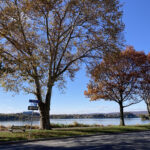
Harrisburg hopes to turn this area in Susquehanna Township into the city’s new composting facility.
Harrisburg mayor Eric Papenfuse came to Susquehanna Township on Thursday with an apology, but still found few supporters for a controversial waste disposal project the city seeks to build on an old school site.
Papenfuse appeared at the Township’s Board of Commissioners workshop meeting to defend the city’s application to build a composting facility at 1850 Stanley Rd. The property, which is owned by the Harrisburg school district, already houses a small composting site.
Papenfuse said that the proposal would expand and improve the existing facility, satisfying a state Department of Environmental Protection mandate that the city have its own composting plant for leaves, lawn debris and woody waste.
The mayor offered to scale back the permit application to help appease community concerns. However, township residents, citing concerns about public health, remained skeptical of the city’s intentions.
“Everything is suspect, and my trust has been destroyed,” said resident Pat Thompson, who called the proposal an issue of environmental justice for the largely African-American neighborhood nearby, citing research that shows that a disproportionate number of waste facilities are located in predominantly non-white neighborhoods.
Resident Jamie Folks pointed out that any agreement that the city reaches with the township could be revised under a future administration. Papenfuse said that the city does not intended to compost food waste at the facility, but Folks said that a future mayor could pursue a different plan.
“We might take food scraps out of the application tonight, but that permit allows for all sorts of things,” she said.
She asked for the creation of a permanent advisory council composed of Susquehanna Township residents with oversight of the facility.
Harrisburg submitted a preliminary permit application to the DEP on April 13 for a facility that would compost food and plant matter. More than 60 residents came to a July 22 commissioners meeting to stand against the project, and the board unanimously passed a resolution opposing the permit application.
Since the land is owned by the Harrisburg school district, the city has the power to go ahead with the project even without approval from the township. At last night’s meeting, however, Papenfuse insisted that community input was essential to the project’s evolution.
“I apologize for how this issue was communicated, and I take responsibility for it,” Papenfuse said, pledging to consider input from the meeting and return with a revised permit application that would be more acceptable to residents.
Papenfuse also defended the choice to build the facility at the Stanley Road site.
“Harrisburg is a small city, and most of it is in the flood plane,” Papenfuse said, reiterating that the city could not find a project site within its own borders.
John Rarig, Harrisburg’s recycling coordinator, insisted that residents would not notice any noise, odor, pests or traffic resulting from the project. He cited comparable facilities in Camp Hill and Swatara Township as evidence that the facility would not affect neighboring home values. Finally, he asked for public trust that the city comply with DEP regulations protecting air and water quality.
“We have nothing to gain from doing this wrong,” Rarig said.
One obstacle that Papenfuse faced last night was a general skepticism of city public works projects. AJ Overton, a Harrisburg resident who has family in Susquehanna Township, asked about the health hazards of the project. Overton grew up in the South Harrisburg neighborhood bordering the city’s incinerator, and she said that she has a chronic lung condition as a result of its air pollutants.
Amy Warnagiris echoed Overtin’s wariness.
“Your administration is the victim of past consequences,” Warnagiris said, addressing Papenfuse.
She said the township has been suspect of the city administration since it began the permit process in April.
“The lack of communication to us did not help,” she said. “The first permit did not go well, and I don’t know what it will take.”
Susquehanna Township residents were not the only ones who came out to oppose the facility. Rhonda Mays spoke on behalf of a community group from Allison Hill, which borders the proposed site south of Arsenal Boulevard. She said that Allison Hill residents have not received the same information as Susquehanna Township citizens, though they fear they will absorb some of the traffic and noise pollution from the project.
In an informal show of hands at the end of the meeting, about half of the people in attendance said they still opposed the project. Papenfuse remained optimistic that he could change their minds.
“We are hopeful that we can continue to work on a revised application that may be acceptable to you,” Papenfuse said, rejecting comparisons to the incinerator and adding that the composting facility carries “no health danger at all.”
Township residents, however, seemed unconvinced.
“You are ignoring us completely,” one resident said in exasperation. “We want nothing to do with it.”
In his final public comment, Papenfuse conceded that the city might need to consider alternative sites.
“There may come a time when this is deemed to not be in the best interest of the city or Susquehanna Township,” Papenfuse said. “We do not want to do something you don’t want.”
Speaking after the meeting, however, Papenfuse said that there are no alternative sites currently under consideration. He explained that building on the Stanley Road property would be mutually beneficial to the city and the school district, since the site is unsuitable for a school but fits the needs of the compost project.
The Stanley Road property, which was sold by the state to the school district decades ago, is bound under an educational covenant that requires it to be used for educational purposes. To comply with the property’s covenant, the facility would accommodate school trips and be used in the district’s environmental science curriculum, he said.
He also elaborated on the terms of the lease with the school district, saying that the city would pay a nominal fee—“maybe a dollar”—for use of the land.
Papenfuse could not offer a concrete timeline for the project, but insisted that the city needs its own composting facility. Currently, Harrisburg sends its lawn waste to a compost plant in Swatara Township. However, the DEP mandates that a municipality of Harrisburg’s size have its own dedicated site for leaves and wood waste.
Author: Lizzy Hardison