Tag Archives: Harrisburg School District

Ready to Read: “500 Men” pours into classrooms to read, listen.

Correspondent Ron Claiborne of “Good Morning America” kicked off the annual “500 Men Reading” event today at Camp Curtin Middle School.

“I’m probably a journalist today because of a book I read when I was 6 years old,” said “Good Morning America’s” Ron Claiborne this morning at Camp Curtin Middle School.

That book, he said, was “Freddy and the Bean Home News” from the “Freddy the Pig” series.

Claiborne helped to open the weeklong “500 Men Reading Week and Career Exploration” event, which kicked off today in the Harrisburg area.

The American Literacy Corp, (ALC) has held this event for 17 years. More than 500 men will read and participate in career awareness in 20 schools in four different school districts this week: Harrisburg, West Shore, Susquehanna and Steelton-Highspire.

Local author and ALC founder Floyd Stokes said he began the event “because I love reading to kids, and I figured that others would enjoy it, too.” He also wanted “to expose kids to men who enjoy reading and value education.”

The readers themselves echoed Stokes’ sentiments and expressed a few reasons of their own.

“Law enforcement is more than lockin’ up the bad guys,” said Harrisburg police Sgt. Russell Winder.

As a child, he said, his mother and aunts read him “everything from Dr. Seuss to the Bible.”

Chatting with Winder was Calvin Hynson. Hynson said he began reading for the group in the beginning, when it was the “100 Men Reading Week.” He said he participated “because you love kids and we men need to give back.”

Both Hynson and Winder served in Operation Desert Storm, and they said that today’s event was another way for them to serve the community.

Mayor Eric Papenfuse was also on hand, continuing a decade-long commitment to the event. He planned to read Edgar Allan Poe’s “A Tell-Tale Heart” to middle-schoolers.

“This is one of my favorite events,” he said.

There were some newbie readers in the group, as well. Robert Jenkins said that he was reading for the first time.

“I’m just trying to give back, trying to inspire the youth coming up,” he said. “Trying to do my part.”

“The Cat in the Hat” and other Dr. Seuss books were his favorites growing up, he said.

Like Jenkins, other men were happy to share their favorite childhood reads. For Winder, it was “Oh! The Places You’ll Go!”; for Stokes, “Animal Farm”; for Hynson “Cat in the Hat”; and, for Claiborne, “Charlotte’s Web,” which he’ll read later in the day.

Some young people joined in, too. Austin Assoko and a few of his classmates from Carson Long Military Academy volunteered to read.

“Volunteerism and community service are the things that get me up in the morning,” Assoko said.

What purpose does all this reading serve?

“It’s not just about literacy. It’s about what it can do to prepare you for life,” said Gary D. St. Hilaire, president and CEO of Capital BlueCross and honorary chair of this year’s read.

He added that “Froggy Gets Dressed” was his children’s book of choice, but that reading was as much about time spent together as the books themselves.

Jamar Johnson, co-coordinator of the week, said he began reading for the event in 2009 and that the students “were excited to have me read to them.” Johnson also said that “there were a lack of men in schools and neighborhoods” and this event demonstrated a collective effort to show that men care about today’s children and youth.

Ultimately, “500 Men Reading Week and Career Awareness” wants to encourage a new generation of readers and leaders. Claiborne said.

“A single book, like a single teacher, can change your life,” he said.

Continue Reading

January News Digest

Comprehensive Plan Draft Criticized, Defended

Harrisburg’s draft comprehensive plan faced a cool reception from business leaders and city administrators last month, as the city Planning Commission hosted its first hearing on the document following a months-long dispute between the city and the plan’s author.

During a hearing in City Council chambers, members of the business community said the plan stepped on the toes of property owners and private developers. They feared that the proposals for land use would restrict investment in the city.

Private citizens and representatives from neighborhood associations were more supportive. Those who spoke out commended the plan’s goals to connect parks and neighborhoods and to redesign roadways for pedestrians and cyclists.

The plan, developed by the Harrisburg-based Office of Planning and Architecture, aims to guide development and urban planning in the city for the next 20 years. The project was delayed more than a year after OPA’s principal, Bret Peters, feuded with the city about compensation, deadlines and proposals in the plan.

Mayor Eric Papenfuse wants the Planning Commission to discard the consultant’s draft entirely and adopt a new draft written by the city’s Planning Bureau. He said their in-house plan includes many of the best ideas from Peters’ draft, but is less specific and ideological.

“[Peters’] plan is a recipe for disaster,” Papenfuse said. “It’s unworkable and unsalvageable.”

Other business professionals offered more specific criticisms.

Attorney Charles Courtney spoke on behalf of his client, Adam Meinstein, who owns the former U.S. Postal Service building at 813 Market St. The draft comprehensive plan recommends dividing that property between commercial, residential and business uses. Courtney said that the specificity of the plan limited his client’s discretion for how to develop the property.

“We need to have a broader view,” Courtney said. “If and when that property is developed, all the stakeholders will want to work together and not have it hamstrung by language in the comprehensive plan.”

Kevin Kulp, president of the Harrisburg Senators, said that the plan would be catastrophic for businesses on City Island. It calls for the elimination of all surface parking on City Island and for parking to be relocated to a garage on the island and overflow lots in downtown Harrisburg.

“We don’t have enough parking as it is, and we need every bit of it,” Kulp said.

Geoffrey Knight, director of the city’s Planning Bureau, said that the plan Harrisburg adopts needs to guide development, not direct it. If an owner did not want to develop a property according to a mandate in the comprehensive plan, Knight said, the owner would have to seek a waiver from the Planning Commission, which is the first body to consider land use proposals.

Some residents came out in support. Joyce Gamble, leader of Camp Curtin Community Neighbors United, said her organization supported the plan and hoped to work with the city to shepherd it to approval. Zach Monnier, a North Street resident, said he appreciated proposals that would make renters stakeholders in their neighborhoods.

Peters later rejected the charge that he did not prioritize private business interests in his draft. Raising the aggregate real estate values in Harrisburg is central to the plan, he said, and will benefit property owners as well as residents. He also said that Harrisburg needed the kind of specific planning that made many attendees at the meeting balk.

“Laissez faire real estate and planning have been practiced in this city for 50 years, and it hasn’t worked,” Peters said.

Planning Commission members will consider the input from the meeting when they convene on Feb. 5.


Mayor’s Aide Loses Job

A senior mayoral aide who was found liable in civil court for threatening an Allison Hill resident is no longer employed with the city.

Communications Director Joyce Davis confirmed last month that Karl Singleton, former senior advisor to Mayor Eric Papenfuse, has not been employed with the city since Papenfuse learned about the court ruling. Davis could not say whether Singleton had resigned or been fired.

In December, Singleton appeared before Magisterial District Justice David O’Leary for a hearing on a civil suit filed last July by Allison Hill resident Timothy Rowbottom. Rowbottom said in court that Singleton threatened his life during a heated argument on May 9, a week before the primary municipal elections, following a debate between mayoral primary candidates at the Hilton Harrisburg.

“I’m from Hall Manor, you should be scared of me,” Singleton allegedly told Rowbottom, referring to Harrisburg’s largest public housing complex, according to the court ruling. “I know where you live; I can have you taken out.”

Rowbottom, who campaigned for Papenfuse challenger Jennie Jenkins during the mayoral primary, allegedly made racist remarks to Singleton prior to the argument. He admitted to calling Singleton “a sorry excuse for a black man” and that he (Rowbottom) “is blacker than [Singleton] ever will be,” stated the court ruling.

O’Leary found Singleton liable for making malicious threats. The judge also said that Singleton’s political position compounded his liability.

Since Rowbottom admitted in court that he was unapologetic for his racially inflammatory remarks and claimed he was unafraid of Singleton, O’Leary only awarded the plaintiff nominal damages.

Davis said she was unaware of any plans to replace Singleton, whose position was incidentally reduced to part-time in January. Papenfuse said during budget hearings in December that the recent addition of a full-time business advisor to his cabinet reduced the need for a full-time aide.


City Officials Sworn In

Harrisburg officials invoked a spirit of optimism and cooperation last month, as the city swore in its returning mayor and most of City Council.

In city hall, newly inaugurated District Justice Hanif Johnson administered the oath of office to Mayor Eric Papenfuse, Treasurer Dan Miller and council members Wanda Williams, Shamaine Daniels, Ben Allatt, Dave Madsen and Ausha Green.

At the ceremony, Papenfuse cited the progress Harrisburg has made during his first term following the financial crisis that nearly bankrupted the city and sent it into state receivership.

“Today, Harrisburg is not a symbol of failure,” he said. “In Pennsylvania and throughout the nation, Harrisburg is a glowing symbol of renaissance and renewal.”

He credited his fellow elected officials, city workers and residents for “the optimism and hope that is so palpable on our streets today.”

“Yes, we have achieved a lot working together these past four years, but much work lies ahead,” he said.

Following the ceremony, City Council held a brief reorganization meeting, unanimously re-electing Williams as council president. Allatt took over as vice president by a 4-3 vote over Councilman Westburn Majors. Daniels, who served previously as vice president, was not re-nominated.

Williams said that, for 2018, her principal goal is ensuring the construction of the police substation on Allison Hill. The city plans to raise a 1,600-square-foot modular building on S. 15th Street, with a planned opening in the late summer. Completion of the city’s comprehensive plan is another priority, she said.


Brewpub RFP Issued

Have you always dreamt of running your own brewpub? If so, you may want to give Harristown a call.

Harristown Enterprises last month issued a request for proposals (RFP) as it seeks a qualified entrepreneur to open a brewpub or full-service restaurant in a large space on Market Street long occupied by the Gingerbread Man.

CEO Brad Jones said Harristown went this route after several potential deals fell through for the space.

“We really want to get the word out,” Jones said. “We think there are a lot of people out there who will find this to be a really attractive deal.”

The 6,000-square-foot space, part of Strawberry Square in downtown Harrisburg, has been empty since the Gingerbread Man closed down in 2014.

The RFP lists several criteria:

  • Brewery or distillery with a full-service restaurant or a brewpub or restaurant with a liquor license
  • A lease of at least seven years
  • Operations seven days a week

Harristown plans to charge $10.50 per square foot of rentable space for the first year and is offering to help defray the cost of the build-out. If interested, Harristown requires a business plan, resumes and financial information by Feb. 5.

“We feel the downtown is underserved for breweries,” Jones said. “That’s the one thing we’re missing.”


U.S. Marshal Killed

A deputy U.S. marshal was killed and a York City police officer wounded last month after gunfire erupted in an Allison Hill residence, where members of a federal fugitive task force went to serve a warrant to a Harrisburg woman.

Deputy U.S. Marshal Christopher David Hill, 45, of York County, an 11-year veteran of the Marshals Service, was killed in the gun battle.

Kevin Sturgis of Philadelphia, who opened fire at the officers, later succumbed to gunshot wounds, said law enforcement officials. The subject of the warrant, Shayla Lynette Towles Pierce, was taken into custody at the scene, charged with making terroristic threats with a weapon, officials said.

According to U.S. Attorney David J. Freed, officers in the U.S. Marshals Fugitive Task Force arrived at the residence in the 1800-block of Mulberry Street just after 6 a.m. to serve Pierce an arrest warrant. After they announced their presence and entered, they apprehended her on the second floor of the dwelling.

After placing Pierce in handcuffs, Freed said, gunfire erupted from the second floor of the residence. Hill and York City police officer Kyle Pitts were both struck. Hill died of his wounds at UPMC Pinnacle Hospital, Freed said. Pitts underwent surgery and is expected to fully recover.

Sturgis fled to the first floor of the building and exited through the front door while firing his weapon, officials said. Officers returned fire and killed him.


School Board Vacancy

The Harrisburg school district is accepting applications for a vacancy on the school board.

Board member Matthew Krupp resigned his seat last month after assuming the elected office of Dauphin County prothonotary.

Applicants have until mid-February to submit their applications. The successful candidate will serve out the remainder of Krupp’s four-year term.

For more information, visit the school district’s website.


Major Gift for SAM

The Susquehanna Art Museum last month announced a $2 million donation from local art collectors, Marty and Tom Philips.

As a result of the donation, the museum building, located in Midtown Harrisburg, has been renamed the Susquehanna Art Museum at the Marty and Tom Philips Family Art Center. The gift is contingent on SAM raising at least $1 million in matching funds over the next two years.

In addition, SAM last month announced naming gifts from the S. Wilson and Grace M. Pollock Foundation, which will lend its name to the Education Center Gallery, and Saul Ewing Arnstein & Lehr LLP, which will have its name above the museum’s entry portico.


So Noted

2K Networking announced a change of ownership last month, as Josh Hinkle, former director of business development, acquired the Harrisburg-based technology company. He took over from former CEO Glenn Pepo, who will stay on as a consultant.

Barley Snyder, which has locations throughout central and eastern Pennsylvania, last month opened its newest office in downtown Harrisburg. The office is staffed with 10 attorneys formerly of Rhoads & Sinon and is located in that firm’s former space at the M&T Bank building.

RSR Realtors last month named Jamie Berrier as president of the Lemoyne-based real estate company. She succeeds Greg Rothman, who will remain as a partner and board chairman, the company said. Moreover, RSR named Jim Koury as CEO, Garrett Rothman as vice president and broker of record and Bill Rothman as treasurer.

Smith Land & Improvement Corp., headquartered in Camp Hill, announced last month that Richard E. Jordan III, formerly chief operating officer, is now president and CEO. He replaced his father, Richard E. Jordan II, who will retain the role of chairman of the board.

The Foundation for Enhancing Communities (TFEC) announced last month the availability of more than 120 scholarship funds available to Pennsylvania students administered by its organization. For more information about scholarship opportunities or to apply, visit www.tfec.org.

Vista, a provider of autism services in eight counties in central PA, last month appointed Kirsten Yurich as chief executive officer. In this role, Yurich, previously the organization’s chief clinical officer, will oversee all operations of the Vista School, the Vista Foundation and Vista Adult Services.


Changing Hands

Balm St., 57: K. & R. Thames to C. & S. Epps, $50,000

Boas St., 318: M. Webb to C. Hughes, $144,000

Boas St., 1815: Harrisburg Rentals LLC to S. Henry, $64,000

Chestnut St., 2014 & 2015 Zarker St.: R. & B. Cielinski to T. Smallwood, $33,500

Croyden Rd., 2962: J. & R. Harle to M. Cabrera, $48,000

Cumberland St., 121: L. Williams to J. & K. Bowser, $59,000

Derry St., 1525: J. Rissler to M. & A. Mekhaiel, $40,000

Derry St., 2641: L. Knoll to E. Chandler, $79,900

Dunkle St., 631: B. Drake to A. Eubanks, $64,900

Emerald St., 521: N. Clelan to C. Gibbs, $84,900

Green St., 1509: R. Stare to A. & K. Tyson, $95,500

Green St., 1936: D. Marquette to G. Tsambas, $210,000

Green St., 2106: J. Evans to Segue Systems LLC, $39,010

Greenwood St., 2506: N. Hanna & J. Parisi to T. Davis & J. Martinez, $99,000

Hanna St., 106: S. Fahey to D. Frank, $174,000

Herr St., 1933: Bajwa & Rana LLC to N. & M. Gill, $250,000

Julia St., 1945: J. & S. Pagliaro to Kanta Estates LP, $230,000

Kelker St., 622: PA Deals LLC to End Properties LLC, $54,000

Lenox St., 1935: J. & K. Alvarez to B. McKinley, $72,500

Lewis St., 308: A. Dittman to C. Engvall & A. Bryant, $112,000

Lewis St., 322: J. Chelgren to K. Franklin, $60,000

Logan St., 2417: W. Blackway to Y. Aquayo & I. Class, $41,000

Market St., 810, 812 & 900 and 12, 21 & 23 N. 9th St., and 24 & 26 N. 10th St.: 812 Market Street LLC & Twenty Lake Holdings to 812 Market Inc. & L&B Realty Advisers LLP, $1,600,000

Market St., 1301: J. & S. Kim to 80 Second Street LLC, $180,000

Nagle St., 121: D. Gadel to P. Donohoe & J. Augustine, $182,000

North St., 1721: D. Hawkins to R. Scott, $40,000

N. 2nd St., 1813: E. Pettis & C. Barker to J. Bailey, $81,500

N. 2nd St., 2141: D. Kumpf to T. & J. Perla, $117,500

N. 2nd St., 2838: S. & B. Blank to Diamond Real Estate Solutions Inc., $90,000

N. 2nd St., 3224: K. Petrich to B. Najia Property LLC, $39,000

N. 3rd St., 512: Genex Properties to RLJG Inc., $80,000

N. 3rd St., 1209: N. Riess to R. Abel, $129,000

N. 3rd St., 1616: W. Taylor & C. Pimentel to T. Breitsprecher, $100,000

N. 6th St., 2470 & 2472: F. & E. Karnouskos & Sixth Street Holdings LLC to Rivas Property Investments LLC, $80,000

N. 17th St., 94: S&S Property Management to N. Booth, $34,000

N. Front St., 1525, unit 402: R. & R. Fried to S. Anthony, $205,000

Penn St., 1930: J. McSurdy & J. Lentini to T. Holderman, $157,400

Penn St., 2139: Central Penn Properties to PA Capital Area Investments LLC, $30,000

Pennwood Rd., 3210: J. Clark to A. & G. Powell, $117,500

Reily St., 313: Judy Fisher 2004 Trust to E. Krokonko, $77,000

Rose St., 925: D. Niles to R. Ritchie, $80,000

Rumson Dr., 281: G. Burdsal to J. Runyan, $72,000

Seneca St., 226: R. Ralls to I. Billington, $127,000

S. 2nd St., 316: Diamond Real Estate Solutions LLC to A. Radford & N. Towne, $110,000

S. 13th St., 14: H. & L. Grajales to B. Crews, $67,000

S. 14th St., 1414: A. & G. Evans to City of Harrisburg, $55,000

S. 14th St., 1416: G. Evans to City of Harrisburg, $51,500

S. 14th St., 1429: J. Newhouse to City of Harrisburg, $45,000

S. 25th St., 638: PA Deals LLC to Mid-Atlantic IRA James Eshelman IRA, $60,000

S. 26th St., 734: Secretary of Housing & Urban Development and Information Systems Networks Corp. to J. Gilpatrick, $41,000

S. 29th St., 526: Kusic Capital Group LLC to R. Morris & A. Courtney, $150,000

S. Front St., 629: Harrisburg PA Properties LLC to J. Snyder, $50,000

S. Front St., 709: D. Smith to L. Foster, $182,900

State St., 1730: Mussani & Co. LP to Next Generation TC FBO Akhter Parvez IRA, $60,750

State St., 1911: JP Homes Inc. to G. & E. Varghese, $34,000

Susquehanna St., 1637: Harrisburg Rentals LLC to S. Henry, $83,900

Susquehanna St., 1716: L. Caro to S. Goodman, $98,500

Valley Rd., 2317: M. Thomas to G. & K. Kooiker, $144,000

Walnut St., 401: M. Tamanini to B. Kowalczyk, $100,000

Continue Reading

Refuge from the Storm: Hurricane survivors have poured into Harrisburg–and their needs are immense.

Lillian Vazquez rode out Hurricane Maria in her mother’s cement house in Puerto Rico, concerned that her own coastal Vega Baja home would not survive the onslaught of wind and rain.

“It was terrible,” she said. “I could see everything flying, you know, the roofs of the houses flying.”

Her mother’s sturdy house shook in the wind as trees fell all around them. Her own home lost its roof.

Lack of water and electricity brought Vazquez to Pennsylvania. Her cousin, Gloria Vazquez Merrick, executive director of the Latino Hispanic American Community Center in Harrisburg (LHACC), invited Vazquez to stay with her.

Like Vazquez, many Puerto Rican families are coming to stay with family on the mainland, and when those families land in Harrisburg, one place they come for help and guidance is LHACC.

“We are the go-to place right now,” said Vazquez Merrick.

An energetic Vazquez Merrick juggles calls about providing families with Christmas gifts, details about Thanksgiving turkey deliveries, and a plethora of other tasks as she talks about LHACC’s increased workload. Since early October, LHACC has served more than 40 newly arrived families in Harrisburg, with more coming daily.

“We anticipated the exodus [from Puerto Rico], because we knew what conditions were,” she said.

Some fathers have sent their families to the states while they handle the cleanup until living conditions improve and schools reopen. Vazquez Merrick said that education is a driving force for people leaving Puerto Rico, as they want their children to get back into a routine as quickly as possible.

“They are afraid that the kids will be left behind from an educational standpoint,” she said.

People come to the center for a variety of needs—food, clothing, housing, transportation, jobs. Warm clothing tops the list because Pennsylvania’s chilly winters seem almost unbearable to folks accustomed to living in a tropical climate.

Recent arrivals share the need for basic necessities, but their needs vary considerably.

“There is no cookie-cutter approach to accommodating their needs,” said Vazquez Merrick.

Some need help getting children into school, finding a doctor, translation services or legal assistance. For example, people have left cars behind and want to transfer the title so that the car can be sold or given to someone else. Transferring that title in Puerto Rico while living in Harrisburg poses logistical problems, and people come to LHACC for assistance with the process.

Vazquez has been volunteering at LHACC since her arrival.

“I am helping my people,” she said. “I feel proud of that.”

Others want to give back, too. One woman, a music teacher, said she doesn’t speak English well but wants to help the center. She’s going to work with the seniors teaching piano, said Vazquez Merrick.

She said that LHACC’s small, dedicated staff of six does a lot of listening.

“Even to refer, you have to understand the whole story,” she said.

Those stories involve tears and showing pictures of their homes before the storm. Some people report nightmares. One little girl panics when it begins to rain. An LHACC supporter has volunteered mental health services for those who survived Maria.

The holidays offer the possibility of a “positive distraction” for displaced families.

“We want to do whatever we can do to help get them through the holidays,” Vazquez Merrick said.

People have offered to “adopt” families and children for Christmas and Three Kings Day (El Dia de los Reyes Magos) on Jan. 6, a special day to the people of Puerto Rico. All families at the center register with Toys for Tots, but Vazquez Merrick said she is concerned that, as families continue to arrive, some children will miss the registration date.

Vazquez Merrick would like to make LHACC a hub for connecting people with services—similar to a model used in New York City—a one-stop shop where people could get registered for school, fill out housing applications, find jobs or connect with a local church food bank. The Harrisburg School District and Christian Churches United HELP Ministries are already on board with the venture, Vazquez Merrick said.

LHACC continues its work helping the all people in the Harrisburg community as it receives those displaced by Maria. Vazquez Merrick said her staff is “stepping up and going above and beyond.”

Those on the receiving end of help show tremendous gratitude, which lifts the spirits of staff and volunteers at the center.

“You give somebody a pair of gloves, and you see how much they appreciate that,” Vazquez Merrick said.

Lending a Hand

LHACC needs a variety of goods, as well as cash donations, to better serve the people displaced from Hurricane Maria. These include:

  • Office supplies, Staples or Amazon gift cards (copier paper, five 2018 desk calendars, one 2-drawer file cabinet with lock, tri-fold presentation board, 3-inch, three-ring binders, tape, large scissors, two staplers, ESL flash cards); medium storage container bins
  • Coffee pot, pots and pans, cupcake and cookie sheets (baking items) and a hand mixer
  • Cleaning supplies/paper towels/trash bags
  • A dolly for moving boxes and heavy items
  • Craft supplies for children and adults in “Sharing Wisdom Program,” or AC Moore/Michael’s gift cards
  • Get It Now Print gift cards (or other print shop in close proximity to 13th and Derry streets)

The Latino Hispanic American Community Center (LHACC) is located at 1301 Derry St., Harrisburg. To donate, call 717-232-8302 or visit www.lhacc.org, where you also can make cash donations.


Continue Reading

All Heat No Fire: Divided Harrisburg school board delays vote on superintendent’s future.

The Harrisburg school board

The former president of the Harrisburg school board sparred tonight with the man who unseated her, alleging that he failed to inform her of a last-minute agenda item.

School board Vice President Danielle Robinson, who served as president until she was ousted in a vote last week, called for the board to table a resolution that would start the process of hiring a new superintendent.

Robinson said that the board failed to follow proper procedure and discuss the resolution in committee. She accused new board President Judd Pittman of adding it to the agenda without telling her.

“This board deserves the respect of not having something slipped in last minute, because you know everything else on this agenda has gone through a committee,” Robinson said.

She claimed that she heard about the resolution on social media before she heard about it from the board.

Pittman said he reached out to Robinson to discuss the matter. She called him a liar and said he never followed through to tell her about it.

The exchange foreshadowed the contentious debate that will likely take place this spring, when the board will consider renewing the contract of current Superintendent Sybil Knight-Burney. Her four-year contract, which carries a $179,208 annual salary, is set to expire in June.

The board can renew Knight-Burney’s contract for another four years or open the position to a competitive hiring process in which she can participate. The state public school code says the board must start the hiring process at least 90 days prior to the day her contract expires, but Harrisburg’s policy requires 150 days.

Robinson also argued that the board should take its time with the resolution for the sake of three members who were sworn in last week. Robinson said that they needed more time to make an informed decision about Knight-Burney’s tenure. Board member Matt Krupp objected.

“It’s unfortunate that this board did not discuss this prior, but I think our members are all well informed and all pay attention enough to vote on this,” Krupp said. “We don’t need to wait.”

The board voted 6-3 in favor of Robinson’s motion, moving the resolution into a committee for discussion. Board members will determine then whether or not to include the item on a future agenda.

The board also tabled a resolution concerning sanitation employees who are represented by the AFSCME union. The resolution would “provide the district with the option” to transfer sanitation workers from the district payroll to the payroll of Aramark, a contractor. AFSCME representative Nichelle Chivis claimed the resolution would violate the collective bargaining law.

“If this goes through, I will file charges,” Chivis said. “The district is attempting to circumvent its responsibilities under the collective bargaining agreement.”

Interim Chief Financial Officer Jim Snell said the item was meant to apply only to AFSCME employees who left the union and sought part-time employment with Aramark.

“I will readily admit that it’s worded very awkwardly, but the intent is the intent,” Snell said.

Board member Percel Eiland motioned to send the resolution back to the Budget, Finance and Facilities Committee to amend the language and avoid a contractual violation. The motion passed 8-1.

Also today: Video surfaces of Superintendent Sybil Knight-Burney speaking at a pro-school voucher rally. 

Continue Reading

To Re-hire or Not? Pro-voucher video surfaces as Harrisburg school board considers Knight-Burney’s future.

Harrisburg School District Superintendent Sybil Knight-Burney speaks at a 2011 pro-voucher rally at the state Capitol, with then-Sen. Jeff Piccola (from a screen shot)

Should the leader of a struggling public school district support a student’s choice to leave it?

That’s one of the questions facing the Harrisburg School Board of Directors and Superintendent Sybil Knight-Burney, who, in 2011, made remarks at the state Capitol supporting a school voucher program. Knight-Burney’s contract with the district is up for renewal in 2018, and the board is meeting tonight to consider her future with the district.

A YouTube clip from 2011 shows Knight-Burney, then the acting superintendent of Harrisburg schools, at a rally in the Capitol Rotunda for Senate Bill 1, a limited-school voucher program. The bill would have allowed low-income students from poor and failing school districts to obtain vouchers to attend private schools. It passed through the Senate but was struck down by the House later that year.

Proponents of school voucher programs say they expand access to private schools and allow low-income students a path out of failing districts. But critics, which include most public school educators and administrators, say they exacerbate problems in under-resourced schools by depriving them of state and federal funds.

At the 2011 rally, Knight-Burney acknowledged that her position on the bill put her at odds with most of the public school community. She addressed a cheering crowd while flanked by school students, lobbyists and legislators, including then-Sen. Jeffrey Piccola, who sponsored the bill.

“This is not about pitting private schools against public schools or saying one is better,” Knight-Burney said. “It’s about providing opportunities of choice for all parents as they seek out educational alternatives… it’s about empowering families to make the best choice for their families.”

Knight-Burney went on to say that the schools have an urgent need to raise student achievement levels. As an educator and a mother, she said, she knows that parents care “more than anyone” about their child’s education.

“Parents and children are consumers of education and should be free to choose the educational product that works best for their child,” she said. “This opportunity should be affordable to all parents no matter what economic level they are categorized in.”

In school choice programs like the one proposed in SB1, a student who is dissatisfied with her public school district can apply to obtain a voucher – essentially a coupon that represents the money that child’s school district would have spent to educate her in public school. The child’s family can then apply the voucher to tuition at another school, including a religious or private school.

The value of the student vouchers is proportional to a school district’s spending-per-pupil. In the Harrisburg school district, that spending is close to $17,000 per student per year. The voucher does not take any local funding out of the district, but does divert the state and federal dollars used to educate the child.

That means that, in Harrisburg schools, almost half of the dollars used to educate a student could leave the district. The school district received 40 percent of its revenue from local sources and 48 percent came from state funding in 2015, according to data from WHYY. Voucher amounts would also be adjusted for the income level of the student’s family.

Knight-Burney was not available for comment on Monday.

Continue Reading

Papenfuse Pitches Composting Facility to City School Board

The site of Harrisburg’s proposed composting facility in Susquehanna Township.

Harrisburg Mayor Eric Papenfuse has renewed a quest to build a city composting facility in Susquehanna Township, but still must return to that municipality for final approval of the project.

Papenfuse appeared tonight before the Harrisburg School Board to present the city’s newest proposal for a composting site on 13 acres of school district property.

Though the proposed site is owned by the school district, it is located in the Edgemont neighborhood of Susquehanna Township, where residents rallied to oppose the project when it was first proposed last spring. Papenfuse and the city’s Public Works Department agreed to limit the scope of the project to placate residents, announcing over the summer that they would not pursue plans to compost food at the facility.

The city now proposes to build a site that composts just leaves and yard waste on five acres of the land. The facility will also serve as an “outdoor learning laboratory” for students in area schools, Papenfuse said, since the land is bound by a covenant saying it must be used for educational purposes.

Papenfuse and members of Public Works presented an informational video, filmed at the site, which explained the composting process and described the proposed facility. The facility would accommodate all of Harrisburg’s leaves and yard waste and produce nutrient-rich topsoil for residents.

School Board Director Percel Eiland said that the school board has always been supportive of the project as long as it pleases Susquehanna Township residents.

“We were pretty much sold the first time we heard this presentation,” he said. “We just want the residents to be satisfied.”

City officials will face a tougher audience later this month, when they make the same presentation to Susquehanna Township residents at a Board of Commissioners meeting. Papenfuse previously told TheBurg that he is optimistic that the scaled-back proposal will get their approval

Continue Reading

Scant Progress for Harrisburg Schools as State Issues Annual “Report Card”

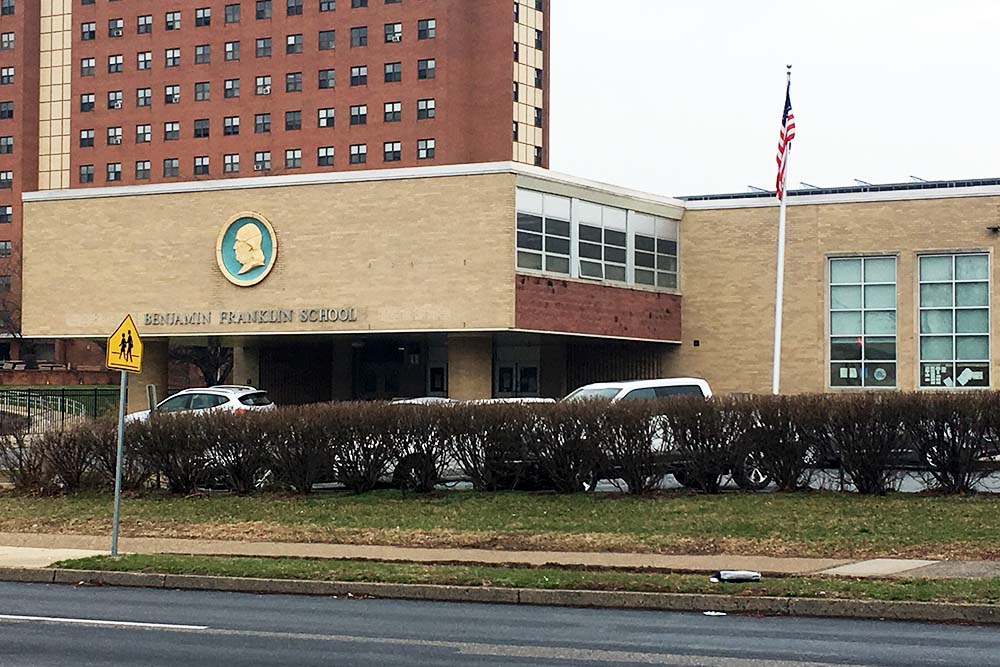
Benjamin Franklin School scored highest among Harrisburg’s elementary schools on an annual state assessment.

Most Harrisburg public schools continued to tread water for the past academic year, once again earning largely poor grades from the state.

District-wise, Harrisburg schools showed little improvement, but they also generally didn’t deteriorate further during the 2016-17 school year compared to recent years, according to the annual “School Performance Profile” released today by the state Department of Education.

“The ‘School Performance Profile’ scores released today provide school-level information to the public related to student achievement and progress,” said Secretary of Education Pedro A. Rivera.

Harrisburg High School attained an academic score of 44 out of 100 total points, identical to the prior year. The SciTech Campus showed more improvement, up to 76.2 points versus 73.2 last year and 61.2 the year before.

To determine academic scores, the state uses a variety of measures, including standardized tests such as the Pennsylvania System of School Assessment (PSSA) and Keystone exams. The scores follow a general academic scoring model with 90 to 100 considered to be excellent and below 60 considered to be deficient.

Other schools in the 6,227-student district scored as follows:

Marshall Math Science Academy: 78.3
Benjamin Franklin School: 60.8
Melrose School: 58.2
Foose School: 53.3
Scott School: 52.7
Marshall Academy: 49.8
Camp Curtin Academy: 45.6
Downey School: 45.5
Rowland Academy: 42.5

The yearly assessment includes a wealth of other data, including graduation rates. In that regard, Harrisburg High School showed a slight improvement, with a graduation rate of 55.8 percent last year, compared to 53.9 percent in 2015-16 and 52.8 percent in 2014-15.

Rivera said that this will be the final time the state uses the current methodology and “report card” grading system to determine school-level academic performance. Next year, the state will transition to what it calls a “Future Ready PA” index, which will use a dashboard approach to present school-level data and will feature a broad range of indicators, such as English language acquisition, career readiness indicators, access to advanced coursework and chronic absenteeism, among others.

Kirsten Keys, the Harrisburg school district’s spokeswoman, declined immediate comment for this story.

Continue Reading

Penalty Phase: Some Harrisburg residents have been assessed a late fee for a yearly school tax. They’re calling foul.

Annie Hughes

This past March, Annie Hughes received an unexpected tax notice at her N. 2nd Street apartment in Midtown.

It was from Keystone Collections Group, and it told Hughes that she was delinquent in paying the occupational assessment tax, a flat annual tax assessed by the Harrisburg School District, for 2016. In addition to the $120 base rate, the notice said she would have to pay an additional $50.20 in fees and penalties.

“I didn’t even know that such a tax existed,” Hughes recalled recently, adding that the delinquent notice was the first time she learned she even owed it. “If I had gotten the first bill, I would have immediately paid it.”

Hughes called the company. A representative told her that they had sent the original bill in July 2016, but Hughes was certain she had never received it. She had moved to her apartment in October 2015 and had paid local income tax, also collected by Keystone, the following February. For that reason, she believed Keystone would have had her correct address by the time of the July mailing.

Around this time, Hughes saw that a neighbor, Timi Lesperance, had posted in a Midtown Facebook group about the same issue—she, too, had received a delinquent notice but no initial bill. In the comments, residents quickly began chiming in with complaints of their own. Soon, they learned of more than 30 neighbors who said they had never received their original tax bills.

Both Hughes and Lesperance eventually sent Keystone a check for the base tax, along with a note saying they were contesting the late fees. They also filed consumer complaints with the state attorney general. Then, in April, they went to a school board meeting and requested that the district investigate the situation.

In May, after the attorney general’s office had forwarded their complaints, a lawyer at Keystone named Michael Mazzella sent formal letters of explanation to Lesperance and Hughes. The letter claimed that original bills had been mailed the previous summer (Keystone enclosed a “reprint” dated July 2016) and that nothing had been returned to the company as undeliverable.

The letter also claimed the company had performed an “internal audit” of “accounts that were mailed from various trays of mail.” The audit showed that some residents had paid their bills in a timely fashion, Mazzella wrote, which “further proves that letters were sent in July.” The letter concluded by asserting that the fees and penalties were valid and demanding payment within 30 days.

Frustrated, Hughes and Lesperance both decided to pay the full amount, while still holding out hope for further action from the attorney general or the school district.

“I ended up, in the interest of a constable not showing up at my house, paying that $50,” Lesperance said.


Problematic

While going through this process, Hughes and Lesperance wondered: Where does that $50 late fee end up anyway? According to the district’s contract with Keystone, it seems that the two entities share it.

A $12 “statutory penalty” goes to the district, and a $13.20 “cost of collection” appears to go to Keystone (the contract language is somewhat vague). It’s unclear from the contact who gets the biggest piece of the pie—a $25 “late filing fee.”

All told, the school occupancy tax brought in $588,000 for the district for 2016 through Jan. 15, 2017, according to the district, responding to a right-to-know request.

Matt Krupp, the chair of the school board’s budget and finance committee, described the missing notices as a real concern for residents. He said it was “problematic” that the administration had not provided an answer to his committee since residents brought it to the board’s attention last April.

“We’ve repeatedly asked that the administration look into it and make sure it’s just an isolated incident,” Krupp said. “It’s unfortunate that it’s five months later and we’ve gotten no clear answer as to what, if anything, the district has learned from Keystone on this issue.”

In the meantime, the missing notices remain unexplained. Karen Mazurkiewicz, a spokesperson for the postal service, said that neither the consumer affairs nor business mail entry units reported any concerns about a mailing from Keystone in July 2016.

And according to Joe Grace, director of communications for the state attorney general, the office has not taken any action against Keystone. However, Grace directed any consumers who feel they have been victimized to contact the consumer protection bureau.


About Fairness
According to its website, Keystone Collections Group has been collecting local taxes in Pennsylvania for 30 years, bringing “integrated state of the art technology and unparalleled industry knowledge” to the field of municipal and school tax collection. The company has collected local income taxes in Dauphin County municipalities since 2012, including in Harrisburg.

In late 2015, the school district approved a contract to switch from its prior collector of the occupational assessment tax to Keystone, citing an initiative in the school’s fiscal recovery plan to improve collections. The contract provided that Keystone would be paid at the rate of $1 per bill issued, plus postage.

According to school board meeting minutes, the district believed that Keystone’s access to employment information from income tax collection would help it locate taxpayers.

Keystone declined to make a representative available to be interviewed for this story. In response to emailed questions, the company provided a one-page statement explaining that it had developed a “comprehensive” mailing list in 2016 that formed the basis of its initial mailing that July.

The company then sent delinquent notices after cross-checking payment data with the original list. “Every taxpayer name on the delinquent list came directly from the original mailing,” the statement said.

Keystone also said that the district had hired it to “bring efficiency and compliance to its occupation tax administration” and that, before 2016, “occupation tax compliance was not strictly enforced in the District.” The company also noted that its penalties and fees are authorized under state law.

Hughes doesn’t dispute Keystone’s legal authority, but just wants to make sure the company is assessing penalties fairly. To that end, she has one critical piece of advice for Harrisburg residents—make sure that you’ve received your 2017 occupational assessment tax bills, which the company says were mailed in July. If you haven’t, call Keystone Collections to pay it.

Keystone does encourage payment online. However, paying the school occupational tax online requires an invoice number, which presents its own confusion. After all, if residents have not received an invoice, they will not have an invoice number to input, so will not be able to pay the bill through the company’s website.

Hughes added that she did receive her 2017 bill on time, but knows several people who say they have not. The penalty period for the tax begins in November. The penalty starts at $12 through December and escalates to $50 next year.

Ultimately, for Hughes, the issue has less to do with the legality of the penalties and more to do with fairness.

“Penalties can be fair, but they need to be based in reality,” she said. “This wasn’t the residents’ fault, and they shouldn’t be charged a penalty.”

To make a payment, call Keystone Collections at 717-978-0300. If you have an invoice number, you can pay online at www.keystonecollects.com.

Continue Reading

Ground Game: Harrisburg mayor makes pitch for new composting site.

Harrisburg Mayor Eric Papenfuse last night led a discussion at the location he hopes will become the city’s new composting site.

City officials outnumbered residents at a meeting in Susquehanna Township last night, as Mayor Eric Papenfuse once again made the case for building a compost site on land in the township borders.

The meeting was held at 1850 Stanley Road, where the city wishes to build a five-acre facility to compost lawn and tree waste. Speaking to residents from the edge of the property, which is owned by the Harrisburg School District, Papenfuse sketched the boundaries of the proposed project and answered questions about its operation.

The proposed facility would consist of a macadam surface beneath piles of decomposing leaves. The only on-site equipment would be a wood chipper, which would process large trees and branches, and a wind turner, which would churn the leaf piles once a month to promote decomposition.

Papenfuse was joined by members of the city’s Public Works Department, who would drive the trucks used to transport waste from the city to the compost site. They promised to develop traffic patterns and operating hours that would have minimal impact on the nearby neighborhoods. Papenfuse also pointed out that the closest home to the facility was not in eyesight from the lot.

The site visit was the latest attempt by the city to win supporters for the composting project, which many township residents protested when it was first proposed in April.

Since then, city officials have tried to shift public opinion by hosting open meetings and appearing at the Susquehanna Township commissioners meeting.

Norvella Mosley, a Harrisburg resident who lives close to the Stanley Road site, said on Wednesday that she’s warmed to the proposal since getting more information from the city.

“At first, I wasn’t for it, but now I’m wavering,” Mosley said. “Now, I think it’ll be a good thing.”

Mosley did say that the project shouldn’t exceed five acres. She and other residents want a clause in the final permit that will prevent future administrations from expanding it.

Papenfuse addressed concerns about the facility growing over time, saying that any expansion to the site would require a new permit from the state Department of Environmental Protection. He reiterated the city’s willingness to enter a 30-year memorandum of understanding with Susquehanna Township, expressing their shared intent not to expand the facility beyond five acres.

On Thursday, Papenfuse said that attitudes toward the project seem to be softening.

“I’d say we started out with 90 percent of people against the facility, and we’re closer to 50/50 now,” he said.

The city will organize a field trip to the Swatara Township compost site on Sept. 30, which will allow residents to see a lawn and leaf compost facility in action. After that, there will be another round of meetings before the city begins drafting a permit application.

Continue Reading

Harrisburg gains new teachers, but the numbers still don’t add up

Benjamin Franklin High School on 6th Street in Harrisburg.

The Harrisburg School District has reduced its district-wide teacher shortage since the beginning of the summer but still began the school year with 12 unfilled positions, according to a district spokesperson.

Kirsten Keys, public relations coordinator for the district, said that most of the vacancies are at the 9th to 12th grade level, specifically at John Harris High School campus.

At the start of the summer, the district had 40 vacant teaching positions. School officials intensified recruitment efforts by holding the district’s first-ever hiring fair, which took place July 13 at the Lincoln Administration Building on State Street. The event allowed district recruiters to interview more than 115 candidates in person and via video call. Keys said that the hiring fair ultimately brought the district between eight and 10 new teachers, since not all applicants who interviewed met state standards.

She said that the district considers the fair “a big success” and plans to host another in 2018.

Teacher shortages are a perennial problem among districts in Pennsylvania, where the number of graduates from teacher-training programs has declined in the past four years. According to data from the state Department of Education, the number of newly certified teachers has fallen from 16,631 in 2013 to 6,125 in 2015.

As the number of qualified teaching applicants has declined, retirements have increased as baby boomers age out of the workforce.

Pennsylvania schools can obtain an “Emergency Permit” from the state, meaning that if they advertise for a position and find no qualified applicants, they may hire an applicant who has not obtained a Pennsylvania teaching certification. The candidate must have earned a bachelor’s degree from a state-approved college or university and must meet all other eligibility requirements, according to the Department of Education website.

Keys said that the district currently employs 28 teachers who were hired under an emergency permit. They will fill other vacant positions with short- or long-term substitutes that they find through a professional substitute agency.

Staffing a school doesn’t end with the recruiting and hiring process, however. Harrisburg schools have struggled in the past with teacher retention. More than 50 employees resigned last year, despite a new, district-wide mentorship program meant to promote retention.

Author: Lizzy Hardison

Continue Reading