Tag Archives: David Morrison

Layers of Flavor: Phyllo draws Greek food fans to the Broad Street Market.

Like the phyllo dough that Katerina Ntzanis works with to craft her Greek specialties, the story of how she decided to embark upon a culinary career consists of many layers, but in the end, it’s all been built on family.

The young chef arrived in the United States at the age of 4 and, shortly afterwards, developed a keen interest in her mother’s culinary skills.

“Throughout my years in school, I paid close attention to what she was doing in the kitchen,” she said. “Everything she made was amazing.”

For Ntzanis, cooking became synonymous with nurturing, love and comfort as she learned various techniques. By the time she reached adulthood, her path was clear. Soon, she was honing her cooking chops at the prestigious International Culinary Center in New York. As part of the program, she also had the opportunity to work at L’Ecole, a restaurant run by the center.

After she completed the program, Ntzanis stayed in New York for a time and worked at a restaurant called Park Avenue Seasonal before returning to the Harrisburg area.

“I moved back because the restaurant was relocating, and I wanted to start something of my own,” she said.

By investing her time and talents in Harrisburg, she is following in the footsteps of other family members. Her father Thomas and brother Sotirios operate the Midtown Tavern on N. 2nd Street.

Her attractive and spacious stand in the stone market building serves the needs of the crowds who flock there.

“We have a convection oven, a fryer, a char broiler and a four-top stove,” said Ntzanis, who is joined by her mother Anna and cousin Vasoula Tsandopoulou in whipping up signature Greek dishes. “My favorite part of the business is working with my family. I feel like I’m at home here.”

The family’s extended network also pitched in to make Phyllo a reality.

“One of my father’s friends built the stand and put in the gas line, the water line and installed the hood system,” she said.


Greek to Me

For those uninitiated in Greek cuisine, Phyllo is there to help.

Several laminated sheets—emblazoned with a simple question, “What is that?”—are placed on the counter so customers can peruse the contents of dishes like horiatiki (red onion, bell pepper, feta, kalamata olives, tomato, cucumber, oregano and olive oil) and the popular spanakopita (“phyllo with filling of mama’s blend of greens and feta”).

“A lot of people are looking for a home-cooked meal, and we provide that, making everything from scratch,” said Ntzanis.

Phyllo also offers a mix-and-match souvlaki skewer option. Customers can choose chicken, pork, lamb or a vegetable mixture of zucchini, onion, pepper and mushroom and pair the skewers with sauces like tzatziki (Greek yogurt, cucumber, garlic, red wine vinegar and olive oil), melitzanosalata (pureed eggplant, garlic, parsley, balsamic vinegar and olive oil) and tirokafteri (described as “ricotta with mama’s spicy blend”).

Daily specials vary and range from dishes like the savory moussaka made with meat sauce, eggplant and béchamel, a baked pasta dish known as pastitsio and a soup called avgolemono, which contains chicken, rice and a lemon egg foam and is guaranteed to warm the insides of patrons during the cold winter months.

As for sweets, the honey-laden, phyllo-layered crowd favorite baklava is a mainstay on the menu, with other Greek desserts making the occasional appearance to keep things interesting.

Customer Nora Noone said the baklava was just one of the offerings that drew her back to the Broad Street Market.

“I also like souvlaki, but hadn’t visited the market for about 10 years,” said the Mechanicsburg resident, who remarked on the portion size of the popular dessert. “They give you a huge triangle, especially compared to what you get at other places.”

Valerie Osipov, also of Mechanicsburg, visited after the opening in December.

“I ordered the souvlaki with the pita bread, and we tried an assortment of dips,” she said. “I think she’ll be very successful.”

David Morrison, acting executive director of Historic Harrisburg Association, said that his recent experience was very positive.

“Phyllo played a crucial role in our Candlelight House Tour,” he said. “They set up a pop-up pastry stall and provided finger food that was excellent.”

“I saw people from the tour visiting our stand after that,” said Ntzanis.

She said she’s excited to be part of a market that is experiencing a renaissance, thanks to an influx of new vendors and growing attractions in Midtown Harrisburg.

“I chose this market specifically because I enjoy the diversity, and I want to be part of the Midtown community,” she said with a smile. “Because I love what I do, I feel like I’m not even working.”

Phyllo is open for lunch and dinner during regular Broad Street Market hours. Visit their Facebook page: Phyllo.

Continue Reading

Mansions & Memories: Historic Harrisburg’s Candlelight Tour to showcase Front Street’s finest.

Screenshot 2015-11-23 16.22.41

Grab your warmest sweater, a steaming thermos of coffee and a comfortable pair of walking shoes. It’s time for Historic Harrisburg’s 42nd annual Candlelight House Tour.

“Grand Impressions” is the event’s theme, a fitting name as this year’s treasure hunt will focus on Front Street’s finest homes, businesses and other historic structures—all dressed up for the holidays—that have been transformed in recent years.

The Candlelight House Tour began in 1973, the year that Historic Harrisburg was founded. At the time, the city was emerging from the devastating flood brought on by Tropical Storm Agnes that sparked conversations about demolishing the entire Shipoke neighborhood.

Each year since has featured a geographical theme, focusing on certain neighborhoods that continue to be revitalized and loved.

“This seemed like the year for Front Street,” said David Morrison, acting executive director of the Historic Harrisburg Association.


Something Special

In recent years, Front Street has enjoyed a mini-renaissance.

Once the favored address of the city’s magnates, the street’s grand houses and mansions went into prolonged decline starting with the Great Depression. By the 1970s, many had been turned into hospitals, group homes and unkempt office buildings, the street itself becoming a three-lane commuter highway.

But things are changing quickly. Increasingly, these landmarks are being renovated and repurposed, some even reverting to single-family homes. This year, the road itself was returned to two lanes, for the first time since the 1950s.

The tour includes a variety of Front Street buildings, including the DuChant Mansion, Temple Beth El, City House Bed and Breakfast and the Dauphin County Courthouse. It also features some private homes, including the former “Teen Challenge” building that is now the private residence of J. Marc Kurowski.

Kurowski explained that, a few years back, several men bought the property from Teen Challenge to turn it into apartments. Partway through the demolition, they decided to sell it instead. That’s when it caught his eye.

“I love the idea of residential properties on Front Street,” Kurowski said.

After living in Midtown for 15 years, he started looking for a waterfront property, but it took some time before anything grabbed his attention. While he originally planned to live in half of the house and rent the other, he quickly fell in love with the architecture of the 1890s home.

While the inside features many modern conveniences, Kurowski tried to maintain the historic feel of the home on the outside. Perhaps his favorite addition is the roof deck that provides him with space to host parties and fundraisers. It’s also a great escape. Sitting so high up blocks out most of the street noise and gives him beautiful views of the Susquehanna River.

Kurowski noted that a friend suggested he showcase it in the Historic Harrisburg tour.

“I tried my best to create something a little special so that other people could see it and enjoy it,” he said. “I want people to see this and know they can do it, too.”


Great Place

Robin Schuldenfrei, a co-chair of this year’s tour, opened up her home in Bellevue Park last year.

“People were just lovely,” Schuldenfrei said of the experience. “They were respectful and polite. And I think they appreciated that, as a Jewish family, we decorated our home for Hanukkah rather than Christmas. It made it a little different for them.”

More than 500 people walked through the house that day, but perhaps the most unexpected guest arrived long before the tour was set to start. One of the former owners heard about the tour but was unable to make it later in the day. Schuldenfrei and her husband gave them a quick tour and learned much of the family’s sentimental history, including the fact that two daughters who grew up there also had their weddings in the home.

“We met neighbors we didn’t know, we made new friends, and we learned more than ever expected,” Schuldenfrei said. “It was exhausting, but it was worth every moment.”

Jeb Stuart, another tour co-chair, has participated for the past 35 years, both as a volunteer with Historic Harrisburg and a homeowner. He first showed a Green Street home he bought straight out of college. His current Front Street home was on the tour in 2009.

“We really want to showcase how livable Harrisburg can be,” Stuart said. “We’ve featured scattered homes on Front Street before but never the street as a whole. There’s so much going on here that it seemed like the time to do it.”

Whether people are wandering into a place of worship, school, home or office space, Front Street has become a diverse place with a lot to offer, he said. The tour not only gives residents and visitors a chance to see these buildings up close, but it offers a chance to understand the city’s history and its future.

“There are tremendous improvements being made in this city nearly every day,” Stuart said. “We want to celebrate that and thank the people who have helped make Harrisburg such a great place to live.”


Historic Harrisburg’s “Grand Impressions: A Tour of Front Street” is set for 1 to 6 p.m., Sunday, Dec. 13. Tickets are $20 in advance or $25 the day of the tour. More information about where to buy tickets can be found at www.historicharrisburg.com or by calling 717-233-4646. Tickets can be picked up the day of the tour at the Troup Mansion, 3511 N. Front St.

Photo by Robin B Schuldenfrei | CAVU Creative

Continue Reading

Structural Assets: Architectural exhibits rise in Harrisburg.

Photo by Elizabeth Stene

Photo by Elizabeth Stene

Throughout history, says Carrie Wissler-Thomas, humans have “designed structures to live in and to work in and have always enhanced them with visual arts.”

“Art and architecture,” says the Art Association of Harrisburg president, “flow together.”

This fall, Harrisburg’s art and architecture don’t just flow together but collide in joyous profusion through a groundbreaking partnership among the Central PA Chapter of the American Institute of Architects, the Art Association of Harrisburg, Historic Harrisburg Association and Susquehanna Art Museum.

Together, the four groups are presenting programs and exhibits showcasing historic and contemporary architecture.

It began when SAM refashioned a classic bank building into its new Midtown home, which opened in January. The project included a large addition, not duplicating the bank design but holding a 21st-century mirror to the original edifice.

That project inspired SAM and AIA to develop “Towards a New/Old Architecture,” the exhibit that has become the four-group collaboration’s centerpiece. It spotlights historic Pennsylvania buildings given new life by contemporary additions.

While developing the exhibit, SAM staff would hold meetings with collaborative members and then head to meetings with architects at the construction site, says Director of Exhibitions Lauren Nye.

“It was very, very fresh in our minds,” Nye says. “We would go from that meeting and put our boots on and come down here with hardhats and talk about what we had just talked about.”

The complicated exhibit—“the most moving parts I have ever planned,” says Nye—features giant, gallery-quality photos of 12 projects, including the instantly iconic Andy Warhol Museum in Pittsburgh, the revitalization-sparking CODO 241 in York, the apocalyptic Levitt Pavilion at Arts Quest in Bethlehem, and a cantilevered home hovering over a Pittsburgh art glass factory. In specially designed light tables, photos and images reveal the evolution of each project.

The overall effect spotlights “the inherent art in the architecture,” says Nye.

“It gives people ownership of the spaces they live in,” she says. “It gives you a new reason to visit a space you may not have before, to come to a neighborhood that is growing, and care about not just tearing something down because it’s old but thinking about how you can use what is good there, and use additions to make it a workable space that people will thrive in.”

On Board

Harrisburg architect Chris Dawson, whose own Hershey Fire Station is in the exhibit, worked with SAM to select exhibit-worthy projects and images that tell stories of transformation.

A successful contemporary addition might purposely contrast the historic space, “but that doesn’t mean it’s a free-for all,” says Dawson. “You have to take cues in scale and proportion.” In the Harrisburg area, “we have these beautiful, under-utilized buildings in our midst, and to have people look at them with fresh eyes was part of our intention.”

Historic Harrisburg Association, long known as a bulwark against bulldozers, is all on board with that, says Executive Director David Morrison.

“The SAM exhibit definitely conveys a vivid message about how old buildings can be transformed and added to,” says Morrison. “The SAM building itself is the perfect example, having received HHA’s 2015 Preservation Award, and then adjoined by a 21st-century sleek, modern, state-of-the-art museum.”

HHA is showing its collection of drawings by 20th-century Harrisburg architect Clayton Lappley, designer of such landmarks as Riverview Manor, John Harris High School and the Moose Lodge temple now slated for a mixed-use renovation by WCI Partners. The news that SAM was planning an architectural exhibition inspired HHA to display its Lappley collection, donated after they were found in the basement of Riverview Manor during restoration.

Quiet Fashion

The snowballing of SAM’s exhibit into a four-way collaboration among arts, architecture and history organizations is “unprecedented, completely unprecedented in terms of the scope of the undertaking,” says Morrison.

“By having four organizations simultaneously present architectural-themed exhibits, it has enormous impact on the viewing public to gain a greater understanding and appreciation of art, architecture and the professions of artists and architects,” he says.

The Art Association of Harrisburg’s involvement created a platform for “all kinds of wild and crazy interpretations” of architecture and structure in its exhibit, “Structures II,” says Wissler-Thomas. There are a whimsical, found-objects rendering of the state Capitol, stainless steel sculptures, a “charming” sculpture of two floating squirrels, and a twig-bamboo bird’s nest construction titled “Christopher Wren” (get it? Look it up for a little architectural history).

“Structures II” will be followed by “Architectural Visions,” an invitational exhibit where architects and artists show their skills in sculpture, photography, painting and other media. Wissler-Thomas hopes the shows—AAH’s and the others—open visitors’ eyes to the artistic value of architecture, “one of the highest form of visual arts because it combines the ability to draw and to see spatially and create three-dimensional reality on a huge scale.”

“All these shows really show how artistic, how visually skilled these people are,” she says. “They don’t just work on a computer and come up with some model of blocks you stack up to make some building. They really have a huge visual sense.”

Arts groups frequently collaborate in quiet fashion, but the joint architecture celebration puts “the fruits of our labor” before the public eye, says Wissler-Thomas.

“I would hope that the general public would come out with a more abiding appreciation for the beautiful architecture that surrounds them, and the feeling that it’s not something you just work in and live in,” she says. “It’s something you should look at and appreciate.”

For information on the exhibits and related events, including lectures, classes and walking tours, visit www.sqart.org, www.historicharrisburg.com and www.artassocofhbg.com.

Continue Reading

Harrisburg Zoning Board Approves Moose Lodge Conversion

WCI Partners may be interested in converting the historic Moose Lodge into a mixed use project.

The historic Moose Lodge in Midtown Harrisburg

The landmark Moose Lodge Temple in Midtown Harrisburg took a step closer to revival and reoccupation tonight, as the city’s Zoning Hearing Board approved a plan to renovate it as mixed-use space.

The board unanimously granted a variance to WCI Partners LP for 33 apartments on three upper floors with commercial space on the ground floor. WCI needed the variance because the size of the apartment units, about 500 square feet apiece, is less than the 1,200-square-foot size permitted under the zoning code for the 900-block of N. 3rd Street.

WCI President David Butcher told the board that the apartment sizes needed to be small due to beams that run vertically through the building, limiting design options. He also said the project would not be economically feasible without the apartment density.

Board members seemed skeptical that WCI could not create a floor plan to accommodate larger units. However, they voted in favor of the variance largely because they want to see the building redeveloped, as it has sat empty and increasingly blighted for a decade.

“This case is a case that must recognize the reality of the facts in this neighborhood,” said board member Thomas Leonard. “The reality is that this property has been vacant for 10 years.”

Leonard also cited a lack of community opposition. Several community organizations in Midtown submitted letters supporting the project, and David Morrison, the interim executive director of Historic Harrisburg Association, spoke in favor of it before the board.

Butcher assured the board that the apartments, while small, would have high-end finishes that would appeal to young professionals. He estimated that the units would rent for around $1,000 per month.

WCI is purchasing the four-story building at the corner of N. 3rd and Boas streets for $900,000 from Atlanta-based Mosaica Education, a for-profit charter school company that is in receivership.

The purchase includes several adjacent parcels of land—three dilapidated townhouses and a 40-vehicle parking lot. Butcher said that WCI also plans to renovate the townhouses into apartments and retail space and would landscape the area around the parking lot to make it more attractive.

Harrisburg City Council now must approve WCI’s land use plan. If all goes smoothly, the project should start by the end of summer with completion expected in 12 to 18 months, said Butcher.

For five years, the former Moose Lodge housed the Ronald Brown Charter School. However, the building has been empty since 2005, when the school district’s board of control refused to reauthorize the school’s charter.

The Harrisburg Moose Lodge Temple was built in 1924, designed in the Beaux Arts style by renowned Harrisburg architect Clayton J. Lappley.

Disclosure: Alex Hartzler, publisher of TheBurg, is a principal with WCI Partners.

Continue Reading

Agency To Seek Buyer For Historic Downtown Homes

The houses at 110 and 112 Locust St. slated for demolition, which could date as far back as the 1820s.

The houses at 110 and 112 Locust St. slated for demolition, which could date as far back as the 1820s.

A pair of historic homes downtown on Locust Street may avoid demolition after all, as the Pennsylvania Housing Finance Agency, which proposed tearing them down earlier this month in a bid for more office space, has lowered the price for someone to take them off the agency’s hands.

In a meeting at PHFA’s Front Street offices last night with preservationists and neighbors, the agency agreed to offer the attached clapboard homes for $150,000, a bit below the $175,000 figure Brian Hudson, PHFA’s executive director, had cited at a planning commission hearing last week.

At that meeting, commissioners urged the agency to meet with members of Historic Harrisburg Association and Capitol Area Neighbors, two groups whose members spoke vigorously in opposition to the demolition during a presentation on the agency’s proposal.

PHFA, which says it has outgrown the eight-story office building it has occupied at Front and Locust since 2004, sought to demolish the homes to clear the way for a new 12-story, 160-foot office tower adjoining its existing structure.

Preservationists and neighbors objected to both the design of the tower and the destruction of the two homes, which are among Harrisburg’s oldest extant residential buildings, likely dating to the early 19th century or perhaps even earlier.

The agreement to seek a buyer “by no means makes all this a done deal,” said David Morrison, HHA’s interim executive director. The neighbors and his group still have concerns about whether the proposed new tower will be compatible with other buildings in the riverfront neighborhood, a historic district, he said.

The agency, for its part, has said that the Locust Street homes sat on the market unsold for three years before they finally purchased them last May for $140,000.

Hudson also noted that PHFA, though tax-exempt as a state-affiliated agency, makes annual payments-in-lieu-of-taxes to the city each year of nearly $100,000, and would continue to do so on any new building built under the proposal.


Continue Reading

Charity for All: Over the years, Harrisburg has invested millions of dollars in the National Civil War Museum. The city’s new mayor now asks if the price is worth it.

Screenshot 2014-08-29 09.27.41Every Wednesday morning at 10 a.m., three men who control a $230 million annual budget meet on the fourth floor of a brick building downtown, across Market Street from city hall. Their meeting room is circular, with wood paneling and brown-and-khaki carpet, and a peculiar assembly of light fixtures hanging from the ceiling. The men sit at one end of this room on a dais, in high-backed, maroon leather chairs, and listen as people take turns approaching a table below.

Often, the petitioners are there to massage their relationships with these men, the Dauphin County commissioners—either to thank them for past support or to ask for future money. But, on the morning of July 30, Harrisburg’s new mayor, Eric Papenfuse, attended the commissioner’s meeting with a different sort of request. Six years prior, in 2008, the commissioners had increased a tax on visitors who stay in Dauphin County hotels. Under the ordinance, a portion of the new revenues from the hike was designated for promoting tourism in Harrisburg. But, under a set of separate agreements signed by the city (Papenfuse, speaking to press after the hearing, called them “quiet, secret deals”), most of the money, for years, had been going to one place: the National Civil War Museum.

Opened in 2001, the Civil War Museum is the crown jewel of former Mayor Stephen Reed’s campaign to draw visitors and renown to Harrisburg by way of a network of cultural institutions. Perched atop a hill in Reservoir Park, the museum commands a view of the city and, to the north, the valley cutting through the mountains. It houses a massive collection of period artifacts, most of them city-owned, among them a gauntlet that had been worn by the Confederate General George Pickett and a Bible owned by Robert E. Lee.

Despite the quality of its collection, and despite its relative proximity to Gettysburg, the museum has struggled to grow the visitor base that was envisioned at the time of its creation. According to figures provided by the museum, annual attendance has never surpassed its first-year peak, of more than 96,000. The total fell every year for the next eight years and has hovered between 38,000 and 41,000 for the past five. (Gettysburg, by contrast, draws 3 million people per year.)

Seated at the table in front of the commissioners, Papenfuse, in characteristically breathless fashion, asked them to freeze the museum’s hotel tax funding. The museum, he argued, was absorbing money that was meant for marketing the city as a whole. Furthermore, the museum only paid the city $1 of rent per year, on a property with a fair market rental value of $633,000, to say nothing of the value of the artifacts on loan inside. The agreements that allowed the museum to do these things, Papenfuse said, had been undemocratically extended in the final months of the Reed administration—one of them all the way out to 2039.

“I think it is time that we recognize that we have spent millions and millions of taxpayer dollars to subsidize this museum,” he said. “We’re not only talking about the costs of building the museum and, you know, the subsidy here for tourism, but we’re talking about moneys we’ve paid to subsidize the health care of the employees over time, staffing, operational expenses. Every time we put money in a parking meter, the public should understand that we are essentially paying back the debt that was incurred for the creation of that museum.”

Outside the hearing, however, Papenfuse went further. “It’s outrageous,” he told the reporter James Roxbury, who had asked about the long-term agreements. “And I think that it’s time we end what is essentially a failed experiment and begin to move towards a redeployment of those assets. If something else moved into that building and were able to contribute rent to the city of Harrisburg, we could use those funds to fix potholes and do all the things that we’d like to do in the city of Harrisburg. If we sold the artifacts, that would be millions more dollars that the city could have to be able to invest wisely.

“I don’t think the public supports the museum, I don’t think the museum caters to the city,” Papenfuse went on. “I think, from its advertising materials alone, you can see that it could be located anywhere in the country. It doesn’t promote Harrisburg in any way.”


“The idea was to have five nationally scaled museums,” Reed said.

He was speaking to David Morrison of the Historic Harrisburg Association, who was interviewing him as part of an oral history project in 2010. The project, sponsored by Highmark Blue Shield, was created to help celebrate the 150th anniversary of Harrisburg’s incorporation. But it also happened that the city’s sesquicentennial coincided with Reed’s departure from office, after a reign of 28 years.

In the interview, video of which is still available online, Reed conveys an air of bemused resignation. Only two of his museums ever came to be, and his opportunity to realize the others had passed. Nonetheless, he waves aside critics of, for example, the National Museum of the Old West, “who were empowered by the Internet and constantly blogged and bad-mouthed it.” Then he lays out the scope of his vision—to have the museums commemorate what were, in his view, “the three most significant events in American history, aside from the American Revolution itself”: the Civil War, Westward expansion and World War II.

“If Harrisburg, Pa., was a place to go in the golden triangle region of tourism in the east coast, east of the Mississippi, where you can learn about all those things, can you imagine how many people that would attract, and the economic benefits that would accrue to the local community and the jobs it would create? That’s what this was all about,” he concludes, sweeping his arms wide. “And some laughably dismissed it.”

By then, though, the vision had been more than laughably dismissed. Two of the museum concepts had ended in ignominy, with the waste of millions in public money. One of the concepts, for a National Sports Hall of Fame, languished without any apparent progress for years, until a 2008 investigation by CBS 21 reporter Jason Bristol exposed, among other things, that its director had no idea a similar museum had already opened in New York City. The museum commemorating the Old West, meanwhile, collapsed after City Council, facing a budget crisis, ordered the sale of millions of dollars worth of artifacts that Reed had quietly acquired over many years.

The means by which Reed purchased most of the Western artifacts was an account known as the City Special Projects Reserve Fund. Reed outlined his request for the fund in a memo dated Christmas Eve, 1990. It was addressed to the board of the Harrisburg Authority, the city’s sewer authority, which had earlier that year modified its charter to become a pass-through vehicle for bond financing. The fund would be filled with fees charged for administering the bonds and would be available for drawing upon at the discretion of the mayor. For two-and-a-half years, the Authority filled the fund with fees from a handful of clients: a few thousand here, a few thousand there, until, by September 1993, the fund held nearly $150,000.

At first, the mayor drew money from the account only rarely. In the summer of 1993, he approved an expense of $5,700, to reimburse the Authority for a full-page ad it had bought in an “Economic Profile” magazine. (The profile was published by the city, through the mayor’s Office of Economic Development.) Another $2,000 was sent to the city treasurer as a contribution towards a city open house.

Then, beginning in the spring of 1994, as funds kept rolling into the account, the city started to ramp up its withdrawals. In March, the mayor requisitioned $160,000 from the fund for deposit in a city account for capital projects. In September, the city withdrew another $20,000—$10,000 of it for Penn State, for consulting on the formation of an “alternative academy,” and another $10,000 for Big Brothers/Big Sisters of Harrisburg, for developing a mentorship program. In October, Reed committed $30,000 to the Center City News, newly re-launched as Harrisburg Magazine; unable to find all the money in the city budget, which he described in a personal letter as “seriously constrained,” he provided $15,000 out of the special fund.

Screenshot 2014-08-29 09.27.18The first mention of Reed’s museum vision in the special projects account occurred in December 1996, when Reed requested $30,000 from the fund for “professional services for the Sports Hall of Fame and War Museum.” Then, early in 1997, the artifact purchases began to be itemized. January 8: “1 Flintlock Mountain Man Pistol w/Map and 1 1896 Sheriff’s Pistol w/Holster,” $2,535. January 15: “one Walnut and Mahogany Veneered case 8-day Regulator Timepiece,” $8,500. The items evidently covered a wider range than the Civil War period, although, curiously, a May 1997 memo collects them under the heading “Civil War Museum.” Between January and May, the mayor spent $28,283 out of the fund on such itemized purchases.

In the summer of 1997, the spending took off. The checkbook register records purchases every few days: a major general’s kepi, a “fur-era trade pistol,” a Conestoga wagon. Between December 1998 and August 2002, the city withdrew more than $9 million from the fund, almost entirely for the purchase of artifacts. At times, especially in later years, Reed would ask the Authority to advance the fund cash from its other accounts, to cover additional artifact invoices until another bond issue closed and its fees could be collected.

The Civil War Museum’s collection is not exclusively bound up in the history of the special projects fund. By 1997, the city already had purchased most of the artifacts that would wind up filling the museum, and many of the purchases after 1998 were connected to the Old West. But the acquisitions for the Civil War Museum, like the others, had the same basic feature. They were purchased with public funds at the discretion of the mayor, who had set no apparent scope or limit on what he was acquiring.

There were people, though, who did speak up about the mayor’s use of the funds. One of them, in 2007, managed to get appointed to the Harrisburg Authority board, where he tried to pry open the records of the special projects account and hold them up for public scrutiny. His name was Eric Papenfuse.


Eric Papenfuse is a man of many personas. One of them, which became more developed in his mayoral campaign, is the sunny city cheerleader—the man with the toothy grin on the city website, who will bring a raft of volunteers to a press conference and will show up to a “brown bag” poetry reading in city hall with a sack lunch in tow. The other is the painstaking policy man, whose facility with budgets, contracts and legislation can lend his press conferences a classroom air.

But there’s another quality to Papenfuse that is less often seen from the podium. He can be fiercely, even stubbornly, adversarial. In April, a month after an unhappy meeting with the school district’s state-appointed recovery officer, he publicly called for the officer’s replacement. The state education secretary stood by the officer, who remained in his position. Nonetheless, three weeks later, Papenfuse raised the issue again, this time in an open letter to the secretary that accused the officer of having “watered down” the district’s academic standards.

Nothing seems to invite Papenfuse’s censure quite like the legacy of Mayor Reed. I learned of one example of this in June, after a former colleague at TheBurg, Dan Webster, published a lengthy article about Reed in his periodical, Local Quarterly. The article, which was based on an interview with the now-reclusive former mayor, included a claim that Reed’s manipulation of certain bond proceeds was “completely legal.” Papenfuse’s Midtown Scholar bookstore refused to carry the magazine. Papenfuse’s wife Catherine Lawrence, who is overseeing the bookstore in his absence, said later that the magazine was pulled from the shelves as a result of the store’s policy not to carry paid periodicals. But Webster and his photographer got a different impression when they met with the mayor at the store. According to the photographer, Papenfuse “repeated over and over, ‘I cannot allow the people of Harrisburg to think that what Reed did was legal.’”

In 2007, a faction within City Council overrode a veto by Mayor Reed, granting itself the power to nominate board members of the Harrisburg Authority. One of their nominees was Papenfuse, who, according to an affidavit that accompanied a lawsuit later filed by the administration, went directly to the Authority offices to demand copies of documents. What documents he requested, the affidavit doesn’t say, but it’s not hard to guess what he was after. In a video clip from October of that year, which is still available on Roxbury News, Papenfuse runs through Authority records of travel expenses reimbursed out of the special projects fund. They were incurred by a city employee, John Levenda, in connection with the pickup and delivery of artifacts. (Levenda, as it happens, was also the subject of Bristol’s 2008 investigation for CBS 21; he was the director of the non-profit Sports Hall of Fame Foundation, where he collected hundreds of thousands of dollars in salary and reimbursed travel expenses over the course of several years.)

In his public comments since his appeal to the county commissioners, Papenfuse has mostly focused on the best use of hotel tax dollars for the city. But it’s hard not to see his efforts as a kind of culmination of the path he started on years before his mayoral campaign. As a critic and a gadfly, he tried to call attention to what he saw as an illegitimate and abusive use of public money. As mayor, he seems to be going a step further—trying to actually undo it.


Two weeks after the mayor’s petition to the county commissioners, I met with Wayne Motts, the National Civil War Museum’s CEO, in his office above the gift shop on the museum’s second floor. Joining us were two board members—Rick Seitz, the current chair and the president of Alexander Building Construction, and Gene Barr, a past chair and the president of the Pennsylvania Chamber of Business and Industry, a business lobbying group.

Motts is a longtime museum man. His father, Warren, founded the Motts Military Museum in Groveport, Ohio. Wayne majored in military history and took a master’s in American history, and he has been a licensed battlefield guide, as he puts it, for “over a quarter century.” He most recently spent eight years as the executive director of the Adams County Historical Society. “There has never been a time, ever, that I haven’t been interested in the American Civil War,” he told me. His father used to read him excerpts from a Civil War diary, which he relates to the function of a museum—teaching history through contact with historical things. “My main interest is because I had a connection with the real artifact, which is what we’re doing here.”

Motts joined the museum board in 2009 and was named CEO in 2012. His predecessor, David Patterson, a former management consultant for the national YMCA, had hoped to bring his business experience to bear on the museum’s declining visitor base. But, when he left, in 2011, the dues were flat and annual attendance had dropped by several thousand. Motts, it was hoped, would improve on that record, combining museum experience with a manifest enthusiasm for Civil War history. “I don’t think there’s a better person for that position,” one Civil War artifact dealer told me.

Motts spends much of his time traveling the country, spreading the word about the museum at conferences and Civil War roundtables. He is an emphatic speaker, with a wide repertoire of punctuating gestures and a rural-flavored voice that breaks on occasion. Earlier in July, he gave a speech at the Gettysburg Foundation’s Sacred Trust Talks, where he spoke about the importance of preservation, highlighting several objects from the museum’s collection. “What if Ford’s Theatre was a Target store? Let’s talk about it. Our understanding of the war would be greatly diminished. Our empathy for it, our connection to it, would be reduced if we did not have those things.”

In his talks, Motts relies only scarcely on notes, but, when we met, he brought along a couple of pages of talking points about the museum’s position in recent years. He cited the attendance figures—around 40,000 per year for the past five years, which he described as a “very even keel.” Mayor Papenfuse, in his statements about the museum, suggested that the opportunity for growth had come and gone. The recent sesquicentennial of the battle of Gettysburg, which brought a renewed focus to the Civil War, appears to have only won the museum a few thousand additional visitors. Motts was sensitive to this. “Everybody always asks, are we satisfied with that? And the answer is no!” he said. “Every day, we’re thinking about, ‘Well, what can we do to maybe get more folks in there?’”

One of the central questions in the museum debate is whether the museum provides enough of an economic benefit to justify the public support it receives. The hotel tax is meant to create a virtuous cycle—money from tourists goes to sustain the things that will attract more tourists. Accordingly, Motts and his staff have conducted their own analysis and come up with a ballpark figure for the museum’s economic impact on the region. Relying on data they collect from visitors, and using a formula from an annual impact study commissioned by the state, they determined that the museum produces $5.7 million of spending in the region each year.

It’s a problematic figure. Motts, who said he removed student visitors from the calculation, suggested it was a conservative estimate. But he also acknowledged that the data he collects doesn’t distinguish between money tourists spend within the city and money they spend in neighboring municipalities. It may seem a small point, but it’s really the crux of the issue, because the museum’s hotel taxes come from what is designated by the county as the city’s share. It’s the share that gets spent on things like this year’s “Summer in the City” campaign. Papenfuse would like to spend more money on these sorts of campaigns, but he can’t—under the long-term contracts, nearly $300,000 of the city’s portion goes directly to the museum.

If the museum provided a regional economic benefit, didn’t it stand to reason that it should draw on the regional, rather than the city, portion? When I asked Motts and the board members about this, though, they objected to the notion that the city had any claim on the money. “It’s not the city’s pool,” Motts and Barr said in unison. “The city has their own funds,” Motts added.

Motts and the board went to some lengths to establish that, even though the funding is countywide, the museum provides an unquestionable benefit to the city. Papenfuse, in the course of his critique of the museum, had suggested that it had no meaningful impact on city tourism at all—he provided a map showing that the building was not even located in the city, but in Susquehanna Township. But Motts said the link between museum and city was beyond doubt. He produced the most recent issue of the Civil War Monitor, a seasonal magazine, in which the museum had taken out a full-page ad. “You can see what’s here,” he said. He pointed to two words in the advertisement: “Harrisburg, Pa.”

There is also a case to be made for the museum that transcends economics. At one point, Barr, who has worked on transportation issues, compared museums to mass transit. “A lot of people say, ‘Don’t fund mass transit, because it’s not self-sufficient.’ And in reality, there’s not a single mass transit system in this country that is self-sufficient. But people believe it’s important because it’s part of the fabric of the community.” In a similar fashion, places like the National Civil War Museum were “part of the culture of a community.”

The museum may be part of the city’s fabric, and it may also draw at least some of the outside interest and prestige that Reed had envisioned. But it’s difficult to assess whether the benefits really merit the price—especially because neither the museum nor the public seems to have ever completely reckoned with what that price was. Motts provided me with a 2012 article by the president of the American Association of Museums, which details the breakdown of revenue streams for museums in the United States. The average American museum, according to the article, receives 25 percent of its funding from the government.

That’s not terribly far from the museum’s current proportion of government support. Last year, the hotel taxes it received under the city agreements represented around 26 percent of its $1,109,128 in revenues (although, if you count other grant support, the amount climbs closer to 40 percent). The trouble is that the museum has required such support from the beginning, and, in the early years, the proportion was even higher. According to its 2003 federal tax form, for example, revenues identified as “government grants” accounted for 58 percent of its budget. In 2005, the figure was 64 percent.

I asked Motts and the board members if they knew where these funds had come from, since the tax forms don’t disclose the government sources. It had happened before their time, they said, and they didn’t know. (I subsequently requested the museum’s audited financial statements, but the museum declined to provide them.) I also showed them a printout, provided by the city’s budget office, detailing payments directly from the city to the museum between 2000 and 2008. They included several large grants, a few short-term loans, and regular monthly advances, ranging between $5,000 and $10,000, out of the city’s direct share of hotel tax funds. They added up to more than $1.2 million.

Again, Barr and Seitz didn’t know the full details of the payments, though Barr believed several of them were the city’s contribution to health insurance for museum employees, a practice that had since ended. “Look,” Barr said finally. “The reality is Steve Reed wanted to create this. I mean, yeah, we’ve had all those debates. Steve Reed wanted, I think as he termed it, a critical mass of museums to get more and more people here. That’s what Steve Reed wanted to do. Steve Reed has been gone now for quite a while. And the rest of us are left here, pushing along, trying to make sure that we make this the best possible facility we can.”


A few days after his announcement to the commissioners, Papenfuse went on a two-and-a-half week vacation. In his absence, people speculated on exactly what he wanted to achieve. His comments to the media had suggested he would like to see the museum closed, its artifacts sold off to provide the city with cash. He had even floated the idea that the building might be a suitable site for city hall. The dispute began to take on an all-or-nothing quality—either the county would let the museum continue with the status quo or the mayor would liquidate it completely.

But the extremes left some wondering if there might be a middle road. I spoke with Jeb Stuart, a former board secretary at the museum who has worked on tourism and development in the region for the better part of 30 years. Through the last decade of the Reed administration, he was a full-time consultant to the city, overseeing projects like the directional signs and placards that identify heritage sites across Harrisburg.

Stuart was pushed out of the museum board in 2008, at a time when new leadership, responding to the Western artifact fiasco, sought to put some distance between the museum and city employees. But he has maintained an active interest in the city’s Civil War heritage, and he still believes the museum could serve as a vital link in the region’s offerings. Several years back, the state launched a “Civil War Trails” initiative, mapping out road trips that visitors could take from one heritage site to the next. (The Papenfuse administration’s tourism director, Lenwood Sloan, worked closely on the project.) Harrisburg, Stuart said, formed a perfect bookend for one such trail, running north from Gettysburg and culminating at the museum. “The Civil War Museum has always kind of been the anchor,” he said.

He asked me to open Google Earth on my computer. We zoomed into Harrisburg, where a 3-D model of the museum can be viewed (and virtually entered, in the form of a panorama image that Stuart helped photograph). Zoom out, and you see an entire field of icons spread across the city. Many are linked to other sites related to the Civil War. He held up photocopies of the covers of two recent books about Harrisburg’s role in the Civil War. One is about the Confederate advance towards Harrisburg; the other is called “Civil War City.”

“What we’re trying to do is to show that Harrisburg should be branded as a Civil War destination, which can emanate to other destinations within the city, whether it be the state Capitol, whether it be City Island, to pull folks from Gettysburg to Harrisburg as part of the linkage,” he said. He wondered if perhaps the mayor’s comments stemmed from a sense that the museum had failed to integrate itself with the city’s other assets. “There are all sorts of things that can happen here,” he said. “But the museum has not stepped up. And that’s where Eric, I think, has viewed that as being a, quote, ‘failed experiment.’”

When he got back from vacation, Papenfuse seemed to have retreated from some of his statements, or at least to have refocused his message. Responding to questions by email—he had begged off a planned interview, citing a busy schedule—his spokeswoman, Joyce Davis, wrote that the mayor had “never proposed closing the museum.” Rather, she said, he objected to having “such a large amount” of hotel taxes go “exclusively to the Civil War Museum.” If the administration had access to its entire share of hotel taxes, she wrote, it could work with the visitors bureau to “develop a strategic marketing plan that would effectively promote Harrisburg and stimulate economic development and tourism in the coming years.”

She also contested the museum board’s account of their meetings with the mayor. In our interview, Barr had said the board’s efforts to negotiate had been “flat-out rejected” because Papenfuse was unwilling to entertain the idea of forwarding the museum reimbursements for capital repairs. (The museum cited a figure of $150,000, owed for renovations the city is supposed to cover under the lease.) But Davis instead put the onus on the board, saying that Papenfuse had tried to negotiate a step-down of hotel tax subsidies over the next three years. “The goal was to get to zero so that the museum would stop being a drain on the city,” she wrote. “The museum representatives were unwilling to negotiate and unwilling to entertain the idea of ending dependence on city resources.”

The museum, meanwhile, has tried to move forward with improving its exhibits and growing its base of supporters. During our interview, Motts mentioned a $45,000 matching grant, recently awarded by the Kline Foundation, to fund a labeling project that will allow the museum to display more of its artifacts, many of which have been tucked away in storage since its opening. Because it is a matching grant, the museum must come up with an equal amount in donations by November in order to receive the money. Motts and the board also point to their efforts to keep the museum’s costs down. Citing figures from their tax forms, he noted in an email that the line for salaries and wages, which was listed at $1,435,745 in 2002, was reduced to $381,161 by 2013.

The question about the museum’s reliance on city support, both past and present, is really about two possibilities. One is that the museum is a Reed-era white elephant—never appropriately vetted, lavished with public money without public scrutiny, and unlikely to escape the legacy of its founder’s bizarre ambition. The other is that the museum, however it came to be, really could be a first-class institution, if only it could be integrated with the city’s offerings as a whole.

Earlier in August, I reached Al Hillman, whose company produced the museum’s audio-visual exhibits. Their work included a sequence of video segments, playing on loop throughout the museum, which followed the lives of fictional Americans from the beginning to the end of the war. During a visit, I had found the sequence to be one of the museum’s most compelling features, offering a full range of perspectives on the conflict—from a freed slave to a small-time slave-owner to a trio of brothers split by their separate loyalties.

“We got actors who could really fall in love with what they were doing,” Hillman said. “Some of them did some really fine work, there.” It was odd to think that, less than 15 years after being created, the exhibits stood at risk of being shuttered as a waste of money and time.

He hoped that, regardless of the museum’s past, people would slow down and really consider what they wanted its future to be. “It’s way too important to just allow to crumple,” he said.

Continue Reading

A Simple Plan: Twenty years ago, the city tried and failed to fix the struggling Broad Street Market. Does the latest effort stand a better chance?

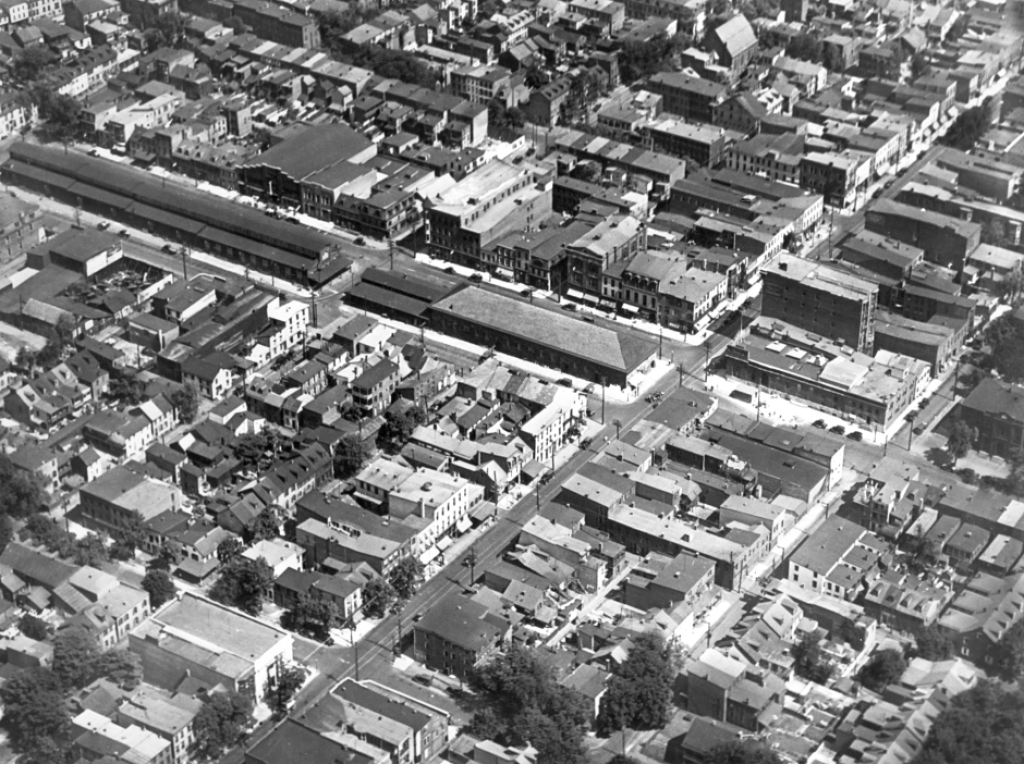
Aerial view of the Broad Street Market neighborhood, believed to have been taken in the 1920's/

Aerial view of the Broad Street Market neighborhood, believed to have been taken in the 1920s.

In the plaza of Harrisburg’s Broad Street Market, between the eastern building, made of brick, and the western one, made of stone, is an echo of something that used to be.

Years ago, a wooden frame structure stood on this spot, running from the end of the stone market house to Capital Street, where trolleys passed by throughout the day. Built in 1869, the wooden market, as the building was sometimes called, witnessed a century of growth and decline: the erection of the brick market house, in the 1870s and ‘80s; the swelling of the market’s occupancy through the 1920s, to hundreds of vendors; the emptying out of the inner city and the rise of the supermarket, the suburb and the automobile.

The wooden market was demolished in 1979, but you can still see its image preserved in the plaza stones. In the 1990s, as part of a $2.5 million renovation, a design team came up with a way to, in the words of Bret Peters, a Harrisburg architect and the project’s manager, bring back the wooden building “as a memory.” Darker stones correspond to the wooden market’s posts, while lighter ones trace its outline; raised ledges in the plaza correspond to the original market’s bays. At the end of one row of ledges, a ladder of dark granite, like a trilobite fossil, records the location of one of the old structure’s staircases. (On top of each ledge is another kind of fossil—a concrete cast derived from photos of a cornfield after harvesting.)

On a Friday in late January, the city’s new mayor, Eric Papenfuse, passed through this plaza on the way to lunch, tailed by a couple of reporters. Moments before, at a podium in the brick building, he had introduced the members of his Broad Street Market Task Force, assembled to address what he called the market’s “unacceptable” status quo. The previous month, in an appearance as mayor-elect before the PennLive editorial board, Papenfuse had critiqued a “crisis of the market’s own making”: hemorrhaged vendors, a stagnant board of directors, a complex dual-management structure and repeated battles with the city over maintenance of the buildings. Now, as one of his first undertakings as mayor, he was making good on a pledge to turn things around.

“There’s a lot positive going on at the market,” Papenfuse said from the podium, flanked by members of the task force. “That’s not what this is about. This is about saying that the market could be even more. It could be much greater than it is. It could have a role in fundamentally helping the economic development for the entire city of Harrisburg.” He suggested that, under proper management, the market could become a vehicle for developing “not just the city, but also the neighborhood in which the market is situated.” As he spoke, a handful of Amish vendors at Fisher’s Bakery, in aprons and bonnets, stood behind display cases of ice cream and shoo-fly pies, watching and talking among themselves.

The task force is not the only recent effort to overhaul the market’s operations. As Papenfuse took his seat in the stone building, over a bowl of Vietnamese noodle soup, he was joined by Josh Kesler, a market vendor and a local developer. Last July, Kesler and a business partner opened Harvest, a stand selling produce and other goods with a focus on locally sourced food. More recently, he bought the Stokes-Millworks building across the street from the market, with plans to convert it to a restaurant and studio space for artists.

Kesler is now a member of the mayor’s task force, but, in the fall, he helped launch the Broad Street Market Alliance, a separate and ongoing initiative focused on reform. Like Papenfuse, the Alliance critiqued the market’s management structure, under which a for-profit manager, the Broad Street Market Corporation, is accountable to its sole shareholder, a preservation non-profit called Historic Harrisburg Association. (This structure is what Papenfuse referred to as “dual management.”) The Alliance proposal, dated Oct. 10, recommended replacing this structure with a new non-profit, governed by a board representing the market’s key constituents: vendors, city government, residents and the “farm and market communities at large.”

Neither the Alliance proposal nor Papenfuse’s task force announcement made any reference to Bret Peters, the architect who oversaw the 1990s renovation. This was a noteworthy omission, given that the city, at the time of that renovation, commissioned and paid Peters to come up with a master plan for the market’s long-term success. The strategy drew upon input from several experts, including an acclaimed consultant on farmers markets, David K. O’Neil, who oversaw the turnaround of Philadelphia’s Reading Terminal Market in the 1980s. Like Papenfuse, the plan expressed a vision of the market as an anchor for development in the surrounding neighborhoods.

Peters updated his plan in 2010, when the market revisited the need for a long-term strategy. The new plan includes an ambitious expansion of the stone building’s hours, so that, in Peters’ words, it becomes a “seven-day engine for the whole market.” It also includes a strong emphasis on filling market stalls with abundant, high-quality produce, which the original plan’s research had shown to be the keystone of any successful farmers market.

In the weeks since the January press conference, the task force has started addressing questions about the market’s future. Will it also learn from the market’s past?

—– 

This is a biased story about the Broad Street Market. I want the Broad Street Market to succeed. I want there to continue to be a place in the middle of Harrisburg where, in a single lap of a 140-odd-year-old building, I can buy smoked gouda, grapes, Brussels sprouts and mushrooms, a loaf of fresh bread and a quart of fresh milk, a barbecue sandwich and a bouquet of flowers, and a tub of sweet pickle slices packed so tight that the lid swells like the skin of a balloon.

I can get these things, minus the historic architecture, at my supermarket across the river, but, there, I have to battle with careening grocery carts, along with what you might call the abstracted quality of supermarket commerce. At the grocery store, you don’t buy things from somebody; you just buy things. I like that, at the market, the person accountable for the goods I’m buying is within arm’s reach. Like the old men shooting the breeze over coffee at a table on the market floor, it makes me feel like part of a social enterprise. As D. H. Lawrence wrote in the 1920s, in his essay about the bustling weekly market of Oaxaca, Mexico, the market is a place to “buy and to sell, but above all, to commingle.”

In an earlier era, the Broad Street Market fulfilled this role spectacularly. Oral histories in the Highmark Blue Shield Living Legacy Series, a digital archive of interviews from 2010, portray the market as the anchor of a vibrant commercial district. In one interview, Joseph H. Kleinfelter, a former president judge of Dauphin County who died in 2011, recalled that, within two or three blocks of the market, “you could find just about anything you wanted”: a drugstore, a jewelry store, a movie theater, a furniture store, a candy shop, a dentist, an eye doctor and, among others, “a bar about every third or fourth establishment.”

The market was also an anchor in another sense—its weekly rhythms served as a kind of cultural and generational glue. David Wise, a former president of the Summit Terrace Neighborhood Association, recalled dragging a wagon on Saturdays from his Steelton home to offer chauffeur services to shoppers: “[W]e would put up our finger indicating to the visitor that we would like to carry her basket in the market…we made good money there.” Wise, who was born in 1923, is African-American; Kleinfelter, who was white, and born 15 years later, had much the same childhood experience. “We would park our wagons there along the curb outside the house,” Kleinfelter recalled. “‘Waiting for a haul,’ we called it.”

The Broad Street Market remains a community anchor today, but, by any measure, there’s a good deal less commingling than there used to be. As late as 1960, the market was home to around 250 vendors. Depending on how you count them, there are now around 23. To a large extent, the market’s fortunes have mirrored the city’s—especially in recent years, when the market, like the city, seemed stuck in a state of unending crisis. The market has gone through five managers in four years. It has closed multiple times over health violations, most recently in the summer of 2012. Last year, someone broke into the market and robbed the ATM machine. Because of the high cost of liability insurance, the market subsequently went without an ATM, to the frustration of customers and vendors.

“I have customers every day who ask about it,” David Lapp, the owner of the market’s Green Ridge Acres stand, told me. “A farmers market has to have an ATM.”

When you look at an aerial photo of Midtown from the 1920s, with the market lying in the middle of a grid crammed with businesses and homes, it’s not hard to grasp the reason for the decline. In the photo, just north of the market, is a series of awnings along 3rd Street; the area is now an empty field.

The more difficult question is why, when the city tried to jump-start the market 20 years ago, the revival didn’t take hold. What does it take for an urban market to thrive?

—– 

Around the time of the renovations in the mid-‘90s, the city, under the leadership of former Mayor Stephen Reed, sought proposals to take over the market’s management. Since 1974, the market’s operations had been in the control of a municipal authority, apparently with unsatisfactory results. In a July 11, 1995 memo to City Council, Reed expressed his displeasure with the existing arrangement. “As we know, the Market has been operating at a loss for years and therefore subsidized by the City,” he wrote. He listed three possible courses of action: close and sell the market, continue subsidizing its operations, or “undertake an extensive historic rehabilitation, coupled with upgraded product and operational policies, and institute a daily, on-going new management and marketing of the Market, with the Market required to be on a self-supporting basis.”

If those choices seem weighted, it’s because the city, in addition to having long since selected the latter option, had already selected a new manager—Historic Harrisburg Association. At the time, HHA was experiencing a surge in prestige and activity. In 1992, the organization had appointed David Morrison, a former executive assistant in the Thornburgh administration, as its first full-time executive director. Under Morrison’s leadership, HHA’s income and base of supporters had swelled; in 1993, the organization relocated to a new headquarters, in the old Pennsylvania National Bank building, across from the market on 3rd Street. “We didn’t want to be in center city, in a professional building,” Morrison told me. “Midtown was where the storefronts are.”

Morrison said that, in large part, the idea of HHA assuming management of the market emerged through conversations with the design team for the renovations, including the market consultant, David O’Neil.

“David specifically said to me, ‘You know, Historic Harrisburg would be ideal. You’re right across the street, you’re an established organization, this fits with your mission, you’ve got volunteers, you’ve got some momentum to get something going.’ And we were kind of looking for more to do at the time.”

O’Neil, when I spoke to him, told me much the same thing. “The fact that they were right there—they had a civic interest, plus an organizational interest. They were invested in the neighborhood, and had a lot of volunteers and a lot of contacts. It put them in very good stead.”

Peters also encouraged Morrison, at least initially. In January of 1994, the pair met at Jeffrey’s Parkside Café at the top of State Street. According to Peters, over dinner and drinks, Morrison expressed a strong interest in HHA’s involvement in the market’s future. Though Morrison’s tone struck him as “brazen,” Peters agreed that HHA could be a perfect fit for the market’s new management. But he advised Morrison that HHA should change its charter and become a community development corporation, or CDC, a legal designation that provides eligibility for various funding streams. (Morrison says he doesn’t remember the meeting, though he does recall discussions about a CDC that “never went anywhere,” in part because of HHA’s personnel limitations.)

As the months progressed, though, Peters felt that he and his team’s plan for the market were increasingly edged out of the frame. On March 7, he received a stop-work order from the city. A couple of weeks later, he was told to re-start the design, but with the scope of work diminished. In particular, though the city wanted to keep Peters’ architectural work on the buildings, it wanted his team to stop developing strategies for market operations—things like desired vendor mix, design guidelines for vendors’ stalls and marketing strategies.

It’s not clear why the city changed course, though some amount of vendor resistance seems to have been involved. That winter, the city began presenting its plans to the market’s existing vendors. One of the plan’s suggestions, based on recommendations from O’Neil, was that the market should place a high priority on fresh produce vendors, which typically drive the most traffic, and a low priority on non-food vendors, which drive the least. It so happened that, in the Broad Street Market, this suggestion wound up being interpreted along racial lines. Rafiyqa Muhammad, who had owned her stand, Creations of Family Muhammad, since the early 1980s, said that she and other vendors sensed a plan to “move black vendors out to make way for white vendors.”

“They felt our stands were not high-end enough,” Muhammad, whose own stand sold African clothes, incense, oils and herbs, told me. On one occasion, her husband returned from a vendor meeting and told her someone had said they didn’t want “none of that black stuff at the market.” When I asked for someone who could corroborate this, she gave me the name of Karen Hasan, another vendor, whose stand sold clothing and jewelry. Hasan said she didn’t recall any explicitly racial language, but that she, too, felt that “everybody who wasn’t white” was being asked to leave. Muhammad and other vendors circulated a protest petition and appeared before City Council; ultimately, they secured a pledge that all the existing vendors would be allowed to stay.

When I asked O’Neil about this, he said that the charge of racism was “ridiculous.” “Markets are best tenanted by local people,” he said. “The more diverse, the better.” He suggested that, perhaps, the vendors who weren’t selling food felt threatened by the promised changes. One of the duties of good management, he added, is to turn down the abundance of non-food applicants. “People selling non-food are relying on traffic that is food-driven,” he said.

“The city, in my mind, panicked,” Peters told me. “They decided to spend all the money on the building and didn’t do anything about the tenants.” In his binder, he has a copy of HHA’s initial management proposal, dated Sept. 30, 1994. Several pages in, under a section about the planned capital improvements, HHA expresses a wish “to collaborate with the City in a prompt review and analysis” of the master plan, “to ascertain if there are any features of the plan which merit change or reconsideration.” On top of Peters’ copy of the proposal is a sticky note, addressed to him and signed by David Morrison: “Our final proposal for your information,” it says. “Thanks for your encouragement and advice.”

—— 

On Sept. 12, 1996, the Broad Street Market launched a three-week long festival to celebrate its grand reopening. An article in the Patriot catalogued the renovations. In addition to the new plaza, the buildings had new doors, windows and lighting, a huge backlit circular sign on the roof, facing down Verbeke Street, and, on the perimeter, colored banners on 30-foot steel poles and fold-down tables for rent by outdoor vendors. The article quotes liberally from Morrison, who, at one point, describes the mayor’s hope that the market will be part of the city’s revitalization: “The mayor’s thinking is that just restoring a white elephant won’t do us any good,” he is quoted as saying. “It’s got to thrive.”

For a time, the market did thrive. Barbara Skelly, who served as market manager from 1997 to 2005, said that, in the years following the renovation, the market saw steady improvement under the guidance of an energized, cohesive board. “I was excited, and they were excited,” she said.

The prior management had grown lax about collecting rent, and one of Skelly’s first directives was to set up payment plans to get all vendors up to date. She orchestrated a deep clean of the stone building’s interior, purchased new tables and chairs, recruited vendors to sell on the outdoor tables and bought new custodial equipment. She also installed ATM machines, which she said were “like gravy”—they increased business for the stands, in addition to bringing in fees for the corporation. In her first year, the market broke even. In the years that followed, it even turned a profit. Skelly recalls giving a check to Mayor Reed on two separate occasions. “I think it was, like, $3,000,” she said. “And the mayor said, ‘I knew it. I knew it could be done.’”

After the initial burst of activity, however, the market once again found itself in decline. No one is exactly sure when the trouble started. A photograph from the summer of 2001 shows a bustling stone market, with vendors occupying both the center and the periphery of the building, and customers crowding the aisles. Skelly thinks the dip began a few months later, following the Sept. 11 terrorist attacks; others have attributed it to a loss of customers to the West Shore Farmers’ Market, which reopened in 2000 after its previous location burned down.

Recently, some observers have suggested that the city’s management agreement with HHA can partly explain the market’s decline. Part of HHA’s proposal included the idea of a philanthropic arm, called Friends of the Broad Street Market, that would help fund improvements through “annual giving” campaigns. Though HHA did secure occasional contributions, according to Morrison, the Friends program never materialized. In later years, as HHA’s own fundraising momentum stalled, it’s possible that its association with the market became more burdensome than useful.

“You could get a lot of people to support a ‘Friends of the Broad Street Market,’ something like that, a charity,” Gregg Fetterman, who served as chairman of the market board from 2007 to 2010, told me. “But the subset of people who would support HHA is a lot less than that. So it was just incompatible. Two completely different organizations. Two completely different missions.”

Peters thinks the problem was that the management was not so much structurally inappropriate as simply lax. “There was such a level of bizarre negligence, of basic issues like merchandizing,” he said. “Is the collection of people in this market a collection of vendors that the public is going to respond to, by coming here and buying stuff?”

In his view, the market has also let itself be dominated by concerns other than the most basic one: selling good food. “There’ve been these other layers of agenda that people have been wanting to get out of it…They use this thing as a vehicle for personal gain and self-importance, rather than using it as a place to sell and distribute first-quality food to the citizens of Harrisburg, Pennsylvania.”

Morrison attributes any decline to factors outside management’s control. I asked him, at one point, if he thought HHA had been a good steward of the market. “As the circumstances have evolved, yes,” he said. “Sure. I think that the system that we created worked very well, really until the time that we decided that it was time to separate it.” He acknowledged that there might have been a period in the 2000s “where the stewardship was a little nebulous,” but suggested that was because the market’s own leadership “was increasingly being trusted to do things on its own and wasn’t looking for HHA to provide more stewardship.”

—–           

In 2009, the market revisited Peters’ plan. That summer, a group including Peters, several of the market’s board members, and an urban planner for the city met one evening in the stone building to discuss the market’s future. The market was understaffed, due to funding shortfalls, and was $70,000 in debt from unpaid heating bills. Fetterman, then chairman of the board, warned of an impending major expense: the market would need to replace its heating system, because the provider was planning to abandon the steam line before the upcoming winter.

The group also discussed the market’s long-term vision. At some point, Peters produced a copy of the master plan from the mid-‘90s. It was the first time most of the group had seen it, including Fetterman. Peters explained that the foundations of the plan were even stronger than before, in part because of the presence of HACC on Reily Street, which provided a second Midtown anchor and an additional source of foot traffic. (Muhammad, who was also in attendance, and who objected to a perceived criticism of the neighborhood north of Reily, told me she raised her hand and said, “Excuse me, but there are families there.”)

In the months after the meeting, Fetterman, along with several other board members, began looking for ways to incorporate Peters’ expertise into the planning process. “Bret knew more about the market than anyone,” Fetterman told me.

Initially, they invited Peters to join the board, but he declined. Instead, he sent them a proposal to create an “architect of the market”—retaining him to update the master plan and to address building and design problems as they arose. “They didn’t have any money,” Peters told me. “I said, ‘I understand. But you need what I do.’” In particular, to be eligible for various forms of funding, the market needed a long-term business strategy. Ultimately, Peters agreed to a deferred-compensation contract, agreeing not to be paid until the market secured its funds. He would, however, require what he called a “token payment” of $500 per month.

In the meantime, the market’s financial situation plummeted further. In the course of a year, the market lost its manager, business manager and treasurer. The heating system, which had not been replaced, failed that winter, costing the market another $70,000 in repairs and in bills for excessive use. In February, the state Department of Agriculture inspected the market and shut it down, citing both the detection of rodents and the failure of the market’s hot water supply. This cost the market another $30,000 in lost rent, out of an annual budget of around $300,000. Board members assumed a greater role in operational duties; on several occasions, Fetterman used his own money to pay the market’s bills.

In the summer of 2010, Fetterman petitioned the city to reimburse the Broad Street Market Corporation for amounts spent maintaining the facilities. For years, he had been insisting that the management agreement was explicit about the city’s obligations: while the corporation was charged with “routine maintenance,” the city, which owned the buildings themselves, was responsible for major repairs. Yet the city’s response was to deny the market funding—not only declining to reimburse repairs, but also withholding previously awarded grant funds, demanding that the market first produce financial documents and a business plan. Fetterman turned to Peters, who produced a draft of a business strategy so the city would release the money.

That 15-page document starts from the premise that, because of the city’s financial difficulties, in the long term the market ought to plan to fund its own maintenance needs. “2011 must be a year of significant change for the market,” it says. The plan goes on to outline a strategy for increasing revenues, primarily by aggressively pursuing high-quality vendors of prepared and specialty foods. These vendors would occupy a reconfigured stone market, whose hours would be expanded to seven days per week; the brick building’s hours and occupants would continue unchanged. The plan also notes that, in past market practice, individual vendors were “encouraged to negotiate their position” without regard for the success of the market at large. To remedy this, the plan recommends “regular, structured communication” between management and vendors, including a leasing manual with rules for stand design and maintenance.

In the months that followed the drafting of the plan, however, board members began to question the market’s commitment to Peters. In late 2010, Alan Kennedy-Shaffer, a new board member, became concerned that Peters’ continuing work on the market was creating bills the market couldn’t afford. “The contract itself was a ballooning payment, where it had a huge potential liability for the market down the road, for services that were not clear and were never provided,” Kennedy-Shaffer told me. He then discovered that Fetterman had signed the Peters contract without getting board approval. Fetterman acknowledged this, but said it was a procedural oversight—the board’s wish to contract with Peters, he said, had never been in doubt. Nonetheless, Kennedy-Shaffer led a successful effort to have the board rescind and repudiate the agreement.

To this day, Fetterman remains mystified as to why the board refused to reconsider the contract with Peters. Peters “has done more work for this market than anyone in the past 10 years,” he told me. He said Peters “had always been open, like, ‘Fine, let’s revisit the contract, let’s do it.’ And no one was ever willing to say, ‘Here’s why I don’t like the contract and here’s what it needs to be.’ It was just dead. It was done.” (Last February, Peters sued the corporation for payment for his services, and the matter is pending litigation.)

In Kennedy-Shaffer’s telling, the dismissal of the Peters plan was largely about insulating the market from a financial liability. But Jonathan Bowser, who joined the board in the midst of the dispute, has said that, in addition to the legal and financial concerns, board members also disagreed with Peters about the plan’s “target market.” “It was more focused on being a regional market that wanted to be more of a tourist attraction,” he said. Before pursuing that strategy, he added, he “needed more confirmation from the community that that’s what they wanted.”

—– 

On Thursday, March 20, at 6 p.m., the task force held its first public meeting. It took place in the stone building, where more than 100 chairs had been set out, facing a couple of tables for task force members, which flanked a projector screen. Gradually, the crowd swelled until the chairs were nearly at capacity. Another 70 or so people stood at the back and along the sides.

As members of the public filed in, a man from the Pennsylvania Downtown Center, whose president, Bill Fontana, is one of the task force members, handed out 100 remote clickers. Their purpose was to allow the public to take a poll on the market and see the results in real time.

Fontana took to the microphone and explained that Mayor Papenfuse had charged the task force with “looking at the future,” rather than dredging up the past. One of the things he’d learned in his career, he said, was that it’s “very easy to rehash what happened.” “If you spend all your energy on these kinds of efforts, you never advance to the next level,” he said.The task force’s desire to leave behind the past seems largely shared by the market’s current board. Both Fetterman and Bowser speak of the market having survived a “perfect storm” of challenges.

“I think we’re weathering that storm,” Bowser told me. “I think people would probably want things to happen a lot sooner than they are, and I understand that completely, me being number one on that list. But the reality is that where we came from, probably being a month to weeks away from being insolvent, to where we’re at today, where we’re showing a monthly surplus as far as operations, I think is commendable, for not just me but for the entire board.”

Vendors, too, seem eager to move on. I spoke with more than a dozen vendors, many of whom expressed the same handful of sentiments—that the market was headed in the right direction, that it wouldn’t help to focus on the negative, that things would get better, but not overnight.

“Leave back what’s back and move ahead,” David Lapp, from Green Ridge Acres, told me. Last December, Lapp, along with Leon Glick, the owner of Two Brothers’ BBQ, were elected to serve as vendor representatives on the market board, where they hope to provide a voice for vendor concerns. When we spoke, they had only attended one meeting, which Lapp said was productive, if a bit too short. “We didn’t cover everything we should’ve,” he said.

At the public meeting in March, the task force polled the audience on a variety of topics relating to the market’s future. Fontana would read a question from the screen; the audience would vote on the remotes, and a few seconds later a bar graph would appear with the percentages. The sample pool had a fair number of regular shoppers (38 percent coming once or twice a week, 35 percent two to three times per month), who came primarily for groceries (72 percent). One question asked whether they thought market vendors should sell food only, or “food and crafts.” Two-thirds voted “food only.”

As I watched the votes, I wondered how useful they would be. We have examples elsewhere of markets that work. The city already paid a team of professionals to tell us that, above all else, people will go to a market to buy fresh food; 20 years later, they’re saying the same thing, with 20 more years of evidence behind them. We can also guess, from past experience, that energetic, consistent management is part of the formula. Regardless of what the community says it wants, won’t a successful plan for the market have to incorporate these things?

When the survey was over, the meeting ended, but much of the audience stayed on to keep talking about what the market could be. During the meeting, topics of race and class had been invoked, and, as the audience split up into circles of chairs, they remained part of the conversation. I watched people in the center of the dark market hall, engrossed in discussion, and thought about something Peters had mentioned, about markets being the “ultimate de-militarized zone.”

“All these other barriers go down when there’s food,” he said. “Harrisburg needs that very badly. And the market doesn’t become the community’s heart and soul when you put community people in charge of it. It becomes the community’s heart and soul when it’s got great food.”

Continue Reading

The Great Divide: Forster Street: a road that splits Harrisburg.

In 1891, Harrisburg’s Mulberry Street Bridge opened, linking Allison Hill with downtown and the rest of the city. The bridge was hailed as a unifier, pulling people closer to each other.

When another bridge, the M. Harvey Taylor Memorial Bridge opened in 1951, requiring tree-lined Forster Street to be widened into a highway, there was no such accolade. Even today, there is dismay with what happened to Forster Street, which now has four through lanes and multiple turning lanes.

“It cut the heart out of the city,” said Ken Frew, city historian and librarian for the Dauphin County Historical Society.

The decline of Forster Street began in the 1940s, when state and local governments began pushing for another span across the Susquehanna.

Originally, the bridge was to be built farther uptown, but Harrisburg political boss Harvey Taylor wanted his namesake bridge in a more prominent location, closer to the Capitol and downtown, according to Jackson Taylor, author of the historical novel set in Harrisburg, “The Blue Orchard.”

So, in the early 1950s, a long line of houses, shops and other buildings was leveled, from Riverfront Park to N. 7th Street.

While benefiting suburban developers and commuters, the widening did damage to the city itself. It made a once-quaint, residential Forster Street into an asphalt wasteland–a congested, noisy street that no one wanted to live on any longer. Soon, the street took on the look of desolation and even danger.

To save as many buildings as possible on the south side of the street, sidewalks were narrowed, making walking in some areas nearly impossible. And then entire swaths of houses were razed for parking lots, while billboards sprung up.

The ugly, harsh state buildings that rose near the Capitol, several built in the stark concrete “brutalist” style common in the 1950s through the ’70s, furthered Forster’s transformation from quaint to forbidding.

Then there was the effect on Midtown.

Before the Forster Street expansion, downtown and Midtown flowed together as an integrated urban community. Afterwards, the residential portion of downtown, accessible to the Capitol and the business district, remained vibrant, while Midtown began to fall apart.

“I think that was one of the most divisive things things that ever happened to this city,” said Frew.

In the early ’90s, there were various city improvement groups that looked at ways to re-connect Midtown to downtown, with ideas such as building pedestrian walkways under and over Forster Street.

“How do we bridge the divide?” said David Morrison, president of Historic Harrisburg Association, who has long been involved in city improvement efforts.

No idea, through, seemed satisfactory. Meanwhile, a renaissance of sorts brought a flourish of new restaurants downtown, particularly along N. 2nd Street, further deepening the divide between Midtown and downtown, Morrison said.

Morrison and Frew are not alone in their assessment. Many, if not most, of the city’s residents and visitors share a critical opinion of Forster Street.

In 1998, Harrisburg Young Professionals, working with PennDOT, took the first steps to try to improve the road. It adopted Forster, planting trees and landscaping the median strip, an effort that continues today.

Bradley Jones, an HYP member at the time who helped initiate the tree-planting, said the sense among the membership was that something needed to be done to make the street less “a harsh sort of roadway barrier between Midtown and downtown.”

The HYP efforts have helped, as Forster, softened up by plantings and regular maintenance, is more pleasant today.

“Now when you come into the city, it’s an attractive boulevard,” said Jones, vice president of community development for Harristown Enterprises.

Landscaping, though, can only do so much. It can’t eliminate the cars whizzing by at high speed that make the street difficult to cross or the abandoned, industrial feel that permeates the entire stretch of road.

Today, there is no plan for Forster Street other than to maintain its surface and HYP’s landscaping. The roadway continues to interrupt the flow of the city.

At the time of the Harvey Taylor/Forster Street project, local and state officials praised it for connecting downtown with the West Shore, allowing commuter traffic fast, easy access to and from the Capitol complex.

However, it had the unintended consequence of dividing the city itself, a division that many believe Harrisburg has never recovered from.

Continue Reading