Tag Archives: David Morrison

Art Along the River: Artsfest 2026 continues tradition of creativity, community

For nearly 60 years, Artsfest has brought artists, musicians and festival-goers to downtown Harrisburg each Memorial Day weekend. This year, thousands once again gathered in Riverfront Park for the 58th annual celebration of art, music and community.

Although the festival boasts a 58-year run, many people don’t know the  history of the event. Despite this, one thing remains certain: the festival is a summer staple for the city.


Mystery of the History

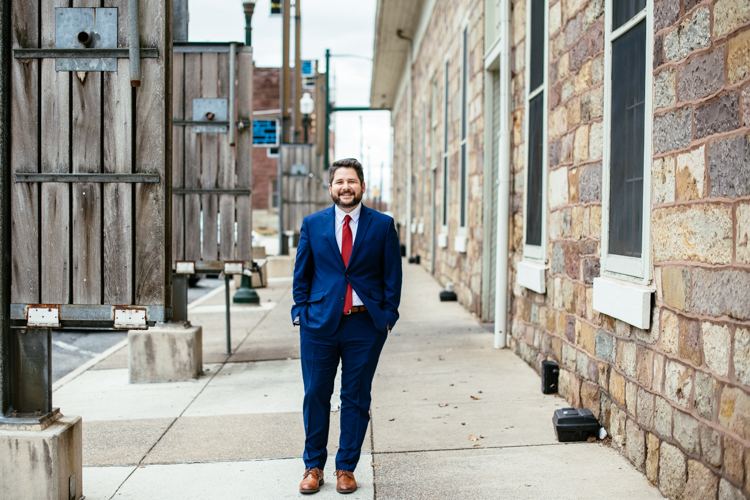
David Morrison, the executive director of the Historic Harrisburg Association, shed light on the history of Artsfest. Morrison was the event chairperson during the late 1980s.

The first question was: When did the festival start?

“The generally accepted answer is 1968,” stated Morrison. “However, the exact first year has become unclear over time.”
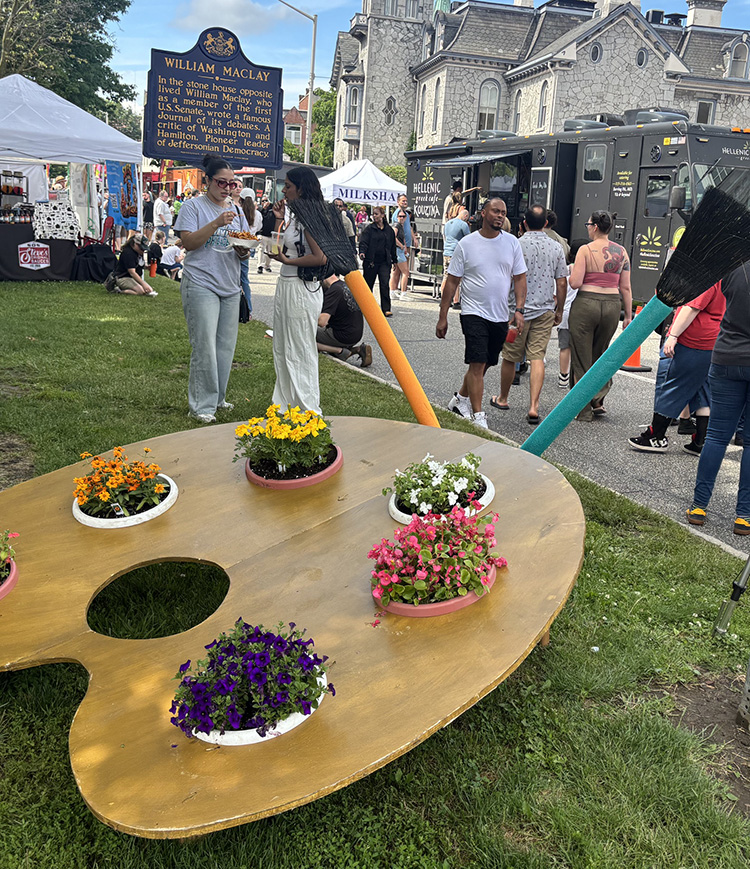
Morrison explained that people tend to use the terms “the first” and “the first annual” interchangeably, and by doing so, the official first year’s date has been lost.

Artsfest began in the plaza located behind the State Museum of Pennsylvania. In 1968, the museum was debuting its newest program, referred to as the “Art of the State” exhibition.

This showcase featured artists from across Pennsylvania. It exhibited painters, sculptors, photographers and artists of all kinds. The annual exhibit still runs to this day.

While the “Art of the State” exhibition was taking place indoors, Artsfest was running outdoors with vendors lining the plaza. The original overseer of the festival was the now-defunct Greater Harrisburg Arts Council.

Over the next two decades, the festival grew into a presence of its own and eventually detached itself from the “Art of the State” showcase.

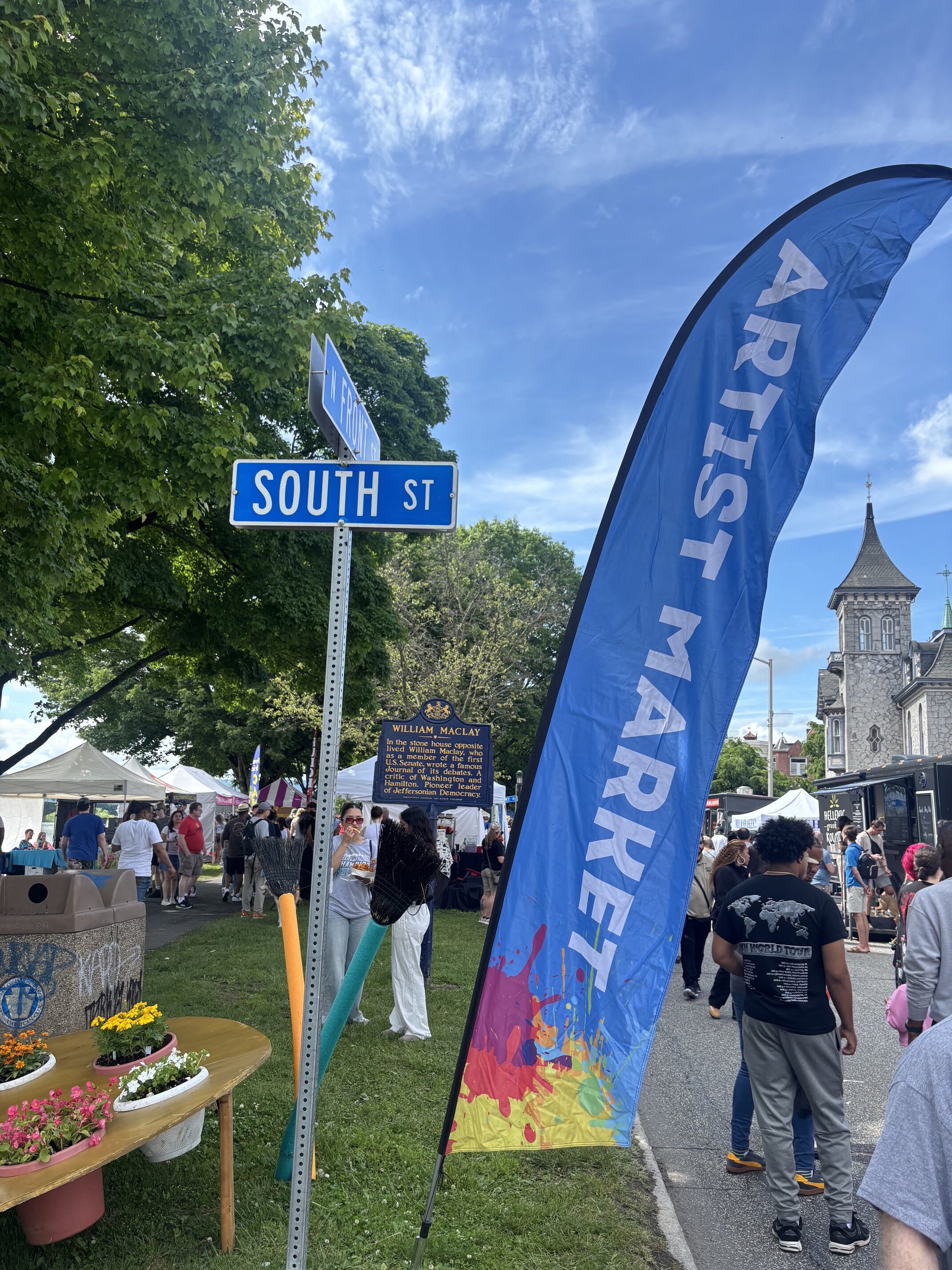
In the 1990s, Harrisburg decided to move the festival to Riverfront Park along the Susquehanna River, where it has remained since.
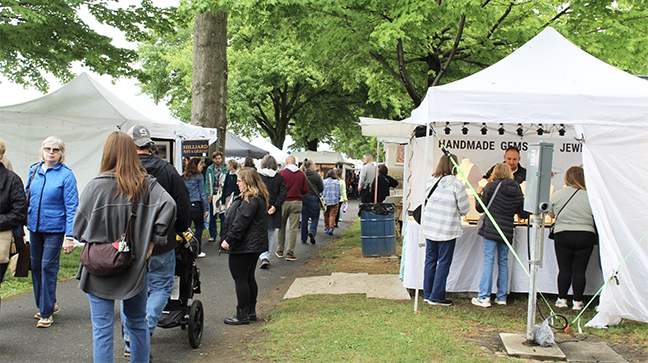
“The Harrisburg Artsfest evolved with the times,” Morrison stated.

Over the years, several organizations organized the festival until the city fully took it over several years ago.

“In the olden days, cities used to just plow snow and issue parking tickets, but Harrisburg was branching into the entertainment business,” Morrison explained. “Harrisburg is now very good at running special events. It was a natural evolution, and that is how the Artsfest has continued to thrive.”


Artsfest 2026

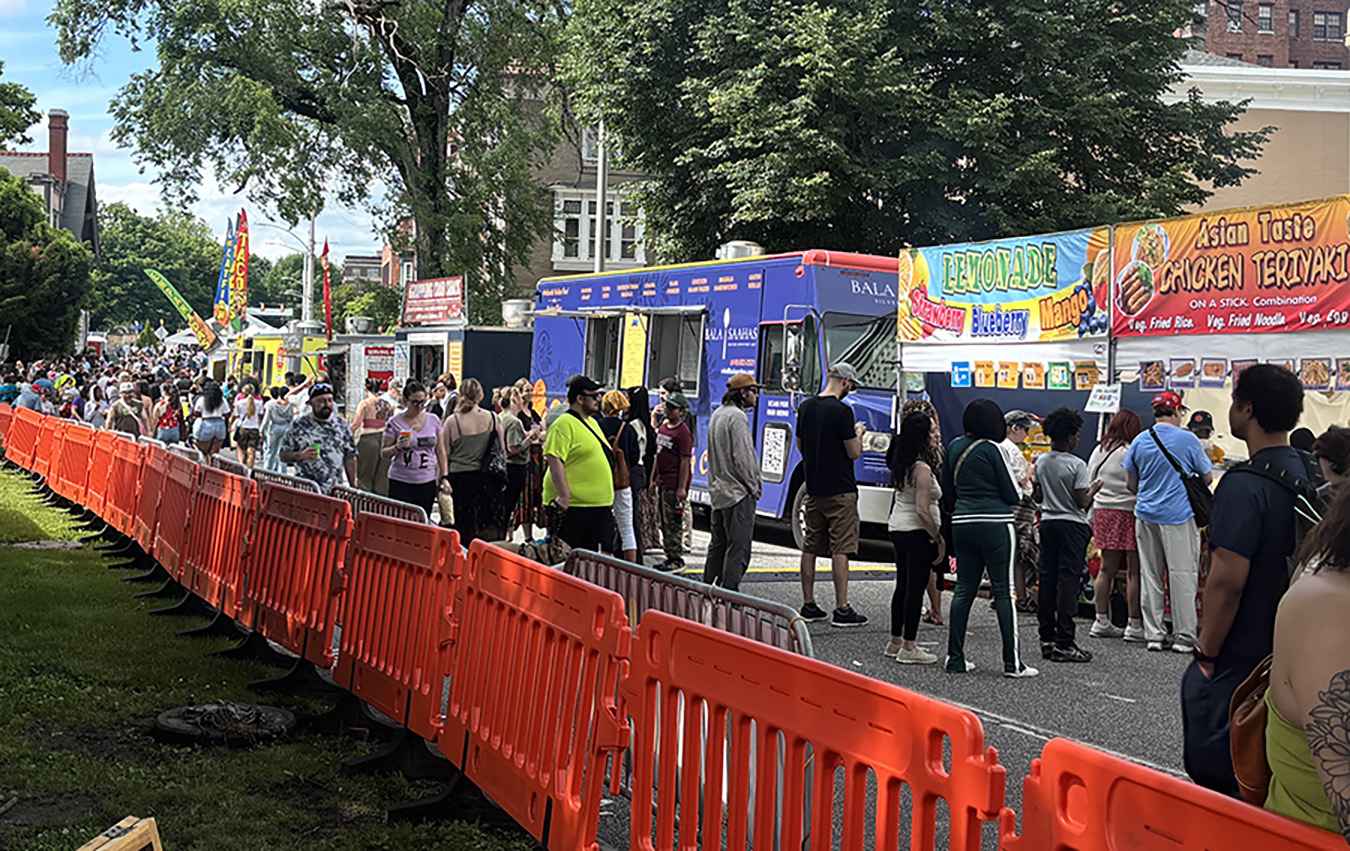
This year’s festival brought together juried artists, metalworkers and leatherworkers, textile artists, ceramic sculptors, jewelry makers and more. The festival also featured several musical attractions, including Jazzfest and acts at the UPMC State Street Stage. Artsfest also featured activities for children called Kidsfest.
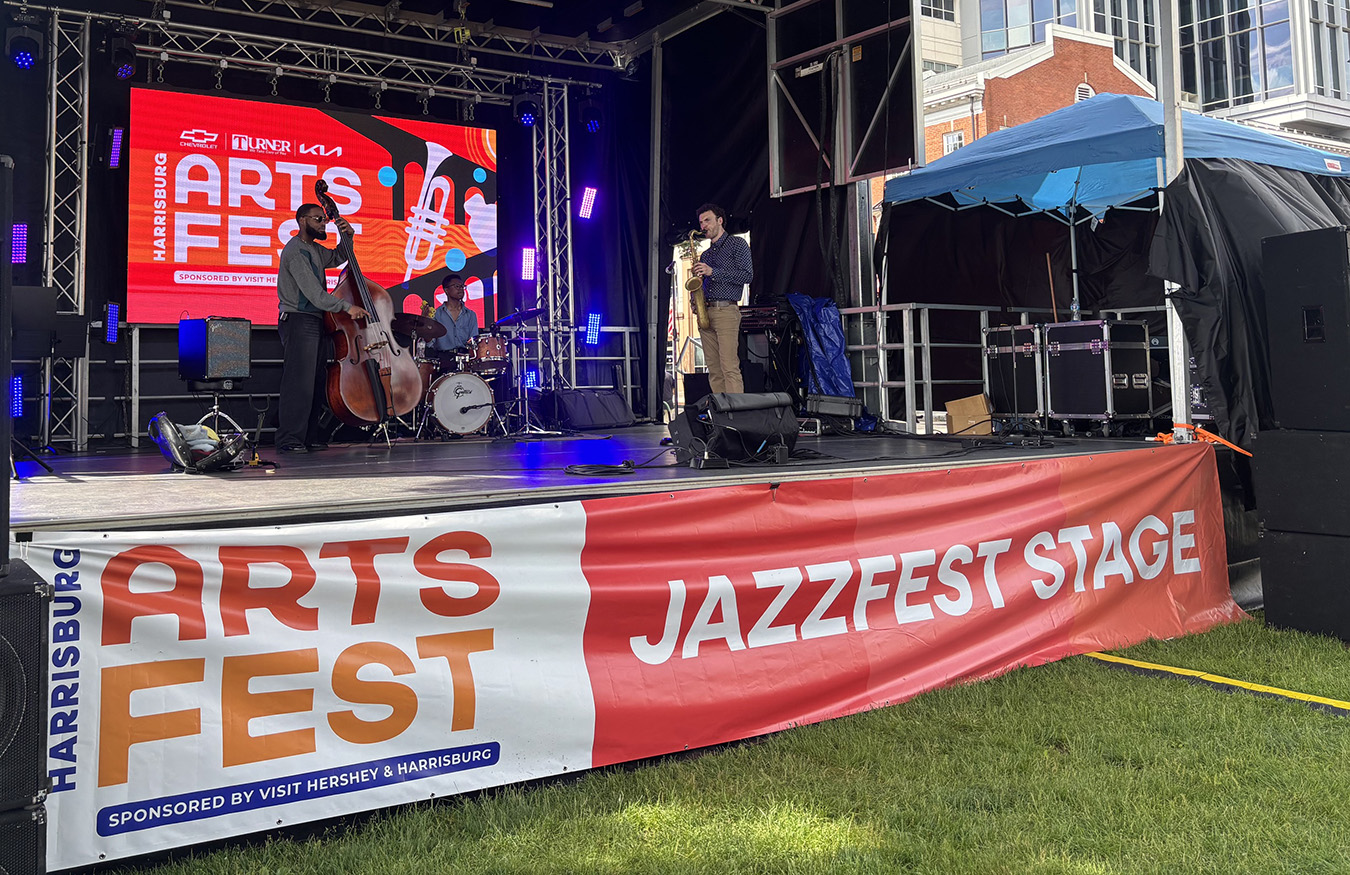
Many artists shared their histories, stories and inspirations behind their artwork. Festivalgoers offered their opinions and experiences as well.

Marina Radanovic displayed her original paintings. Radanivic spoke about her journey with painting and what inspires her work. Radanivic also displays artwork in galleries.

“I went to school for graphic design, but I realized halfway through that graphic design wasn’t for me. So, I switched to fine art,” she said.

Radanovic graduated with a degree in drawing and relief printmaking, and after graduating, decided to pursue painting. Radanovic painted throughout high school and took painting classes in college, so the medium was familiar.
She spoke about what inspires her work.

“I take inspiration from all sorts of things. Sometimes it’s a dream. Sometimes it’s observations from the world, or if I just happen to snap a photo that fits, I can make it into a composition.”

Nearby, Lora Russell displayed her unique style of paintings. Russell described her artistic process and journey of self-expression through art.

“I was kind of born an artist, but I spent time honing my skills. For 20 years, I did watercolor portraits. Watercolor is very picture-perfect proper. I was also a people pleaser. About six years ago, I had a rebellion against the picture-perfect, people-pleasing attitude, for art and in my life.”

Russell’s paintings now feature colorful, free-flowing and expressive designs.

“One day, I just took everything outside and started throwing paint authentically. I don’t think I was ever an authentic painter before. (My art now) is happy, free-flowing, colorful, vibrant. It’s almost like I just grew as a person and as an artist, and I became extremely happy.”

Carolyn Garay discussed her technical artistic training and choice of medium. Garay’s work leans heavily into imagery of portals and otherworldly beings. The paintings feature lots of space and nature. She attributes these qualities to her worldview.

“In general, I think of my paintings as an expression of my inner world and parts of self. I have always been interested in the idea of how we can never see the world from outside of our own perspectives, yet we still try to.”
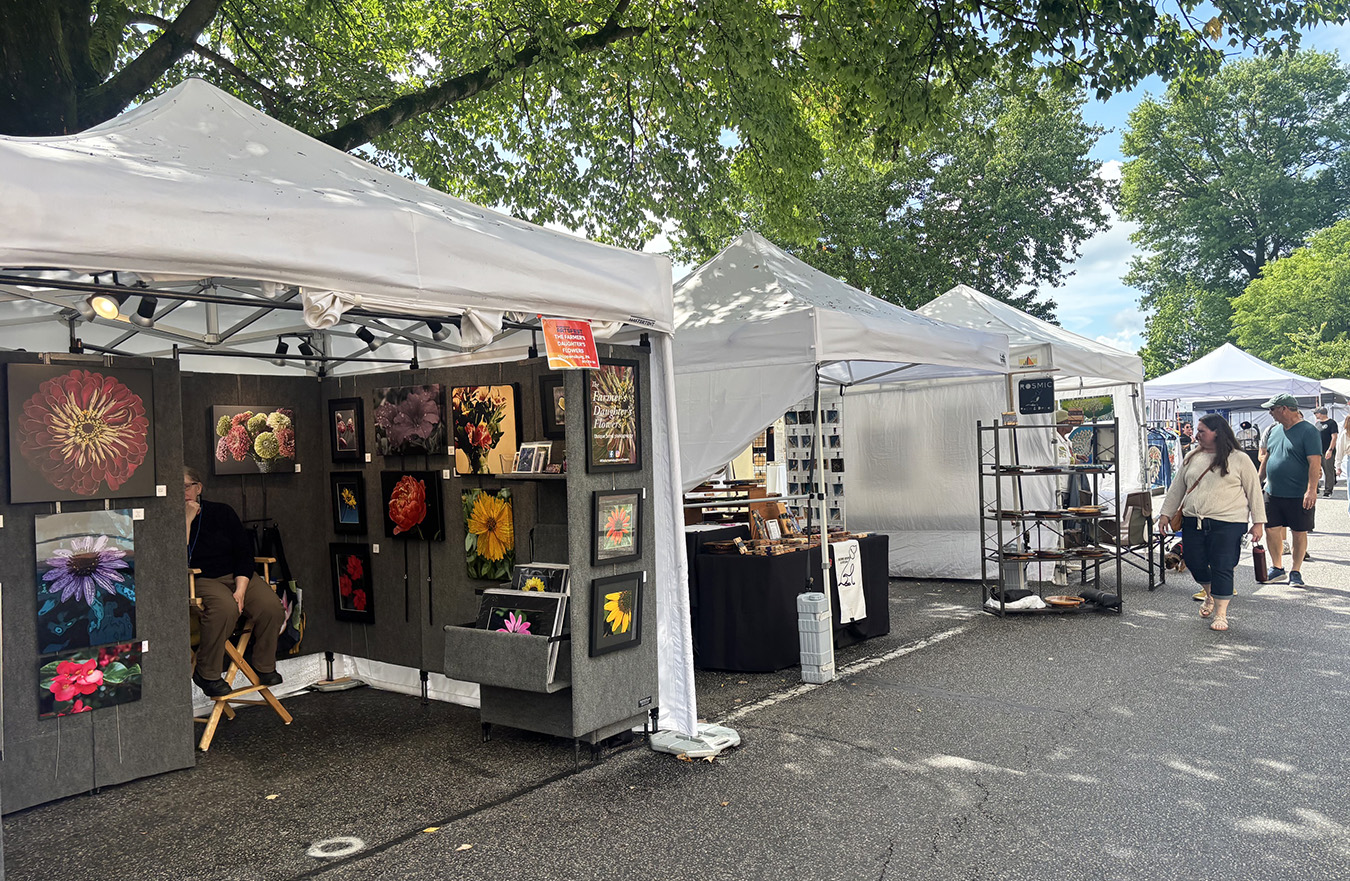
Artists’ booths

Garay spoke about her undergraduate degree program and how that eventually led her to pursue oil painting.

“I’ve been oil painting for about 13 years now and drawing since forever. In undergrad, I dual majored in both art and chemistry, but I remember no chemistry. Afterwards, I followed the art path and started showing my work at the Ann Arbor Fair. Eventually, I built up to doing shows full time and have been doing that for the last four years.”

Katie Trainer ran this year’s community art project, an annual tradition for the Harrisburg Artsfest.

This year featured paintings from more than 500 festivalgoers on 24 sheets of parachute fabric. Eventually, these sheets will be stitched together into a banner displaying everyone’s work.

Previous years’ community art projects include the 2024 “Fish of City Island” project and the 2025 “Block Print Planter Art” displayed throughout downtown Harrisburg.
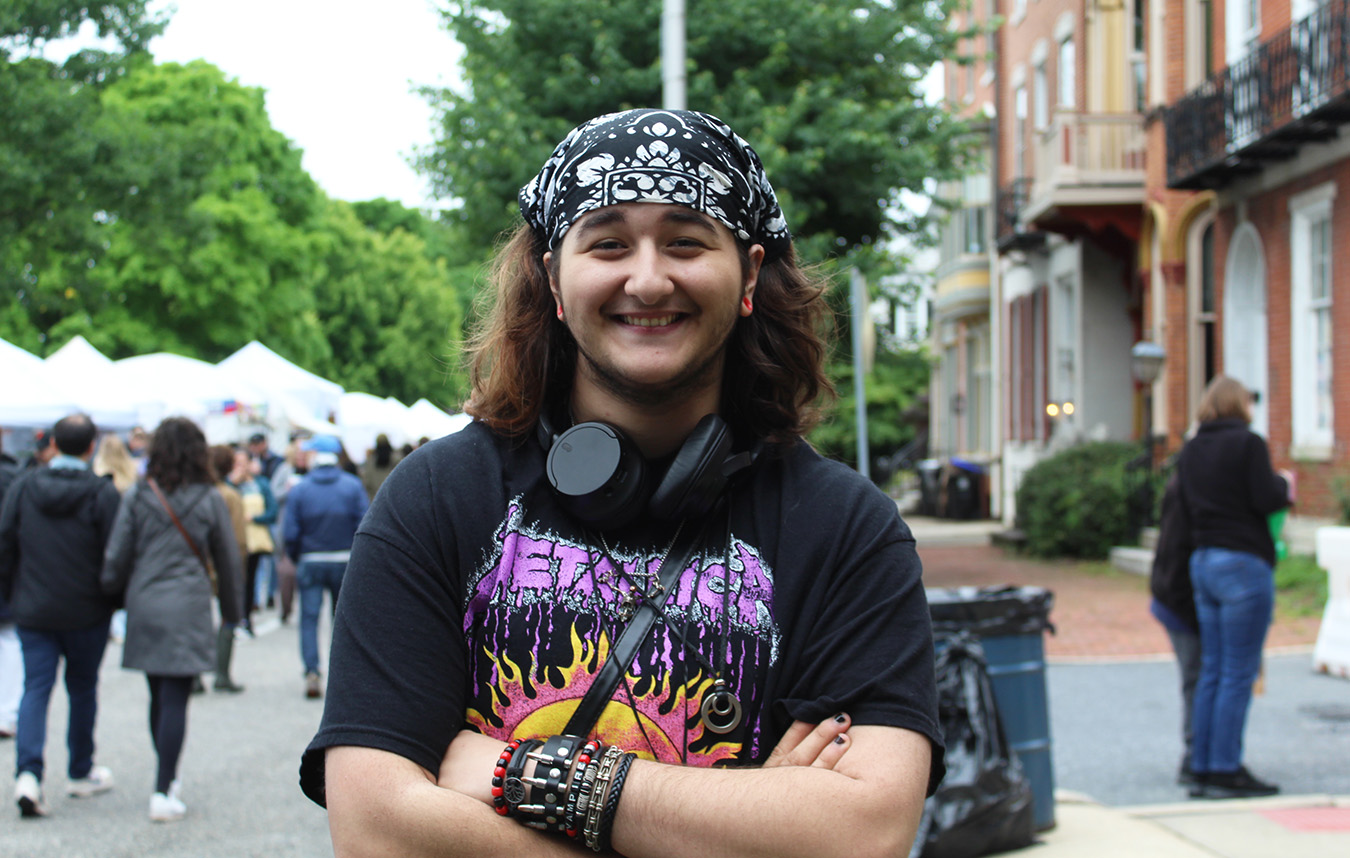
 

Lorenzo Hoban at Artsfest

Lorenzo Hoban of York said it was his second time attending Artsfest.

Hoban praised the originality of the artwork at the festival, saying, “Even with the rise of generative AI art, I haven’t seen any artists trying to sell it here.”

Likewise, Karen and Don Carrick of Reading were attending for their second year

“We just had such a great time in the past, so we had to come back,” Karen said.

Despite parts of the festival’s history being lost over time, Artsfest still brings people together year after year. Whether it was artists sharing their work, families walking along Riverfront Park or festivalgoers stopping to talk with vendors, the event once again showed why it has remained such an important part of Harrisburg for nearly six decades.
If you like what we do, please support our work.
Continue Reading

Fit for a King: This year, Harrisburg’s majestic King Mansion turns 100—and has never looked better

Photos courtesy of King Mansion

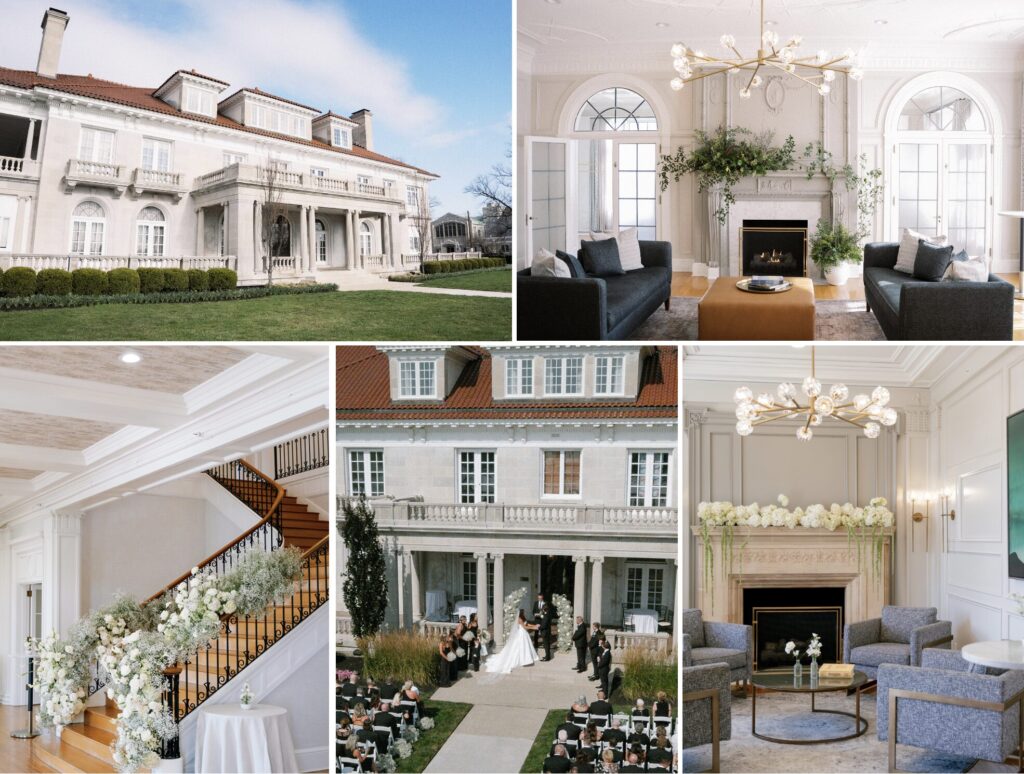
The King Mansion was a welcoming family home long before it blossomed into a breathtaking venue.

Grandma leapt from balcony to balcony so she could scare the kids by hopping through their bedroom window. Family slept on the balcony to catch summertime breezes. Guests danced at the foot of the grand staircase while the band played on the landing.

“You could really make an entrance coming down those stairs,” said Will King, grandson of Horace King, the attorney who built the masterpiece for his musician wife and six kids.

This year, the King Mansion celebrates its centennial as a remarkably preserved testament to Harrisburg’s 1926 City Beautiful-inspired renaissance. If all goes well for the next 100 years, it will help lead the city’s post-pandemic revitalization and continue standing as a premier destination for weddings, events and a taste of Jazz Age opulence.

“This place,” said current owner Marc Kurowski, “was absolutely made to entertain.”


Home for the Kids

Horace and Rose King wanted a family home at Front and Woodbine streets, facing the Susquehanna River.

The tax attorney commissioned Harrisburg’s trending architect, Frank Gordon Fahnestock Jr., for a massive, Mediterranean-style, Indiana limestone house that “practically set a new standard for living on the riverfront,” wrote Ken Frew, research librarian for the Historical Society of Dauphin County, in “Building Harrisburg,” his seminal review of city architecture.

At a time when the average working American earned $2,000 a year, the stately home cost nearly $135,000 to complete.

Horace King had “big ideas” to occupy the kids, and Fahnestock accommodated. Gymnasium on the third floor. Swimming pool, billiard room and bowling alley in the basement. For guests, accomplished musician Rose King—“she had an amazing voice,” said Will King—played the grand piano and sang.

King called his grandfather “a very creative, pioneering man” who organized Loyal Order of Moose lodges nationwide. The former minor league baseball player played one-base baseball with his kids on the mansion grounds.

We can also thank Horace for preventing the city from building Hoffman Street straight through the William Penn High School campus—a case he took to the state Supreme Court and won.

“I’m glad we were able to do something to save the campus, do something for the school children,” King told the Harrisburg Telegraph at the time.

After Horace’s death in 1938, Rose sold the house to a rest home, beginning its transformation to business use. From 1947 to 2003, it was headquarters of the Merchants & Business Men’s Mutual Insurance Co.

In the 1950s, Will King was growing up north of Harrisburg, and his family sometimes got tours of his father’s childhood home. The bowling alley, King told TheBurg, was converted to a shooting range because the humidity from the pool had warped the lanes.

The elegant mansion has “always been an inspiration” for King, who has built and renovated homes. Attorneys have “a sense of style and architecture,” he said. “It’s such a work of art, so well-proportioned and balanced and beautifully done.”

Owners have taken meticulous care of the building over the decades, he added, and Kurowski’s group is “doing the best job of all of them, in my opinion.”

Red Land High School sweethearts Paige and Cole Wagner were attending the University of Georgia and looking for a wedding venue when their mothers toured King Mansion. Fifteen minutes on FaceTime clinched the deal.

“Yep, that’s our wedding venue,” Paige said.

Then they experienced the mansion and its riverfront idyll in person.

“This is as stunning as it gets,” Cole said. “When you walk up to the front of the mansion, it’s absolutely breathtaking. The memories are going to last a lifetime, but the photos you get are what you keep coming back to.”

Even the July weather didn’t upset the proceedings. The outdoor ceremony went off smoothly after a 15-minute storm delay. The cocktail hour was intended to be partly on the long porch, but the heat sent everyone inside, and no one was cramped.

“It’s awesome with the rooms because there’s seating everywhere,” Paige said, a feature appreciated by grandparents and older guests. 

Marc Kurowski

Falling in Love

Several years ago, Kurowski wanted a city site for his business, K&W Engineers. His real estate agent connected him with Josh Gray, who was moving the company, Webclients.net, out of King Mansion.

“He wanted somebody who would be a steward of the building,” Kurowski said.

He was intrigued by Gray’s offhand comment that he got married there. Others occasionally asked about using the space for weddings, Gray told him.

JDK Catering—today, one of the mansion’s exclusive caterers—liked the venue idea, and Kurowski decided on a test drive. During COVID, he “dived in with both feet” with renovations. The first “for-real, full-time wedding” was held in March 2021.

The ballroom gallery that hosts up to 160 guests was gutted to the concrete floor, now polished to a gleam, and stripped of decades of HVAC components. Columns on the wall that look original were actually built to conceal utility chases.

“They look like they’ve been here,” Kurowski said. “Those guys did a hell of a job.”

Italian newspapers found tucked in upstairs walls attest to the original builders and the “old-world craftsmanship from the 1920s,” he added. “The bones are phenomenal. It’s held up because of the way it was built.”

In late 2024, Kurowski added luxury, river view suites on the third floor, where the King kids played basketball. Almost inevitably, wedding parties rent them.

“It’s such a fun idea for couples to escape upstairs after your wedding,” said Venue Manager Courtney Cerjanic.

Cerjanic “fell in love with the mansion” when she was hired in late 2023.

“It’s like a little piece of Europe in Harrisburg,” she said.

Wedding couples—97 weddings are booked for 2026—come from the midstate and the Mid-Atlantic. Businesses host meetings, and nonprofits stage galas (including—shameless plug alert—TheBurg’s Friends of the TheBurg Bash every September).

“We want folks to come here to experience the King Mansion,” Kurowski said.

It is a venue for celebrations but also, he hopes, a place “to share ideas, whether that is political or community-minded folks having a place to connect and informally talk about the business of the city.”

Nathan Imboden, CEO of Boden Wealth in Lemoyne, regularly attended an informal gathering of area businesspeople as the mansion was converting to event space, and he realized he found the ideal setting for client appreciation dinners.

Guests are greeted with champagne. Before dinner, they mingle in the foyer, parlor, bar and sitting room. They take photos with the “gorgeous fireplace background.”

“I see people in pockets of different areas,” he said. “They’re laughing and engaged. All this stuff happens naturally.”

The venue reflects and continues to uphold its business heritage, Imboden said.

“You hear of places tearing down these old structures and putting up something new or an apartment complex,” he said. “The fact that a building that has such a rich history and is now still used for some form of business helps to continue that legacy.”

Ahead for the mansion are more accommodations, “other fun stuff” like signage and landscaping, and at some point, upgrades for the basement, where the pool and its bathhouses remain, Kurowski said.

King Mansion attracts about 20,000 visitors a year who dine, stay in hotels, and support the local economy, he added. As Cerjanic put it, “We’re helping make central PA more of a destination for people, especially Harrisburg but also Hershey. People turn it into a long weekend.”

The mansion hits the trifecta of historic preservation, said Historic Harrisburg Association Executive Director David Morrison: an exterior in “tiptop condition,” nearly original Roaring ‘20s interior, and use by thousands of people yearly.

King Mansion’s preservation supports Front Street’s “world-class streetscape” that tourists are eager to experience.

“It was built for entertaining,” Morrison said. “It’s living its best new life.”

In a moment of serendipity for the Wagners, guests watched from the mansion lawn as the Harrisburg Senators set off their Friday night fireworks.

Cole called it the “cherry on top” of a wedding that guests called one of the best ever.

King Mansion allowed them to relax, said Paige, and Cole has “no doubt at all” that the space launched their marriage on a great note.

“If we had the chance to do it all over again, we wouldn’t have changed a thing,” he said. “That was exactly where we wanted to be.”

Will King “can’t tell you how thrilled I am” to see the mansion’s rejuvenation. His grandfather “made such a statement with a house that is still there, and we’re still talking about it and still talking about him,” he said. “It really is inspirational that this is the way to leave your mark, to leave something that endures.”


The King Mansion is located at 2201 N. Front St., Harrisburg. For more information, visit
www.kingmansionpa.com.

If you like what we do, please support our work. Become a Friend of TheBurg!    

Continue Reading

Two downtown Harrisburg projects win historic preservation awards

The Lowengard

Historic Harrisburg Association has awarded two downtown preservation projects.

The nonprofit announced on Wednesday that it would recognize developers of Walnut Street Commons and The Lowengard building at a May ceremony.

Walnut Street Commons, a project by Harristown Enterprises, included the restoration of 104 and 106 Walnut St, right across from the McCormick Riverfront Library. The pre-20th century buildings were converted back to residential units after previously being used as offices. Each building holds two upscale apartments.

Harristown cut the ribbon on their project in February 2025.

The Lowengard building, at 210 N. 3rd St., was renovated by Chris Dawson, Architect. The building sat largely vacant for years, besides a first-floor commercial space. Mary Sachs opened her first store in the building in 1918 and the building was also home to the Courier Press, owned by the Lowengard family.

Dawson’s firm restored the building to include two apartments, offices for his business, first-floor commercial space and a rooftop deck. He and local officials cut the ribbon on the project in October 2025.

“Both of these projects exemplify the increasing focus on revitalizing downtown Harrisburg,” said Historic Harrisburg’s Executive Director David Morrison. “In both cases, they are meeting the demand for downtown residential options while demonstrating the importance of historic preservation to the appearance and the economy of the downtown.”

Walnut Commons

HHA will present the awards to both developers at their 2026 Preservation Celebration and Toast at Whitaker Center on May 14.

For more information, visit the Historic Harrisburg Association’s website.

If you like what we do, please support our work. Become a Friend of TheBurg!   

Continue Reading

Creative Century: Art Association of Harrisburg shares its flair as it turns 100.

Art Association of Harrisburg

When novice artists hit their stride, “you start looking at the world differently.”

“To an artist, there’s no such thing as white snow,” said Art Association of Harrisburg teacher Richard Michaelian. “Snow always has some kind of a hue to it. You look at the snow as dusk is approaching, and it’ll look blue or purple.”

For 100 years, artists have been boosted along their art journeys by the Art Association of Harrisburg.

“It starts with taking lessons, then creating your own painting, then from there, getting your painting into a frame,” Michaelian said. “That can take a little while for people to want to do that, and then exhibiting and getting it hanging on a wall.”

Founded in 1926, the Art Association of Harrisburg celebrates this centennial with its usual flair. Founded from an art-patron mindset, AAH has blossomed into a cauldron of learning, where people hungry for art find their voices amid a nurturing community of creatives.

“Art is the most important thing in the world,” said long-time Executive Director Carrie Wissler-Thomas. “Art is what makes life beautiful. With all the turmoil everywhere, people need art in order to find beauty in their lives. It’s a way to express oneself. Art nurtures the soul.”


 Finer Things

The “stars in the firmament of 1926 Harrisburg society” applied for the charter creating the Art Association of Harrisburg, wrote Wissler-Thomas in her AAH history, “As the Paint Dries.” Like Theatre Harrisburg, it sprang from the women of the Harrisburg Civic Club as the turn-of-the-20th-century City Beautiful Movement reached its peak.

With a goal of civic uplift, the new association focused on attracting top-tier exhibits to Harrisburg. Through early patron Homer Saint-Gaudens, son of renowned sculptor Augustus Saint-Gaudens, the fledgling organization scored a coup by attracting a major show of interiors, landscapes and portraits by Sir John Lavery.

The prominent British painter, just as enamored with this upstart group as Saint-Gaudens, startled the city by gifting two of his paintings to the association—the genesis of a permanent collection that, recently, got its own Art Association gallery.

Local artists entered the picture in 1927 with an exhibit in the Harrisburg Public Library, and, by the 1930s, artists themselves were operating a separate but tandem group, called the Studio. In the ‘40s, as money for traveling museum shows dwindled and AAH’s founders were passing on, exhibitions by local artists became the norm. In 1953, AAH reorganized, absorbing the Studio and launching a new era of encouraging the creation and display of art.

Not all of it was progressive or groundbreaking. An Evening News writer celebrated a 1963 show’s lack of works from “the automobile parts school of sculptor and ‘pop art.’”

“Neither is missed,” he sniffed.

Still, an art scene was growing up around the association, as members founded their own galleries and taught college-level art. To the possible horror of the Evening News scoffer, AAH stalwart Wanda Macomber became a well-known abstract precisionist painter.

AAH’s rejection of a nude self-portrait by Gene Suchma for a 1974 exhibit shattered relations with some members of the art community.

“This was not the Art Association’s finest hour,” wrote Wissler-Thomas, adding that, since 1980, AAH “stands tall against censorship in all its ugly forms.”

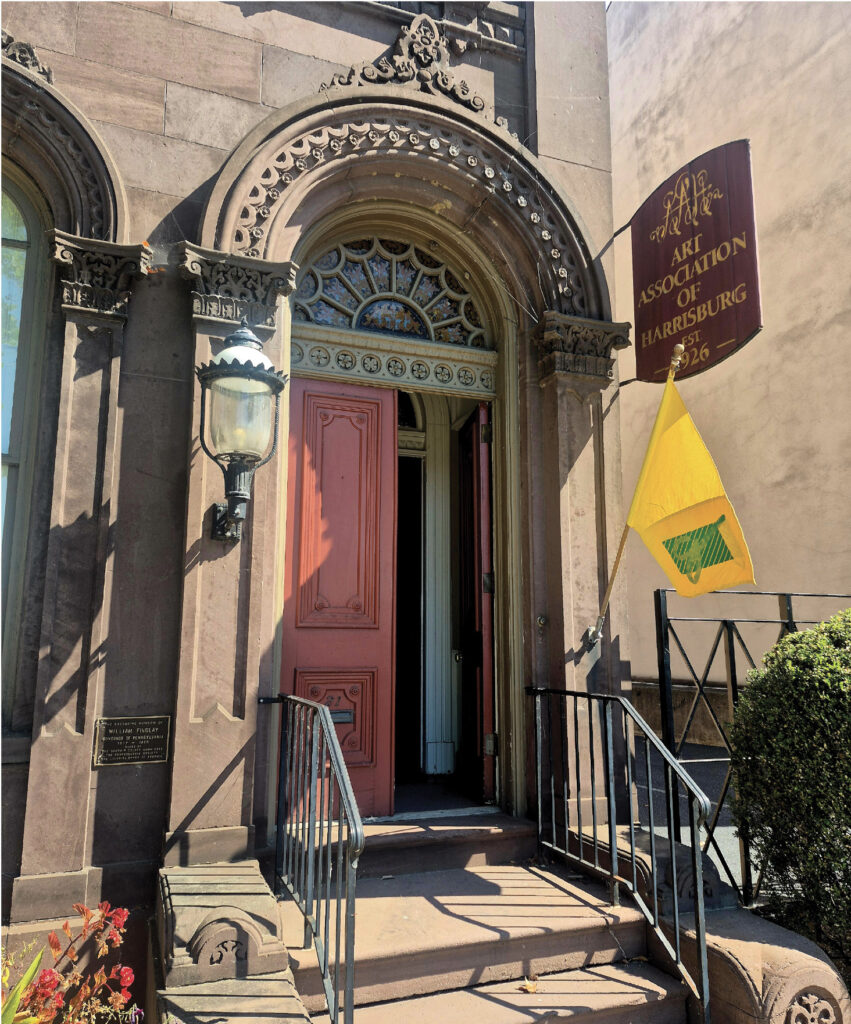
AAH found its dream home, the historic riverfront Governor Findlay mansion, in 1964. Surviving threatened demolition in the 1970s, a 2014 mini-tornado, and, of course, the joys of water leaks, the building today hosts exhibits, a sales gallery and classes, all on four levels of parquet-floored, fireplaced, carved-molding style.

There were eras of debtors and three-figure checking accounts. Active board members, nimble executive directors, and supporters kept the doors open through donations, art sales, capital campaigns and events.

Today, Summer Soirees extend members’ artwork into the elegant backyards of AAH patrons, while Community Exhibitions hang curated works in the galleries of participating businesses and institutions, bringing the serenity of art to workaday settings.

“It’s a chance to get artists’ work out in the community,” said Wissler-Thomas. “Artists will join the Art Association just because they can show their work.”


Heart for Learning

After thriving in the watercolor classes he requested for Father’s Day, Michaelian transitioned from student to teacher. As he watched artists mature to the point where they were teaching the teacher, he hatched the idea for Open Painting Studio, where burgeoning and experienced artists can find space to hone their techniques without formal instruction.

Held in Giant Food Stores’ Camp Hill community room, sessions host 40 to 50 artists weekly.

“The beginning artists seem to enjoy it because they get to see what others are creating, and the other artists get to enjoy walking around and helping the beginners,” he said.

And, he added, “A lot of my students will do their grocery shopping afterwards.”

Past AAH President David Morrison, now executive director of Historic Harrisburg Association, guided AAH through some lean financial years. He remembers the 2002 and 2003 exhibits of live tattoo recipients, displaying the works inked on their skins.

“It was really, really cool and attracted an entirely different clientele from normal art exhibits,” he said. “So, that was really a clever outreach, getting new audiences and showing that art isn’t stuffy.”

A local art association inspires artists to capture the region’s architectural and natural beauty, Morrison noted. AAH once held classes in the Historic Harrisburg Resource Center, helping to cement ties between two of the city’s anchor cultural organizations.

“The fact that we had it right here under our roof really broadened our horizons,” he said. “It brought art to Midtown long before there was the Millworks or Susquehanna Art Museum or Midtown Scholar Bookstore. So, it was kind of the beginning of expanding culture into Midtown.”


Show & Share

To Michaelian, showing at an Art Association exhibit is the North Star for budding artists. When his students exhibit for the first time, “their family wants to take their picture standing next to it, even if they don’t win a prize or it doesn’t sell,” he said. “Carrie and the association bring that to life.”

Susan Fortini and her partner, Raymond Kasper, of Lower Paxton Township, are longtime AAH donors. Artists need outlets for learning, showing and support because “it’s a little hard to do it on your own, and if there’s an organization you could participate in, it helps you to share,” she said. “I believe, if you have a talent, it’s your responsibility to share it. With organizations like the Art Association, you can get involved and have an opportunity to share your talent, your gift.”

Erie native M. Travis DiNicola was working in arts leadership and communications in Indiana. He and his wife, Michelle, had already decided to relocate to Pennsylvania when they attended an AAH show featuring her mother’s work in 2016.

There, Wissler-Thomas convinced them to make Harrisburg their home. DiNicola would serve on the AAH board when he arrived, she pronounced.

True to her word, he is the current president. Since his arrival, DiNicola has seen a diverse, professional board support the staff.

“There’s a lot of respect from local and regional artists for the work the Art Association does and tries to do and can do, and they’ve really pushed the staff and the board, as well, to be innovative and to grow,” he said.

The post-COVID need for socialization and expression propelled enrollment in the AAH school to record-breaking, “crazy high” levels of around 650, DiNicola added. AAH artists are always “pushing each other to be better,” and the organization has the potential to attract tourism and capitalize on “this amazing river” flowing on the other side of Front Street.

In a world where museums, galleries and art groups all have roles in promoting the arts, the Art Association is unique because “the artists are of and from the community and develop in the community for the community,” DiNicola said.

In its first century, the Art Association’s impact has been “huge,” said Wissler-Thomas. Students in the association’s classes—drawing, painting, mixed media, pottery, children’s classes—are constantly sharing the joy the courses have brought them and their loved ones.

To anyone who says computers have made art obsolete, Wissler-Thomas says, “That’s balderdash.” Art created by human hands has soul.

“Over 100 years, we have touched so many lives,” she said. “We’re open seven days a week, so people can come in and enjoy the art whenever they feel the urge. Art is in everything that we look at.”

The Art Association of Harrisburg is located at 21 N. Front St., Harrisburg. For more information, visit www.artassocofhbg.com.

Centennial year exhibits include “Women of the Permanent Collection,” through Nov. 27, and a Carrie Wissler-Thomas retrospective, July 3 to Aug. 30. The Centennial Gala will be held at the King Mansion on April 26.

If you like what we do, please support our work.
Continue Reading

Broad Street Market tops historic preservation priorities list for 2026

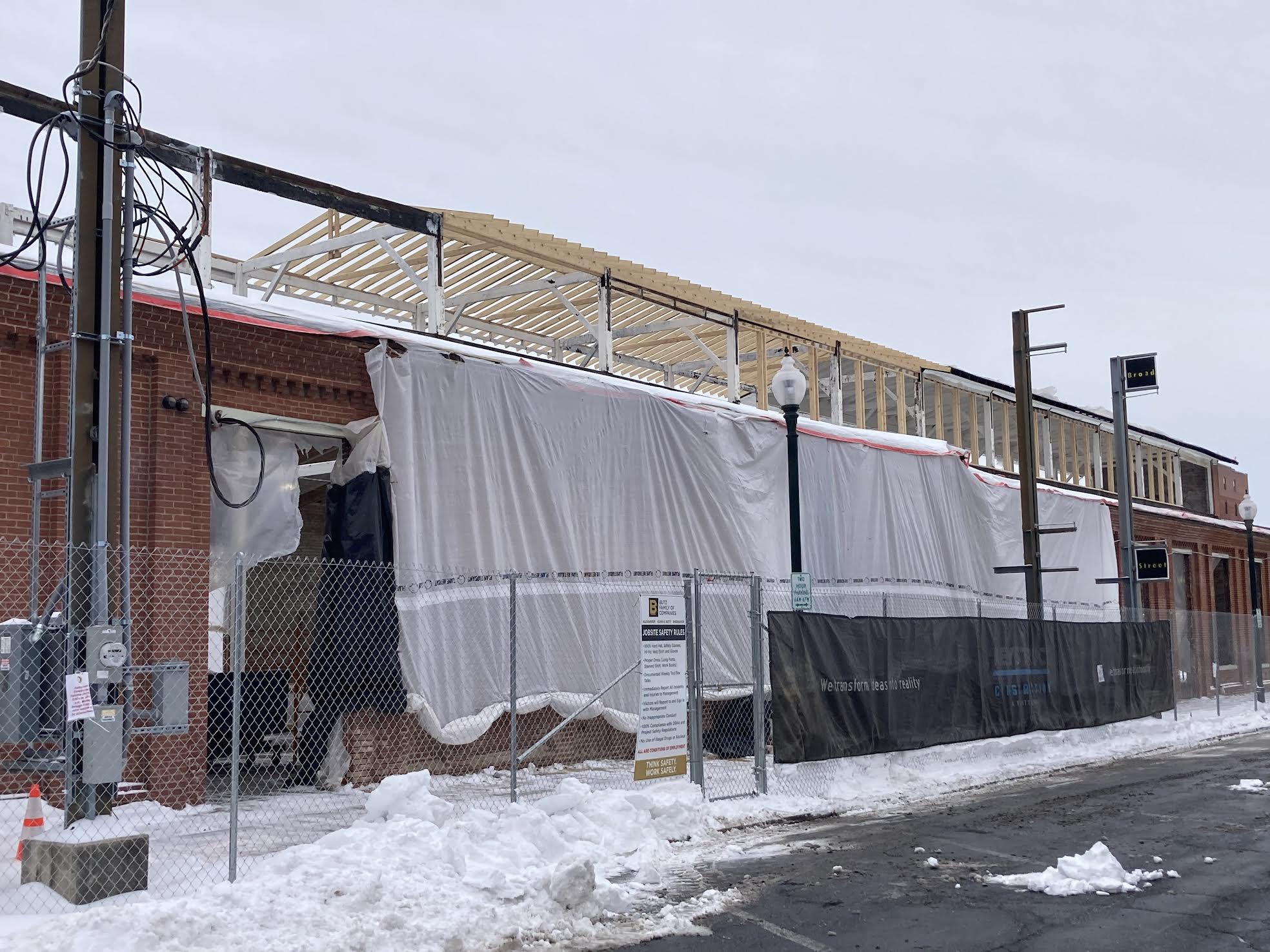
The Broad Street Market’s brick building mid-reconstruction on Tuesday, Jan. 27.

For the second year in a row, Harrisburg’s historic farmers market tops an annual list of “preservation priorities” for an area historic preservation group.

On Monday, the Historic Harrisburg Association presented its list of endangered historic structures in the Harrisburg area, naming the Broad Street Market as its top preservation priority for 2026.

“Because it’s so important to the community and to the metropolitan area and beyond, obviously, it’s our first preservation priority at this point,” explained Jeb Stuart, president of HHA’s board of directors.

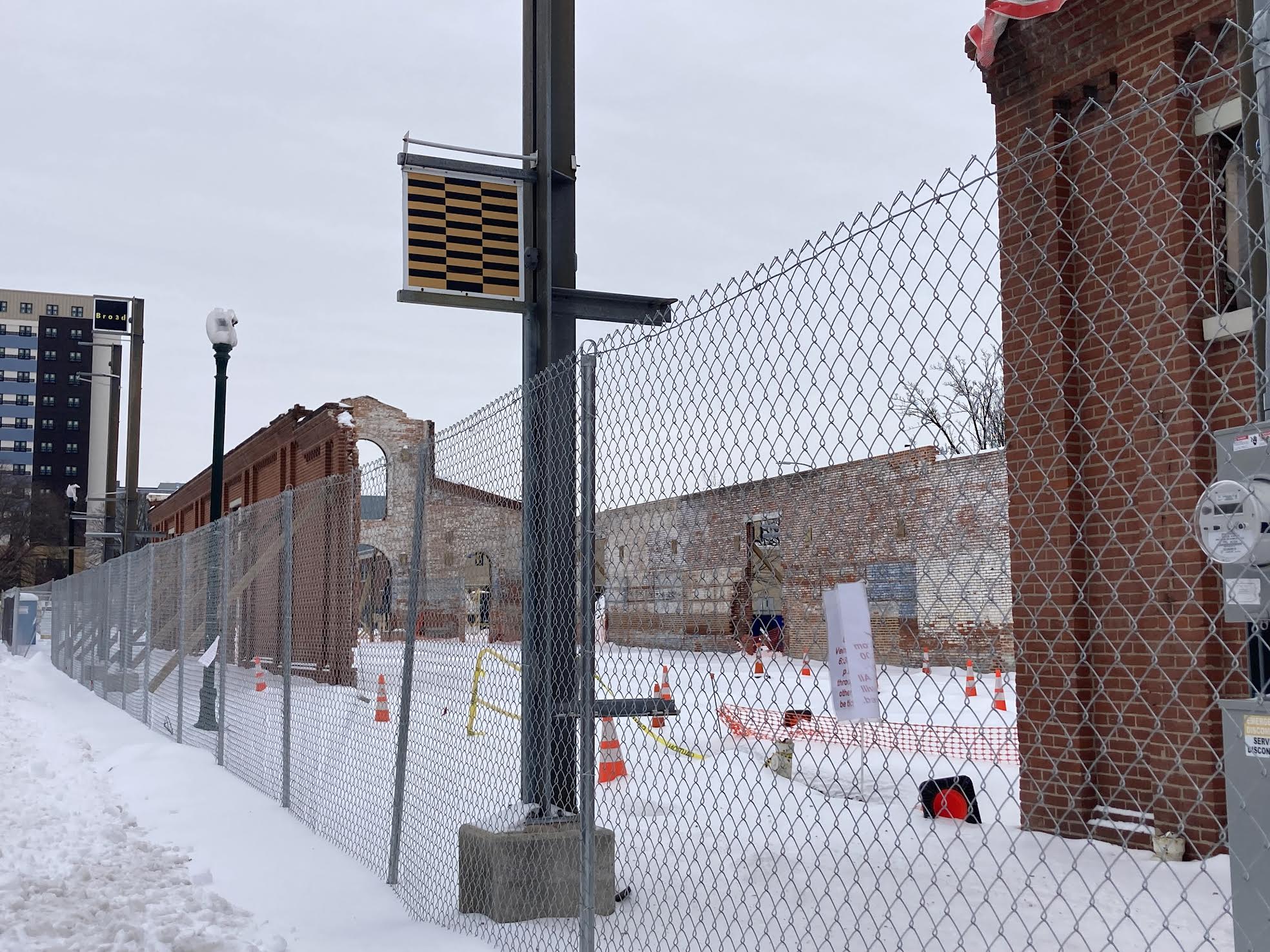
The Broad Street Market’s 1870s-era brick building, listed on the National Register of Historic Places,  faced a devastating fire in July 2023. The partially-destroyed structure sat vacant for a little over two years before Harrisburg began the reconstruction process in the fall of 2025, which was complicated by a wall collapse in December. 

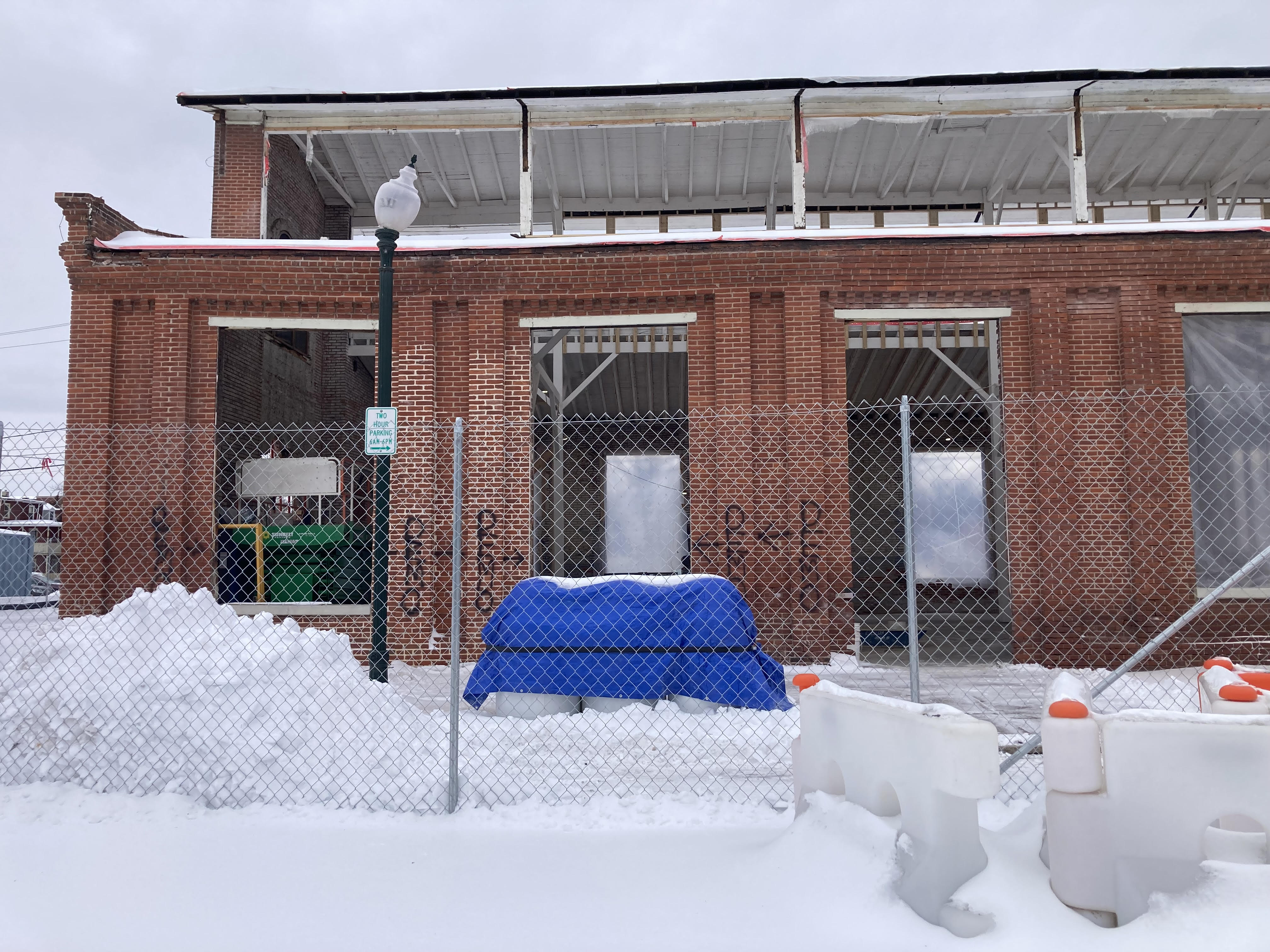
The Broad Street Market’s brick building suffered a partial wall collapse in December.

“That has kind of set things back a ways,” Stuart noted Monday. “Hopefully the city will be more transparent and forthcoming about where the plans are and how they’re moving forward, but we can see the work is being done.”

He added that the brick building’s pop-up roof is being restored to match the original building’s design and that the city, in January, identified an unstable wall it needs to demolish and rebuild as part of the restoration process. The association sees the latter as a positive.

Reconstruction of the historic roof of Broad Street Market’s brick building as of Tuesday, Jan. 27.

“The fact that this work is being done, and that the architects have at least been able to determine that a part of the wall was bulging before it collapsed is a good sign they will hopefully be able to rebuild it,” Stuart said.

The portion of the brick building’s wall identified for demolition.

The association’s remaining four preservation priorities for 2026 include:

  • Former Bishop McDevitt High School, a 95-year-old, neo-Gothic brick building in Allison Hill that served as a school until 2012
  • William Penn High School, a shuttered, 100-year-old school building near Italian Lake
  • Balsley House, a dilapidated, Federal-style former grocery store, located beside Sawyer’s in downtown Harrisburg
  • Riverside Firehouse, a vacant, city-owned former fire station in Uptown that suffered a bell-tower collapse this past year

Stuart expressed concern Monday that the current owner of Bishop McDevitt has “unfortunately” painted a portion of the brick building white. 

The painting of the former band room section of the building has caused people in the neighborhood to express concerns about the owner maintaining the building’s historic integrity, Stuart said. 

“We have found that the owner is trying to do other things that may be inappropriate to the building,” Stuart added. “The city has shut down, from what we understand, further work. They have a stop-work order until certain code issues and other issues are resolved.”

The association named the preservation of the Harrisburg School District’s former vocational school, William Penn, as another top preservation priority. 

The district proposed demolishing the school in 2023, but reversed course. After exiting receivership in June, the school board reviewed its slate of options for the property at a November special board meeting.

At this time, the future of the building remains unclear. 

Stuart noted that Historic Harrisburg views the district’s apparent reluctance to sell the property as “an issue” standing in the way of any proposed reuse or restoration projects for the site.

Stuart expressed hope for another structure on the list, the Balsley House, located on N. 2nd Street in downtown Harrisburg. One of the oldest structures in downtown, and formerly a grocery store, he said Historic Harrisburg has hopes of seeing it repurposed into a retail location.

Lastly, he listed the Riverside Firehouse. The 1923 building, located in Uptown, suffered damage to its historic belltower due to heavy winds in November.

“It continues to suffer from deterioration,” Stuart said, urging the city to resolve a real estate title issue and push the property out to potential buyers who could restore the structure.

Historic Harrisburg’s annual “Watch List”

Historic Harrisburg also placed almost two-dozen buildings and structures on its “watch list” Monday. 

These include:

  • Mira Lloyd Dock House, Front and Reily streets
  • Lochiel Hotel, 901 Shanois St.
  • Central Publishing House, 100 N. 13th St.
  • Former Chisuk Emuna Synagogue, 423 Division St.
  • Bartholomew & DeVout Mansion, 208 Hummel St.
  • Old State Police HQ/American Dream Diner at 2100 Herr St. (Susquehanna Township)
  • Meyers Mansion, 213 Front St.
  • Market Street Bridge
  • 19th Street Armory, 1313 S. 19th St.
  • Cumberland County Railroad Bridge (connects Lemoyne and downtown Harrisburg)
  • Historic Peace Church (Hampden Township)
  • Donald Cameron Mansion, Front and State streets
  • Bishop Bridge, Cumberland and York counties
  • First United Methodist Church, Boas Street
  • Grace United Methodist Church, State Street
  • Former St. Paul’s Methodist Church, Vine Street
  • Harrisburg State Hospital
  • Paxton Firehouse, 336 S. 2nd St.
  • Camp Curtin Church, 2221 N. 6th St.
  • Atlas Building, 6th and Maclay streets
  • Walnut Street Bridge (connects downtown and City Island)
  • Captain John Gilchrist Homestead, Linglestown Road

Preservation Successes

Stuart also identified two preservation successes in the Harrisburg region: the Prospect Hill Cemetery Gatehouse, at 25th and Market streets, which has been restored after being hit and damaged by a car, and the Nauman Mansion, at 315 N. Front St., which is being transformed into apartments.

According to Historic Harrisburg’s executive director David Morrison, the organization has been creating annual “Preservation Priorities” for 20 years now and presenting them for roughly 10 with the goal of making the public aware of historic structures in need of preservation efforts.

Click here for more information on Historic Harrisburg.

If you like what we do, please support our work. Become a Friend of TheBurg!

Continue Reading

Governor’s Residence will remain on historic home tour, despite arson attack

The Pennsylvania Governor’s Residence will be a stop on the Historic Harrisburg Association’s annual tour.

The Governor’s Residence will be a stop on an annual holiday home tour, despite an arson attack last April that prompted extensive renovations.

The Historic Harrisburg Association announced Wednesday that the residence, which has historically been included on the group’s annual Candlelight House Tour, will remain a stop this year, following “uncertainty as to its inclusion.”

In April, Penbrook resident Cody Balmer lit the mansion on fire. The arsonist firebombed the residence at 2 a.m., targeting Gov. Josh Shapiro, who had just celebrated the Passover holiday with his family. In October, Balmer was sentenced to more than two decades in prison for his crimes.

The self-guided tour offers attendees a chance to walk through a selection of historic homes in Harrisburg at their own pace, using a provided guidebook. The tour will take place Sunday, Dec. 14 between 1 and 6 p.m.. 

Launched in 1973, this marks the Association’s 52nd year hosting the event. HHA executive director David Morrison said the tour is “the oldest and biggest tour of its kind in the Mid-Atlantic region.”

For $20 in advance, or $30 day of, tickets can be purchased online or in-person at the Historic Harrisburg Resource Center.

The Historic Harrisburg Resource Center is located at 1230 N. 3rd St. in Harrisburg. For more information about HHA, visit its website.

If you like what we do, please support our work. Become a Friend of TheBurg!

Continue Reading

Wind damages “deteriorating” Harrisburg firehouse; historic association urges sale before it’s “too late”

Riverside Firehouse. The roof of the bell tower was removed after sustaining damage due to wind.

Local historians and community members are concerned about the state of a historic firehouse.

Harrisburg’s Riverside Firehouse suffered damage after a windstorm over the weekend, which David Morrison, executive director of Historic Harrisburg Association, says is only part of the deterioration of the historic building.

The firehouse, located at 3203 N. 4th St., hasn’t been operational in decades, but has since served as a polling place and community gathering space for neighbors, although it has largely been vacant in recent years. Harrisburg owns the property.

“It is seriously deteriorating,” Morrison said of the building, constructed in 1923.

According to City Public Works Director Dave West, a small wooden roof detached from the building’s bell tower during the recent high winds. The city’s demolition crew removed the dry, rotted roof on Monday and plans to temporarily secure the brick portion of the bell tower on Wednesday. Eventually, West said he plans to have the brick tower repointed.

West assured that the building is not a public safety concern.

However, Morrison described the firehouse as in “precarious condition,” noting that it has been on HHA’s “Preservation Priorities” list for several years.

“It’s a beautiful historic building that could be repurposed,” he said. “The frustrating thing is that we know there are interested people that would buy it.”

The hold-up currently rests with the city, which has had plans to sell the building for as long as six years.

The property is actually comprised of two parcels, one which was historically owned by the city and one by Riverside Fire Co. No. 15, an inactive volunteer fire company in Harrisburg. In November 2019, City Council passed a resolution to transfer its parcel to the Harrisburg Redevelopment Authority (HRA) and stated that the fire company would transfer its parcel to HRA as well. The plan was to have the parcels consolidated and then put on the market for sale.

However, that has not yet happened.

According to City Solicitor Neil Grover, the city’s parcel has not yet been transferred to HRA. The fire company’s parcel was sold to HRA in 2020, according to Dauphin County property tax information.

Grover said that the city’s holdup is due to his office’s budgetary and time constraints, citing the pandemic as a factor in the delay, as well.

Morrison said that, if sold, the firehouse could be beautifully restored, but worried that further delay would allow the building to continue to deteriorate. He cited the Allison Hook & Ladder Co. building on S. 14th Street, which was fully renovated in 2019, as an example of what could be accomplished.

“We would love to see the same thing happen with Riverside, but it’s got to happen quickly or it’ll be too late,” Morrison said.

The firehouse has become somewhat of a gathering place for the Riverside United Neighbors (RUN) community group. It’s where they host their annual Halloween candy drop and have held yard sales, according to RUN board member Diane McCormick.

“That space has been the center of the community for decades,” McCormick said. “It’s really an anchor for the community.”

The neighborhood group hasn’t used the inside of the building for much more than storage in years, but uses the exterior lawn for events.

McCormick said that RUN members would like to see the building historically restored, no matter if it’s purchased for private or public use.

“It just needs to come back,” she said. “It’s a space that the community would like to see revitalized in some way.”

If you like what we do, please support our work. Become a Friend of TheBurg!          

Continue Reading

Planting Pride: Bill Gantt’s love of Allison Hill extended to his neighbors and his beautification efforts—and his legacy lives on

Bill Gantt

Life on the quiet block of Sylvan Terrace in Allison Hill was reminiscent of an old-fashioned neighborhood—almost idyllic.

Neighbors became friends, and their children played tag on the sidewalk, caught fireflies in the summer, and built snow forts on days off from school. The adults lent a hand in each other’s gardens and shared plates of food. The elders and parents all kept a watchful eye on the kids from their front porches.

When a huge snowstorm hit the city one year and the plow couldn’t make it down their tight street, neighbors shoveled the road and dug out parking spots for those who had to work.

“That’s the kind of community we have,” said Deb Rodriguez. “Our neighbors look out for each other.”

Bill and Deb Gantt’s house sits near the middle of the snug block, and neighbors attributed much of the camaraderie on the block to the family.

Next door to their house is the late Eulalia “Lala” Rodriguez’s home, where the families have been neighbors since 1977. Several of Lala’s children and grandchildren have also lived in the neighborhood.

Nearly 10 members of the Rodriguez and Gantt families gathered in the home this spring to reminisce on the neighborhood and share Bill’s story with me—a story that is deeply bound to their own, and their neighborhood’s.

Over the decades, the families’ lives became entwined. Bill was known to casually walk in the front door with a tin of home baked cookies or cake and leave with some of Lala’s signature rice and beans.

When Bill wasn’t baking, he was working on his home, which he restored and designed himself, tending to his garden or helping his neighbors with projects.

“He was like the glue that held the block together,” said Gloria Montalvo, one of the nine children of Lala.

Bill passed away in December from health complications, leaving a hole in the community that he deeply loved. Harrisburg was his home, and the community his passion. And his impact reached beyond Sylvan Terrace, to all of Allison Hill, where he would regularly take on beautification projects and frequent the local watering holes to meet people and make new friends.

Possibly his longest, most dedicated project was planting flowers annually in the historic horse watering trough at Mulberry and Derry streets. Every spring, for 50 years, Bill planted the flowers on his own dime.

“Spring’s coming up, so this is when he’d always be out, so it’s going to be sad,” Montalvo said.

However, the family and neighbors won’t let the watering trough sit empty. They’ve already come together, with help from local organizations, to fill it with flowers in Bill’s honor—fulfilling a final request of his.

“This man devoted his life to that,” said Deb Rodriguez, who married into the Rodriguez family and lives on the block. “There are a lot of people in our community that really do care—Bill was at the pinnacle. He was our go-to guy.”


Preservation Pioneer

Gantt moved to Harrisburg in 1970 for a job downtown at the old Pomeroy’s department store. Living in the same city apartment building, young Bill met Deb, who thought he was handsome. Like the start of a rom-com movie (Bill brought the comedy—his friends and family described him as a jokester) the couple started dating, later married, and bought their Sylvan Terrace home.

The couple fell in love with the city and enjoyed raising their son Julian in such a family-friendly and diverse neighborhood.

The neighbors represented various cultures and races—the Rodriguez’s being Puerto Rican, the Gantts white, and other neighbors were Asian, Greek, Black and Latino—and they celebrated their differences. Although, mostly, they didn’t really think about them, the neighbors shared, as they saw each other as family.

“You didn’t really experience differences,” said Andrea Taylor, Deb and Angelo Rodriguez’s daughter who grew up playing with Julian and the neighborhood kids. “You never thought about it.”

Julian believes that was part of why Bill appreciated his community so much. It was different from his upbringing at his family’s small dairy farm in West Virginia.

“He loved getting to know people from different backgrounds and different cultures,” Julian said. “He was very curious and open and wanted to learn more. He loved the diversity, loved the community.”

Bill wanted his neighborhood to take pride in where they lived, which drove his community and historical work on Allison Hill. He started the South Allison Hill Civic Association and the Allison Hill Municipal Historic District, served on the Harrisburg Architectural Review Board and worked closely with the Historic Harrisburg Association.

“He was really a history preservation pioneer in Allison Hill,” said David Morrison, executive director of HHA. “He was certainly one of the major leaders. His impact on that neighborhood was huge.”

Morrison described his preservation work as “contagious,” and Bill helped neighbors with home projects, while also restoring several houses that he owned.

Bill was an artist and a master of interior design, even crafting curtains for and wallpapering the city’s historic John Harris Mansion, and eventually opening his own storefront.

He loved to use his many talents to help his neighbors. That included hand-crafting a bassinet for a new baby, teaching neighbors some of his skills, and, lovingly, telling a neighbor that if they adjusted their Christmas decorations, the display would look better.

“He would say, ‘I don’t know what you did there, but I would take all of that down. It doesn’t even match.’ I’d say, ‘Oh, I’m sorry. We’re Puerto Rican so it doesn’t have to match,’” Diana Rodriguez said jokingly.


Neighborhood Guy

When Andre Butts opened his restaurant, Uncle Dre’s Café on Vernon Street four years ago, Bill quickly became a regular—and a friend.

He came to the café dressed for Halloween, was a judge for the Superbowl hot wing eating contest and would often engage in long conversations with Butts.

“He was a neighborhood guy,” Butts said. “Everybody knew him. He was all about the community.”

Bill’s wife Deb said that he loved going to the local bars to meet people and have conversations about life and Allison Hill. And while people knew he was involved, he never made a show of it, but worked quietly and committedly behind the scenes.

“He just loved it here. He loved his neighbors, and he tried to do whatever he could to improve the neighborhood,” Deb Rodriguez said. “He was so instrumental in all the good things that happened in this neighborhood.”

To continue his legacy, the family will organize the flower planting at the historic watering trough, with aid from local organizations. Historic Harrisburg Association has offered its Community Historic Preservation Fund to collect donations to maintain the trough in Bill’s honor. The Latino Hispanic American Community Center, located near the structure, will also pitch in by using a stipend of the donated funds to pay someone to care for the plants.

Julian believes his dad would’ve loved to see how people have come together to continue beautifying his beloved Allison Hill. Because to Bill, his community was really his world. He wanted others to feel pride in where they lived because that was unapologetically how he felt.

And so, the story of Bill’s life and that of his neighborhood are so tied up that one couldn’t be told without the other.

“It was totally intertwined with his identity—living in Allison Hill,” Julian said. “It was who he was. He chose to live there. He set up his life there after leaving the farm. It was totally part of his soul—living in that neighborhood.”

To donate to Historic Harrisburg Association’s fund for the historic watering trough, visit www.historicharrisburg.org/getinvovled/donate and note that the donation is for the “Bill Gantt Fund.”

If you like what we do, please support our work. Become a Friend of TheBurg!   

Continue Reading

Restoration & Frustration: Long after a destructive blaze, the Broad Street Market endures, abides, presses ahead

Eric Hagarty

In a charmless, cramped tent where the floor wobbles underfoot, hungry lunchtime customers formed long lines for deli sandwiches and barbecue at the Broad Street Market.

“Their club sandwich is amazing,” a Fisher’s Delights patron told his companion.

The Broad Street Market, constituting the stone building and a hard-sided tent, is open and supplying fresh, healthy and scrumptious food. As the market perseveres, its future preoccupies the minds of countless stakeholders—city officials, board members, vendors, residents—hoping to see its shattered half rise from the ashes of a devastating fire.


Brick Building

On July 10, 2023, fire tore through Broad Street Market’s brick building, the circa-1870s companion to the Civil War-era stone building.

City, county and state officials vowed to rebuild. Over 20 months later, the building looks almost like it did the day after the fire. Chain link fencing warns away the public. On brisk days, torn sheeting covering the clerestory windows flaps in the wind. By anyone’s account, progress has been slow.

The city owns both buildings and the market land. David Baker, city facilities and special projects director, confirmed a restoration timeline—which extends two years from now, or nearly four years after the early-morning fire.

Construction drawings are complete, and bidding begins June 2025. Construction starts Sept. 1. Construction is done May 1, 2027. The city will continue sharing renderings via media, social media and market-related groups, said Mischelle Moyer, the city’s communications director.

Before a standing-room-only crowd at a February town hall, city officials promised to prioritize brick building reconstruction above all market-related plans.

Plans drawn by Murphy & Dittenhafer Architects showed a building restored to its historic look on the exterior.

Note the operative word, “look.” Exterior renovations of buildings in Harrisburg’s Midtown Municipal Historic District require review by the Harrisburg Architectural Review Board and City Council approval. HARB’s standards are strict but allow some modern materials that uphold historic integrity.

The National Register of Historic Places, which lists the market, does not require historically accurate exterior renovations unless U.S. Department of the Interior funding is involved, according to Frank Grumbine, community preservation coordinator of the central region, State Historic Preservation Office, Pennsylvania Historical and Museum Commission.

The fire offered “a big opportunity to blend old with new,” Grumbine said. “With such a tragedy and such a loss, there’s always a silver lining on how to address the market in the future and the role of the market in Harrisburg.”

David Morrison

Historic Harrisburg Association hopes to see preservation best practices campus-wide, said Executive Director David Morrison. He recalled the 1990-era restoration of the brick building’s 42 enormous windows, which used rock maple—not “squishy” new-growth lumber—for the frames.

“That was a major expense, and it was done right,” Morrison said. “I’m hoping that that same attention to detail and authenticity and durability will be incorporated into the restoration. There are wood windows, and there are ‘wood windows.’”

Plans call for a new mezzanine augmenting ground-level seating. Small, medium and large modular units would maximize space by accommodating vendors of different sizes as they come and go. And hallelujah, the sometimes sweltering, sometimes freezing building would be equipped with air conditioning and heating.


Vivi Sterste Brandler

The Courtyard

In January, Harrisburg Mayor Wanda Williams threw a boulder into a still pond by releasing a proposal to erect a two-story, glass-walled enclosure in the courtyard linking the market’s two buildings.

Stressing that plans are preliminary, city officials have touted the possibilities. Shelter from the elements. Room for more vendors. Revenue generation through rentals.

The city will “need to establish funding before any further steps will be taken with the middle building,” Moyer said. In other words, a new building constructed in the current courtyard is, as of right now, little more than an idea.

Vivi Sterste Brandler, owner of nearby Vivi’s on Verbeke, doesn’t like that “idea”—at all. She is circulating a petition to retain the courtyard’s free, open-air tradition that dovetails with today’s “third space” trends.

“People have come to me and told me how some of those enclosed spaces just don’t work for the community,” she said while collecting signatures in the stone building. “We want to maintain the sun and the community space because people like to come just spontaneously.”

Some proponents of a new structure cite precedent, as a building long stood in the courtyard, from the 1860s until around the 1960s. Morrison countered that the market’s then-private owners erected the wood building hastily, before acquiring land and constructing the permanent brick building, to accommodate the pressing need for vendors.

Covering the courtyard could obscure the market buildings’ historic facades and erase a beloved third space “that’s available to the public 24/7,” Morrison said. “It makes the market more than just a shopping center. It makes the market more of a destination.”

Before the fire, Jennifer Adams and her children would hang out in the courtyard on Fridays, listening to local musicians and buying veggies from outdoor vendors. The East Pennsboro Township resident, who works at nearby Radish & Rye Food Hub, includes the market in her “little walkabouts at lunch.”

“I love any space where people can gather in the city of Harrisburg,” she said. “It was a space where we could just go. I don’t want to see that go away.”

If the city decides to build a third structure, the Broad Street Market Alliance—responsible for market operations—would request details on its business viability, vendor demand and assignment of responsibilities for operations and utilities, said alliance Chair Eric Hagarty.

“The opinion that matters is not mine but the public’s,” he said.


Stone Building

Untouched by the fire, the stone building doesn’t qualify for any of the $10 million in insurance funds going toward the brick building, but like its brick sibling, it needs air conditioning and ventilation upgrades, plus a new roof.

The city has established funding for preliminary stone building upgrades and will request funding from the Pennsylvania governor’s office toward additional renovations, Baker said. Any construction must wait for renegotiation of the agreement between the city and the market alliance delineating their responsibilities, he added.

And although city officials continue to emphasize that any stone building upgrades must wait until the brick building is complete, Hagarty could envision efficiencies gained by simultaneous upgrades, if funding materializes.

“We hope to raise money as the alliance to help contribute to the city’s efforts,” he said. “Figuring out the financing is a little complicated, but my aspirational hope is that we can leverage the activity that’s happening at the brick building.”

After the fire, market revenue plummeted, and the market alliance was facing a projected $160,000 structural deficit.

Revenue losses were just one worry. In the shockwave following the departure of market Executive Director Tanis Monroy, later charged with felony theft from market accounts, the board discovered about $50,000 in unpaid bills, plus a lack of business-loss insurance that would have covered lost revenue—“a huge mistake,” Hagarty said.

Today, with a $350,000 Pennsylvania Department of Community and Economic Development grant plus donations, operating efficiencies, and a voluntary rate hike accepted by vendors, the market expects to close out 2026 with “well over” $100,000 in the bank, Hagarty said.

To solidify procedural reforms, the board is taking steps to adopt financial management plans, retain proper insurance coverage, create leadership succession plans, and post financial transactions on its website.

“It’s going to require the public to continue to hold the market alliance accountable,” Hagarty said. “We are setting a precedent of transparency, so that any member of the public should, in theory, be able to go to our website and ask questions. You should not need to be a board member in order to understand the health of the organization.”


Brighter Days

So, to recap. Fire. Fraud. Fiscal woes.

And still, the market abides.

“The Broad Street Market is so much more than just architecture, and it certainly matters to the community,” Morrison said.

Hagarty thanked “everyone in the community who has stepped up over the last year and a half to help save the market.” Alliance members Venus Hawbaker and Tashia James helped him manage the market as the alliance has been seeking a new executive director. The city’s Baker and his colleagues “are working every day to try to make this project move as quickly as possible.”

“It’s all a great example of the cliché that it takes a village,” Hagarty said. “I’m extremely confident that the market’s brightest days are ahead after a very dark year. Every week, I feel more and more encouraged, and it’s all because of everyone who lives here, who’s been volunteering and donating and showing up to work to help keep things going.”

The Broad Street Market is located at N. 3rd and Verbeke streets, Harrisburg. The full market is open for business. The stone building’s hours are 7 a.m. to 6 p.m., Thursday through Saturday. The tent’s hours are 7 a.m. to 5 p.m. Thursday and Friday, 7 a.m. to 4 p.m. on Saturday.

Photos by Dani Fresh.

If you like what we do, please support our work. Become a Friend of TheBurg!   

Continue Reading

“Merci”: Harrisburg welcomes back Marquis de Lafayette, hero of the American Revolution

Michael Halbert as Marquis de Lafayette, in front of the exhibit at the McCormick Riverfront Library in Harrisburg

Harrisburg founder John Harris, Jr., was no fan of the French after the French and Indian War, but last Saturday night, he returned from the beyond to remind his city’s 21st-century residents that he petitioned to name his county “Dauphin,” honoring the French prince and the French support that was instrumental in breaking free from British despots.

And then he turned to the regal gentleman in black Regency-era tailcoat beside him, Gilbert du Motier, Marquis de Lafayette, general of the American Revolution.

“Your patriotism for those of us who are seeking liberty, seeking freedom, seeking our own government, seeking not just colonies but states – sir, to you this night, the General Marquis de Lafayette, we salute you,” said “Harris,” portrayed by interpreter David Biser. “Hear, hear, good sir. Vive la liberté. Welcome to our fine city, sir.”

The gathering on the evening of Feb. 1, 2025, commemorated the Jan. 30 to Feb. 2, 1825, visit of Lafayette to Harrisburg.

In 1824, Lafayette left his native France for an America that had grown from 13 colonies to 24 states. The planned three-month tour stretched into 13, as Americans clamored to see their hero, the last living Revolutionary general.

His visit to Harrisburg, at the invitation of Gov. John Andrew Schulze, included a reception at Schulze’s home (owned and built by Capitol architect Stephen Hills) at 27 N. Front Street – and that is where the 2025 commemoration happened, in the Kunkel Foundation Community Room of Dauphin County Library System’s recently restored Haldeman Haly House.

“I am proud to say that we tonight are in the room where it happened,” said Biser.

Yes, he was quoting “Hamilton.” And no, John Harris, Jr., could not attend the 1825 reception due to his death in 1791, but with Biser as his messenger, he gladly noted that his sons served under Lafayette at the Battle of Brandywine.

David Biser as John Harris Jr. and Michael Halbert as Marquis de Lafayette

The evening’s organizers were the Pennsylvania Heritage Foundation, Historical Society of Dauphin County, Historic Harrisburg Association, Harrisburg Chapter of the National Society of the Daughters of the American Revolution, and Dauphin County Library System.

Many of the 50-plus guests dressed in attire from a patchwork of historical eras. The evening transported them back in time, with soft lighting, built-in shelves filled with law books, wavy-glass windows overlooking the Susquehanna River, strolling violinist Betsy Barnicle dressed in French Revolutionary tri-color, and marble-surrounded fireplace (lit with battery-operated candles. Thanks, 21st century.)

As portrayed by French-accented interpreter Michael Halbert, Lafayette expressed his gratitude to the people of Pennsylvania, Philadelphia, and Harrisburg for their “cordial reception.” He was overwhelmed with emotions to be near Brandywine, where he “first shed blood in cause of this country” under his friend and mentor, Gen. George Washington.

Dominish Miller, DAR member, at the event

Americans should be “uncompromisingly proud of their Republic,” Lafayette said. Americans were setting an example for other countries, now eyeing the “happiness and prosperity” crafted by a population growing in wealth and prestige under their democratic system.

“I join with you in hoping that the blessings of America will be more generally diffused, and the bright example of America not be lost to the nations of the earth,” he said.

Lafayette was not the only person overwhelmed by the proceedings. After he spoke, Historic Harrisburg Association Executive Director David Morrison enthused, “We have just relived history, which very few people get an opportunity to do.”

“Lafayette is back,” Lafayette 200 Executive Director Chuck Schwam told attendees. “I don’t know if you’re getting goosebumps thinking about the fact that we are in the room that he was in 200 years ago, but I’m getting goosebumps.”

Americans of 1824 flocked to see Lafayette not only because he championed their cause of liberty, Schwam said, but also to see “the human rights champion, and abolitionist, and feminist, a friend of the Native Americans, a man who felt we should be able to worship in any way we should.”

To commemorate the 2025 visit, Art of Association of Harrisburg Executive Director Carrie Wissler-Thomas unveiled a portrait of Lafayette. Presented on behalf of abolitionist Gov. William Findlay (1817-1820), it will hang a few doors up the street at 21 N. Front Street, Findlay’s mansion and now home to the Art Association.

Holding the event in library space conjured the spirit of Lafayette for the power of reading, hearing, and engaging with ideas, said Dauphin County Library System Executive Director Ryan McCrory, attired in 18th-century flourish.

“When you do those three things in the library, if you do it with genuine curiosity and honest hearts and a critical eye with both the ideas and the people that you engage with, we can cross an ocean,” he said. “We can forge a brand new nation.

Like the real-life Lafayette, Halbert is crisscrossing the U.S. for bicentennial commemorations. He typically crafts his addresses from the patchy record of Lafayette’s statements but, he told TheBurg, his Harrisburg remarks were based on a uniquely rich trove documenting his talks before the Pennsylvania legislature and local dignitaries.

Lafayette closed his remarks with his delight in reconnecting with his American friends and their children and grandchildren.

“The people of Harrisburg and all who are assembled here, please accept my thanks with this expression of your attachment, and receive my best wishes for every degree of prosperity which the freedom and independence you enjoy entitles you to afford,” he said. “Merci.”

For more on the 200th anniversary of Lafayette’s visit to Harrisburg, read our magazine story from the January issue.

If you like what we do, please support our work. Become a Friend of TheBurg!

Continue Reading