Illustration by Rich Hauck
I co-founded TheBurg back in 2008, at the start of the worldwide financial crisis.
At the time, I described to a friend my less-than-ideal timing.
“I feel like I’m starting a company in 1929,” I said, referring to the stock market crash and start of the Great Depression.
As it turned out, the “Great Recession” wasn’t quite as terrible as that earlier economic calamity, and we were able to muddle through, though not without considerable challenges and sacrifices.
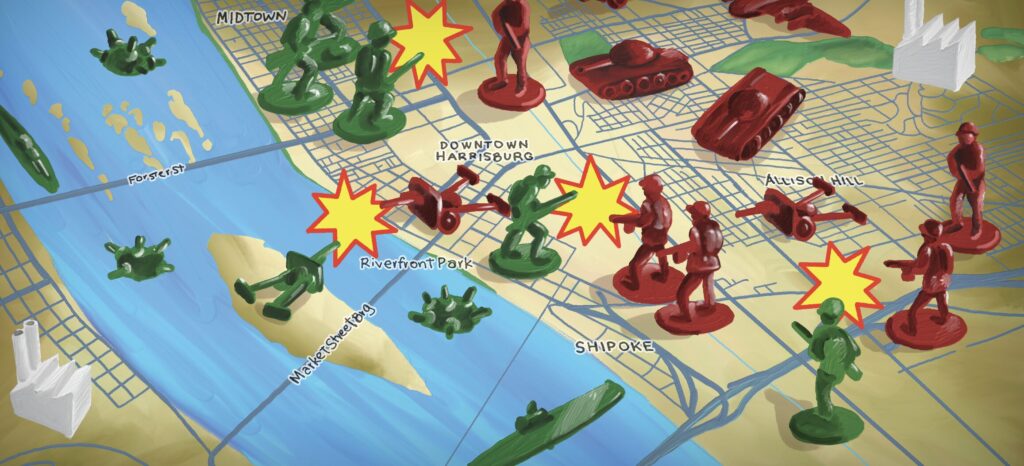
The thing I didn’t see coming was the precarious situation in Harrisburg, that the city where I would start my business was about to enter its own financial crisis apart from the national one. In fact, since my arrival, I feel that Harrisburg has veered from one crisis to the next. Just as one ends, another seems to take its place.
As a resident, as a homeowner, as a business owner, as a stakeholder, as someone who cares deeply about this place, I’ve felt knocked about for much of the past 18 years.
To me, the question is—why? Why is this little city—seemingly so blessed by its setting on a magnificent river and by its status as a state capital—in a constant state of crisis?
To me, the answer is twofold. The first part is beyond our control. The second part is very much within our control.
Since the 1950s, Harrisburg has been buffeted by misfortune. The steel industry collapsed. The railroads died out. Floods devastated neighborhoods. All these caused large and small businesses to close, people to leave and investment to wither.




By the 1980s, Harrisburg’s population had been halved, downtown was a ghost town after dark, and large swaths of neighborhoods were boarded up or razed in the name of slum clearance.
More recently, the city has been walloped again by forces beyond its control. This time, it’s taken the form of COVID, of remote office work, of the heartbreaking fire at the Broad Street Market.
The head swims.
But Harrisburg’s lowly state isn’t just because of exogenous forces or “acts of God,” as the insurance people like to say. It’s also been a matter of leaders’ flawed responses to these crises, which, in my opinion, constitutes the second part of the equation.
I know that, in Harrisburg, many people are tired of the nagging comparison with Lancaster, which, yes, is overstated. But bear with me, because this part is apt.
Lancaster also suffered from such problems as the collapse of heavy industry, aging infrastructure, and the rise of the suburbs. But the people of Lancaster, as a whole, never forsook their city. Key stakeholders stayed, the population remained stable, and business and government combined forces to find creative solutions to tough problems, including making and financing long-range plans.
Contrast that to Harrisburg.
Here, people abandoned their city. Harrisburg-born companies, some very successful, moved out, taking their workforces and money with them. Investment dried up; residents fled. The city got caught in a vicious downward spiral, left to the predations of arsonists, slumlords and profiteers.
Into this vacuum stepped the city’s self-styled savior, seven-term Mayor Steve Reed. Reed legitimately wanted to help Harrisburg, but his ambitions vastly overwhelmed his wallet. He built the city’s rebirth on a quicksand of massive debt, resulting in short-term gain but long-term pain.
In addition, Reed set a terrible precedent. His leadership style could be described as self-important and high-handed, the first in a string of such mayors. In my view, this shared trait has led to many unforced errors, as the city’s leaders often have chosen control, command and conflict over modesty, cooperation and pragmatism.


The state government’s approach to its capital city hasn’t helped either.
For much of history, the commonwealth largely ignored Harrisburg, except when it wanted something from it, like ever-more land. When it did intervene, in 2011, it was to ban the city from declaring municipal bankruptcy and then imposing its own heavy-handed solution, which caused the city to lose control of its valuable parking system. The state then looked the other way as its chosen parking manager ran amok, repeatedly raising rates until people stopped coming downtown. Its lenient work-from-home policy was another nail in the coffin.
The commonwealth now is promising to work with city stakeholders to help revive the downtown. We’ll have to see if their current pledges work out any better than their past ones. I, for one, will wait and see.
Honestly, it’s exhausting. Since I’ve been in Harrisburg, it’s been one battle after another, to crib from the recent Oscar-winning film.
Unfortunately, Harrisburg can’t do much about the external forces that seem to bedevil it. One day, for instance, there will be another flood. But it can do something about its response to these crises, as well as to the routine challenges that bubble up each day.
Harrisburg needs leadership that puts pragmatism before politics, caring over conceit. It needs hard-working people in government who will cast their egos aside and selflessly serve others. It needs leaders who understand how to set priorities, collaborate, motivate and efficiently get things done for the common good.
The best government works in the background, humming along, delivering services as quietly and responsibly as possible. It doesn’t create problems; it solves them. It places the long-term welfare of people over the short-lived allure of self-interested power.
Lawrance Binda is editor and publisher of TheBurg.
If you like what we do, please support our work. Become a Friend of TheBurg!