Tag Archives: Danielle Bowers

Harrisburg Council refuses to confirm housing director; mayor says programs now threatened

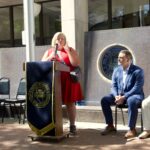
Franchon Dickinson, center, as she and Mayor Eric Papenfuse accepted a check for the city’s lead abatement program on Tuesday morning.

Harrisburg City Council on Tuesday rejected a top administration appointment, with the mayor stating that the decision imperils key city housing programs.

By a 4-2 vote, council turned down the appointment of Franchon Dickinson as the city’s new director of building and housing, the second time this year council members had refused to confirm her appointment.

Following the vote, Dickinson, who was serving as interim department director, resigned her job with the city.

Mayor Eric Papenfuse railed against the vote, saying that Dickinson’s departure endangers two critical housing programs—the annual Community Development Block Grant (CDBG) program and the city’s Lead Hazard Reduction Program.

“There is no way this can be understood as anything other than pure dysfunction on the part of City Council,” he said, following the meeting.

Council members Ben Allatt, Ausha Green, Danielle Bowers and Dave Madsen voted against the appointment, while council President Wanda Williams and Councilman Westburn Majors voted in favor. Councilwoman Shamaine Daniels was absent from the meeting.

In June, council voted 4-3 against the appointment.

Just hours earlier on Tuesday, Dickinson had hosted a city hall ceremony in which she accepted a check for $5.6 million from the federal Department of Housing and Urban Development to continue the city’s lead abatement program for five years.

Papenfuse said that Dickinson was fundamental in securing both CDBG funds and the federal lead abatement grant and that, without her leadership, both programs were at risk.

“This puts our HUD funding in jeopardy,” he said. “I don’t feel we’ll be able to implement that grant or even our CDBG funding right now.”

City Business Administrator Marc Woolley also condemned the council vote, saying that Dickinson proved her value by securing the lead program funds and rescuing the CDBG program following mismanagement.

After the meeting, Bowers said that she couldn’t discuss the issue, which she considered a confidential personnel matter. But she said that the next move is up to the mayor.

“I would hope that the administration and City Council can find some resolution to this issue, but it would be up to the administration to determine a next step to fill the role on an interim basis,” she said.

Continue Reading

Harrisburg will provide sanitation services to Steelton under new intergovernmental agreement

Members of Harrisburg City Council in session on Tuesday night.

Harrisburg soon will provide sanitation services to Steelton, as the city on Tuesday night agreed to begin trash collection in the neighboring borough.

Harrisburg City Council unanimously voted to enter into an intergovernmental agreement so that the city will begin picking up Steelton’s residential trash and recyclables starting the week of July 1.

Steelton’s council approved the same agreement on Monday night.

“This is a really exciting and positive development for the city of Harrisburg and the borough of Steelton,” said Harrisburg Mayor Eric Papenfuse.

Borough Manager Doug Brown said that Steelton wanted to make the change because of residents’ dissatisfaction with the service provided by long-time hauler Republic Services, as well as a proposed price increase by the company.

“It was significantly more money,” Brown said. “That, plus the problematic service we were getting.”

Therefore, Steelton had the idea of approaching Harrisburg to see if the city had the interest and ability to take on its trash removal.

Harrisburg Public Works Director Aaron Johnson described the arrangement as “all positive,” since Steelton’s trash has been picked up on Wednesdays, the one day when Harrisburg has enough spare capacity to handle the borough’s 2,500 residential customers.

“It couldn’t happen on a better day,” he said. “For us, it’s just like adding another route.”

The agreement calls only for residential, not commercial, trash pickup, which is handled privately in Steelton.

Papenfuse said that Harrisburg does not expect to have to add any personnel or equipment to handle Steelton’s trash, because Wednesday has been a slow day for the city’s sanitation workforce.

Under the agreement, Steelton households will pay Harrisburg $25 a month for pickup, or $300 per year. Residents now pay Republic $24.45 a month, but that price would have increased by $13 to $15 a month under the company’s renewal proposal, Brown said.

Papenfuse declined to describe the agreement as a potential revenue generator for the city, but said it would offset some costs.

“It will pay for part of our employees’ time and the truck’s time, which will free up money for other uses,” he said.

Papenfuse also pointed out the turnabout from several years ago, when, under the “Harrisburg Strong” financial recovery plan, the city almost privatized its trash pickup to Republic Services. City Council pushed back on the deal brokered by then-Mayor Linda Thompson, and sanitation remained a city-provided service.

Notably, the sanitation charge for Steelton residents will be less than that for Harrisburg residents, who receive a monthly sanitation bill of $32.34. The difference, Papenfuse told council, is due to the vastly different amounts that the two municipalities pay for refuse disposal at the Lancaster County Solid Waste Management Authority (LCSWMA) facility in south Harrisburg.

Steelton pays a “tipping fee” of $85 per ton, while Harrisburg, due to the terms of its agreement with LCSWMA that helped resolve its financial crisis, pays $195 per ton.

The agreement reached between Harrisburg and Steelton is only a temporary measure that runs through Dec. 31. Both municipalities will need to hammer out a longer-term deal in the fall.

Council members said they were pleased with the agreement, both because it represented an efficient use of the city’s resources and because it offered a rare example of cooperation and shared services between local governments.

“It seems like a no brainer,” said Councilwoman Danielle Bowers. “I hope this is the first of many cooperation agreements between us and neighboring municipalities.”

Harrisburg and Steelton officials plan to make a formal announcement of their agreement during a press conference tomorrow afternoon.

Continue Reading

May News Digest

Challengers Sweep School Board Incumbents

Voter turnout may have been light, but the impact on Harrisburg could be huge, as challengers for city school board swept the Democratic primary last month.

The four challengers on the reformist slate known as C.A.T.C.H. (Concerned About the Children of Harrisburg) were all victorious: Gerald Welch, Jayne Buchwach, Steven Williams and Doug Thompson Leader. Challenger James Thompson, a former member of the school board, also picked up a nomination for one of the five, four-year seats at stake.

All four incumbents lost, some by a lot: Lola Lawson, Ellis R. Roy, Lionel Gonzalez and Patricia Whitehead-Myers. Three other challengers, Lewis Butts Jr., Cory X. Williams and Ralph Rodriguez, failed to secure nominations.

The victorious challengers had all run campaigns broadly critical of the policies of the current school board majority and the district administration led by Superintendent Sybil Knight-Burney.

“This feels gratifying. It feels like mission accomplished,” said Buchwach, the top vote-getter for city school board. “But it’s not my win. It’s a win for Harrisburg, and that’s what feels great to me.”

Buchwach said that, once seated, the new board would have to get to work improving the district’s finances, bettering its academics and rebuilding trust with residents.

“We have to be transparent. We have to be accountable in everything we do,” she said. “We have to tell the citizens of Harrisburg, ‘This is what we will do and why.’”

No Republicans ran in the primary election for Harrisburg school board, meaning that the winners likely will prevail in the general election in November.

In the six-person race for Harrisburg City Council, incumbents Westburn Majors, Dave Madsen and Danielle Bowers easily won nomination for three, four-year seats, defeating challengers Christina Kostelecky, Dionna Reeves and Brianna Smith.

No Republicans ran in the primary, meaning that the winners likely will prevail during the general election in November.

In Dauphin County, incumbent commissioners Jeff Haste and Mike Pries ran unopposed for the two Republican nominations. On the Democratic side, incumbent George Hartwick won a spot on the November ballot, as did challenger Diane Bowman, who prevailed over challenger Tom Connolly.

In the general election, voters will select three commissioners from the two Republican and two Democratic nominees.

For other county offices, all of the Republican incumbents had no competition in their primaries, so won nomination: District Attorney Fran Chardo, Sheriff Nick Chimienti, Clerk of Courts Dale Klein, Recorder of Deeds Jim Zugay, Treasurer Janis Creason, Controller Timothy DeFoor and Register of Wills/Clerk of Orphans’ Court Jean Marfizo King.

On the Democratic side, four candidates ran unopposed and therefore won their party’s nominations: Cole Goodman for Recorder of Deeds, Brad Koplinski for Clerk of Courts, Tim Butler for Treasurer and Bridget Whitley for Register of Wills/Clerk of Orphans’ Court.

The general election is slated for Nov. 5.


School Tax Hike Proposed

For a second straight year, Harrisburg property owners would see their tax bills shoot up under a proposed budget by the city school administration.

The district is proposing a 3.4-percent tax hike that would increase the millage rate from 28.8 mills to 29.78 mills.

The average city homeowner, with a median property value of $42.800, would see the school portion of their property tax bill increase by $41.91, according to budget data. The hike would raise $1.37 million for the district.

Property taxes support about one-quarter of the district’s annual budget, with the remainder originating from a variety of other taxes and fees, as well as state and federal government support.

“I don’t agree with raising taxes to make up for the budget shortfall,” said board member Carrie Fowler, who added that she opposes the proposed budget. “We’ve been taxed enough. We don’t need to be taxed more for this over-bloated administration.”

The $155.5 million proposed budget for the 2019-20 school year is about $5 million more than the current, 2018-19 budget and about $9 million more than the 2017-18 budget.

The greatest increases in expenses originate from faculty pay and retirement contributions. The district, which has 6,540 K-12 students and 936 faculty and staff, also proposes dipping into its reserve (savings), reducing that fund by some $3 million.

Last year, school property taxes rose 3.6 percent, the maximum amount allowable under state law.


5-Year Plan Unveiled

Harrisburg officials last month dug into the details of a proposed, five-year financial plan for the city, a critical step to fulfill a state mandate and ultimately exit Act 47.

Mayor Eric Papenfuse made a presentation of what he called a “responsible” long-range budget, which assumes “no significant growth” in the city’s tax base, yielding a flat operating budget of about $64 million through 2023.

“This is, in my opinion, a fiscally responsible plan,” he said. “It doesn’t call for the raising of taxes.”

The commonwealth required Harrisburg to draft a five-year financial plan as part of legislation passed last year that allowed the city to retain its elevated local services and earned income tax rates for another five years.

That plan must be approved by the Intergovernmental Cooperation Authority (ICA), the state-created body tasked with overseeing the city’s financial recovery.

After the budget plan passes muster, both the ICA and City Council must approve an Intergovernmental Cooperation Agreement. Papenfuse said that he hoped that step would occur by early July, before council takes its traditional six-week summer recess.

At that point, the city would be able to exit Act 47, the state’s program for financially distressed municipalities, Papenfuse said. The city has been in the program since 2010.

While revenues are assumed to remain mostly flat over the five-year period, expenses are expected to increase by several million dollars per year, with the gap made up by tapping the city’s substantial fund balance.

Over the next five years, the fund balance is projected to decrease from the current $21 million to about $3.3 million, leveling out at about 5 percent of the operating budget, which, according to Papenfuse, is the city’s target level.

In recent years, the city has built up a large fund balance mostly by under-spending its budget over successive years.


HMAC Sale Pending

A major arts and entertainment venue in Harrisburg is poised to exit bankruptcy, in a move that promises to bring significant change to the House of Music, Arts & Culture (HMAC).

Judge Henry W. Van Eck, U.S. Bankruptcy Court for the Middle District of Pennsylvania, has approved the sale of the sprawling Midtown venue, its liquor license and other assets for $6 million to a new partnership called HMAC LLC. This will enable the current controlling entity—Bartlett, Traynor & London—to exit Chapter 11 bankruptcy.

Chuck London, a founding HMAC partner, is a minority owner in the new entity. His founding co-partners, Gary Bartlett and John Traynor, will have no ownership in the new company.

“I feel we’re at a turning point with the promise of a new beginning,” London said, in a telephone interview. “We need to take all the lessons we’ve learned from the past and make them our future.”

Bartlett, Traynor & London LLC entered Chapter 11 bankruptcy last August following a loss of business that Traynor blamed on a social media firestorm directed at the venue. He also said that the bankruptcy filing would allow the company to reorganize its finances in preparation for a sale.

Under the new ownership, Traynor said that he will step down as the day-to-day manager of HMAC, which, until a rebranding, was known as the Harrisburg Midtown Arts Center. He expects to stay on for about six months to help with the transition and to help supervise a period of construction.

That construction will include the renovation of the basement level into a third music space, a rooftop deck and a “major facelift” to the front of the building, Traynor said. Much of the construction will be funded with a $1 million state Redevelopment Assistance Capital Program (RACP) grant that HMAC received in late 2017, he said.

“Now that we have new ownership, it’s going to be a bright new future for this building and for this community,” Traynor said.

In late 2007, Traynor, Bartlett and London purchased the former Harrisburg Jewish Community Center and Police Athletic Club building from the Harrisburg Redevelopment Authority. At the time, the sprawling, 34,000-square-foot building had been long abandoned and was badly blighted.

A lengthy, costly renovation followed that eventually yielded the Stage on Herr bar and performance space on the lower level, a restaurant and bar on the main level and the spacious Capitol Room upstairs.


Area Home Sales Strong

The Harrisburg area’s housing market had a solid start to the spring buying season, as inventory dropped and prices crept up.

For April, the median sales price increased 2.9 percent to $180,000 from $175,000 in the year-ago period, according to the Greater Harrisburg Association of Realtors (GHAR).

The number of unit sales dropped to 573 from 623, which GHAR blamed on a lack of inventory. Indeed, “average days on market” dropped significantly, to 50 days from 67 days in April 2018, GHAR said.

In Dauphin County, the median sales price increased to $168,000 versus $156,450 in the year-ago period, while unit sales fell to 265 from 296, according to GHAR. In Cumberland County, the median price fell slightly, to $200,000 from $205,500, with sales falling to 281 units from 300 units in April 2018.

Perry County saw a significant increase in the median sales price, $189,900 compared to $160,000, while sales were flat at 27 units, GHAR said.


So Noted

Alexis Singleton-Robinson last month was named the recipient of the Harrisburg Area Civic Garden Center Inc. scholarship. A graduating senior of Sci-Tech High, she plans to attend North Carolina A&T State University.

Fredricksen Library cut the ribbon last month to its new lower-level entrance, which will allow easier access to the children’s library and public meeting rooms on the ground floor, according to the library. It also debuted its new, main-floor Business and Career Center @ Fredricksen, which will bring workshops, programming and technology assistance for employment and career goals. A final phase, a “reading plaza” on the Walnut Street side, should be completed this fall.

Harrisburg University last month named Jay Jayamohan as executive director for its new Center for Innovation and Entrepreneurship. An engineer, product manager and entrepreneur, Jayamohan brings more than 20 years of experience developing startup companies and tech products, according to HU.

Historic Harrisburg Association
last month named two new members to its board of directors: Dr. David Bronstein and Michael Waterloo. Bronstein has practiced medicine locally for more than 63 years and has served on numerous other nonprofit boards. Waterloo works as a content manager for Bravo Group. They join 17 other members of the board of HHA, which is dedicated to historic preservation, urban revitalization and smart growth.

Midtown Scholar Bookstore will be expanding into a nearby storefront located at 1324 N. 3rd St., Harrisburg. Co-owner Catherine Lawrence said that she her husband, city Mayor Eric Papenfuse, purchased the long-time location of Fornwald’s Shades to house their discount book retail operations.

Orrstown Bank last month named Zachary “Zack” Khuri as its new executive vice president and market president for the Capital Region. In this role, he’s responsible for overseeing the bank’s business development and community engagement efforts throughout Dauphin and York counties, as well as the West Shore community in Cumberland County.

The Storm, Harrisburg University’s varsity e-sports team, captured the ESPN Overwatch National Championship trophy last month, defeating three other teams in the inaugural Collegiate Esports Championship. The victory closed out The Storm’s undefeated 33-0 season.

Three Mile Island plans to proceed with a plan to shut down the nuclear energy facility by Sept. 30. In a news release, TMI owner Excelon Generation stated that hoped-for legislative relief would not come in time to save the plant, which is located in Londonderry Township.


In Memoriam
Edward “Naed” Smith Jr., the long-time manager of the St. Martin de Porres Catholic Worker House in Harrisburg, died suddenly last month. Smith, 52, was born in Wilkes-Barre, where he began his career advocating for social justice and serving the poor. He moved to Harrisburg more than 20 years ago, serving the Allison Hill community and anyone who needed help. Friends are encouraged to make contributions in his memory to the St. Francis of Assisi Catholic Church, 1439 Market St., Harrisburg, Pa., 17103, or to the St. Martin de Porres Catholic Worker House, 1440 Market St., Harrisburg, Pa., 17103.


Changing Hands

Berryhill St., 2306: Jiang Brothers Realty LLC to D. Dang, $43,000

Brookwood St., 2610: University Park Plaza Corp. to Harrisburg Mini Storage LLC, $239,000

Briggs St., 1941: V. Rivas to A. Reyes & F. Narvaez, $65,000

Crescent St. 243: M. Redding to ICE Properties LLC, $32,500

Cumberland St., 261, 263 & 265: J&S Estates to A. Himalaya PA II LLC, $355,000

Delaware St., 263: R. & C. Steele to K. Chaney, $139,900

Derry St., 2505: C. Johnson to M. Ousley, $62,000

Fulton St., 1726: R. & K. Lloyd to T. Reinhart, $110,000

Fulton St., 1939: R. Bowman to Wells Fargo Bank NA, $65,985

Graham St., 304: S. Walther to J. & K. Pianka, $120,000

Green St., 1114 & 221 Sassafras St.: L. & L. Raver to R. Snyder, $148,000

Green St., 1117: PNC Bank NA to A. Nebbou & C. Myers, $55,500

Green St., 1804: C. & R. Stevens to S. Serafini, $140,000

Green St., 2031: WCI Partners LP to M. & M. Doughty, $237,000

Green St., 2046: M. Hochberg to HAMR Property Services LLC, $108,000

Greenwood St., 2239: AADE RML LLC to Rental Link LLC, $33,100

Hamilton St., 232: A. & M. Fretz to J. Serra Jr., $164,900

Hamilton St., 336: S. Heredia to J. Pierre, $35,000

Herr St., 312: M. Kraemer to M. Harris, $133,000

Hudson St., 1131: R9 Holdings to T. Smarsh, $45,000

Lewis St., 228: C. Moss Trust to J. & C. Bisel Trust, $68,500

Logan St., 2222: Jakk B Ventures LLC to B. & K. Saltzgiver, $44,250

Logan St., 2235: Jakk B Ventures LLC to B. & K. Saltzgiver, $44,250

Logan St., 2305: Jakk B Ventures LLC to B. & K. Saltzgiver, $44,250

Logan St., 2157: Jakk B Ventures LLC to B. & K. Saltzgiver, $44,250

Maclay St., 324: R. & S. Keller to J Elias Holdings LLC, $37,500

Market St., 1903: Federal National Mortgage Assoc. to CAR Property Holdings LLC, $62,000

Market St., 2019: T. & T. Black to Harrisburg Community Partners LLC, $140,000

Market St., 2101: E Street Properties LLC to C. Good & B. Mengel, $60,000

Muench St., 273: WCI Partners LP to S. Eicher, $143,000

N. 2nd St., 1205: L. Smith to S. & J. Toole, $80,000

N. 2nd St., 1611: A. Skocik to S. & J. Toole, $140,000

N. 2nd St., 1708: J. Seigle to Harrisburg Redevelopment Group LLC, $176,000

N. 2nd St., 1710: G. Miller to Harrisburg Redevelopment Group LLC, $182,700

N. 2nd St., 2522: A. Graham & J. Hays to G. Narehood, $120,500

N. 4th St., 1911: M. Demeo to D. Bukowski, $80,000

N. 4th St., 2428: D. Leaman to A. Norris, $51,500

N. 4th St., 2635: Jhonleo Home Renovations LLC to A. Sload & M. Drake, $121,000

N. 6th St., 2500, 2502 & 2504: J. & E. Cooper to Harvest DCP of Pennsylvania LLC, $750,000

N. 6th St., 3203: Premier Property Solutions LLC to Wylie and Wylie Enterprise LLC, $41,000

N. 14th St., 228: J. Johnson to G. Brown, $47,000

N. 15th St., 1609: Cama Sidra LLC FBO Shirley Mitrovich IRA to T. & D. Yuncker, $49,000

N. 16th St., 805: Premier Property Solutions LLC to M. Temba, $39,738

N. 17th St., 29: D. & L. Godoy to S. Mercado, $39,485

N. Front St., 1525, Unit 405: S. Freet to C. Crago, $153,000

N. Front St., 1701: R. Simons & T. Bissey to 1701 N Front LLC, $350,000

Penn St., 1908: K. Smyth & D. Smith to T. Palmieri & S. Russell, $172,500

Penn St., 2119: G. Neff to DHS Team LLC, $40,000

Race St., 568: E. Fultz to Green Book Enterprises LLC, $142,100

Rudy Rd., 2406: P. & R. Brehm to J. Cruz & C. Proctor, $195,000

Rudy Rd., 2482: N. Wright to F. Sisuc, $52,000

Rumson Dr., 2965: Reverse Mortgage Solutions Inc. to T. Jones, $52,900

Shellis St., 2102: A. Bintavihok to E. Lillo, $52,000

S. 13th St., 330: A. & R. Stoltzfus to S. Fisher, $35,000

S. 13th St., 421: B. Nguyen to D. Nguyen, $34,000

S. 16th St., 943: L. & D. Burkhart to Dowling Management Co. LLC, $35,250

S. 17th St., 137: D. Peffley Sr. to WH RE LLC, $230,000

S. 25th St., 434: T. Thompson to W. & C. Eubanks, $95,000

S. 26th St., 633: M. Tucci to Q. & L. Tran, $75,000

State St., 1510: J. Ansell to Shizzymac 717 Homes LLC, $36,000

Susquehanna St., 2246: University Park Plaza Corp. to Harrisburg Mini Storage LLC, $114,500

Swatara St., 2039: J. Stoltzfus to JPC Property LLC, $49,350

Sycamore St., 1705: K. Jarrett to C. Faicon, $38,000

Waldo St., 2610: W. Foutres to Tassia Corp., $35,000

Walnut St., 120 & 122: Tang & Perkins Property Management LLC to A. Himalaya PA II LLC, $455,000

Zarker St., 1423: T. Freeman & Habitat for Humanity to C. Waters, $64,000

Continue Reading

Challengers sweep Harrisburg school board race; incumbents prevail for City Council

The polling station for Harrisburg’s Ward 4

Voter turnout may have been light, but the impact of Tuesday’s election on Harrisburg could be huge, as challengers for the city school board swept the Democratic primary.

The four challengers on the reformist slate known as C.A.T.C.H. (Concerned About the Children of Harrisburg) were all victorious: Gerald Welch, Jayne Buchwach, Steven Williams and Doug Thompson Leader. Challenger James Thompson, a former member of the school board, also picked up a nomination for one of the five, four-year seats at stake.

All four incumbents lost, some by a lot. Lola Lawson, Ellis R. Roy, Lionel Gonzalez and Patricia Whitehead-Myers were all defeated, as were three other challengers–Lewis Butts Jr., Cory X. Williams and Ralph Rodriguez.

The victorious challengers had all run campaigns broadly critical of the current school board majority and the policies of the district administration led by Superintendent Sybil Knight-Burney.

“This feels gratifying. It feels like mission accomplished,” said Buchwach, the top vote-getter for city school board. “But it’s not my win. It’s a win for Harrisburg, and that’s what feels great to me.”

Buchwach said that, once seated, the new board would have to get to work improving the district’s finances, bettering its academics and rebuilding trust with residents.

“We have to be transparent. We have to be accountable in everything we do,” she said. “We have to tell the citizens of Harrisburg, ‘This is what we will do and why.'”

Unofficial results for today’s primary race for Harrisburg school board.

No Republicans ran in the primary election for Harrisburg school board, meaning that tonight’s winners likely will prevail during the general election in November.

In the six-person race for Harrisburg City Council, incumbents Danielle Bowers, Westburn Majors and Dave Madsen easily won the nomination for three, four-year seats, defeating challengers Christina Kostelecky, Dionna Reeves and Brianna Smith.

No Republicans ran in the primary, meaning that tonight’s winners likely will secure seats during the general election in November.

Unofficial results for today’s primary race for Harrisburg City Council.

In Dauphin County, incumbent commissioners Jeff Haste and Mike Pries ran unopposed for the two Republican nominations. On the Democratic side, incumbent George Hartwick won a spot on the November ballot, as did challenger Diane Bowman, prevailing over challenger Tom Connolly.

In the general election, voters will select three commissioners from the two Republican and two Democratic nominees.

For other county offices, all of the Republican incumbents had no competition in their primaries, so breezed to victory: District Attorney Fran Chardo, Sheriff Nick Chimienti, Clerk of Courts Dale Klein, Recorder of Deeds Jim Zugay, Treasurer Janis Creason, Controller Timothy DeFoor and Register of Wills/Clerk of Orphans’ Court Jean Marfizo King.

On the Democratic side, four candidates ran unopposed and therefore won their party’s nominations: Cole Goodman for Recorder of Deeds, Brad Koplinski for Clerk of Courts, Tim Butler for Treasurer and Bridget Whitley for Register of Wills/Clerk of Orphans’ Court.

The general election is slated for Nov. 5.

Continue Reading

Harrisburg Today, Tomorrow: Council candidates share ideas, policies, visions

Councilman Dave Madsen speaks as challenger Christina Kostelecky, Councilman Westburn Majors and Councilwoman Danielle Bowers look on during Wednesday night’s candidate debate.

A Harrisburg City Council debate on Wednesday night was short on fireworks, but long on hope for the future, as four candidates shared ideas and policies on a wide range of issues facing the city.

Much discussion centered around the city’s financial future, as well as economic development and the state of the city school system.

“I see improving our schools as the number-one issue in Harrisburg because it has so many implications for the rest of our city,” said challenger Christina Kostelecky, who was joined on stage by incumbents Dave Madsen, Westburn Majors and Danielle Bowers.

Challengers Dionna Reeves and Brianna Smith were not present. The event’s sponsor, the community group Friends of Midtown, said that they were invited.

The six Democratic candidates are vying for three, four-year seats on Harrisburg City Council. No Republicans are running in the May 21 primary election.

About 70 residents attended the two-hour event inside the House of Music, Arts & Culture (HMAC) in the debate moderated by Mark Hall of abc27.

While city government has little control over the struggling city school system, candidates still spent much of the debate weighing in on ways that council could assist students.

“A youth invasion,” said Bowers. “Youth can come in and see how the city operates. They can see how the departments operate and perhaps find some new career opportunities through that.”

Several candidates mentioned safety, both from crime and while crossing city streets, as one way to help public school students. Madsen advocated for greater vocational training, while Majors suggested that successful graduates could act as role models and mentors.

“Kids from Harrisburg can excel in this life and be productive citizens not only in Harrisburg but in the world,” Majors said. “[Students] need to connect with graduates who are doing productive things.”

The candidates were more split on the issue of the district possibly entering state receivership. Bowers and Kostelecky said that receivership may be needed as a last resort, while Majors said he’d prefer to avoid a state takeover of the district.

Madsen said that, before receivership, the state might consider something like the Intergovernmental Cooperation Authority (ICA), a state-appointed board that currently is overseeing the city’s finances and the implementation of a five-year financial plan.

The candidates also addressed the city’s ICA, generally viewing it as a positive step forward. They all hoped that the financial plan implemented under the ICA would restore Harrisburg’s long-term fiscal health. If not, they said, they might consider a Home Rule charter, which would free Harrisburg from the state’s strict 3rd class city code, giving it greater flexibility in taxation policies.

The candidates agreed that the biggest issue with Home Rule is its complexity, which would make a charter difficult for residents to understand, support and, eventually, approve.

“My concern with a Home Rule charter is that it’s fairly complicated,” Madsen said. “I’m always open to the conversation, but . . . a lot of charters are voted down because [residents] don’t understand them.”

The candidates returned several times to two issues that seem to be growing in significance in Harrisburg—community-building and the importance of small businesses.

Several times, candidates touted Harrisburg’s neighborhoods, growing community spirit and walkability. They also seemed to agree on the value of small, homegrown businesses as vital both for growing the economy and fostering sense of community.

“In terms of City Council, we should rework the [business] regulations that already exist,” said Kostelecky, who said she believes that some small businesses are harmed by the complexity and cost of existing city rules. “A lot of regulations have been on the books for a long time.”

Interestingly, two issues that have been hot topics for years were not stressed at the debate. Parking didn’t come up at all, while the issue of crime made only brief appearances, mostly after an audience question about how to get guns off of city streets.

“The biggest thing we can do is get to a full complement in our police force,” Madsen said. “We have to get to a full complement and budget for that. Once we get more police on the street, it will reduce drugs and reduce the flow of guns.”

Hall asked the candidates to dream a little bit in a question about what they’d like the city to be like in 25 years.

“Our school system would be the premier school system in the state, which would encourage people to move here,” said Bowers, who, during the debate, also stressed the importance of an affordable housing policy in Harrisburg. “Our neighborhoods would be healthy, meaning they’re free of blight and litter. Our economy would be thriving.”

Majors said that he would like to see a city that has turned away from automobiles and embraced mass transit.

“I want to see Harrisburg be a more green city,” he said. “I want to see more connections from east to west in the city. . . as well as a top-notch education system.”

Madsen picked up on the themes of transportation and schools.

“I would love to see Harrisburg in 25 years with the best schools in the world,” he said. “Then I would like to see a bullet train that goes from D.C. to New York. That would make Harrisburg almost a suburb. That would be an economic boom that would take off—and a beautiful, green city.”

Kostelecky mentioned a block party she attended last year in her Midtown neighborhood, where neighbors met, shared stories and enjoyed food from city-based craft food producers and vendors.

“This is the Harrisburg that we deserve, a Harrisburg in which we all know our neighbors, we support local businesses,” she said. “We develop these close relationships, with every person incredibly proud to be in Harrisburg.”

Friends of Midtown will hold a debate for candidates for Harrisburg school board on Wednesday, May 8, at HMAC, 1110 N. 3rd St., Harrisburg. Doors open at 5:30, and the debate begins at 6 p.m.

Continue Reading

New Policies? Revised Zoning? Harrisburg council meets to hear about, discuss affordable housing

Craig Wolf of the York YMCA spoke at Tuesday’s work session.

Should Harrisburg adopt an affordable housing program? If so, what kind?

Those were the topics at hand on Tuesday night, as City Council held a special work session devoted to this issue.

The session was spurred, in part, by last year’s citywide affordable housing study, which stated that, in Harrisburg, 40 percent of renter households are cost-burdened, meaning they spend more than 30 percent of their income on rent.

“During the next five years, there is a significant need for affordable housing in every area of the city,” said Councilwoman Danielle Bowers, the chair of council’s building and housing committee.

The issue, then, is how to address that shortfall.

To that end, council invited three entities to make presentations: a group of Penn State Harrisburg graduate students; representatives of the Lancaster Housing Opportunity Partnership; and the director of community development for the York YMCA.

The Penn State students led the evening, repeating a presentation they made to council two weeks ago that offered results of a study they conducted of two capital cities that, they said, shared similar characteristics to Harrisburg—Albany, N.Y., and Annapolis, Md.

Their study yielded several recommendations, including taking maximum advantage of federal housing programs, improving the construction permitting process, easing professional licensure procedures for residents, and encouraging landlords to lease to Section 8 (subsidized rent) tenants.

Next, COO Shelby Nauman and Director of Lending Miriam Soto spoke of their work at the Lancaster Housing Opportunity Partnership, which offers loans, advocacy and education to create fair and affordable housing.

Their presentation focused on their mission, the services they offer and the projects they’ve undertaken. While Lancaster-based, they provide services in an eight-county region and are currently providing financing for Paxton Place, a 37-unit affordable senior housing project in Harrisburg near the Penbrook border.

“We don’t only want to do projects in Lancaster,” said Soto. “We want to spread the wealth.”

Finally, Craig Wolf spoke of his experience spearheading the revitalization of the area around the York YMCA. He said that, 20 years ago, the Y was surrounded on all sides by blight and crime.

“We didn’t know where to start,” he said. “We didn’t know what to do.”

So, his team began acquiring what he called “the worst properties” through the use of low-income tax credits, in the process driving out drug dealers and nuisance bars. One project led to another, resulting in $30 million in investment since 1998, he said.

“We must create neighborhoods in which families have a sense of belonging,” he said.

Other advice from participants included creating partnerships with similarly aligned groups, offering residents additional community services beyond affordable housing and persevering when challenges are inevitably encountered.

The work session closed with a heated discussion on the subject of inclusionary zoning, which requires or encourages developers to include affordable or low-income housing in their residential projects.

One of the Penn State students, who lives in Allison Hill and owns rental properties there, insisted that such a measure was premature for Harrisburg, where there has been scant interest from outside developers to build market-rate housing.

“Inclusionary zoning is a very good idea to fix a problem that Harrisburg doesn’t have,” he said. “It’s the wrong idea to use for Harrisburg. We’re on the other side of the spectrum from [places like] Seattle and Denver.”

In fact, the Harrisburg housing study stated that the city currently has some 4,000 vacant houses and commercial buildings, which could help alleviate the affordable housing crunch if rehabilitated.

This discussion caused Senghor Manns, the director of the Harrisburg Housing Authority, to approach the microphone from the audience. He insisted that an inclusionary zoning ordinance would have value for Harrisburg.

“You don’t want to fighting this retroactively, like in Seattle, like in Denver,” he said. “As the city grows and becomes more appealing to investors, there will be more pressure.”

Council President Wanda Williams concurred.

“We certainly need a policy of inclusionary housing,” she stated.

Nauman of the Lancaster Housing Opportunity Partnership said she believed that Harrisburg could use more housing “at every price point.”

“We’re hoping, if we get more housing, things will come back into balance,” she said.

For now, Bowers said, every idea is on the table as Harrisburg works to develop an affordable housing policy over the coming years.

“I think this is a great starting base to continue the conversation,” she said.

Continue Reading

6 Candidates, 1 Question: Where do Harrisburg City Council candidates see the city going over the next four years?

Ah, May. Flowers bloom, birds sing and, if you live in Pennsylvania, candidates canvas and campaign.

Harrisburg almost always has interesting races, especially in off-year, municipal elections. Since the city is overwhelmingly Democratic, the primary is usually where the action is, and this year is no exception, as no Republicans are running for citywide office.

For City Council, six Democratic candidates are vying for their party’s nomination for three, four-year seats. The candidates include three current office-holders, Danielle Bowers, Dave Madsen and Westburn Majors, and three challengers, Christina Kostelecky, Dionna Reeves and Brianna Smith.

To get an idea of where the candidates stand, we asked all the same question, requesting that they keep their answers to 500 words. We hope that these responses offer insight into the candidates’ visions for the city and how they hope to achieve them. Responses are listed in alphabetical order and have been lightly edited to conform to our style and grammar guidelines.

The primary is May 21. Please vote to make your voice heard on the future of your city.


Danielle L. Bowers

Question: The term for this Harrisburg City Council seat runs for four years. What one or two major goals would you like to see Harrisburg accomplish over the next four years? Why? How would you, as a council member, try to accomplish these goals?

Answer: Over the next four years, I would like to see the City of Harrisburg accomplish the following two goals:

  1. Affordable Housing
  2. Economic Development

Affordable housing can be achieved through inclusionary zoning and blight reduction. The city conducted a housing study in 2018 to determine housing needs over the next five years. The study determined that there is a need for affordable housing in every area of the city over the next five years.

I believe the city should take a proactive approach to meet the impending need. Inclusionary zoning can be implemented to achieve affordable housing. Inclusionary zoning requires developers to designate a percentage of their housing units for low to moderate-income residents.

Blight reduction could also assist in achieving affordable housing. By reducing blight, I believe the city will have more viable sites for affordable housing. The city has a Harrisburg Property Reinvestment Board. The board meets monthly, and its sole purpose is to address blighted property throughout the city.

The goal of economic development can be achieved through promotion of equitable development, support of local entrepreneurs, and spurring job creation for local residents. Equitable development assists in achieving the goal of economic development within the city. Equitable development ensures that minority-owned business enterprises (MBEs), women-owned business enterprises (WBEs) and disadvantaged business enterprises (DBEs) are active participants in the city’s procurement and contracting opportunities. Equitable development could be achieved through participation in business workshops offered by the city, partnerships with the local chambers of commerce to identify businesses for contracting opportunities and targeted community engagement.

By supporting local entrepreneurs, the city will not only improve the local economy, but improve neighborhoods as well. Through local development, the city will provide access to goods and services available in their communities. Finally, economic development within the city will spur job creation for local residents. The city has a strong talent pool in an increasingly competitive labor market. Through increased development, the city should see more available jobs in various industries being filled by city residents who are qualified to succeed in these roles.

As a council member, I will work to ensure the city meets the two major goals of affordable housing and economic development. I believe these goals can be achieved through social innovation, effective research and collaboration between council and the administration. Should I be elected to serve a full term on City Council, I will continue to work to achieve these goals over the next four years.


Christina Kostelecky

Question: The term for this Harrisburg City Council seat runs for four years. What one or two major goals would you like to see Harrisburg accomplish over the next four years? Why? How would you, as a council member, try to accomplish these goals?

Answer: I’m Christina Kostelecky, and I’m running for our community. My goals focus on improvements for all residents rather than just a select few.

Economic development throughout the city. It’s time to focus on neighborhood development throughout the city. Evidence shows that costs are lower and returns are greater when we focus on small projects throughout neighborhoods. So, I’ll work with community groups and the planning commission to develop projects that our neighborhoods want that will benefit all Harrisburg residents. Imagine your neighborhood with wide sidewalks, clean streets and a locally-owned business just a few doors down.

I’ve spoken with Andrea, Shaun and Julia, local entrepreneurs frustrated with the hoops they’re jumping through while trying to start or expand a business in Harrisburg. I’m committing to the time and energy required to go through current legislation, line by line, to find outdated policies, to draft new language, and to build the coalitions necessary to reform the laws. Big, out-of-state developers don’t suffer from our tedious regulations; they simply hire expensive legal teams and pass costs along to the customers. Meanwhile, small business owners can’t afford to delay an opening (and therefore revenue) by several months. Our goal must be to encourage local businesses, not discourage them with antiquated, costly regulations.

Improve our schools. Undoubtedly you’ve heard about the state of our schools. Whether you’re a parent or are planning to have children, a business looking for a qualified workforce, or a long term resident of Harrisburg, you understand the importance of great schools and care deeply about their improvement. The quality of our city depends on the quality of our schools, and it’s time for City Council to play an active role in giving our city’s youth the positive learning environment and promising future they deserve. Simple steps like attending school board meetings can go a long way in making sure we stay on track with the administration and necessary improvements.

I recently met Kim and Yamaris, both parents of two who share my view that the solutions to our school problems are complex and will take time. Kim talks about walking a bunch of kids to school to make sure they stay safe, but she worries when she’s not around to do that. Yamaris dropped out of school and doesn’t want that for her own kids. While City Council members can’t change the schools overnight, we can hold the school board accountable. To that end, I commit to attending at least four school board meetings each year. Roughly two-thirds of our taxes go to the school system—I’m willing to pay that much when there’s some return on our investment.

Other goals include private-public partnerships for our community spaces (e.g. allow businesses to sponsor parks and paths), addressing affordable housing (e.g. reduce lot size restrictions), and increasing civic engagement by encouraging participation in citywide events. I invite each of you reading this to reach out to me; let’s start that engagement today—for our community!


Dave Madsen

Question: The term for this Harrisburg City Council seat runs for four years. What one or two major goals would you like to see Harrisburg accomplish over the next four years? Why? How would you, as a council member, try to accomplish these goals?

Answer: The goal is to improve the quality of life for our citizens. By making sure the budget reflects the health, safety and welfare of our community. We will accomplish this by continuing to invest in our police, fire and public works departments.


Westburn Majors

Question: The term for this Harrisburg City Council seat runs for four years. What one or two major goals would you like to see Harrisburg accomplish over the next four years? Why? How would you, as a council member, try to accomplish these goals?

Answer:
As a lifelong resident of the City of Harrisburg, I am excited about the opportunity to continue to serve my community on City Council. Over the next four years, my focus on City Council will be:

Continuing the work of improving public infrastructure and addressing blight.

In my role on City Council as chair of the Public Works Committee, over the last four years I listened to the needs of our community to improve the conditions of our neighborhoods. We know that as a city if we are going to be able to grow, attract new business and encourage existing businesses to expand, we must continue the work to repair our infrastructure and address blight.

Blight and trash discourage people from investing in our communities and neighborhoods. Last year, we went to the community to hold a series of meetings on ways to address these matters. The result was the adoption of a sanitation ordinance that increased fines and penalties for violations (including illegal dumping) and holds property owners accountable. Over the next four years, I remain committed to supporting increased enforcement and aggressively holding the responsible parties accountable for the cost of cleanup—instead of taxpayers. By improving the condition of our neighborhoods, we can restore a sense of pride in the city and attract more people to reside in the city while making it more attractive for businesses to locate in the city, which leads to jobs and improved living conditions for everyone. Over the next four years, I will work to develop policies that will encourage redevelopment.

Continued financial recovery and economic development.

Harrisburg has come a long way over the last four years. When I was elected to council in 2015, the city was in state receivership through Act 47. Council has worked with the administration to develop balanced budgets and stabilize our finances. Now the city is emerging from Act 47 and working with the Intergovernmental Cooperation Authority to develop a plan to improve our finances over the next five years. The law passed by the General Assembly gives the city five years, with our increased taxing authority under Act 47, to stabilize our finances.

My goal in the next four years is to make Harrisburg a more attractive place for investment. I will work with the business community to encourage reviving vacant commercial properties in our business corridors in Uptown, Allison Hill and throughout the city instead of looking to locate in surrounding areas outside the city. If we are able to grow our tax base through business development and growth in our neighborhoods, we will not need to increase taxes on a community that is already stretched. This includes working diligently with city departments to engage in partnerships with businesses, contractors and employers to provide greater opportunities for employment, job training and entrepreneurial experiences for the citizens of the city.

This is an exciting time for the city of Harrisburg, and I look forward to being a committed voice of the citizens, responsive to their needs and making Harrisburg an example of the benefits that can be gained when community, business and government work collectively for the good of the people.


Dionna Reeves

Question: The term for this Harrisburg City Council seat runs for four years. What one or two major goals would you like to see Harrisburg accomplish over the next four years? Why? How would you, as a council member, try to accomplish these goals? 

Answer: The city of Harrisburg has its share of challenges as I am sure other cities may have. A major goal I would like the city to accomplish over the next four years is the beautification of the city. Throughout areas of Harrisburg, there are vacant or abandoned properties. These vacant or abandoned properties are blight on the entire city, creating safety issues and a negative image.

Tackling this goal will be essential in improving the quality of life for residents. Encouraging revitalization throughout the entire city, not only in targeted areas, is a possible solution as all neighborhoods deserve attention. Community outreach will be a vital task to determine the needs in different neighborhoods around the city. Improving the overall attitude about Harrisburg can eventually create a feeling of hope and pride with city residents. Revitalization and beautification can keep residents living safely and thriving daily.

Other possible solutions to creating the beautification in our city are developing a strategic plan to include new policies and procedures for landlords. Landlord accountability needs to be reinforced, stricter enforcement of the current rules for blight remediation, and strengthening penalties for violations of city codes could all improve Harrisburg’s appearance. The revitalization of Harrisburg would be the responsibility of the city and city residents to rebuild and restore our community.


Brianna Smith

Question: The term for this Harrisburg City Council seat runs for four years. What one or two major goals would you like to see Harrisburg accomplish over the next four years? Why? How would you, as a council member, try to accomplish these goals?

Answer: One goal that I would like to see Harrisburg accomplish over the next four years is to increase job opportunities for today’s youth. For every young person, a job offering decent work is an important step in effecting the transition to adulthood, a milestone towards independence and self-reliance. For young people living in poverty and in other disadvantaged situations, employment is often the main means for achieving a better life. Creating and fulfilling income-generating job opportunities for young people can have a direct positive outcome for poverty improvement in Harrisburg. Youth employment benefits social development. It also benefits economic development by helping the entry of young, skilled people into the productive sectors of an economy and enabling the economy to sustain or increase its productivity and competitiveness in the global marketplace. Also, I would like to create partnerships with local businesses to invest in our youth by hiring them.


School Slate
Harrisburg City Council isn’t the only competitive primary race in Harrisburg this year.

The race for school board is arguably even more contentious, with 12 Democratic candidates competing for five, four-year seats. Like in the City Council race, no Republicans chose to run.

Below are the names of the candidates, with incumbents (elected and appointed) indicated by (I) after their names.

  • Jayne Buchwach
  • Lewis Butts Jr.
  • Lionel Gonzalez (I)
  • Lola Lawson (I)
  • Ralph Rodriguez
  • Ellis R. Roy (I)
  • James Thompson
  • Doug Thompson Leader
  • Gerald Welch
  • Patricia Whitehead-Myers (I)
  • Cory X. Williams
  • Steven Williams

At press time, several community groups were planning to host candidate forums and debates for both City Council and school board. We urge you to attend one of those events to learn more about the candidates.

Continue Reading

March News Digest

Primary Field Set

This year’s municipal primary looks to be a hot one in Harrisburg, as Democratic voters face a crowded field for both City Council and school board.

Last month was the deadline for handing in nomination petitions, and numerous candidates filed, according to the Dauphin County Bureau of Elections & Voter Registration.

For council, three, four-year seats are up for grabs.

Three sitting council members have turned in nomination petitions: Danielle Bowers, Dave Madsen and Westburn Majors. This is the first contested race for Bowers, who was appointed last year to fill an open seat following the departure of former Councilman Cornelius Johnson.

The Democratic incumbents will face three challengers in the primary: Christina Kostelecky of Midtown, Brianna Smith of Midtown and Dionna Reeves of North Allison Hill.

No Republican candidates filed to run for council.

In the very crowded primary race for Harrisburg school board, 12 Democratic candidates will vie for five, four-year seats. These include current school board directors Lionel Gonzalez, Lola Lawson, Ellis R. Roy and Patricia Whitehead-Myers, and eight challengers: Jayne Buchwach, Lewis Butts Jr., Ralph Rodriguez, James Thompson, Doug Thompson Leader, Gerald Welch, Cory X. Williams and Steven Williams.

No one filed to run in the Republican primary.

In the only other city race, incumbent Treasurer Dan Miller is seeking re-election for a four-year term. He is unchallenged in the Democratic primary, and no candidate filed to run in the Republican primary.

On the county level, incumbent commissioners Jeff Haste and Mike Pries are running for re-election unopposed in the Republican primary. On the Democratic side, incumbent George Hartwick and challengers Diane Bowman and Tom Connolly are vying for the two Democratic slots.

For other county offices, none of the Republican incumbents have competition in the primary: District Attorney Fran Chardo, Sheriff Nick Chimienti, Clerk of Courts Dale Klein, Recorder of Deeds Jim Zugay, Treasurer Janis Creason, Controller Timothy DeFoor and Register of Wills/Clerk of Orphans’ Court Jean Marfizo King.

On the Democratic side, Cole Goodman has filed for Recorder of Deeds, Tim Butler is running for Treasurer, Brad Koplinski is running for Clerk of Courts and Bridget Whitley has filed for Register of Wills/Clerk of Orphans’ Court. All are unopposed in the primary.

This list is regarded as preliminary pending possible challenges to nomination petitions, which sometimes knocks candidates off of the ballot.

The primary election is on May 21. The winners will continue on to the general election, which is Nov. 5.


HU Tower Gets Planning Approval

The Harrisburg Planning Commission last month gave its blessing to a new downtown high-rise for Harrisburg University, a building design that knocks another two floors off of the project.

The land development plan, approved unanimously by the commission, envisions a 17-story building totaling 386,200 square feet of space at the corner of Chestnut and S. 3rd streets.

“I think this is a very good project,” said commission Chairman Joe Alsberry, before casting his vote in favor.

Last year, HU floated a concept for a building exceeding 30 floors, which would have made it the tallest building in the city. Last fall, the height was cut back to 19 floors and now has been approved at 17.

With Planning Commission approval, the land development plan now must be approved by City Council before HU can break ground.

The building consists of three parts: an academic portion that would house mainly health sciences programs, a separately owned hotel and a restaurant. The university envisions a two-year construction period.

In its vote, the city Planning Commission approved the consolidation of the four parcels that make up the building site: 222 Chestnut St. and 24, 26 and 28 S. 3rd St. Currently, 222 Chestnut St., the largest parcel, is a surface parking lot, while the 3rd Street parcels all house 19th-century commercial buildings, which would be demolished during the site-clearing process.

HU’s attorney and architects, who attended the meeting, were satisfied with the approval, with one exception.

As a condition for approval, the city’s Planning Bureau suggested that HU make changes to the building façade so that it would have a more “consistent” design, with less visible concrete.

HU attorney Diane Tokarsky of McNees Wallace & Nurick pushed back hard on the suggestion that design changes were needed.

“Beauty is in the eye of the beholder,” she said. “There would be a significant cost to the university to begin redesigning the façade of the building.”

City Solicitor Neil Grover clarified that the city can’t force the university to change its design.

In the end, HU representatives said they’d willingly continue the conversation with the city, but within limits.

“We would be happy to have further dialogue,” Tokarsky said. “But we need finality. We’re not redesigning this building.”


Lead Paint Abatement Continues

Harrisburg is known for its historic homes, which often have such touches as wide moldings, pocket doors and ceiling medallions.

Sometimes, those houses have something else much less desirable—lead-based paint.

Therefore, the city government wants residents to know that it is seeking applicants for its 2019 lead paint remediation program, an effort aimed at lower- and moderate-income owners and renters.

“It’s not just homeowners,” said Franchon Beeks, program manager and interim director of the city’s Department of Building and Housing Development. “We need more tenants and landlords to be aware of the program.”

The program is open to city residents who meet certain conditions, including income requirements (50 to 80 percent of median family income) and having children in the household younger than 6 years old, since eating chipped, lead-based paint can result in learning disabilities and behavioral problems. In addition, the housing unit must have been built before 1978.

Beeks spoke last month during a Harrisburg City Council work session, offering council members a recent history of the program and a look at plans for 2019.

She told council that a federal Department of Housing and Urban Development (HUD) “Lead Hazardous Reduction Demonstration” grant for $3.7 million had expired on Dec. 31. However, the city has received notice that the Pennsylvania Department of Health had approved a one-year, $986,245 grant, allowing the lead paint control and remediation program to continue through 2019.


Petition Drive for Charter School

A group denied permission to open a new public charter school has begun a petition drive to overturn the decision of the Harrisburg school board.

The board of the proposed PA STEAM Academy needs to gather valid signatures from 1,000 city residents, 18 years and older, to force the matter to the Dauphin County Court of Common Pleas.

“The bottom line is—what’s in the best interest of the kids?” said Susan Kegerise, a former Susquehanna Township school district superintendent and now a member of the proposed charter school’s board. “We’re going to keep going because it’s in the best interest of the kids.”

PA STEAM Academy has until mid-April—60 days following the city school board’s unanimous denial of its charter application on Feb. 19—to gather the signatures for its appeal. If the court validates the petitions and issues a decree, the matter goes to the state Department of Education’s seven-member Charter School Appeal Board, which will make a final decision to affirm or overturn the school board’s decision.

To coordinate the petition drive, PA STEAM supporters have been gathering signatures during city festivals, on 3rd in the Burg nights, in Strawberry Square and at the Broad Street Market, among other places.

In the meantime, PA STEAM is still moving forward with a planned opening for the fall semester, said Carolyn Dumaresq, president of the charter school board and a former state secretary of education.

To do so, board members will need to hire a principal, six teachers and support staff, in addition to accepting the first round of students.

PA STEAM plans to open with 120 students, grades K-2, in Midtown 2 at N. 3rd and Reily streets in Harrisburg. The 115,000-square-foot building is currently occupied by HACC, but the college’s lease expires in 2022, and it is slated to begin moving programs out of the building later this year.

PA STEAM plans to expand on an annual basis, adding a grade level each year until it becomes a K-8 school. It also expects to grow horizontally, so that each grade level eventually would have 80 students.


Gaming Grants Announced

The Dauphin County commissioners last month allotted $6.4 million to some 60 projects in its annual disbursal of gaming funds.

Locally, Harrisburg city will receive $203,000 to upgrade its phone system and create an off-site backup storage facility for data such as crime, property, tax and codes information.

Elsewhere in Harrisburg, Hamilton Health Center will receive $115,000 to remove contaminated soil in an adjacent lot to prepare for a planned facility expansion.

“We’ve run out of exam room space, and we want to expand our medical and behavioral health services,” said Jeannine Peterson, Hamilton’s CEO.

Funding for the projects comes from the county’s share of gaming revenue generated from Hollywood Casino at Penn National in East Hanover Township.

The Dauphin County Gaming Advisory Board reviews project requests before sending its recommendations to the commissioners for approval. While 62 projects were funded, another 37 were denied funding.

Other notable projects in the immediate Harrisburg area that were funded include:

  • D&H Distributing for a new and expanded training center: $160,000
  • Tri-County HDC to help fund a $1.4 million project to build 12 townhomes on Adams Street in Steelton: $125,000
  • Steelton Borough for Phase 2 of the Skate Park and for fire department gear and equipment: $94,394
  • Jewish Home of Greater Harrisburg for generator purchase: $70,000
  • The Salvation Army for security system installation: $53,000
  • Camp Curtin YMCA for an affordable housing construction project: $50,000
  • Dauphin County Library System for computer equipment: $50,000
  • Penbrook Borough for sewer interceptor replacement: $50,000
  • Harrisburg Scottish Rite Masonic Theatre for auditorium upgrades: $47,780
  • Cameron Street Boxing Club for facility renovation and equipment: $35,000
  • Breaking the Chainz Inc. for a van: $29,411
  • Harrisburg University for HUE Festival security services: $25,000
  • Theatre Harrisburg for seating and platforms purchase: $25,000
  • Stephens Episcopal School for safety and security improvements: $8,230

Under state law, the county must use the grant funds for projects that help human services, improve local infrastructure, enhance transportation, address health and safety needs, assist with emergency services and further public interest initiatives.


So Noted

Charlotte Katzenmoyer was selected last month as the new chief executive officer of Capital Region Water, the Harrisburg area’s water and sewer authority. Katzenmoyer previously served as the long-time director of public works for Lancaster city.

Darla Hoover last month was named artistic director of the Central Pennsylvania Youth Ballet, following the death of CPYB founder and Artistic Director Marcia Dale Weary. Hoover previously served as associate artistic director.

Laura Hughes has been named executive director of the Central Pennsylvania Chapter of the American Red Cross. Before joining the Red Cross, Hughes held roles with Spooky Nook Sports and The American Heart Association.

Ron Hetrick last month was appointed WITF’s new president and CEO, replacing Kathleen Pavelko, who has retired. A Harrisburg native, Hetrick joined WITF in 2000 and has served as senior vice president of finance and administration since 2015.

Michael Boyd Menswear will open this month at 2205 Market St., Camp Hill. The men’s clothing retailer operated for many years on N. 3rd Street in downtown Harrisburg before relocating.

Stephen M. Massini will take over as chief executive officer for Penn State Health, it was announced last month. Massini, the current executive vice president, will assume the position upon the retirement of current CEO A. Craig Hillemeier, who plans to step down in the summer.

Tiki T’s Mini Donuts and More is expected to open this month in the ground floor space at the Bogg on Cranberry, a newly renovated apartment building at N. 2nd and Cranberry streets in Harrisburg. Owner Will Horn said that he will offer branded coffee, bagels and waffles, in addition to his signature bags and buckets of miniature doughnuts.


In Memoriam

Marcia Dale Weary, the founder and long-time leader of the Central Pennsylvania Youth Ballet, died last month at age 82. Born in Carlisle, she founded the Marcia Dale School of Dance in 1955, which later became the nonprofit Central Pennsylvania Youth Ballet, now an internationally recognized school of classical ballet. To honor her legacy, donations may be made to the school. Visit www.cpyb.org.
 

Changing Hands

Adrian St., 2474: M. Jones to H. Montoya & S. Flores, $60,000

Boas St., 1954: Family First Financial LLC to M. Brown, $51,500

Briggs St., 1927: Mosca Greene Associates to J. Fider, $55,000

Briggs St., 1931: Front Door Properties LLC to Equity Trust Co. Custodian Gary D. Brown IRA, $33,500

Crescent St., 249 & 306: C. Frater to PD Estate Properties LLC, $56,000

Cumberland St., 120: B. Kephart to Berlin Group LLC, $87,000

Green St., 916: Bricker Boys Partnership to J. Ehring, $95,000

Green St., 1701A: J. & V. Wills to M. Ton, $196,500

Green St., 1947: S. Roeder to J. Howett, $208,000

Greenwood St., 2111: CW Property Management LLC to J. Elias Holdings LLC, $30,000

Hudson St., 1219: B. Messick to R. & P. Michael, $106,000

Manada St., 1915 & 1917: W. & K. Nolt to PA Property Brothers LLC, $83,500

Market St., 2305: DND Enterprises to D. Jordan & A. Knee, $129,000

Muench St., 215: A. Barone to T. & S. Wisyanski, $130,000

Muench St., 216: WCI Partners LP to K. Boyce, $118,000

N. 2nd St., 805: W. Grace to B. Mummau, $165,000

N. 2nd St., 1715: G. Hitz to PA Deals LLC, $72,000

N. 2nd St., 1815: Pharma Enterprises LLC to M. Tenba, $97,000

N. 2nd St., 2143: R. Steele to A. Arnold Jr., $169,000

N. 2nd St., 2534: M. Tuck to A. Massaro, $165,000

N. 2nd St., 2827: J. Prosseda to J. Charles Realty LLC, $349,000

N. 3rd St., 1820: B. & R. Gordon to MMLM Realty & Ian Smith Contracting, Inc., $69.000

N. 3rd St., 1935 & 1932 Logan St.: D. Goodwin to K. & E. Hummel, $245,000

N. 3rd St., 2214 & 2214A: C. Frater to PD Estate Properties LLC, $104,000

N. 4th St., 3022: R. Birch to CNC Realty Group LLC, $123,750

N. 5th St., 3132: Willowscott Investments LLC to R. & D. Corrigan, $137,900

N. 6th St., 1000: A. Antoun to N&R Group LLC, $31,000

N. 12th St., 56: LMK Properties LLC to B. & L. Young, $30,000

N. Front St., 1525, Unit 611: K. Uhlmann to G. & J. Hellmann, $190,000

Paxton St., 1125, 1150, 1200, 1201, 728 S. 13th St., & 701 S. Cameron St.: Sutliff Enterprises Inc. to Last Enterprises LLC, $7,175,000

Penn St., 915: Penn St. LLC to J. Craig & F. Combs, $60,500

Penn St., 1626: D. Cinelli to H. & D. Brubaker, $139,900

Pennwood Rd., 3243: Consolidated Holdings International LLC to I Deal Cars Holdings LLC, $230,000

Race St., 560: G. & N. Glen to E. Stoltzfus, $108,000

Rolleston St., 1016: C. & R. Wilson to N. Barger, $51,500

Rumson Dr., 2987: G. Marshall to L. Payne, $70,000

Seneca St., 235: D. Ulloa to H. & B. Cook, $145,000

Showers St., 616: S. Clearfield to S. Rinato & M. Siegel, $125,000

S. 14th St., 1443: Harrisburg Housing Authority to City of Harrisburg, $50,000

S. 17th St., 315: N. Bhatti to 2566 Investment Group Inc., $42,000

S. Front St., 621: N. Rados to C. O’Donnell, $122,000

State St., 231, Unit 601: LUX 1 LP to R. Brooks, $184,900

Susquehanna St., 1408: W. Baker to Campus Square Partners, $290,000

Susquehanna St., 1418: W. & C. Baker to Campus Square Partners LP, $30,000

Susquehanna St., 1816: C. Harner to R9 Holdings LLC, $34,000

Susquehanna St., 2118: K. Scott to J. Elias Holdings LLC, $34,000

Swatara St., 2008: C. Woods to Y. Velazquez, $58,000


Harrisburg property sales for February 2019, greater than $30,000. Source: Dauphin County. Data is assumed to be accurate.

Continue Reading

Harrisburg Democrats to weigh crowded primary field for city council, school board

This year’s municipal primary looks to be a hot one in Harrisburg, as Democratic voters face a crowded field for both City Council and school board.

Tuesday was the deadline for handing in nomination petitions, and numerous candidates filed, according to the Dauphin County Bureau of Elections & Voter Registration.

For council, three, four-year seats are up for grabs.

Three sitting council members have turned in nomination petitions: Danielle Bowers, Dave Madsen and Westburn Majors. This is the first contested race for Bowers, who was appointed last year to fill an open seat following the departure of former Councilman Cornelius Johnson.

The Democratic incumbents will face three challengers in the primary: Christina Kostelecky of Midtown, Brianna Smith of Midtown and Dionna Reeves of North Allison Hill.

No Republican candidates filed to run for council.

In the very crowded primary race for Harrisburg school board, 12 Democratic candidates will vie for five, four-year seats. These include current school board directors Lionel Gonzalez, Lola Lawson, Ellis R. Roy and Patricia Whitehead-Myers, and eight challengers: Jayne Buchwach, Lewis Butts Jr., Ralph Rodriguez, James Thompson, Doug Thompson Leader, Gerald Welch, Cory X. Williams and Steven Williams.

No one filed to run in the Republican primary.

In the only other city race, incumbent Treasurer Dan Miller is seeking re-election for a four-year term. He is unchallenged in the Democratic primary, and no candidate filed to run in the Republican primary.

On the county level, incumbents Jeff Haste and Mike Pries are running for re-election unopposed in the Republican primary for commissioner. On the Democratic side, incumbent George Hartwick and challengers Diane Bowman and Tom Connolly are running for the two Democratic slots.

For other county offices, all of the Republican incumbents have no competition in the primary: District Attorney Fran Chardo, Sheriff Nick Chimienti, Clerk of Courts Dale Klein, Recorder of Deeds Jim Zugay, Treasurer Janis Creason, Controller Timothy DeFoor and Register of Wills/Clerk of Orphans’ Court Jean Marfizo King.

On the Democratic side, Cole Goodman has filed for Recorder of Deeds, Tim Butler is running for Treasurer, Brad Koplinski is running for Clerk of Courts and Bridget Whitley has filed for Register of Wills/Clerk of Orphans’ Court. All are unopposed in the primary.

This list is regarded as preliminary pending possible challenges to nomination petitions, which sometimes knocks candidates off of the ballot.

The primary election is on May 21. The winners will continue on to the general election, which is Nov. 5.

Continue Reading

Harrisburg, Dauphin County municipal primary field begins to take shape

There are still a few days to go before final nomination petitions are due, but the Harrisburg and Dauphin County municipal primary races are already beginning to take shape.

The county Bureau of Elections & Voter Registration has posted the names of candidates who have handed in petitions as of end-of-day on Thursday for the primary.

In Harrisburg, three, four-year seats for City Council are up for grabs.

So far, all three sitting council members have turned in nomination petitions: Danielle Bowers, Dave Madsen and Westburn Majors. This is the first contested race for Bowers, who was appointed last year to fill an open seat following the departure of former Councilman Cornelius Johnson.

Midtown resident Christina Kostelecky is the only challenger thus far to turn in a nomination petition for a City Council seat.

In the closely watched race for five, four-year seats on the Harrisburg school board, incumbents Lionel Gonzalez and Ellis R. Roy have turned in petitions, as have challengers Jayne Buchwach and Steven Williams.

In the only other city race, incumbent Treasurer Dan Miller is seeking re-election for a four-year term. So far, he is unchallenged.

On the county level, Republican incumbents Jeff Haste and Mike Pries have turned in nomination petitions, as have incumbent Democrat George Hartwick and Democratic challenger Diane Bowman.

So far, only Republican incumbents have turned in petitions for county row offices. These include District Attorney Fran Chardo, Sheriff Nick Chimienti, Clerk of Courts Dale Klein, Recorder of Deeds Jim Zugay, Treasurer Janis Creason and Register of Wills/Clerk of Orphans’ Court Jean Marfizo King. As of last night, no candidate had submitted petitions for county controller.

Candidates have until this Tuesday, March 12, to turn in nomination petitions with sufficient valid signatures to the county Bureau of Elections. The primary election is on May 21. The general election is on Nov. 5.

Continue Reading