
Dock Street Dam
Lisa Hollingsworth-Segedy stood atop the concrete steps of the Susquehanna River on a sunny, high-water day. She pointed at a slight curve in the water, followed by a few feet of white-capped crests.
The Dock Street Dam sat below the surface, but it was virtually invisible with the water level 8 feet high.
“If you’re out on the water,” said Hollingsworth-Segedy, the director of river restoration at American Rivers, “you don’t know you’re in trouble until you’re really in trouble.”
Although it’s safer to go over the dam when the water is higher (and there’s a better chance of shooting across), the low-head dam’s hydraulics make it a danger at all times.
A “drowning machine,” the dam forcibly recirculates water at its base, trapping objects and people. According to Hollingsworth-Segedy, there is no other dam in the country that comes close the Dock Street Dam in terms of fatalities.
Since the dam was installed more than a century ago, at least 31 people have drowned there—the last, a 64-year-old boater in April 2023. His boat engine stalled. The vessel went over the dam, and its backwash trapped him and his friend, who survived, underwater.
Several incidents last year marked near misses.
In spring 2025, two kayakers were saved from the dam by a nearby fisherman after going over by mistake, realizing it was there just before the drop. A few months later, during a thunderstorm and torrential downpour, a near-drowned man in the river was pulled by firefighters as he floated toward the dam.
According to an Association of State Dam Safety Officials report, 30 earlier near-fatalities occurred between 1935 and 2018.
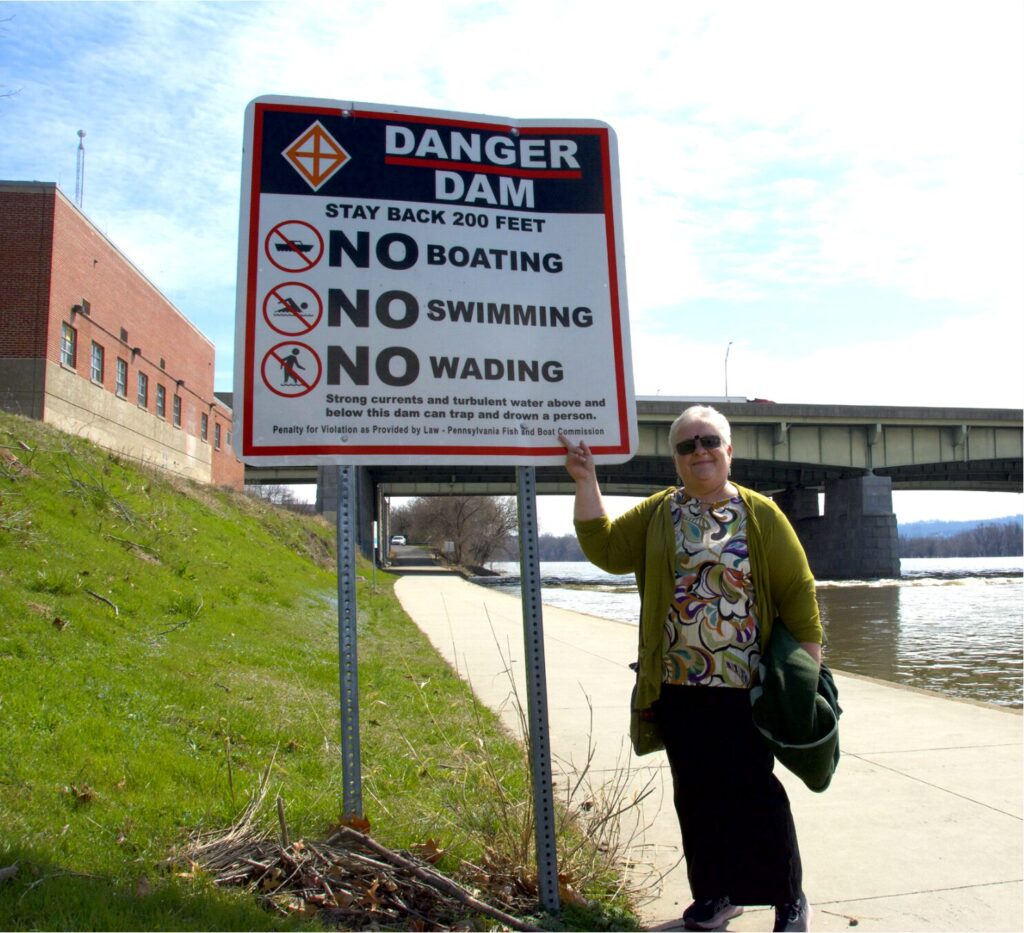
Lisa Hollingsworth-Segedy with sign warning of the dam’s danger.
The vast number of deaths and close calls are what inspired Hollingsworth-Segedy to act.
“Somebody needs to do something,” she said.
She and her team at American Rivers want to figure out what that “something” is.
With support and interest from the city, state and local river-related constituents, the national nonprofit, American Rivers, will be analyzing options for the low-head structure over the next 1½ to two years. They anticipate the study will begin in July.
“Tell us what it’s going to cost if we take the dam out, if we don’t take the dam out, if we do something different—if we put a rock ramp in front of it. Can we take out half the dam? Can we lower the dam by 50%?” Hollingsworth-Segedy said.
The study has been funded by a $75,000 National Fish & Wildlife Foundation grant, which American Rivers is complementing with $35,000 from a private foundation. Additional grants have been applied for.
The analysis will detail community and ecological benefits, drawbacks, and costs associated with full or partial removal of the dam and other options to reduce deadliness as well as no action.
“Up to this point, the local sentiment from my encounters have framed the argument as, ‘If we remove the dam to reduce fatalities at the most dangerous low-head dam in the country, then we will strip away all recreational use of the river in the vicinity of City Island,’” explained Hollingsworth-Segedy. “The point of the study is to use science and technology to determine the veracity of that claim.”

Dock Street Dam in high water
Sanitation to Recreation
A hundred years ago, a low-head dam seemed like the perfect way to keep raw sewage in the river underwater.
That’s why the Dock Street Dam was initially put in.
Installed by the City of Harrisburg in stages between 1913 and 1916, a New York-based contractor charged the city just $65,000, or $2.1 million today, for the project, per the local historian Ken Frew’s book “Building Harrisburg: The Architects and Builders, 1719-1941.”
According to Erik Fasick, author of “Harrisburg and the Susquehanna River,” the builders secured concrete slabs to the riverbed to create the approximately 6-foot-tall structure, which “raised the water level 4 feet at the dam, with a gradual decrease heading upstream.”
The extra water volume did help with sewage odors, but in the 1970s, when the U.S. started treating its wastewater in line with the Clean Water Act, the dam’s original purpose (excluding combined-sewer-overflow instances) became mostly obsolete.
“Now we’re at a point where the dam wasn’t built for recreation, but it kind of provides recreation,” said Hollingsworth-Segedy.
Sarah Dropkin, owner of Blue Mountain Outfitters in Marysville, estimated she puts around 500 to 600 canoers and kayakers in the water every boating season, only sending people as far down the river as City Island.
“It’s a way for people in the city to get away from the city,” Dropkin said.
The problem only comes if the recreation turns dangerous.
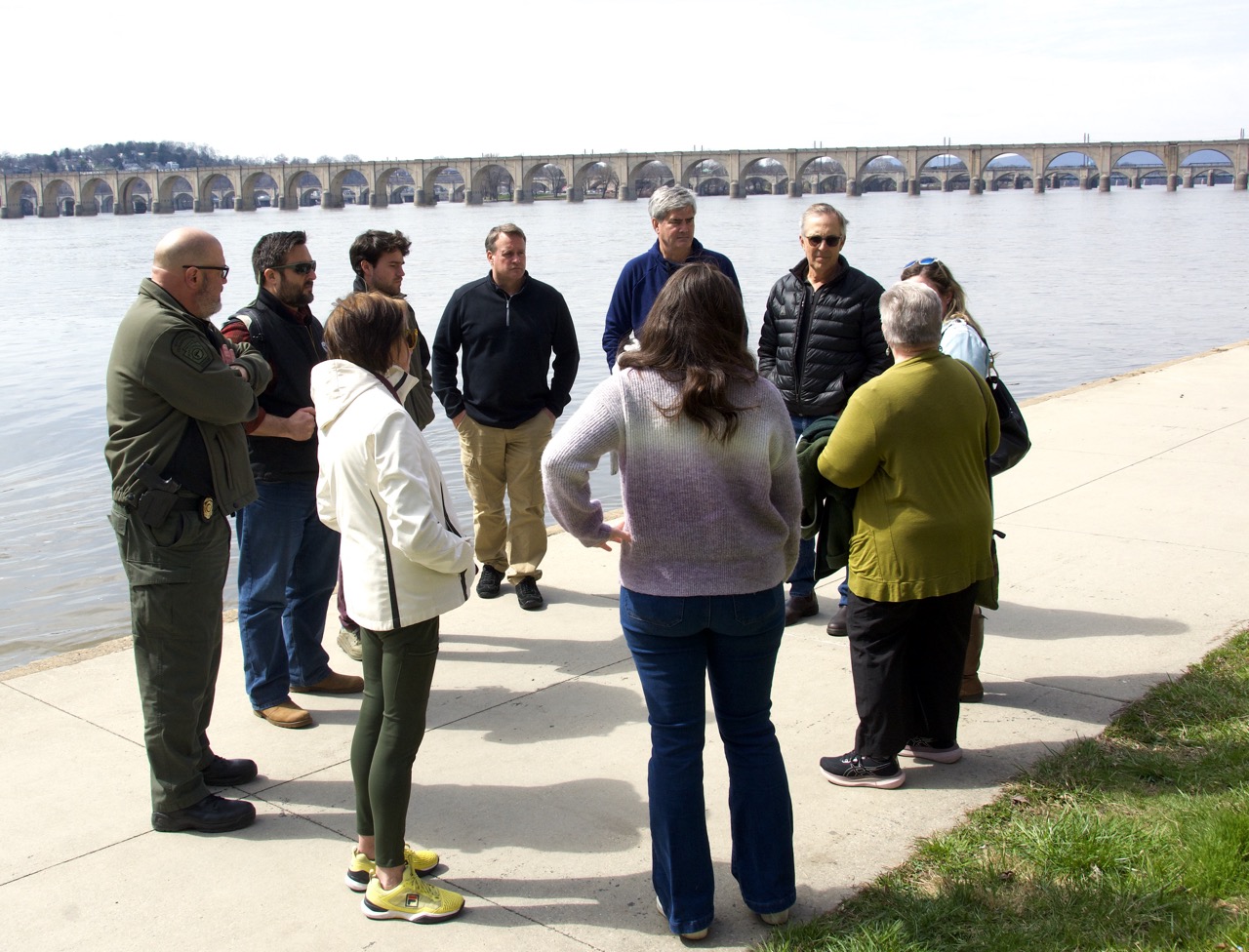
American Rivers assembles advisory members to look at the Dock Street Dam
Out of Sight
Mark Sweppenhiser, director of the Bureau of Boating for the PA Fish and Boat Commission, said the dam isn’t visible to boaters on the water “because it’s only a 2- or 3- foot drop.”
“It looks like the water is flowing like it would normally flow,” he said.
While some boaters know the dam is there and take all the precautions necessary to avoid its danger, others overestimate their ability to navigate it—or underestimate the danger, Sweppenhiser said. A smaller subset of new boaters or those from outside the area end up at the dam by mistake.
If someone goes over the dam, they are likely to capsize or roll their boat. From there, other threats emerge.
“It’s highly aerated water,” Sweppenhiser said. “There’s all kinds of strainers on the backside of the dam that catch your clothing and hold you under. They don’t call it a drowning machine for nothing.”
At minimum, boaters should turn back 200 feet before the dam, he said, indicated by several signs placed around the river in accordance with the Dam Safety Act. Pennsylvania law also requires warning buoys to be installed and maintained at a minimum of 200 feet upstream of the dam.
But keeping necessary mid-river signs warning of the dam has proven difficult. According to city spokesperson Mischelle Moyer, Harrisburg has to replace buoys marking the dam in early May each year, as they are often swept away by high water after initial placement.
Even with signage, boaters, paddlers, swimmers or anybody who ends up in the water may not see warnings until it’s pretty much too late to escape.
Tony Reigle, chief of Harrisburg River Rescue, said that his team sees anywhere from three to five calls to the dam per boating season.
Harrisburg Fire Chief Brian Enterline’s department also conducts dam rescues.
Enterline emphasized that boaters should know the dangers of any body of water they put their vessel into.
He likened it to riding a motorcycle with a helmet—the smart move, while not mandated by law. A big reason Dock Street proves so deadly is that it stretches the entire width of the Susquehanna River, almost a mile in length. This means it can be hard to reach either side of the river to escape in an emergency.
“If you’re in the middle and you’re already out of gas, either figuratively or legitimately, that is a very wide river that you have to try and navigate against the current,” Enterline said.

Dock Street Dam waters
Gathering Ideas
Ideas have been thrown around to redo the city’s dam before, although none have worked out.
In the 1980s, Mayor Steve Reed proposed a $254 million inflatable rubber dam near City Island that would have raised water levels by up to 13 feet and generated electricity. Decades later, still under Reed in 2001, the city explored building a $25 million, 8-foot-tall rubber inflatable dam to replace the Dock Street Dam.
The dam, as it exists, was last updated in 1967 and is due for work soon.
“If we do nothing, then chances are, at some point, that the dam is going to start failing,” said Hollingsworth-Segedy.
American Rivers’ analysis will be informed by two advisory teams.
A technical team will give input on technological, infrastructure and life safety aspects of the study. Its members include the PA Fish and Boat, the PA Department of Conservation and Natural Resources, PennDOT, the Susquehanna River Basin Commission, Capital Region Water and city officials.
A community advisory team, made up of community stakeholders, will advise on neighborhood concerns, community river access and recreational use opportunities and review the final report to ensure it properly evaluates local issues.
“We want the city’s input. We want community residents’ input. We want people who use the river. We want people who don’t use the river now, but they would if it was safe,” said Hollingsworth-Segedy.
The timing of the study overlaps with a major infrastructure update—the $1 billion replacement of the I-83 South Bridge, expected to begin within the next year.
Just above Dock Street’s waters, the project will involve placing new bridge pillars in the river, a process for which PennDOT will take measurements of the water that could help with American Rivers’ study.
“We can use PennDOT’s data from the bridge studies to figure out how the river would change if we took the dam out,” Hollingsworth-Segedy said.
According to Moyer, the city is interested in the results of American Rivers’ analysis.
“The mayor is looking forward to working with American Rivers to determine a best course of action to address the safety at the Dock Street Dam,” Moyer said.
Multiple sources indicated that fixing the dam situation could be costly, and that finding an ultimate solution may require outside funding, grants or federal assistance as a solution. Hollingsworth-Segedy said that she is not aware of any funding sources that cover the cost of dam repair, particularly when that dam does not meet the purpose for which it was built.
Sweppenhiser emphasized that the ultimate goal is a solution that best benefits the community.
“Anybody who’s looking at this, or reading it, keep an open mind,” Sweppenhiser said. “We’re trying to find a way to provide recreational boating and make boating safer in Pennsylvania, while balancing some of those other concerns.”
Hollingsworth-Segedy indicated it will be a matter of collaboration among those involved.
“We’re just trying to look at all the potential options,” she said.
American Rivers is a national nonprofit organization that protects, restores and conserves clean water and rivers. For more information, visit www.americanrivers.org.
If you like what we do, please support our work. Become a Friend of TheBurg!