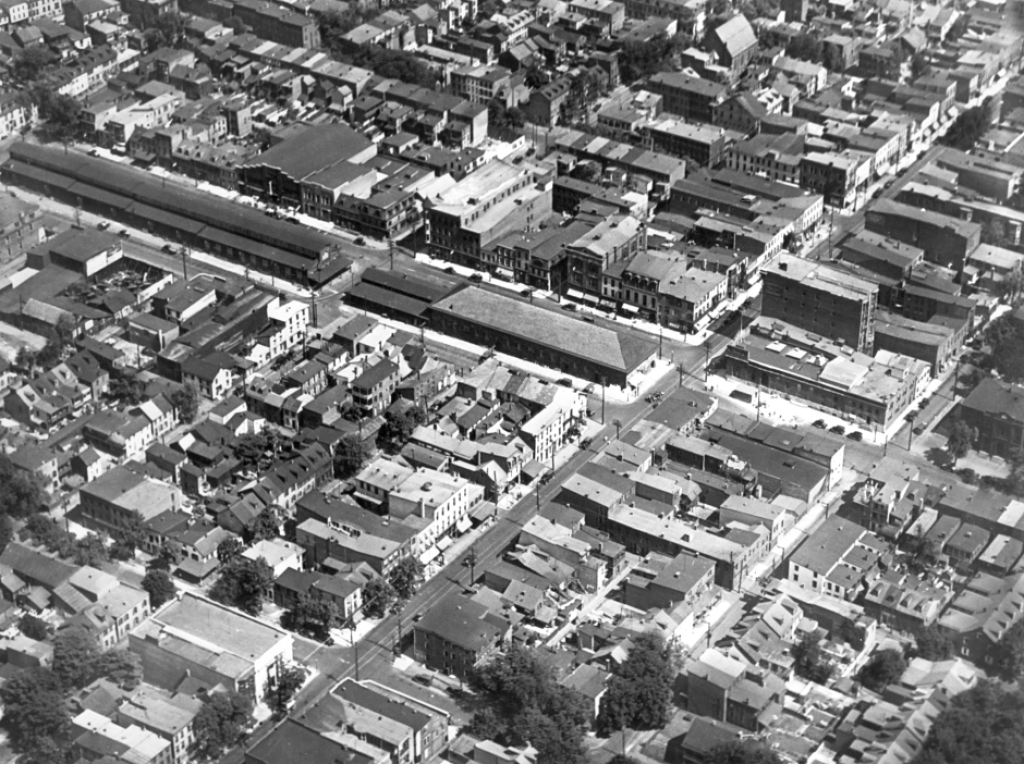
Aerial view of the Broad Street Market neighborhood, believed to have been taken in the 1920s.
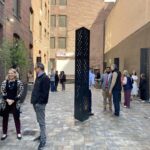
In the plaza of Harrisburg’s Broad Street Market, between the eastern building, made of brick, and the western one, made of stone, is an echo of something that used to be.
Years ago, a wooden frame structure stood on this spot, running from the end of the stone market house to Capital Street, where trolleys passed by throughout the day. Built in 1869, the wooden market, as the building was sometimes called, witnessed a century of growth and decline: the erection of the brick market house, in the 1870s and ‘80s; the swelling of the market’s occupancy through the 1920s, to hundreds of vendors; the emptying out of the inner city and the rise of the supermarket, the suburb and the automobile.
The wooden market was demolished in 1979, but you can still see its image preserved in the plaza stones. In the 1990s, as part of a $2.5 million renovation, a design team came up with a way to, in the words of Bret Peters, a Harrisburg architect and the project’s manager, bring back the wooden building “as a memory.” Darker stones correspond to the wooden market’s posts, while lighter ones trace its outline; raised ledges in the plaza correspond to the original market’s bays. At the end of one row of ledges, a ladder of dark granite, like a trilobite fossil, records the location of one of the old structure’s staircases. (On top of each ledge is another kind of fossil—a concrete cast derived from photos of a cornfield after harvesting.)
On a Friday in late January, the city’s new mayor, Eric Papenfuse, passed through this plaza on the way to lunch, tailed by a couple of reporters. Moments before, at a podium in the brick building, he had introduced the members of his Broad Street Market Task Force, assembled to address what he called the market’s “unacceptable” status quo. The previous month, in an appearance as mayor-elect before the PennLive editorial board, Papenfuse had critiqued a “crisis of the market’s own making”: hemorrhaged vendors, a stagnant board of directors, a complex dual-management structure and repeated battles with the city over maintenance of the buildings. Now, as one of his first undertakings as mayor, he was making good on a pledge to turn things around.
“There’s a lot positive going on at the market,” Papenfuse said from the podium, flanked by members of the task force. “That’s not what this is about. This is about saying that the market could be even more. It could be much greater than it is. It could have a role in fundamentally helping the economic development for the entire city of Harrisburg.” He suggested that, under proper management, the market could become a vehicle for developing “not just the city, but also the neighborhood in which the market is situated.” As he spoke, a handful of Amish vendors at Fisher’s Bakery, in aprons and bonnets, stood behind display cases of ice cream and shoo-fly pies, watching and talking among themselves.
The task force is not the only recent effort to overhaul the market’s operations. As Papenfuse took his seat in the stone building, over a bowl of Vietnamese noodle soup, he was joined by Josh Kesler, a market vendor and a local developer. Last July, Kesler and a business partner opened Harvest, a stand selling produce and other goods with a focus on locally sourced food. More recently, he bought the Stokes-Millworks building across the street from the market, with plans to convert it to a restaurant and studio space for artists.
Kesler is now a member of the mayor’s task force, but, in the fall, he helped launch the Broad Street Market Alliance, a separate and ongoing initiative focused on reform. Like Papenfuse, the Alliance critiqued the market’s management structure, under which a for-profit manager, the Broad Street Market Corporation, is accountable to its sole shareholder, a preservation non-profit called Historic Harrisburg Association. (This structure is what Papenfuse referred to as “dual management.”) The Alliance proposal, dated Oct. 10, recommended replacing this structure with a new non-profit, governed by a board representing the market’s key constituents: vendors, city government, residents and the “farm and market communities at large.”
Neither the Alliance proposal nor Papenfuse’s task force announcement made any reference to Bret Peters, the architect who oversaw the 1990s renovation. This was a noteworthy omission, given that the city, at the time of that renovation, commissioned and paid Peters to come up with a master plan for the market’s long-term success. The strategy drew upon input from several experts, including an acclaimed consultant on farmers markets, David K. O’Neil, who oversaw the turnaround of Philadelphia’s Reading Terminal Market in the 1980s. Like Papenfuse, the plan expressed a vision of the market as an anchor for development in the surrounding neighborhoods.
Peters updated his plan in 2010, when the market revisited the need for a long-term strategy. The new plan includes an ambitious expansion of the stone building’s hours, so that, in Peters’ words, it becomes a “seven-day engine for the whole market.” It also includes a strong emphasis on filling market stalls with abundant, high-quality produce, which the original plan’s research had shown to be the keystone of any successful farmers market.
In the weeks since the January press conference, the task force has started addressing questions about the market’s future. Will it also learn from the market’s past?
—–
This is a biased story about the Broad Street Market. I want the Broad Street Market to succeed. I want there to continue to be a place in the middle of Harrisburg where, in a single lap of a 140-odd-year-old building, I can buy smoked gouda, grapes, Brussels sprouts and mushrooms, a loaf of fresh bread and a quart of fresh milk, a barbecue sandwich and a bouquet of flowers, and a tub of sweet pickle slices packed so tight that the lid swells like the skin of a balloon.
I can get these things, minus the historic architecture, at my supermarket across the river, but, there, I have to battle with careening grocery carts, along with what you might call the abstracted quality of supermarket commerce. At the grocery store, you don’t buy things from somebody; you just buy things. I like that, at the market, the person accountable for the goods I’m buying is within arm’s reach. Like the old men shooting the breeze over coffee at a table on the market floor, it makes me feel like part of a social enterprise. As D. H. Lawrence wrote in the 1920s, in his essay about the bustling weekly market of Oaxaca, Mexico, the market is a place to “buy and to sell, but above all, to commingle.”
In an earlier era, the Broad Street Market fulfilled this role spectacularly. Oral histories in the Highmark Blue Shield Living Legacy Series, a digital archive of interviews from 2010, portray the market as the anchor of a vibrant commercial district. In one interview, Joseph H. Kleinfelter, a former president judge of Dauphin County who died in 2011, recalled that, within two or three blocks of the market, “you could find just about anything you wanted”: a drugstore, a jewelry store, a movie theater, a furniture store, a candy shop, a dentist, an eye doctor and, among others, “a bar about every third or fourth establishment.”
The market was also an anchor in another sense—its weekly rhythms served as a kind of cultural and generational glue. David Wise, a former president of the Summit Terrace Neighborhood Association, recalled dragging a wagon on Saturdays from his Steelton home to offer chauffeur services to shoppers: “[W]e would put up our finger indicating to the visitor that we would like to carry her basket in the market…we made good money there.” Wise, who was born in 1923, is African-American; Kleinfelter, who was white, and born 15 years later, had much the same childhood experience. “We would park our wagons there along the curb outside the house,” Kleinfelter recalled. “‘Waiting for a haul,’ we called it.”
The Broad Street Market remains a community anchor today, but, by any measure, there’s a good deal less commingling than there used to be. As late as 1960, the market was home to around 250 vendors. Depending on how you count them, there are now around 23. To a large extent, the market’s fortunes have mirrored the city’s—especially in recent years, when the market, like the city, seemed stuck in a state of unending crisis. The market has gone through five managers in four years. It has closed multiple times over health violations, most recently in the summer of 2012. Last year, someone broke into the market and robbed the ATM machine. Because of the high cost of liability insurance, the market subsequently went without an ATM, to the frustration of customers and vendors.
“I have customers every day who ask about it,” David Lapp, the owner of the market’s Green Ridge Acres stand, told me. “A farmers market has to have an ATM.”
When you look at an aerial photo of Midtown from the 1920s, with the market lying in the middle of a grid crammed with businesses and homes, it’s not hard to grasp the reason for the decline. In the photo, just north of the market, is a series of awnings along 3rd Street; the area is now an empty field.
The more difficult question is why, when the city tried to jump-start the market 20 years ago, the revival didn’t take hold. What does it take for an urban market to thrive?
—–
Around the time of the renovations in the mid-‘90s, the city, under the leadership of former Mayor Stephen Reed, sought proposals to take over the market’s management. Since 1974, the market’s operations had been in the control of a municipal authority, apparently with unsatisfactory results. In a July 11, 1995 memo to City Council, Reed expressed his displeasure with the existing arrangement. “As we know, the Market has been operating at a loss for years and therefore subsidized by the City,” he wrote. He listed three possible courses of action: close and sell the market, continue subsidizing its operations, or “undertake an extensive historic rehabilitation, coupled with upgraded product and operational policies, and institute a daily, on-going new management and marketing of the Market, with the Market required to be on a self-supporting basis.”
If those choices seem weighted, it’s because the city, in addition to having long since selected the latter option, had already selected a new manager—Historic Harrisburg Association. At the time, HHA was experiencing a surge in prestige and activity. In 1992, the organization had appointed David Morrison, a former executive assistant in the Thornburgh administration, as its first full-time executive director. Under Morrison’s leadership, HHA’s income and base of supporters had swelled; in 1993, the organization relocated to a new headquarters, in the old Pennsylvania National Bank building, across from the market on 3rd Street. “We didn’t want to be in center city, in a professional building,” Morrison told me. “Midtown was where the storefronts are.”
Morrison said that, in large part, the idea of HHA assuming management of the market emerged through conversations with the design team for the renovations, including the market consultant, David O’Neil.
“David specifically said to me, ‘You know, Historic Harrisburg would be ideal. You’re right across the street, you’re an established organization, this fits with your mission, you’ve got volunteers, you’ve got some momentum to get something going.’ And we were kind of looking for more to do at the time.”
O’Neil, when I spoke to him, told me much the same thing. “The fact that they were right there—they had a civic interest, plus an organizational interest. They were invested in the neighborhood, and had a lot of volunteers and a lot of contacts. It put them in very good stead.”
Peters also encouraged Morrison, at least initially. In January of 1994, the pair met at Jeffrey’s Parkside Café at the top of State Street. According to Peters, over dinner and drinks, Morrison expressed a strong interest in HHA’s involvement in the market’s future. Though Morrison’s tone struck him as “brazen,” Peters agreed that HHA could be a perfect fit for the market’s new management. But he advised Morrison that HHA should change its charter and become a community development corporation, or CDC, a legal designation that provides eligibility for various funding streams. (Morrison says he doesn’t remember the meeting, though he does recall discussions about a CDC that “never went anywhere,” in part because of HHA’s personnel limitations.)
As the months progressed, though, Peters felt that he and his team’s plan for the market were increasingly edged out of the frame. On March 7, he received a stop-work order from the city. A couple of weeks later, he was told to re-start the design, but with the scope of work diminished. In particular, though the city wanted to keep Peters’ architectural work on the buildings, it wanted his team to stop developing strategies for market operations—things like desired vendor mix, design guidelines for vendors’ stalls and marketing strategies.
It’s not clear why the city changed course, though some amount of vendor resistance seems to have been involved. That winter, the city began presenting its plans to the market’s existing vendors. One of the plan’s suggestions, based on recommendations from O’Neil, was that the market should place a high priority on fresh produce vendors, which typically drive the most traffic, and a low priority on non-food vendors, which drive the least. It so happened that, in the Broad Street Market, this suggestion wound up being interpreted along racial lines. Rafiyqa Muhammad, who had owned her stand, Creations of Family Muhammad, since the early 1980s, said that she and other vendors sensed a plan to “move black vendors out to make way for white vendors.”
“They felt our stands were not high-end enough,” Muhammad, whose own stand sold African clothes, incense, oils and herbs, told me. On one occasion, her husband returned from a vendor meeting and told her someone had said they didn’t want “none of that black stuff at the market.” When I asked for someone who could corroborate this, she gave me the name of Karen Hasan, another vendor, whose stand sold clothing and jewelry. Hasan said she didn’t recall any explicitly racial language, but that she, too, felt that “everybody who wasn’t white” was being asked to leave. Muhammad and other vendors circulated a protest petition and appeared before City Council; ultimately, they secured a pledge that all the existing vendors would be allowed to stay.
When I asked O’Neil about this, he said that the charge of racism was “ridiculous.” “Markets are best tenanted by local people,” he said. “The more diverse, the better.” He suggested that, perhaps, the vendors who weren’t selling food felt threatened by the promised changes. One of the duties of good management, he added, is to turn down the abundance of non-food applicants. “People selling non-food are relying on traffic that is food-driven,” he said.
“The city, in my mind, panicked,” Peters told me. “They decided to spend all the money on the building and didn’t do anything about the tenants.” In his binder, he has a copy of HHA’s initial management proposal, dated Sept. 30, 1994. Several pages in, under a section about the planned capital improvements, HHA expresses a wish “to collaborate with the City in a prompt review and analysis” of the master plan, “to ascertain if there are any features of the plan which merit change or reconsideration.” On top of Peters’ copy of the proposal is a sticky note, addressed to him and signed by David Morrison: “Our final proposal for your information,” it says. “Thanks for your encouragement and advice.”
——
On Sept. 12, 1996, the Broad Street Market launched a three-week long festival to celebrate its grand reopening. An article in the Patriot catalogued the renovations. In addition to the new plaza, the buildings had new doors, windows and lighting, a huge backlit circular sign on the roof, facing down Verbeke Street, and, on the perimeter, colored banners on 30-foot steel poles and fold-down tables for rent by outdoor vendors. The article quotes liberally from Morrison, who, at one point, describes the mayor’s hope that the market will be part of the city’s revitalization: “The mayor’s thinking is that just restoring a white elephant won’t do us any good,” he is quoted as saying. “It’s got to thrive.”
For a time, the market did thrive. Barbara Skelly, who served as market manager from 1997 to 2005, said that, in the years following the renovation, the market saw steady improvement under the guidance of an energized, cohesive board. “I was excited, and they were excited,” she said.
The prior management had grown lax about collecting rent, and one of Skelly’s first directives was to set up payment plans to get all vendors up to date. She orchestrated a deep clean of the stone building’s interior, purchased new tables and chairs, recruited vendors to sell on the outdoor tables and bought new custodial equipment. She also installed ATM machines, which she said were “like gravy”—they increased business for the stands, in addition to bringing in fees for the corporation. In her first year, the market broke even. In the years that followed, it even turned a profit. Skelly recalls giving a check to Mayor Reed on two separate occasions. “I think it was, like, $3,000,” she said. “And the mayor said, ‘I knew it. I knew it could be done.’”
After the initial burst of activity, however, the market once again found itself in decline. No one is exactly sure when the trouble started. A photograph from the summer of 2001 shows a bustling stone market, with vendors occupying both the center and the periphery of the building, and customers crowding the aisles. Skelly thinks the dip began a few months later, following the Sept. 11 terrorist attacks; others have attributed it to a loss of customers to the West Shore Farmers’ Market, which reopened in 2000 after its previous location burned down.
Recently, some observers have suggested that the city’s management agreement with HHA can partly explain the market’s decline. Part of HHA’s proposal included the idea of a philanthropic arm, called Friends of the Broad Street Market, that would help fund improvements through “annual giving” campaigns. Though HHA did secure occasional contributions, according to Morrison, the Friends program never materialized. In later years, as HHA’s own fundraising momentum stalled, it’s possible that its association with the market became more burdensome than useful.
“You could get a lot of people to support a ‘Friends of the Broad Street Market,’ something like that, a charity,” Gregg Fetterman, who served as chairman of the market board from 2007 to 2010, told me. “But the subset of people who would support HHA is a lot less than that. So it was just incompatible. Two completely different organizations. Two completely different missions.”
Peters thinks the problem was that the management was not so much structurally inappropriate as simply lax. “There was such a level of bizarre negligence, of basic issues like merchandizing,” he said. “Is the collection of people in this market a collection of vendors that the public is going to respond to, by coming here and buying stuff?”
In his view, the market has also let itself be dominated by concerns other than the most basic one: selling good food. “There’ve been these other layers of agenda that people have been wanting to get out of it…They use this thing as a vehicle for personal gain and self-importance, rather than using it as a place to sell and distribute first-quality food to the citizens of Harrisburg, Pennsylvania.”
Morrison attributes any decline to factors outside management’s control. I asked him, at one point, if he thought HHA had been a good steward of the market. “As the circumstances have evolved, yes,” he said. “Sure. I think that the system that we created worked very well, really until the time that we decided that it was time to separate it.” He acknowledged that there might have been a period in the 2000s “where the stewardship was a little nebulous,” but suggested that was because the market’s own leadership “was increasingly being trusted to do things on its own and wasn’t looking for HHA to provide more stewardship.”
—–
In 2009, the market revisited Peters’ plan. That summer, a group including Peters, several of the market’s board members, and an urban planner for the city met one evening in the stone building to discuss the market’s future. The market was understaffed, due to funding shortfalls, and was $70,000 in debt from unpaid heating bills. Fetterman, then chairman of the board, warned of an impending major expense: the market would need to replace its heating system, because the provider was planning to abandon the steam line before the upcoming winter.
The group also discussed the market’s long-term vision. At some point, Peters produced a copy of the master plan from the mid-‘90s. It was the first time most of the group had seen it, including Fetterman. Peters explained that the foundations of the plan were even stronger than before, in part because of the presence of HACC on Reily Street, which provided a second Midtown anchor and an additional source of foot traffic. (Muhammad, who was also in attendance, and who objected to a perceived criticism of the neighborhood north of Reily, told me she raised her hand and said, “Excuse me, but there are families there.”)
In the months after the meeting, Fetterman, along with several other board members, began looking for ways to incorporate Peters’ expertise into the planning process. “Bret knew more about the market than anyone,” Fetterman told me.
Initially, they invited Peters to join the board, but he declined. Instead, he sent them a proposal to create an “architect of the market”—retaining him to update the master plan and to address building and design problems as they arose. “They didn’t have any money,” Peters told me. “I said, ‘I understand. But you need what I do.’” In particular, to be eligible for various forms of funding, the market needed a long-term business strategy. Ultimately, Peters agreed to a deferred-compensation contract, agreeing not to be paid until the market secured its funds. He would, however, require what he called a “token payment” of $500 per month.
In the meantime, the market’s financial situation plummeted further. In the course of a year, the market lost its manager, business manager and treasurer. The heating system, which had not been replaced, failed that winter, costing the market another $70,000 in repairs and in bills for excessive use. In February, the state Department of Agriculture inspected the market and shut it down, citing both the detection of rodents and the failure of the market’s hot water supply. This cost the market another $30,000 in lost rent, out of an annual budget of around $300,000. Board members assumed a greater role in operational duties; on several occasions, Fetterman used his own money to pay the market’s bills.
In the summer of 2010, Fetterman petitioned the city to reimburse the Broad Street Market Corporation for amounts spent maintaining the facilities. For years, he had been insisting that the management agreement was explicit about the city’s obligations: while the corporation was charged with “routine maintenance,” the city, which owned the buildings themselves, was responsible for major repairs. Yet the city’s response was to deny the market funding—not only declining to reimburse repairs, but also withholding previously awarded grant funds, demanding that the market first produce financial documents and a business plan. Fetterman turned to Peters, who produced a draft of a business strategy so the city would release the money.
That 15-page document starts from the premise that, because of the city’s financial difficulties, in the long term the market ought to plan to fund its own maintenance needs. “2011 must be a year of significant change for the market,” it says. The plan goes on to outline a strategy for increasing revenues, primarily by aggressively pursuing high-quality vendors of prepared and specialty foods. These vendors would occupy a reconfigured stone market, whose hours would be expanded to seven days per week; the brick building’s hours and occupants would continue unchanged. The plan also notes that, in past market practice, individual vendors were “encouraged to negotiate their position” without regard for the success of the market at large. To remedy this, the plan recommends “regular, structured communication” between management and vendors, including a leasing manual with rules for stand design and maintenance.
In the months that followed the drafting of the plan, however, board members began to question the market’s commitment to Peters. In late 2010, Alan Kennedy-Shaffer, a new board member, became concerned that Peters’ continuing work on the market was creating bills the market couldn’t afford. “The contract itself was a ballooning payment, where it had a huge potential liability for the market down the road, for services that were not clear and were never provided,” Kennedy-Shaffer told me. He then discovered that Fetterman had signed the Peters contract without getting board approval. Fetterman acknowledged this, but said it was a procedural oversight—the board’s wish to contract with Peters, he said, had never been in doubt. Nonetheless, Kennedy-Shaffer led a successful effort to have the board rescind and repudiate the agreement.
To this day, Fetterman remains mystified as to why the board refused to reconsider the contract with Peters. Peters “has done more work for this market than anyone in the past 10 years,” he told me. He said Peters “had always been open, like, ‘Fine, let’s revisit the contract, let’s do it.’ And no one was ever willing to say, ‘Here’s why I don’t like the contract and here’s what it needs to be.’ It was just dead. It was done.” (Last February, Peters sued the corporation for payment for his services, and the matter is pending litigation.)
In Kennedy-Shaffer’s telling, the dismissal of the Peters plan was largely about insulating the market from a financial liability. But Jonathan Bowser, who joined the board in the midst of the dispute, has said that, in addition to the legal and financial concerns, board members also disagreed with Peters about the plan’s “target market.” “It was more focused on being a regional market that wanted to be more of a tourist attraction,” he said. Before pursuing that strategy, he added, he “needed more confirmation from the community that that’s what they wanted.”
—–
On Thursday, March 20, at 6 p.m., the task force held its first public meeting. It took place in the stone building, where more than 100 chairs had been set out, facing a couple of tables for task force members, which flanked a projector screen. Gradually, the crowd swelled until the chairs were nearly at capacity. Another 70 or so people stood at the back and along the sides.
As members of the public filed in, a man from the Pennsylvania Downtown Center, whose president, Bill Fontana, is one of the task force members, handed out 100 remote clickers. Their purpose was to allow the public to take a poll on the market and see the results in real time.
Fontana took to the microphone and explained that Mayor Papenfuse had charged the task force with “looking at the future,” rather than dredging up the past. One of the things he’d learned in his career, he said, was that it’s “very easy to rehash what happened.” “If you spend all your energy on these kinds of efforts, you never advance to the next level,” he said.The task force’s desire to leave behind the past seems largely shared by the market’s current board. Both Fetterman and Bowser speak of the market having survived a “perfect storm” of challenges.
“I think we’re weathering that storm,” Bowser told me. “I think people would probably want things to happen a lot sooner than they are, and I understand that completely, me being number one on that list. But the reality is that where we came from, probably being a month to weeks away from being insolvent, to where we’re at today, where we’re showing a monthly surplus as far as operations, I think is commendable, for not just me but for the entire board.”
Vendors, too, seem eager to move on. I spoke with more than a dozen vendors, many of whom expressed the same handful of sentiments—that the market was headed in the right direction, that it wouldn’t help to focus on the negative, that things would get better, but not overnight.
“Leave back what’s back and move ahead,” David Lapp, from Green Ridge Acres, told me. Last December, Lapp, along with Leon Glick, the owner of Two Brothers’ BBQ, were elected to serve as vendor representatives on the market board, where they hope to provide a voice for vendor concerns. When we spoke, they had only attended one meeting, which Lapp said was productive, if a bit too short. “We didn’t cover everything we should’ve,” he said.
At the public meeting in March, the task force polled the audience on a variety of topics relating to the market’s future. Fontana would read a question from the screen; the audience would vote on the remotes, and a few seconds later a bar graph would appear with the percentages. The sample pool had a fair number of regular shoppers (38 percent coming once or twice a week, 35 percent two to three times per month), who came primarily for groceries (72 percent). One question asked whether they thought market vendors should sell food only, or “food and crafts.” Two-thirds voted “food only.”
As I watched the votes, I wondered how useful they would be. We have examples elsewhere of markets that work. The city already paid a team of professionals to tell us that, above all else, people will go to a market to buy fresh food; 20 years later, they’re saying the same thing, with 20 more years of evidence behind them. We can also guess, from past experience, that energetic, consistent management is part of the formula. Regardless of what the community says it wants, won’t a successful plan for the market have to incorporate these things?
When the survey was over, the meeting ended, but much of the audience stayed on to keep talking about what the market could be. During the meeting, topics of race and class had been invoked, and, as the audience split up into circles of chairs, they remained part of the conversation. I watched people in the center of the dark market hall, engrossed in discussion, and thought about something Peters had mentioned, about markets being the “ultimate de-militarized zone.”
“All these other barriers go down when there’s food,” he said. “Harrisburg needs that very badly. And the market doesn’t become the community’s heart and soul when you put community people in charge of it. It becomes the community’s heart and soul when it’s got great food.”