Ross Willard
Over the weekend, Harrisburg lost one of its most dedicated and charismatic public advocates, Ross Willard.
Ross was the founder and force behind Recycle Bicycle, which gave away hundreds, perhaps thousands, of bikes over the course of the past 25 years—mostly to people who, otherwise, couldn’t afford them. He also taught bicycle repair and safety, and pressed, often against considerable odds and opposition, for bike-friendly streets and infrastructure.
Around Harrisburg, it was hard to miss Ross. Sure, he spent hours nearly every day in his bike workshop on Allison Hill, but he also was a constant presence on city streets and at events. At annual riverfront festivals, he’d gladly babysit your bike as you enjoyed your day, and maybe even tune it up in the process, leaving it in better shape than when you dropped it off.
We often encountered Ross at public meetings for road and bridge projects, where he made no bones, before city and state officials, about the need for bike lanes and accessibility. Sometimes, folks listened; too often, they did not. But that never deterred Ross from forging ahead, in his determined, pointed style, ready to wage the next battle.
We were delighted to call Ross a friend of TheBurg.
I’ll never forget the day, nearly a decade ago, when Ross appeared unexpectedly at our door, shortly after we moved into our current offices on N. 3rd Street. He welcomed us into our new space in the most Ross-appropriate way possible, with a gift of a reclaimed and fully repaired bicycle, which we deemed “TheBurg Bike” and still have.
Fittingly, we saw Ross for the final time just last week, as he stopped by our office to remind us of Bike Month events, including the annual “Ride of Silence,” which will take on special meaning this year.
Ross leaves us with a remarkable legacy, one that I’m certain now will be taken up by other members of Recycle Bicycle. Nonetheless, it surely will take the Harrisburg community, and the area’s biking community, time to rebound from the loss of such a committed, caring man, who was unmatched in his dedication and generosity.
To honor Ross, we are reposting a profile that we published back in 2014. Some of the details are outdated, but the piece still captures the style and spirit of this singular man and his uncommon commitment to the cause of safe, affordable, accessible biking.
For more information and to donate to Recycle Bicycle, visit their website.
Hey, Bike Dude! Recycle Bicycle’s Ross Willard is Harrisburg’s go-to bike guy.
By Missy Smith
Ross Willard has some serious energy. When I recently visited his Bike Warehouse on a rainy Saturday, I was ready to go with my camera and a list of questions that I hoped to have answered about his non-profit organization, Recycle Bicycle.
After getting introductions out of the way, he jumped right in about the building we were standing in, a dim, damp, yet expansive warehouse that was donated to his organization to use as a repair shop. He told me about the countless bikes that go through triage at the warehouse and the importance of teaching people how to fix their own bicycles. About the personal transformations that people experience through the organization. About the self-sufficiency, empowerment and public service that the organization provides.
After a thorough tour of the warehouse, I had quite a lot of my questions answered without having to ask. Willard is passionate, animated, relentless and strong-willed about a free public service that strives to keep the city’s bikers safe—so much so that he left a corporate job on an early buyout to repair bikes.
Moral Dilemma
Fourteen years ago, Willard encountered the personal resolve that would fuel the all-volunteer Recycle Bicycle community. As part of a food drive to feed people in Harrisburg, he acted as security for the group’s food van and became disturbed by all of the kids who would pass by on the street, pushing bicycles without brakes on the tires. “I faced a moral dilemma,” he reflects.
He remembers thinking that people who didn’t have access to enough food wouldn’t necessarily face the imminent threat of death. “But kids going through the intersection without breaks, that scared me.”
So, he began setting up shop at intersections throughout the city with a little bike repair bag and waited for people with bikes that needed a little love. Recycle Bicycle volunteers would also crash block parties with large crowds, where they would set up a makeshift street repair shop. That small repair bag became a toolbox, which became a chest, then later a van, then a trailer and finally, the Bike Warehouse, where Recycle Bicycle has operated for five years.
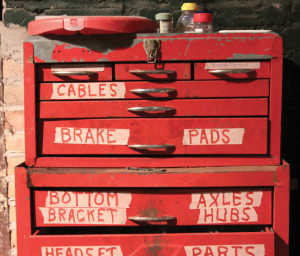
Within 15,000 square feet, Bike Warehouse is jam-packed with tires, wheels, brakes, chains, pedals, you name it. Most of the bike parts are donated or removed from bikes that are no longer suited for riding. These parts go toward the repair or the building of bikes, and the scrap metal is recycled.
“We’re here to help people build their own bikes,” says Willard. “We are a do-it-yourself shop that costs you nothing, but you have to invest in helping.”
Willard doesn’t believe in taking someone’s bike and merely fixing it. Instead, Recycle Bicycle provides the tools and expertise to help people learn how to fix their bikes for themselves, at what he calls his “teaching warehouse.” One of the greatest advantages that the organization provides is a sense of empowerment.
“Kids will be savvier when dealing with mechanics later in life,” Williard explains. “They will know what questions to ask.”
Other people come in to donate their time, helping with repairs, in sort of a work-share program, during which they can earn a bike after putting in the allotted number of hours.
“Recycle” is key in the organization’s name. Willard is able to supply free bikes to the Harrisburg community because the parts that go toward repairs have been recycled from other bikes. Excess parts get shipped to other bike organizations throughout Pennsylvania and the world.
“We recycle everything: steel, aluminum, boxes [that held] parts that people donated, water bottles,” Willard says. Any scrap metal that the organization collects, it recycles for cash that goes toward the purchase of tools.
Obviously, biking in an urban community, in and of itself, is a natural way to conserve resources. Within his organization, Willard not only demands bike safety, but he takes a strong stand on ecologically friendly habits and ways of life.
“Let’s live on a bike in the city and be ecologically correct,” he says. “We spend too much money on gas and oil. [Recycle Bicycle] is ecologically correct, and we help prevent too much car use.”
Not a Toy
Volunteers provide an integral component to the organization. When I visited the Bike Warehouse, I met Greg Chiesa of Camp Hill, who was hard at work repairing bikes. By day, Chiesa works for the commonwealth and, in his spare time, he gives to the bike-building cause.
“I’ve always loved bikes, fixing them, riding them,” says Chiesa, who says he didn’t know about Recycle Bicycle until he started looking for a place where he could donate biking equipment. Before volunteering with the organization, he says, “I was always into ‘the new.’ But now, I ask, ‘Can I fix it or recycle it?’”
While Recycle Bicycle reuses most of the frames and parts to build new bikes, some bike frames beyond repair are stowed away in their own special room at the Bike Warehouse. He and his team paint the unsalvageable bikes white and break out the “ghost bikes” once a year during the “Ride of Silence,” in which they display the bikes as a memorial to the Pennsylvania bikers who died while riding in that particular year.
One particular bike that hangs within the warehouse, just beyond the entrance, leaves visitors with an uneasy feeling and a resonating lesson. It is painted in the innocent pink-and-white pattern of a child’s bike, but has mangled wheels that offer a grim picture of what happened. Willard explains that the owner was a young girl who crashed with an oncoming motorist and lost her life.
“I use it as an illustration that [a bike] is not a toy, but a vehicle that can be deadly,” Willard explains.
The smashed bike serves as a stark reminder that bike safety is important, and it paints a clear picture of why Willard is so impassioned about his volunteer service to the community.
 He says that the organization needs more dedicated volunteers like Chiesa who have the serious desire to keep Harrisburg’s biking community safe.
“I don’t want the kids to die. I want people to learn that it’s dangerous out there,” he says. “We need more volunteers who understand that. They have to have my heart. I didn’t burn out because I’m hyper.”
His charismatic and entertaining personality, his fiery drive to make bikers safe and his non-profit repair shop have made Willard a popular sight in Harrisburg. He jokes that, when he isn’t riding a bike, people will recognize his vehicle, run up to him and ask when the warehouse is open. Some nights, he will pass through rough parts of the city and, “Out of the shadows, I’ll hear, ‘Hey, bike dude,’” he laughs.
“We are the best guys in town, and we feel good about it,” says Willard. “With whatever power you’re given, use it correctly.”
If you like what we do, please support our work. Become a Friend of TheBurg!