
Pairing the Old, the New: Mount Hill Tavern matches history with modernity.

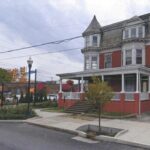
Through the window panes of Mount Hill Tavern’s original three-story stone structure that dates to 1798, the mountain views evoke colonial times, when some of the hats doffed upon entry were tricorn-shaped.

Sitting at the foot of Blue Mountain, near the corner of Colonial and Lingelstown roads in Lower Paxton Township, Mount Hill, now open four years, is the only 18th century dining room in the region, said A.J. Neidich, the dining manager.

The modern-day addition, nearly three times the size of the old tavern, echoes 18th century design, but with 21st century flourishes and amenities such as a glass enclosed, climate controlled wine-rack room with more than 100 wines from around the world.

“We wanted to pay homage to the historic section of the building,” Neidich said.

The new section of the building includes a bar with a select variety of ales on tap, such as Pennsylvania’s Victory and Oregon’s Rogue that either pair nicely with certain menu items or great just to quaff.

Wine, though, is particularly important to the proprietorship.

“We sell as much wine as we do beer and liquor,” Neidich said. “We taste wines continually. Everything you get off the [wine] list we’ve had.”

Mount Hill is divided into five sections for dining. In the addition’s ground floor there is the Main Dining Room (seats 54) and the Cellar Room (seats 16), across from the wine-rack room. On the second floor is the Mezzanine Room (seats 26).

Outside, the stone patio with a large fireplace for warmth on cool evenings seats 85. A feature attractive to corporate or private groups is the privacy the Cellar, Mezzanine and tavern rooms afford parties.

With seating for a total of 220 inside and outside, there could be parties or events in every location and yet “No one knows the other is going on,” said Zeke Curry, the bar manager.

The historic tavern, built by Godfrey Fritchey, a German immigrant who began serving spirits there in 1805, is divided into two rooms that seat 50. The stone building has two more floors to it, currently being used as storage.

According to Neidich, the tavern is in nearly its original condition. The hardwood floors, thick plaster walls, woodwork, hardware, stairway, fireplaces and, of course, the window glass are almost all original.

As in the other rooms at Mount Hill, the tavern’s tables and chairs, period re-creations, are arranged in a way that makes the room feel spacious.

“We wanted people to feel as comfortable as possible,” Neidich said.

Mount Hill boasts extensive lush lawns amid thick foliage, where tents can be set up for events. As for the menu, it changes seasonally; food is fresh and, as much as possible, local, prepared by Wayne LeBerre, a chef with 30 years experience.

The selection is contemporary, ranging from chicken Marsala and crab-stuffed flounder to lobster ravioli and bacon-wrapped filet mignon. Tavern specialties include fish and chips.

And there’s always an event, whether dinners with historic themes like a 19th century meal in honor of Harrisburg founder John Harris or paring five wines with five foods. “We try to keep it varied,” Neidich said.

Mount Hill Tavern, 2120 Colonial Rd, Harrisburg, Mon-Fri., 11:30 a.m. to 10 p.m., Sat. 5 p.m. to 11 p.m. Call 717-540-6840 or visit www.mounthilltavern.com.
Continue Reading

Hop on Over: Bunny burgers, topped with nostalgia, served up at Red Rabbit.

The restaurant business ran deep in the Snyder family. Sam Snyder, along with brothers Dick and Ken, were co-owners of the former BBQ Cottage on North Front Street in Harrisburg in the early 1960’s.

Sam ran the kitchen of this popular hot-spot, a favorite hangout for area teens, known for its great burgers and fries. Sam’s wife Maggie worked for the commonwealth at the time. After the couple bought and settled on a piece of property in Duncannon, their daily drive down Route 322 every day to Harrisburg took them past the former Distelfink Ice Cream and Sandwich Shop, sitting empty near the Clark’s Ferry Bridge.

Eyeing the opportunity to have their own place, and work a lot closer to home, the Snyders bought the place, did some slight renovations, and opened on Mother’s Day, 1964, as the Red Rabbit. Their slogan: “Make the Red Rabbit a habit.”

Although there was no particular reason for the name, it stuck and became a most popular destination for locals. Nearly 50 years later, they are still serving up hundreds of their signature Bunny Burgers every weekend. The Snyders turned over operations to their daughter, Cindy, and son-in-law, Sam Berger, in 1988.

The Synders changed little of the Distelfink shop, keeping the popular curbside car hop service. Pull in, blink your lights and your server is right at your window to take your order, then brings it to you on a tray that hangs on your side window. Picnic tables are available, if you would rather not eat in your car. It has no inside seating.

Four servers are on duty at all times, making service quick and efficient. The Red Rabbit employs 25, mostly teenagers. The majority of the employees started out as part-timers; most of the long-time employees started there as teens.

The Bunny Burger was Sam Snyder’s creation. Served on a sesame seed or poppy seed bun, it includes a ground beef patty, hickory smoked bacon, melted cheese, lettuce, tomato, pickles and onions, topped with their special sauce (Snyder’s original recipe).

When the Red Rabbit opened in ‘64, fast-food restaurants were just starting to emerge, serving pre-made food, every order precisely the same as the last. Snyder, on the other hand, held on to the strong conviction that food should be made to order, and that continues today.

Most popular dishes, besides the Bunny Burger of course, are the ham and pork BBQ, the fish sandwiches and the fried chicken, fish and shrimp dinners. The dinners come with French fries, home-made creamy slaw and a roll. Ice cream, including floats, shakes and sundaes, are also offered.

The family has always insisted on good quality food and good service. Despite rumors to the contrary, Sam and Cindy Berger intend to serve burgers as long as possible, feeling blessed to have the opportunity to continue the nearly half-century old tradition.

“We appreciate our customers, many of whom are regulars who have been coming for years – be it every weekend or every few weeks,” Sam Berger said.

Red Rabbit benefits from a great location along busy Route 322. Penn State football weekends bring heavy traffic past the drive-in; Mother’s Day is their busiest day. They end up serving more than 3,000 burgers on a busy weekend.

Five decades is a long time (the Bergers plan on something for the drive-in’s 50th anniversary in 2014), but times change as development along Route 322 is beginning to crowd things. Yet, the Red Rabbit is more popular than ever.

The Red Rabbit is located in Duncannon along Route 322, ¼-mile east of Rts 11/15 and ½-mile west of the Clark’s Ferry Bridge. Open 11 a.m. to 9 p.m. Friday, Saturday and Sunday, closed the rest of the week. Call 717 834-4696 or visit www.redrabbitdrivein.com.

Continue Reading

Healing Foods: HealthyWay will fix you up with a tasty, good-for-you meal.

Her husband’s illness, requiring him to follow a strict diet to regain his health, compelled MaMa Chef Grace Yong Lee to learn how to prepare “healing foods,” which are mostly organic and whole grain.

Now, 10 years later, her husband, Joon, full of vim once again (he bragged that at 61 he could out-run men half his age), the couple decided to share what Yong’s travels to Asia taught her about healing foods.

In late May, they opened HealthyWay, a restaurant and grocery at 405 Walnut St. in Harrisburg. It features all natural foods that Lee said is fresh, mostly local, and 65 to 70 percent organic. She makes soy milk daily.

“I prepare all natural, mostly,” said the Korean native who once had a restaurant in Seattle. She lives by the German proverb printed in their menu: “Man is what he eats.”

Yong said it is difficult to find organic in all foods (she’s trying, though) but some of the items they sell such as vegetables and chicken are 100 percent organic. She uses no preservatives, artificial ingredients, white flour or sugar in her cooking.

“I studied healing foods,” the 59-year-old chef said. “I went to Japan, Korea, China and India – learning how to make healing foods.”

She takes the macrobiotic approach to food preparation. Yong said it resulted in returning her husband to full health, which moved her to open the restaurant so the public could get in on this healthy way of eating and living.

“I wanted to share,” she said, smiling.

Joon is a macrobiotic believer. He said people should know that “besides exercise, they need good food.”

They serve breakfast and early dinner, their hours are from 7 a.m. to 5 p.m., seven days a week. Some of their dishes include Soy waffle, naturally sweetened, grilled organic chicken, sweet potato noodles, fruit or yogurt smoothies and chicken soup.

They can accommodate vegetarians and those who desire meat, said Solomon Lee, the couple’s 19-year-old son. The challenge for HealthyWay, though, is making sure the products they use and sell are free of preservatives and additives.

“It’s really hard to get organic food so sometimes we have to make it ourselves,” Solomon said. “That way we can make sure it’s healthy for you.”

MaMa Chef, who wears a red apron with her smile, wants her customers to enjoy not just her food, but her hospitality; she enjoys meeting them and becoming friends. “I treat all my customers like family,” she said.

HealthyWay, 40 Walnut St., is open 7 a.m. to 5 p.m., Mon-Sun. 717-234-7010 or visit them on Facebook.

Continue Reading

A Town with a Heart: Quaint, walkable Hummelstown set to turn 250.

Hummelstown, population of 4,500, may seem like a very “small town,” but when Barb Miller was a child, it was the “big city.”

“My aunt used to take us for Christmas shopping at Hower’s Department Store,” said Miller, who grew up in Shellsville. “When my sister started high school [there], I thought she was so lucky. Six years later, I came. Because we had only one car, my Dad had to drive us in for activities.”

At 21, she moved to Hummelstown and not long after, married Bradley Miller, now mayor. “We moved into our house on Main Street the week of Three Mile Island,” she recalled. “We liked it so much. There are beautiful businesses, the people are nice, and the level of volunteering is unbelievable.”

Her husband agreed. “We thought it was a wonderful neighborhood to raise children in, and we liked the Lower Dauphin School District,” he said. “The borough is a nice-looking town, with great places to shop and eat.”

Other highlights are CAT’s Park-N-Ride for commuters on 2nd Street, working with the fire company – which the mayor calls a “great group of volunteers who give so much of themselves” – and an impressive police department, borough manager and council.

Borough Councilman Robert “Red” Jones, a scientist, is a former president of the council and the school board. Originally from Jonestown, he and his wife moved to Hummelstown in 1973 when he became a professor at the medical school.

“We thought of living in the country,” Jones said. “But our friends who did were spending most of their time as a ‘taxi service’ for their kids, who went to school in Hummelstown. We saw that our kids could walk to school. Both of us had grown up in small towns, and Hummelstown had that 1950s feel.”

The local government – composed of people who “want to do the right thing,” impressed Jones. And the voluntarism; after the flood last fall, a few hundred answered the call to help pump water out of neighbors’ homes. Dozens are volunteering for Hummelstown 250, the anniversary celebration Barb Miller is chairing. “That doesn’t happen everywhere,” he said.

Bill Jackson’s position as editor of the Antique Auto Magazine brought him and his wife to Hershey in 1968. “We were riding around with a real estate guy,” recalled Jackson, editor of The Sun for many years; his wife, Rosemary, was publisher. “I asked why a town like Hershey didn’t have its own newspaper.” He looked at me and said, ‘How did you know The Sun’s for sale?”

He didn’t. Hummelstown had seemed like a “creaky old town down the road.” Nonetheless, the couple went to the newspaper, and bought it from the Hartwell family, owners since 1913.

“Hummelstown is a town with a heart,” he said. “It has everything – restaurants, drugstore, furniture store, a town center, with cradle-to-grave activity, a food bank. A church ministerium. We take care of our own.” Another source of pride: the new public library at 2nd and Railroad.

Debra and Dave Buffington are “newbies” who love Hummelstown.

“We’ve lived in the area for ‘only 17’ years,’” joked Dave Buffington, who took over The Sun as editor/publisher in 2007. “We’re actually residents of Derry Township but with a Hummelstown address – like a lot of people in the area. We’ve adopted Hummelstown as our town. This is a walkable community, with an identity. We’re here for the long haul. Some cities are dying, but towns are doing just fine.”

On any evening, you can find people are walking around – “and they’re not just lost tourists with a map,” Buffington said with a laugh.

You can sense the borough’s spirit in its celebration, he said. “Not just one parade and thank-you very much, but more than two weeks of events – all organized by volunteers.”

In sum, said the mayor, “What is special about the community? What isn’t?”

After preview events of March-June, the Hummelstown 250 Anniversary celebration gets under way July 8-22. For details, visit www.hummelstown250.com.

Continue Reading

Ideas for Your Castle: Pick up some tips at Hummelstown Home & Garden Tour.

As part of Hummelstown’s 250th Anniversary celebration in July, six distinctive homes and seven unique gardens will be featured in a home and garden tour:

  • Matlack House, built in 1872 in the Italianate style for Enoch and Lydia Matlack who owned a tannery on the banks of the Swatara Creek.
  • Henderson House, a three story brick townhouse of Greek revival influence, replaced a log structure in 1849. David Early began restoring the building in 2004 and now lives in the upper floors.
  • Stanton Gardens hides behind a modest ranch home and must be seen to be appreciated. The first 200 visitors will receive a free hosta plant from the Susquehanna Hosta Society. Cassel Wineries of Hershey will offer wine-tasting there.
  • Krasuski Garden has a diversity of plantings creating a beautiful visual flow in the large yard. West Hanover Winery will offer tasting under the gazebo.
  • Lotwick House is a charming piece of Hummelstown history. The property first appeared on the tax records in 1755. It is told that George Washington stopped there in 1793 on his way to quell the Whiskey Rebellion.
  • Lelii Garden, one block off Main Street, has a very nice paver patio planted with shade-loving annuals and shrubbery, featuring a mushroom water feature and a gazebo hot tub.
  • Tebera Garden highlights a creative use of bricks. The entire garden was graded and planted by hand by the owner. The extensive use of perennial plantings reduces the need for maintenance with color provided by container annuals.
  • Smith/Hagenbuch Garden is handmade starting with the hand forging of the fence and gates as well as the trellis. The plantings were designed to emulate an English Garden. Note the landscape plan and photo album available on site.
  • Fenical Home and Garden allows you to see what the homes looked like in the 1880’s, the Victorian period. Once through the home, you can enjoy the small private retreat which has evolved over the years with mature trees and colorful koi in the pond.
  • Brandt House, built around the turn of the 20th century, had changed little until 2005 when the present owner modified the original layout with materials chosen to match those of the original house.
  • Ricker/Faust House, next door to the Brandt House, is a handsome two-unit built in 1892. It has had many renovations, but many original features have survived, including interior doors and cabinetry. The gardens in the back have been transformed into a showcase for the marriage of rocks and plants that creates a bucolic setting.
  • Patton Garden is a lovely place where the owner goes to escape the stresses of daily life. Throughout the garden are fountains, statues, birdhouses and lighting to color the area at night.

The Hummelstown Home and Garden Tour is 1 p.m. to 5 p.m., Sunday, July 22. For more information, visit www.hummelstown250.com.
 Jay Stanton of Hummelstown is a gardener.

Continue Reading

The Heart of Italy: The beauty, cuisine of Umbria captures Rosemary’s memory.

Our friends, Cindy and Ron Pisani, former Italian residents, and seasoned Italian travelers, finally convinced us to accompany them to their favorite region of Italy, Umbria. This was in May and despite my usual insistence on being a homebody and thinking that now is “not the right time,” once there I was mesmerized and charmed by the quiet beauty of Italy’s “Green Heart.”

Before the trip, I knew nothing about Umbria and rather had harbored a dream of one day seeing Tuscany with its rolling hills, red-roofed villas, olive groves, vineyards, and towering cypress trees beloved and painted by artists the world over. I know now that Umbria is Tuscany’s next-door neighbor and that they share many similarities, except–have you ever heard anyone say they were going to Umbria?

We stayed at an old farmhouse called Villa Rosy (Was this my mother’s doing?) The owner of the villa, Paolo, came every day to tend his small grove of olive and fruit trees. At Villa Rosy, spectacular roses grow to the size of lunch plates in the Umbrian soil. One day, I asked Paolo what he fed them. He shrugged, looked puzzled, and said “nothing.” Rosemary plants, because of Umbria’s mild winters, become large bushes, sturdy enough to form hedges along the property. Sweet jasmine covers a pergola Paolo built around a large slab of stone that serves as a table for dining. It was perfect for wine-sipping at the end of the day. Aside from church bells in the distance, and a few barking dogs at night, there was nothing but stillness and peace at Villa Rosy.

The region is also a land of saints. In the nearby hill town of Assisi the memory of St. Francis is honored all along the cobble-stoned streets. In Sienna, with its magical shops selling sweet cakes known as panforte and bottle after bottle of limoncello, we were surrounded by images of its own great saint, Catherine of Sienna. And the towns and villages have churches on every corner, an ever-present reminder of the influence of the Roman Church throughout Italy.

Umbrian food was a surprise to me. Its cuisine relies heavily on meats of the region like baby lamb and veal which are often roasted over an open fire. Sweet cream sauces replace tomato, and Bolognese sauce is made with boar not beef. The Umbrians love their cheeses: Caprese Salad (tomatoes and mozzarella cheese) is on every restaurant menu, and many local artisan cheeses are offered as antipasti. Mushrooms and truffles, gathered in the Umbrian woods, find their way into countless pasta dishes. There is little fresh fish, but an infinite variety of cured meats, sausages, prosciutto, salami and mortadela are used in countless dishes, even for breakfast. Roasted potatoes are scented with Rosemary and accompany the grilled meats.

I want to share with you a recipe that would be right at home in Umbria. I have made it many times having found it in an issue of Cucina Italiano, one of my favorite Italian recipe collections. It is called Penne con salsiccia e zafferano or Penne with Sausage and Saffron. It may not be “summery” but I think you will love this pasta anytime.

  • Combine 1 tablespoon water and a pinch of saffron in a small bowl and set aside. Prepare a large pot of salted boiling water for the pasta.
  • In a large non-stick skillet, heat 2 tablespoons olive oil over medium high heat. Add 1 cup of thinly sliced sweet onion and a tablespoon fresh thyme leaves and cook for 4 minutes. Stir the mixture frequently. (You could also use Rosemary)
  • To the onion mixture, add ¾ pound crumbled sweet Italian sausage and stir with a wooden spoon until cooked, about 6 minutes.
  • Add 1 cup of heavy cream to the skillet, along with the saffron mixture and a pinch of salt. Simmer for 2 to 3 minutes. Remove from the heat and cover to keep warm.
  • Cook the penne according to package directions. Drain the pasta when done and place in a large bowl.
  • Combine the pasta with the cream and sausage mixture, mix well and serve,

I am very grateful to have had the opportunity to visit the green hills of Umbria. While I was there, I remembered with fondness my father talking of its beauty having returned from one of his many art trips to Italy. On one occasion, he discovered an old monastery and thought what a wonderful place it would be for an art school. That idea met an untimely end at the hand of my mother. But I know now how he must have felt. The warmth of the people, the wonderful food, the rolling fields of poppies and lentil flowers, and magical light of central Italy just embrace your heart.

Continue Reading

Protecting Harrisburg: Defense of important city was sudden, ad hoc.

From its beginnings, Harrisburg’s location astride the Susquehanna River and Appalachians made it a significant hub for transportation from all directions. This significance was even more evident when the Pennsylvania canal, and later Cumberland Valley, Pennsylvania and Northern Central railroads constructed bridges around the city.

Owing not only to its stature as the Capitol of the Commonwealth, but also to this network of roads, railroads and canals, it was a logical location during the Civil War for Camp Curtin, the largest mustering and training camp in the north during the war. Despite the location, importance and presence of Camp Curtin, Harrisburg was scarcely defended when compared with other important military targets.

One reason for this might be the initial consensus that the war would be short, therefore there was no real hurry to fortify the bluffs across the river. After this myth was dispelled by the First Battle of Bull Run, military resources were largely focused southward and no one believed the city could be a legitimate target, until the north’s military set-backs of July and August 1862.

By early September 1862, Robert E. Lee’s army was on the move northward. Quickly, Pennsylvania emergency militia troops were formed to help repel the invasion. Fortunately, Lee’s army was fought to a draw at the battle of Antietam, the bloodiest single day in American history. Ideally, this dramatic and bloody battle, in which the Union claimed victory, should have alerted state and city officials to the need for increased forts and earthworks west and south of Harrisburg, but again, nothing was done until early June of 1863.

In June, victorious after smashing the Union army at Chancellorsville, Lee’s rebels again marched north. This time there was little to impede their march. Harrisburg, like the rest of south-central Pennsylvania, was in turmoil and stood open to invasion. President Lincoln called for another 100,000 emergency troops, but only 30,000 responded. General Darius N. Couch, head of the newly created Department of the Susquehanna now at Harrisburg, finally began creating a series of earthworks opposite the city. It also prepared to fire or dynamite most of the bridges crossing the Susquehanna River near the city. As the Confederate’s approached and captured York, the bridge at Columbia/Wrightsville was burned on June 28th. The next day Lee’s army was ordered to concentrate around Gettysburg, saving Harrisburg from potential capture.

After Gettysburg, the Department of the Susquehanna moved back to Chambersburg and Camp Curtin returned to the business of sending troops and supplies to the front. It also was used as a prisoner-of-war camp. Some of the Confederate POW’s who died as laborers are buried in Harrisburg Cemetery, as well as other cemeteries around Dauphin County.

The Gettysburg campaign was the last time during the Civil War that Harrisburg was in peril as the war continued to rage in southern Virginia. Camp Curtin lasted until November of 1865 when it was officially closed.

Continue Reading

Getting Enough Vitamin D: A supplement may be a good idea.

As we discuss how children are eating during check-ups, many parents will ask me whether taking a multivitamin would be a good idea for their child. Certainly, taking a vitamin is not a substitute for a healthy diet, but it may be increasingly important to ensure adequate intake of vitamin D.

Recently, vitamin D has received press as the new “wonder vitamin.” Vitamin D is important to maintain healthy bones and teeth. It has also been found to be important in maintaining a healthy immune system, prevention of diabetes, heart disease and cancer. Vitamin D deficiency has been associated with asthma and depression.

Your body will naturally make vitamin D when your skin is exposed to the sun’s ultraviolet rays. However, it turns out that most people are not getting enough vitamin D. Studies done in multiple cities in the United States demonstrate most people have low levels of vitamin D, especially during the wintertime. Several factors may actually limit the amount of vitamin D an individual produces.

Firstly, there has been a major push to decrease skin cancer and limit sun exposure. Even when outside, people are taking good measures to protect their skin from ultraviolet light by the use of sunscreen, which is important to protect against sunburn and skin cancer, but limits vitamin D production.

In Pennsylvania, where a good portion of the year is cooler, people need to wear clothing which covers more of their skin, which also limits vitamin D production. People in cool climates tend to spend more time indoors, limiting sunlight exposure.

Interestingly, darker skinned individuals are less likely to develop skin cancer, but more likely to have low vitamin D levels. Melanin, which is the pigment that gives skin its color, protects skin from sun damage but also blocks vitamin D production.

Additionally, certain health conditions like cystic fibrosis and inflammatory bowel disease may affect the body’s absorption of vitamin D.

It is currently recommended that children over 1 year-old and teenagers receive 600 IU of vitamin D daily. Though vitamin D is found in fatty fish and oil, these are not traditionally popular foods. Many products are fortified with vitamin D including milk, orange juice, soy milk, cereals and bread. However, parents need to read labels carefully to determine how much vitamin D is actually present. For example, each 8-ounce glass of vitamin D fortified milk contains only about 100 IU of vitamin D. I tell parents that I certainly do not want children drinking 48 ounces of milk daily to get enough vitamin D!

Thus, taking a multivitamin is important for most children to meet their daily requirements for vitamin D. Most over the counter multivitamins for infants and children contain 400 IU of vitamin D. If this is added to a healthy diet including a couple glasses of milk daily or other vitamin D fortified foods, children will likely get the required 600 IU daily. Most people who eat vitamin D rich foods, get normal sun exposure and take a multivitamin containing vitamin D will not get toxic levels of vitamin D. Issues with vitamin D toxicity occur from taking mega doses of the vitamin.

Lately, I have started recommending to parents to consider a daily multivitamin to help children meet their vitamin D requirements. In fact, with the array of vitamins available – chewables and gummies in a variety of flavors, this is usually a very easy change to implement. It is a positive step in maintaining bone health as well as preventing other chronic conditions.

Continue Reading

A Vision, Rising: Chisuk Emuna’s Riverside synagogue takes shape.

Some big changes are happening at the corner of Vaughn and Green streets in uptown Harrisburg. The brick building once known as Riverside Elementary School has been replaced with dug-up earth and huge pieces of construction equipment. A chain-linked fence and trailers surround the property.

It’s all part of the work being done to build a new Chisuk Emuna Congregation synagogue at 3219 Green St. by this time next year.

In April 2009, right before Passover, an accidental fire decimated the former synagogue at 5th and Division streets. It left the building uninhabitable. Since then, the congregation has held events at the Jewish Community Center on Front Street. In October 2010, members broke ground for a synagogue at its new location.

“It’s going to be gorgeous,” one neighbor, who lives across the street from the construction, said. “I can’t wait for it to open,” agreed another neighbor. Both declined to give their names.

Carl Shuman, president of Chisuk Emuna congregation, said, “We have enjoyed getting to meet our new neighbors and we want Chisuk Emuna to be a place in which they, too, take pride.”

“Great excitement,” Rabbi Ron Muroff said, visiting the site one afternoon. “To see a building is rising is very exciting and the building will serve a higher purpose.

“We hope this new home will allow us to serve our members, serve our communities in ways we weren’t able to before, and move from strength to strength.”

The 15,000-square-foot contemporary building will be smaller than the 200,000 square feet at Chisuk Emuna’s former home, but it will provide the same services and more.

The new building will be one level instead of three, beneficial for older members of the congregation and for visitors with special needs. There is hope for a garden to grow vegetables to share with neighbors and those in need within the community.

While Riverside Elementary, which had been re-named Thomas Morris Chester School, no longer exists, gone the way of the wrecking ball, a member of the Chisuk Emuna congregation had actually been the principal there for years.

“I’m delighted that Jay Krevsky’s grandchildren will be attending Hebrew school at the site where he nurtured so many other children,” Shuman said.

The construction means the end of the old school’s popularly used grassy slope.

“Riverside Elementary’s hill probably won’t be available any longer for winter sledding,” Shuman said. “[But] I hope that we’ll be able to develop programs for our children, and for the children of the neighborhood, that will be as rewarding and leave them with equally happy memories.”

Rabbi Muroff said: “The story of one small congregation partnering with other congregations within the Jewish community, with Christians, Jews, Muslims, others; there’s something good going on, something is happening here.”

Chisuk Emuna is looking to open its new home in a year. It has raised $2.8 million of the $3.5 million needed, thanks to the generosity of its congregation along with the community. If you would like to make a contribution, you can do so by mailing it to: Chisuk Emuna Congregation, P.O. Box 5507, Harrisburg, PA 17110. You can also find out more by going to www.chisukemuna.org

Continue Reading

On Safari, Midstate-Style: Into the wild at Lake Tobias.

Just 25 miles north of Harrisburg, Lake Tobias Wildlife Park, with its hundreds of animals from around the world, celebrates its 48th season this year. It remains a popular destination for locals and out-of-staters alike.

“We attract approximately 150,000 visitors from May through October,” said Jan Tobias, director of public relations and advertising.

The park appeals to both young and old who arrive in anticipation of getting up close and personal with a whole host of wildlife, including African lions, alligators, bears, Bengal tigers, ostriches, two-toed sloths, poison dart frogs, camels and peacocks, to name just a few of the creatures that call the 150-acre woodland their home.

Jan’s father, the late J.R. Tobias, was always fascinated with wildlife, initially planning a career path that involved studying animals and agriculture, but that path veered off into a little detour when he was drafted into the marines.

After serving in the military, he founded Lake Tobias on his childhood homestead near Halifax and was finally able to indulge his passion for wildlife, a hobby that morphed quickly into a business.

Since 1965, millions of visitors have streamed through the entrance to the park anticipating a great animal adventure. People of all ages usually consider the educational safari tour a highlight of the trip. Riding along with a tour guide in a converted open-air school bus, passengers are given a birds-eye view of approximately 500 head of mammals and flightless birds.

“The 50-minute safari tour is the favorite attraction for everyone who comes to the park and we usually add a few new animals each year,” Tobias said.

Dauphin resident Shawn Marie Mann, a fan of the park and a blogger at amusementparkmom.com, takes her family there often. “My three children love it and it’s very affordable. My oldest daughter spent her last five birthdays there,” she said.

And apparently she’s not alone; in 2011, Central Penn Parent Magazine named Lake Tobias the best party facility and the best place for a picnic.

Mann likes bringing her own food to the park. “It saves money and our family suffers from allergies, so if we can bring our own, it’s one less thing to worry about,” she said. For those who would rather purchase food, there is a concession stand on site where hungry visitors can order picnic food like burgers, fries and chicken.

Halifax resident Mary Gualtier worked at Lake Tobias for several years during her retirement. “They hire retirees before the kids are off school,” she said. “I liked everything about working there. It’s in a beautiful location.”

Those who haven’t visited the park in several years may be surprised at the changes.

In 2006, a new tiger and black bear exhibit was added; two years later, an African lion and baboon exhibit; and last June, a new reptile and exotics building with a 15-minute educational program offered several times a day.

“Local people don’t realize how much we have changed throughout the years,” Tobias said. “When they come back, they are amazed at how advanced the park is.”

So grab the kids, get out of the house and prepare to spend a day enjoying the great outdoors in the beautiful countryside. Your adventure waits.

Lake Tobias Wildlife Park, 760 Tobias Rd., Halifax, 717-362-9126 or www.laketobias.com. Open May-Sept., 10 a.m. – 7 p.m., Sat. & Sun.; Between Memorial Day and Labor Day, 10 a.m. – 6 p.m., Mon.-Fri.; 10 a.m. – 7 p.m., Sat. & Sun.; Oct. 10 a.m. – 6 p.m., Sat. & Sun.

Continue Reading