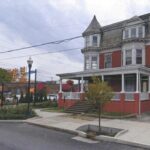
This Very Old House: Central PA has its share of antebellum buildings. Owning one, however, can be more challenging than charming.

Screenshot 2015-02-22 11.29.43On a dead-end street, blossoming cherry trees flank a small stone cottage, evoking a scene straight from “Snow White and the Seven Dwarfs.” A brick path curves to the front door; a spring bubbles up and meanders down the bank beside the residence.

Evan and Sommer Keller have lived in this 1790s home on Fetrow Lane in Fairview Township for 13 years. Known as the Fetrow Farm, it originally served as a distillery, later as an orphanage and as a summer home for a family from New Cumberland.

When asked why they decided to purchase the home, Evan replied, “When we saw it, it was a charming little cottage…it was cool and old and whimsical.”

Not everything about living in a very old home is cool, however. The Kellers said that they had to upgrade the electrical wiring throughout the house and put in a new heating system. This work was made more difficult by the plaster made of horsehair, straw and mud that covered the walls.

And nothing in this home is level, plum or square.

The home had no insulation when the family first moved in. So, until they were able to insulate their home, the Kellers slept with a heating blanket.

Bob and Eileen Young can attest to these challenges. For 38 years, they lived in an 1857 Shipoke house once owned by Civil War Gen. Joseph Knipe. Every door in the home hung askew, and the attic door wouldn’t even close.

“It helps to be young, enthusiastic and able to use a hammer,” Eileen quipped.

Caretaker of History

Indeed, home improvement projects can prove extra challenging in old homes because no building codes existed at the time, so nothing is standard. In his 30 years of renovation experience, Dave Leaman of Harrisburg-based Renovations Company has found that each old house presents its own set of unique trials.

First of all, there’s the aforementioned lack of insulation in ceilings, walls and floors. Then there are the windows and doors that leak heat and the floors and ceilings that sag because of large spans between floor joists.

Also, much of what needs to be repaired or replaced in an old home, such as moldings, trim, doors and windows, doesn’t come stock. That means special orders or unique vendors, which equals money.

Because of the costly nature of owning an old home, Leaman said that people with “big dreams and no money” should enter into a purchase cautiously.

He added that, when considering a contractor, owners should make sure that the firm has experience working on vintage homes. The Youngs concur. Homeowners, they said, should find a contractor that is willing to do the often-laborious work necessary to maintain the historical integrity of the structure.

For those who take the plunge, living in an older home often involves the desire to retain its antiquity.

The Kellers, for instance, left exposed beams in their living room. They removed the horsehair and mud stucco from the brick in the upstairs to reveal beautiful stonework.

They also wanted to refurbish the upstairs flooring, but the downstairs ceiling was attached to the floor. So, they supported the ceiling beams, at great effort; removed the floorboards; re-planed the wide pine boards; epoxied the holes; created new tongue and grooves; and reinstalled the floor.

It took two years.

However, they couldn’t keep all of the house’s aged appeal. Sometimes, practicality had to win out. For instance, they installed drywall throughout the house to run new electrical wires.

After the devastating 1972 flood, the Youngs felt strongly about keeping their Shipoke home’s original floors.

So, instead of taking the easier option of ripping them out, they cleaned them up themselves—with toothbrushes. After a project to move the furnace from the basement to the third floor destroyed some 13-inch molding, they took the extra step to have moldings reproduced by the former Snyder Lumber Mill in Harrisburg,

Eileen Young said that living in an old home made them feel like they were “caretakers of history,” a responsibility that they took seriously.

Extra Effort

Is all of this effort worth it?

Absolutely, according to the Kellers.

“It was a hobby and a joy and a love before we had kids,” said Sommer. “We didn’t go to sports games or shopping. We’d stay up all night and work on the house. We had a blast.”

It’s evident that folks live in these homes because of the special feeling it invokes.

“I love this house every time I visit something new,” said Evan Keller. “It makes you love the things that are old.”

The family has come to appreciate the house’s quirkiness—its soul. For instance, there is something extraordinary about the sound of a rainstorm on a tin roof, the Kellers said.

“When you’re in a rainstorm and hear the rain on the metal roof, you think people have basically been doing this for 200 years,” said Evan.

The Youngs echo those sentiments, saying that an old house is like living in history and that “there is always something to see,” referring to the woodwork and moldings in the home.

These houses feel distinct. The low, sagging ceilings, natural stone and wooden beams bring the past into the present. Homeowners are enveloped in history every time they walk down the uneven walkway and up the tilting steps through the crooked front door.


Continue Reading

Water and Air: Harrisburg’s historic Waterworks has found new purpose as a yoga studio—and it’s taking flight.

Photo by Jay Stover Photography.

Photo by Jay Stover Photography.

The Old Waterworks on Front Street long has been considered one of Harrisburg’s most iconic buildings.

In recent years, it was home to an advertising firm and, after that, mostly sat empty, which is how Rachel and Ulysses Wilson discovered it a few months ago. The couple was driving through Harrisburg after looking at another potential site for a new venture—a second location of their Camp Hill-based yoga studio, Om My Yoga.

“The location we were coming from would have been similar,” Rachel started, the stopped quickly. “No, actually, there’s nothing with a similar feel. We looked in all the windows and then thought, ‘This is it! This is the space!’”

Rachel and Ulysses laughed. “By the end of the day, we knew who owned it, but we didn’t know how much it would cost because it wasn’t even listed,” she said.

The space, which is now home to the couple’s new yoga world (the word “studio” just doesn’t do it justice), has incredible arched windows and industrial-looking beams that naturally fit with the aesthetic of the warehouse space. The high ceilings were perfect for Om My Yoga’s Aerial Yoga—a type of yoga that involves incorporating silk hammocks that hang from the ceiling into traditional yoga practice.

Whole New Level

The Waterworks location culminates a years-long story of the couple’s increasing devotion to the practice and business of yoga.

Rachel long had been a fitness instructor, teaching spinning and other exercise classes at a local gym. After she gave birth to their son, she chose to focus her energy on yoga.

She started with private sessions in their home, which soon expanded into classes of five and then into the double digits. This growth inspired them, in 2011, to move into the space in Camp Hill, a studio that quickly expanded to the location next door.

Meanwhile, Ulysses started to gain an interest in acrobatic yoga, a fusion of the stretching and movements of yoga and acrobatics. The couple traveled all over the East Coast to train with acrobats, gymnasts and professional dancers.

“Sometimes, [we were] way out of our league,” Rachel said. “And it’s been good! It’s pushed us to a whole new level. Then we come back here, and we feel we have so much to offer to this city and to this area. We just want people to come and experience it because we’ve spent the time in Miami and New York City training with all these great people, and we’re just excited to share it.”

A Reflection

After about eight weeks of negotiating for the space, the couple and their core team of 12 yoga enthusiasts took the leap into the new project, which involved a lot of scrubbing and cleaning to return the Waterworks to its former beauty.

The original tin and iron and wood detailing now give the space an industrial look, perfect for the Wilson’s preference and needs. The main studio space is open and draws the eye up to the stunning windows, which reflect light off of the Susquehanna.

Rich, colorful details both complement and contrast with the stark interior, bringing Rachel and Ulysses’ vision for the space to life. Furniture and pillows are brightly colored, while lamps are of various motifs, sizes, shapes and colors. Even the restrooms show creativity and whimsy. One is Beatles-themed, while the other has a chalkboard graffiti wall, which, when I was there, had scribbled on it, “Once in a while, blow your own mind.”

The space is a reflection of the couple’s energy, enthusiasm and love for the art of yoga.

“We might be pushing the envelope here in Harrisburg, bringing something like this, but I’m a go big or go home kind of person, and we wanted to bring our vision here and see if it was accepted and inspiring and, so far, everyone that has come has been mind-blown with excitement,” Rachel explained.

If I walked away with anything from our meeting, it was the couple’s zest for life and their passion for their business and what it does for others.

“We like to be active and play and have fun and help people to remember that they don’t have to be so serious all the time and to try something new and have an adventure,” Rachel explained as she stood below a vintage-looking stop sign that appropriately read, “STOP. Enjoy Your Life.”

Om My Yoga now offers double the classes that it had prior to the Harrisburg opening. If you’re not sure if a class is for you, the team offers an open night on Tuesdays starting at 6 p.m. when, for $5, you can experiment with the hammocks and acrobatic yoga in a no-pressure situation.

“For the last two weeks, it’s been people on the hammocks, acro-yoga, hooping, and last week someone brought fire spinning [batons],” Rachel said. “We have a mini circus in here!”

Om My Yoga is located at 614 N. Front St., Harrisburg, and 4407 Carlisle Pike, Camp Hill. For a complete list of Om My Yoga’s classes and other information, visit ommyyoga.com.


Continue Reading

Musical Notes: Warming trend–less snow, more sounds.

I am so sick of winter.

It’s been way too cold, and Punxsutawney Phil’s forecast gets me down. My hunch is that you are as tired of hiding under blankets as I am. Thankfully, March means spring is just around the corner. And while warming weather and buds on trees are worth celebrating on their own, March also features some wonderful music to wake you from your winter hibernation. So, you may need to squint as you emerge from winter’s darkness, but, I assure you, these shows are worth the trip.

HEXBELT w/THE WILD HYMNS, 3/6, 8PM, ABBEY BAR, $5/$7:
Both of these area bands have a rootsy vibe. However, for Hexbelt, this vibe is channeled through high-energy performances that oscillate between punk rock abandon and jam band guitar licks. Equal parts political and personal, their music evokes a range of moods and experiences. The Wild Hymns, on the other hand, are much more subdued, but no less evocative. Ethereal, indie-folk arrangements perfectly complement the soulful voice of lead singer and songwriter Krystle Seitz. This is a show that is sure to satisfy the tastes of a variety of music fans.

STELTH ULVANG w/FLOWER GARDEN, 3/9, 7:30PM, THE MAKESPACE, $5 SUGGESTED DONATION:
Piano driven and high energy, Stelth Ulvang, who has been touring as a member of the Lumineers, breaks down your expectations of what a bluesy songwriter should sound like. With a voice that permanently sits at the cusp of laryngitis, Ulvang’s music perfectly exemplifies the touring life. He can slow it down, as well, but his music never loses that impassioned edge. The result is a deeply personal and raw experience that is still accessible. He will be joined by upbeat Harrisburg locals Flower Garden.

VERNAL EQUINOX CELEBRATION w/MISHA KASHOCK, CLINTON DAUB & JIM AGUZZI, 3/20, 7PM, LITTLE AMPS DOWNTOWN, FREE:
Although this night of percussion and dancing in celebration of the coming of spring may be atypical for “Musical Notes,” it seemed too inviting to pass up. Although it will feature some set performers, it also promises to be interactive, welcoming attendees to join in on the fun. This evening will be especially appropriate for families. Plus, it’s free! So stop on by and really celebrate the end of winter.

Mentionables: George Thorogood & the Destroyers, 3/11, the Forum; Tommy Emmanuel, 3/12, Whitaker Center; Dean Thomas, 3/13, Little Amps Downtown; Kites in Flight, 3/20, Midtown Scholar; Juggling Suns, 3/27, Abbey Bar

3/6
Hexbelt w/The Wild Hymns
Abbey Bar
50 N. Cameron St., Harrisburg
Starts at 8 PM

3/9
Stelth Ulvang w/Flower Garden
The MakeSpace
1916 N. 3rd St., Harrisburg
Starts at 7:30 PM

3/12
Tommy Emmanuel
Whitaker Center
222 Market St., Harrisburg
Starts at 7:30 PM

3/20
Vernal Equinox Celebration
Little Amps Downtown
2nd & State streets, Harrisburg
Starts at 7 PM

3/20
Kites in Flight
Midtown Scholar Bookstore
1302 N. 3rd St., Harrisburg
Starts at 7:30 PM

Continue Reading

Intentional and Gorgeous: Oscar-nominated “Timbuktu” touches both the personal and the universal.

Screenshot 2015-02-22 11.35.15The first shots are jarring, the sound of gunfire breaking through the peaceful scenery as a jeep full of armed men shoot at a fleeing gazelle.

“Tire it! Tire it!” they cry as they shoot near it but not at it. “Don’t kill it, tire it!”

Eventually, their game diverts from live animals to little people-shaped targets made of wood and clay, which collapse as the bullets tear into them.

If you want to (but you won’t), you could stop right here and pick out the message that Director Abderrahmane Sissako had in mind for “Timbuktu,” the West African film that landed itself an Oscar nomination in this year’s foreign language film category.

The film depicts a community—the metaphorical gazelle—that has fallen under the control of jihadists in the early rise of conflict in Mali. These jihadists set right to work fitting people into the religious restrictions laid out by their interpretation of Islam. Patrolling the city with loudspeakers, they ban music, take balls away from kids, tell the women they must wear socks and gloves at all times—imposing draconian rules on the community.

Our protagonists are members of a family who, unlike most of their neighbors, have not fled Timbuktu, despite the imposition of jihadist law. Kidane (Ibrahim Ahmed) and Satima (Toulou Kiki) live fairly simple lives. They are parents to a 12-year-old daughter Toya (Layla Walet Mohamed) and guardians to an orphaned boy, Issan (Mehdi A.G. Mohamed). They live in a modest tent and have eight cows, which Issan gladly tends. When a nearby fisherman kills Kidane’s favorite cow, Kidane angrily makes a mistake that upturns the entire family’s life.

But “Timbuktu” doesn’t give a one-sided, stereotypical look at jihadism. In fact, right from the start, it divulges a personal side that the media tend to skip over. Though the film makes remittent use of humor to portray the ridiculous antics of the jihadists, they are first and foremost portrayed simply as people.

The antagonist of the story is Abdelkerim (played by Abel Jafri), a leader whose only goal is to fulfill Islamic law. Though the outcomes of many of his decisions seem cruel and cold (such as stoning and flogging as punishments), he gives the outward appearance of a gentle, pious man. He just wants people to follow Islam.

“What do you know about inner strength and good men?” he asks his driver at the beginning of the film. “One has to be a good believer.”

“They are believers,” his driver replies. “This is good enough for me.”

The driver’s words reflect the actions of the surrounding community. This is another point that the film drives home: with restriction comes resistance.

The city of Timbuktu becomes a character itself, its many citizens uniformly rebelling against the grip the jihadists have on their religion and lifestyle. The children cannot own a ball, so they play football without a football. A woman gets 40 lashes for making music, so she sings as she receives her punishment. There is even an early scene in which an imam lectures the jihadists about not truly having their faith in mind.

Every second of this film is intentional and gorgeous. The cinematography, crafted by the same cinematographer of “Blue Is The Warmest Color” (Sofian El Fani), is stunning and continually adds emotional weight to the scenes. And though the majority of the cast has no prior film experience, their performances deftly bring a story of such quintessential humanity to life. It’s a refreshing film to watch in a world so riddled with prejudice and stigma against people unlike ourselves.

“Timbuktu” will be playing at the Midtown Cinema. I highly recommend that you check it out.


Midtown Cinema: March Events


Digital Classic Theatre Series

“The Tempest” w/Christopher Plummer
Sunday, March 1, 4pm & Tuesday, March 3, 7pm

Stratford Festival’s “King Lear”
Sunday, March 8, 4pm & Tuesday, March 10, 7pm

Royal Shakespeare Company’s “Love’s Labour’s Lost”
Sunday, March 15, 4pm & Tuesday, March 17, 7pm

Classic Film Series 

“Battleship Potemkin”
Sergei Eisenstein’s 1925 silent film
Sunday, March 8, 6pm

Down in Front!

Improv crew skewers
“Zaat!” (1971) BYOB
Friday, March 13, 9:30ish

Saturday Morning Cartoons

March 14, 9:30-11:30am

Mommy & Me Matinees

Early matinees every second Saturday!
Saturday, March 14

Family Film Series

“Cloudy with a Chance of Meatballs”
Saturday, March 14, noon
Sunday, March 15, 2pm
Tuesday, March 17, 7pm

3rd in The Burg $3 Movie

“Clue” (1985)
Friday, March 20, 9:30ish BYOB
Costume & Mrs. White Impression Contest

MOVIATE Presents

“Morris County” (a horror film screening)
Sunday, March 22, 7:30pm
Meet filmmaker Matt Garrett

Digital Contemporary Theatre Series

“From Here to Eternity: The Musical”
Sunday, March 29, 4pm & Tuesday, March 31, 7pm

Continue Reading

Sense of the City: Playwright Paul Hood gives voice to urban life, his life.

Screenshot 2015-02-22 11.34.27As a child, playwright Paul Hood dreamed of being a film star.

That dream may not have been too farfetched. Hood is an imposing figure at 6-feet-3-inches tall, with piercing eyes, a reassuring voice, and a smile that could tame a road-rager. But don’t think for a minute that this cool guy is going to let his audiences off the hook when they come to see his plays. Sure, he’ll make you laugh, but he’ll also force you to think deeply, ponder life and question your truths.

“What makes me tick are the mysteries of life,” Hood muses. “I feel like, as a writer, if I figured this all out, I would be bored out of my mind. Some of the questions I have about existence fuel me to explore things in my writing such as love, addictions, failures, the plight of dysfunctional families and relationships, the joys and wonders of simple things.”

Hood admits to his love/hate relationship with life—something he struggles with. Fortunately, he’s able to examine that struggle through his creative outlet of choice—play writing—which allows him to “share my thoughts with the universe.”

“It’s an enjoyably cathartic endeavor,” he says.

Local theater-goers have been witness to those endeavors inside venues such as Open Stage of Harrisburg, Gamut Theatre and Hershey Area Playhouse, among others. Hood has had a flurry of staged works produced in and around the ‘Burg as of late, and upcoming this month is “My Electric Life,” which explores the notion of Internet addiction of three completely different individuals.

Hood’s inspiration for “My Electric Life” came about one summer when he realized how much his own online routine—Facebook, dating sites, general surfing—had turned into a habit that wasn’t allowing him to write, to truly live, to fully connect one-on-one with others.

“I wanted to explore the idea with honesty and humor and not sugarcoat anything about three strangers who have to face one another and open up about why it is they isolate themselves from the world,” Hood says. “I wrote it thinking I’d maybe enter it into the Philly Fringe festival or The Capital Fringe in Washington, D.C., but then I realized I could try it out in Harrisburg first because we have a pretty large theater scene open to hearing new work by local playwrights.

Hood is particularly thrilled about the premiere of “My Electric Life” because it will be his first full production in Harrisburg after almost four years of staged readings, where actors on stage have scripts in hand.

While “My Electric Life” was inspired by Hood’s own Internet habits, most of his other plays that deal with social and mental health issues (along with the absurdities of life) are triggered by the things he sees and hears throughout the city. Plays such as “Other Cat,” “Aldous Remembers” (which had its first reading at Midtown Scholar Bookstore) or Hood’s longer works—such as “I, Journeyman” and “Brighton’s Green Street”—incorporate the rhythm and vibe of urban living.

“I couldn’t see any of my plays taking place in the countryside of Pennsylvania,” he says. “The themes I explore feed off the energy of my surroundings, which has always been city life.”

The city lives and breathes in Hood’s pores even though he originally hailed from Birmingham, Ala., then Youngstown, Ohio, and Middletown, Pa., before his mother unexpectedly moved the family to Harrisburg when Hood was 11 years old. As a youngster, Hood was pretty much a “hermit,” painfully shy, insecure and saddled with a severe learning disability. The “city” loomed large, too large, so movies and comic books were his escapes. He’d spend his summer days inside watching movies and took notice of how things “worked”—character motivations, setting, plotting and dialogue.

“I watched movies clearly to invest myself in the lives of people I thought I wanted to be like when I grew up,” he recalls. “Like all kids in the John Hughes films or the young kids in ‘Goonies’ and ‘E.T.,’ I wanted their lives. I grew up in a dysfunctional family so anything on a screen filled with adventure or comedy was craved.”

Hood’s love of the big screen segued to him becoming a respected local movie critic after he answered an online ad for a local entertainment website called Harrisburg Online. Here, he could combine his two loves—writing and film. He began taking old short stories he’d written and converting them into screenplays that eventually morphed into plays.

“The change for me happened after a room filled with hundreds of people howled with laughter, gasped and listened intently to words I had written,” Hood says. “I was hooked. I had found my true voice as a writer, everything beforehand was practice.”

Hood is a member of Playwrights Alliance of Pennsylvania (PAPA), the region’s playwriting group, with whom he’ll be working on a theme-based play, and one of his short plays will be featured at Oyster Mill Playhouse in Camp Hill this summer. He also hopes to raise funds to get a production of “Brighton’s Green Street” on stage somewhere in the city.

This self-described former “hermit,” this shy, insecure, film-obsessed playwright, has risen above it all, giving voice to city life and to us a piece of his mind. All we have to do is batten the hatches, hang on and hope for the best.

“Playwriting gives me a chance to explore ideas or say things I may be afraid to talk about in person,” Hood says. “The stage is my virtual podium for self-expression, a place where my philosophies and questions can come to life in the form of something enlightening to an audience.”

Paul Hood’s “My Electric Life” will be performed March 27 to 29 and April 10 to 12 at the Harrisburg Improv Theatre, 1633 N. 3rd St., Harrisburg. Visit www.hbgimprov.com.


Continue Reading

A Play of Their Own: All-female cast treads the boards in “Women Playing Hamlet.”

WPHamlet_18x24_2Back in Shakespeare’s time, men and boys played every part, even female roles, as women were not allowed to act on stage.

Turnabout is fair play in “Women Playing Hamlet,” which premieres this month at Harrisburg’s Gamut Classic Theatre. Written by playwright William Missouri Downs, the play tells the story of an actress who auditions for Ophelia in “Hamlet,” only to end up being cast in the title role.

Gamut Theatre Group was selected to participate in a “rolling world premiere” of the play, a debut that includes just three American theaters. The actresses in the local production of Downs’ play, billed as “a comedy about the tragedy of modern life,” find it exciting to participate in a world premiere.

“There is something very freeing about working on material that hasn’t been loaded with preconceived notions of who-plays-what-and-how,” said actress Tara Herweg-Mann.

Honored

The rolling premiere is sponsored by the National New Play Network (NNPN), an alliance of theaters devoted to the development, production and continued life of new works.

Gamut’s participation was serendipitous, said Executive Director Melissa Nicholson.

The theater is a member of the Shakespeare Theatre Association (STA), which provides a forum for theaters primarily involved with the production of the works of Shakespeare.

Patrick Flick, executive director of STA and the literary manager of NNPN, had seen works by Downs in the past. When he heard the playwright had a new work with a Shakespearean theme, he sent out the word to STA members.

“I saw that communication, read the description of the play, and thought it would be perfect for Gamut to produce,” Nicholson said. “We have a talent for playing multiple roles and our women are very strong. Also, our women are sometimes underutilized in our main stage productions due to the amount of female characters available to play in Shakespeare.”

Nicholson responded to Flick’s e-mail that very day.

To produce a rolling premiere, theaters must be NNPN members and demonstrate a dedication to new works. All of the Popcorn Hat Players’ shows are new works written specifically for the company, and Young Acting Company shows recently have been full-length new works by resident playwright Sean Adams.

“In addition,” Nicholson added, “we have produced some new works over the years with a classical theme.”

Theaters that do the rolling premieres have to agree to produce the play within a 12-month period and work collaboratively with the other theaters involved and with NNPN, explained Nan Barnett, NNPN executive director.

“They receive a $21,000 award—divided among the three theaters—to cover production expenses,” she said.

The rolling premieres aim to give “life” to new plays in a way a one-time premiere often cannot—and bring cachet and prestige to the playwrights.

“It’s a wonderful opportunity for playwrights to see their works done in and by three different artistic teams, facilities, actors and audiences,” Barnett said.

After filling out an application and being interviewed by the playwright, Gamut received word in July 2014 that it had been chosen.

“We are very honored,” Nicholson said

Image provided by the Gamut Theatre Group

Image provided by the Gamut Theatre Group

Idea of Self

The four actresses in “Women Playing Hamlet will play 20 roles of both genders.

Kathryn Miller plays a variety of parts—including a young actress, a Catholic priest, a male bicycle messenger, a 14-year-old female computer geek, a toothless barfly, a home-shopping network model and a young soap opera starlet.

“Being one of the first to discover the characters and perform them on stage is refreshing and unique,” said Miller.

Amy Burke portrays an unsympathetic humanities professor, the ghost of Hamlet’s father and an acting coach, while Herweg-Mann is the protagonist, Jessica.

Despite Jessica’s training and experience, the idea of playing Hamlet, this “role of roles” in the theatrical canon, is “a bit overwhelming, to say the least,” said Herweg-Mann.

Trying to find herself, the protagonist seeks help from a host of characters, and each interaction brings her closer to finding the answer to the question, “How do you define yourself?” said Downs, the playwright.

He said that he’s captivated by the idea of “self,” a search that brought him to “Hamlet” and the creation of “Women Playing Hamlet.”

“I think more truth can be found in comedy than in tragedy, for the human condition is not a tragedy but a wonderfully absurd free-for-all,” Downs said.

In addition, Hamlet is different from most protagonists in literature.

“Unlike in melodramatic movies, plays and novels, in which the protagonist knows who he is, what he wants, and what he must do to win, he first sets out to define himself to himself,” Downs added. “I’m not sure he succeeds.”

Downs has authored more than 30 plays and teleplays with a variety of themes and styles, but this is only the second time he’s used Shakespeare as inspiration.

Gamut’s actresses are delighted that Downs took the leap to rethink “Hamlet” for an all-female cast and that its premier is right here in Harrisburg.

“I had never experienced before what it is like to be one of the first actresses to play a role,” said Burke.

“Women Playing Hamlet” runs March 13 to 29 at Gamut Classic Theatre, 3rd Floor of Strawberry Square, Harrisburg. Performances are Fridays and Saturdays at 7:30 p.m. and Sundays at 2:30 p.m. General admission tickets are $27. Tickets for seniors and students are $17. For tickets, call 238-4111 or e-mail [email protected].

There will be an opening night post-show discussion with the playwright, director and NNPN’s executive director. On March 14, Gamut will host an Opening Weekend Gala. Guests will have the opportunity to meet and chat with the actors, playwright and director. Gala tickets are $40 a person and $75 a couple, including admission to the performance and wine and hors d’oeuvres at the gala.

Continue Reading

Student Scribes: Travels of a Slug

Screenshot 2015-02-22 11.34.44“Watch out for the dead slugs,” I heard my friend shriek as I skipped over the dried skin and guts smeared about the sidewalk. The slugs lay trampled on the gray concrete near the entrance of her dorm. They were streaks of green, white, tan and black covered in dirt and made crispy by the sun.

They were leopard slugs. One of the only slugs I can differentiate due to their size and their pattern of black inkblot markings on a tan, glimmering, smooth membrane. The design, as the name hints, resembles a leopard pelt. Their length hits 4 inches and sometimes 8, considerably larger than your everyday garden slug.

Only a day or two before this scene, when the rain had been pouring and the air was thick with the smell of mud, I had seen a live slug of the same type in the exact same spot. After observing for a moment with what would be described as a mix of fascination and disgust, I ferried the little passenger, using a piece of paper to keep my distance. I transported my pilgrim to the side where pavement meets grass and where unwary pedestrians would be less likely to trample the smaller citizen making its way about the path as well. I have no particular affinity for slugs or worms, or any slimy creatures of that nature. However, I will admit I felt sympathy for the slippery soul trying to make its way in a place it had no place being, in a place where its life could be extinguished so easily and uneventfully.

Several days later, the sun had returned and, despite my attempt, the carcasses of not one, but three of these little travelers lay ground into the coarse pavement, causing my friend no small amount of distress upon exiting or entering her dorm. Some casualties cannot be stopped, I suppose. Even so, I wondered if the people who had trod on them had unintentionally ended the lives of the little streaks of slime, or if they had done it with a purposeful stomp and drag. I also wondered why these slugs had all chosen to travel on the pavement in the first place, instead of staying in the relative safety of the soil and grass where they belonged. Originally, I had thought that the answer was simple. The heavy rainfall must have rendered their usual home of soil and turf uninhabitable, forcing them to escape. They obviously could not live in such waterlogged conditions. Like victims of a flood, fleeing for higher and drier ground, these slugs must have been searching for a place to wait out the rain.

Satisfied with my own answer, I continued on up the stairs following my friend to her dorm, only mourning their disastrous end about as much as I mourned the death of my distant aunt who lived in one of those Midwestern states I can never remember. Distant was their existence from mine. They were only a few feet away in reality, but separated by scale and “intelligence,” these slugs were simply an unfortunate mess to be avoided as I went on my way.

It was not until recently that I learned the actual reason these slugs had been all about the pavement. Although it was a common belief for years that worms, slugs and other animals of that sort had been drawn out of their homes during heavy rain by the risk of drowning, the theory has changed. Unlike humans, these creatures breathe through the many pores in their skin, and they do not drown easily. In fact, they need moisture in the air and soil to survive. The main theory now is that rain provides these critters with an extraordinary chance for travel.

Traveling below the earth or close to soil and grass can be a slow and tough method of travel. Pushing through hot gravel, roots and grass prevents an easy voyage. The cool rain allows these creatures to survive above the earth in places they could not normally last for long. They can travel greater distances much quicker than on the average warm day, using the abundance of moisture to glide about the terrain.

Every day, I cross the same terrain so easily. It is the scale, again. The scale keeps us distant. Feet to me are like miles to them, and yet they still travel and attempt to get where things may be better. How can I get to where I want to be, even if I do not know where that is? I feel the danger involved with cutting out the paths I need to take. I desire to avoid the danger, afraid to be trampled by life. The slugs and worms take the risk to find green leaves and dandelions in plenty. They travel in storms, rain their aid, over scabrous manufactured tar. Although the scale is different, it is familiar all the same. The leopard slug is only indigenous to Europe, a distant continent even for human beings. Thousands of miles of salty ocean divide us. Yet, they made the crossing despite their size, and so did we. How distant are these creatures really, and why do they seem braver than me?

Kyle Bussino, a sophomore, is a computer science major at Penn State Harrisburg.

Continue Reading

Classical Magic: What happens when you combine Brahms, spectacle and the circus arts?

Screenshot 2015-02-22 11.32.52There’s an old cliché that says, “Everyone loves a circus.”

When Cirque de la Symphonie comes to town, don’t expect just to love it, however. Expect to be entranced and surprised and carried away, as well.

“This is not a popcorn and peanuts kind of presentation,” said Bill Allen, executive director and producer. “It’s more of a theatrical production. We perform to classical music with only one act going on at a time. Our show is meant to raise Cirque artistry to the fine arts level.”

Cirque de la Symphonie began in 2005 when Allen joined forces with Alexander Streltsov, a Russian aerial artist. On his own, Streltsov had put together similar programs with the Cincinnati Pops.

“The shows were very successful, and it was actually the conductor, Erich Kunzel, who gave us the idea of starting the company,” Streltsov said.

Now 10 years later, Cirque de la Symphonie works with 50 to 60 orchestras a season, along with some 65 Cirque artists, and regularly fills the house. In fact, last year’s two shows with the Harrisburg Symphony Orchestra at The Forum sold out, and, at press time, tickets for this month’s shows were going fast.

Allen said that the shows attract new patrons to the music hall, many of whom may never have seen an orchestra before.

“You would expect to see grandmothers luring in their grandchildren to be exposed to the symphony with the promise that they may see a clown or a juggler or something like that, but what’s really interesting is that you see a very large number of young adults in their 20s and 30s who have just about everything else in the world competing for their entertainment dollar, and they choose to come see this program,” he said. “These young adults are the very people that orchestras need to be recruiting as new subscribers.”

Cirque de la Symphonie is the only Cirque company in the world that works exclusively with symphony orchestras.

“Performing along with live classical music is a very different kind of performance for these Cirque performers,” said Allen. “The orchestra is not there just to be a background band and play along to what antics are going along down stage.”

Alina Sergeeva, a third generation circus performer who specializes in hoops and hand balancing, said that she loves getting into a venue, doing just one rehearsal with the orchestra and then putting on the show.

“Live music makes it all better,” she said.” The symphony really helps you do the best you can on stage.”

When Cirque de la Symphonie comes to Harrisburg, the group will perform feats that make the “nearly impossible look easy,” accompanied by well-known classical masterpieces, said Allen.

“They’ll hear a little bit of Shostakovich’s ‘Festive Overture,’ Rossini’s ‘Tarantella’ from ‘La Boutique fantasque,’ some Rimsky-Korsakov, Kabalevsky and Brahms,” he said. “We also have some recognizable music that the young people would find interesting, like ‘Flight to Neverland’ from the movie ‘Hook.’”

Streltsov is one of the eight Cirque artists who will be performing in Harrisburg. A celebrated aerial artist, he performs mostly on “silks,” which are long pieces of fabric that are suspended from the ceiling. Streltsov comes from a circus family and has performed for three Russian presidents, with the Bolshoi Ballet and on Broadway.

Other performers include award-winning acrobatic gymnast Christine Van Loo; Vitalii Buza, an elite gymnast with the Russian national team; master juggler and illusionist Vova Tsarkov; aerial and balancing specialist Sergeeva; and 13-year-old contortionist Nate Nordine.

Jaroslaw Marciniak and Dariusz Wronski (known as Jarek and Darek) appear as a matched pair, painted from head to toe in gold. They will display strength and agility as they show off their skills as Poland’s former national hand-balancing champions.

“All of our Cirque artists are consummate performers who are at the top of their game,” said Allen. “Imagine what it’s like for them to be highlighted as a solo artist with a sold-out music hall in front of you and the power of a full symphony orchestra behind you. It doesn’t get any better than that.”

Cirque de la Symphonie performs with the Harrisburg Symphony Orchestra on March 7 at 8 p.m. and March 8 at 3 p.m. at The Forum in Harrisburg. To find out about ticket availability or to learn about any of the Symphony’s other programs, visit www.harrisburgsymphony.org. 

Continue Reading

Student Scribes: “My best friend and I made a slip ‘n’ slide in the winter”


Screenshot 2015-02-22 11.34.51We went into the snow in socks and taped garbage bags together.
We went through 10 bottles of shampoo, 2 bottles of baby
oil, 8 bottles of conditioner, 1 bottle of dishwashing liquid, and 37
bottles of water. In addition, probably three or four toes each. What
we learned? Life is exhilarating, even in the blanketed white.

In the end, we were both soaked and shivering, but we rolled
up the garbage bags anyway and hid all the garbage; our parents
wouldn’t like our idea. What we learned? It didn’t matter
what they liked.

We liked the idea. We also liked the idea of an egg fight in the driveway.
The frozen eggs left welts on my arms; her aim was a little too
good. We liked the idea of mixing every food we could find in
the kitchen, and eating it. A challenge. What we learned? Never eat anything
that is bright purple.

We didn’t so much like the idea of her stage 4 cancer. She had
known that something was wrong, but not this.
19 and dying was a challenge, too. Taking every truth
of life and mixing it together. What we learned? Getting Subway
on the way to chemo every day will make you hate Subway.

We ate brownies to celebrate her remission. Then
we went to a concert and got into all the mosh pits.
Something you can shove back is a better bully.
What we learned? Screaming can be kind of fun if
no one knows about the rage behind it.


Alaina Richardson is a double major in English education and communications at Penn State Harrisburg. She is a junior.


Continue Reading

Charity Bowl: Animeals fills the belly, warms the heart.

Screenshot 2015-02-22 11.32.16In 2006, Theresa Fazzolari was a returning student completing her bachelor’s degree in social work at Temple University in Harrisburg. She was assigned to identify a community need and come up with a way to address it.

At the time, she was interning for the Dauphin County Department of Aging and began to be concerned that the low-income, elderly, often homebound clients being served by the Meals on Wheels program might be having trouble feeding their pets.

If folks couldn’t afford to feed themselves, she thought, how could they feed their four-legged friends?

Fazzolari discovered a program in California called Animeals, created in 1984 by the Helen Woodward Animal Center after a Meals on Wheels volunteer realized one of her clients was sharing her delivered food with her cats.

Clearly, there must be elderly people in the Harrisburg area facing similar issues, Fazzolari thought. So, she drafted a flyer that was distributed to Meals on Wheels recipients.

Soon, the names of people requesting pet food started arriving, and Fazzolari was stunned.

“There was such a need,” said Fazzolari, now 49. “ I didn’t think it would take off like it did.”

Purina sent 5,000 pounds of pet food to get the group started but Fazzolari—who today distributes more than 500 pounds of food a month—soon learned how quickly supplies dry up.

Compared with non-pet owners, elderly people with pets have lower blood pressure and cholesterol levels, have a better sense of security, are more active, experience less depression, and even live longer, according to research compiled by the Helen Woodward Center.

Beyond Kibble

Over the last decade, Fazzolari has helped scores of individuals keep their pets and, in turn, helped keep families intact.

Many of her early clients have passed away or been admitted into nursing homes, but new clients arrive with their pets on a regular basis.

This year, Animeals serves 57 elderly men and women and about the same number of cats and dogs. The group’s oldest client, Ann Dennis of Mechanicsburg, is 101. Animeals volunteers deliver a monthly bag of food for her cat, Marilyn Monroe.

Fazzolari, her husband Tony and her volunteers have expanded their good deeds far beyond kibble delivery.

She has enlisted her neighbor, Charles Palentz, a Navy Depot retiree, who pitches in to help with home repairs from changing light bulbs to building handrails and fixing roofs. Professional groomer LeeAnn Menut, who owns Pet Bath and Beyond in Camp Hill, provides nail trimming and bathing. Her husband Ken takes clients’ pets to vet Tracy Moussa of Animal Birth Control of Middletown, who donates most of her services, charging only for drugs and supplies.

In one case, Fazzolari dipped into the Animeals account to buy a client a tank of fuel oil when no crisis help was available from the county. “She was so grateful,” said Fazzolari. “We justified it by figuring their pet needs to stay warm, too.”

In some states, pet food delivery services operate through county Meals on Wheels programs. In Pennsylvania, most Animeals organizations receive county referrals, but are independent and must find donations, raise money and recruit volunteers on their own.

“It’s hard to believe,” said Amy Kaunas, executive director of the Humane Society of Harrisburg Area, which supplies Animeals with most of its food. “Pets are so important to older people for their mental health. Government agencies don’t get that they’d be feeding their county-funded people food to their pets if they had to.”

Every month, Fazzolari stocks up on dog and cat food from the Humane Society of the Harrisburg Area and Animal Rescue Food Bank in Wellsville that operate large pet food pantries to stock the shelves of area pet rescue groups.

“It’s amazing what she does,” said Kaunas, who has worked with Fazzolari since the program started. “Her group was one of my early partnerships when I got here.”

Fazzolari is grateful for what she gets to hand out each month, but sometimes that means lesser quality food and that animals have to eat different brands of food that come with each delivery.

“There’s no consistency,” she said. “And we struggle to fill the shelves every month.”

Just the Start

On a recent Saturday morning, Fazzolari’s porch was packed with several dozen paper bags of food, some with treats and toys sticking out.

She took a visitor to her storage facility—the not-quite bare shelves in the basement of her Camp Hill home.

“This is what it looks like after we distribute food each month,” she said, then picked up a lone donated pet bed. “I haven’t decided who’s going to get that.”

Later that morning, Larry Miller, 75, was standing outside his apartment on Maclay Street in Harrisburg, bundled up in a varsity letterman-style coat—a gift from Fazzolari—with his boxer Bronco (also wearing a coat thanks to Animeals).

When Bronco saw Fazzolari, he strained at the leash to greet her.

“Hey Bronco, how’s my boy,” she said, rubbing his head and bending down for a kiss.

Miller and Bronco, who is 7 years old, have been through some tough patches together. He’d never had a pet, but there was no question he would take over as Bronco’s caregiver after his owner and Miller’s friend, Emeric Bosak, suffered a stroke and was taken to a nursing home.

Every month for almost two years, Miller and Bronco would pile into Fazzolari’s car and visit Bosak at the nursing home until his death last November.

Fazzolari estimates it costs about $30 a month to feed a pet. But that’s just the start of a pet owner’s responsibilities. Routine vet care can run into the hundreds of dollars and emergency care into the thousands.

In 2013, Miller and Bronco were on the sidewalk just a few doors from his apartment when a pit bull pushed open the screen door of its house and viciously attacked Bronco. Miller tried to stop the mauling, but, when it was over, Bronco was lying on the sidewalk bloody and badly injured. A tearful Miller quickly called Fazzolari, who immediately contacted their vet. Bronco lost his right eye and required stitches for other wounds. The total Moussa charged Animeals was $70.

Miller said he gets by on about $600 a month, making a little extra for sweeping up street trash for landlords of neighboring properties, but knew he could never pay for regular food, let alone a large vet bill.

“I could never afford to keep him,” said Miller.

Tons of Food

Fazzolari said she would like to expand Animeals to other counties, but needs to find a sustained funding source to continue its work in Dauphin and Cumberland counties.

Her group is seeking a long-term donor and volunteers to design a website and help with grant writing. She also would like to find a mobile veterinarian to ease the burden of transporting animals to vet clinics.

Karel Minor, president of the Humane League of Lancaster County and the Humane Society of Berks County, runs a similar program, but his distributes most of its food to low-income pet owners through central sites rather than door-to-door delivery.

“It keeps animals out of shelters,” said Minor, who estimates his group doled out eight tons of food in 2013. In order to be enrolled in his group’s program, individuals and families must receive some type of government service and agree to participate in regular vet care, including mandatory spay/neutering.

“Vet care is a way to prevent benign neglect,” said Minor.

On that chilly Saturday morning in January, Miller and Bronco lapped up the attention on Maclay Street—a visit from a television crew, a news photographer and the occasional passerby greeting Bronco by name.

“Everybody knows Bronco,” said Miller, looking down at the wriggling bundle of brown fur at his feet. “He’s the king of the neighborhood.”

Then he paused and turned serious.

“I live alone,” said Miller. “He’s all I’ve got.”

If you’re interested in helping out Animeals, please contact Theresa Fazzolari at [email protected] or 717-571-8883.

Continue Reading