Weekend Roundup with Sara Bozich

Happy Weekend!

I was hoping to go to the PSU wrestling match on Saturday, but all the matches during prime time this season! Not ideal for a baby. I so figured Bo could make it to his first match on a chilly Sunday afternoon this season, but so far no luck.

Instead, I’ll spend a relaxing weekend (no complaints there!) with a trip to the Market, cooking, and maybe binge watch Grace and Frankie.

Plus, football gets one more day! Super Bowl Sunday is this weekend, but I suppose I don’t have to tell those of you who are Eagles fans. I’m debating between Victory Home Grown Lager and Yards Brawler — or just Nugget because it’s already in my fridge — with my game-winning nachos (should’ve made them for the AFC Championship I KNOW).

Other ideas for you to consider this weekend: Start your Valentine’s Day shopping in Camp Hill Borough. The Market Street corridor is chock-full of shops to find unique gift ideas. Little Bits & Pieces Gift Boutique is hosting 20% off all fall and winter merchandise this Saturday. Also this weekend — set-up your 2018 for success with Body IQ Life’s Workshop II: Vision Questing for the New Year!

What are you doing this weekend?

(more…)

Continue Reading

Grant Plan: Harrisburg seeks input for next 5 years of HUD funding

CDBG funds enable neighborhood improvement projects in low- and moderate-income areas.

Is there a nonprofit that’s doing good in your neighborhood?

That’s one of the questions that city administrators will pose at a pair of upcoming public meetings in February and March, as Harrisburg begins to chart its priorities for Community Development Block Grant (CDBG) money over the next five years.

CDBG funds are allocated annually to organizations that help build community and stabilize neighborhoods in low- and moderate-income areas. The city received $1.9 million last year and expects the same this year, according to city communications director Joyce Davis.

The federal Department of Housing and Urban Development (HUD), which disburses CDBG money, requires each municipality receiving grants to have a “consolidated plan” describing its development priorities and goals.

Harrisburg’s current three-year plan is set to expire in September. Roy Christ, Harrisburg’s director of Building and Housing, said that development projects started during Mayor Eric Papenfuse’s first term require a new plan with a longer duration.

“We planted a lot of seeds in these past few years,” Christ said. “We want to drive our roots deeper, because the projects we’re doing now are going to come to fruition in the next five years.”

In past years, CDBG funds have supported organizations such as the Heinz-Menaker Senior Center, Habitat for Humanity of Greater Harrisburg, the Latino Hispanic American Community Center and MidPenn Legal Services.

City departments can also apply for grants. Last year, the Harrisburg Police Bureau received $90,000, which paid for a community policing van and helped launch the police cadet program.

For this planning cycle, Christ said Harrisburg hopes to target projects in “tipping point” neighborhoods.

“These are neighborhoods that need a bit of help to bounce back and become self-sustaining,” he said.

City residents can contribute input at public meetings or through a forthcoming online survey. The meetings will be held on Feb. 20 at the Latino Hispanic American Community Center and March 5 at Jackson-Lick Tower, both at 5:30 p.m.

Christ and Jackie Parker, director of Community and Economic Development, hope that public input will help the department determine which neighborhoods need investment in the next half-decade and which nonprofit groups can help them achieve those goals. The city’s five-year plan won’t dictate which groups will get funding in the future, but it will outline broad development strategies that will guide the city’s allocations.

CDBG funds vary year to year, which can complicate this type of planning exercise, Christ said. Local agencies expect that HUD cutbacks will continue under the Trump administration, which makes the process of allocating money more labored.

Harrisburg also has a significant limitation on its funding—almost a third of it goes straight into debt service. The city is still paying for the crimes of local developer David Dodd, who embezzled federal money while constructing the Capitol View Commerce Center at Cameron and Herr streets.

Harrisburg and Dauphin County awarded Dodd $860,000 in HUD funds to construct the building, which was abandoned halfway through the project and finally completed by another developer in 2015. Both parties also guaranteed loans for Dodd’s $28 million project, bringing the city’s liability alone up to $5 million.

As a result, Harrisburg has diverted as much as $600,000 of its annual CDBG funding to debt service in the years since Dodd’s conviction.

Limited funds have made CDBG allocations an annual point of contention between City Council and the mayor’s office. Nonprofit leaders who apply for grants don’t think that any long-term planning effort will change that.

“It’s the nature of the beast,” said Les Ford, director of the Heinz-Menaker center.

Ford has applied for HUD funding almost every year since he began leading the center in 2012. He said he’ll do so reluctantly this year, despite the shrinking pot of money and the cumbersome application process.

While Ford is ambivalent that a new five-year plan will streamline Harrisburg’s CDBG allocation process, he does hope that it will at least help the city communicate its development goals clearly to applicants.

Continue Reading

TheBurg Crossword Puzzle Solution

Continue Reading

Burg Blog: If Facebook and Google truly want to save local journalism, here’s what they should do.

Some past covers of TheBurg.

Facebook and Google seem to have a case of the guilties.

Both have been accused, with good reason, of making us a less informed, more gullible public by hosting and spreading fake news and by degrading and destroying local news. They now want to make amends.

So, Facebook is launching on an initiative that will better highlight local news and events to its users. Google, it was reported last week, has begun piloting something it calls “Bulletin,” an app that it claims can turn anyone into a local news reporter.

Sigh.

I understand why these tech behemoths are seeking solutions from within their own platforms and staffs. Shouldn’t they try to undo the damage they have done? And, besides, it’s not surprising that these technology companies believe that the solution to problems caused by technology is more technology.

However, both Facebook and Google are misdiagnosing the sick man that is local news and, thus, applying the wrong salve. Local news is suffering not because people can’t find it, and a solution is certainly not having random residents periodically shoot raw video at city council meetings.

Local news is in a state of eclipse because it’s become impoverished.

Facebook and Google have contributed profoundly to the financial collapse of the local news industry, as advertising dollars that used to stay in the local community, supporting local journalism, are now going to them.

Now, it’s not all their fault. Newspapers themselves, particularly chain-owned properties, which constitute the majority of local papers, have made many mistakes attempting to respond to the rise of digital news. I’ll also lay some of the blame on advertising agencies, which have fallen in love with their digital metrics and high-margin social media strategies at the expense of spending their clients’ money with the local paper.

Nonetheless, copious ad dollars are now being directly funneled to a few square miles in and around Menlo Park, Calif., enriching Facebook, Google, et al, instead of staying in cities and towns throughout the United States, supporting professional reporters who do the hard, thankless work of holding public officials accountable, reporting on poverty, crime and business, and generally keeping their communities informed.

If they really want to solve the existential crisis facing local reporting, Facebook and Google need to stop messing around with silly, feckless Band-Aids. Moving up local events in a Facebook newsfeed or uploading a few random, citizen-made videos to another Google platform will do nothing to aid the cause of responsible, consistent and professional local journalism.

But here’s what will. Facebook, Google and other tech giants can and should directly support and fund the hyper-local journalism that they claim they want to save.

There are, I believe, two simple ways to do this.

First, they should commit to putting an additional reporter or two into independent (non-chain) newsrooms across the country, focusing on smaller communities where one or two more journalists would make a world of difference. They could even brand them—call them Google or Facebook-endowed reporting positions or some such—thereby linking their companies with this great cause.

Secondly, they should start an incubator that would offer start-up capital, guidance and assistance for qualified journalists who want to begin newspapers (paper and digital) in underserved communities across the United States.

These may sound like wild ideas, but Facebook and Google seem intent on flushing their money anyway. So, why not spend it on something that might actually work, that could make a real difference? Why not return it to the communities it’s been taken from?

For the tech companies, such an effort also would be a public relations windfall, allowing them to reclaim their good names, lauded long after “Bulletin” inevitably flops and fades to obscurity. They even could invoke the spirit of Andrew Carnegie, the face of our prior Gilded Age, who managed to rehabilitate his soiled reputation by taking his vast wealth and spreading knowledge (libraries) in community after community across the country.

“Hey, who’s that young guy covering the school board meeting? Oh, that our new Facebook reporter.”

Repeated in hundreds of cities and towns across America.

So, now, I’ll venture over to my mailbox and wait for that check so that I can fill the first Google-endowed reporting position at TheBurg. Should I send her to the zoning board meeting? The community forum on education reform? An interview with the mayor, with the new business owner?

Alas, I know that I’m far likelier to receive a push notification that “Bulletin” is now available in my area. But perhaps, before Facebook and Google waste more of their money on some pointless venture dreamed up by the usual suspects in Conference Room 3, Building C, Palo Alto, Calif., they should ask a hyper-local journalist laboring in the vast provinces what might actually help.

Lawrance Binda is editor in chief of TheBurg. And, while he realizes that this proposal is self-serving, he also knows that the loss of money, not a loss of readership, integrity or interest, is the cause of the crisis facing local journalism.

Continue Reading

Teaching Empty Seats: As the Harrisburg School District nears the end of its five-year recovery plan, how well has it improved student attendance?


Today’s American classrooms bear little resemblance to their counterparts of yore. Touch screen monitors have replaced blackboards, students exchange text messages in lieu of folded paper notes, and teachers tap-tap on tablets to distribute homework assignments and quizzes.

And yet, the most important issue in education today is pretty old fashioned: getting kids to show up.

In recent years, educational experts have identified chronic absenteeism—students missing 15 or more school days per year—as one of the single greatest impediments to a district’s academic success. A 2016 report by the U.S. Department of Education called chronic absenteeism “a hidden educational crisis” in America’s schools.

“Curbing absenteeism has to be a priority because it undermines all other good efforts in a school,” said Robert Balfanz, a professor at Johns Hopkins University School of Education and a leading researcher on the harms of absenteeism. “Regular, consistent presence is a prerequisite for anything else to work.”

Balfanz, who leads the dropout prevention program, “Everyone Graduates,” has spent most of his career trying to answer one question: what keeps students from finishing high school? Time and again, he says, research has shown that a student’s attendance history is a better indicator than test scores at predicting his odds of graduating. A study Balfanz led in Philadelphia found that, if a student missed 20 days of school, his chance of graduating dropped as low as 10 percent. In Utah, researchers found that even a single year of chronic absenteeism between 8th and 12th grade could increase a student’s likelihood of dropping out seven-fold.

Like many urban school districts, Harrisburg schools have historically struggled with high rates of student absenteeism. The district recorded 45 percent of its 6,338 students as chronically absent in the 2013-14 school year, the last period for which data is publicly available. Nationally, the rate of chronically absent students that year was 14 percent, according to the U.S. Department of Education Office for Civil Rights. *

Administrators in Harrisburg say that attendance-boosting initiatives strengthened under the district’s five-year recovery plan have stabilized school attendance rates. State data show that daily attendance averages in that time period are indeed consistent, but remain well below an acceptable level. Audrey Utley, the district’s chief recovery officer, said that the district won’t meet the attendance goals outlined in the recovery plan by the time it expires in June 2018.

Left unchecked, a high rate of chronic absence among students can impede any district’s academic performance. The good news is that a concerted effort to increase regular attendance can help a school raise test scores, graduation rates and student growth rates—even without changing any part of its curriculum. What can Harrisburg do to get there?

Devil’s in the Data

The idea that consistent attendance boosts student performance seems intuitive enough. According to Balfanz, however, the method that states have historically used to track attendance allows troubling rates of absenteeism—and the academic consequences they carry—to persist.

For every year since 2011, Harrisburg has logged an average daily attendance (ADA) rate between 88 and 90 percent. That metric represents how many students are present in school on an average day. Since ADA rates are aggregate figures, however, they don’t account for the fact that different students are absent on different days.

As a result, average daily attendance data can obfuscate a much higher incidence of chronically absent students, Balfanz said.

“Our tendency is to think that, if something is in the low 90s, we get an A,” Balfanz said. “But even at that ADA rate, you can still have a quarter or more of your kids chronically absent.”

Indeed, data from Harrisburg show that a middling ADA figure can mask a scourge of chronic absence. In 2013-14, the same year that 45 percent of Harrisburg students were chronically absent, the district reported an ADA of 88 percent, according to Pennsylvania Department of Education data. By comparison, the district’s ADA for the 2015-16 school year was 89 percent.

Balfanz said that any district with an ADA under 95 percent likely has a significant problem with chronic absenteeism. That means that, even if Harrisburg schools did meet the attendance benchmark set by the recovery plan in 2011—which was to bring the district-wide ADA to 92 percent by 2018—they would not eradicate chronic absenteeism.

Pennsylvania is one of the 44 states in the country that does not require schools to report chronic absenteeism data. Jaime Foster, chief curriculum officer for the city school district, could not disclose its current rate of chronic absenteeism, citing student confidentiality concerns. She did claim that the figure is lower than it’s ever been.

“When you’re not in school when you should be, every day is like a new day,” Foster said. “The district’s efforts to monitor and support students who are chronically absent have significantly increased over the past three years.”

Foster said that Harrisburg schools issue letters to families when a student has accrued too many consecutive or non-consecutive absences. Teachers can also meet with parents to discuss their child’s attendance record or arrange for a social worker to visit a student’s home, Foster said. Jody Barksdale, president of the Harrisburg Education Association, added that school guidance counselors help communicate the value of attendance to families. Foster said that schools also offer incentives for regular attendance, such as class pizza parties or public recognition assemblies.

“These policies have always been in place, but now we’re implementing them with greater fidelity,”
Foster said.

However, the lack of significant improvement in the district’s attendance rates over the past five years cast doubt on the current methods for tracking and curtailing absences. What’s more, the misplaced focus on daily attendance averages, as opposed to chronic absentee data, could allow many students not to meet critical attendance thresholds.

As research shows, students who don’t meet those thresholds have greatly diminished graduation odds.

What’s a District to Do?

Chronic absenteeism is endemic to many urban districts across the country, which means that schools have tested a broad range of initiatives to curb the problem. According to Balfanz, reducing absence requires a multi-tier approach: preventative measures and interventions, incentives and opportunities to build relationships within school settings.

In Philadelphia schools, administrators have found that a simple postcard can go a long way to decreasing student absences.

Philadelphia schools participated in a federal Department of Education study in the 2014-15 school year that sent families postcards telling them how often their children missed school. Students who received a postcard missed, on average, one fewer day of school than students in a control group. Reitano said the experiment generated 20,000 days of additional attendance in the district that year. Taking into account the cost of the mailings, each day of additional attendance cost the district just 6.96 cents.

One additional day of school may not seem like a lot, Reitano said, but it could make all the difference for a student teetering on the edge of chronic absence.

Mailings may be the most cost-effective method to produce modest attendance gains, but Reitano and other researchers know they won’t replace people-based initiatives. The consensus in the education community is that forging student relationships are the most effective way to encourage regular attendance. In Harrisburg, Foster agreed that teachers are “the number-one influence” in getting students to attend schools.

“I can’t stress enough the importance of the positive teacher and student relationship to improve the absenteeism rate,” Foster said. “It’s not climate, it’s not books. If you have a great teacher in front of you, you will want to come.”

In a district such as Harrisburg, however, the struggle to retain teachers throughout the school year can hamper a teacher-centered approach to curbing absenteeism. As of late November, 45 teachers had resigned from the district since the start of the academic year, according to the Harrisburg Education Association. What’s more, teachers in Harrisburg have their own checkered attendance record: 325 teachers (73 percent of the district faculty) were absent 10 or more school days in 2013-14, according to federal data.

The schools that see the most dramatic reductions in chronic absence are those where nonprofits and local agencies collaborate to provide integrated support to students. These programs often include individualized attention and mentorship for students.

In an attendance-boosting initiative in Pittsburgh, intern social workers were charged with tracking students with poor attendance records. The interns welcomed the students to school each morning, checked on them throughout the day and personally called the students’ homes when they were marked absent. Forty percent of the targeted at-risk students in that program showed an increase in their attendance. Through a similar program in Kent County, Mich., a coalition of nonprofits and state and county support caseworkers provide integrated support to at-risk students. In that county, the decision to post a DHS caseworker in select schools boosted attendance by a full week, according to the nonprofit AttendanceWorks.

In schools in Seattle and Philadelphia, young adult mentors provide in-class assistance, after school tutoring and cheery greetings to students as they arrive to school in the morning. Nonprofits like CityYear, Communities in Schools or Balfanz’s own Diplomas Now employ cadres of these young recruits to give students individual attention throughout the day—something teachers can’t always afford to do in large classes.

According to a report in the Seattle Times, two south Seattle middle schools that partnered with young adult mentors saw dramatic results in student test scores. In the three years after the schools began focusing on attendance, they reported a combined 79-percent drop in the number of students failing English and a 96-percent decrease in those failing math. The number of students with attendance problems fell by 15 percent.

“When it comes to absence, you have to change a behavior, and that’s very hard to do without a positive relationship with the student,” Balfanz said. “Very few of us change behaviors on our own.”

At the heart of a nationwide attendance epidemic lies a cruel irony: the very students who benefit the most from a stable school environment are those most likely to encounter barriers to entering it.

In an urban community like Harrisburg, those barriers align with all of the various deprivations of poverty—inadequate transportation and healthcare, as well as transient or tumultuous homes. Overcoming these obstacles can’t be the job of a school district alone. But as other, similarly struggling districts have shown, increasing student attendance and, by extension, graduation odds, may eliminate at least one significant hurdle on the path to leaving poverty.

*In a January 2018 interview, Audrey Utley, chief recovery officer for Harrisburg schools, defined chronic absence as students missing 10 or more days of school a year, not 15. Pennsylvania law offers yet another standard. According to a 2017 consolidated state plan published under the Every Student Succeeds Act, chronic absenteeism is defined as missing 10 percent of the school year, or roughly 18 out of 180 school days. For the purposes of this story, chronic absenteeism was defined as 15 or more absences in a school year. This is the standard in a U.S. Department of Education Office for Civil Rights report, in which Harrisburg reported 45 percent of its student body as chronically absent.

Continue Reading

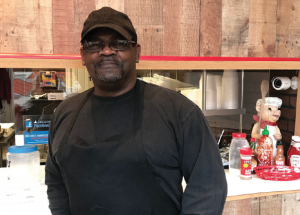
Badges to Briskets: Litho Ware serves the city he once served.

For 28 years, Litho Ware served on the Harrisburg police force, gaining a reputation for fairness and friendliness.

Some of his fellow officers knew one more important thing about Ware—he was a heckuva cook.

Still, it may have taken them by surprise when Ware decided to trade in his uniform for an apron, opening a snug barbecue joint just on the Midtown side of Forster Street.

“My father and grandparents barbequed a lot,” Ware said. “They brought that with them from the South as they migrated north.”

Ware said his father’s side of the family is from the Seminole Indian reservation in northern Florida and southern Georgia. Once his father and aunt were old enough, the family began migrating north until they reached Pennsylvania.

“As I grew up, I became accustomed to some of their ways,” he said. “I remember my grandmother doing some Indian chants and things for rain. Some things we might say are weird today, but I remember doing all of them.”


Tight Knit

Ware and his four siblings were raised in a house his grandfather, father and a few friends helped to build in Susquehanna Township—his mother still lives there today. He said the house didn’t have plumbing or running water for “the longest time,” and that the family bonded over cooking with the old wood stove.

“I used to sit in there and watch my grandmother, grandfather and father cook and enjoy that,” he said. “We had a pretty tight family. And there wasn’t a whole bunch to do. Everything we did we did as a family, because we couldn’t afford a TV.”

Aftering retiring from the Harrisburg police force in 2006, Ware decided to go active duty with the Army. He served as a chief warrant officer for another 10 years, including combat tours in Afghanistan, Bosnia, Iraq and Kuwait. He’s also a member of the National Guard.

In addition to the influence his upbringing has on his cooking style, Ware said his time in the military had an impact on his eventual decision to open up Boo Boo’s Barbeque on the 900-block of N. 3rd Street.

“Service members are a tight-knit group, so they get together and have barbeques,” he said. “If you go to a lot of military bases on the weekends when service members are off, you might go to different communities on base, and you’ll smell the barbeque grills. That’s what they do.”

Ware said his fellow service members learned quickly who was the best guy to have behind the grill. Upon returning to the states, he and the soldiers who worked for him continued the tradition of barbecuing in their spare time, and eventually they started encouraging him to open up his own restaurant.

“That’s when I said, ‘No, I’m not opening up anything,’” he said. “I told them that I’m not working for anybody. I’ll have two retirements, and there’s no reason to work — even though I see it as a hobby. And, well, I ended up barbecuing.”


Sight & Taste

The family-style cooking traditions Ware grew up with have heavily influenced not only the way he cooks, but by the way he runs his restaurant. The carryout-only shop focuses on simplicity. With Ware behind the smoker, no measuring is required—he cooks completely by sight and taste.

You’ll find classic barbecue offerings on Boo Boo’s menu, including brisket, pulled pork, pulled chicken, chicken strips, rotisserie chicken halves, full chicken wings and, of course, barbecued ribs.

For family dinners or get-togethers, you can order Boo Boo’s bucket of ribs complete with a full rack, five pieces of corn on the cob, two sides and four pieces of cornbread. Or a large bucket comes with two racks, two sides, eight pieces of corn and eight pieces of cornbread.

No barbecue meal would be complete without southern sides like baked mac and cheese, baked beans, green beans, collard greens and cole slaw. He also serves shareable appetizers like fries and onion rings. Various options for combination platters and sandwiches are available, as well.

Ware said that his sauce and seasonings are what makes his barbecue so tasty. After years of experimenting, he believes he’s nailed the taste customers are looking for in homestyle barbecue.

One thing that likely won’t be on the couple’s menu is transforming Boo Boo’s into a sit-down restaurant. Ware stressed that he opened the barbecue joint as a form of stress relief, as well as to give the people of Harrisburg a true taste of southern flavor.


Boo Boo’s Babecue is located at 912 N. 3rd St., Harrisburg. For more information, call 717-727-7089 or visit www.booboosbarbecue.com.

Continue Reading

She Builds: A social champion is in the house.

Crystal Brown

“I remember standing on the corner watching my house burn in my ‘New Kids on the Block’ nightie.”

That memory is one of Crystal Brown’s earliest and most formative ones, as a 5-year-old living in Ohio, forced to face a hate crime sparked by her parents’ interracial marriage.

“We were very fortunate that we were able to stay with family until my parents were able to find another home,” Brown recalled. “Actually, a person from the community let us stay with them since all of our family was in Pennsylvania.”

Thus, Brown understood from a young age that having a support system is important to maintaining stability.

“If it would not have been for family and those kind neighbors, we would have been homeless,” she said. “That is why I believe in the work we do at BHA.”

BHA stands for Brethren Housing Association, a nonprofit, interdenominational organization that owns more than 10 properties in South Allison Hill, serving about 85 adults and children a year. Their red-doored headquarters is situated in the shadow of the Capitol, on Hummel Street, across from the Mulberry Street Bridge.

Named executive director in 2011, Brown helps Harrisburg residents obtain housing and the skills they need to keep that housing. BHA is probably best known for its “Transitions” program, in which women with children who are homeless are given transitional housing. Families live in BHA-owned housing, obtaining their own apartment without being forced to share common spaces. BHA also works to secure permanent housing for people with disabilities and offers an aftercare program for families once served by their programs.

Brown said she and her staff give clients both “encouragement and accountability.” Many came to BHA from an emergency shelter or were couch-surfing, she explained, “doubling up” with another family temporarily.

The reasons for homelessness vary, she said.

“Every family is different, but there is usually the need to supplement their income,” she said.

Most are in need of a job, an education, and, often, basic money management skills.

“They need skills to keep their apartment neat, pay their bills on time, live successfully with their neighbors,” she said.


Love and Support

A 2004 graduate of Susquehanna Township High School, Brown began volunteering at the Interfaith Shelter, which operates under the auspices of Catholic Charities in Lower Paxton Township, while earning a degree in social work from West Chester University. The Shelter offered her a job soon after, and she went on to earn a master’s degree from Temple-Harrisburg.

The desire to serve families in need is in her genes. Her father, the Rev. Wayne Baxter, served a congregation in Edgemont, and her grandfather also was a minister.

Brown said that, unlike the Interfaith Shelter, where families usually stay only 30 days, her goal is about permanence, opportunity and access. Families can stay as long as two years. With more time, she can better help clients acquire the skills they need and connect them with more resources for long-term stability.

“I feel like housing is a right,” she said. “People deserve to have a roof over their head.”

That sentiment is reflected in many of the plaques bearing motivational quotes in her busy first-floor office, which straddles a large open meeting room where clients gather. One of them reads: “You have to be taught to be second class. You’re not born that way.”

She notes that homelessness is part of a larger problem. Low-cost housing leads to housing segregation, which leads to educational segregation—which “leads to a perfect storm, and our families live with the aftermath,” she said. She pointed out that rent for a two-bedroom apartment in Dauphin County costs about $886.

“I can’t change federal policies, but I can give love and support and encouragement,” she said.


Tag Out

Brown sees a lack of affordable housing as a serious problem in every American city, but especially Harrisburg.

So many restrictions are often imposed upon prospective tenants, such as criminal background checks and credit checks. The homeless with criminal records often can’t get housing, which leads to not just homelessness, but hopelessness. Many have paid their debt to society, but cannot break out of homelessness because of their past.

“People make mistakes,” Brown said matter-of-factly.

Although memories of her childhood house fire remain, other, more recent memories lift her spirits. She recalls a single mother, frazzled after dealing with a boisterous 3-year-old all day, with no one around to give her a break. Brown came home with the mom and calmed the child by singing “Itsy Bitsy Spider.” That child is now 6 and doing well in school.

“I got to be that tag out” for that mom, Brown said.

The community is a vital partner in BHA’s efforts. One of their most popular programs is “Adopt an Apartment.” Caring donors can buy pots, pans, lamps and more for a family moving into a new apartment. She said UPMC Pinnacle and its employees are frequent sponsors.

She is often asked if she ever feels afraid, working where she does. She replies that she is no more scared than she would be in a parking lot at Wal-Mart or camping.

And, while she may have little experience camping or living in a rustic environment, she clearly knows what she is doing in an urban setting.

“I have a healthy level of fear,” she said.


Such Transformation

One of Brown’s mentors is Lisa Peck, program director at Interfaith Shelter. Peck returns the respect.

“Crystal is very open, very honest, and she very much believes in her work,” Peck said.

Peck and Brown often brainstorm about how they can make things better for others.

“She is very, very dynamic,” Peck said. “She does everything with enthusiasm and nothing is too small to take on. She is always up to challenges and will stop at nothing to help the less fortunate.”

When families arrive, Brown is “always warm and welcoming,” Peck said.

“I really enjoy working with the women,” Brown said. “Every day, I learn and grow. It continues to humble me. It is a constant reminder to not pass judgement.”

Still, amidst the triumphs are tragedies. One of BHA’s most ardent supporters, Ray Diener, was brutally murdered several years ago, and one of the rehabbed houses on Hummel Street was named in his honor.

That experience forces a reflection on another plaque on her wall: “Pray about everything. Worry about nothing.”

“We are here to serve—to love God and love our neighbor,” Brown said.

One of Brown’s greatest sources of pride is that they are a “trauma-informed organization.”

Many homeless people are victims of physical and sexual abuse, she explained, and that trauma hinders their growth and stability. Homelessness then becomes an additional trauma. BHA partners with Pressley Ridge to offer counseling.

“Instead of asking, ‘Why did you spend that $100 on that?’ we try to understand their story and put it in context,” she said.

BHA also works with Dauphin County’s Office of Children and Youth, since many of the children in the child welfare system are there due to homelessness.

In the mid-winter cold, Brown gave a short tour of snow-topped Hummel Street. The townhouses across the street from her office are new construction. BHA demolished old buildings and built new with the help of UPMC Pinnacle. A playground, pavilion and garden are also part of the tidy block. A state grant helped with streetscaping.

“There is such transformation on this block,” she said.

The growth in their properties is among the accomplishments she is most proud of.

She lists many other housing construction and renovation projects going up around her, including 50 affordable housing units slated for 13th and Mulberry and Crescent and Mulberry, in conjunction with the Harrisburg Housing Authority.

Her end goal is more housing, less hate.

“We just need to be nice to each other and share in our abundance,” she said.

The mean-spiritedness she witnesses is rooted in fear, she believes. People are afraid that, if someone else gets an opportunity, it subtracts opportunity from them.

But she knows it is not a zero-sum game.

She pointed to her favorite quote on her wall, uttered by Frederick Douglass: “It is easier to build strong children than to repair broken men.” And so she builds.


Brethren Housing Association is located at 219 Hummel St., Harrisburg. For more information, call 717-233-6016 or visit www.bha-pa.org.


 

Continue Reading

Something Eternal: “Our Town”–more than just a slice-of-life at Gamut Theatre.

Both the director, Thomas Weaver, and lead actor, David Zayas, separately describe Thornton Wilder’s Pulitzer Prize-winning drama, “Our Town,” as a play that grasps appreciation for life in its entirety— the mundane and the extraordinary, the difficult and the rewarding. The play, as Zayas describes it, is “simple, but surprising with how deeply it resonates.”

“Our Town,” written in 1938, is a work that is “aware of itself as a play,” Weaver says. Focusing on two families that live in the small town of Grover’s Corners, N.H., in the early 1900s, the play follows the everyday life and death of a community and how that community deals with the emotions that come with both.

Zayas calls the play “a study of life,” which happens to focus on a particular time and place. However, Gamut’s production treats Grover’s Corners as a town just like any other town and the people representative of any people in any time or place. Zayas continues by saying that it is more than a specific story about a specific moment in time—it is a story that shows “what it is to be a human being.”

Because the play is about everyday moments in life, Gamut’s production is as an interactive, meta experience.

Zayas plays the role of the “stage manager,” a character who operates in multiple dimensions: a director of sorts to the action of the play and to the actors, a narrator of the play to the audience, and a bridge that creates a sense of harmony between the two. Through his direction, Weaver makes this possible by having the actors present on stage throughout the course of the play, even when they are “off-stage,” effectively calling into question all of the conventions audiences accept when seeing a play.

“What [Weaver] has been doing is taking a look at elements of theater that we take for granted,” Zayas said. “We know in our minds that there is a back-stage area where the actors go when they leave the stage, and they aren’t that character anymore, but we don’t have to think about it. But here, the actors are with the audience for the entire show, and when any particular actor is not playing their character, they return to an exposed backstage area where they are enjoying the show with the rest of the audience.”

This transparency is intended to make the experience of seeing a play have unity with both the actors and the audience, where every person in the room is experiencing the same story together, a concept the script itself encourages audiences to realize. That is, the importance of every moment in life as both beautiful and meaningful.

Even in something as simple as going to see a play in a theater, “Our Town” calls attention to the fact that every person has a role to play in the telling of the story, and that role shapes the purpose and meaning of the play, whether you are an audience member, a director or an actor on the stage. Weaver states that the purpose of Wilder’s play is to highlight shared humanity.

“We may be watching a story about people who were alive in the early 1900s, but these people are still alive with us today,” he said. “They are our ancestors, and a part of them is within us, the same way generations from now will carry us with them.”

In the words of the character of the stage manager: “There is something eternal about every human being.”

This is why, in order to appreciate the role we all play in life, Weaver has chosen to depict the play in minimal terms. There are few traditional lighting effects, there is no scenery, and the actors create the sound effects on stage and mime items instead of physically holding them.

“This requires the audience to fill in all of those blank spaces with their imaginations,” Weaver said. “It engages you as an audience member in totally different ways. We don’t answer the questions for you. We simply present the story, and it is up to you to decide what that looks like.”

Sincerity is Weaver’s guiding concept for the production. Zayas agrees that the play is nothing if not sincere.

“At its core, the play speaks to what it means and what is beautiful about being a human being in this world of other human beings, more pointedly than other stories,” he said. “And it has changed my outlook on day-to-day life in a way that no other play has.”

Weaver responded similarly.

“When approached in a matter-of-fact way, you recognize that Wilder is ultimately saying we don’t have a lot of time while we’re here, and it’s impossible for us to appreciate every single moment we experience,” he said. “But even though we don’t have a lot of time, we have to try. That, to me, is where the beauty of the play exists.”

In the play, one character has an opportunity to relive a moment in her life, and she says, “It goes so fast. We don’t have time to look at one another.” In producing this play, the goal is to take a moment to stop, appreciate and watch a representation of life, participate in the moment of the production, and be reminded of the beauty of existence.

Zayas stated that he hopes audiences leave with “a sense of appreciation for the feeling of their hands clapping together, the breath that they’re using in laughter, and the person they’re sitting next to as they are watching the show.”

“And I hope that appreciation lasts even as they leave the theater and drive home,” he said.

Both Weaver and Zayas, believe that “Our Town” puts a new perspective on life and living, and they are excited to share that experience with others.

“Our Town” runs Feb. 10 to 25 at Gamut Theatre, 15 N. 4th St., Harrisburg. For more information, call 717-238-4111 or visit www.gamuttheatre.org.

UPCOMING THEATRE EVENTS
AT HARRISBURG’S PROFESSIONAL
DOWNTOWN THEATERS

At Gamut Theatre
www.gamuttheatre.org
717-238-4111

“Our Town”
By Thornton Wilder
Feb. 10 to 25
Fridays and Saturdays at 7:30 p.m.
Sundays at 2:30 p.m.
Doors and bar open one hour prior to performance.

TMI Improv Show
Feb. 22
Doors and bar open at 6:30 and will remain open throughout the event.
Tickets are $10 and can be purchased online or at the door.

At Open Stage of Harrisburg
www.openstage.com
717-232-6736

“The Vagina Monologues”
By Eve Ensler
Feb. 2, 3 at 7:30 p.m. and Feb. 4 at 2 p.m.
A feminist tour de force about the forbidden zone.

“Akeelah and the Bee”
By Cheryl L. West, based on the works of Doug Atchison
Feb. 16 to March 11
A bright young girl from the South Side of Chicago trains to achieve a championship at the National Spelling Bee.

Continue Reading

The Next Phase: Harrisburg breaks with “City Discontented.”

Illustration by Rich Hauck

In the late 1890s, Harry and Louisa Orth, both in their 50s, lived in a four-bedroom house on Briggs Street in Harrisburg’s downtown district.

The couple, 34 years married, had three children, but only one survived—Carrie, a 29-year-old schoolteacher who still lived with them.

Harry was a “pattern-maker,” likely creating industrial patterns, and both his parents had emigrated from Germany. Their next-door neighbors, in an attached house sharing a baker’s alley, were the Floyds: husband M.A., wife Janet, daughter Edna and son Allen.

This information comes from Harrisburg’s 1900 city directory, a fascinating snapshot of time at the turn of the 20th century in the rapidly growing industrial city.

I reflect upon this tiny patch of Harrisburg because I now own and live in the Orth’s house, and I sometimes look at my surroundings and think to myself that these were the same floors and walls and stairs, even doors, that the Orth family walked on and leaned against and opened and closed.

In his book, “City Contented, City Discontented,” the late journalist and historian Paul Beers divided Harrisburg into two great epochs.

“City Contented” was the Harrisburg that the Orths knew. They were lucky enough not only to live in Beers’ happy phase, but, arguably, at peak contentment. Theirs was an expanding Harrisburg, a city about half-developed but rapidly building out its remaining vacant land, especially Uptown and on Allison Hill.

The city’s steel factories churned out bars and beams and its railroads carried them away to distant places. Scores of smaller factories produced everything from hats and books to fabric and beer. Moreover, the City Beautiful movement was about to take hold, helping to smooth out the roughest edges of unregulated capitalism.

More recent owners of my house—and there have been six over just the past 20 years—have not been so lucky.

Beers began his “City Discontented” phase with Harrisburg’s post-war decline, the result of de-industrialization, white flight, disinvestment, racial tensions, the 1972 flood and inept attempts to deal with all of the above. He ended his essays in the mid-1980s, the city in the grip of discontentment and Beers skeptical that the sorrow would end anytime soon.

In that, he was right.

During Steve Reed’s seven terms as mayor, some thought that the pendulum had begun to swing back, but that proved to be a false hope. As the city collapsed financially following decades of reckless public spending, it quickly returned to the grip not only of discontentment but of deep depression.

For cities, it gets no worse than financial collapse. Think New York in the 1970s or Washington, D.C., in the 1990s. However, in both these cases, insolvency represented the low point and, though you couldn’t know it at the time, both cities were poised for dramatic reversals once fiscal sanity was restored and confidence built back.

So, what now for Harrisburg? If Beers were still alive today, how would he feel? Would he believe that a new era had started—maybe “City Semi-Contented” or “City Re-Contented?”

Personally, I’m cautiously optimistic that the 2011-13 period was Harrisburg’s nadir, as it hit bottom after 60 years of desertion, neglect, crisis, mismanagement and false promise, or, in Beers’ more general term, discontent.

We are seeing clear signs of revival, with a general rebuilding and re-peopling of downtown and Midtown, capped off by Harrisburg University’s plan to construct the tallest building in the city. And, importantly, this is happening privately, from the bottom up, without the local government acting as the economy’s planner, prime mover and creative accountant.

So, I’m pretty confident that Beers’ “City Discontented” phase has ended. But to what exactly, I can’t say.

I do hope that, in a hundred years time, the future owners of a certain house on Briggs Street will think to themselves, “That guy back in 2018 was lucky. He lived through the start of something special.”

My desire now is to be there long enough to see this new era evolve, take its measure, and, in the spirit of Beers, give it a fitting name.

To learn about your own house and about Harrisburg history, visit digitalharrisburg.com.

Lawrance Binda is editor in chief of TheBurg.

Continue Reading

Telling Our Stories: This month, a new African-American theater company stages its first play.

In the Ghanaian Twi language, the word sankofa means to “reach back to move forward.”


The word encapsulates well the mission and spirit of the new Sankofa African American Theatre Company, which mounts its first production this month.

“We’re trying to tell our stories,” said Sharia Benn, Sankofa’s managing director. “We’re doing what other theaters aren’t doing or aren’t able to do, or as often as they want to do it, in our area.”

Sankofa has its roots in Open Stage of Harrisburg, which has produced, and Benn has starred in, several works by African-American playwright August Wilson.

In fact, Sankofa’s first show—“Akeelah and the Bee”—is a co-production with Open Stage, where the play will be staged. Benn will co-direct with Stuart Landon, Open Stage’s producing artistic director.

Adapted from Doug Atchison’s hit movie of 2006, the play centers on Akeelah, an 11-year-old spelling prodigy preparing for a national bee. Among the challenges to Akeelah’s success is pervasive gun violence in her inner-city neighborhood, which took the life of her father less than a year earlier.

Nonetheless, Akeelah is determined, and she enlists the help of Dr. Joshua Larabee, an English professor and potential father figure who lost a girl of Akeelah’s age and is willing to coach her.

Although Sankofa’s efforts center on gaining access to acting and other theatrical opportunities for African Americans, the cast of “Akeelah” is diverse, said Benn, who is particularly “excited” that many of the performers are new to Open Stage.

Megan Mwaura, the lead in the play, is 16 and a sophomore at Bishop McDevitt High School. Though she has been in school plays and musicals, this is the first time she is doing a play with a professional theater company.

“I’m part of Open Stage’s 180 Prep acting program,” Mwuara said. “Through this, I got to know artistic director Stuart Landon, who invited me to the audition for ‘Akeelah.’ That is when I learned more about Sankofa and how it is partnering with Open Stage for this show.”

Meeting Benn increased her desire to be in the production.

“Her vision, along with Sankofa, is to tell the stories of the people whose stories are not often in the spotlight on stage,” Mwuara said. “As an African girl, this is something that is obviously very important to me.”

The play has a great message for young people, she added—to have confidence in oneself.

“No matter who you are and where you come from, you have the ability to achieve greatness,” Mwaura said.

Sankofa’s mission reaches beyond staging plays.

One of its signature programs is “Peer-to-Peer,” which trains teenagers in theater performance and leadership and encourages them to create a curriculum on their own so they can, in turn, teach middle-school students.

“The training strengthens social, academic and life skills,” said Benn. “The students will develop content for the final performance of the program, which could be writing a play or giving a staged reading.”

Aside from Open Stage, Sankofa plans to collaborate with other area theater groups, such as Theatre Harrisburg. Sankofa also is in negotiations with Gamut Theatre Group to commemorate the 50th anniversary of Dr. Martin Luther King’s assassination (April 4). In addition, it will work with other community organizations, such as the Boys and Girls Club.

While embracing African-American culture and emphasizing its vital role in the community, Sankofa hopes to use theater as a vehicle for dialogue and social change. Its productions will be directed and produced by African-American theater professionals.

Sankofa also will lend help to anyone outside the formal theater scene who wants to be involved—such as a church youth group aiming to write a play or stage it.

“According to our mission and vision, productions are more of a byproduct,” she said. “Our main focus is on developing awareness in and access to the community to make the community better and stronger. Every time an actor is enriched—those are our productions.”

“Akeelah and the Bee” runs Feb. 16 to March 11 at Open Stage of Harrisburg, 25 N. Court St., Harrisburg. For more information, call 717-232-6736 or visit www.openstagehbg.com.

For general information about Sankofa, call 717-214-3251, e-mail [email protected] or visit their Facebook page.

Continue Reading