House committee passes bill that would let Harrisburg exit Act 47, retain current tax levels for 5 years

Members of the House Local Government Committee met today to vote on HB2557.

A House committee today passed a bill that would terminate Harrisburg’s Act 47 status, letting the city retain its current, enhanced taxing authority for the next five years.

An amended version of House Bill 2557, which would let Harrisburg exit Act 47, the state oversight program for distressed cities, and keep its current tax rates through 2023, was passed 24-1 by the House Local Government Committee.

The bill can now up for a vote before the House, and then the Senate.

The original legislation introduced by Rep. Greg Rothman, R-Cumberland County called for Harrisburg to retain its current taxing authority in perpetuity. Under Act 47, Harrisburg has levied a local services tax (LST) and earned income tax (EIT) that are higher than what is allowed under state law.

But the bill that the committee approved this afternoon was amended over the weekend to include two new provisions: one to retire the special taxing provisions for Harrisburg in five years, and another convening a special oversight committee to monitor the city’s finances.

Rep. Patty Kim, who represents Harrisburg and parts of Dauphin County, said the bill Rothman wrote “was what Harrisburg wanted and needed. But in order for us to gain enough support… we made a lot of concessions.”

One of those concessions is submitting to an Intergovernmental Cooperation Authority (ICA) — an oversight committee governed by five voting members, all appointed by state lawmakers. The Harrisburg City Controller will sit on the board but may not vote.

The ICA will receive a $100,000 annual operating budget from the general assembly. Kim said its duties and operations are so far vague, but would be modeled after an ICA convened for Pittsburgh, which exited Act 47 earlier this year.

“This is the best we can do, and this is what a compromise looks like,” Kim said.

Speaking to reporters after the meeting, however, Kim called the amendments a “gut and replace” tactic.

Committee members approved the amendment unanimously before voting on the bill, which only garnered one dissenting vote — from Rep. Gary Day, R-Berks County.

“Cities that have spent years managing themselves into Act 47 should work within the Act 47 framework,” Day said. “I think to be able to come out of Act 47 but maintain the enhanced taxing authorities sets a dangerous precedent for all municipalities.”

Harrisburg’s enhanced taxes bring in a combined $11.8 million for the city each year. Mayor Eric Papenfuse testified at a joint committee hearing last month that Harrisburg cannot fund basic services without them.

The local services tax, which takes $156 a year from every person who works in the city, has allowed Harrisburg to shift some of its tax burden from its 48,000 residents to the 50,000 commuters who enter the city each day for work. Papenfuse has said that the daytime population of the city stresses its infrastructure and emergency services, which are otherwise funded by Harrisburg’s small, largely impoverished tax base.

The mayor was restrained in his comments about the amendment at a city council meeting tonight.

“We’ll wait and see what happens,” Papenfuse said. “I don’t think it should pass in its current form, but we’ll wait and see.”

If the General Assembly does not pass the bill before its session days conclude next week, Harrisburg must adopt an Act 47 exit plan. That state-sponsored document will dictate Harrisburg’s budget until 2021, when its Act 47 status expires.

The latest draft of Harrisburg’s Act 47 exit plan called for massive property tax increases in two years to replace the revenue that would be lost without the LST and EIT. Residents, elected officials, and business leaders have called that proposal unworkable.

Kim said that the bill’s easy passage in committee bodes well for a final vote by the House.

“I was told my colleagues would vote for this [amended bill],” she said.

This post was updated on Tuesday night to include comments from Mayor Eric Papenfuse.

Continue Reading

Changing Places: New polling station on tap for some voters in Midtown Harrisburg

The Neighborhood Center on a past Election Day.

If you live in Midtown Harrisburg, you may need to change where you cast your ballot next month.

The Dauphin County Elections Bureau announced today that it has moved voting for the 12th Ward from the Neighborhood Center of the United Methodist Church, located at N. 3rd and Kelker streets, to the Laurel Towers Apartments a few blocks away at 1531 N. 3rd St.

For several years, the Neighborhood Center has served as the polling place for both the 11th and 12th wards, as the building sits at the boundary between the wards. However, according to the county, the bureau needed to make the move after the center changed the configuration of its voting areas.

“In November of 2017, the center, which is situated in the 11th Ward, moved both precincts out of its secured area, where each precinct had use of separate rooms for polling sites, into one meeting room just before entry into the secure portion of the building,” according to a release from Dauphin County. “Due to limited space for both election districts, the Elections Bureau must move one of the election districts to a new site.”

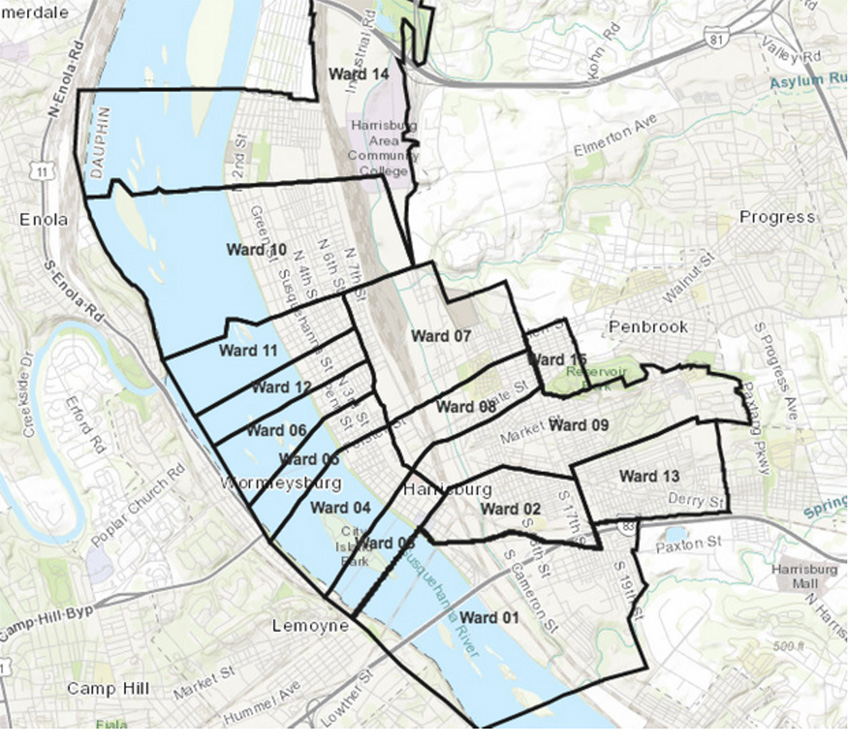
Most of Midtown Harrisburg is divided into wards 5, 6, 7, 11 and 12. Wards 11 and 12 encompass much of the northern parts of Midtown, separated at Kelker Street.

Ward boundaries in Harrisburg

The Elections Bureau today announced other changes to polling areas in Dauphin County. These include:

  • Londonderry Township, 2nd Precinct, moved from the Londonderry Township Building to the Londonderry Fire Co.
  • Lower Paxton Township, 4th Precinct, moved from Christ Evangelical Lutheran Church to American Legion Post 272
  • Lower Paxton Township, 25th Precinct, moved from Sports City to the Village at Lauren Ridge
  • West Hanover Township, 3rd Precinct, moved from West Hanover Elementary School to the Office of MDJ Lowell Witmer

Voters in the new districts will be receiving postcards informing them of the changes, according to the county. A complete list of polling places in Dauphin County is also available by clicking here.

Continue Reading

ULI Report: Harrisburg’s 3rd Street corridor good, but could be great

One of the commercial centers of the 3rd Street corridor–N. 3rd and Verbeke streets in Midtown Harrisburg.

Harrisburg’s 3rd Street corridor is headed in a positive direction, though it remains a work in progress in terms of redevelopment, economic activity and walkability.

That’s the general conclusion of a just-completed study by the Washington, D.C.-based Urban Land Institute (ULI), a nonprofit research and educational organization that recently examined the corridor from Reily Street in Midtown to Chestnut Street downtown.

“The 3rd Street corridor possesses a great deal of momentum and potential for continued development,” states the report, titled “TLC for Harrisburg’s Third Street Corridor.” “Strategically bridging the gap between the downtown and Midtown neighborhoods can put Harrisburg on the map as a vibrant capital city with a strong urban core.”

ULI visited Harrisburg for two days in April, walking the two-mile stretch then interviewing stakeholders who live, work and own businesses there. Their analysis and report were sponsored by Harristown Development, which owns Strawberry Square, as well as many buildings on S. 3rd Street between Market and Chestnut streets.

The 14-page report lauds the recent redevelopment and adaptive reuse that has occurred along the stretch, praising such places as the Susquehanna Art Museum, Midtown Scholar Bookstore, Midtown Cinema, the Broad Street Market and the Millworks.

However, it states that much work still needs to be done so that the corridor can achieve a fuller potential. It cites three specific challenges:

  • “Dead Zones”: Many buildings have been restored, but many have not. There is still too much blight and too many empty storefronts along the corridor, creating areas of inactivity.
  • Forster Street: Forster Street is too wide, busy and inhospitable, cutting off downtown from Midtown and deterring pedestrian activity.
  • Aesthetics: Aesthetics are inconsistent. Some areas appear pleasant, while others do not, both in terms of streetscape and the condition of structures.

The busy intersection of N. 3rd and Forster streets, cited in a recent report as an impediment to improving the 3rd Street corridor in Harrisburg.

The study then offers a variety of recommendations, such as incentivizing homeownership, encouraging pop-ups in empty storefronts, increasing police visibility, enforcing maintenance codes, improving the streetscape and better connecting downtown and Midtown.

Two suggestions stand out as especially ambitious.

The first recommends improving the intersection of N. 3rd and Forster streets by employing traffic-calming measures, making it more pedestrian-friendly and possibly reducing the number of lanes. The second proposes forming a “Third Street Coalition,” which would help promote, brand and advocate for the corridor.

“[The study} accomplished what I thought it would, which is to highlight the corridor and promote collaboration,” said Brad Jones, CEO of Harristown. “It highlighted a lot of the progress here, but showed there’s a lot of opportunity to grow and improve this corridor.”

Click here to read the report: Harrisburg Third St Corridor TAP Report, web final 2

Disclosure: TheBurg is located along the 3rd Street corridor. Editor-in-Chief Lawrance Binda offered input for this study as a “stakeholder participant.”

Continue Reading

Weekend Roundup with Sara Bozich

Happy Weekend!

SoMa is tonight! We bumped up the time to account for daylight/cooler temps, so please join us from 6-9 p.m. for the last SoMa Block Party of the year!

There are some really fun fall events happening this weekend, and I’m hoping I can find myself at at least one of them. Ever Grain Brewing Co. has its anniversary/Oktoberfest combo party, and I’m really excited about the Saturday Bavarian food part of it. Think I can take the baby and still manage to eat? idk.

Troegs also is having a full weekend party, starting Friday, continuing Saturday with the Hop Dash 5K and after party, and then really like who would want to watch the awful Steelers, so I think visiting their market and brunch on Sunday is a pretty good idea.

If none of these, perhaps the Apple Festival? I wanted to do New Cumberland’s last weekend but my poor kiddo was sick.

What are you doing this weekend?

(more…)

Continue Reading

Legislative staffer appointed as newest member of Harrisburg City Council

Harrisburg City Council. Top row, left to right: Shamaine Daniels, Westburn Majors, Ben Allatt, and Dave Madsen. Bottom row: Ausha Green, Wanda Williams, and newcomer Danielle Bowers.

Danielle Bowers, a lifelong Harrisburg resident and state government staffer, is the newest member of Harrisburg City Council.

Bowers beat out 14 other candidates, including one past council president, to take the seat formerly held by council member Cornelius Johnson. She was appointed at a special council session tonight and will take her seat on Oct. 9.

Bowers currently works as an executive director for the Pennsylvania House of Representatives Tourism and Recreational Development Committee. She previously held researcher roles with the Democratic Policy Office and Legislative Black Caucus, and holds a master’s degree in public administration from Pennsylvania State University.

Her appointment to council creates a vacancy on the Zoning Hearing Board, where she has served for the past three years.

President Wanda Williams said that the board is one of the most prestigious volunteer bodies in the city and that Bowers distinguished herself as a dedicated, meticulous member during her service.

“She’s very precise and does her homework,” Williams said. “She did a yeoman’s job on the zoning board.”

Seventeen candidates applied for the vacant council seat in September — an unusually high number, according to council members. One was eliminated during vetting by the city’s human resources department and another did not appear at tonight’s selection meeting.

The remaining 15 candidates appeared before council tonight to share their qualifications and ask for a chance to serve on the city’s legislative branch. But only four were invited to participate in the interview phase, where sitting council members asked candidates about their skills and goals for public service.

During her interview, Bowers touted her legislative experience and her knowledge of the city’s finances. She said she would like to pass legislation to bolster public safety and hopes to see the city’s Police Bureau return to its full complement of officers.

Bowers entered the interview phase with three nominations from council members – an early show of consensus that Mayor Eric Papenfuse said was unprecedented in council appointments. Council members made their nominations anonymously.

Candidates Josiah Yonker, an IT professional, Gloria Martin-Roberts, a former council president and mayoral candidate, and Airis Smallwood, a healthcare administrator and musician, also received nominations and sat for interviews.

During the voting round, council members Ben Allatt, Shamaine Daniels, Westburn Majors, and Ausha Greene cast votes for Bowers. Dave Madsen and council President Wanda Williams voted for Martin-Roberts.

Papenfuse said that council member appointments usually entail multiple rounds of voting or a tie-breaking vote from the mayor.

“This is the fastest it’s ever happened,” Papenfuse said.

The mayor also praised Bowers’ record on the Zoning Hearing Board and applauded her appointment to city council.

Continue Reading

Harrisburg mulls new debt, spending policies as Act 47 deadline looms.

As state lawmakers consider a bill that would terminate Harrisburg’s financial distress status, city officials are advancing a pair of policies that would establish best practices for long-term money management.

Together, the two proposals would create Harrisburg’s first written guidelines for borrowing money and spending its cash savings.

Both policies come at the recommendation of the city’s Act 47 coordinator, the state official charged with guiding Harrisburg through financial recovery, and are adapted from legislation by the Government Finance Officers Association (GFOA), a national society that sets best practices for municipal finance.

Act 47 Coordinator Marita Kelley said that most major cities in the United States have similar policies on the books.

“These are policies you can apply to any government,” Kelley said. “When you’re unsure on these two practices, this gives you a guideline so that you are adhering to what other major cities in the U.S. follow.”

One policy under consideration is a debt management policy, which establishes guidelines for borrowing money and repaying debt. At a work session tonight, Councilman Ben Allatt said the rules could spare the debt-ridden city future financial harm.

“We’ve had a history of bad borrowing that’s led us to the debt we have in the city today,” Allatt said. “If we were following guidance provided by this debt management policy, [some deals] never would have or could have gone through.”

As an example, Allatt pointed to the 1999 Verizon Tower deal, in which former mayor Steve Reed tried to bridge a $7 million deficit by guaranteeing debt associated with the Verizon Tower in Strawberry Square. When Verizon backed out of its lease in the building, Harrisburg was on the hook for more than $40 million in debt obligations.

Harrisburg was able to avoid total calamity when the state Department of General Services signed a $65 million lease to occupy the 12-story building. Harrisburg still had to cover more than $15 million in debt payments.

Under the new policy, Harrisburg officials would have to seek approval from attorneys in the state Department of Community and Economic Development for every borrowing agreement over $100,000.

The guidelines also task the city’s business manager with overall responsibility for debt issuance. The business manager would have to coordinate with the finance director and law bureau to ensure that all debt held by the city is in compliance with the GFOA guidelines. The draft document considered by City Council tonight includes a 14-point checklist of considerations for debt deals.

The debt management policy must be revised every three years according to guidelines from the GFOA.

The second policy council considered tonight would create rules for use of the city’s fund balance — the cash savings it accrues by underspending its annual budget.

For many years, Harrisburg operated at a deficit and did not have a fund balance to bridge budget gaps. But the elevated tax rates that the city passed under Act 47, combined with years of consecutive underspending by Mayor Eric Papenfuse’s administration, have allowed the city to build a fund with a current balance of $20.4 million.

However, Harrisburg does not have any formal policies governing how that money can be spent.

The proposal submitted to council would recommend that Harrisburg maintain a fund balance equal to 5 percent of its yearly general fund. That means that in 2018, a year that Harrisburg had a $72 million general fund budget, it could not draw its fund balance below $3.6 million.

That would also permit city officials to make “permanent draws” – withdrawals that they do not intend to repay – only for use on capital improvement projects or debt service.

Both policies have the support of council members and the city’s administration.

“These weren’t done hastily,” Papenfuse said. “After working for several years with multiple coordinators, what we’ve reached now is a really good compromise that incorporates everyone’s views.”

Note: This story was edited to correct the figure representing 5 percent of Harrisburg’s 2018 general fund. That figure is $3.6 million, not $14 million.

Continue Reading

Cathedral Education Center gets HARB approval; fundraising campaign planned

The planned Cathedral Education Center would unite the Liberty Street school building (foreground) and the Shanahan Center (background).

Harrisburg’s Catholic parochial school has been given the go-ahead for a new education center, but it now needs to raise the funds for renovation and construction.

Last night, the project received unanimous approval from the Harrisburg Architectural Review Board (HARB), allowing the Cathedral Parish of St. Patrick to launch a capital campaign for the new Cathedral Education Center.

The $5.7 million project would renovate the circa-1950 Harrisburg Catholic Elementary School on Liberty Street and the 109-year-old Shanahan Center on North Street. A three-story, 3,250-square-foot addition between the buildings would be constructed, creating a single, unified structure totaling 26,475 square feet. Currently, the two buildings are separated by a small walkway.

HARB members did request a few design changes, most notably that the addition linking the buildings should include more windows and that the windows should be more vertically oriented.

“I’m really excited about this proposal personally,” said HARB Chair AJ Knee. “I like the concept of this [new] building being a wedge between the two [existing] buildings.”

The new education center would allow the parish to consolidate into one facility the current Cathedral Campus, which serves pre-K and grades 5-8 and is located behind St. Patrick’s Cathedral, and the Holy Family Campus, which serves grades K-4 and is located on Allison Hill. It also would give the parish more space for programming and improve wheelchair accessibility.

According to the parish, another benefit includes a new hall with a caterer’s kitchen that would seat as many as 190 people. It also would free up funds for parish programs that now go to building maintenance.

A rendering of the project, which shows the modern addition connecting the two existing buildings. Image courtesy of TKS Architects.

Dale Forney of Harrisburg-based JEM Group, the general contractor, told HARB members that he hopes to begin the project once school lets out next May and complete it in January or February 2020. However, the actual timing depends on the parish being able to raise the needed funds.

Kathy Speaker MacNett, who lives directly across the street from the Shanahan Center, characterized the project as another step forward in the continued redevelopment of the Capitol neighborhood.

“I am very excited about the project,” she said, citing several other projects nearby. “For the first time in my recollection, we actually have construction going in in our neighborhood–and not only construction but infilling.”

Continue Reading

TheBurg Podcast: Plunder and Pawpaw Edition.

It’s the end of October, which can only mean one thing: it’s Pawpaw season in Central Pennsylvania!

Oh, and there’s a new issue of TheBurg Magazine, which hits newsstands today. And the deadline is nearing for Harrisburg to pass an Act 47 exit plan. There’s no shortage of news to keep up with this week, but TheBurg’s editor in chief Larry Binda and city reporter Lizzy Hardison recap it all in the newest episode of TheBurg podcast.

We start by discussing the recent house committee hearing on Harrisburg’s tax bill, which would let the city exit Act 47 once and for all. Is it doomed to die on the House floor? We also place bets on the upcoming appointment of a new member of Harrisburg City Council. Stay tuned until the end for a spirited discussion of Pawpaws, America’s forgotten fruit!

Listen to the episode here, or subscribe to TheBurg Podcast in the Apple or Android podcast apps:

Learn more about the topics in this week’s episode at TheBurgNews.com:

State & The City: Harrisburg mayor makes case to retain tax rates, exit Act 47.
House bill would prohibit commuter tax, extend current taxing authority for Harrisburg
Leaving Act 47: The private sector has revitalized Harrisburg in the past. It can do so again.
Former mayoral candidate among 17 seeking seat on Harrisburg City Council
HBG FAQ: Welcome to Harrisburg. Now read this.

TheBurg Podcast is released semi-monthly by TheBurg Magazine. It is recorded in the offices of Startup Harrisburg and produced by Lizzy Hardison. Special thanks to Paul Coolley, who wrote our theme music.

Continue Reading

Bonding Over Beans: Thanks to a reader, we have a new recipe to enjoy.

One of the best things about writing this column for TheBurg is getting to meet so many nice people who love cooking and good food.

Recently, a reader approached me and asked if I had ever cooked or eaten “Marcella beans.” I told him I had not. I had never heard of “Marcella beans,” although I assumed they likely had some relationship to the queen of Italian cooking, Marcella Hazan.

His friend found me one early Saturday morning, shopping basket in hand, at the farmers market, and handed me a pound of beautiful, creamy, white cannellini beans, the famous Marcella beans! I promised to try them.

Well, a little research was first in order. What exactly are Marcella beans and how did they come to be? This is what I learned.

Steve Sando is a food lover and cookbook author from Napa Valley in California, who began growing heirloom beans and offering them through an online company called Rancho Gordo. One day, he received an order for several pounds of beans, as well as a copy of one of his cookbooks. He eventually learned that the person placing the order was none other than Marcella Hazan, author of the famous cookbook, “Classic Italian Cooking.” Hazan and Sando became online “friends,” sharing their thoughts about food, Italian music and, of course, beans!

Marcella loved warm beans with good olive oil and told Sando her favorite was Sorana beans, a white cannellini variety grown near the Italian town of Sorana. She said they were hard to find even in Tuscany but impossible to find in the United States.

Sando spent many months searching for Sorana seeds and eventually was able to purchase a small amount. The first harvest was small, but produced enough beans to send a small bag to Marcella. He was saddened to learn that, before the little bag of beans could reach her, she had passed away. But her husband, Victor, was happy to receive the gift and kindly gave Sando permission to name the beans after Marcella.

So that is the story of how the Marcella bean came to be. I was eager to try cooking them. These beans require a little more care than the more commonly available dried beans. They do best with slow, gentle heat and can’t be stirred too much. I followed the recipe below, which my readers later sent to me. I also had to inform my long-suffering spouse that he was getting beans for dinner.


Simple Beans on Toast
(From the New York Times cooking website)

Ingredients

  • 2 tablespoons extra virgin olive oil, plus extra for finishing
  • 3 garlic cloves, finely chopped
  • 1 medium onion, chopped
  • 1 medium carrot, peeled and finely chopped
  • 1 medium celery stalk, finely chopped
  • 1 pound dried heirloom beans, picked over and rinsed
  • 2 teaspoons kosher salt


And if serving on toast:

  • 8 large slices crusty Italian bread
  • 4 tablespoons unsalted butter
  • Sea salt and freshly ground pepper


Directions

  • Heat 2 tablespoons of olive oil in a large pot over medium heat until it shimmers. Add the garlic, onion, carrot and celery and cook until the vegetables are soft and fragrant but not browned. Stir frequently.
  • Add the beans and enough water to cover by 2 inches.
  • Increase the heat to high, bring to a boil, and cook for 15 minutes.
  • Reduce the heat to a very gentle simmer, partly cover, and cook about 1 hour and 15 minutes. Add more water if necessary to keep the beans fully submerged. (I followed this cooking time exactly.)
  • Gently stir in kosher salt and continue to cook until the beans are creamy in texture but not bursting, about 10 to 45 minutes more. (I cooked the longer time.)
  • Drain the beans and save the cooking liquid if you wish to use as a base for soup.

If you are serving the beans on toast:

  • Toast the bread slices and butter each piece.
  • Spoon about ½ cup beans onto each bread slice and crush slightly with a fork.
  • Divide the remaining beans among the toast (about ¼ cup per toast).
  • Drizzle each with olive oil and sprinkle with sea salt and pepper.

I tossed the cooked beans with lots of olive oil and served in bowls. I topped the creamy beans with chunks of jarred Italian tuna and several tablespoons of capers and served crusty Italian rolls and a salad alongside. They were wonderful. I plan to try the toast variation as a hearty appetizer for a Sunday dinner. The leftovers were great for lunch.

I want to thank my gentlemen readers for introducing me to Marcella beans. This has been a cooking adventure!

Continue Reading

Wines in the Balance: South African quaffs emerge on the scene.

Of the top-10 wine producing countries today, South Africa may be among the least familiar.

This land, where the Atlantic and Indian oceans collide, has a history of viniculture going back to 1659, when grapes were planted to help ward off scurvy during the voyages along the SpiceRoute. At one time, Muscat from the Constantia vineyards was famous throughout Europe. Legend has it that Napoleon Bonaparte asked for a glass on his deathbed.

Today, if you ask someone to name a favorite South African wine, a blank stare will most likely greet you.

South Africa did not have the great influx of grape-growing immigrants the way that Chile and Argentina did. Most land was used to produce food for the population and to support the ostrich feather industry, with a small percentage allocated for vineyards. And, instead of bottling wine, distilling brandy was the first priority. Transporting wine to world markets presented another problem, as did the phylloxera aphid, which arrived in the late 1880s and devastated the grapes, requiring all vines to be grafted

As recently as 1990, only about 30 percent of fermented wine was bottled, with 70 percent made into brandy. However, by 2003, the trend had completely reversed.

Today, South African wines have gained an international reputation for quality, with new regions developing to complement the newest techniques in enology. French grapes take center stage with Syrah, cabernet sauvignon and cabernet Franc for red wines and Chardonnay, sauvignon blanc and Chenin blanc for whites.

In South Africa, Chenin blanc, locally known as “steen,” has been one of the greatest success stories. Grown throughout the different regions and made in a variety of styles, it should be on every wine drinkers list.

South Africa has its own indigenous grape known as “pinotage,” a cross produced from pinot noir, the great black fruit of Burgundy, and cinsault, a red blending grape from the Rhone valley. Some drinkers express an aversion to pinotage, especially in the nose, but others enjoy it, enough to keep demand high.

Take a walk through a Fine Wine and Good Spirits store, and the number and variety of South African offerings deserve recognition and tasting. Syrah is bottled alone, blended with pinotage or, in the classic style of the Rhone Valley, with Mourvèdre and grenache.

Cabernet sauvignon is available as a solo offering, as a rosè or in Bordeaux blends. Chardonnay and pinot noir are blended to make sparklers that rival those of France.

The amazing thing is that all these wines are distinct from any others I have tried. This land on the tip of Africa has a terroir that produces quaffs that are too easily overlooked in our modern markets. The wines possess a certain tautness and balance that I find intriguing in a world of overly fruity blends.

Keep sipping,
Steve

Continue Reading