HU sets July ground-breaking for new academic tower, hotel

Harrisburg University expects to break ground on its new academic tower and hotel in midsummer, the university confirmed today.

Spokesman Steven Infanti projected a late July start date for the 17-story, $135 million project at the corner of Chestnut and S. 3rd streets.

Infanti said that university expects a two-year construction period, with a grand opening slated for summer 2021, in time for the 2021-22 academic year.

Two weeks ago, the Harrisburg Planning Commission unanimously approved the project (rendering above), which had been scaled down from 19 to 17 floors, about half the height of the original plan. The land use plan still must be approved by City Council.

Infanti expects the building to house at least 1,000 new students and a health science education center for nursing, pharmaceutical sciences and other health-related programs. It also will have classrooms and training space for advanced manufacturing and interactive media programs, he said.

The 386,200-square-foot building consists of two other portions: a hotel and a restaurant. Owners and operators for these have not yet been announced.

Four parcels make up the building site: 222 Chestnut St. and 24, 26 and 28 S. 3rd St. Currently, 222 Chestnut St., the largest parcel, is a surface parking lot, while the 3rd Street parcels all house 19th-century commercial buildings, which would be demolished during the site-clearing process.

Alex Wing of Stantec is the lead architect for the project, supported by Harrisburg-based Reynolds Enterprises Inc. and The Whiting-Turner Contracting Co., based in Baltimore.

For more information about Harrisburg University, visit www.harrisburgu.edu.


Continue Reading

Burg Review: Boxer Charles Feathers opens knock-out exhibit at HMAC

It was only fitting that the old Police Athletic League (PAL) building was the backdrop for bantamweight Charles Feathers’ art show at the House of Music, Arts and Culture (HMAC) for 3rd in the Burg on Friday.

Feathers (pictured left) shook the very foundation with his show, which defied description. Everything from stylized ray guns to an apocalyptic wedding dress–including his signature “Bootleg” creations, presented in a no-holds-barred, knock ’em to the canvas style–made for a singular art exhibit.

Before venturing to the upstairs gallery, a laid back jazz duo put down an extra chill vibe on slide trombone and keyboards. The duo, Jim McFalls and Steve Rudolph, respectively, set the tone for a Mardi Gras ambiance in the downstairs bar and restaurant. As a visual backdrop behind them, hand-painted boxing gloves in a nod to the old PAL were on display.

A decade ago, the PAL building was reincarnated as HMAC and, preceding that, it housed the Jewish Community Center. Just off the elevator upstairs, an oversized, multi-colored yarn llama, replete with a cobalt blue saddle and gold suede harness, set off alarms for the riot of color alone. The police, one felt, could have been called in to save “the jumper,” an outsized plaster zebra (10 feet tall) as it perched precariously atop a questionable ledge while hanging onto a wedding veil in one hoof. Behind it was the aforementioned wedding dress with “burnout” patterns from a futuristic nuptial scene.

Otherworldly creations from Feathers included a metal-winged motorcycle jacket fit for a biker angel emblazoned with the “Bootleg” stamp. In a different vein, suspended from the ceiling, was a twisted metal sculpture hoop festooned with peacock feathers. In promoting the “feather fantasy,” Feathers made metal viewing glasses (sans lenses) adorned with peacock plumes outrageously placed across the frames or spinning out of control, extending the temples well beyond the wearer’s head. All the better to view “Planet Charlie” up close.

Artist and HMAC co-owner Gary Bartlett added three installations on the upstairs stage that complemented the avant garde work of Mr. Feathers. One installation spanned across either end of the stage, comprised of air duct vent tubes lit inside with multi-colored bulbs, giving the effect of an underground happening entitled, “American Dream/American Nightmare,” depending on the viewer’s point of view. Bartlett added two separate mannequin forms—one featured pieces from a shredded red Japanese lantern and gauzy material, and the companion piece was a torso adorned with scrabble letters.

What Feathers references in his “Bootleg Creations” is the imprimatur shark, which, in large part, is a tribute to the long-time collaboration with his dearly departed friend and co-creator, Dan Kalbach. Feathers carries on his legacy through the many iterations of “Bootleg,” an artistic genre in its own right.

What makes the body of work represented in Feathers’ oeuvre is the skill presented in diverse media—a potter, a sculptor, a photographer and, most of all, a visionary from another realm. His art is best seen and appreciated up close with clear eyes and an open mind. Whimsy is a large part of Feathers’ lexicon but so is romance and fantasy. All of this together makes Feathers a knockout artist. The evening was a TKO.

Be sure to view Feathers and Bartlett’s works at HMAC through April 17, before it leaves its orbit headed to another solar system.

The House of Music, Arts and Culture is located at 1110 N. 3rd St., Harrisburg. For more information, visit www.harrisburgarts.com.

Continue Reading

Burg Blog: 2 Lives, 2 Streets

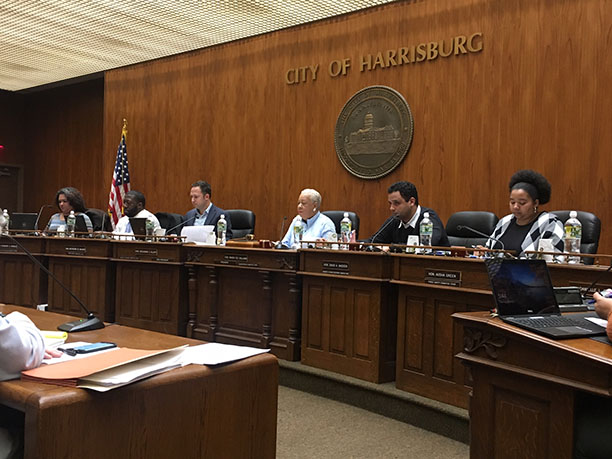
Harrisburg City Council in session this week

Not every Harrisburg City Council meeting has fireworks.

This past week, for instance, the legislative session lasted less than a half-hour, as the agenda was small, and the few items on it were non-controversial or sent into committee for later discussion.

However, there were two resolutions, passed unanimously, that I feel should be noted. Both memorialized a community member, recently deceased, whose lives now will be recognized on the streets where they lived.

They led very different lives, and, as well, had very different fates.

The first resolution honored Dennis Green, who, as a child, lived with his family on the 1100-block of Walnut Street. He would go on to star as a halfback at the University of Iowa.

Green never played in the NFL, but later worked his way up the football coaching ranks, first on the college then the professional level. In 1992, he became the head coach for the Minnesota Vikings, becoming just the second African American head coach in the league. He coached the Vikings for an impressive 10 years, then spent several more with the Arizona Cardinals and as an ESPN analyst.

He died last July, more than a decade after retiring from football.

“Mr. Green was a phenomenal resident of the city of Harrisburg,” said Councilman Westburn Majors. “Mr. Green would come back to Harrisburg and helped to guide our athletes.”

The second resolution honored a woman whose impact remained more local to Harrisburg but was profound nonetheless.

Jacqueline Black was a lifelong city resident, spending some four decades in her house on the 300-block of Emerald Street, where she raised a family. Then, last June, tragedy struck.

Her house caught fire, and she died in the blaze, but not before helping three of her grandchildren escape out of a second-floor window. Without her action, those children may have perished, as well.

“Ms. Black was my friend, and she made an impact as a strong matriarch,” said Council President Wanda Williams. “She was a special angel.”

To honor Green, council passed a resolution recognizing the 1100 to 1300 blocks of Walnut Street as “Dennis Green Way.”

To honor Black, council passed a resolution recognizing the 300-block of Emerald Street as “Jacqueline Black Way.”

The streets will retain their official, existing names, but also will be designated by their new names.

Green and Black were two Harrisburg natives who impacted many over the course of their lives, whether on the national stage or the local one. They now will be honored on the streets where they lived.

Continue Reading

Weekend Roundup with Sara Bozich

Happy Weekend! It is a wild weekend ahead (for you guys, though I am thinking about putting some Irish Cream in my coffee on Sunday) with 3rd in the Burg, sip @ soma, and St. Patrick’s Day, which apparently is celebrated ad nauseum. I’m getting a massage today for the first time in well over a year, and tonight it’s a meeting + sip. Saturday, we’re going to see Tig Notaro at Whitaker Center!

What are you doing this weekend?

(more…)
Continue Reading

Harrisburg Democrats to weigh crowded primary field for city council, school board

This year’s municipal primary looks to be a hot one in Harrisburg, as Democratic voters face a crowded field for both City Council and school board.

Tuesday was the deadline for handing in nomination petitions, and numerous candidates filed, according to the Dauphin County Bureau of Elections & Voter Registration.

For council, three, four-year seats are up for grabs.

Three sitting council members have turned in nomination petitions: Danielle Bowers, Dave Madsen and Westburn Majors. This is the first contested race for Bowers, who was appointed last year to fill an open seat following the departure of former Councilman Cornelius Johnson.

The Democratic incumbents will face three challengers in the primary: Christina Kostelecky of Midtown, Brianna Smith of Midtown and Dionna Reeves of North Allison Hill.

No Republican candidates filed to run for council.

In the very crowded primary race for Harrisburg school board, 12 Democratic candidates will vie for five, four-year seats. These include current school board directors Lionel Gonzalez, Lola Lawson, Ellis R. Roy and Patricia Whitehead-Myers, and eight challengers: Jayne Buchwach, Lewis Butts Jr., Ralph Rodriguez, James Thompson, Doug Thompson Leader, Gerald Welch, Cory X. Williams and Steven Williams.

No one filed to run in the Republican primary.

In the only other city race, incumbent Treasurer Dan Miller is seeking re-election for a four-year term. He is unchallenged in the Democratic primary, and no candidate filed to run in the Republican primary.

On the county level, incumbents Jeff Haste and Mike Pries are running for re-election unopposed in the Republican primary for commissioner. On the Democratic side, incumbent George Hartwick and challengers Diane Bowman and Tom Connolly are running for the two Democratic slots.

For other county offices, all of the Republican incumbents have no competition in the primary: District Attorney Fran Chardo, Sheriff Nick Chimienti, Clerk of Courts Dale Klein, Recorder of Deeds Jim Zugay, Treasurer Janis Creason, Controller Timothy DeFoor and Register of Wills/Clerk of Orphans’ Court Jean Marfizo King.

On the Democratic side, Cole Goodman has filed for Recorder of Deeds, Tim Butler is running for Treasurer, Brad Koplinski is running for Clerk of Courts and Bridget Whitley has filed for Register of Wills/Clerk of Orphans’ Court. All are unopposed in the primary.

This list is regarded as preliminary pending possible challenges to nomination petitions, which sometimes knocks candidates off of the ballot.

The primary election is on May 21. The winners will continue on to the general election, which is Nov. 5.

Continue Reading

Harrisburg, Dauphin County municipal primary field begins to take shape

There are still a few days to go before final nomination petitions are due, but the Harrisburg and Dauphin County municipal primary races are already beginning to take shape.

The county Bureau of Elections & Voter Registration has posted the names of candidates who have handed in petitions as of end-of-day on Thursday for the primary.

In Harrisburg, three, four-year seats for City Council are up for grabs.

So far, all three sitting council members have turned in nomination petitions: Danielle Bowers, Dave Madsen and Westburn Majors. This is the first contested race for Bowers, who was appointed last year to fill an open seat following the departure of former Councilman Cornelius Johnson.

Midtown resident Christina Kostelecky is the only challenger thus far to turn in a nomination petition for a City Council seat.

In the closely watched race for five, four-year seats on the Harrisburg school board, incumbents Lionel Gonzalez and Ellis R. Roy have turned in petitions, as have challengers Jayne Buchwach and Steven Williams.

In the only other city race, incumbent Treasurer Dan Miller is seeking re-election for a four-year term. So far, he is unchallenged.

On the county level, Republican incumbents Jeff Haste and Mike Pries have turned in nomination petitions, as have incumbent Democrat George Hartwick and Democratic challenger Diane Bowman.

So far, only Republican incumbents have turned in petitions for county row offices. These include District Attorney Fran Chardo, Sheriff Nick Chimienti, Clerk of Courts Dale Klein, Recorder of Deeds Jim Zugay, Treasurer Janis Creason and Register of Wills/Clerk of Orphans’ Court Jean Marfizo King. As of last night, no candidate had submitted petitions for county controller.

Candidates have until this Tuesday, March 12, to turn in nomination petitions with sufficient valid signatures to the county Bureau of Elections. The primary election is on May 21. The general election is on Nov. 5.

Continue Reading

HBG Planning Commission approves Harrisburg University tower, now cut down to 17 floors

Architects from the firm Stantec show Harrisburg Planning Commission members street views of their latest design for Harrisburg University’s proposed downtown high-rise.

The Harrisburg Planning Commission this week gave its blessing to a new downtown high-rise for Harrisburg University, a building design that knocks another two floors off of the project.

The land development plan, approved unanimously by the commission on Wednesday night, envisions a 17-story building totaling 386,200 square feet of space at the corner of Chestnut and S. 3rd streets.

“I think this is a very good project,” said commission Chairman Joe Alsberry, before casting his vote in favor.

Last year, HU floated a concept for a building exceeding 30 floors, which would have made it the tallest building in the city. Last fall, the height was cut back to 19 floors and now has been approved at 17.

With Planning Commission approval, the land development plan now must be approved by City Council before HU can break ground.

The building (rendering left) consists of three parts: an academic portion that would house mainly health sciences programs, a separately owned hotel and a restaurant. The university envisions a two-year construction period.

In its vote on Wednesday, the city Planning Commission approved the consolidation of the four parcels that make up the building site: 222 Chestnut St. and 24, 26 and 28 S. 3rd St. Currently, 222 Chestnut St., the largest parcel, is a surface parking lot, while the 3rd Street parcels all house 19th-century commercial buildings, which would be demolished during the site-clearing process.

HU’s attorney and architects, who attended the meeting, were satisfied with the approval, with one exception.

As a condition for approval, the city’s Planning Bureau suggested that HU make changes to the building façade so that it would have a more “consistent” design, with less visible concrete.

City Planning Director Geoffrey Knight also noted how much the building looks like HU’s existing, 15-year-old tower on Market Street.

“We’d like architecture that is a bit more aspirational than the design indicates,” he said.

Knight emphasized that the city supports the project, but would prefer certain façade improvements for the sake of the city streetscape and skyline.

“We want to make sure it’s something that will age well,” he said.

HU attorney Diane Tokarsky of McNees Wallace & Nurick pushed back hard on the suggestion that design changes were needed.

“Beauty is in the eye of the beholder,” she said. “There would be a significant cost to the university to begin redesigning the façade of the building.”

City Solicitor Neil Grover clarified that the city can’t force the university to change its design.

Nonetheless, Tokarsky strongly objected to the condition placed on the approval. She said that she wanted an all-clear from the city, stating that any conditions not explicitly met could negatively affect the university’s next steps, including finalizing financing and putting construction work out for bid.

“We need to be able to say, ‘This is our building. This is the cost of our building,’” she said.

Planning Commission members discussed stripping out the condition that suggested the façade changes, but, in the end, opted to leave it in as part of its approval.

“I’m excited about this project overall,” said commissioner Anne Marek. “The only sticking point goes back to this façade conversation.”

In the end, HU representatives said they’d willingly continue the conversation with the city, but within limits.

“We would be happy to have further dialogue,” Tokarsky said. “But we need finality. We’re not redesigning this building.”

A Harrisburg University spokesman yesterday declined further comment for this story.

Continue Reading

Women in Business 2019

March is National Women’s History Month, the perfect time to honor the businesswomen of central Pennsylvania. Over the past several years, women increasingly have become a driving force in shops, offices and boardrooms throughout our area. We hope you enjoy learning about some of these women—how they started in business, how they succeeded and how they find purpose, meaning and even fun in their work. Maybe you’ll even decide to follow in their footsteps!

Sponsored Content

Continue Reading

Weekend Roundup with Sara Bozich

Happy Weekend!

It’s Daylight Saving weekend, which while you’re all excited about more daylight and spring, I’m here to remind you we’re losing an hour and don’t visit Twitter unless you’re prepared to join arguments about DST’s existence.

All of that to say, hey! I’m going out with a girlfriend on Saturday to celebrate our birthdays. I’ll be older soon.

We’re rolling out a bunch of events soon, so it’s a good time to make sure you’re on our email list.

Annnd, some shameless self-promotion: earlier this week, I was featured on WHP-TV’s ‘Women at Work‘ feature by Jasmine Brooks. You can watch it here.

What are you doing this weekend?

(more…)

Continue Reading

Harrisburg renews effort to fight lead paint hazards in city homes

Harrisburg City Council during Tuesday’s work session

Harrisburg is known for its historic homes, which often have such touches as wide moldings, pocket doors and ceiling medallions.

Sometimes, those houses have something else much less desirable—lead-based paint.

Therefore, the city government wants residents to know that it is seeking applicants for its 2019 lead paint remediation program, an effort aimed at lower- and moderate-income owners and renters.

“It’s not just homeowners,” said Franchon Beeks, program manager and interim director of the city’s Department of Building and Housing Development. “We need more tenants and landlords to be aware of the program.”

The program is open to city residents who meet certain conditions, including income requirements (50 to 80 percent of median family income) and having children in the household younger than 6 years old, since eating chipped, lead-based paint can result in learning disabilities and behavioral problems. In addition, the housing unit must have been built before 1978.

Beeks spoke on Tuesday night during a Harrisburg City Council work session, offering council members a recent history of the program and a look at plans for 2019.

She told council that a federal Department of Housing and Urban Development (HUD) “Lead Hazardous Reduction Demonstration” grant for $3.7 million had expired on Dec. 31. However, last week, the city received notice that the Pennsylvania Department of Health had approved a one-year, $986,245 grant, allowing the lead paint control and remediation program to continue through 2019.

Beeks’ presentation wasn’t all good news.

She started by saying that the three-year HUD program got off to a slow start. By June 2017—halfway through the grant period—the city had fallen 20 units short of its benchmark of 70 remediated units. By Sept. 30, 2017, the city had fallen even further behind its goal, completing just 63 of an expected 100 units.

HUD then cited Harrisburg as “noncompliant,” the program manager resigned and Beeks was hired to replace him.

“We had a real problem with this grant,” said Mayor Eric Papenfuse. “We brought on Franchon, and, since then, things have really come around.”

By the end of the grant period in December, the city had completed 181 units, one more than its benchmark of 180. Still, the city left about $1 million of the grant money unspent, but that was largely because the average cost-per-unit, at $9,600, was far below the benchmark cost, Beeks said.

Susan Brown-Wilson, a former city councilwoman who is now client outreach and relocation coordinator for the program, said that they generated interest in the program by speaking before many organizations, attending numerous events and passing out information.

“We blanketed this entire city with flyers,” she said. “We did a lot of footwork to get the applications we received.”

Beeks and Brown-Wilson said that they expect to make the same outreach effort this time around, with a goal of remediating 70 units by year-end. They even plan to include program information in the city’s monthly sanitation bills.

“Having mailers in the trash bill will help with the visibility of this program,” said Councilman Westburn Majors.

To date, most of the participants have been homeowners, but Beeks said that she would like to reach more landlords and renters, as renters make up a large percentage of the city’s lower-income residents. Reaching this population has proven to be difficult, she said, even though the cost of relocation and temporary accommodations–necessary while the work is performed–is also paid through the program.

Looking forward, Beeks said that the city plans this year to apply for the next federal HUD grant, which will run from 2020 to 2023.

“For the next grant, we hope to increase our units,” Beeks said.

Click here for more information on Harrisburg’s Lead Hazard Reduction Program or call 3-1-1 and request an application.


Continue Reading